
By Rajeev ChauhanBy Rajeev Chauhan
http://www.cysectips.blogspot.inhttp://www.cysectips.blogspot.in
https://www.facebook.com/cyberoxenhttps://www.facebook.com/cyberoxen
http://cyberoxen.comhttp://cyberoxen.com
Bluetooth SecurityBluetooth Security
Step by Step AnalysisStep by Step Analysis
cyberoxen
Bluetooth SecurityBluetooth Security
●
Depends on pair codes to establishDepends on pair codes to establish
the BT Communicationthe BT Communication..
●
Pin cracked.......aim achieved.Pin cracked.......aim achieved.
●
SourceSource Cracking the Bluetooth PinCracking the Bluetooth Pin byby
Yaniv ShakedYaniv Shaked andand Avishai Wool.Avishai Wool.cyberoxen
Bluetooth ConnectivityBluetooth Connectivity
●
Basic TriviaBasic Trivia::
–
PIN: Personal Identification NumberPIN: Personal Identification Number..
●
The PIN code is 1-8 bytes long (8-128 bits).The PIN code is 1-8 bytes long (8-128 bits).
●
Most devices use PIN sizes of 4 decimal digits.Most devices use PIN sizes of 4 decimal digits.
–
BD_ADDRBD_ADDR :Each Bluetooth device has a 48 bit:Each Bluetooth device has a 48 bit
unique address that is called the Bluetooth Deviceunique address that is called the Bluetooth Device
Address.Address.
–
Pairing :Pairing :The process in which two (or more) BluetoothThe process in which two (or more) Bluetooth
devices hook up to create a shared secret valuedevices hook up to create a shared secret value
called K_init. The K_init forms the basis for all futurecalled K_init. The K_init forms the basis for all future
Bluetooth negotiations between these two devicesBluetooth negotiations between these two devices.
cyberoxen
Image ref http://www.hudo.com/joke/men-women-bluetooth-and-wi-fi/
cyberoxen
Bluetooth Pairing andBluetooth Pairing and
AuthenticationAuthentication
●
It involvesIt involves
–
Creation of Intialisation key (KCreation of Intialisation key (K_init_init).).
–
Creation of Link Key (KCreation of Link Key (K_ab_ab).).
–
Authentication.Authentication.
–
Derive Encryption Key forDerive Encryption Key for
communication.communication.
cyberoxen
Creation of K_Creation of K_initinit
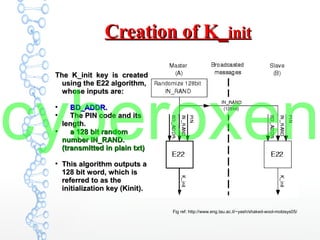
The K_init key is createdThe K_init key is created
using the E22 algorithm,using the E22 algorithm,
whose inputs are:whose inputs are:
●
BD_ADDR.BD_ADDR.
●
The PIN code and itsThe PIN code and its
length.length.
●
a 128 bit randoma 128 bit random
number IN_RAND.number IN_RAND.
(transmitted in plain txt)(transmitted in plain txt)
●
This algorithm outputs aThis algorithm outputs a
128 bit word, which is128 bit word, which is
referred to as thereferred to as the
initialization key (Kinit).initialization key (Kinit).
Fig ref: http://www.eng.tau.ac.il/~yash/shaked-wool-mobisys05/
cyberoxen
Creation of KCreation of K__abab
●
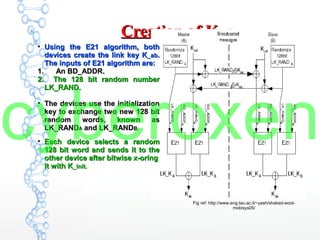
Using the E21 algorithm, bothUsing the E21 algorithm, both
devices create the link key Kdevices create the link key K_ab_ab..
The inputs of E21 algorithm are:The inputs of E21 algorithm are:
1.1. An BD_ADDRAn BD_ADDR..
2.2. The 128 bit random numberThe 128 bit random number
LK_RAND.LK_RAND.
●
The devices use the initializationThe devices use the initialization
key to exchange two new 128 bitkey to exchange two new 128 bit
random words, known asrandom words, known as
LK_RANDLK_RANDAA and LK_RANDand LK_RANDB.B.
●
Each device selects a randomEach device selects a random
128 bit word and sends it to the128 bit word and sends it to the
other device after bitwise x-oringother device after bitwise x-oring
it with Kit with K_init._init.
Fig ref: http://www.eng.tau.ac.il/~yash/shaked-wool-
mobisys05/
cyberoxen
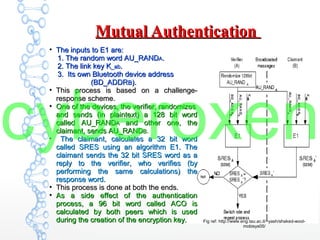
Mutual AuthenticationMutual Authentication
●
The inputs to E1 are:The inputs to E1 are:
1. The random word AU_RAND1. The random word AU_RANDAA..
2. The link key K2. The link key K_ab_ab..
3. Its own Bluetooth device address3. Its own Bluetooth device address
(BD_ADDR(BD_ADDRBB).).
●
This process is based on a challenge-This process is based on a challenge-
response scheme.response scheme.
●
One of the devices, the verifier, randomizesOne of the devices, the verifier, randomizes
and sends (in plaintext) a 128 bit wordand sends (in plaintext) a 128 bit word
called AU_RANDcalled AU_RANDAA and other one, theand other one, the
claimant, sends AU_RANDclaimant, sends AU_RANDB.B.
●
The claimant, calculates a 32 bit wordThe claimant, calculates a 32 bit word
called SRES using an algorithm E1. Thecalled SRES using an algorithm E1. The
claimant sends the 32 bit SRES word as aclaimant sends the 32 bit SRES word as a
reply to the verifier, who verifies (byreply to the verifier, who verifies (by
performing the same calculations) theperforming the same calculations) the
response word.response word.
●
This process is done at both the ends.This process is done at both the ends.
●
As a side effect of the authenticationAs a side effect of the authentication
process, a 96 bit word called ACO isprocess, a 96 bit word called ACO is
calculated by both peers which is usedcalculated by both peers which is used
during the creation of the encryption key.during the creation of the encryption key. Fig ref: http://www.eng.tau.ac.il/~yash/shaked-wool-
mobisys05/
cyberoxen
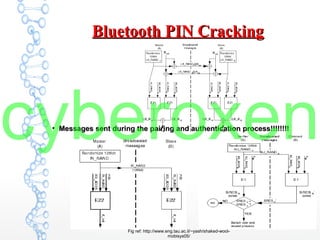
Bluetooth PIN CrackingBluetooth PIN Cracking
●
Messages sent during the pairing and authentication process!!!!!!!!Messages sent during the pairing and authentication process!!!!!!!!
Fig ref: http://www.eng.tau.ac.il/~yash/shaked-wool-
mobisys05/
cyberoxen
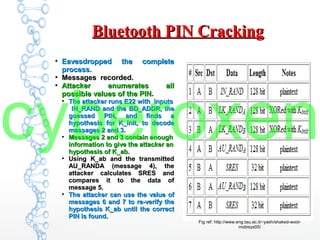
Bluetooth PIN CrackingBluetooth PIN Cracking
●
Eavesdropped the completeEavesdropped the complete
process.process.
●
Messages recorded.Messages recorded.
●
Attacker enumerates allAttacker enumerates all
possible values of the PINpossible values of the PIN..
●
The attacker runs E22 with inputsThe attacker runs E22 with inputs
IN_RAND and the BD_ADDR, theIN_RAND and the BD_ADDR, the
guessed PIN, and finds aguessed PIN, and finds a
hypothesis for K_init, to decodehypothesis for K_init, to decode
messages 2 and 3.messages 2 and 3.
●
Messages 2 and 3 contain enoughMessages 2 and 3 contain enough
information to give the attacker aninformation to give the attacker an
hypothesis of K_ab.hypothesis of K_ab.
●
Using K_ab and the transmittedUsing K_ab and the transmitted
AU_RANDA (message 4), theAU_RANDA (message 4), the
attacker calculates SRES andattacker calculates SRES and
compares it to the data ofcompares it to the data of
message 5.message 5.
●
The attacker can use the value ofThe attacker can use the value of
messages 6 and 7 to re-verify themessages 6 and 7 to re-verify the
hypothesis K_ab until the correcthypothesis K_ab until the correct
PIN is found.PIN is found.
Fig ref: http://www.eng.tau.ac.il/~yash/shaked-wool-
mobisys05/
cyberoxen
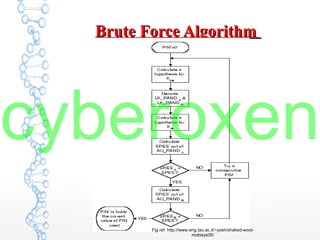
Brute Force AlgorithmBrute Force Algorithm
Fig ref: http://www.eng.tau.ac.il/~yash/shaked-wool-
mobisys05/
cyberoxen
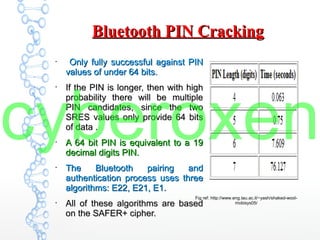
Bluetooth PIN CrackingBluetooth PIN Cracking
●
Only fully successful against PINOnly fully successful against PIN
values of under 64 bits.values of under 64 bits.
●
If the PIN is longer, then with highIf the PIN is longer, then with high
probability there will be multipleprobability there will be multiple
PIN candidates, since the twoPIN candidates, since the two
SRES values only provide 64 bitsSRES values only provide 64 bits
of data .of data .
●
A 64 bit PIN is equivalent to a 19A 64 bit PIN is equivalent to a 19
decimal digits PIN.decimal digits PIN.
●
The Bluetooth pairing andThe Bluetooth pairing and
authentication process uses threeauthentication process uses three
algorithms: E22, E21, E1.algorithms: E22, E21, E1.
●
All of these algorithms are basedAll of these algorithms are based
on the SAFER+ cipher.on the SAFER+ cipher.
Fig ref: http://www.eng.tau.ac.il/~yash/shaked-wool-
mobisys05/
cyberoxen
The Re-Pairing attackThe Re-Pairing attack
●
AssumptionsAssumptions::
–
Both the devices are already paired once.Both the devices are already paired once.
–
Pairing process completed.Pairing process completed.
–
Link Key K_ab stored in each deviceLink Key K_ab stored in each device..
–
Attacker to record all the messages andAttacker to record all the messages and
crack the PIN using the Basic attackcrack the PIN using the Basic attack.
–
Proceed directly to the AuthenticationProceed directly to the Authentication
phasephase.
–
Force the devices to repeat the pairingForce the devices to repeat the pairing
process.process.
–
Bluetooth specifications allow a BluetoothBluetooth specifications allow a Bluetooth
cyberoxen
The Re-Pairing attackThe Re-Pairing attack
●
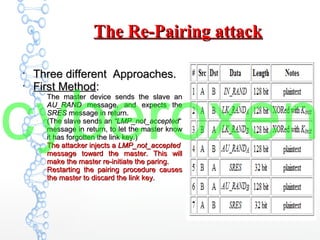
Three different Approaches.Three different Approaches.
●
First MethodFirst Method::
–
The master device sends the slave anThe master device sends the slave an
AU_RANDAU_RAND message, and expects themessage, and expects the
SRESSRES message in return.message in return.
–
(The slave sends an(The slave sends an “LMP_not_accepted“LMP_not_accepted““
message in return, to let the master knowmessage in return, to let the master know
it has forgotten the link key.)it has forgotten the link key.)
–
The attacker injects aThe attacker injects a LMP_not_acceptedLMP_not_accepted
message toward the master. This willmessage toward the master. This will
make the master re-initiate the paring.make the master re-initiate the paring.
–
Restarting the pairing procedure causesRestarting the pairing procedure causes
the master to discard the link key.the master to discard the link key.
cyberoxen
The Re-Pairing attackThe Re-Pairing attack
●
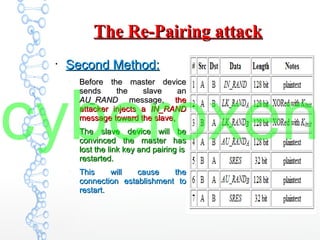
Second Method:Second Method:
–
Before the master deviceBefore the master device
sends the slave ansends the slave an
AU_RANDAU_RAND message,message, thethe
attacker injects aattacker injects a IN_RANDIN_RAND
message toward the slave,message toward the slave,
–
The slave device will beThe slave device will be
convinced the master hasconvinced the master has
lost the link key and pairing islost the link key and pairing is
restarted.restarted.
–
This will cause theThis will cause the
connection establishment toconnection establishment to
restart.restart.
cyberoxen
The Re-Pairing attackThe Re-Pairing attack
●
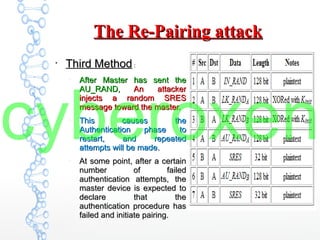
Third MethodThird Method ::
–
After Master has sent theAfter Master has sent the
AU_RAND,AU_RAND, An attackerAn attacker
injects a random SRESinjects a random SRES
message toward the master.message toward the master.
–
This causes theThis causes the
Authentication phase toAuthentication phase to
restart, and repeatedrestart, and repeated
attempts will be made.attempts will be made.
–
At some point, after a certainAt some point, after a certain
number of failednumber of failed
authentication attempts, theauthentication attempts, the
master device is expected tomaster device is expected to
declare that thedeclare that the
authentication procedure hasauthentication procedure has
failed and initiate pairing.failed and initiate pairing.
cyberoxen
The Re-Pairing attackThe Re-Pairing attack
●
CulminationCulmination::
–
This assures the pairing process will occur during the nextThis assures the pairing process will occur during the next
connection establishment, so the attacker will be able toconnection establishment, so the attacker will be able to
eavesdrop on the entire process, and use the basic methodeavesdrop on the entire process, and use the basic method
to crack the PIN.to crack the PIN.
–
After breaking the PIN (0.06-0.3 sec for a 4 digit PIN), theAfter breaking the PIN (0.06-0.3 sec for a 4 digit PIN), the
attacker can decode the saved messages, and continue toattacker can decode the saved messages, and continue to
eavesdrop and decode the communication on the fly.eavesdrop and decode the communication on the fly.
–
Since Bluetooth supports a bit rate of 1 Megabit per second,Since Bluetooth supports a bit rate of 1 Megabit per second,
a 40KB buffer is more than enough for the common case ofa 40KB buffer is more than enough for the common case of
a 4 digit PIN.a 4 digit PIN.
cyberoxen
CountermeasuresCountermeasures
●
Refrain from entering the PIN into the Bluetooth device forRefrain from entering the PIN into the Bluetooth device for
pairing as much as possible.pairing as much as possible.
●
Use PIN longer than 6 digits.Use PIN longer than 6 digits.
●
The PIN length ranges from 8 to 128 bits. Should ask forThe PIN length ranges from 8 to 128 bits. Should ask for
longer bit lenghts.longer bit lenghts.
●
Set Bluetooth device in “non-discoverable mode/hiddenSet Bluetooth device in “non-discoverable mode/hidden
mode”.mode”.
●
Application level security in addition to BT authentication....Application level security in addition to BT authentication....
ie password.ie password.
cyberoxen
CountermeasuresCountermeasures
●
Use the strongest Bluetooth securityUse the strongest Bluetooth security
mode available on the device.mode available on the device.
●
Avoid use of standard commercialAvoid use of standard commercial
Bluetooth headsets.Bluetooth headsets.
●
Disable Bluetooth functionality whenDisable Bluetooth functionality when
not in use. Use shorter range Class 2not in use. Use shorter range Class 2
or 3 devices.or 3 devices.
●
Make devices discoverable onlyMake devices discoverable only
when necessary.when necessary.
●
Pair Bluetooth devices in a securePair Bluetooth devices in a secure
area using long and randomlyarea using long and randomly
cyberoxen
INFORMATION SOURCESINFORMATION SOURCES
●
http://www.mysecurecyberspace.com/encyclopediahttp://www.mysecurecyberspace.com/encyclopedia
/index/pin-cracking.html/index/pin-cracking.html
●
http://www.eng.tau.ac.il/~yash/shaked-wool-mobihttp://www.eng.tau.ac.il/~yash/shaked-wool-mobi
sys05/sys05/
●
https://www.sans.org/reading-room/whitepapers/wihttps://www.sans.org/reading-room/whitepapers/wi
reless/bluetooth-inherent-security-issues-945reless/bluetooth-inherent-security-issues-945
●
http://pervasive.cs.uah.edu/PSP/BluetoothSechttp://pervasive.cs.uah.edu/PSP/BluetoothSec
urityurity
●
http://www.techradar.com/news/networking/bluetoohttp://www.techradar.com/news/networking/bluetoo
th-jumps-to-4-1-makes-an-early-leap-for-the-inteth-jumps-to-4-1-makes-an-early-leap-for-the-inte
rnet-of-things-1204915rnet-of-things-1204915
cyberoxen
cyberoxen

Bluetooth Hacking: Cracking the PIN and Repairing Attack

  • 1.
    By Rajeev ChauhanByRajeev Chauhan http://www.cysectips.blogspot.inhttp://www.cysectips.blogspot.in https://www.facebook.com/cyberoxenhttps://www.facebook.com/cyberoxen http://cyberoxen.comhttp://cyberoxen.com Bluetooth SecurityBluetooth Security Step by Step AnalysisStep by Step Analysis cyberoxen
  • 2.
    Bluetooth SecurityBluetooth Security ● Dependson pair codes to establishDepends on pair codes to establish the BT Communicationthe BT Communication.. ● Pin cracked.......aim achieved.Pin cracked.......aim achieved. ● SourceSource Cracking the Bluetooth PinCracking the Bluetooth Pin byby Yaniv ShakedYaniv Shaked andand Avishai Wool.Avishai Wool.cyberoxen
  • 3.
    Bluetooth ConnectivityBluetooth Connectivity ● BasicTriviaBasic Trivia:: – PIN: Personal Identification NumberPIN: Personal Identification Number.. ● The PIN code is 1-8 bytes long (8-128 bits).The PIN code is 1-8 bytes long (8-128 bits). ● Most devices use PIN sizes of 4 decimal digits.Most devices use PIN sizes of 4 decimal digits. – BD_ADDRBD_ADDR :Each Bluetooth device has a 48 bit:Each Bluetooth device has a 48 bit unique address that is called the Bluetooth Deviceunique address that is called the Bluetooth Device Address.Address. – Pairing :Pairing :The process in which two (or more) BluetoothThe process in which two (or more) Bluetooth devices hook up to create a shared secret valuedevices hook up to create a shared secret value called K_init. The K_init forms the basis for all futurecalled K_init. The K_init forms the basis for all future Bluetooth negotiations between these two devicesBluetooth negotiations between these two devices. cyberoxen
  • 4.
  • 5.
    Bluetooth Pairing andBluetoothPairing and AuthenticationAuthentication ● It involvesIt involves – Creation of Intialisation key (KCreation of Intialisation key (K_init_init).). – Creation of Link Key (KCreation of Link Key (K_ab_ab).). – Authentication.Authentication. – Derive Encryption Key forDerive Encryption Key for communication.communication. cyberoxen
  • 6.
    Creation of K_Creationof K_initinit The K_init key is createdThe K_init key is created using the E22 algorithm,using the E22 algorithm, whose inputs are:whose inputs are: ● BD_ADDR.BD_ADDR. ● The PIN code and itsThe PIN code and its length.length. ● a 128 bit randoma 128 bit random number IN_RAND.number IN_RAND. (transmitted in plain txt)(transmitted in plain txt) ● This algorithm outputs aThis algorithm outputs a 128 bit word, which is128 bit word, which is referred to as thereferred to as the initialization key (Kinit).initialization key (Kinit). Fig ref: http://www.eng.tau.ac.il/~yash/shaked-wool-mobisys05/ cyberoxen
  • 7.
    Creation of KCreationof K__abab ● Using the E21 algorithm, bothUsing the E21 algorithm, both devices create the link key Kdevices create the link key K_ab_ab.. The inputs of E21 algorithm are:The inputs of E21 algorithm are: 1.1. An BD_ADDRAn BD_ADDR.. 2.2. The 128 bit random numberThe 128 bit random number LK_RAND.LK_RAND. ● The devices use the initializationThe devices use the initialization key to exchange two new 128 bitkey to exchange two new 128 bit random words, known asrandom words, known as LK_RANDLK_RANDAA and LK_RANDand LK_RANDB.B. ● Each device selects a randomEach device selects a random 128 bit word and sends it to the128 bit word and sends it to the other device after bitwise x-oringother device after bitwise x-oring it with Kit with K_init._init. Fig ref: http://www.eng.tau.ac.il/~yash/shaked-wool- mobisys05/ cyberoxen
  • 8.
    Mutual AuthenticationMutual Authentication ● Theinputs to E1 are:The inputs to E1 are: 1. The random word AU_RAND1. The random word AU_RANDAA.. 2. The link key K2. The link key K_ab_ab.. 3. Its own Bluetooth device address3. Its own Bluetooth device address (BD_ADDR(BD_ADDRBB).). ● This process is based on a challenge-This process is based on a challenge- response scheme.response scheme. ● One of the devices, the verifier, randomizesOne of the devices, the verifier, randomizes and sends (in plaintext) a 128 bit wordand sends (in plaintext) a 128 bit word called AU_RANDcalled AU_RANDAA and other one, theand other one, the claimant, sends AU_RANDclaimant, sends AU_RANDB.B. ● The claimant, calculates a 32 bit wordThe claimant, calculates a 32 bit word called SRES using an algorithm E1. Thecalled SRES using an algorithm E1. The claimant sends the 32 bit SRES word as aclaimant sends the 32 bit SRES word as a reply to the verifier, who verifies (byreply to the verifier, who verifies (by performing the same calculations) theperforming the same calculations) the response word.response word. ● This process is done at both the ends.This process is done at both the ends. ● As a side effect of the authenticationAs a side effect of the authentication process, a 96 bit word called ACO isprocess, a 96 bit word called ACO is calculated by both peers which is usedcalculated by both peers which is used during the creation of the encryption key.during the creation of the encryption key. Fig ref: http://www.eng.tau.ac.il/~yash/shaked-wool- mobisys05/ cyberoxen
  • 9.
    Bluetooth PIN CrackingBluetoothPIN Cracking ● Messages sent during the pairing and authentication process!!!!!!!!Messages sent during the pairing and authentication process!!!!!!!! Fig ref: http://www.eng.tau.ac.il/~yash/shaked-wool- mobisys05/ cyberoxen
  • 10.
    Bluetooth PIN CrackingBluetoothPIN Cracking ● Eavesdropped the completeEavesdropped the complete process.process. ● Messages recorded.Messages recorded. ● Attacker enumerates allAttacker enumerates all possible values of the PINpossible values of the PIN.. ● The attacker runs E22 with inputsThe attacker runs E22 with inputs IN_RAND and the BD_ADDR, theIN_RAND and the BD_ADDR, the guessed PIN, and finds aguessed PIN, and finds a hypothesis for K_init, to decodehypothesis for K_init, to decode messages 2 and 3.messages 2 and 3. ● Messages 2 and 3 contain enoughMessages 2 and 3 contain enough information to give the attacker aninformation to give the attacker an hypothesis of K_ab.hypothesis of K_ab. ● Using K_ab and the transmittedUsing K_ab and the transmitted AU_RANDA (message 4), theAU_RANDA (message 4), the attacker calculates SRES andattacker calculates SRES and compares it to the data ofcompares it to the data of message 5.message 5. ● The attacker can use the value ofThe attacker can use the value of messages 6 and 7 to re-verify themessages 6 and 7 to re-verify the hypothesis K_ab until the correcthypothesis K_ab until the correct PIN is found.PIN is found. Fig ref: http://www.eng.tau.ac.il/~yash/shaked-wool- mobisys05/ cyberoxen
  • 11.
    Brute Force AlgorithmBruteForce Algorithm Fig ref: http://www.eng.tau.ac.il/~yash/shaked-wool- mobisys05/ cyberoxen
  • 12.
    Bluetooth PIN CrackingBluetoothPIN Cracking ● Only fully successful against PINOnly fully successful against PIN values of under 64 bits.values of under 64 bits. ● If the PIN is longer, then with highIf the PIN is longer, then with high probability there will be multipleprobability there will be multiple PIN candidates, since the twoPIN candidates, since the two SRES values only provide 64 bitsSRES values only provide 64 bits of data .of data . ● A 64 bit PIN is equivalent to a 19A 64 bit PIN is equivalent to a 19 decimal digits PIN.decimal digits PIN. ● The Bluetooth pairing andThe Bluetooth pairing and authentication process uses threeauthentication process uses three algorithms: E22, E21, E1.algorithms: E22, E21, E1. ● All of these algorithms are basedAll of these algorithms are based on the SAFER+ cipher.on the SAFER+ cipher. Fig ref: http://www.eng.tau.ac.il/~yash/shaked-wool- mobisys05/ cyberoxen
  • 13.
    The Re-Pairing attackTheRe-Pairing attack ● AssumptionsAssumptions:: – Both the devices are already paired once.Both the devices are already paired once. – Pairing process completed.Pairing process completed. – Link Key K_ab stored in each deviceLink Key K_ab stored in each device.. – Attacker to record all the messages andAttacker to record all the messages and crack the PIN using the Basic attackcrack the PIN using the Basic attack. – Proceed directly to the AuthenticationProceed directly to the Authentication phasephase. – Force the devices to repeat the pairingForce the devices to repeat the pairing process.process. – Bluetooth specifications allow a BluetoothBluetooth specifications allow a Bluetooth cyberoxen
  • 14.
    The Re-Pairing attackTheRe-Pairing attack ● Three different Approaches.Three different Approaches. ● First MethodFirst Method:: – The master device sends the slave anThe master device sends the slave an AU_RANDAU_RAND message, and expects themessage, and expects the SRESSRES message in return.message in return. – (The slave sends an(The slave sends an “LMP_not_accepted“LMP_not_accepted““ message in return, to let the master knowmessage in return, to let the master know it has forgotten the link key.)it has forgotten the link key.) – The attacker injects aThe attacker injects a LMP_not_acceptedLMP_not_accepted message toward the master. This willmessage toward the master. This will make the master re-initiate the paring.make the master re-initiate the paring. – Restarting the pairing procedure causesRestarting the pairing procedure causes the master to discard the link key.the master to discard the link key. cyberoxen
  • 15.
    The Re-Pairing attackTheRe-Pairing attack ● Second Method:Second Method: – Before the master deviceBefore the master device sends the slave ansends the slave an AU_RANDAU_RAND message,message, thethe attacker injects aattacker injects a IN_RANDIN_RAND message toward the slave,message toward the slave, – The slave device will beThe slave device will be convinced the master hasconvinced the master has lost the link key and pairing islost the link key and pairing is restarted.restarted. – This will cause theThis will cause the connection establishment toconnection establishment to restart.restart. cyberoxen
  • 16.
    The Re-Pairing attackTheRe-Pairing attack ● Third MethodThird Method :: – After Master has sent theAfter Master has sent the AU_RAND,AU_RAND, An attackerAn attacker injects a random SRESinjects a random SRES message toward the master.message toward the master. – This causes theThis causes the Authentication phase toAuthentication phase to restart, and repeatedrestart, and repeated attempts will be made.attempts will be made. – At some point, after a certainAt some point, after a certain number of failednumber of failed authentication attempts, theauthentication attempts, the master device is expected tomaster device is expected to declare that thedeclare that the authentication procedure hasauthentication procedure has failed and initiate pairing.failed and initiate pairing. cyberoxen
  • 17.
    The Re-Pairing attackTheRe-Pairing attack ● CulminationCulmination:: – This assures the pairing process will occur during the nextThis assures the pairing process will occur during the next connection establishment, so the attacker will be able toconnection establishment, so the attacker will be able to eavesdrop on the entire process, and use the basic methodeavesdrop on the entire process, and use the basic method to crack the PIN.to crack the PIN. – After breaking the PIN (0.06-0.3 sec for a 4 digit PIN), theAfter breaking the PIN (0.06-0.3 sec for a 4 digit PIN), the attacker can decode the saved messages, and continue toattacker can decode the saved messages, and continue to eavesdrop and decode the communication on the fly.eavesdrop and decode the communication on the fly. – Since Bluetooth supports a bit rate of 1 Megabit per second,Since Bluetooth supports a bit rate of 1 Megabit per second, a 40KB buffer is more than enough for the common case ofa 40KB buffer is more than enough for the common case of a 4 digit PIN.a 4 digit PIN. cyberoxen
  • 18.
    CountermeasuresCountermeasures ● Refrain from enteringthe PIN into the Bluetooth device forRefrain from entering the PIN into the Bluetooth device for pairing as much as possible.pairing as much as possible. ● Use PIN longer than 6 digits.Use PIN longer than 6 digits. ● The PIN length ranges from 8 to 128 bits. Should ask forThe PIN length ranges from 8 to 128 bits. Should ask for longer bit lenghts.longer bit lenghts. ● Set Bluetooth device in “non-discoverable mode/hiddenSet Bluetooth device in “non-discoverable mode/hidden mode”.mode”. ● Application level security in addition to BT authentication....Application level security in addition to BT authentication.... ie password.ie password. cyberoxen
  • 19.
    CountermeasuresCountermeasures ● Use the strongestBluetooth securityUse the strongest Bluetooth security mode available on the device.mode available on the device. ● Avoid use of standard commercialAvoid use of standard commercial Bluetooth headsets.Bluetooth headsets. ● Disable Bluetooth functionality whenDisable Bluetooth functionality when not in use. Use shorter range Class 2not in use. Use shorter range Class 2 or 3 devices.or 3 devices. ● Make devices discoverable onlyMake devices discoverable only when necessary.when necessary. ● Pair Bluetooth devices in a securePair Bluetooth devices in a secure area using long and randomlyarea using long and randomly cyberoxen
  • 20.
    INFORMATION SOURCESINFORMATION SOURCES ● http://www.mysecurecyberspace.com/encyclopediahttp://www.mysecurecyberspace.com/encyclopedia /index/pin-cracking.html/index/pin-cracking.html ● http://www.eng.tau.ac.il/~yash/shaked-wool-mobihttp://www.eng.tau.ac.il/~yash/shaked-wool-mobi sys05/sys05/ ● https://www.sans.org/reading-room/whitepapers/wihttps://www.sans.org/reading-room/whitepapers/wi reless/bluetooth-inherent-security-issues-945reless/bluetooth-inherent-security-issues-945 ● http://pervasive.cs.uah.edu/PSP/BluetoothSechttp://pervasive.cs.uah.edu/PSP/BluetoothSec urityurity ● http://www.techradar.com/news/networking/bluetoohttp://www.techradar.com/news/networking/bluetoo th-jumps-to-4-1-makes-an-early-leap-for-the-inteth-jumps-to-4-1-makes-an-early-leap-for-the-inte rnet-of-things-1204915rnet-of-things-1204915 cyberoxen
  • 21.