Facts, Concepts and
  Generalizations
       , 2012
Learning Objectives for today’s Lesson:

Students (You!  ) will be able to:
• Differentiate between a fact, concept and
  generalization.
• Explain the importance of generalizations.
• Identify strategies for teaching concepts and
  generalizations.

This relates to our Course Objective of:
• Explain and implement the role of inquiry,
  concepts and generalizations in Social Studies.
Important Idea to remember…
• Students gain factual knowledge, build
  concepts and form generalizations all the
  time (at home, on the playground, in front
  of the tv)
• In class, we want to create experiences for
  students to gain factual knowledge, build
  concepts and form generalizations that
  help them understand Social Studies
  content (life!) better.
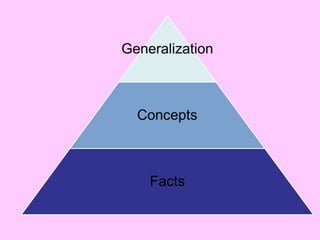
Facts
• Do not need to be
  “academic” sounding.
• Do not need to be
  detailed.
• Examples of Facts:
  – My family has four
    people in it.
  – Florida has a warmer
    winter than Canada.
Concepts
•   Ideas
•   Abstract
•   Construct Meaning
•   Examples:
    –   Family
    –   Climate
    –   Nation
    –   Island
    –   War
Activity
• Pick an age group and discuss what “factual” knowledge
  you would expect your students to have based on their
  prior experience.
• Your group will have one of the following concepts:
   –   Family
   –   Community
   –   Money
   –   Trade
   –   War
   –   Internet
   –   Religion
   –   Government
   –   Law
Generalization
• Relationships among 2 or more concepts.
• These can be big understandings/ideas for a
  unit.
• Examples:
  – Families vary in structure, number and experience.
  – Climate varies by location.
  – War has negative effects for the environment and
    citizens of a region.
  – Creating, using and understanding maps helps us
    understand our world and its people.
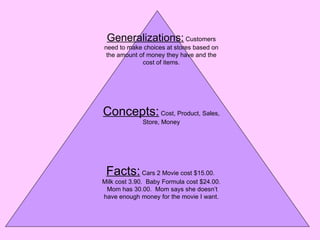
Generalizations: Customers
need to make choices at stores based on
 the amount of money they have and the
             cost of items.


Concepts: Cost, Product, Sales,
              Store, Money


 Facts: Cars 2 Movie cost $15.00.
Milk cost 3.90. Baby Formula cost $24.00.
 Mom has 30.00. Mom says she doesn’t
have enough money for the movie I want.
Activity
•   Playground
•   Restaurant
•   Riding in Car
•   Playing Baseball
•   Hallway at School
•   Going to the Airport
•   Going to the Library
•   Watching a professional hockey game.
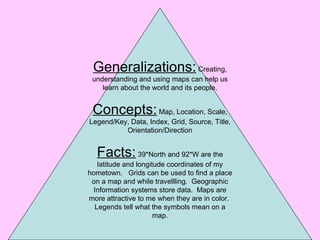
Generalizations: Creating,
 understanding and using maps can help us
    learn about the world and its people.


 Concepts: Map, Location, Scale,
Legend/Key, Data, Index, Grid, Source, Title,
          Orientation/Direction


  Facts: 39*North and 92*W are the
   latitude and longitude coordinates of my
hometown. Grids can be used to find a place
 on a map and while travellling. Geographic
 Information systems store data. Maps are
more attractive to me when they are in color.
  Legends tell what the symbols mean on a
                      map.
Activity
• Create a Facts, Concepts, Generalizations
  triangle to include some of your ideas for
  your thematic unit.
• Consider and list on the side:
  – Possible Misconceptions
  – Possible Inaccurate Generalization
Experiences in the classroom.
• Like Inquiry, creating experiences where
  students gain factual knowledge, construct
  concepts and form generalizations can
  take many forms.
  – Inquiry based activities
  – Guided Discovery (what we’ll be doing today)
  – Field Trips
  – Books
  – Summative Projects
Africa Posters Activity
• “Country Projects”
• “Concept Maps”


• Developed Countries
• Examples and Non Examples
• Gather Data
• Concept Map
Matching Quiz
• Based on readings and lecture.

4 facts, concepts and generalizations jan 19

  • 1.
    Facts, Concepts and Generalizations , 2012
  • 2.
    Learning Objectives fortoday’s Lesson: Students (You!  ) will be able to: • Differentiate between a fact, concept and generalization. • Explain the importance of generalizations. • Identify strategies for teaching concepts and generalizations. This relates to our Course Objective of: • Explain and implement the role of inquiry, concepts and generalizations in Social Studies.
  • 3.
    Important Idea toremember… • Students gain factual knowledge, build concepts and form generalizations all the time (at home, on the playground, in front of the tv) • In class, we want to create experiences for students to gain factual knowledge, build concepts and form generalizations that help them understand Social Studies content (life!) better.
  • 4.
    Facts • Do notneed to be “academic” sounding. • Do not need to be detailed. • Examples of Facts: – My family has four people in it. – Florida has a warmer winter than Canada.
  • 5.
    Concepts • Ideas • Abstract • Construct Meaning • Examples: – Family – Climate – Nation – Island – War
  • 6.
    Activity • Pick anage group and discuss what “factual” knowledge you would expect your students to have based on their prior experience. • Your group will have one of the following concepts: – Family – Community – Money – Trade – War – Internet – Religion – Government – Law
  • 7.
    Generalization • Relationships among2 or more concepts. • These can be big understandings/ideas for a unit. • Examples: – Families vary in structure, number and experience. – Climate varies by location. – War has negative effects for the environment and citizens of a region. – Creating, using and understanding maps helps us understand our world and its people.
  • 9.
    Generalizations: Customers need tomake choices at stores based on the amount of money they have and the cost of items. Concepts: Cost, Product, Sales, Store, Money Facts: Cars 2 Movie cost $15.00. Milk cost 3.90. Baby Formula cost $24.00. Mom has 30.00. Mom says she doesn’t have enough money for the movie I want.
  • 10.
    Activity • Playground • Restaurant • Riding in Car • Playing Baseball • Hallway at School • Going to the Airport • Going to the Library • Watching a professional hockey game.
  • 11.
    Generalizations: Creating, understandingand using maps can help us learn about the world and its people. Concepts: Map, Location, Scale, Legend/Key, Data, Index, Grid, Source, Title, Orientation/Direction Facts: 39*North and 92*W are the latitude and longitude coordinates of my hometown. Grids can be used to find a place on a map and while travellling. Geographic Information systems store data. Maps are more attractive to me when they are in color. Legends tell what the symbols mean on a map.
  • 12.
    Activity • Create aFacts, Concepts, Generalizations triangle to include some of your ideas for your thematic unit. • Consider and list on the side: – Possible Misconceptions – Possible Inaccurate Generalization
  • 13.
    Experiences in theclassroom. • Like Inquiry, creating experiences where students gain factual knowledge, construct concepts and form generalizations can take many forms. – Inquiry based activities – Guided Discovery (what we’ll be doing today) – Field Trips – Books – Summative Projects
  • 14.
    Africa Posters Activity •“Country Projects” • “Concept Maps” • Developed Countries • Examples and Non Examples • Gather Data
  • 15.
  • 16.
    Matching Quiz • Basedon readings and lecture.