STROKE
(CLASSIFICATION, CLINICAL FEATURES,DIAGNOSIS)
 STROKE
also called as cerebrovascular accident, Occurs when the blood supply of
the brain is reduced or blocked completely, which then prevents the brain
tissue from getting oxygen and nutrients known as stroke.
 The WHO clinically defines stroke as ‘the rapid development of clinical
signs and symptoms of a focal neurological disturbance lasting more than
24 hours or leading to death with no apparent cause other than vascular
origin’ (WHO 2005).
 It is the second commonest cause of death and fourth leading cause of
disability worldwide (Strong 2007).
 In India, the ICMR estimates in 2004 indicated that stroke contributed 41%
of deaths and 72% of disability adjusted life years amongst the non-
communicable diseases (ICMR 2004).
 The Indian National Commission on Macro-economics and
Health estimated that the number of strokes will increase from
1,081,480 in 2000 to 1,667,372 in 2015, (Shah + Mathur 2006).
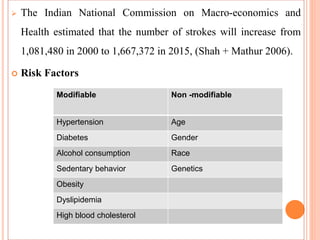
 Risk Factors
Modifiable Non -modifiable
Hypertension Age
Diabetes Gender
Alcohol consumption Race
Sedentary behavior Genetics
Obesity
Dyslipidemia
High blood cholesterol
 Classification on the basis of pathophysiology:
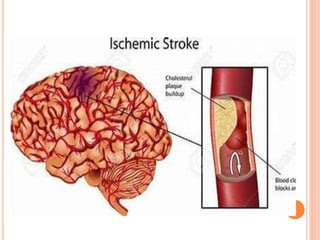
 Ischaemic stroke is caused by sudden occlusion of arteries
supplying the brain, either due to a thrombus at the site of occlusion
or formed in another part of the circulation.
 It account for 50%–85% of all strokes worldwide. (Feigin et al
2009) In an ischemic stroke, blood supply to part of the brain is
decreased, leading to dysfunction of the brain tissue in that area.
 Types of ischaemic stroke
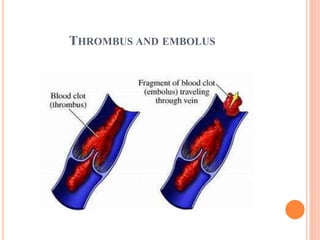
 Thrombosis is the formation of a blood clot inside a blood
vessel, obstructing the flow of blood through the circulatory
system.
 When a blood vessel a vein or an artery is injured, the body
uses platelets (thrombocytes) and fibrin to form a blood clot to
prevent blood loss.
 Even when a blood vessel is not injured, blood clots may form in the
body under certain conditions. A clot, or a piece of the clot, that
breaks free and begins to travel around the body is known as
an embolus.
 Thrombosis may occur in veins (venous thrombosis) or in arteries
(arterial thrombosis). Venous thrombosis leads to congestion of the
affected part of the body, while arterial thrombosis (and rarely severe
venous thrombosis) affects the blood supply and leads to damage of
the tissue supplied by that artery (ischemia and necrosis).
 A piece of either an arterial or a venous thrombus can break off as an
embolus which can travel through the circulation and lodge
somewhere else as an embolism. This type of embolism is known as
a thromboembolism.
 Complications can arise when venous thromboembolism (commonly
called a VTE) lodges in the lung as a pulmonary embolism.
 An arterial embolus may travel further down the affected blood
vessel where it can lodge as an embolism.
 Types
 Deep vein thrombosis
 Deep vein thrombosis (DVT) is the formation of a blood clot within
a deep vein. It most commonly affects leg veins, such as the femoral
vein.
 Three factors are important in the formation of a blood clot within a
deep vein , rate of blood flow, the thickness of the blood and
qualities of the vessel wall.
 Classical signs of DVT include swelling, pain and redness of the
affected area.
THROMBUS AND EMBOLUS
 Paget-Schroetter disease
 Paget-Schroetter disease or upper extremity DVT (UEDVT) is the
obstruction of an arm vein (such as the axillary vein or subclavian
vein) by a thrombus.
 The condition usually comes to light after vigorous exercise and
usually presents in younger, otherwise healthy people. Men are
affected more than women.
 Budd-Chiari syndrome
 Budd-Chiari syndrome is the blockage of a hepatic vein or of the
hepatic part of the inferior vena cava.
 This form of thrombosis presents with abdominal
pain, ascites and enlarged liver.
 Treatment varies between therapy and surgical intervention by the
use of shunts.
 Portal vein thrombosis
 Portal vein thrombosis affects the hepatic portal vein, which can
lead to portal hypertension and reduction of the blood supply to the
liver.
 It usually happens in the setting of another disease such
as pancreatitis, cirrhosis, diverticulitis or cholangiocarcinoma.
 Renal vein thrombosis
 Renal vein thrombosis is the obstruction of the renal vein by a
thrombus.
 This tends to lead to reduced drainage from the kidney.
 Cerebral venous sinus thrombosis
 Cerebral venous sinus thrombosis (CVST) is a rare form
of stroke which results from the blockage of the dural venous
sinuses by a thrombus.
 Symptoms may include headache, abnormal vision, any of the
symptoms of stroke such as weakness of the face and limbs on
one side of the body and seizures.
 The diagnosis is usually made with a CTor MRI scan. The
majority of persons affected make a full recovery. The mortality
rate is 4.3%.
 Jugular vein thrombosis
 Jugular vein thrombosis is a condition that may occur due to
infection, intravenous drug use or malignancy.
 Jugular vein thrombosis can have a varying list of complications,
including: systemic sepsis, pulmonary embolism,
and papilledema. Though characterized by a sharp pain at the site
of the vein, it can prove difficult to diagnose, because it can occur
at random.
 Cavernous sinus thrombosis
 Cavernous sinus thrombosis is a specialized form of cerebral
venous sinus thrombosis, where there is thrombosis of
the cavernous sinus of the basal skull dura, due to the retrograde
spread of infection and endothelial damage from the danger
triangle of the face.
 The facial veins in this area anastomose with
the superior and inferior ophthalmic veins of the orbit, which drain
directly posteriorly into the cavernous sinus through the superior
orbital fissure. .
 Arterial thrombosis
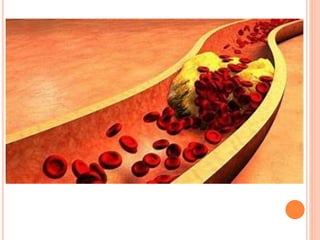
 Arterial thrombosis is the formation of a thrombus within an artery.
 In most cases, arterial thrombosis follows rupture of atheroma (a
fat-rich deposit in the blood vessel wall), and is therefore referred to
as atherothrombosis. .
 Embolism (obstruction due to an embolus from elsewhere in the
body) An embolism is the lodging of an embolus, a blockage-
causing piece of material, inside a blood vessel.
 The embolus may be a blood clot (thrombus), a fat globule (fat
embolism), a bubble of air or other gas (gas embolism), amniotic
fluid (amniotic fluid embolism), or foreign material.
 An embolism can cause partial or total blockage of blood flow in
the affected vessel. Such a blockage (a vascular occlusion) may
affect a part of the body distant from the origin of the embolus.
 An embolism in which the embolus is a piece of thrombus is called
a thromboembolism.
 An embolism is usually a pathological event, i.e.,
accompanying illness or injury.
 Sometimes it is created intentionally for a therapeutic reason, such
as to stop bleeding or to kill a cancerous tumor by stopping its
blood supply. Such therapy is called embolization
 Arterial
 Arterial embolism can cause occlusion in any part of the body. It is
a major cause of infarction (tissue death from blockage of the
blood supply).
 An arterial embolus might originate in the heart (from a thrombus
in the left atrium, following atrial fibrillation or be a septic
embolus resulting from endocarditis).
 Thrombus formation within the atrium occurs mainly in patients
with mitral valve disease, and especially in those with mitral
valve stenosis (narrowing), with atrial fibrillation (AF). In the
absence of AF, pure mitral regurgitation has a low incidence of
thromboembolism.
 Thrombus formation can also take place within the ventricles, and
it occurs in approximately 30% of anterior-wall myocardial
infarctions, compared with only 5% of inferior ones.
 Patients with prosthetic valves also carry a significant increase in
risk of thromboembolism.
 Emboli often have more serious consequences when they occur in
the so-called "end circulation": areas of the body that have no
redundant blood supply, such as the brain and heart.
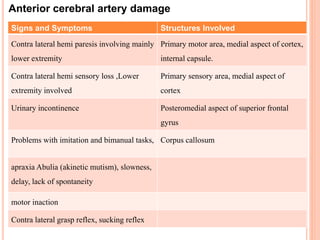
Anterior cerebral artery damage
Signs and Symptoms Structures Involved
Contra lateral hemi paresis involving mainly
lower extremity
Primary motor area, medial aspect of cortex,
internal capsule.
Contra lateral hemi sensory loss ,Lower
extremity involved
Primary sensory area, medial aspect of
cortex
Urinary incontinence Posteromedial aspect of superior frontal
gyrus
Problems with imitation and bimanual tasks, Corpus callosum
apraxia Abulia (akinetic mutism), slowness,
delay, lack of spontaneity
motor inaction
Contra lateral grasp reflex, sucking reflex
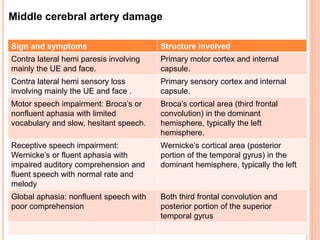
Middle cerebral artery damage
Sign and symptoms Structure involved
Contra lateral hemi paresis involving
mainly the UE and face.
Primary motor cortex and internal
capsule.
Contra lateral hemi sensory loss
involving mainly the UE and face .
Primary sensory cortex and internal
capsule.
Motor speech impairment: Broca’s or
nonfluent aphasia with limited
vocabulary and slow, hesitant speech.
Broca’s cortical area (third frontal
convolution) in the dominant
hemisphere, typically the left
hemisphere.
Receptive speech impairment:
Wernicke’s or fluent aphasia with
impaired auditory comprehension and
fluent speech with normal rate and
melody
Wernicke’s cortical area (posterior
portion of the temporal gyrus) in the
dominant hemisphere, typically the left
Global aphasia: nonfluent speech with
poor comprehension
Both third frontal convolution and
posterior portion of the superior
temporal gyrus
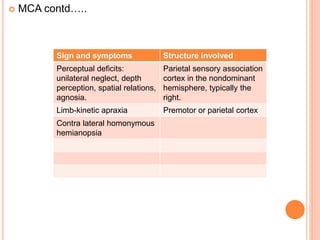
 MCA contd…..
Sign and symptoms Structure involved
Perceptual deficits:
unilateral neglect, depth
perception, spatial relations,
agnosia.
Parietal sensory association
cortex in the nondominant
hemisphere, typically the
right.
Limb-kinetic apraxia Premotor or parietal cortex
Contra lateral homonymous
hemianopsia
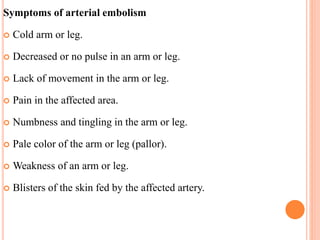
Symptoms of arterial embolism
 Cold arm or leg.
 Decreased or no pulse in an arm or leg.
 Lack of movement in the arm or leg.
 Pain in the affected area.
 Numbness and tingling in the arm or leg.
 Pale color of the arm or leg (pallor).
 Weakness of an arm or leg.
 Blisters of the skin fed by the affected artery.
 Shedding (sloughing) of skin.
 Skin erosion (ulcer).
 Tissue death (necrosis; skin is dark and damaged).
 Direction
 The direction of the embolus can be one of two types:
 Anterograde
 In anterograde embolism, the movement of emboli is in the
direction of blood flow.
 Retrograde
 In retrograde embolism, the emboli move in opposition to the
blood flow direction; this is usually significant only in blood
vessels with low pressure (veins) or with emboli of high weight.
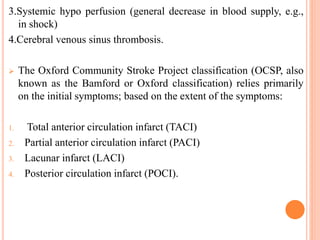
3.Systemic hypo perfusion (general decrease in blood supply, e.g.,
in shock)
4.Cerebral venous sinus thrombosis.
 The Oxford Community Stroke Project classification (OCSP, also
known as the Bamford or Oxford classification) relies primarily
on the initial symptoms; based on the extent of the symptoms:
1. Total anterior circulation infarct (TACI)
2. Partial anterior circulation infarct (PACI)
3. Lacunar infarct (LACI)
4. Posterior circulation infarct (POCI).
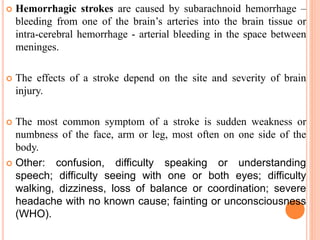
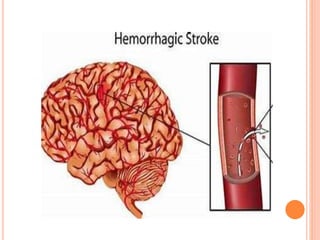
 Hemorrhagic strokes are caused by subarachnoid hemorrhage –
bleeding from one of the brain’s arteries into the brain tissue or
intra-cerebral hemorrhage - arterial bleeding in the space between
meninges.
 The effects of a stroke depend on the site and severity of brain
injury.
 The most common symptom of a stroke is sudden weakness or
numbness of the face, arm or leg, most often on one side of the
body.
 Other: confusion, difficulty speaking or understanding
speech; difficulty seeing with one or both eyes; difficulty
walking, dizziness, loss of balance or coordination; severe
headache with no known cause; fainting or unconsciousness
(WHO).
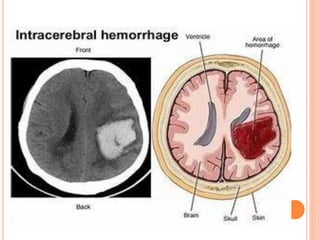
 Intracerebral hemorrhage (ICH), also known as cerebral
bleed, intraparenchymal bleed, and hemorrhagic stroke,
or haemorrhagic stroke, is a sudden bleeding into the tissues of
the brain, into its ventricles.
 Symptoms can include headache, one-sided weakness, vomiting,
seizures, decreased level of consciousness, and neck
stiffness. Often, symptoms get worse over time. Fever is also
common.
 Causes include brain trauma, aneurysms, arteriovenous
malformations, and brain tumors. The largest risk factors for
spontaneous bleeding are high blood pressure and amyloidosis.
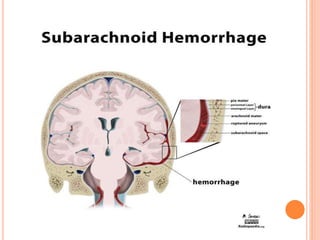
 Subarachnoid hemorrhage (SAH) is bleeding into
the subarachnoid space—the area between the arachnoid
membrane and the pia mater surrounding the brain.
 Symptoms : severe headache of rapid onset, vomiting, decreased
level of consciousness, fever, and sometimes seizures. Neck
stiffness or neck pain are also relatively common. In about a quarter
of people a small bleed with resolving symptoms occurs within a
month of a larger bleed.
 SAH may occur as a result of a head injury or spontaneously,
usually from a ruptured cerebral aneurysm.
 Early recognition
 Sudden-onset face weakness.
 Arm drift (i.e., if a person, when asked to raise both arms,
involuntarily lets one arm drift downward).
 Abnormal speech.
 Subtypes
 If the area of the brain affected includes one of the three
prominent central nervous system pathways—the spinothalamic
tract, corticospinal tract, and the dorsal column–medial lemniscus
pathway, symptoms may include:
 Hemiplegia and muscle weakness of the face.
 Numbness.
 Reduction in sensory or vibratory sensation.
 Initial flaccidity (reduced muscle tone), replaced
by spasticity (increased muscle tone), excessive reflexes, and
obligatory synergies.
 A brainstem stroke affecting the brainstem and brain, therefore, can
produce symptoms relating to deficits in these cranial nerves:
 Altered smell, taste, hearing, or vision (total or partial).
 Drooping of eyelid (ptosis) and weakness of ocular muscles.
 Decreased reflexes: gag, swallow, pupil reactivity to light.
 Decreased sensation and muscle weakness of the face.
 Balance problems and nystagmus.
 Altered breathing and heart rate.
 Weakness in sternocleidomastoid muscle with inability to turn head
to one side.
 Weakness in tongue (inability to stick out the tongue or move it
from side to side).
 With cerebral cortex involvement, the CNS pathways can again
be affected
 Aphasia (difficulty with verbal expression, auditory
comprehension, reading and writing; Broca's or Wernicke's
area typically involved)
 Dysarthria (motor speech disorder resulting from neurological
injury)
 Apraxia (altered voluntary movements)
 Visual field defect
 memory deficits (involvement of temporal lobe)
 Hemineglect (involvement of parietal lobe).
 Disorganized thinking, confusion, hypersexual gestures (with
involvement of frontal lobe).
 Lack of insight of his or her, usually stroke-related, disability.
 With cerebellum involvement:
 Ataxia.
 Altered walking gait.
 Altered movement coordination.
 Vertigo and or disequilibrium.
 Diagnosis
 Physical examination
 A physical examination, including taking a medical history of the symptoms
and a neurological status, helps giving an evaluation of the location and severity
of a stroke. It can give a standard score on e.g., the NIH stroke scale.
 Imaging
 For diagnosing ischemic (blockage) stroke in the emergency setting:
 CT scans (without contrast enhancements)
 MRI scan
 Cerebral angiogram: Dyes is injected to get detailed view of brain and neck
blood vessels visible under X-ray.
 Echocardiogram: To check for any sources of clots that could have travelled to
the brain and lead to stroke.
 Cerebral angiogram: Dyes is injected to get detailed view of
brain and neck blood vessels visible under X-ray.
 Echocardiogram: To check for any sources of clots that could
have travelled to the brain and lead to stroke.
 Physiotherapy assessment
 Posture
 Alignment
 Neglect
 Balance
1. Sitting Balance
2. Standing Balance
 Voluntary Movement
 Range of Movement
 Strength
1.Coordination
Finger to Nose Test, Heel to Shin Test
2.Dysdiadochokinesia (Rapidly Alternating Movement)
3.Involuntary Movement
Tremor,Clonus
 Chorea
 Tone
 Decreased-Hypotonia, flaccidity.
 Increased-Spasticity is a motor disorder characterised by a velocity-
dependent increase in tonic stretch reflexes with exaggerated
tendon jerks.
 Rigidity : increased resistance to passive movement which is
constant throughout the range of movement.
 Reflexes
 Deep Tendon Reflexes
Biceps (C5/6),Triceps (C7/8),Brachioradialis (C6/7),Patellar / Knee
(L3/4) ,Achilles / Ankle (S1/2)
 Plantar Reflex (Babinski's Sign)
 Hoffmanns Reflex (Finger Flexor Test)
presence or absence of problems in the corticospinal
tract. The test involves tapping the nail or flicking the terminal
phalanx of the middle or ring finger. A positive response is
seen with flexion of the terminal phalanx of thumb.
 Sensation
 Pressure , Pain / Pin Prick,Temperature,Vibration
 Proprioceptions
 Touch Localization
 Stereognosis, Graphesthesia
 Light Touch
 Pain / Pin Prick
 Two Point Discrimination
 Vision,Hearing

 Assessment of functional daily living activities are vital to ensure the
patient receives the level of upport required on the ward at each given
stage within their rehabilitation and also provides assistance with goal
setting and treatment plans.
 Bed Mobility.
 Transfers
 Sitting Balance.
 Standing Balance.
 Upper Limb Function.
 Lower Limb Function.
 Mobility.
 Stairs
 Gait

stroke

  • 1.
  • 2.
     STROKE also calledas cerebrovascular accident, Occurs when the blood supply of the brain is reduced or blocked completely, which then prevents the brain tissue from getting oxygen and nutrients known as stroke.  The WHO clinically defines stroke as ‘the rapid development of clinical signs and symptoms of a focal neurological disturbance lasting more than 24 hours or leading to death with no apparent cause other than vascular origin’ (WHO 2005).  It is the second commonest cause of death and fourth leading cause of disability worldwide (Strong 2007).  In India, the ICMR estimates in 2004 indicated that stroke contributed 41% of deaths and 72% of disability adjusted life years amongst the non- communicable diseases (ICMR 2004).
  • 3.
     The IndianNational Commission on Macro-economics and Health estimated that the number of strokes will increase from 1,081,480 in 2000 to 1,667,372 in 2015, (Shah + Mathur 2006).  Risk Factors Modifiable Non -modifiable Hypertension Age Diabetes Gender Alcohol consumption Race Sedentary behavior Genetics Obesity Dyslipidemia High blood cholesterol
  • 4.
     Classification onthe basis of pathophysiology:  Ischaemic stroke is caused by sudden occlusion of arteries supplying the brain, either due to a thrombus at the site of occlusion or formed in another part of the circulation.  It account for 50%–85% of all strokes worldwide. (Feigin et al 2009) In an ischemic stroke, blood supply to part of the brain is decreased, leading to dysfunction of the brain tissue in that area.  Types of ischaemic stroke  Thrombosis is the formation of a blood clot inside a blood vessel, obstructing the flow of blood through the circulatory system.
  • 7.
     When ablood vessel a vein or an artery is injured, the body uses platelets (thrombocytes) and fibrin to form a blood clot to prevent blood loss.  Even when a blood vessel is not injured, blood clots may form in the body under certain conditions. A clot, or a piece of the clot, that breaks free and begins to travel around the body is known as an embolus.  Thrombosis may occur in veins (venous thrombosis) or in arteries (arterial thrombosis). Venous thrombosis leads to congestion of the affected part of the body, while arterial thrombosis (and rarely severe venous thrombosis) affects the blood supply and leads to damage of the tissue supplied by that artery (ischemia and necrosis).
  • 8.
     A pieceof either an arterial or a venous thrombus can break off as an embolus which can travel through the circulation and lodge somewhere else as an embolism. This type of embolism is known as a thromboembolism.  Complications can arise when venous thromboembolism (commonly called a VTE) lodges in the lung as a pulmonary embolism.  An arterial embolus may travel further down the affected blood vessel where it can lodge as an embolism.
  • 9.
     Types  Deepvein thrombosis  Deep vein thrombosis (DVT) is the formation of a blood clot within a deep vein. It most commonly affects leg veins, such as the femoral vein.  Three factors are important in the formation of a blood clot within a deep vein , rate of blood flow, the thickness of the blood and qualities of the vessel wall.  Classical signs of DVT include swelling, pain and redness of the affected area.
  • 10.
  • 11.
     Paget-Schroetter disease Paget-Schroetter disease or upper extremity DVT (UEDVT) is the obstruction of an arm vein (such as the axillary vein or subclavian vein) by a thrombus.  The condition usually comes to light after vigorous exercise and usually presents in younger, otherwise healthy people. Men are affected more than women.
  • 12.
     Budd-Chiari syndrome Budd-Chiari syndrome is the blockage of a hepatic vein or of the hepatic part of the inferior vena cava.  This form of thrombosis presents with abdominal pain, ascites and enlarged liver.  Treatment varies between therapy and surgical intervention by the use of shunts.
  • 13.
     Portal veinthrombosis  Portal vein thrombosis affects the hepatic portal vein, which can lead to portal hypertension and reduction of the blood supply to the liver.  It usually happens in the setting of another disease such as pancreatitis, cirrhosis, diverticulitis or cholangiocarcinoma.
  • 14.
     Renal veinthrombosis  Renal vein thrombosis is the obstruction of the renal vein by a thrombus.  This tends to lead to reduced drainage from the kidney.
  • 15.
     Cerebral venoussinus thrombosis  Cerebral venous sinus thrombosis (CVST) is a rare form of stroke which results from the blockage of the dural venous sinuses by a thrombus.  Symptoms may include headache, abnormal vision, any of the symptoms of stroke such as weakness of the face and limbs on one side of the body and seizures.  The diagnosis is usually made with a CTor MRI scan. The majority of persons affected make a full recovery. The mortality rate is 4.3%.
  • 16.
     Jugular veinthrombosis  Jugular vein thrombosis is a condition that may occur due to infection, intravenous drug use or malignancy.  Jugular vein thrombosis can have a varying list of complications, including: systemic sepsis, pulmonary embolism, and papilledema. Though characterized by a sharp pain at the site of the vein, it can prove difficult to diagnose, because it can occur at random.
  • 17.
     Cavernous sinusthrombosis  Cavernous sinus thrombosis is a specialized form of cerebral venous sinus thrombosis, where there is thrombosis of the cavernous sinus of the basal skull dura, due to the retrograde spread of infection and endothelial damage from the danger triangle of the face.  The facial veins in this area anastomose with the superior and inferior ophthalmic veins of the orbit, which drain directly posteriorly into the cavernous sinus through the superior orbital fissure. .
  • 18.
     Arterial thrombosis Arterial thrombosis is the formation of a thrombus within an artery.  In most cases, arterial thrombosis follows rupture of atheroma (a fat-rich deposit in the blood vessel wall), and is therefore referred to as atherothrombosis. .
  • 19.
     Embolism (obstructiondue to an embolus from elsewhere in the body) An embolism is the lodging of an embolus, a blockage- causing piece of material, inside a blood vessel.  The embolus may be a blood clot (thrombus), a fat globule (fat embolism), a bubble of air or other gas (gas embolism), amniotic fluid (amniotic fluid embolism), or foreign material.  An embolism can cause partial or total blockage of blood flow in the affected vessel. Such a blockage (a vascular occlusion) may affect a part of the body distant from the origin of the embolus.
  • 20.
     An embolismin which the embolus is a piece of thrombus is called a thromboembolism.  An embolism is usually a pathological event, i.e., accompanying illness or injury.  Sometimes it is created intentionally for a therapeutic reason, such as to stop bleeding or to kill a cancerous tumor by stopping its blood supply. Such therapy is called embolization
  • 21.
     Arterial  Arterialembolism can cause occlusion in any part of the body. It is a major cause of infarction (tissue death from blockage of the blood supply).  An arterial embolus might originate in the heart (from a thrombus in the left atrium, following atrial fibrillation or be a septic embolus resulting from endocarditis).  Thrombus formation within the atrium occurs mainly in patients with mitral valve disease, and especially in those with mitral valve stenosis (narrowing), with atrial fibrillation (AF). In the absence of AF, pure mitral regurgitation has a low incidence of thromboembolism.
  • 22.
     Thrombus formationcan also take place within the ventricles, and it occurs in approximately 30% of anterior-wall myocardial infarctions, compared with only 5% of inferior ones.  Patients with prosthetic valves also carry a significant increase in risk of thromboembolism.  Emboli often have more serious consequences when they occur in the so-called "end circulation": areas of the body that have no redundant blood supply, such as the brain and heart.
  • 23.
    Anterior cerebral arterydamage Signs and Symptoms Structures Involved Contra lateral hemi paresis involving mainly lower extremity Primary motor area, medial aspect of cortex, internal capsule. Contra lateral hemi sensory loss ,Lower extremity involved Primary sensory area, medial aspect of cortex Urinary incontinence Posteromedial aspect of superior frontal gyrus Problems with imitation and bimanual tasks, Corpus callosum apraxia Abulia (akinetic mutism), slowness, delay, lack of spontaneity motor inaction Contra lateral grasp reflex, sucking reflex
  • 24.
    Middle cerebral arterydamage Sign and symptoms Structure involved Contra lateral hemi paresis involving mainly the UE and face. Primary motor cortex and internal capsule. Contra lateral hemi sensory loss involving mainly the UE and face . Primary sensory cortex and internal capsule. Motor speech impairment: Broca’s or nonfluent aphasia with limited vocabulary and slow, hesitant speech. Broca’s cortical area (third frontal convolution) in the dominant hemisphere, typically the left hemisphere. Receptive speech impairment: Wernicke’s or fluent aphasia with impaired auditory comprehension and fluent speech with normal rate and melody Wernicke’s cortical area (posterior portion of the temporal gyrus) in the dominant hemisphere, typically the left Global aphasia: nonfluent speech with poor comprehension Both third frontal convolution and posterior portion of the superior temporal gyrus
  • 25.
     MCA contd….. Signand symptoms Structure involved Perceptual deficits: unilateral neglect, depth perception, spatial relations, agnosia. Parietal sensory association cortex in the nondominant hemisphere, typically the right. Limb-kinetic apraxia Premotor or parietal cortex Contra lateral homonymous hemianopsia
  • 26.
    Symptoms of arterialembolism  Cold arm or leg.  Decreased or no pulse in an arm or leg.  Lack of movement in the arm or leg.  Pain in the affected area.  Numbness and tingling in the arm or leg.  Pale color of the arm or leg (pallor).  Weakness of an arm or leg.  Blisters of the skin fed by the affected artery.
  • 27.
     Shedding (sloughing)of skin.  Skin erosion (ulcer).  Tissue death (necrosis; skin is dark and damaged).
  • 28.
     Direction  Thedirection of the embolus can be one of two types:  Anterograde  In anterograde embolism, the movement of emboli is in the direction of blood flow.  Retrograde  In retrograde embolism, the emboli move in opposition to the blood flow direction; this is usually significant only in blood vessels with low pressure (veins) or with emboli of high weight.
  • 29.
    3.Systemic hypo perfusion(general decrease in blood supply, e.g., in shock) 4.Cerebral venous sinus thrombosis.  The Oxford Community Stroke Project classification (OCSP, also known as the Bamford or Oxford classification) relies primarily on the initial symptoms; based on the extent of the symptoms: 1. Total anterior circulation infarct (TACI) 2. Partial anterior circulation infarct (PACI) 3. Lacunar infarct (LACI) 4. Posterior circulation infarct (POCI).
  • 30.
     Hemorrhagic strokesare caused by subarachnoid hemorrhage – bleeding from one of the brain’s arteries into the brain tissue or intra-cerebral hemorrhage - arterial bleeding in the space between meninges.  The effects of a stroke depend on the site and severity of brain injury.  The most common symptom of a stroke is sudden weakness or numbness of the face, arm or leg, most often on one side of the body.  Other: confusion, difficulty speaking or understanding speech; difficulty seeing with one or both eyes; difficulty walking, dizziness, loss of balance or coordination; severe headache with no known cause; fainting or unconsciousness (WHO).
  • 32.
     Intracerebral hemorrhage(ICH), also known as cerebral bleed, intraparenchymal bleed, and hemorrhagic stroke, or haemorrhagic stroke, is a sudden bleeding into the tissues of the brain, into its ventricles.  Symptoms can include headache, one-sided weakness, vomiting, seizures, decreased level of consciousness, and neck stiffness. Often, symptoms get worse over time. Fever is also common.  Causes include brain trauma, aneurysms, arteriovenous malformations, and brain tumors. The largest risk factors for spontaneous bleeding are high blood pressure and amyloidosis.
  • 34.
     Subarachnoid hemorrhage(SAH) is bleeding into the subarachnoid space—the area between the arachnoid membrane and the pia mater surrounding the brain.  Symptoms : severe headache of rapid onset, vomiting, decreased level of consciousness, fever, and sometimes seizures. Neck stiffness or neck pain are also relatively common. In about a quarter of people a small bleed with resolving symptoms occurs within a month of a larger bleed.  SAH may occur as a result of a head injury or spontaneously, usually from a ruptured cerebral aneurysm.
  • 36.
     Early recognition Sudden-onset face weakness.  Arm drift (i.e., if a person, when asked to raise both arms, involuntarily lets one arm drift downward).  Abnormal speech.
  • 37.
     Subtypes  Ifthe area of the brain affected includes one of the three prominent central nervous system pathways—the spinothalamic tract, corticospinal tract, and the dorsal column–medial lemniscus pathway, symptoms may include:  Hemiplegia and muscle weakness of the face.  Numbness.  Reduction in sensory or vibratory sensation.  Initial flaccidity (reduced muscle tone), replaced by spasticity (increased muscle tone), excessive reflexes, and obligatory synergies.
  • 38.
     A brainstemstroke affecting the brainstem and brain, therefore, can produce symptoms relating to deficits in these cranial nerves:  Altered smell, taste, hearing, or vision (total or partial).  Drooping of eyelid (ptosis) and weakness of ocular muscles.  Decreased reflexes: gag, swallow, pupil reactivity to light.  Decreased sensation and muscle weakness of the face.  Balance problems and nystagmus.  Altered breathing and heart rate.  Weakness in sternocleidomastoid muscle with inability to turn head to one side.  Weakness in tongue (inability to stick out the tongue or move it from side to side).
  • 39.
     With cerebralcortex involvement, the CNS pathways can again be affected  Aphasia (difficulty with verbal expression, auditory comprehension, reading and writing; Broca's or Wernicke's area typically involved)  Dysarthria (motor speech disorder resulting from neurological injury)  Apraxia (altered voluntary movements)  Visual field defect  memory deficits (involvement of temporal lobe)
  • 40.
     Hemineglect (involvementof parietal lobe).  Disorganized thinking, confusion, hypersexual gestures (with involvement of frontal lobe).  Lack of insight of his or her, usually stroke-related, disability.  With cerebellum involvement:  Ataxia.  Altered walking gait.  Altered movement coordination.  Vertigo and or disequilibrium.
  • 41.
     Diagnosis  Physicalexamination  A physical examination, including taking a medical history of the symptoms and a neurological status, helps giving an evaluation of the location and severity of a stroke. It can give a standard score on e.g., the NIH stroke scale.  Imaging  For diagnosing ischemic (blockage) stroke in the emergency setting:  CT scans (without contrast enhancements)  MRI scan  Cerebral angiogram: Dyes is injected to get detailed view of brain and neck blood vessels visible under X-ray.  Echocardiogram: To check for any sources of clots that could have travelled to the brain and lead to stroke.
  • 42.
     Cerebral angiogram:Dyes is injected to get detailed view of brain and neck blood vessels visible under X-ray.  Echocardiogram: To check for any sources of clots that could have travelled to the brain and lead to stroke.
  • 43.
     Physiotherapy assessment Posture  Alignment  Neglect  Balance 1. Sitting Balance 2. Standing Balance  Voluntary Movement  Range of Movement
  • 44.
     Strength 1.Coordination Finger toNose Test, Heel to Shin Test 2.Dysdiadochokinesia (Rapidly Alternating Movement) 3.Involuntary Movement Tremor,Clonus
  • 45.
     Chorea  Tone Decreased-Hypotonia, flaccidity.  Increased-Spasticity is a motor disorder characterised by a velocity- dependent increase in tonic stretch reflexes with exaggerated tendon jerks.  Rigidity : increased resistance to passive movement which is constant throughout the range of movement.
  • 46.
     Reflexes  DeepTendon Reflexes Biceps (C5/6),Triceps (C7/8),Brachioradialis (C6/7),Patellar / Knee (L3/4) ,Achilles / Ankle (S1/2)  Plantar Reflex (Babinski's Sign)  Hoffmanns Reflex (Finger Flexor Test) presence or absence of problems in the corticospinal tract. The test involves tapping the nail or flicking the terminal phalanx of the middle or ring finger. A positive response is seen with flexion of the terminal phalanx of thumb.
  • 47.
     Sensation  Pressure, Pain / Pin Prick,Temperature,Vibration  Proprioceptions  Touch Localization  Stereognosis, Graphesthesia  Light Touch  Pain / Pin Prick  Two Point Discrimination  Vision,Hearing 
  • 48.
     Assessment offunctional daily living activities are vital to ensure the patient receives the level of upport required on the ward at each given stage within their rehabilitation and also provides assistance with goal setting and treatment plans.  Bed Mobility.  Transfers  Sitting Balance.  Standing Balance.  Upper Limb Function.  Lower Limb Function.  Mobility.  Stairs  Gait