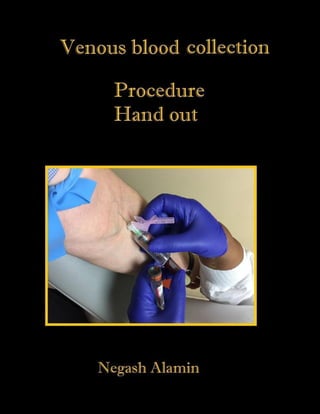


Title: Venous blood collection procedure
Name: Negash Alamin
Profession: Clinical Laboratory Scientist
Email: drnegash@gmail.com
Date: 28/10/17
Principles of the procedure
The overall idea of venous blood collection or venipuncture
is to collect large amounts of blood from the patient to
perform several tests. This method allows us to perform all
types of tests in adequate blood volume unlike capillary
blood collection which is scanty and inconvenient to
perform lots of tests from a single prick.
The standard area and vein for withdrawing blood from the
patient are called antecubital fossa (area) and the vein is
called median cubital vein. Even though vein blood
collection is an excellent method to collect blood from a
patient it becomes problematic when dealing with infants
due to the size of their physical stature and vein size.
Materials required
1- Gloves.
2- Vacutainer test tube.
3- Vacutainer tube holder and an appropriate needle
that goes along with it.
4- Cotton gauze.
5- 70% Alcohol.
6- Tourniquet.
7- Syringes in case we use syringes instead of
Vacutainer kits.
Procedure
1- Clean the arm (antecubital region) using 70%
alcohol to the outside using anti-clock wise
direction.
2- Don’t retouch the area; because it will contaminate
the area.
3- Break the paper on the Vacutainer needle and insert
it in the Vacutainer holder.
4- Apply tourniquet on the upper arm and inject the
Vacutainer needle in the median cubital vein to
draw blood.
5- Fill the tube ¾ with blood according to the
anticoagulant concentration and the ratio mandated.
6- Remove the needle and place cotton gauze on the
site of injection to stop bleeding.
7- Finally, mix the blood in the tube by making
number 8 symbol in the air while holding the test
tube.
Clinical significance
The blood collected can be used for numerous tests
as said above which include:
 CBC (complete blood count)
 WBC (white blood cell count)
 RBC (red blood cell count)
 MCV (mean cell volume)
 MCH (mean cell hemoglobin)
 MCHC (mean cell hemoglobin concentration)
 Platelet count
 Differential count
 ESR
 Culture

Venous blood collection procedure

  • 2.
    Title: Venous bloodcollection procedure Name: Negash Alamin Profession: Clinical Laboratory Scientist Email: drnegash@gmail.com Date: 28/10/17
  • 3.
    Principles of theprocedure The overall idea of venous blood collection or venipuncture is to collect large amounts of blood from the patient to perform several tests. This method allows us to perform all types of tests in adequate blood volume unlike capillary blood collection which is scanty and inconvenient to perform lots of tests from a single prick. The standard area and vein for withdrawing blood from the patient are called antecubital fossa (area) and the vein is called median cubital vein. Even though vein blood collection is an excellent method to collect blood from a patient it becomes problematic when dealing with infants due to the size of their physical stature and vein size. Materials required 1- Gloves. 2- Vacutainer test tube. 3- Vacutainer tube holder and an appropriate needle that goes along with it. 4- Cotton gauze. 5- 70% Alcohol. 6- Tourniquet. 7- Syringes in case we use syringes instead of Vacutainer kits.
  • 4.
    Procedure 1- Clean thearm (antecubital region) using 70% alcohol to the outside using anti-clock wise direction. 2- Don’t retouch the area; because it will contaminate the area. 3- Break the paper on the Vacutainer needle and insert it in the Vacutainer holder. 4- Apply tourniquet on the upper arm and inject the Vacutainer needle in the median cubital vein to draw blood. 5- Fill the tube ¾ with blood according to the anticoagulant concentration and the ratio mandated. 6- Remove the needle and place cotton gauze on the site of injection to stop bleeding. 7- Finally, mix the blood in the tube by making number 8 symbol in the air while holding the test tube. Clinical significance The blood collected can be used for numerous tests as said above which include:  CBC (complete blood count)  WBC (white blood cell count)  RBC (red blood cell count)
  • 5.
     MCV (meancell volume)  MCH (mean cell hemoglobin)  MCHC (mean cell hemoglobin concentration)  Platelet count  Differential count  ESR  Culture