Order of Draw in
Phlebotomy Section
A Review Study
Usman Ali Shams
Abstract
• Blood collection is one of the most common nursing procedures and
is not devoid of complications.
• The order of draw during blood collection is a controversial theme.
• We aimed to define the efficacy of the order of draw during blood
collection to guarantee an exact Diagnostic results.
• We carried out a systematic literature review on PubMed, Scopus,
Web of Science, CINAHL, Embase, Joanna Briggs Institute, Cochrane
Library, and Google Scholar.
Abstract Cont…
• The analysis of the 11 articles included highlighted different opinions;
• However, the most recent evidence declares that the cross
contamination caused by the incorrect order of draw is a trait only in
the open system of drawing.
• The most recent evidence affirms the negligible effect of the order of
draw during blood collection when using the closed blood collection
system, while it is recommended when using the open collection
system.
Introduction
• One of the most common nursing procedures is blood collection.
• Indeed, this is a technique practiced in all departments that allows
investigation of the patient’s blood values, but it is not without risks.
• Therefore, it is extremely important that the results obtained are true
and without mistakes.
• It is well known that the pre-analytical phase is essential for good-
quality laboratory results.
• several studies have shown that almost 75% of all analytical mistakes
occur during blood collection
CONT…
• The types of errors that could occur in the preanalytical phase range
from wrong patient identification to filling an incorrect sample tube
and other mistakes in the course of the procedure.
• The WHO and the CLSI have edited specific guidelines to ensure the
good quality of the preanalytical phase.
• However, in the biomedical literature, there are different opinions
about one special item of the recommendations: the ORDER OF
DRAW of blood collection tubes.
• This particular finding has been the focus of numerous studies since
1977, when Sun and Knauf reported a case of spurious hyperkalemia
and hypocalcemia due to suspected blood contamination with an
Additive from secondary Vial.
CLSI Recommended Order of Draw
• Be Loving, Respectful, Gracious, Lighthearted, and Gentle:
Effects of Wrong order of Draw
• Additive contamination, when it occurs, does not only result in
erroneous blood values but also in a waste of healthcare resources
and, particularly, if not swiftly recognized, may negatively affect
patient care.
• In general, the carryover of additives could virtually increase or
decrease some laboratory values.
Effects of Wrong order of Draw
• The contamination with EDTA can lead to spurious electrolyte results
such as hyperkalemia, hypocalcemia, hypomagnesemia,
hypozincemia, hypophosphatemia, and longer coagulation times.
• It can also modify other laboratory parameters like unsaturated iron
binding capacity, bicarbonate, aspartate transaminase, alanine
transaminase, lactate dehydrogenase, creatine kinase, alkaline
phosphatase, and α-amylase.
Effects of Wrong order of Draw
• Similar effects might be caused by citrate contamination.
• The coagulation parameters could even potentially be altered by
contamination with heparin.
• Finally, hematological parameters could be modified by fluoride or
oxalate because of their capacity to cause disruption to the cell
membranes.
• Despite this, several studies in the literature have shown deeply
varying results and maintain a different viewpoints about the
possibility of cross-contamination.
• The contamination is reported to occur through three different
mechanisms.
• First, by direct transfer of blood from one tube to another; it is
strongly recommended not to decant blood from one tube to another
because of the contamination of blood due to the additive of the first
tube.
• Second, by backflow of blood from the first tube into the second tube
using the vacutainer system, the contaminated blood from the first
tube could backflow into the needle and be transferred to the second
tube.
• Third, by syringe needle contamination when pouring blood into
different blood collection tubes, as blood is drawn with a syringe and
tubes are filled one by one.
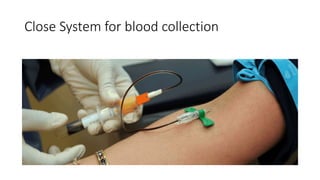
Close System for blood collection
Open System for blood collection
Conclusion
• According to the latest evidence, the focus of this problem actually
seems to be the blood collection system used.
• The latest studies declare that the possibility of cross contamination
using the closed blood collection system with today’s materials and
devices seems to be negligible even if the recommended order of
filling tubes is not followed.
• Indeed, in the case of blood collection using a closed system, the
order of draw appears negligible.
• However, whenever blood collection is performed using an open
system, the filling blood tube order would become essential to
guarantee an exact biochemical result.
Reference
• The Order of Draw during Blood Collection: A Systematic Literature
Review by Giacomo Bazzano ,† , Alessandro Galazzi , Gian Domenico
Giusti , Mauro Panigada and Dario Laquintana.
• Phlebotomy Notes by Susan King Strasinger,DA, MT (ASCP) and
Marjorie Schaub Di Lorenzo, MT (ASCP), SH.
ā€«Ų“Ś©Ų±ŪŒŪā€¬