ANTICOAGULANTS
HAEMATOLOGY &
BLOOD BANKING
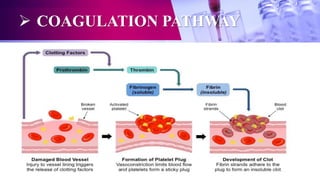
 COAGULATION PATHWAY
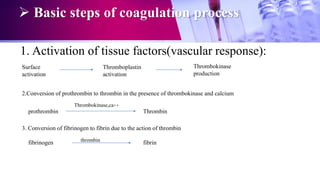
 Basic steps of coagulation process
1. Activation of tissue factors(vascular response):
Surface
activation
Thromboplastin
activation
Thrombokinase
production
2.Conversion of prothrombin to thrombin in the presence of thrombokinase and calcium
prothrombin Thrombin
Thrombokinase,ca++
3. Conversion of fibrinogen to fibrin due to the action of thrombin
fibrinogen fibrin
thrombin
 ANTICOAGULANT
DEFINATION:
• A substance that prevents blood from
clotting by suppressing the synthesis
or function of various clotting factors.
• E.g. it stops blood from clotting.
• These drugs tend to prevent new clot
from forming or an existing clot from
enlarging.
• They don’t dissolve a blood clot.
 Use:
• Anticoagulants have various uses- some are used for
the prophylaxis or the treatment of thromboembolic
disorders.
• Thrombi are clots. Emboli are clot that break free,
travel through blood stream & lodge therein .
• Used for prevention of vein thrombosis, pulmonary
embolism, myocardial infarction & strokes.
 Ideal characteristics of
Anticoagulants:
• An anticoagulant selected for use in hematological examination must have the
following qualities:
1. It must not alter the size of the cell
2. It must not cause hemolysis
3. It must minimize platelet aggregation
4. It must minimize disruption of staining and morphology of leukocytes
5. It must be readily soluble in water
6. It should be soluble in blood
7. It must be keep the blood in fluid condition
8. It should efficiently prevent clotting of blood with minimum quantity.
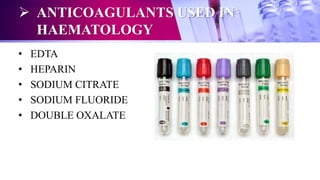
 ANTICOAGULANTS USED IN
HAEMATOLOGY
• EDTA
• HEPARIN
• SODIUM CITRATE
• SODIUM FLUORIDE
• DOUBLE OXALATE
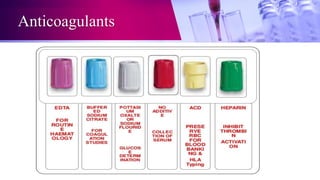
Anticoagulants
A. EDTA(ETHYLENE DIAMINE
TETRAACETIC ACID)
 EDTA is used as a disodium or dipotassium salt.it is also used as a
trisodium salt.
 Disodium and dipotassium salts are solids and trisodium salt is in
liquid form.
 Mostly potassium EDTA is used as an anticoagulant, recommended
for hematology studies.
 EDTA is most frequently used to carry out hematological test,
because it preserves the cellular components well.
 It is also known as sequestrene or vercene.
 This is a chelating agent that binds the calcium which is needed for
coagulation.
Mode of action:
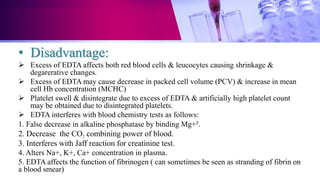
 EDTA binds to metal via 4 carboxylate and 2 amino
groups. EDTA forms especially strong complexes
with metals.
 EDTA strongly and irreversibly binds to calcium so
act as a powerful calcium chelating agent.
 Calcium in blood is bound in an unionized and
soluble complex with EDTA.
MODE OF ACTION
OF EDTA
 CONCENTRATION:
• It is effective at a final concentration of
1 to 2 mg / mL of blood.
• It will preserve blood excellently for at least 6 hrs.
• Refrigeration will extend the preservation to 24 hrs.
• Disadvantage:
 Excess of EDTA affects both red blood cells & leucocytes causing shrinkage &
degarerative changes.
 Excess of EDTA may cause decrease in packed cell volume (PCV) & increase in mean
cell Hb concentration (MCHC)
 Platelet swell & disintegrate due to excess of EDTA & artificially high platelet count
may be obtained due to disintegrated platelets.
 EDTA interferes with blood chemistry tests as follows:
1. False decrease in alkaline phosphatase by binding Mg+².
2. Decrease the CO2 combining power of blood.
3. Interferes with Jaff reaction for creatinine test.
4. Alters Na+, K+, Ca+ concentration in plasma.
5. EDTA affects the function of fibrinogen ( can sometimes be seen as stranding of fibrin on
a blood smear)
• Advantages:
• It gives best preservation of cellular morphology after 2
to 3 hrs of blood.
• It inhibits platelet clumping so useful in platelet count.
• Other uses:
• Food preservative, textile industry, pulp & paper industry,
oil production etc.
B. Heparine
• It is a natural anticoagulant in the body, found in the
liver, and may also be with in basophils and mast
cells, heparin also called anti thromboplastin or
antithrombin.
• It is available in a liquid or dry form as…… sodium,
calcium, ammonium and lithium salt,
• Each of these will interfere with determination of their
respective ions in the plasma
• It was first discovered by JaymMclean in 1916 & William
henry Howell in 1918.
• It is known as anti-thromboplastin or anti-thrombin
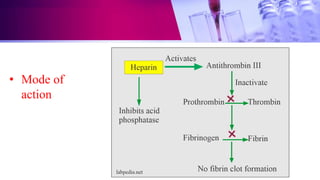
• Mode of action:
• It interfers in the formation &/ or activity of thrombin &
activity of clotting factor X, XI, XII, IX
• By this action it stops formation of thrombin from
prothrombin & thus stopping the formation of fibrin from
fibrinogen.
• Mode of
action
• Concentration: the optimum conc. is 0.1- 0.2 mg/ml of blood.
 Advantage:
• Heparin is the choice of Anticoagulant for blood pH,and blood gas Analysis.
Acid base balance.
• It may be used for special trace elements studies and some cytology .
• Excessive heparin does not alter the RBC volume
• It is used in vivo in suspected thrombosis & pulmonary embolic condition to
prevent intravascular coagulation.
• It is also used for enzyme studies.
• It is used for osmotic fragility testing.
• Used for cell culture
 Disadvantages :
• It causes clumping of leukocytes
• It interferes with staining of leukocytes.
• It is the most expensive of the anticoagulant
• Blood clot in 8-12 hrs because clotting is only delayed and not
prevented.
• It is not suitable for agglutination tests , and coagulation
studies
• It may interfere with some automated biochemical analysis of
plasma.
3. Sodium Citrate
• A citrate can refer to the conjugate base of citric acid
to esters of citric acid. Molecular formula of
C6H5Na3O7 (sodium citrate).
• An example of former, a salt is trisodium citrate an
ester is trimethyl citrate.
• It is used in liquid form.
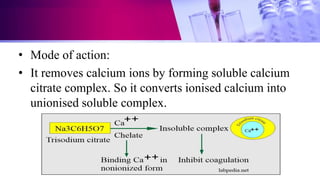
• Mode of action:
• It removes calcium ions by forming soluble calcium
citrate complex. So it converts ionised calcium into
unionised soluble complex.
• Advantages:
• In the ESR determination by westergen method. (2 ml
marked) test tube 0.4ml of 3.8 g/dl trisodium citrate
solution is taken & blood is added upto mark (1.6 ml of
blood). Nowadays EDTA is used instead of citrate.
• In Prothrombin time determination. In a (2.5 ml marked)
test tube 0.25ml of 3.8 g/dL sodium citrate dilution is
taken & blood is added upto mark 2.25ml of blood) for
this test 3g/dl sodium citrate is required.
• Disadvantages
• It interferes with many chemical tests
• Used alone it preserves blood for only few min.
• It has a tendency to shrink cells. Because of 10% dilution
of blood – sodium citrate is generally not used for CBC
• It inhibits enzyme activities such as SGPT, SGOT &
alkaline phosphatase & interfers in the determination of
calcium & inorganic phosphorus
• Uses:
• It is used in liquid form & it forms calcium citrate
complex which is soluble so it is also used for
coagulation studies.
• ESR by westergen method
• Reticulocytes count
• Act as a both diluent and anticoagulant
• Heinz body detection
• Trisodium citrate is employed as a flavouring agent.
4. Sodium Fluoride & Potassium Oxalate
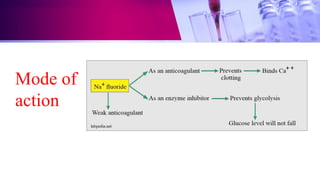
• These tubes contain mixture of fluoride & oxalates.
• Sodium fluoride is a weak anticoagulant therefore it is
used with potassium oxalate.
• Mode of action:
• Sodium fluoride inhibits the glycolytic enzyme
responsible for the breakdown of glucose in blood.
• Blood glucose concentration decrease by about 10 mg/dl
per hr at 25 C if specimen is untreated.
Mode of
action
• Uses:
• It is used for blood glucose determination
• Blood urea estimation
• Disadvantages:
• Fluoride plasma is not suitable for enzyme
determination because it inhibits enzyme activity.
5. Double Oxalate
• Types :
• A. Potassium oxalate
• B. Ammonium oxalate
• Three parts of Ammonium oxalate and two parts of Potassium
oxalate are combined together & forms Double Oxalate.
• This two oxalates are used in combination, because they
balance the adverse effect of each other that is swelling effect
of ammonium oxalate & shrinking effect of potassium oxalate
on red blood cells.
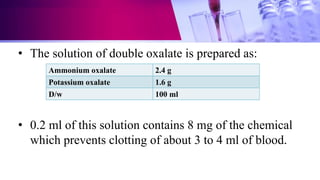
• The solution of double oxalate is prepared as:
• 0.2 ml of this solution contains 8 mg of the chemical
which prevents clotting of about 3 to 4 ml of blood.
Ammonium oxalate 2.4 g
Potassium oxalate 1.6 g
D/w 100 ml
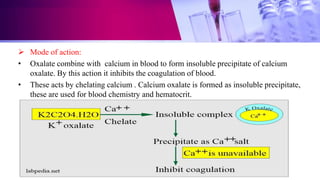
 Mode of action:
• Oxalate combine with calcium in blood to form insoluble precipitate of calcium
oxalate. By this action it inhibits the coagulation of blood.
• These acts by chelating calcium . Calcium oxalate is formed as insoluble precipitate,
these are used for blood chemistry and hematocrit.
• Use
• Double oxalate is used for Hb studies, RBC count & WBC count.
• ESR rate determination by wintrobe’s method
• It is also used for packed cell volume (PCV) determination.
• Disadvantages:
• WBC morphology is not preserved well hence it is not generally
used for blood smear.it may cause harm, it is never used for blood
banking for blood transfusion.
Anticoagulant use
in Blood Banking
Introduction
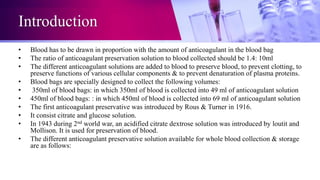
• Blood has to be drawn in proportion with the amount of anticoagulant in the blood bag
• The ratio of anticoagulant preservation solution to blood collected should be 1.4: 10ml
• The different anticoagulant solutions are added to blood to preserve blood, to prevent clotting, to
preserve functions of various cellular components & to prevent denaturation of plasma proteins.
• Blood bags are specially designed to collect the following volumes:
• 350ml of blood bags: in which 350ml of blood is collected into 49 ml of anticoagulant solution
• 450ml of blood bags: : in which 450ml of blood is collected into 69 ml of anticoagulant solution
• The first anticoagulant preservative was introduced by Rous & Turner in 1916.
• It consist citrate and glucose solution.
• In 1943 during 2nd world war, an acidified citrate dextrose solution was introduced by loutit and
Mollison. It is used for preservation of blood.
• The different anticoagulant preservative solution available for whole blood collection & storage
are as follows:
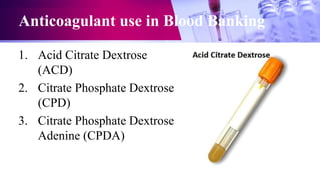
Anticoagulant use in Blood Banking
1. Acid Citrate Dextrose
(ACD)
2. Citrate Phosphate Dextrose
(CPD)
3. Citrate Phosphate Dextrose
Adenine (CPDA)
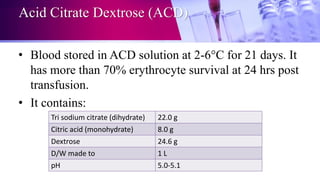
Acid Citrate Dextrose (ACD)
• Blood stored in ACD solution at 2-6°C for 21 days. It
has more than 70% erythrocyte survival at 24 hrs post
transfusion.
• It contains:
Tri sodium citrate (dihydrate) 22.0 g
Citric acid (monohydrate) 8.0 g
Dextrose 24.6 g
D/W made to 1 L
pH 5.0-5.1
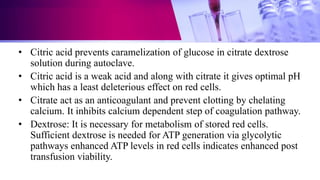
• Citric acid prevents caramelization of glucose in citrate dextrose
solution during autoclave.
• Citric acid is a weak acid and along with citrate it gives optimal pH
which has a least deleterious effect on red cells.
• Citrate act as an anticoagulant and prevent clotting by chelating
calcium. It inhibits calcium dependent step of coagulation pathway.
• Dextrose: It is necessary for metabolism of stored red cells.
Sufficient dextrose is needed for ATP generation via glycolytic
pathways enhanced ATP levels in red cells indicates enhanced post
transfusion viability.
Citrate Phosphate Dextrose (CPD)
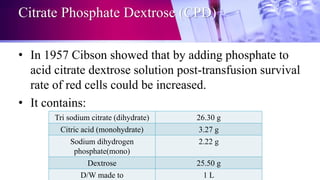
• In 1957 Cibson showed that by adding phosphate to
acid citrate dextrose solution post-transfusion survival
rate of red cells could be increased.
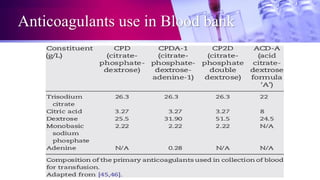
• It contains:
Tri sodium citrate (dihydrate) 26.30 g
Citric acid (monohydrate) 3.27 g
Sodium dihydrogen
phosphate(mono)
2.22 g
Dextrose 25.50 g
D/W made to 1 L
• Sodium dihydrogen phosphate act as a buffer to
control decrease in pH expected from build up of
lactic acid, an end product of glycolysis.
• The blood stored in CPD has better post transfusion
survival after 21 days than ACD due to slightly higher
pH because of phosphate compound.
CPDA-1
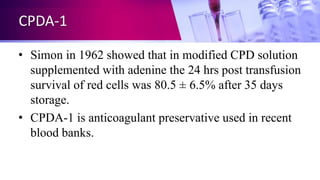
• Simon in 1962 showed that in modified CPD solution
supplemented with adenine the 24 hrs post transfusion
survival of red cells was 80.5 ± 6.5% after 35 days
storage.
• CPDA-1 is anticoagulant preservative used in recent
blood banks.
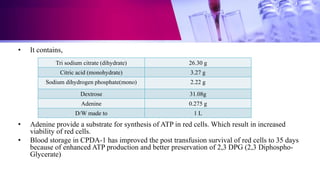
• It contains,
• Adenine provide a substrate for synthesis of ATP in red cells. Which result in increased
viability of red cells.
• Blood storage in CPDA-1 has improved the post transfusion survival of red cells to 35 days
because of enhanced ATP production and better preservation of 2,3 DPG (2,3 Diphospho-
Glycerate)
Tri sodium citrate (dihydrate) 26.30 g
Citric acid (monohydrate) 3.27 g
Sodium dihydrogen phosphate(mono) 2.22 g
Dextrose 31.08g
Adenine 0.275 g
D/W made to 1 L
CPDA-2
• CPDA-2 has all constituent same as CPDA-1.
• The difference between these two is conc. of dextrose
and adenine is different.
• In CPDA-2 the amount of dextrose is increased to
44.6 g And amount of adenine to 0.55 g.
• It is better than CPDA-1 due to more dextrose and
adenine contents.
Anticoagulants use in Blood bank

Anticoagulants

  • 1.
  • 2.
  • 3.
     Basic stepsof coagulation process 1. Activation of tissue factors(vascular response): Surface activation Thromboplastin activation Thrombokinase production 2.Conversion of prothrombin to thrombin in the presence of thrombokinase and calcium prothrombin Thrombin Thrombokinase,ca++ 3. Conversion of fibrinogen to fibrin due to the action of thrombin fibrinogen fibrin thrombin
  • 4.
     ANTICOAGULANT DEFINATION: • Asubstance that prevents blood from clotting by suppressing the synthesis or function of various clotting factors. • E.g. it stops blood from clotting. • These drugs tend to prevent new clot from forming or an existing clot from enlarging. • They don’t dissolve a blood clot.
  • 5.
     Use: • Anticoagulantshave various uses- some are used for the prophylaxis or the treatment of thromboembolic disorders. • Thrombi are clots. Emboli are clot that break free, travel through blood stream & lodge therein . • Used for prevention of vein thrombosis, pulmonary embolism, myocardial infarction & strokes.
  • 6.
     Ideal characteristicsof Anticoagulants: • An anticoagulant selected for use in hematological examination must have the following qualities: 1. It must not alter the size of the cell 2. It must not cause hemolysis 3. It must minimize platelet aggregation 4. It must minimize disruption of staining and morphology of leukocytes 5. It must be readily soluble in water 6. It should be soluble in blood 7. It must be keep the blood in fluid condition 8. It should efficiently prevent clotting of blood with minimum quantity.
  • 7.
     ANTICOAGULANTS USEDIN HAEMATOLOGY • EDTA • HEPARIN • SODIUM CITRATE • SODIUM FLUORIDE • DOUBLE OXALATE
  • 8.
  • 9.
    A. EDTA(ETHYLENE DIAMINE TETRAACETICACID)  EDTA is used as a disodium or dipotassium salt.it is also used as a trisodium salt.  Disodium and dipotassium salts are solids and trisodium salt is in liquid form.  Mostly potassium EDTA is used as an anticoagulant, recommended for hematology studies.  EDTA is most frequently used to carry out hematological test, because it preserves the cellular components well.  It is also known as sequestrene or vercene.  This is a chelating agent that binds the calcium which is needed for coagulation.
  • 10.
    Mode of action: EDTA binds to metal via 4 carboxylate and 2 amino groups. EDTA forms especially strong complexes with metals.  EDTA strongly and irreversibly binds to calcium so act as a powerful calcium chelating agent.  Calcium in blood is bound in an unionized and soluble complex with EDTA.
  • 11.
  • 12.
     CONCENTRATION: • Itis effective at a final concentration of 1 to 2 mg / mL of blood. • It will preserve blood excellently for at least 6 hrs. • Refrigeration will extend the preservation to 24 hrs.
  • 13.
    • Disadvantage:  Excessof EDTA affects both red blood cells & leucocytes causing shrinkage & degarerative changes.  Excess of EDTA may cause decrease in packed cell volume (PCV) & increase in mean cell Hb concentration (MCHC)  Platelet swell & disintegrate due to excess of EDTA & artificially high platelet count may be obtained due to disintegrated platelets.  EDTA interferes with blood chemistry tests as follows: 1. False decrease in alkaline phosphatase by binding Mg+². 2. Decrease the CO2 combining power of blood. 3. Interferes with Jaff reaction for creatinine test. 4. Alters Na+, K+, Ca+ concentration in plasma. 5. EDTA affects the function of fibrinogen ( can sometimes be seen as stranding of fibrin on a blood smear)
  • 14.
    • Advantages: • Itgives best preservation of cellular morphology after 2 to 3 hrs of blood. • It inhibits platelet clumping so useful in platelet count. • Other uses: • Food preservative, textile industry, pulp & paper industry, oil production etc.
  • 15.
    B. Heparine • Itis a natural anticoagulant in the body, found in the liver, and may also be with in basophils and mast cells, heparin also called anti thromboplastin or antithrombin. • It is available in a liquid or dry form as…… sodium, calcium, ammonium and lithium salt, • Each of these will interfere with determination of their respective ions in the plasma
  • 16.
    • It wasfirst discovered by JaymMclean in 1916 & William henry Howell in 1918. • It is known as anti-thromboplastin or anti-thrombin • Mode of action: • It interfers in the formation &/ or activity of thrombin & activity of clotting factor X, XI, XII, IX • By this action it stops formation of thrombin from prothrombin & thus stopping the formation of fibrin from fibrinogen.
  • 17.
  • 18.
    • Concentration: theoptimum conc. is 0.1- 0.2 mg/ml of blood.  Advantage: • Heparin is the choice of Anticoagulant for blood pH,and blood gas Analysis. Acid base balance. • It may be used for special trace elements studies and some cytology . • Excessive heparin does not alter the RBC volume • It is used in vivo in suspected thrombosis & pulmonary embolic condition to prevent intravascular coagulation. • It is also used for enzyme studies. • It is used for osmotic fragility testing. • Used for cell culture
  • 19.
     Disadvantages : •It causes clumping of leukocytes • It interferes with staining of leukocytes. • It is the most expensive of the anticoagulant • Blood clot in 8-12 hrs because clotting is only delayed and not prevented. • It is not suitable for agglutination tests , and coagulation studies • It may interfere with some automated biochemical analysis of plasma.
  • 20.
    3. Sodium Citrate •A citrate can refer to the conjugate base of citric acid to esters of citric acid. Molecular formula of C6H5Na3O7 (sodium citrate). • An example of former, a salt is trisodium citrate an ester is trimethyl citrate. • It is used in liquid form.
  • 21.
    • Mode ofaction: • It removes calcium ions by forming soluble calcium citrate complex. So it converts ionised calcium into unionised soluble complex.
  • 22.
    • Advantages: • Inthe ESR determination by westergen method. (2 ml marked) test tube 0.4ml of 3.8 g/dl trisodium citrate solution is taken & blood is added upto mark (1.6 ml of blood). Nowadays EDTA is used instead of citrate. • In Prothrombin time determination. In a (2.5 ml marked) test tube 0.25ml of 3.8 g/dL sodium citrate dilution is taken & blood is added upto mark 2.25ml of blood) for this test 3g/dl sodium citrate is required.
  • 23.
    • Disadvantages • Itinterferes with many chemical tests • Used alone it preserves blood for only few min. • It has a tendency to shrink cells. Because of 10% dilution of blood – sodium citrate is generally not used for CBC • It inhibits enzyme activities such as SGPT, SGOT & alkaline phosphatase & interfers in the determination of calcium & inorganic phosphorus
  • 24.
    • Uses: • Itis used in liquid form & it forms calcium citrate complex which is soluble so it is also used for coagulation studies. • ESR by westergen method • Reticulocytes count • Act as a both diluent and anticoagulant • Heinz body detection • Trisodium citrate is employed as a flavouring agent.
  • 25.
    4. Sodium Fluoride& Potassium Oxalate • These tubes contain mixture of fluoride & oxalates. • Sodium fluoride is a weak anticoagulant therefore it is used with potassium oxalate. • Mode of action: • Sodium fluoride inhibits the glycolytic enzyme responsible for the breakdown of glucose in blood. • Blood glucose concentration decrease by about 10 mg/dl per hr at 25 C if specimen is untreated.
  • 26.
  • 27.
    • Uses: • Itis used for blood glucose determination • Blood urea estimation • Disadvantages: • Fluoride plasma is not suitable for enzyme determination because it inhibits enzyme activity.
  • 28.
    5. Double Oxalate •Types : • A. Potassium oxalate • B. Ammonium oxalate • Three parts of Ammonium oxalate and two parts of Potassium oxalate are combined together & forms Double Oxalate. • This two oxalates are used in combination, because they balance the adverse effect of each other that is swelling effect of ammonium oxalate & shrinking effect of potassium oxalate on red blood cells.
  • 29.
    • The solutionof double oxalate is prepared as: • 0.2 ml of this solution contains 8 mg of the chemical which prevents clotting of about 3 to 4 ml of blood. Ammonium oxalate 2.4 g Potassium oxalate 1.6 g D/w 100 ml
  • 30.
     Mode ofaction: • Oxalate combine with calcium in blood to form insoluble precipitate of calcium oxalate. By this action it inhibits the coagulation of blood. • These acts by chelating calcium . Calcium oxalate is formed as insoluble precipitate, these are used for blood chemistry and hematocrit.
  • 31.
    • Use • Doubleoxalate is used for Hb studies, RBC count & WBC count. • ESR rate determination by wintrobe’s method • It is also used for packed cell volume (PCV) determination. • Disadvantages: • WBC morphology is not preserved well hence it is not generally used for blood smear.it may cause harm, it is never used for blood banking for blood transfusion.
  • 32.
  • 33.
    Introduction • Blood hasto be drawn in proportion with the amount of anticoagulant in the blood bag • The ratio of anticoagulant preservation solution to blood collected should be 1.4: 10ml • The different anticoagulant solutions are added to blood to preserve blood, to prevent clotting, to preserve functions of various cellular components & to prevent denaturation of plasma proteins. • Blood bags are specially designed to collect the following volumes: • 350ml of blood bags: in which 350ml of blood is collected into 49 ml of anticoagulant solution • 450ml of blood bags: : in which 450ml of blood is collected into 69 ml of anticoagulant solution • The first anticoagulant preservative was introduced by Rous & Turner in 1916. • It consist citrate and glucose solution. • In 1943 during 2nd world war, an acidified citrate dextrose solution was introduced by loutit and Mollison. It is used for preservation of blood. • The different anticoagulant preservative solution available for whole blood collection & storage are as follows:
  • 34.
    Anticoagulant use inBlood Banking 1. Acid Citrate Dextrose (ACD) 2. Citrate Phosphate Dextrose (CPD) 3. Citrate Phosphate Dextrose Adenine (CPDA)
  • 35.
    Acid Citrate Dextrose(ACD) • Blood stored in ACD solution at 2-6°C for 21 days. It has more than 70% erythrocyte survival at 24 hrs post transfusion. • It contains: Tri sodium citrate (dihydrate) 22.0 g Citric acid (monohydrate) 8.0 g Dextrose 24.6 g D/W made to 1 L pH 5.0-5.1
  • 36.
    • Citric acidprevents caramelization of glucose in citrate dextrose solution during autoclave. • Citric acid is a weak acid and along with citrate it gives optimal pH which has a least deleterious effect on red cells. • Citrate act as an anticoagulant and prevent clotting by chelating calcium. It inhibits calcium dependent step of coagulation pathway. • Dextrose: It is necessary for metabolism of stored red cells. Sufficient dextrose is needed for ATP generation via glycolytic pathways enhanced ATP levels in red cells indicates enhanced post transfusion viability.
  • 37.
    Citrate Phosphate Dextrose(CPD) • In 1957 Cibson showed that by adding phosphate to acid citrate dextrose solution post-transfusion survival rate of red cells could be increased. • It contains: Tri sodium citrate (dihydrate) 26.30 g Citric acid (monohydrate) 3.27 g Sodium dihydrogen phosphate(mono) 2.22 g Dextrose 25.50 g D/W made to 1 L
  • 38.
    • Sodium dihydrogenphosphate act as a buffer to control decrease in pH expected from build up of lactic acid, an end product of glycolysis. • The blood stored in CPD has better post transfusion survival after 21 days than ACD due to slightly higher pH because of phosphate compound.
  • 39.
    CPDA-1 • Simon in1962 showed that in modified CPD solution supplemented with adenine the 24 hrs post transfusion survival of red cells was 80.5 ± 6.5% after 35 days storage. • CPDA-1 is anticoagulant preservative used in recent blood banks.
  • 40.
    • It contains, •Adenine provide a substrate for synthesis of ATP in red cells. Which result in increased viability of red cells. • Blood storage in CPDA-1 has improved the post transfusion survival of red cells to 35 days because of enhanced ATP production and better preservation of 2,3 DPG (2,3 Diphospho- Glycerate) Tri sodium citrate (dihydrate) 26.30 g Citric acid (monohydrate) 3.27 g Sodium dihydrogen phosphate(mono) 2.22 g Dextrose 31.08g Adenine 0.275 g D/W made to 1 L
  • 41.
    CPDA-2 • CPDA-2 hasall constituent same as CPDA-1. • The difference between these two is conc. of dextrose and adenine is different. • In CPDA-2 the amount of dextrose is increased to 44.6 g And amount of adenine to 0.55 g. • It is better than CPDA-1 due to more dextrose and adenine contents.
  • 42.