Dr. Shyambala Bali
Asst. Prof. Kriyasharir Dept.
T.A.M.V.PUNE
 Coagulation or clotting is defined as the process in
which blood loses its fluidity and becomes a jelly-like
mass few minutes after it is shed out.
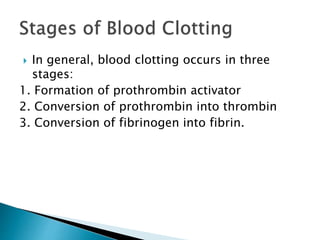
 In general, blood clotting occurs in three
stages:
1. Formation of prothrombin activator
2. Conversion of prothrombin into thrombin
3. Conversion of fibrinogen into fibrin.
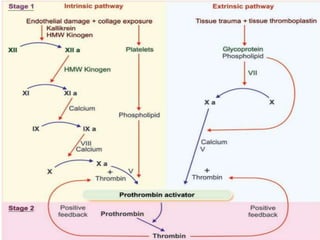
 Blood clotting commences with the formation
of a substance called prothrombin activator,
which converts prothrombin into thrombin. Its
formation is initiated by substances produced
either within the blood or outside the blood.
 Thus, formation of prothrombin activator
occurs through two pathways:
i. Intrinsic pathway
ii. Extrinsic pathway.
2. CONVERSION OF PROTHROMBIN INTO THROMBIN
Blood clotting is all about thrombin formation.
Once thrombin is formed, it definitely leads to clot
formation.
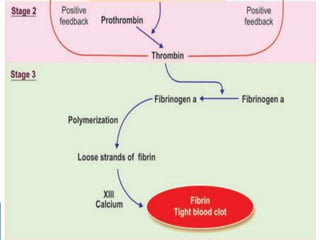
3. CONVERSION OF FIBRINOGEN INTO FIBRIN
The final stage of blood clotting involves the
conversion of fibrinogen into fibrin by thrombin.
 Blood clot
 Clot Retraction
 Fibrinolysis
 Anticoagulant-
◦Heparin
◦Coumarin
derivatives(e.g.Dicoumoral)
◦EDTA
◦Oxalates Compounds
◦Citrates
APPLIED PHYSIOLOGY
 BLEEDING DISORDERS
 Bleeding disorders are the conditions characterized by
 prolonged bleeding time or clotting time.
 Bleeding disorders are of three types:
 1. Hemophilia.
 2. Purpura.
 3. Von Willebrand disease.
Blood coagulation.pptx

Blood coagulation.pptx

  • 1.
    Dr. Shyambala Bali Asst.Prof. Kriyasharir Dept. T.A.M.V.PUNE
  • 2.
     Coagulation orclotting is defined as the process in which blood loses its fluidity and becomes a jelly-like mass few minutes after it is shed out.
  • 4.
     In general,blood clotting occurs in three stages: 1. Formation of prothrombin activator 2. Conversion of prothrombin into thrombin 3. Conversion of fibrinogen into fibrin.
  • 5.
     Blood clottingcommences with the formation of a substance called prothrombin activator, which converts prothrombin into thrombin. Its formation is initiated by substances produced either within the blood or outside the blood.  Thus, formation of prothrombin activator occurs through two pathways: i. Intrinsic pathway ii. Extrinsic pathway.
  • 6.
    2. CONVERSION OFPROTHROMBIN INTO THROMBIN Blood clotting is all about thrombin formation. Once thrombin is formed, it definitely leads to clot formation. 3. CONVERSION OF FIBRINOGEN INTO FIBRIN The final stage of blood clotting involves the conversion of fibrinogen into fibrin by thrombin.
  • 9.
     Blood clot Clot Retraction  Fibrinolysis  Anticoagulant- ◦Heparin ◦Coumarin derivatives(e.g.Dicoumoral) ◦EDTA ◦Oxalates Compounds ◦Citrates
  • 10.
    APPLIED PHYSIOLOGY  BLEEDINGDISORDERS  Bleeding disorders are the conditions characterized by  prolonged bleeding time or clotting time.  Bleeding disorders are of three types:  1. Hemophilia.  2. Purpura.  3. Von Willebrand disease.