Massive transfusion in  trauma  R.Sinha, D.Roxby, R.Seshadri  Flinders Medical Centre,  SA
Massive transfusion Massive transfusion – a response to uncontrollable haemorrhage Must be timely and directed at volume replacement ,oxygen delivery, prevention and correction of  coagulopathy Opportunities and risks
Who needs massive transfusion In a study of 5646 trauma patients by Como & colleagues  - 2.5% received more than 10 units of red cells during their admission American military casualty study 8% received massive transfusion Como JJ,Dutton RP,Scalea TJ,Edelman BB Hess JR.Blood transfusion rates in the care of trauma deaths. Transfusion 2004;44:809-813 Borgman  et al. The ratio of blood products transfused affects mortality in patients receiving massive transfusion at a combat support hospital. J trauma 2007;63:805-813
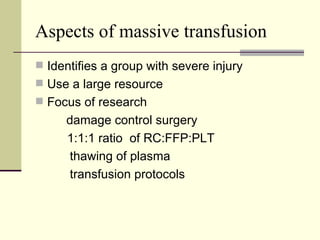
Aspects of massive transfusion Identifies a group with severe injury Use a large resource Focus of research damage control surgery 1:1:1 ratio  of RC:FFP:PLT thawing of plasma transfusion protocols
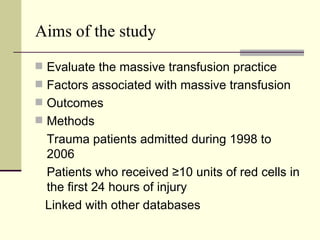
Aims of the study Evaluate the massive transfusion practice Factors associated with massive transfusion  Outcomes Methods Trauma patients admitted during 1998 to 2006 Patients who received ≥10 units of red cells in the first 24 hours of injury Linked with other databases
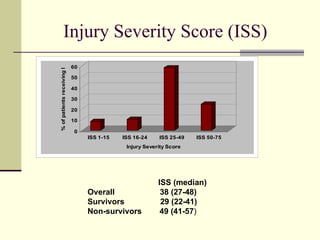
Results TOTAL 6488 trauma patients 438 (7%) received transfusion 358 received 1-9 red cells and 80 received ≥10  red cells. Major trauma (ISS>15) - 1021 patients 313 (30%) were transfused ISS [16-24]  - 19% ISS [25-49]  - 45% ISS [50-75]  -  8%
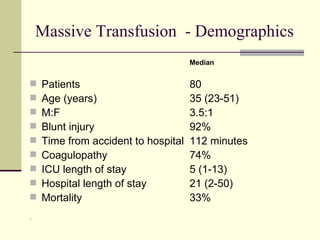
Massive Transfusion  - Demographics Median  Patients 80 Age (years)  35 (23-51) M:F 3.5:1 Blunt injury 92% Time from accident to hospital 112 minutes Coagulopathy 74% ICU length of stay 5 (1-13) Hospital length of stay 21 (2-50) Mortality 33% .
Injury Severity Score (ISS)   ISS (median) Overall   38 (27-48) Survivors  29 (22-41) Non-survivors  49 (41-57 )
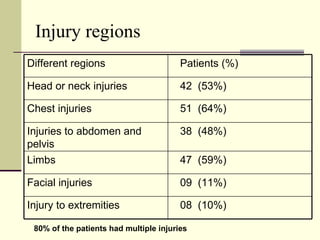
Injury regions 80% of the patients had multiple injuries 08  (10%) Injury to extremities 09  (11%) Facial injuries 47  (59%) Limbs  38  (48%) Injuries to abdomen and pelvis 51  (64%) Chest injuries 42  (53%) Head or neck injuries Patients (%) Different regions
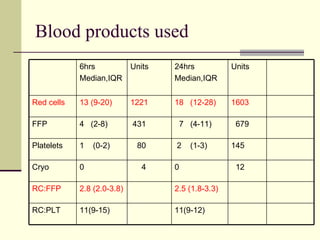
Blood products used  Units 24hrs Median,IQR Units 6hrs Median,IQR 1603 18  (12-28) 1221 13 (9-20) Red cells 679 7  (4-11) 431 4  (2-8) FFP 145 2  (1-3) 80 1  (0-2) Platelets 12 0 4 0 Cryo 2.5 (1.8-3.3) 2.8 (2.0-3.8) RC:FFP 11(9-12) 11(9-15) RC:PLT
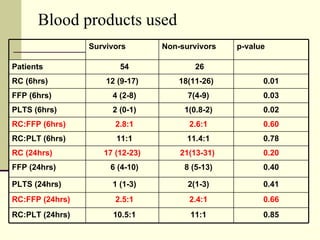
Blood products used 0.20 21(13-31) 17 (12-23) RC (24hrs) 0.40 8 (5-13) 6 (4-10) FFP (24hrs) 0.41 2(1-3) 1 (1-3) PLTS (24hrs) 0.66 2.4:1 2.5:1 RC:FFP (24hrs) 0.85 11:1 10.5:1 RC:PLT (24hrs) 26 54 Patients 0.01 18(11-26) 12 (9-17) RC (6hrs) 0.03 7(4-9) 4 (2-8) FFP (6hrs) 0.02 1(0.8-2) 2 (0-1) PLTS (6hrs) 0.60 2.6:1 2.8:1 RC:FFP (6hrs) 0.78 11.4:1 11:1 RC:PLT (6hrs) p-value Non-survivors Survivors
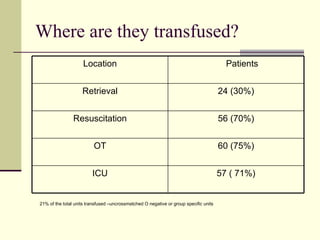
Where are they transfused? 21% of the total units transfused –uncrossmatched O negative or group specific units ICU OT Resuscitation Retrieval Location 57 ( 71%) 60 (75%) 56 (70%) 24 (30%) Patients
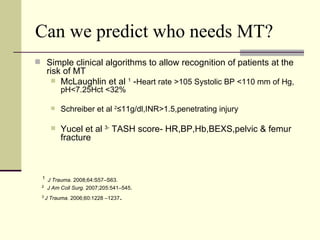
Can we predict who needs MT? Simple clinical algorithms to allow recognition of patients at the risk of MT McLaughlin et al  1  - Heart rate >105 Systolic BP <110 mm of Hg, pH<7.25Hct <32% Schreiber et al  2 ≤11g/dl,INR>1.5,penetrating injury Yucel et al  3-  TASH score- HR,BP,Hb,BEXS,pelvic & femur fracture 1  J Trauma.  2008;64:S57–S63. 2  J Am Coll Surg.  2007;205:541–545 . 3  J Trauma.  2006;60:1228 –1237 .
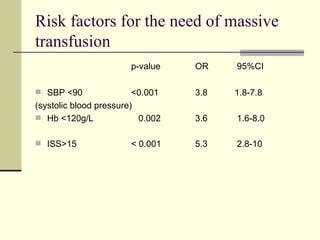
Risk factors for the need of massive transfusion p-value OR   95%CI SBP <90 <0.001 3.8   1.8-7.8 (systolic blood pressure) Hb <120g/L   0.002 3.6   1.6-8.0 ISS>15   < 0.001 5.3   2.8-10
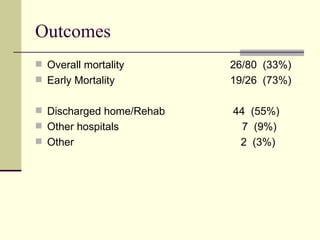
Outcomes Overall mortality  26/80  (33%) Early Mortality   19/26  (73%) Discharged home/Rehab   44  (55%) Other hospitals     7  (9%) Other   2  (3%)
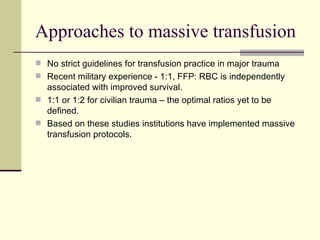
Approaches to massive transfusion  No strict guidelines for transfusion practice in major trauma Recent military experience - 1:1, FFP: RBC is independently associated with improved survival.  1:1 or 1:2 for civilian trauma – the optimal ratios yet to be defined. Based on these studies institutions have implemented massive transfusion protocols.
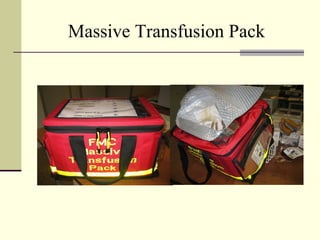
Massive Transfusion Pack
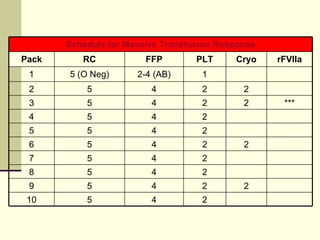
Schedule for Massive Transfusion Response Pack RC FFP PLT Cryo rFVIIa 1 5 (O Neg) 2-4 (AB) 1 2 5 4 2 2 3 5 4 2 2 *** 4 5 4 2 5 5 4 2 6 5 4 2 2 7 5 4 2 8 5 4 2 9 5 4 2 2 10 5 4 2
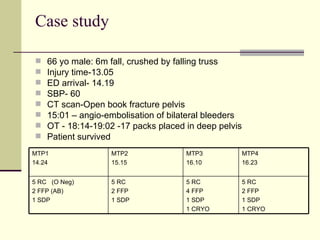
Case study 66 yo male: 6m fall, crushed by falling truss Injury time-13.05 ED arrival- 14.19 SBP- 60  CT scan-Open book fracture pelvis 15:01 – angio-embolisation of bilateral bleeders OT - 18:14-19:02 -17 packs placed in deep pelvis Patient survived 5 RC  2 FFP 1 SDP 1 CRYO 5 RC  4 FFP 1 SDP 1 CRYO 5 RC  2 FFP 1 SDP 5 RC  (O Neg) 2 FFP (AB) 1 SDP MTP4 16.23 MTP3 16.10 MTP2 15.15 MTP1 14.24
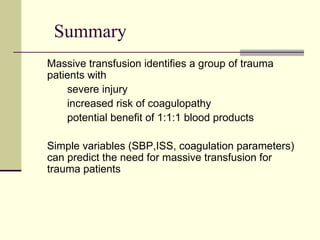
Summary Massive transfusion identifies a group of trauma patients with  severe injury increased risk of coagulopathy  potential benefit of 1:1:1 blood products Simple variables (SBP,ISS, coagulation parameters) can predict the need for massive transfusion for trauma patients
Thank you

Massive Transfusion In Trauma

  • 1.
    Massive transfusion in trauma R.Sinha, D.Roxby, R.Seshadri Flinders Medical Centre, SA
  • 2.
    Massive transfusion Massivetransfusion – a response to uncontrollable haemorrhage Must be timely and directed at volume replacement ,oxygen delivery, prevention and correction of coagulopathy Opportunities and risks
  • 3.
    Who needs massivetransfusion In a study of 5646 trauma patients by Como & colleagues - 2.5% received more than 10 units of red cells during their admission American military casualty study 8% received massive transfusion Como JJ,Dutton RP,Scalea TJ,Edelman BB Hess JR.Blood transfusion rates in the care of trauma deaths. Transfusion 2004;44:809-813 Borgman et al. The ratio of blood products transfused affects mortality in patients receiving massive transfusion at a combat support hospital. J trauma 2007;63:805-813
  • 4.
    Aspects of massivetransfusion Identifies a group with severe injury Use a large resource Focus of research damage control surgery 1:1:1 ratio of RC:FFP:PLT thawing of plasma transfusion protocols
  • 5.
    Aims of thestudy Evaluate the massive transfusion practice Factors associated with massive transfusion Outcomes Methods Trauma patients admitted during 1998 to 2006 Patients who received ≥10 units of red cells in the first 24 hours of injury Linked with other databases
  • 6.
    Results TOTAL 6488trauma patients 438 (7%) received transfusion 358 received 1-9 red cells and 80 received ≥10 red cells. Major trauma (ISS>15) - 1021 patients 313 (30%) were transfused ISS [16-24] - 19% ISS [25-49] - 45% ISS [50-75] - 8%
  • 7.
    Massive Transfusion - Demographics Median Patients 80 Age (years) 35 (23-51) M:F 3.5:1 Blunt injury 92% Time from accident to hospital 112 minutes Coagulopathy 74% ICU length of stay 5 (1-13) Hospital length of stay 21 (2-50) Mortality 33% .
  • 8.
    Injury Severity Score(ISS) ISS (median) Overall 38 (27-48) Survivors 29 (22-41) Non-survivors 49 (41-57 )
  • 9.
    Injury regions 80%of the patients had multiple injuries 08 (10%) Injury to extremities 09 (11%) Facial injuries 47 (59%) Limbs 38 (48%) Injuries to abdomen and pelvis 51 (64%) Chest injuries 42 (53%) Head or neck injuries Patients (%) Different regions
  • 10.
    Blood products used Units 24hrs Median,IQR Units 6hrs Median,IQR 1603 18 (12-28) 1221 13 (9-20) Red cells 679 7 (4-11) 431 4 (2-8) FFP 145 2 (1-3) 80 1 (0-2) Platelets 12 0 4 0 Cryo 2.5 (1.8-3.3) 2.8 (2.0-3.8) RC:FFP 11(9-12) 11(9-15) RC:PLT
  • 11.
    Blood products used0.20 21(13-31) 17 (12-23) RC (24hrs) 0.40 8 (5-13) 6 (4-10) FFP (24hrs) 0.41 2(1-3) 1 (1-3) PLTS (24hrs) 0.66 2.4:1 2.5:1 RC:FFP (24hrs) 0.85 11:1 10.5:1 RC:PLT (24hrs) 26 54 Patients 0.01 18(11-26) 12 (9-17) RC (6hrs) 0.03 7(4-9) 4 (2-8) FFP (6hrs) 0.02 1(0.8-2) 2 (0-1) PLTS (6hrs) 0.60 2.6:1 2.8:1 RC:FFP (6hrs) 0.78 11.4:1 11:1 RC:PLT (6hrs) p-value Non-survivors Survivors
  • 12.
    Where are theytransfused? 21% of the total units transfused –uncrossmatched O negative or group specific units ICU OT Resuscitation Retrieval Location 57 ( 71%) 60 (75%) 56 (70%) 24 (30%) Patients
  • 13.
    Can we predictwho needs MT? Simple clinical algorithms to allow recognition of patients at the risk of MT McLaughlin et al 1 - Heart rate >105 Systolic BP <110 mm of Hg, pH<7.25Hct <32% Schreiber et al 2 ≤11g/dl,INR>1.5,penetrating injury Yucel et al 3- TASH score- HR,BP,Hb,BEXS,pelvic & femur fracture 1 J Trauma. 2008;64:S57–S63. 2 J Am Coll Surg. 2007;205:541–545 . 3 J Trauma. 2006;60:1228 –1237 .
  • 14.
    Risk factors forthe need of massive transfusion p-value OR 95%CI SBP <90 <0.001 3.8 1.8-7.8 (systolic blood pressure) Hb <120g/L 0.002 3.6 1.6-8.0 ISS>15 < 0.001 5.3 2.8-10
  • 15.
    Outcomes Overall mortality 26/80 (33%) Early Mortality 19/26 (73%) Discharged home/Rehab 44 (55%) Other hospitals 7 (9%) Other 2 (3%)
  • 16.
    Approaches to massivetransfusion No strict guidelines for transfusion practice in major trauma Recent military experience - 1:1, FFP: RBC is independently associated with improved survival. 1:1 or 1:2 for civilian trauma – the optimal ratios yet to be defined. Based on these studies institutions have implemented massive transfusion protocols.
  • 17.
  • 18.
    Schedule for MassiveTransfusion Response Pack RC FFP PLT Cryo rFVIIa 1 5 (O Neg) 2-4 (AB) 1 2 5 4 2 2 3 5 4 2 2 *** 4 5 4 2 5 5 4 2 6 5 4 2 2 7 5 4 2 8 5 4 2 9 5 4 2 2 10 5 4 2
  • 19.
    Case study 66yo male: 6m fall, crushed by falling truss Injury time-13.05 ED arrival- 14.19 SBP- 60 CT scan-Open book fracture pelvis 15:01 – angio-embolisation of bilateral bleeders OT - 18:14-19:02 -17 packs placed in deep pelvis Patient survived 5 RC 2 FFP 1 SDP 1 CRYO 5 RC 4 FFP 1 SDP 1 CRYO 5 RC 2 FFP 1 SDP 5 RC (O Neg) 2 FFP (AB) 1 SDP MTP4 16.23 MTP3 16.10 MTP2 15.15 MTP1 14.24
  • 20.
    Summary Massive transfusionidentifies a group of trauma patients with severe injury increased risk of coagulopathy potential benefit of 1:1:1 blood products Simple variables (SBP,ISS, coagulation parameters) can predict the need for massive transfusion for trauma patients
  • 21.