

Routine weaning from  CPB Abeer elnakera Lecturer of anesthesia 2010
Objectives  Communications between surgeon, anesthesiologist and perfusionist are the corner stone for successful CPB separation (isa) The steps of routine weaning from CPB Meticulous monitoring and prompt intervention are highly important
As a role There should be close and clear communication among the per fusionist, the surgeon, and the anesthesiologist while weaning a patient from CPB
The anesthesiologist
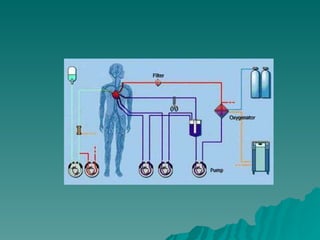
The actual process of weaning from CPB begins with  partially occluding the venous return cannula  with a clamp This causes blood to flow into the right ventricle. As the right ventricle fills and begins to pump blood through the lungs,  the left side of the heart will begin to fill . When this occurs,  the left ventricle will begin to eject , and the  arterial waveform will become pulsatile . Next,  the perfusionist will gradually decrease the pump flow rate to avoid emptying  the pump reservoir..
 
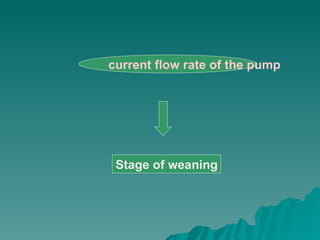
the per fusionist should communicate to the physicians three important parameters: the current flow rate of the pump,  the volume in the pump reservoir,  and the oxygen saturation of venous blood returning to the pump from the patient.
current flow rate of the pump Stage of weaning
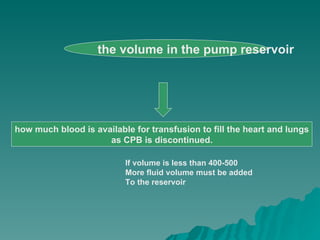
the volume in the pump reservoir how much blood is available for transfusion to fill the heart and lungs as CPB is discontinued.   If volume is less than 400-500 More fluid volume must be added To the reservoir
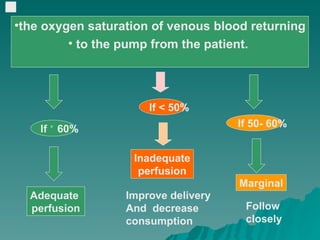
the oxygen saturation of venous blood returning to the pump from the patient.  If ˃ 60% Adequate  perfusion If < 50% If 50- 60% Inadequate perfusion Marginal Improve delivery And  decrease consumption Follow closely
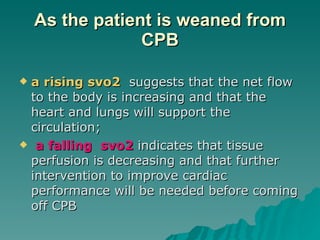
As the patient is weaned from CPB a rising svo2   suggests that the net flow to the body is increasing and that the heart and lungs will support the circulation; a falling  svo2  indicates that tissue perfusion is decreasing and that further intervention to improve cardiac performance will be needed before coming off CPB
One approach to weaning from CPB is to bring the  filling pressure  being monitored (e.g., central venous pressure [CVP], PAOP, LAP) to a specific, predetermined level somewhat lower than may be necessary and then assess the hemdynamics.
Volume (preload) of the heart  may also be judged by   direct observation( RV)  of its size or with  TEE (LV) . Further filling is done in  small increments (50 to 100 mL)   while closely monitoring the preload until the   hemodynamics appear satisfactory as judged by the  arterial pressure, the appearance of the heart, and the trend of the svo2  .  Overfilling and distention of the heart   should be avoided because it may stretch the myofibrils beyond the most efficient length and dilate the annuli of the mitral and tricuspid valves, rendering them incompetent, which is easily detected with TEE.
NOW we are off bypass .  When the pump flow has been decreased to 1 L/min or less in an adult and the hemodynamics are satisfactory ( systolic arterial pressure is judged to be adequate > 80–90 mm Hg),  the venous cannula may be completely clamped and the pump flow turned off .  At this point, the patient is “off bypass.”
This is a critical juncture in the operation .  The anesthesiologist should pause a moment to make a brief scan of the patient and monitors to  confirm that  the lungs are being ventilated with oxygen,  the hemodynamic status is acceptable and stable, the electrocardiogram shows no new signs of ischemia,  the heart does not appear to be distending, and the drug infusions are functioning as desired.
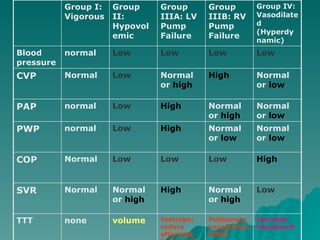
Next  Further fine-tuning of the preload  is accomplished by transfusing 50- to 100-mL boluses from the pump reservoir through the arterial cannula and observing the effect on hemodynamics.  Most patients fall into one of  four  groups when coming off bypass
Increase hematocrit Pulmonary vasodilator; RVAD Inotrope; reduce afterload, IABP, LVAD volume none TTT Low Normal or  high   High Normal or  high Normal  SVR High   Low   Low   Low Normal  COP Normal or  low  Normal or  low High Low normal PWP Normal or  low  Normal or  high High Low normal PAP Normal or  low  High Normal or  high Low Normal  CVP Low Low Low Low normal Blood pressure Group IV: Vasodilated (Hyperdynamic) Group IIIB: RV Pump Failure Group IIIA: LV Pump Failure Group II: Hypovolemic Group I: Vigorous
Hypovolemic patients are a mixed group that includes both patients with  normal ventricular function and those with varying degrees of impairment .  Those with preserved myocardial function  quickly respond to 100-mL aliquots of pump blood infused via the aortic cannula. Blood pressure and cardiac output rise with each bolus, and the increase becomes progressively more sustained. Most of these patients maintain good blood pressure and cardiac output with a left ventricular filling pressure below 10–15 mm Hg.
Hypovolemic patients Ventricular impairment   should be suspected in hypovolemic patients whose filling pressures rise during volume infusion without appreciable changes in blood pressure or cardiac output or in those who require filling pressures above 10–15 mm Hg.
Patients with pump failure If there is acute failure of the circulation as evidenced by unstable rhythm, falling arterial and rising filling pressures, or visible distention of the heart, .  In such cases, CPB is reinstituted  while inotropic therapy is initiated. If SVR is high, afterload reduction with nitroprusside or an inodilator (eg, milrinone) can be tried .
Patients with pump failure The patient should be evaluated for unrecognized ischemia (kinked graft or coronary vasospasm), valvular dysfunction, shunting, or right ventricular failure (the distention is primarily right sided). TEE may facilitate the diagnosis in these cases. If inotropes and afterload reduction fail,  intraaortic balloon pump (IABP)  is initiated before another attempt is made to wean the patient.
Patients with pump failure Use of partial bypass, in the form of  a left or right ventricular assist device  (LVAD or RVAD, respectively), may be necessary for patients with refractory pump failure.
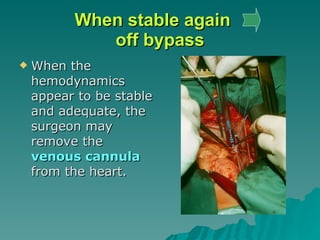
When stable again  off bypass When the hemodynamics appear to be stable and adequate, the surgeon may remove the  venous cannula  from the heart.
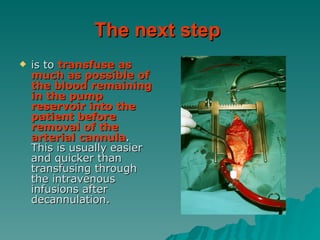
The next step   is to  transfuse as much as possible of the blood remaining in the pump reservoir into the patient before removal of the arterial cannula . This is usually easier and quicker than transfusing through the intravenous infusions after  decannulation.
Protamine  After discontinuing CPB, the  anticoagulation by heparin is reversed with protamine . Depending on institutional preference, protamine may be administered before or after removal of the arterial cannula. Giving it before removal allows for  continued transfusion from the pump and easier return to CPB  if there is a severe protamine reaction
When transfusion of the pump reservoir blood is completed ,  a thorough assessment of the patient's  condition should be made before removing the arterial cannula, because after this is done returning to CPB becomes much more difficult.  Hemodynamics should be satisfactory and stable . (TEE is valuable) Adequate oxygenation and ventilation should be confirmed
When transfusion of the pump reservoir blood is completed (cont.) Bleeding from the heart should be at a manageable level  before removal of the arterial cannula. because it may be difficult to keep up with the blood loss through intravenous infusions alone.  Bleeding sites behind the heart may have to be repaired on CPB  if the patient cannot tolerate lifting the heart to expose the problem area.
At the time of arterial decannulation , the systolic pressure should be between 85 and 105 mmHg to minimize the risk of dissection or tearing of the aorta .  The head of the bed may be raised, or small boluses of a short-acting vasodilator   may be given   as necessary . Tight control of the arterial blood pressure may be needed   for a few minutes until the cannulation site is secure.
Now the  routine process of discontinuing CPB is complete . However,  in patients with poor ventricular function after CPB, multiple drugs or even mechanical assist devices may be required throughout the rest of the operation and continued in the intensive care unit.
Any Questions ?
Summary   Communications between anesthesiologist, surgeon and perfusionist  are highly useful The actual process of weaning from CPB Patient categories after CPB Continuous assessment and stabilization of the patient continue all through the post bypass period
Thank you

Routine cpb weaning

  • 1.
    Routine weaning from CPB Abeer elnakera Lecturer of anesthesia 2010
  • 2.
    Objectives Communicationsbetween surgeon, anesthesiologist and perfusionist are the corner stone for successful CPB separation (isa) The steps of routine weaning from CPB Meticulous monitoring and prompt intervention are highly important
  • 3.
    As a roleThere should be close and clear communication among the per fusionist, the surgeon, and the anesthesiologist while weaning a patient from CPB
  • 4.
  • 5.
    The actual processof weaning from CPB begins with partially occluding the venous return cannula with a clamp This causes blood to flow into the right ventricle. As the right ventricle fills and begins to pump blood through the lungs, the left side of the heart will begin to fill . When this occurs, the left ventricle will begin to eject , and the arterial waveform will become pulsatile . Next, the perfusionist will gradually decrease the pump flow rate to avoid emptying the pump reservoir..
  • 6.
  • 7.
    the per fusionistshould communicate to the physicians three important parameters: the current flow rate of the pump, the volume in the pump reservoir, and the oxygen saturation of venous blood returning to the pump from the patient.
  • 8.
    current flow rateof the pump Stage of weaning
  • 9.
    the volume inthe pump reservoir how much blood is available for transfusion to fill the heart and lungs as CPB is discontinued. If volume is less than 400-500 More fluid volume must be added To the reservoir
  • 10.
    the oxygen saturationof venous blood returning to the pump from the patient. If ˃ 60% Adequate perfusion If < 50% If 50- 60% Inadequate perfusion Marginal Improve delivery And decrease consumption Follow closely
  • 11.
    As the patientis weaned from CPB a rising svo2 suggests that the net flow to the body is increasing and that the heart and lungs will support the circulation; a falling svo2 indicates that tissue perfusion is decreasing and that further intervention to improve cardiac performance will be needed before coming off CPB
  • 12.
    One approach toweaning from CPB is to bring the filling pressure being monitored (e.g., central venous pressure [CVP], PAOP, LAP) to a specific, predetermined level somewhat lower than may be necessary and then assess the hemdynamics.
  • 13.
    Volume (preload) ofthe heart may also be judged by direct observation( RV) of its size or with TEE (LV) . Further filling is done in small increments (50 to 100 mL) while closely monitoring the preload until the hemodynamics appear satisfactory as judged by the arterial pressure, the appearance of the heart, and the trend of the svo2 . Overfilling and distention of the heart should be avoided because it may stretch the myofibrils beyond the most efficient length and dilate the annuli of the mitral and tricuspid valves, rendering them incompetent, which is easily detected with TEE.
  • 14.
    NOW we areoff bypass . When the pump flow has been decreased to 1 L/min or less in an adult and the hemodynamics are satisfactory ( systolic arterial pressure is judged to be adequate > 80–90 mm Hg), the venous cannula may be completely clamped and the pump flow turned off . At this point, the patient is “off bypass.”
  • 15.
    This is acritical juncture in the operation . The anesthesiologist should pause a moment to make a brief scan of the patient and monitors to confirm that the lungs are being ventilated with oxygen, the hemodynamic status is acceptable and stable, the electrocardiogram shows no new signs of ischemia, the heart does not appear to be distending, and the drug infusions are functioning as desired.
  • 16.
    Next Furtherfine-tuning of the preload is accomplished by transfusing 50- to 100-mL boluses from the pump reservoir through the arterial cannula and observing the effect on hemodynamics. Most patients fall into one of four groups when coming off bypass
  • 17.
    Increase hematocrit Pulmonaryvasodilator; RVAD Inotrope; reduce afterload, IABP, LVAD volume none TTT Low Normal or high High Normal or high Normal SVR High Low Low Low Normal COP Normal or low Normal or low High Low normal PWP Normal or low Normal or high High Low normal PAP Normal or low High Normal or high Low Normal CVP Low Low Low Low normal Blood pressure Group IV: Vasodilated (Hyperdynamic) Group IIIB: RV Pump Failure Group IIIA: LV Pump Failure Group II: Hypovolemic Group I: Vigorous
  • 18.
    Hypovolemic patients area mixed group that includes both patients with normal ventricular function and those with varying degrees of impairment . Those with preserved myocardial function quickly respond to 100-mL aliquots of pump blood infused via the aortic cannula. Blood pressure and cardiac output rise with each bolus, and the increase becomes progressively more sustained. Most of these patients maintain good blood pressure and cardiac output with a left ventricular filling pressure below 10–15 mm Hg.
  • 19.
    Hypovolemic patients Ventricularimpairment should be suspected in hypovolemic patients whose filling pressures rise during volume infusion without appreciable changes in blood pressure or cardiac output or in those who require filling pressures above 10–15 mm Hg.
  • 20.
    Patients with pumpfailure If there is acute failure of the circulation as evidenced by unstable rhythm, falling arterial and rising filling pressures, or visible distention of the heart, . In such cases, CPB is reinstituted while inotropic therapy is initiated. If SVR is high, afterload reduction with nitroprusside or an inodilator (eg, milrinone) can be tried .
  • 21.
    Patients with pumpfailure The patient should be evaluated for unrecognized ischemia (kinked graft or coronary vasospasm), valvular dysfunction, shunting, or right ventricular failure (the distention is primarily right sided). TEE may facilitate the diagnosis in these cases. If inotropes and afterload reduction fail, intraaortic balloon pump (IABP) is initiated before another attempt is made to wean the patient.
  • 22.
    Patients with pumpfailure Use of partial bypass, in the form of a left or right ventricular assist device (LVAD or RVAD, respectively), may be necessary for patients with refractory pump failure.
  • 23.
    When stable again off bypass When the hemodynamics appear to be stable and adequate, the surgeon may remove the venous cannula from the heart.
  • 24.
    The next step is to transfuse as much as possible of the blood remaining in the pump reservoir into the patient before removal of the arterial cannula . This is usually easier and quicker than transfusing through the intravenous infusions after decannulation.
  • 25.
    Protamine Afterdiscontinuing CPB, the anticoagulation by heparin is reversed with protamine . Depending on institutional preference, protamine may be administered before or after removal of the arterial cannula. Giving it before removal allows for continued transfusion from the pump and easier return to CPB if there is a severe protamine reaction
  • 26.
    When transfusion ofthe pump reservoir blood is completed , a thorough assessment of the patient's condition should be made before removing the arterial cannula, because after this is done returning to CPB becomes much more difficult. Hemodynamics should be satisfactory and stable . (TEE is valuable) Adequate oxygenation and ventilation should be confirmed
  • 27.
    When transfusion ofthe pump reservoir blood is completed (cont.) Bleeding from the heart should be at a manageable level before removal of the arterial cannula. because it may be difficult to keep up with the blood loss through intravenous infusions alone. Bleeding sites behind the heart may have to be repaired on CPB if the patient cannot tolerate lifting the heart to expose the problem area.
  • 28.
    At the timeof arterial decannulation , the systolic pressure should be between 85 and 105 mmHg to minimize the risk of dissection or tearing of the aorta . The head of the bed may be raised, or small boluses of a short-acting vasodilator may be given as necessary . Tight control of the arterial blood pressure may be needed for a few minutes until the cannulation site is secure.
  • 29.
    Now the routine process of discontinuing CPB is complete . However, in patients with poor ventricular function after CPB, multiple drugs or even mechanical assist devices may be required throughout the rest of the operation and continued in the intensive care unit.
  • 30.
  • 31.
    Summary Communications between anesthesiologist, surgeon and perfusionist are highly useful The actual process of weaning from CPB Patient categories after CPB Continuous assessment and stabilization of the patient continue all through the post bypass period
  • 32.