Continuous Assessment 1
Topic Name: Understanding Control Systems through
Block Diagram Representation and its Algebra
Submitted By: Raza Shaud
Roll No.: 35501622018
Registration No.: 223550110027
Submitted to: Dr. Raja Ram
Kumar
(Department of Electrical Engineering, GKCIET, Malda)
Ghani Khan Choudhury Institute Of Engineering And
Technology
Outlines of Presentation
1. Introduction to Control System
2. Block Diagram in Control System
3. Basic Elements of Block Diagram
4. Block Diagram Representation of Electrical Systems
5. Block Diagram Reduction Technique and its
Algebra
.
6. Advantages, Disadvantages and Applications
7. Conclusion
8. References
❑ The control systems is very important for all engineers.The first significant control device was James
Watt's flyball governer. This was invented in 1767 to keep the speed of the engine constant by
regulating the supply of the steam to the engine
❑ In control system the behaviour of the system is described by the differential equations. Minorsky, in
1922 showed that how to determine the stability from the differential equations describing the
systems. The differential equations may be ordinary differential equations or the difference equations.
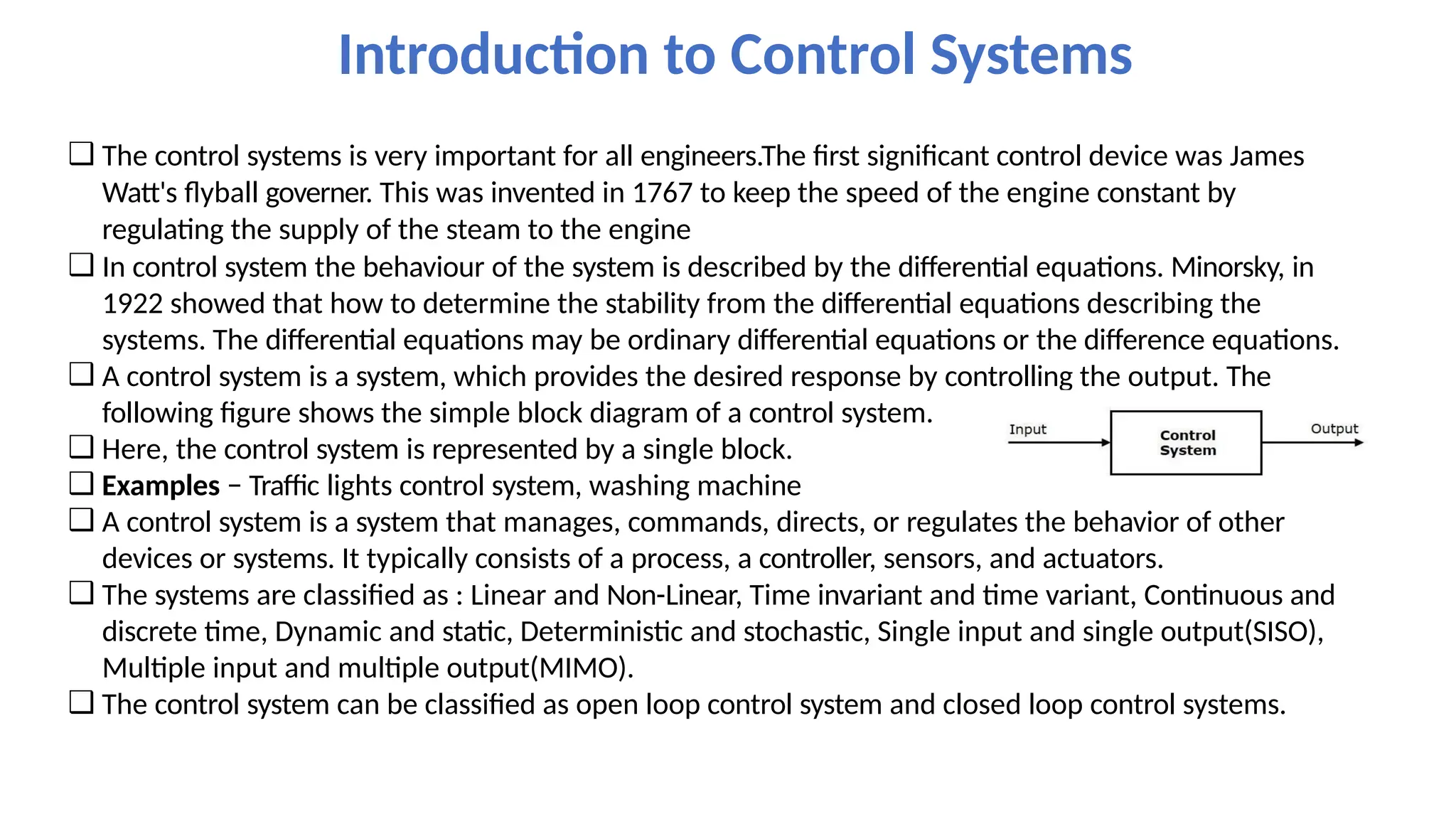
❑ A control system is a system, which provides the desired response by controlling the output. The
following figure shows the simple block diagram of a control system.
❑ Here, the control system is represented by a single block.
❑ Examples − Traffic lights control system, washing machine
❑ A control system is a system that manages, commands, directs, or regulates the behavior of other
devices or systems. It typically consists of a process, a controller, sensors, and actuators.
❑ The systems are classified as : Linear and Non-Linear, Time invariant and time variant, Continuous and
discrete time, Dynamic and static, Deterministic and stochastic, Single input and single output(SISO),
Multiple input and multiple output(MIMO).
❑ The control system can be classified as open loop control system and closed loop control systems.
Introduction to Control Systems
❑ Any system can be described by a set of differential equations, or it can be represented by the
schematic diagram that contains all the components and their connections. However, these methods do
not work for complicated systems.
❑ The Block diagram representation is a combination of these two methods. A block diagram is a
representation of a system using blocks.
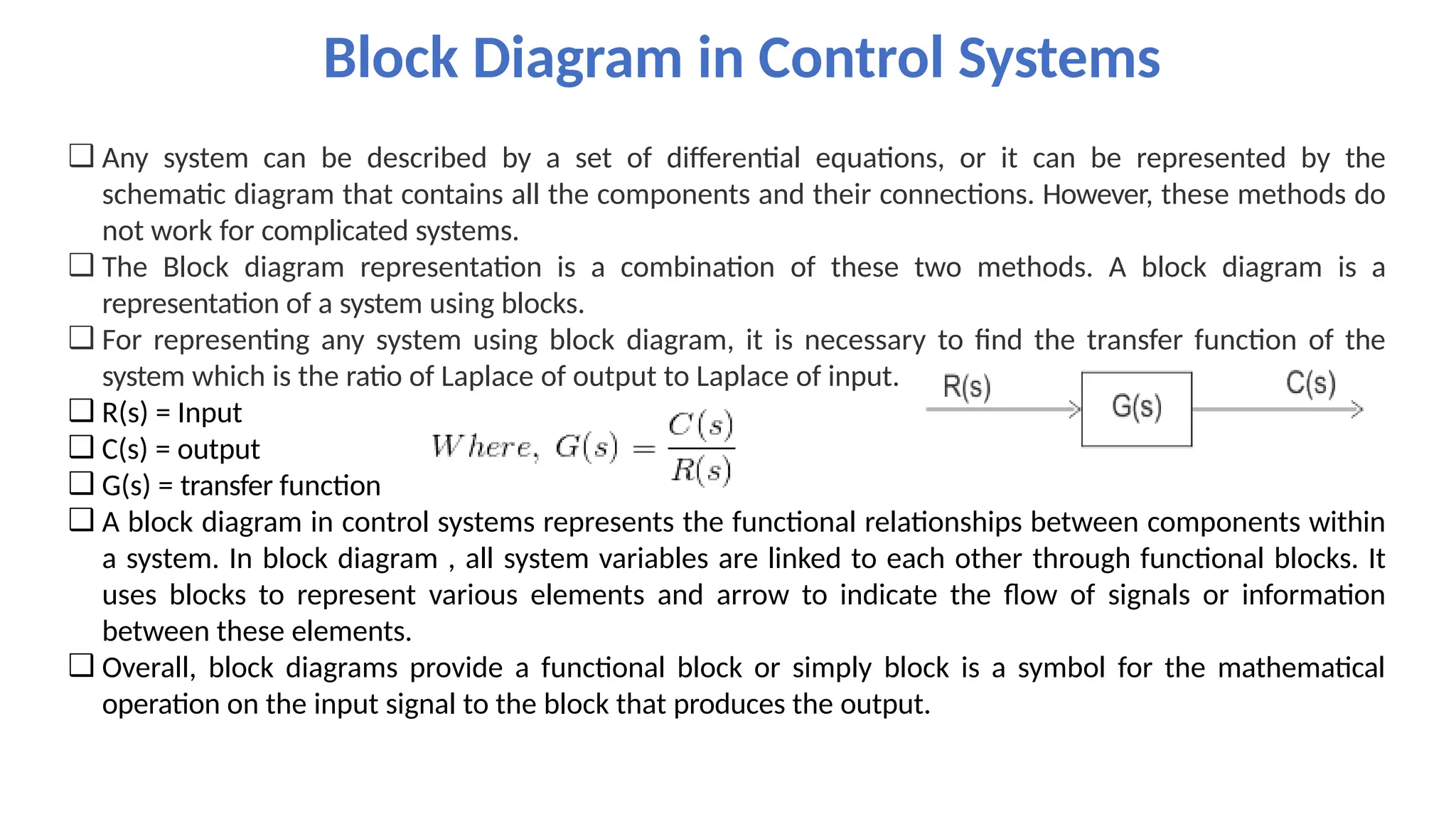
❑ For representing any system using block diagram, it is necessary to find the transfer function of the
system which is the ratio of Laplace of output to Laplace of input.
❑ R(s) = Input
❑ C(s) = output
❑ G(s) = transfer function
❑ A block diagram in control systems represents the functional relationships between components within
a system. In block diagram , all system variables are linked to each other through functional blocks. It
uses blocks to represent various elements and arrow to indicate the flow of signals or information
between these elements.
❑ Overall, block diagrams provide a functional block or simply block is a symbol for the mathematical
operation on the input signal to the block that produces the output.
Block Diagram in Control Systems
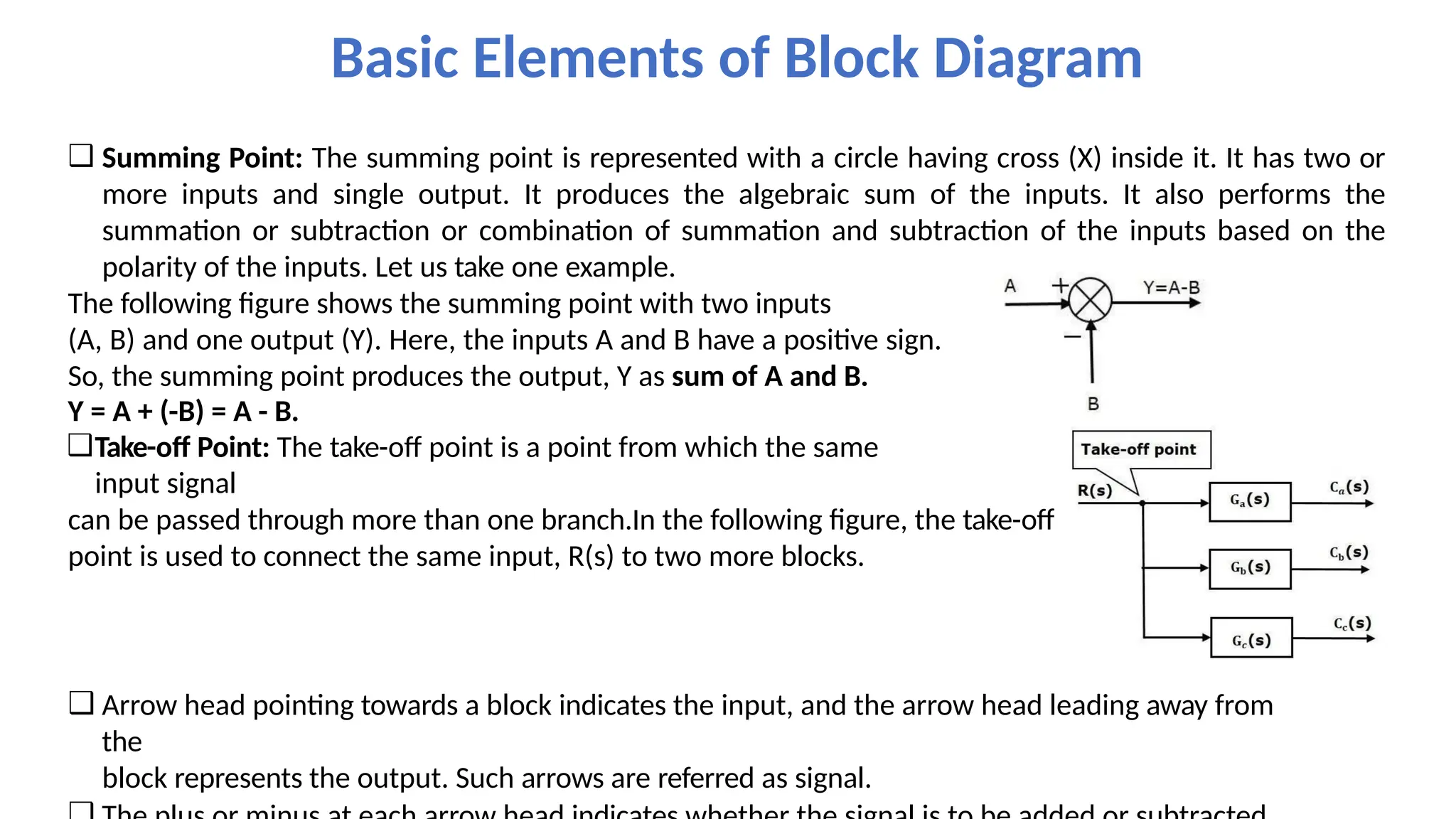
❑ Summing Point: The summing point is represented with a circle having cross (X) inside it. It has two or
more inputs and single output. It produces the algebraic sum of the inputs. It also performs the
summation or subtraction or combination of summation and subtraction of the inputs based on the
polarity of the inputs. Let us take one example.
The following figure shows the summing point with two inputs
(A, B) and one output (Y). Here, the inputs A and B have a positive sign.
So, the summing point produces the output, Y as sum of A and B.
Y = A + (-B) = A - B.
❑Take-off Point: The take-off point is a point from which the same
input signal
can be passed through more than one branch.In the following figure, the take-off
point is used to connect the same input, R(s) to two more blocks.
❑ Arrow head pointing towards a block indicates the input, and the arrow head leading away from
the
block represents the output. Such arrows are referred as signal.
Basic Elements of Block Diagram
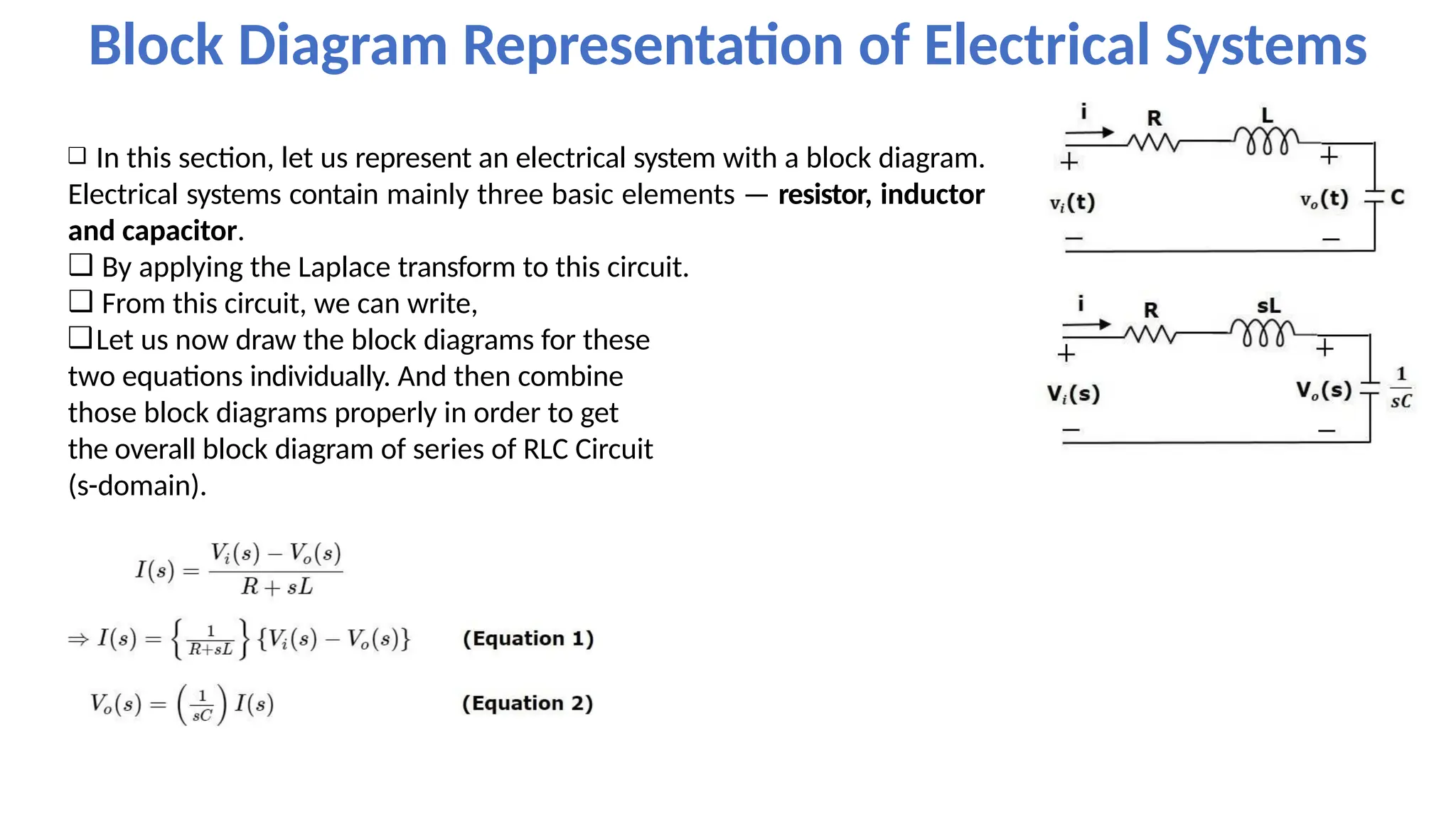
❑ In this section, let us represent an electrical system with a block diagram.
Electrical systems contain mainly three basic elements — resistor, inductor
and capacitor.
❑ By applying the Laplace transform to this circuit.
❑ From this circuit, we can write,
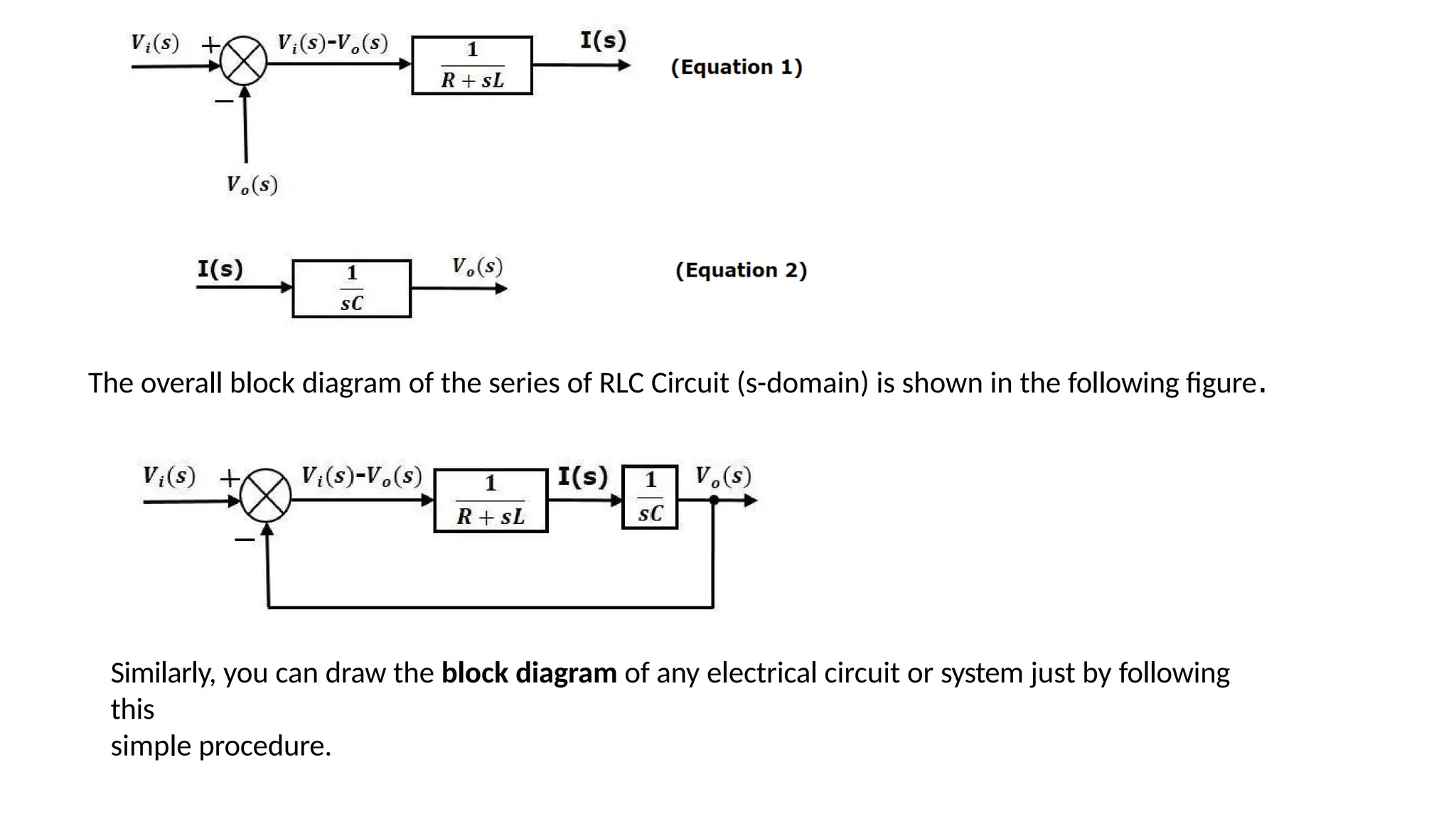
❑Let us now draw the block diagrams for these
two equations individually. And then combine
those block diagrams properly in order to get
the overall block diagram of series of RLC Circuit
(s-domain).
Block Diagram Representation of Electrical Systems
The overall block diagram of the series of RLC Circuit (s-domain) is shown in the following figure.
Similarly, you can draw the block diagram of any electrical circuit or system just by following
this
simple procedure.
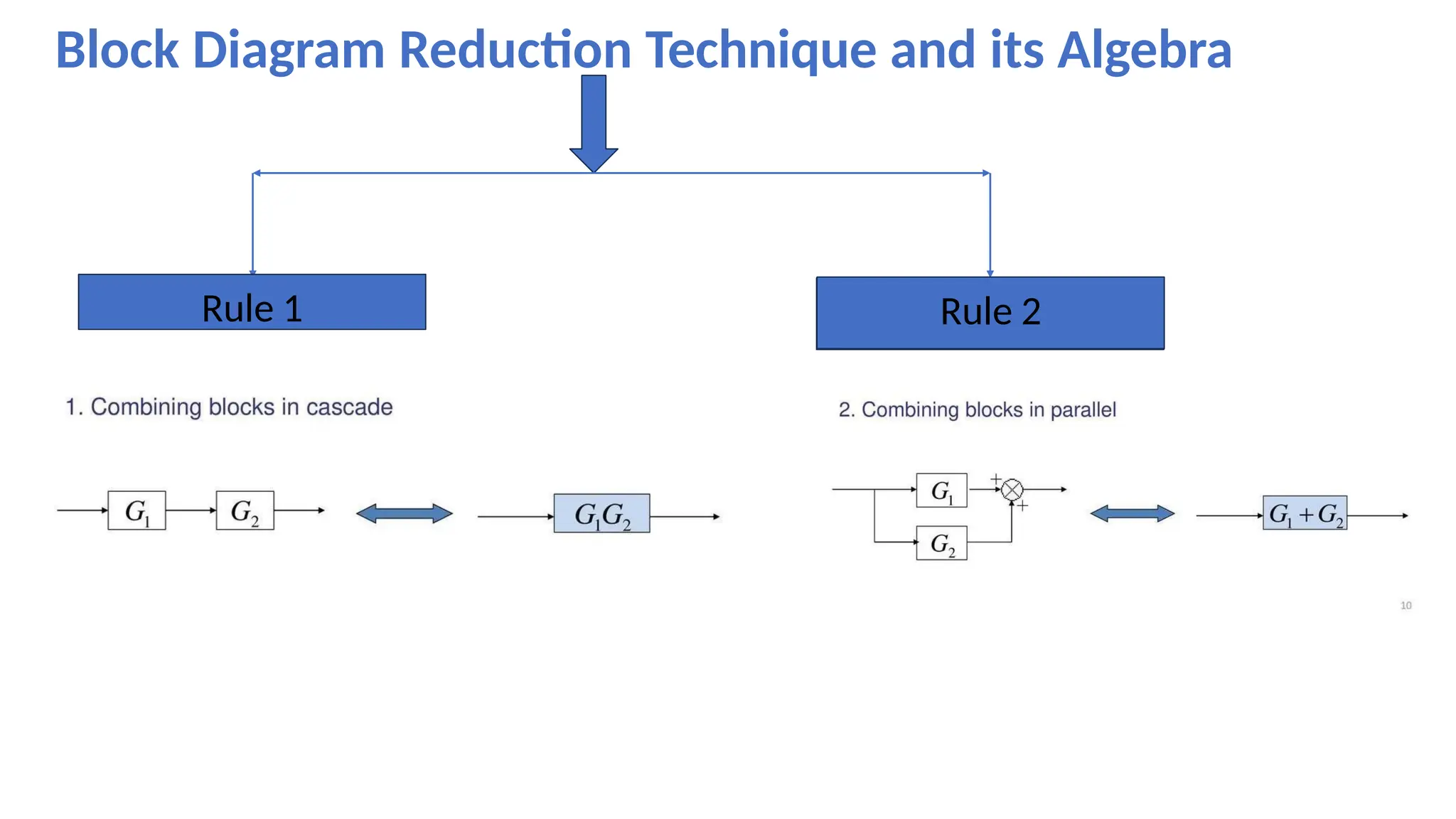
Block Diagram Reduction Technique and its Algebra
Rule 1 Rule 2
Block Diagram Reduction Technique and its Algebra
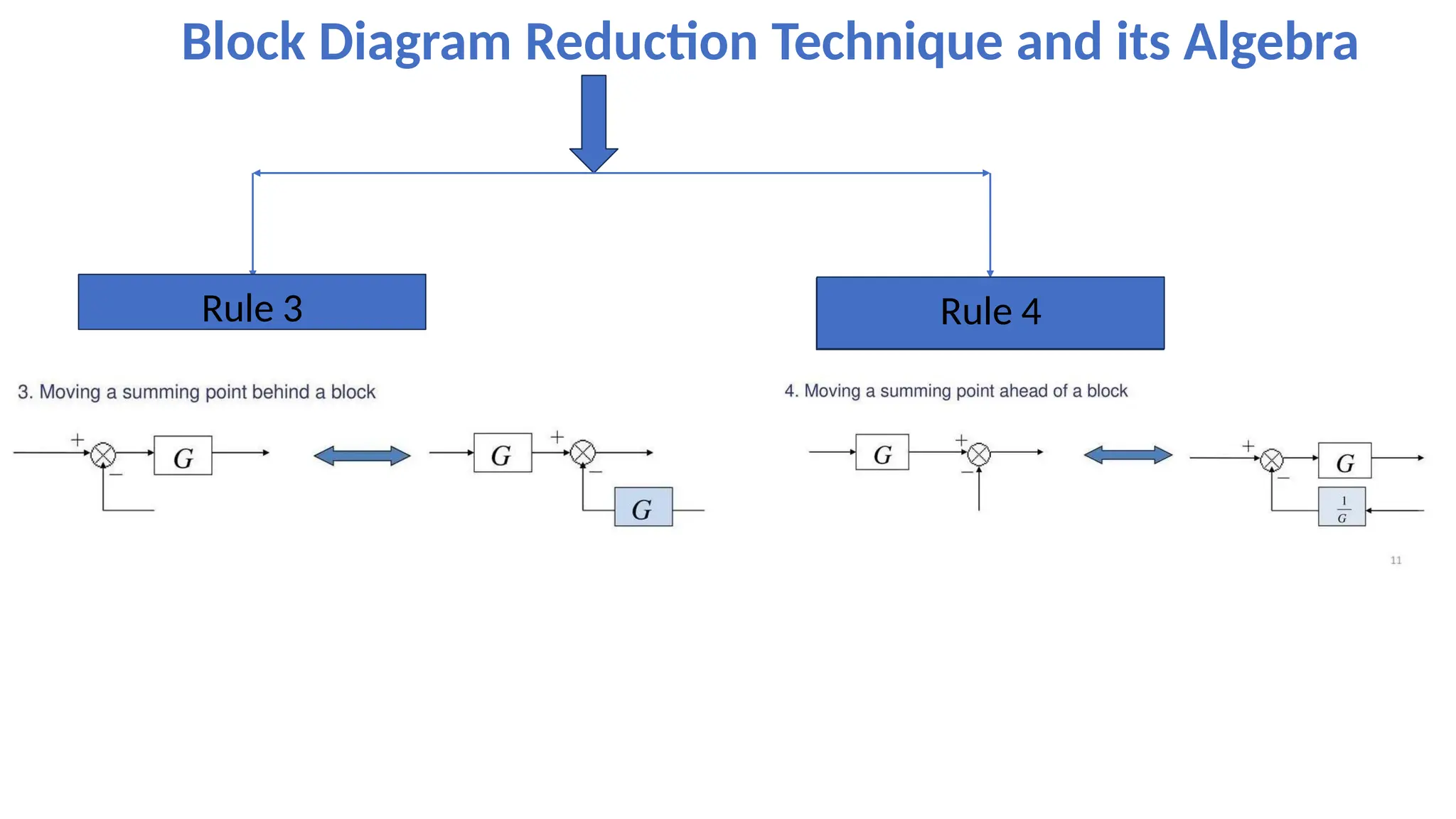
Rule 3 Rule 4
Block Diagram Reduction Technique and its Algebra
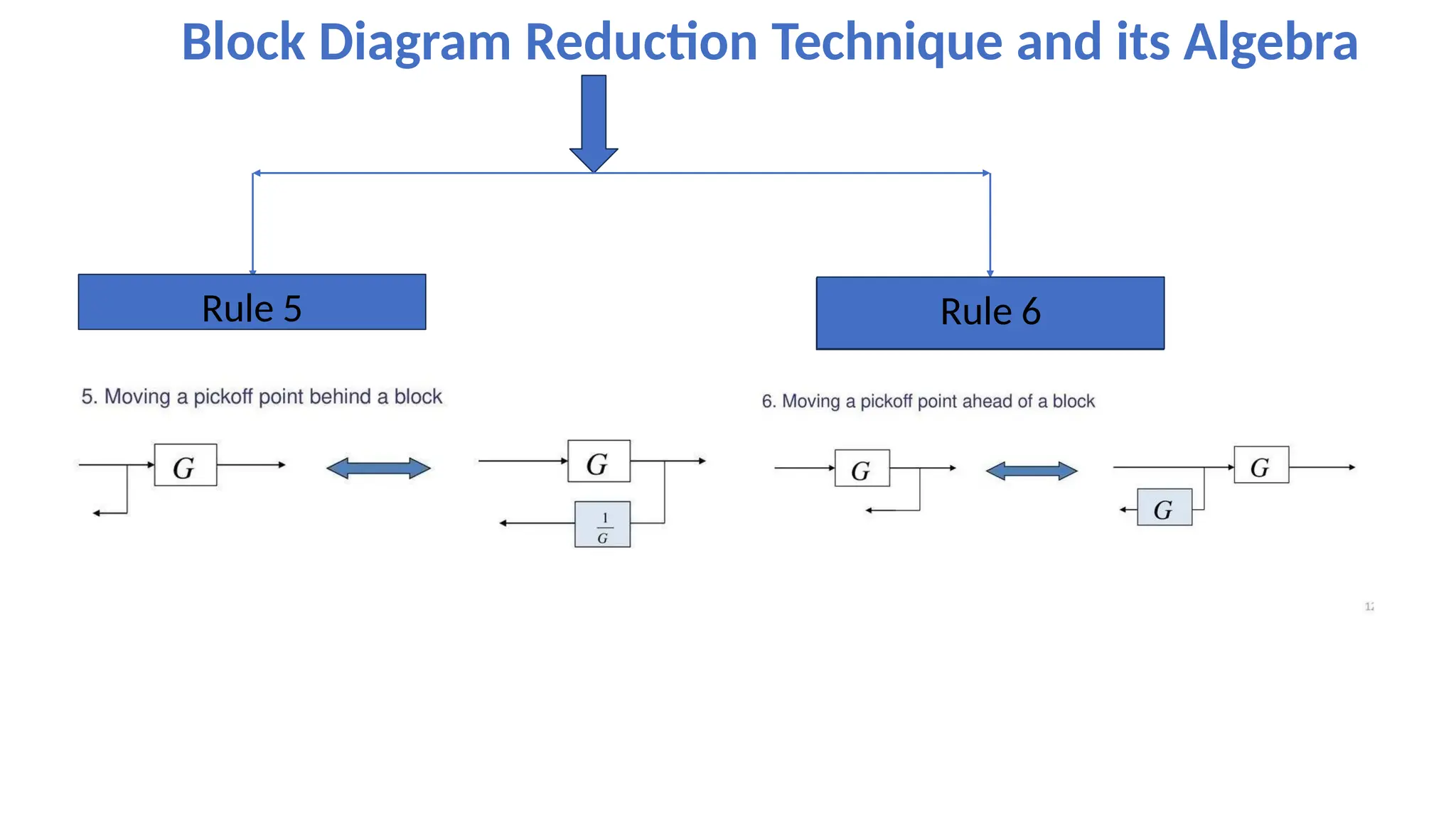
Rule 5 Rule 6
Block Diagram Reduction Technique and its Algebra
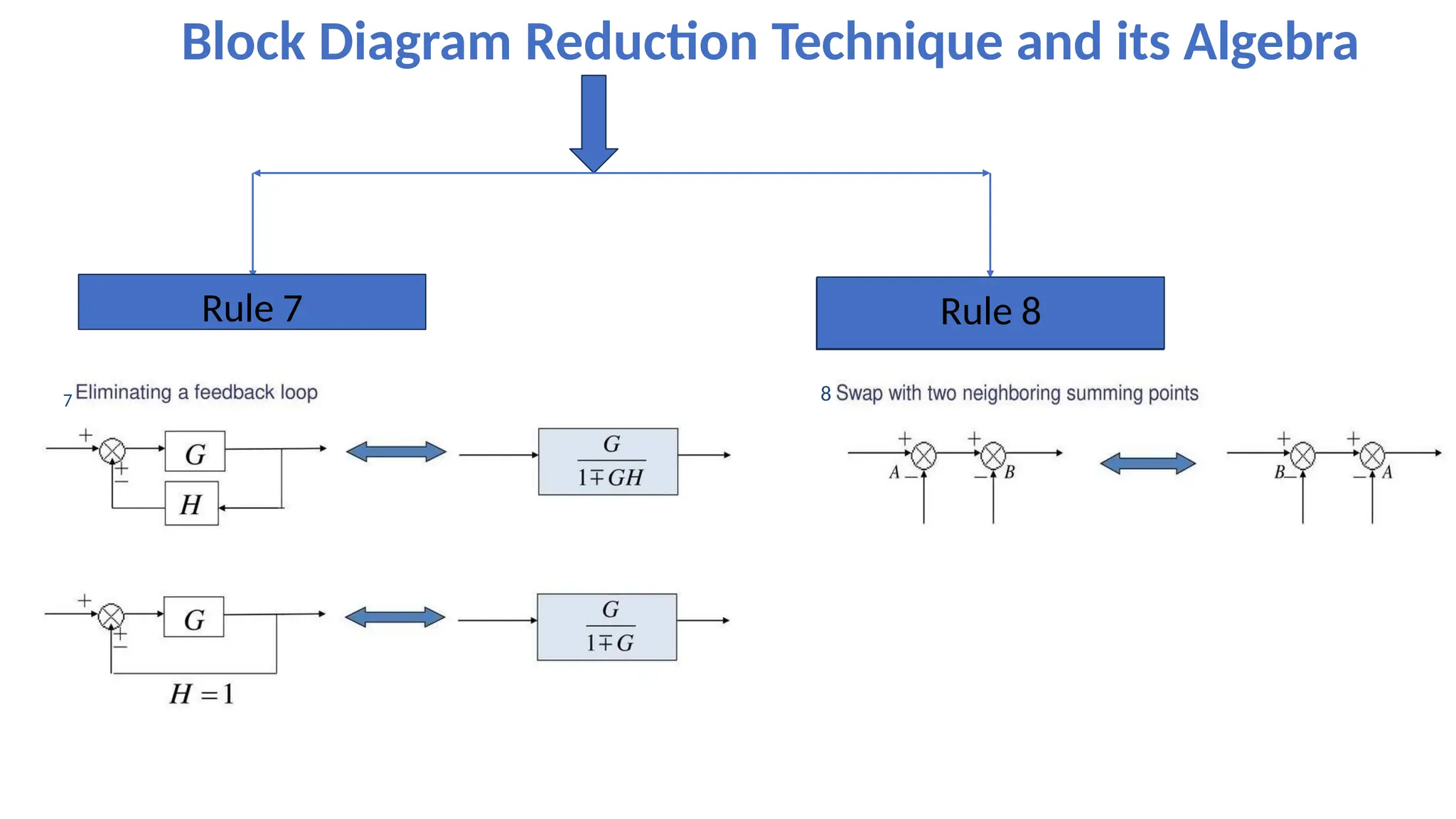
Rule 7 Rule 8
c7 8
Block Diagram Reduction Technique and its Algebra
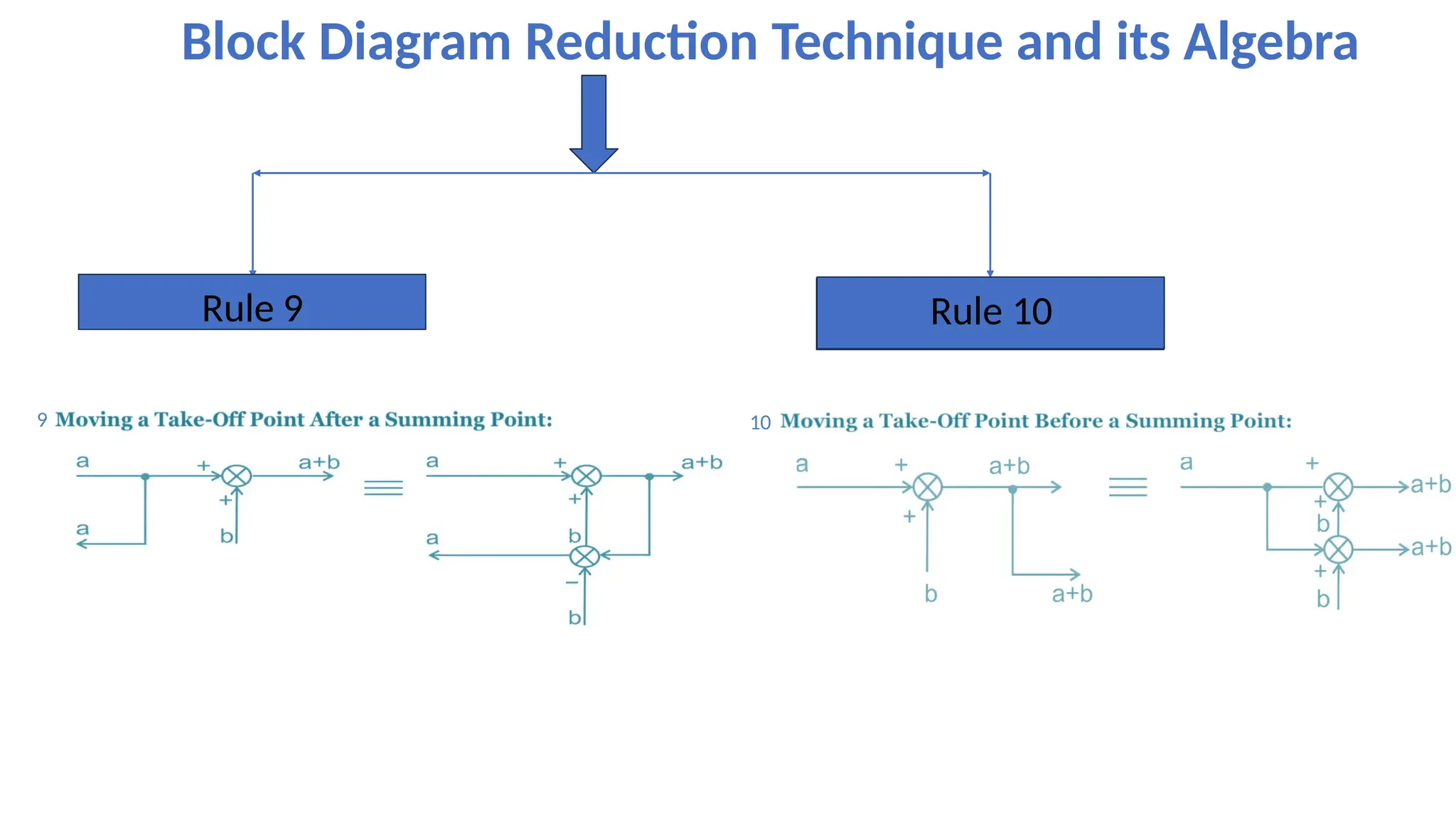
Rule 9 Rule 10
9 10
❑ Very simple to construct block diagram for a complicated system.
❑ Function of individual element can be visualized.
❑ Individual & Overall performance can be studied.
❑ Over all transfer function can be calculated easily.
Disadvantages
❑ Block diagram for any system is not unique.
❑ Source of energy in the system is not shown in the diagram.
❑ In the process of block diagram reduction, some important functions may omitted.
❑ It does not give information about physical construction of system.
Applications
❑ It can be utilize for Hardware Design.
❑ It can be utilize for Electric System Design.
❑ In Software Design one can use block Diagram.
❑ Process Flow Diagram it can be utilize.
Advantages
References
1. Automatic Control Systems, S. Hasan Saeed. Khatson Books
2. Control systems, K.R. Varmah, Mc Graw hill
3. Automatic Control system, A. William, Wolovich, Oxford
4. Research Paper Link: https://
www.researchgate.net/publication/312811390_Block_Diagrams_and_Introduction_to_Control_Systems
Conclusion
❑ Block diagram representation is a fundamental tool in control systems engineering that provides a clear and systematic
way to visualize the interactions between different components within a system. It help us comprehend the overall
architecture of the control system, including the roles of controllers, plants, sensors, and actuators. The diagrams allow us
to derive and analyze transfer functions, which are critical for assessing system stability, transient response, and steady-
state accuracy. By breaking down complex systems into manageable blocks, block diagrams provide a clear view that
simplifies the process of understanding, designing, and improving control systems.
❑ Block diagram reduction is a method to simplify the complex system by combining and rearranging blocks. By eliminating
unnecessary blocks and connections, it helps to make overall system easier to analyze and understand. By doing block
diagram reduction, system become simpler and more understandable.
SAMPLE.pptx for all ai solitions and othehrd

SAMPLE.pptx for all ai solitions and othehrd

  • 1.
    Continuous Assessment 1 TopicName: Understanding Control Systems through Block Diagram Representation and its Algebra Submitted By: Raza Shaud Roll No.: 35501622018 Registration No.: 223550110027 Submitted to: Dr. Raja Ram Kumar (Department of Electrical Engineering, GKCIET, Malda) Ghani Khan Choudhury Institute Of Engineering And Technology
  • 2.
    Outlines of Presentation 1.Introduction to Control System 2. Block Diagram in Control System 3. Basic Elements of Block Diagram 4. Block Diagram Representation of Electrical Systems 5. Block Diagram Reduction Technique and its Algebra . 6. Advantages, Disadvantages and Applications 7. Conclusion 8. References
  • 3.
    ❑ The controlsystems is very important for all engineers.The first significant control device was James Watt's flyball governer. This was invented in 1767 to keep the speed of the engine constant by regulating the supply of the steam to the engine ❑ In control system the behaviour of the system is described by the differential equations. Minorsky, in 1922 showed that how to determine the stability from the differential equations describing the systems. The differential equations may be ordinary differential equations or the difference equations. ❑ A control system is a system, which provides the desired response by controlling the output. The following figure shows the simple block diagram of a control system. ❑ Here, the control system is represented by a single block. ❑ Examples − Traffic lights control system, washing machine ❑ A control system is a system that manages, commands, directs, or regulates the behavior of other devices or systems. It typically consists of a process, a controller, sensors, and actuators. ❑ The systems are classified as : Linear and Non-Linear, Time invariant and time variant, Continuous and discrete time, Dynamic and static, Deterministic and stochastic, Single input and single output(SISO), Multiple input and multiple output(MIMO). ❑ The control system can be classified as open loop control system and closed loop control systems. Introduction to Control Systems
  • 4.
    ❑ Any systemcan be described by a set of differential equations, or it can be represented by the schematic diagram that contains all the components and their connections. However, these methods do not work for complicated systems. ❑ The Block diagram representation is a combination of these two methods. A block diagram is a representation of a system using blocks. ❑ For representing any system using block diagram, it is necessary to find the transfer function of the system which is the ratio of Laplace of output to Laplace of input. ❑ R(s) = Input ❑ C(s) = output ❑ G(s) = transfer function ❑ A block diagram in control systems represents the functional relationships between components within a system. In block diagram , all system variables are linked to each other through functional blocks. It uses blocks to represent various elements and arrow to indicate the flow of signals or information between these elements. ❑ Overall, block diagrams provide a functional block or simply block is a symbol for the mathematical operation on the input signal to the block that produces the output. Block Diagram in Control Systems
  • 5.
    ❑ Summing Point:The summing point is represented with a circle having cross (X) inside it. It has two or more inputs and single output. It produces the algebraic sum of the inputs. It also performs the summation or subtraction or combination of summation and subtraction of the inputs based on the polarity of the inputs. Let us take one example. The following figure shows the summing point with two inputs (A, B) and one output (Y). Here, the inputs A and B have a positive sign. So, the summing point produces the output, Y as sum of A and B. Y = A + (-B) = A - B. ❑Take-off Point: The take-off point is a point from which the same input signal can be passed through more than one branch.In the following figure, the take-off point is used to connect the same input, R(s) to two more blocks. ❑ Arrow head pointing towards a block indicates the input, and the arrow head leading away from the block represents the output. Such arrows are referred as signal. Basic Elements of Block Diagram
  • 6.
    ❑ In thissection, let us represent an electrical system with a block diagram. Electrical systems contain mainly three basic elements — resistor, inductor and capacitor. ❑ By applying the Laplace transform to this circuit. ❑ From this circuit, we can write, ❑Let us now draw the block diagrams for these two equations individually. And then combine those block diagrams properly in order to get the overall block diagram of series of RLC Circuit (s-domain). Block Diagram Representation of Electrical Systems
  • 7.
    The overall blockdiagram of the series of RLC Circuit (s-domain) is shown in the following figure. Similarly, you can draw the block diagram of any electrical circuit or system just by following this simple procedure.
  • 8.
    Block Diagram ReductionTechnique and its Algebra Rule 1 Rule 2
  • 9.
    Block Diagram ReductionTechnique and its Algebra Rule 3 Rule 4
  • 10.
    Block Diagram ReductionTechnique and its Algebra Rule 5 Rule 6
  • 11.
    Block Diagram ReductionTechnique and its Algebra Rule 7 Rule 8 c7 8
  • 12.
    Block Diagram ReductionTechnique and its Algebra Rule 9 Rule 10 9 10
  • 13.
    ❑ Very simpleto construct block diagram for a complicated system. ❑ Function of individual element can be visualized. ❑ Individual & Overall performance can be studied. ❑ Over all transfer function can be calculated easily. Disadvantages ❑ Block diagram for any system is not unique. ❑ Source of energy in the system is not shown in the diagram. ❑ In the process of block diagram reduction, some important functions may omitted. ❑ It does not give information about physical construction of system. Applications ❑ It can be utilize for Hardware Design. ❑ It can be utilize for Electric System Design. ❑ In Software Design one can use block Diagram. ❑ Process Flow Diagram it can be utilize. Advantages
  • 14.
    References 1. Automatic ControlSystems, S. Hasan Saeed. Khatson Books 2. Control systems, K.R. Varmah, Mc Graw hill 3. Automatic Control system, A. William, Wolovich, Oxford 4. Research Paper Link: https:// www.researchgate.net/publication/312811390_Block_Diagrams_and_Introduction_to_Control_Systems Conclusion ❑ Block diagram representation is a fundamental tool in control systems engineering that provides a clear and systematic way to visualize the interactions between different components within a system. It help us comprehend the overall architecture of the control system, including the roles of controllers, plants, sensors, and actuators. The diagrams allow us to derive and analyze transfer functions, which are critical for assessing system stability, transient response, and steady- state accuracy. By breaking down complex systems into manageable blocks, block diagrams provide a clear view that simplifies the process of understanding, designing, and improving control systems. ❑ Block diagram reduction is a method to simplify the complex system by combining and rearranging blocks. By eliminating unnecessary blocks and connections, it helps to make overall system easier to analyze and understand. By doing block diagram reduction, system become simpler and more understandable.