Gail Matthews-DeNatale, Ph.D.
Graduate School of Education
Northeastern University
Blended Learning Workshop
Introduction
Ten Questions Discussion
Blended Learning Workshop
What is Blended Learning?
• Blended = hybrid
• Combines the availability/persistence of online
with the immediacy of in-person interaction
• Integration between modes is pre-planned and
pedagogically sound
• A portion of the face-to-face time is replaced
online activity. Note: reduction in face-to-face
time does not mean reduction in learning or
reduced contact with peers/faculty – usually
provides more time
Advantages of Blended
• Continuous presence of course/learning in the lives
of students
• Students learn how to become independent/active
learners
• Get to know your students better
• More effective/efficient use of time
• Rapid turn-around and feedback
(peer-to-peer, faculty-to-student)
• Affords a rich(er) variety of experience
(independent inquiry, project/group work, peer
feedback, multimedia case studies, discussion, etc.)
Challenges of Blended
• There is no set model – many decisions need to
be made anew (what’s online?, what’s f2f?, how?)
• Learning how to integrate (flow between ol & f2f)
• Both you and your students need to learn how to
“be in class” online and how to treat online work as
“real” (not an add-on)
• Time to plan, manage workload, stay organized
• Online can’t “wing it” as you can f2f
• Online, need to write things out that you’d normally
say in class – need to be explicit
Debrief on the 10 Questions
• What do you want students to know?
• What would be better achieved online and what would be best
achieved face-to-face?
• What learning activities will take place online?
• What role will online discussion play?
• How will face-to-face and online integrate and support one another?
• How will you handle scheduling and supporting students as online
learners?
• What % online and face-to-face?
• What will be your strategies for assessment?
• What technologies will you use, and how will students become
oriented?
• What steps will you take to avoid “course and a half” syndrome?
Exercise adapted from UW-M, Blended Learning Faculty Development Initiative - https://www4.uwm.edu/ltc/blended_courses
10 Questions Discussion
• Discuss in pairs for 5 minutes:
• Which questions do you think you can already
“answer” or address for your course?
• Which questions do you think you will need
help addressing?
• Which questions do you find most provocative?
Most problematic? Most helpful? Why?
• Discuss as a whole group for 15 minutes
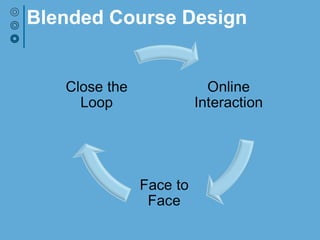
Blended Course Design
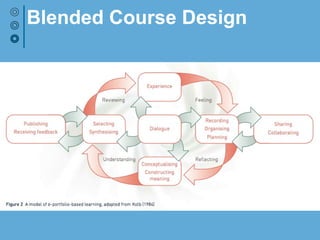
Source: Payal Mahajan - http://artoflearning.in/blog/2009/05/13/e-portfolios-a-celebration-of-an-vibrant-reflective-mind
Blended Course Design
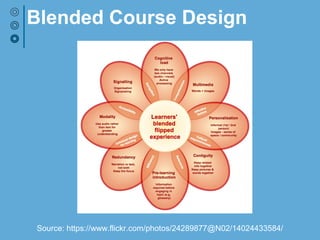
Source: Hazel Owen - https://www.flickr.com/photos/24289877@N02/14024433584
Break
Blended Learning Workshop
Suggested Process for Blending
Blended Learning Workshop
A suggested process for
blended course design
Classic work on “backward design”
• Understanding by Design, Wiggins & McTighe 2005
Advantages of backward design
• Practice-oriented instead of abstract theory
• Intuitive for most faculty
• Learning objectives linked to empirically verifiable
outcomes
• Focus on learning sequence helps structure
decisions regarding technology and the online/face-
to-face blend
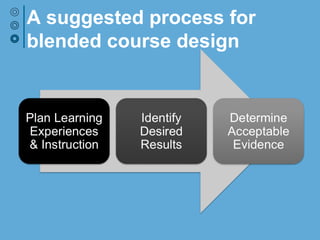
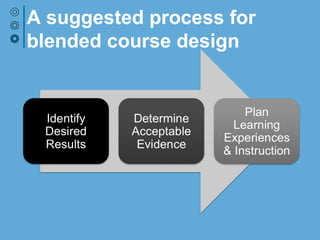
Traditional design approach
Backward Design approach
Backward design process
• Who are my students. What assets do they
bring to the table and what are their
challenges?
• What changes do I want to see in their skills,
behaviors, thinking, etc.? What do I want them
to be able to do by the end of the course?
• What evidence will document or demonstrate
these changes?
• What assignments will engage students in
producing this evidence or documentation?
We will revisit these questions often
Blended Assignment Design
Introduce the Planner
Use this to guide your thoughts and take notes
You will be given a clean copy in the afternoon to
author a plan for a blended learning sequence
(i.e. one “chunk” of your class or cycle of
online/blended learning)
Who are your students?
Demographics … life circumstances …
characteristics … assets … needs … challenges
Whole Group Brainstorm
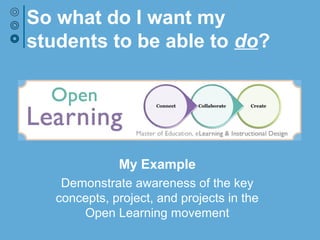
So what do I want my
students to be able to do?
My Example
Contextual Understanding: Demonstrate
awareness of the key concepts, projects, and
visionaries in the Open Learning movement
So what do I want my
students to be able to do?
What do you want your students to be able to do?
What evidence will I accept?
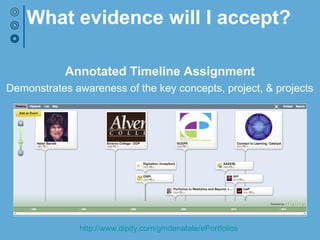
Annotated Timeline Assignment
Demonstrate awareness of key concepts, projects, & visionaries
http://www.dipity.com/gmdenatale/ePortfolios
Blended Assignment Design
Review write-up of blended learning assignment
What Constitutes Evidence?
Review “What Constitutes Evidence?” handout
Pick one unit in your course. Identify an
assignment to blend, or think of a new
assignment that you want to create.
What evidence will You
accept?
What evidence would document or demonstrate
the growth that you want to see in your
students?
What work will engage students in producing this
evidence or documentation?
What supports (content, skills, resources) will
they need to be equipped for this work?
Lunch
Blended Learning Workshop
Open Education Resources:
You Don’t Have to Do It All!
Blended Learning Workshop
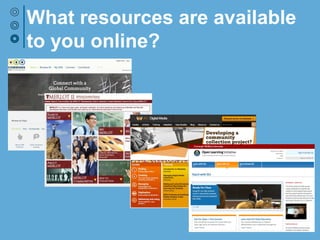
What resources are available
to you online?
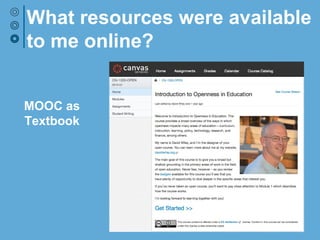
What resources were available
to me online?
MOOC as
Textbook
What people are available to
you online?
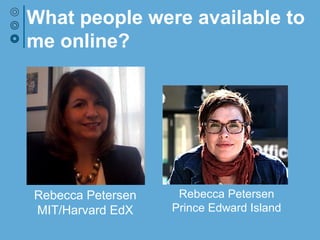
What people were available to
me online?
Rebecca Petersen
MIT/Harvard EdX
Bonnie Stewart
Prince Edward Island
What resources and people
are available to you online?
Exercise: Use iPads to search for resources
related to your assignment
•Who are leaders in the field? Could their keynote talks
serve as a weekly lecture?
•Are materials available through learned or professional
organizations?
•What about OER repositories such as CMU’s Open
Learning Initiative, Merlot, JISC, or OER Commons?
Share findings
What resources and people
are available to you online?
Planning
Blended Learning Workshop
Blended Assignment Design
Revisit the planner
Introduce the session template
Blended Assignment Design
Exercise:
• 30 minutes independent planning
• 20 minutes peer feedback
• 10 minutes group report
Orienting Your Students
Blended Learning Workshop
Blended Assignment Design
Review a sample blended syllabus
Final Questions & Feedback
Blended Learning Workshop

Blended Learning One Day Workshop

  • 1.
    Gail Matthews-DeNatale, Ph.D. GraduateSchool of Education Northeastern University Blended Learning Workshop
  • 2.
  • 3.
    What is BlendedLearning? • Blended = hybrid • Combines the availability/persistence of online with the immediacy of in-person interaction • Integration between modes is pre-planned and pedagogically sound • A portion of the face-to-face time is replaced online activity. Note: reduction in face-to-face time does not mean reduction in learning or reduced contact with peers/faculty – usually provides more time
  • 4.
    Advantages of Blended •Continuous presence of course/learning in the lives of students • Students learn how to become independent/active learners • Get to know your students better • More effective/efficient use of time • Rapid turn-around and feedback (peer-to-peer, faculty-to-student) • Affords a rich(er) variety of experience (independent inquiry, project/group work, peer feedback, multimedia case studies, discussion, etc.)
  • 5.
    Challenges of Blended •There is no set model – many decisions need to be made anew (what’s online?, what’s f2f?, how?) • Learning how to integrate (flow between ol & f2f) • Both you and your students need to learn how to “be in class” online and how to treat online work as “real” (not an add-on) • Time to plan, manage workload, stay organized • Online can’t “wing it” as you can f2f • Online, need to write things out that you’d normally say in class – need to be explicit
  • 6.
    Debrief on the10 Questions • What do you want students to know? • What would be better achieved online and what would be best achieved face-to-face? • What learning activities will take place online? • What role will online discussion play? • How will face-to-face and online integrate and support one another? • How will you handle scheduling and supporting students as online learners? • What % online and face-to-face? • What will be your strategies for assessment? • What technologies will you use, and how will students become oriented? • What steps will you take to avoid “course and a half” syndrome? Exercise adapted from UW-M, Blended Learning Faculty Development Initiative - https://www4.uwm.edu/ltc/blended_courses
  • 7.
    10 Questions Discussion •Discuss in pairs for 5 minutes: • Which questions do you think you can already “answer” or address for your course? • Which questions do you think you will need help addressing? • Which questions do you find most provocative? Most problematic? Most helpful? Why? • Discuss as a whole group for 15 minutes
  • 8.
  • 9.
    Blended Course Design Source:Payal Mahajan - http://artoflearning.in/blog/2009/05/13/e-portfolios-a-celebration-of-an-vibrant-reflective-mind
  • 10.
    Blended Course Design Source:Hazel Owen - https://www.flickr.com/photos/24289877@N02/14024433584
  • 11.
  • 12.
    Suggested Process forBlending Blended Learning Workshop
  • 13.
    A suggested processfor blended course design Classic work on “backward design” • Understanding by Design, Wiggins & McTighe 2005 Advantages of backward design • Practice-oriented instead of abstract theory • Intuitive for most faculty • Learning objectives linked to empirically verifiable outcomes • Focus on learning sequence helps structure decisions regarding technology and the online/face- to-face blend
  • 14.
  • 15.
  • 16.
    Backward design process •Who are my students. What assets do they bring to the table and what are their challenges? • What changes do I want to see in their skills, behaviors, thinking, etc.? What do I want them to be able to do by the end of the course? • What evidence will document or demonstrate these changes? • What assignments will engage students in producing this evidence or documentation? We will revisit these questions often
  • 17.
    Blended Assignment Design Introducethe Planner Use this to guide your thoughts and take notes You will be given a clean copy in the afternoon to author a plan for a blended learning sequence (i.e. one “chunk” of your class or cycle of online/blended learning)
  • 18.
    Who are yourstudents? Demographics … life circumstances … characteristics … assets … needs … challenges Whole Group Brainstorm
  • 19.
    So what doI want my students to be able to do? My Example Contextual Understanding: Demonstrate awareness of the key concepts, projects, and visionaries in the Open Learning movement
  • 20.
    So what doI want my students to be able to do? What do you want your students to be able to do?
  • 21.
    What evidence willI accept? Annotated Timeline Assignment Demonstrate awareness of key concepts, projects, & visionaries http://www.dipity.com/gmdenatale/ePortfolios
  • 22.
    Blended Assignment Design Reviewwrite-up of blended learning assignment
  • 23.
    What Constitutes Evidence? Review“What Constitutes Evidence?” handout Pick one unit in your course. Identify an assignment to blend, or think of a new assignment that you want to create.
  • 24.
    What evidence willYou accept? What evidence would document or demonstrate the growth that you want to see in your students? What work will engage students in producing this evidence or documentation? What supports (content, skills, resources) will they need to be equipped for this work?
  • 25.
  • 26.
    Open Education Resources: YouDon’t Have to Do It All! Blended Learning Workshop
  • 27.
    What resources areavailable to you online?
  • 28.
    What resources wereavailable to me online? MOOC as Textbook
  • 29.
    What people areavailable to you online?
  • 30.
    What people wereavailable to me online? Rebecca Petersen MIT/Harvard EdX Bonnie Stewart Prince Edward Island
  • 31.
    What resources andpeople are available to you online? Exercise: Use iPads to search for resources related to your assignment •Who are leaders in the field? Could their keynote talks serve as a weekly lecture? •Are materials available through learned or professional organizations? •What about OER repositories such as CMU’s Open Learning Initiative, Merlot, JISC, or OER Commons?
  • 32.
    Share findings What resourcesand people are available to you online?
  • 33.
  • 34.
    Blended Assignment Design Revisitthe planner Introduce the session template
  • 35.
    Blended Assignment Design Exercise: •30 minutes independent planning • 20 minutes peer feedback • 10 minutes group report
  • 36.
  • 37.
    Blended Assignment Design Reviewa sample blended syllabus
  • 38.
    Final Questions &Feedback Blended Learning Workshop

Editor's Notes

  • #4 Flexibility – can be “in class” at a time that suits their needs Availability – class is available from any location that has an Internet connection Persistence – There is a durable record of student participation because all work needs to be posted to the course – good for increasing student reflection and critical thinking.
  • #7 Turn to neighbor, discuss the two most pressing questions and your preliminary thoughts on addressing them (5 mins). Share back to the group (15 mins).
  • #8 Refer to questions on p 8
  • #9 In my opinion, the the integration between online and face-to-face learning is the most important to attaining successful blended learning. Think of it as a journey that takes you and your student through a sequence of learning environments. It’s sometimes called “closing the loop”
  • #10 Along the way, think also about the different modes of engagement that your students will experience, what’s the most constructive sequence for them to build their knowledge and abilities, and the optimal environment for each phase of learning.
  • #11 Consider also optimal use of media and types of formats so that your students are engaged, yet not overloaded.
  • #14 Perhaps some of you have already worked with backward design – ask for a show of hands: How many have heard about this approach to course planning? How many have used this approach to course planning? People with raised hands – good – your colleagues will benefit from your for advice and counsel.
  • #15 Perhaps some of you have already worked with backward design – ask for a show of hands: How many have heard about this approach to course planning? How many have used this approach to course planning? People with raised hands – good – your colleagues will benefit from your for advice and counsel.
  • #16 Perhaps some of you have already worked with backward design – ask for a show of hands: How many have heard about this approach to course planning? How many have used this approach to course planning? People with raised hands – good – your colleagues will benefit from your for advice and counsel.
  • #22 We start out talking about assignments and evidence – but as this develops, we will consider sequence (so-called “scaffolding”) and integration – how can the experiences be sequenced to create a journey of learning and professional development?