Telling Our Stories, CTDLC 2007
ePortfolios in Action:
An Evolving Learning Landscape
Gail Matthews-DeNatale, Ph.D.
Associate Director
Academic Technology, Simmons College
Presentation Overview
1. Preliminary Thoughts
2. Stories and Learning
3. ePortfolios in Action
4. Final Thoughts
Part I
Preliminary Thoughts
Preliminary Thought #1
Developing an
ePortfolio program
is not for the faint
of heart
Preliminary Thought #2
Our culture yearns
for truth tellers …
yet people who tell
the truth seem to
be in short supply
Jon Stewart
Glenn Kelman, Redfin
Mary Catherine Bateson
“It can be very difficult to
recognize the ways in
which one situation or
event in your life is linked
to others …Because our
society has preferred
continuous versions of stories, discontinuities
seem to indicate that something is wrong with
you. One strategy … is to make a story that
interprets change as continuity.”
Preliminary Thought #3
ePortfolios help
students get in
touch with their
inner truth-teller
Part II
Stories and Learning
What is “Story”?
Story is…
•Product
•Process
•Cycle
“Stories are the large and
small instruments of
meaning, of explanation,
that we store in our
memories.”
Joe Lambert / Roger Schank
Story as Product
“Those who do not have power
over the story that dominates their
lives, the power to retell it, rethink
it, deconstruct it, joke about it, and
change it as times change, truly
are powerless, because they
cannot think new thoughts.”
Salman Rushdie
Story as Process
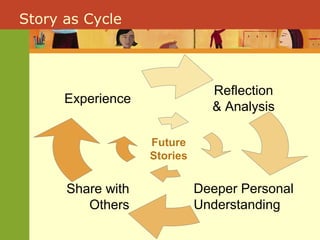
Story as Cycle
Reflection
& Analysis
Share with
Others
Experience
Deeper Personal
Understanding
Future
Stories
Challenging Questions for Educators
How can we help students increase
the amount of time they devote to
reflection and critical thinking?
How can we help students articulate
what they’re learning? … and what
they need to learn?
How can we help students
remember and care about learning?
Part III
ePortfolios in Action
Undergraduate Honors ePortfolio
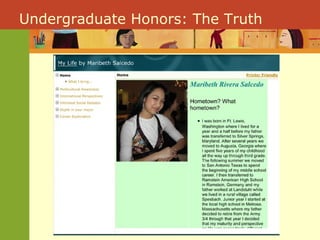
Undergraduate Honors: The Truth
eP Contents Perceived Value
Year 1
Year 2
Year 3
Year 4
Undergraduate Honors: The Truth
GSLIS ePortfolios
GSLIS ePortfolios: The Truth
School of Social Work ePortfolios
SSW ePortfolios: The Truth
Part IV
Final Thoughts
Final Thoughts
ePortfolios support students as
they learn to
1. Cherish the product
2. Enjoy (but don’t underestimate)
the process
3. Embrace the truth-telling cycle
We owe it to them to do the same!

ePortfolios in Action: An Evolving Learning Landscape

Editor's Notes

  • #2 Presentation Abstract: ePortfolios shape, and are shaped by, those who create them. A brief survey of the landscape reveals that ePortfolios can be used for a rich variety of learning scenarios: graduate and undergraduate, private and public, personal and professional, curricular and co-curricular, course-specific and lifelong. Real life vignettes bear witness to both the multifaceted potential of ePortfolios and to the challenges associated with educational innovation. Understanding the present context of ePortfolios in action also helps us imagine refinements and new directions for the future.
  • #3 Since the title of the conference is “Telling Our Stories,’ I think it makes sense to devote some attention to the relationship between stories and learning.
  • #4 GAIL
  • #5 I want this keynote to be energizing, but I’m not going to lie to you! We’re experimenting with an idea that is profound, but still in the early stages of development. We don’t have it all sewn up. ePortfolios challenge us to rethink almost all our systems for curriculum development, advising, assessment, etc. If you’re feeling like this is difficult, if you’re feeling perplexed and even vulnerable, then you’re probably on the right track! Reminds me of the story about the person who went to see her doctor about three weeks after major surgery. She said doctor, it hurts here, itches like crazy there, and aches here. The doctor listened intently, then said, “that’s good, that’s just how you’re supposed to feel at this stage in your recovery.”
  • #6 We live in a culture of spin … we don’t have many truth tellers. The irony is that we yearn for truth-telling but often we don’t know how to achieve this goal. Perhaps even we, ourselves, feel like we’ve forgotten how to tell the truth. Who’s telling the truth, and what can we learn about truth-telling from them? I’m going to be a bit provocative and hold up three unlikely candidates.
  • #7 Jon Stewart. Did you know that more young people get their news from Jon Stewart’s program, “The Daily Show,” than from the nightly news? Through humor he somehow is able to point out the things that don’t make sense, things that are flawed and wind up getting closer to the truth than the anchors of ABC, CBS, NBC put together. Youth gravitate toward Stewart because when the Emperor has no clothes, he says so! Aside: Katie Couric is a close family friend. Much has been written about her ranking in comparison with the other networks. Yet in conversation with her, SHE says that one of the people she envies most is Jon Stewart. Why? Because he stood the genre of evening news on its head and, ins so doing, invented a new form for news acquisition. He has invented a “news” genre that is refreshing, innovative, and that truly engages the attention – and the minds – of his viewers.
  • #8 Glenn Kelman, Redfin April issue of Wired Article titled “Get Naked” caught my attention. Glenn Kelman, CEO of Online Brokerage Firm Redfin, turning the real estate world upside down, but blacklisted by other brokers. Decided to “openly discuss his personal opinions about the way his business should be run … talked about the kinds of internal struggles most companies try to keep quiet … dared to share stories that might not cast his company/self in the best light. A remarkable thing happened: his business grew. It turns out that customers liked this new open model.” And others in RE, people afraid to agree openly, joined him. This is called radical transparency – the idea is that you can’t grow if you can’t admit and own gaps and non-sequiturs in Society at large Your work Your life
  • #9 [ALLOW PAUSE FOR READING] Quote is from MC Bateson’s “Composing a Life.” her father was Gregory Bateson, her mother was Margaret Mead. MCB he discusses the “checkered” career of Gregory Bateson “First he was a biologist. Then he got interested in anthropology and went to New Guinea. He made a couple of field trips that he never wrote up. Then to Bali. During the war he wrote an analysis of propaganda films and worked in psychological warfare. Then he did a study of communication in psychotherapy. Then he worked on alcoholism and schizophrenia, and then on dolphins and octopuses.“ He also analyzed the rel. betw. play & learning At times GB felt like a failure – only when he compiled his essays into the classic publication “Steps toward an ecology of the mind” did he realize how the pieces of his life’s learning fit together. Like Rushdie, he thought new thoughts and did not follow convention. As you help your students learn how to tell the truths about themselves, how to own the disconnected pieces of their lives, they will bloom and also think new thoughts – they will own (and celebrate) not only their accomplishments, but also the areas in which they intend to grow.
  • #10 ePortfolios are essentially a vehicle for radical transparency, for truth-telling Like JS, ePs stand the concept of assessment on its head, creating a new genre Like GK/Redfin, ePs structure a process of truth seeking and truth telling (provide evidence for assertions about learning Like MCB, ePs embrace discontinuity, helping the learner seek connections across courses and life experiences. How? Assertions about progress toward goals need to be backed up with evidence Rubrics help students understand what is expected (it’s not cheating to share your goals with your students) Through self-assessment and dialogue with eP advisors, students learn how to be honest with themselves about areas in which they need to grow Almost all of us, when we see the gap between where we are and where we need to go, we feel failure. We need to be like the doctor, who sees that pain for the GROWING PAIN that it is, then says “good, now we’re getting somewhere.”
  • #11 GAIL
  • #12 It may mot be obvious, but what we’ve been talking about is STORYTELLING. The word “story” is sometimes bandied about – perhaps it’s even over-used. I’d like to dig a bit deeper into what I mean by “story.” Some people think of “story” as being antithetical to “truth,” but that’s not the case at all. As with the comic Jon Stewart, sometimes you can get closer to the truth with a story or parody than you can by any other means. Stewart, Kelman, and Bateson are storytellers. But they are a particular kind of storyteller – truth-tellers. (CLICK) I like to think that there are three ways that stories help us learn– each provides a different understanding of what we mean by “story” – Story as product, as process, and as cycle.
  • #13 [PAUSE TO LET THEM READ] Stories can be used as objects that promote or encapsulate learning. For example, many stories types are closely aligned with learning and teaching: Fable (a short tale to teach a moral lesson) Parable (a short allegorical story designed to illustrate or teach some truth) Exemplum (anecdote, often from a real life experience, that illustrates or supports a point) As a product, stories are not only instruments of meaning, they also provide us with a rearview mirror, helping us address the challenge of making learning “memorable and manageable” and allowing us to avoid past mistakes the “next time.”
  • #14 [PAUSE TO LET THEM READ] As process, story is a journey. It may involve rethinking and challenging the truisms and unspoken messages that were part of our childhood enculturation. What aspects of my upbringing, my family lore, do I want to carry with me into adulthood? What stories do I want to revise for myself and for future generations? It may involve making meaning out of our experiences in the present. Out of all that we experience in a given day, What’s worth mulling over and storing for future use? What can be forgotten without consequence? This speaks to the challenge of increasing student’s reflection and critical thinking, but also their willingness to make fundamental sea changes in life direction when they realize that that is what the story warrants.
  • #15 Story cycle is fundamental to eP process (collect, select, reflect, share) Primary Exp. (Research, Service Learning, Study Abroad, etc.) Reflection/Analysis (Sifting through “evidence” --aspects of the experience-- to make connections, look for patterns, question prior assumptions, change your mind in light of evidence) Deeper Personal Understanding (Informs movement going forward) Contribute to Learning Community (Don’t just keep it to self”) (CLICK) EXPERIENCE INCREASES ATTENTIVENESS MOVING FORWARD Henry James once said that “Stories Happen to People who Know how to tell them.” Likewise, learning and meaning-making happens to people who know how to express what they’ve learned. This process shapes the story-maker’s world view – they start seeing stories (and opportunities for learning) in the world around them. This speaks to the role that ongoing, formative assessment plays in learning. Story as cycle helps us identify next steps -- to create a positive spiral -- not just increased knowledge, but continuously improving ability to learn I just want to take a moment and note the profound difference between this type of assessment (for learning) and the world of high stakes summative assessment in which K-12 students live. It’s difficult for ANYBODY to do, let alone a child whose primary learning experience has been test-driven (teach to test) Let us not underestimate the challenge of changing, fundamentally, how we thing about assessment.
  • #16 We have a LOT of VERY IMPORTANT work to do, and many unanswered questions before us. Engagement, time on task, refuting and/or refining ideas Metacognition – understanding how they learn, “owning” their learning, learning how to learn, formative assessment or assessment for learning Making learning both memorable and manageable What follows is three vignettes about ePortfolios in Action at Simmons You can also see the posters about the projects at the front of the hallway. We use these posters as a strategy for “telling the story” of ePortfolios at Simmons. Be forewarned, that I’m going to pull a Redfin and tell the truth about our experiences – because I believe that it will open the doors for more constructive dialogue AND because I don’t think that we can expect our students to tell the truth about their learning if we are unwilling to tell the truth about the bumps associated with our ePortfolio learning curve.
  • #17 Whether we’re talking about story as product, process, or cycle, ePortfolios help students Gain new perspective on the story of their learning (the overarching narrative) -- what’s it adding up to? Look for (and address) gaps in the story Share their story (versions of their story) with others
  • #18 Program Director Mary Jane Treacy Concerned that students came to program with a linear view of their future (e.g., become a nurse), and the did not question that path throughout their years at Simmons. Also wanted to create a mechanism by which program’s “Core Commitments” come into focus for students Multicultural awareness International perspective Informed citizenship Disciplinary depth Career exploration Integrate academic learning with co-curricular activities and work experiences Engage interest and encourage responsibility for own learning. Begins as a vehicle for formative assessment, develops into a showcase mechanism over the course of four years
  • #19 Issue – The inverted pyramid of value – How to get students to collect work before the value of collecting becomes evident? (CLICK, CLICK, CLICK) We are experimenting with strategies for scaffolding this – credited component for honors program, at Stanford, they use “idealogs” to involve students in collecting before the value becomes fully apparent.
  • #20 Issue – Faculty Understanding and Engagement – CAS faculty are ambivalent about the “extra work” – know how to “teach,” but don’t really know what to do with the student’s ePortfolios – how to interact with students on their evolving learning journey. This is why we do things like the posters you see today, faculty lunches, guest consultations, etc. Program has one strong champion, but success depends on buy-in from many faculty. Faculty need help understanding the nature of this new genre. What does it mean if the student owns the work, if it’s different from a discrete graded item for assessment? For example, how is reviewing/responding to an eP different from responding to an online discussion post? This kind of writing is a new genre in itself for faculty. Faculty professional development is a long term commitment.
  • #21 Goals: Encourage student reflection and self-assessment Concentrate attention on clearly defined learning outcomes Focus faculty attention on program outcomes when developing assignments and assessing student work Provides a mechanism for 360 assessment: first year focuses on self- and faculty assessment, in second year, employers also use the rubric and eP evidence to assess program participant work.
  • #22 No matter how sophisticated the software, “one size fits all” usually doesn’t. Quote from a Design Blog called “37 Signals” for software developers: Stu is your customer. The problem is there are two Stus. There’s Stu 1: Stu before he uses your product. And then there’s Stu 2: Stu after he uses your product. Stu 1 and 2 want different things. Stu 1 cares about features and capabilities. Stu 2 cares about ease of use. The problem is Stu 1 makes the initial purchase decision. Stu 2 has to live with the consequences. This was part of a 1.5 Million dollar grant – research/accountability component was very specific and complex. GSLIS had to create their own tool for addressing their complex assessment and reporting needs. Even if our tool could have been jury-rigged to meet their needs, because this was grant funded, they would have wanted to build their own add-on. In addition, they wanted social networking and group-work capabilities that aren’t integrated into the tool. This is understandable – eportfolios now exist in a Web 2.0 context – people inevitably compare the software with blogs, wikis, etc. – not realizing that, to a large extent, 2.0 products are easier to use because they have fewer features – they’re for Stu #2!
  • #23 Goals: Through the eP’s design, embed assessment and evaluation in both the program and in the students’ learning experience Enable students to Assess their strongest work and reflect on their learning Integrate learning across both the classroom and experiences in the field Share work during job searches SW doesn’t usually involve high-tech – so they were intrigued with the possibilities for enhancing the use of cutting-edge technology in their program because they thought it might be a differentiator.
  • #24 The process of developing rubrics has helped faculty clarify their expectations for student learning. What are the competencies of a professional? What does a “novice” look like? What does a “professional” look like? What are the phases of development inbetween? It also opened up a conversation among faculty as to what ARE the competencies of a professional!
  • #25 We realized that the eP template needed to scaffold students’ understanding of this rubric and understanding of how to use it in relationship to their own learning. In addition, we’re rethinking how we orient students to the eP. We began by introducing them to the software, then with a follow-up reflective exercise. Next time we plan to introduce the exercise, then have them bring that to the orientation session with them so that the learning process is more meaningful. Focus first on orienting to “folio thinking,” then on software usage. Finally, we realize that some students take to this like a duck to water, whereas others have difficulty finding the motivation. We’re doing focus groups with those who have made active use of their ePs, as well as with those who haven’t. The intent is to compare responses and see how their perspectives differ. We believe that we can use the active group’s responses to reframe ePs for the inactive group. Our suspicion (thesis) is that students who embrace ePs have a very different mental model for what they’re doing than those who don’t. This becomes a teachable moment for the unmotivated – reframing how they think about what they’re doing.
  • #27 We to remember that this chapter of the narrative we are composing about e-portfolios entails significant discontinuities from the past, from “business as usual.” We are not just trying to transform education and learning, we are also trying to transform the teacher (what it means to educate others) and the learner (how they perceive their role, the scope of what they’re undertaking, etc.) Also, if we want students to invest in their stories, we need to invest in their stories. We need to talk with them and gain deeper insight into what makes students want to invest in (and retain) evidence of their own learning. (CLICK) We need to be willing to make a sea change in our course of work with ePortfolios in light of evidence – in light of what we learn from our students and from the faculty with whom we work. As we consider next steps in our work with ePortfolios, we need to be open to the opportunities that are associated with the challenges we encounter along the way. We need to remember that the story of “ePortfolios in Education” is also an evolving work-in-progress, and that discontinuity is not bad -- it is a sign that we are paying attention – and, in the words of the good doctor, right where we’re supposed to be!