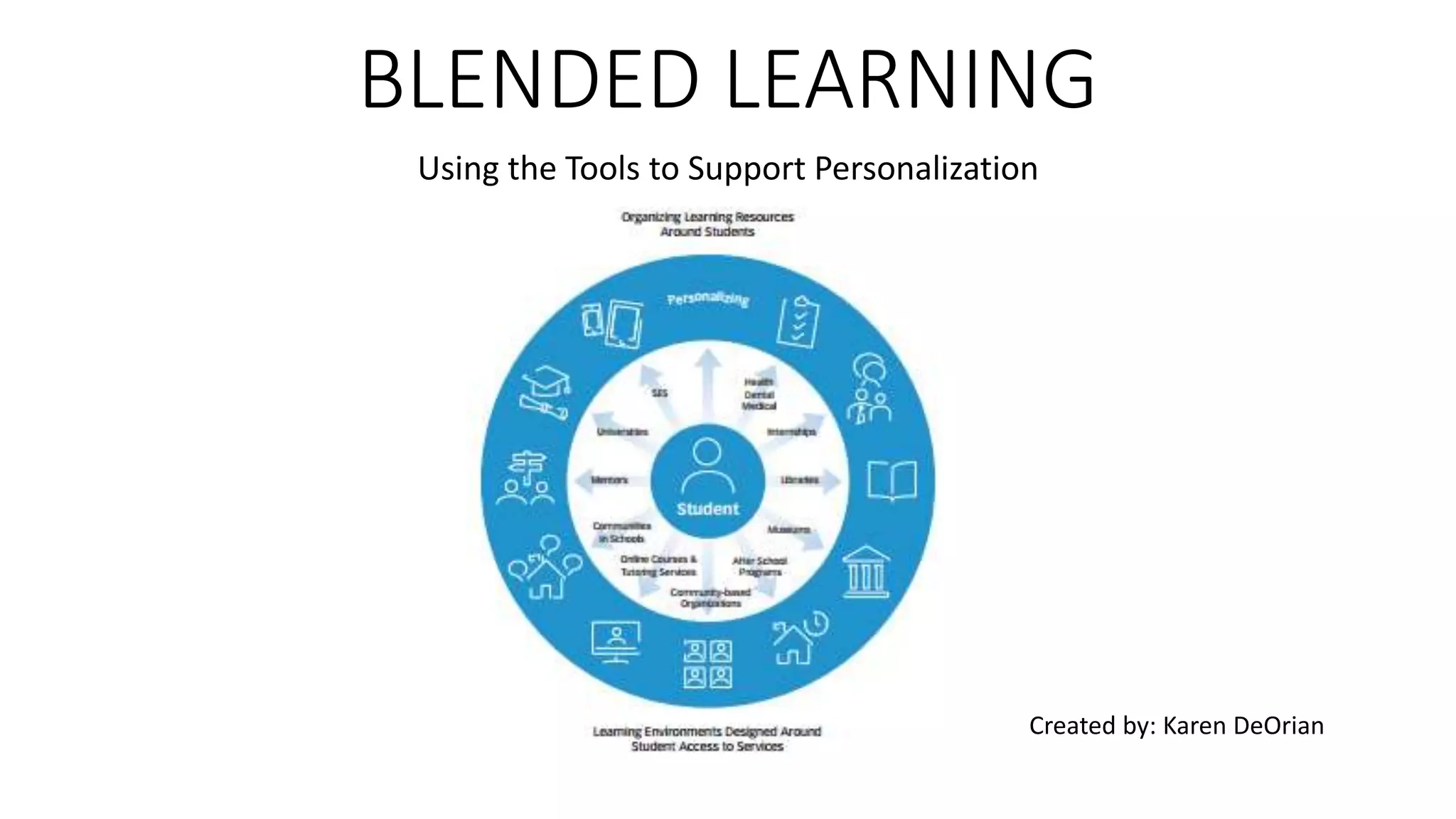
BLENDED LEARNING
Using the Tools to Support Personalization
Created by: Karen DeOrian
GPS to Success
• blended and online learning environments can be a vehicle for
personalized learning through use of a customized dashboard display
showing real-time information and offering tools to support
optimized pathways along a personalized learning journey toward
graduation and student success.
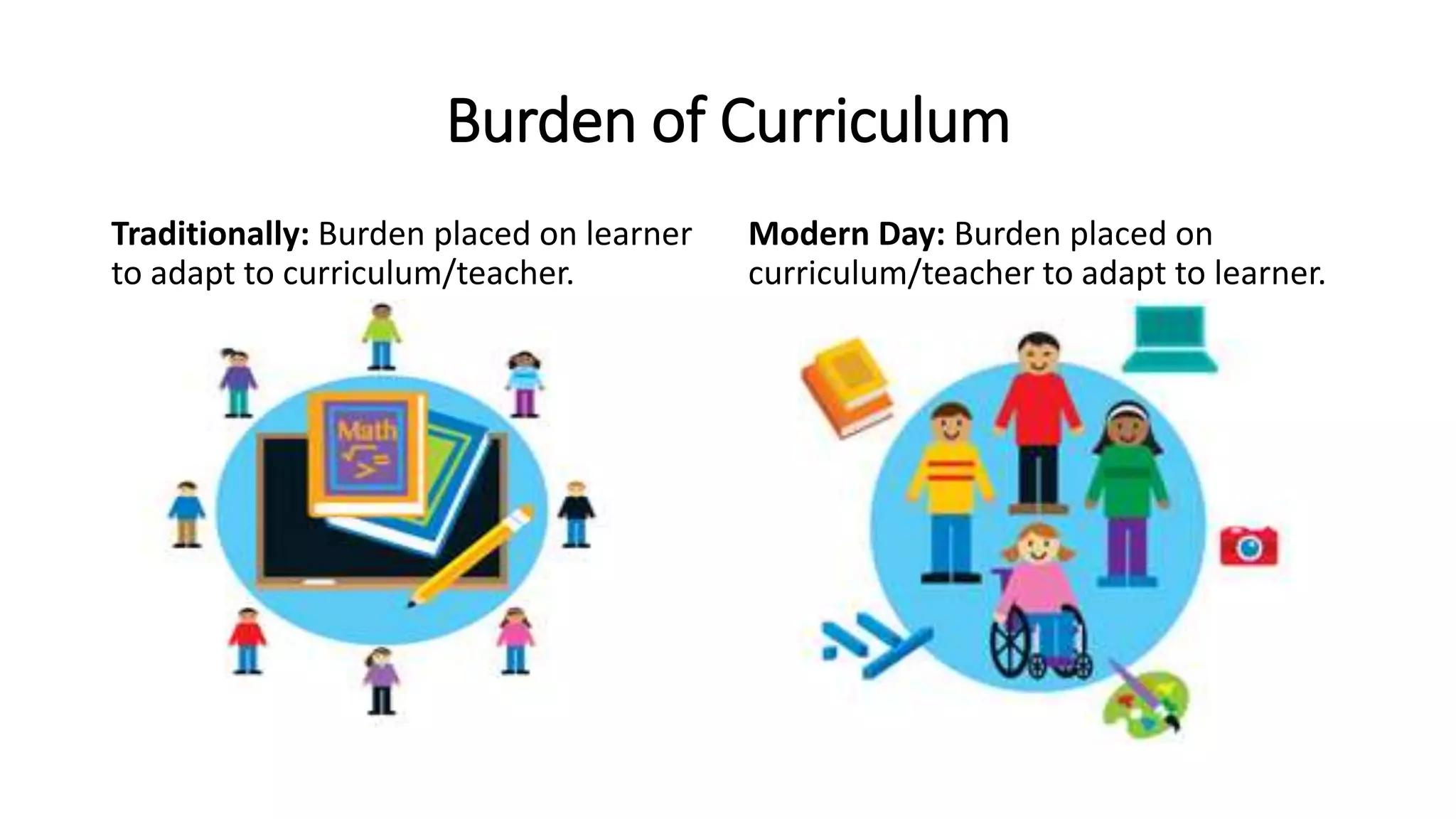
Burden of Curriculum
Traditionally: Burden placed on learner
to adapt to curriculum/teacher.
Modern Day: Burden placed on
curriculum/teacher to adapt to learner.
Jobs for the Future report on Students at the
Center (2012)
The definition of student-centered learning has four distinct elements
for student-centered approaches to learning that explicitly challenge
the current schooling and education paradigm:
• Embracing the adolescent’s experience and learning theory as the
starting point of education;
• Harnessing the full range of learning experiences at all times of the
day, week, and year; •
Expanding and reshaping the role of the educator; and
• Determining progression based upon mastery.
Blended Learning Models
Rotation Model
• Students rotate on a fixed schedule or at the teacher’s discretion
between learning modalities, at least one of which is online learning.
• Other modalities might include activities such as small-group or full-class
instruction, group projects, individual tutoring, and pencil-and paper
assignments.
• The Rotation model has four sub-models:
• Station Rotation
• Lab Rotation
• Flipped Classroom
• Individual Rotation.
Instructional Model
Fundamental Redesign
• Blended learning should be viewed as a pedagogical approach that combines the
effectiveness and socialization opportunities of the classroom with the
technologically enhanced active learning possibilities of the online environment,
rather than a ratio of delivery modalities. In other words, blended learning should
be approached not merely as a temporal construct, but rather as a fundamental
redesign of the instructional model with the following characteristics:
• Shift from lecture- to student-centered instruction in which students become
active and interactive learners (this shift should apply to the entire course,
including face-to-face contact sessions);
• Increases in interaction between student-instructor, student-student, student-
content, and student outside resources
• Integrated formative and summative assessment mechanisms for students and
instructor
Top Ten Essential Components Of Personalization
1. Student agency (student has voice and choice on level of standards/lesson and some
control over how they learn)
2. Differentiated instruction
3. Immediate instructional interventions and supports for each student is on-demand,
when needed
4. Flexible pacing
5. Individual student profiles (personalized learning plan)
6. Deeper learning and problem solving to develop meaning
7. Frequent feedback from instructors and peers
8. Standards-based, world-class knowledge and skills
9. Anywhere, anytime learning can occur
10. Performance-based assessments, such as project-based learning and portfolios of
student work.
Student Centered
• Learning environments respond to each student’s needs and interests,
making use of new tools for doing so. Critical and distinct elements of
student-centered approaches to learning challenge the current schooling
and education paradigm. From Students at the Center.
• Embracing the adolescent’s experience and learning theory as the starting
point of education
• Harnessing the full range of learning experiences at all times of the day,
week, and year
• Expanding and reshaping the role of the educator
• Determining progression based upon mastery
Equitable and Accessible for All Students
• Provides access to courses, experiences, and teachers they would
otherwise not have
• Meets the individual learning needs of each student, including students
with disabilities
• Results in equally or more rigorous learning opportunities for students
• Provides multiple methods of instruction (context, content, and
instructional methodology) to ensure that students from different cultures
and life experiences have the opportunity to succeed
• Digital content is designed using the principles of Universal Design for
Learning (UDL) so that the content is accessible to all students
Result in Higher Student Achievement
• Use competency-based models to ensure student mastery
• Use data to drive instruction through the analysis of frequent and
varying forms of assessment
• Use valid and reliable assessments in ways that are meaningful to
students
• Assess students on their performance in multiple ways and multiple
times to ensure they have reached proficiency (may include adaptive
assessments, formative assessments, imbedded assessments,
performance-based assessments and summative assessments).
Technology-Enhanced
• Provide opportunities for students to collaborate with teachers and
peers, unlimited by proximity
• Students engage with digital content, which can occur anytime,
anyplace, and have multiple pathways that are competency-based
and not tied to a fixed school calendar
• Integrate student information and learning management systems
designed around competency-based approaches, providing data to
support students, teachers, and schools for improving performance
Affordable and Sustainable
• Approaches add productivity and value to ensure cost-effectiveness. It is
important to monitor the relationship between results and services and
spending in order to be effective
• Integrate blended and online learning into essential K-12 education funding
process
• Allow funding to follow students down to the course level
• Performance-based funding may tie (at least part of) K-12 funding to
student growth, rather than “seat time”
• Use public and private partnerships to achieve efficiencies and avoid “re-
inventing the wheel”
• New learning models are sustainable on recurring public revenue after four
years of launching and implementation.
Vmath Lesson – Rotation Model
• Students will be divided into homogeneous groups of 4-6, and rotate
through 4 stations during one periods.
• After administering the Placement Test from the publisher, students
fell into three levels, and will be grouped accordingly. T
• here is plenty of curriculum for both the students and teachers to
plan for the different levels.
• Laptops are available in the classroom for the online learning.
Rotation Model Visual
Teacher Station
• Direct instruction with gradual release on skill acquisition for a
homogeneous group.
• Using Vmath curriculum at ability level
Small Group
• Small groups are released to practice, discuss and complete a
previously learned skill at the functional level of the group
• Activities could be
• Comparing measurement
• Solving problems
• Creating projects/diagrams/presentation
• Gizmos Concept Practice (online)
Paraprofessional Group
• Paraprofessional will provide additional practice, support or extension
activities using the Vmath Reteach Curriculum as directed by the
teacher.
5-7 Students working online: Vmath Live;
individual CCSS standards/goals at own level
Online Activities in Game Format
Games played against online players with
dashboard results
Student and Teacher monitor online progress
Blended Learning Project

Blended Learning Project

  • 1.
    BLENDED LEARNING Using theTools to Support Personalization Created by: Karen DeOrian
  • 2.
    GPS to Success •blended and online learning environments can be a vehicle for personalized learning through use of a customized dashboard display showing real-time information and offering tools to support optimized pathways along a personalized learning journey toward graduation and student success.
  • 3.
    Burden of Curriculum Traditionally:Burden placed on learner to adapt to curriculum/teacher. Modern Day: Burden placed on curriculum/teacher to adapt to learner.
  • 4.
    Jobs for theFuture report on Students at the Center (2012) The definition of student-centered learning has four distinct elements for student-centered approaches to learning that explicitly challenge the current schooling and education paradigm: • Embracing the adolescent’s experience and learning theory as the starting point of education; • Harnessing the full range of learning experiences at all times of the day, week, and year; • Expanding and reshaping the role of the educator; and • Determining progression based upon mastery.
  • 5.
  • 6.
    Rotation Model • Studentsrotate on a fixed schedule or at the teacher’s discretion between learning modalities, at least one of which is online learning. • Other modalities might include activities such as small-group or full-class instruction, group projects, individual tutoring, and pencil-and paper assignments. • The Rotation model has four sub-models: • Station Rotation • Lab Rotation • Flipped Classroom • Individual Rotation.
  • 7.
    Instructional Model Fundamental Redesign •Blended learning should be viewed as a pedagogical approach that combines the effectiveness and socialization opportunities of the classroom with the technologically enhanced active learning possibilities of the online environment, rather than a ratio of delivery modalities. In other words, blended learning should be approached not merely as a temporal construct, but rather as a fundamental redesign of the instructional model with the following characteristics: • Shift from lecture- to student-centered instruction in which students become active and interactive learners (this shift should apply to the entire course, including face-to-face contact sessions); • Increases in interaction between student-instructor, student-student, student- content, and student outside resources • Integrated formative and summative assessment mechanisms for students and instructor
  • 8.
    Top Ten EssentialComponents Of Personalization 1. Student agency (student has voice and choice on level of standards/lesson and some control over how they learn) 2. Differentiated instruction 3. Immediate instructional interventions and supports for each student is on-demand, when needed 4. Flexible pacing 5. Individual student profiles (personalized learning plan) 6. Deeper learning and problem solving to develop meaning 7. Frequent feedback from instructors and peers 8. Standards-based, world-class knowledge and skills 9. Anywhere, anytime learning can occur 10. Performance-based assessments, such as project-based learning and portfolios of student work.
  • 9.
    Student Centered • Learningenvironments respond to each student’s needs and interests, making use of new tools for doing so. Critical and distinct elements of student-centered approaches to learning challenge the current schooling and education paradigm. From Students at the Center. • Embracing the adolescent’s experience and learning theory as the starting point of education • Harnessing the full range of learning experiences at all times of the day, week, and year • Expanding and reshaping the role of the educator • Determining progression based upon mastery
  • 10.
    Equitable and Accessiblefor All Students • Provides access to courses, experiences, and teachers they would otherwise not have • Meets the individual learning needs of each student, including students with disabilities • Results in equally or more rigorous learning opportunities for students • Provides multiple methods of instruction (context, content, and instructional methodology) to ensure that students from different cultures and life experiences have the opportunity to succeed • Digital content is designed using the principles of Universal Design for Learning (UDL) so that the content is accessible to all students
  • 11.
    Result in HigherStudent Achievement • Use competency-based models to ensure student mastery • Use data to drive instruction through the analysis of frequent and varying forms of assessment • Use valid and reliable assessments in ways that are meaningful to students • Assess students on their performance in multiple ways and multiple times to ensure they have reached proficiency (may include adaptive assessments, formative assessments, imbedded assessments, performance-based assessments and summative assessments).
  • 12.
    Technology-Enhanced • Provide opportunitiesfor students to collaborate with teachers and peers, unlimited by proximity • Students engage with digital content, which can occur anytime, anyplace, and have multiple pathways that are competency-based and not tied to a fixed school calendar • Integrate student information and learning management systems designed around competency-based approaches, providing data to support students, teachers, and schools for improving performance
  • 13.
    Affordable and Sustainable •Approaches add productivity and value to ensure cost-effectiveness. It is important to monitor the relationship between results and services and spending in order to be effective • Integrate blended and online learning into essential K-12 education funding process • Allow funding to follow students down to the course level • Performance-based funding may tie (at least part of) K-12 funding to student growth, rather than “seat time” • Use public and private partnerships to achieve efficiencies and avoid “re- inventing the wheel” • New learning models are sustainable on recurring public revenue after four years of launching and implementation.
  • 14.
    Vmath Lesson –Rotation Model • Students will be divided into homogeneous groups of 4-6, and rotate through 4 stations during one periods. • After administering the Placement Test from the publisher, students fell into three levels, and will be grouped accordingly. T • here is plenty of curriculum for both the students and teachers to plan for the different levels. • Laptops are available in the classroom for the online learning.
  • 15.
  • 16.
    Teacher Station • Directinstruction with gradual release on skill acquisition for a homogeneous group. • Using Vmath curriculum at ability level
  • 17.
    Small Group • Smallgroups are released to practice, discuss and complete a previously learned skill at the functional level of the group • Activities could be • Comparing measurement • Solving problems • Creating projects/diagrams/presentation • Gizmos Concept Practice (online)
  • 18.
    Paraprofessional Group • Paraprofessionalwill provide additional practice, support or extension activities using the Vmath Reteach Curriculum as directed by the teacher.
  • 19.
    5-7 Students workingonline: Vmath Live; individual CCSS standards/goals at own level
  • 20.
  • 21.
    Games played againstonline players with dashboard results
  • 22.
    Student and Teachermonitor online progress