Understanding the Past & Present
While Weaving the Future
ePortfolios as a Space for Professional
Discernment and Growth
Gail Matthews-DeNatale, Ph.D.
Lecturer, Graduate School of Education
Associate Director, Center for Advancing Teaching and
Learning Through Research
Northeastern University
overview
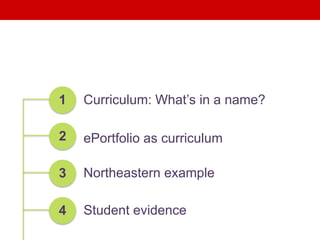
1 Curriculum: What’s in a name?
2
3
4
ePortfolio as curriculum
Northeastern example
Student evidence
1 Curriculum: What’s in a name?
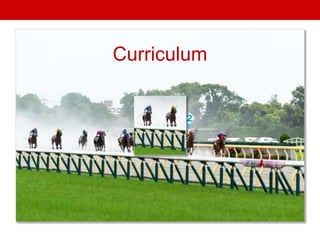
Curriculum
Currere
This autobiographical method [for
curriculum] asks us to remember,
even enter, the past and
meditatively imagine the future ...
in order to understand more fully,
with more complexity and subtlety ...
the present
This autobiographical method [for
curriculum] asks us to remember,
even enter, the past and
meditatively imagine the future ...
in order to understand more fully,
with more complexity and subtlety ...
the present.
(William Pinar, 2004)
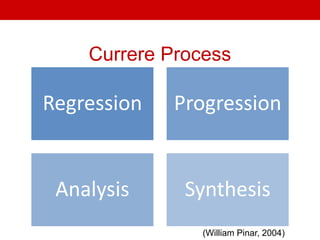
Currere Process
(William Pinar, 2004)
Regression Progression
Analysis Synthesis
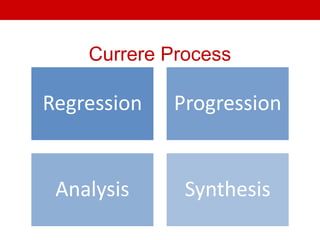
Currere Process
(William Pinar, 2004)
Regression
Return to past,
capture it,
hover over it
Progression
Look forward to what
is not yet the case,
not yet present
Analysis
Consider how the
future is in the past,
and past in the future
Synthesis
Listen to inner voice
for the meaning of
the present
1 Curriculum: What’s in a name?
2 ePortfolio as curriculum
Portfolio Moves
Currere Process
Remember Envision
Analyze Synthesize
Regression Progression
Analysis Synthesis
Syllabi, etc. Reflections
Feedback
Artifacts
ePortfolio as
Curriculum
Remember
How can I record
my work and
thinking to revisit
the past as data in
the future?
Envision
What do I imagine
and desire that is
not yet present?
What are the
possibilities?
Synthesize
Given what I have
experienced, who
am I now? How am
I, and my thinking,
transformed?
Analyze
What relationships
do I perceive
between the past,
present, and
future?
Past Future
Present
1 Curriculum: What’s in a name?
2 ePortfolio as curriculum
3 Northeastern example
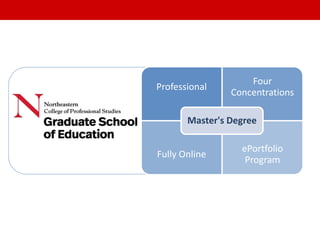
Professional
Four
Concentrations
Fully Online
ePortfolio
Program
Master's Degree
Gateway
Course
Education as an
Advanced Field
of Study
Concentration
Core
e.g. How People
Learn
Elective
Courses
e.g. Social Media
Learning Portfolio
Signature
Assignment(s)
Education
Narrative
Signature
Assignment(s)
Case
Study
Signature
Assignment(s)
Media
Critique
Capstone
Learning Portfolio
Work/Life Experiences
Professional Portfolio
1 Curriculum: What’s in a name?
2 ePortfolio as curriculum
3 Northeastern example
4 Student evidence
• Week 1 – Annotated Curriculum
• Week 2 – Self-Assessment
• Week 12 – Final Reflection
Evidence Considered
Wk1 Annotated Curriculum
WL: At the beginning I felt a bit overwhelmed. I
didn’t know what [terms] meant and how they
related to the work I was doing … that bothered me
at the time.
[Now] I use research to direct my thinking and
deepen my understanding …
I would not have come to that realization
without the starting at the beginning and feeling
overwhelmed at first.
Past
Present
Present
Past
Wk2 Self-Assessment
LW: As an undergraduate, I just presented data
that existed.
[Now I ] acknowledge my own perspective and
how it directs my work … [I can] connect ideas on
the spot …
I note a change in my mindset from simply
understanding that issues exist in higher education
to engaging in work meant to change and
improve higher education.
Past
Present
Present
Future
Wk12. Final Reflection
JN: Returning to the end at the
beginning, my philosophy statement
reflects what I have learned about
those views I held so long ago in
my educational narrative.
I still believe in equality of opportunity
in education. I still believe in
supporting students as individuals to
find their respective paths in their
lives through education. What has
changed is my ability to help
others achieve these goals.
Final Thoughts
The value of ePortfolio as currere is that it
creates a space for students to hold past,
present, and future in dialogue.
If we intentionally elicit this form of
engagement, they will increase their sense
of agency in relation to “curriculum,” their
development, and their path forward.
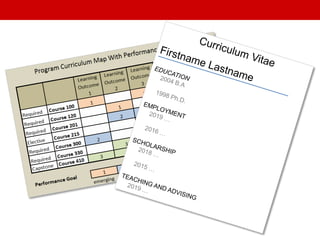
https://champlain.instructure.com/courses/200147/pages/curriculum-mapping
https://www.flickr.com/photos/aciel_akra/28335879908
images

ePortfolio as Curriculum

  • 1.
    Understanding the Past& Present While Weaving the Future ePortfolios as a Space for Professional Discernment and Growth Gail Matthews-DeNatale, Ph.D. Lecturer, Graduate School of Education Associate Director, Center for Advancing Teaching and Learning Through Research Northeastern University
  • 2.
    overview 1 Curriculum: What’sin a name? 2 3 4 ePortfolio as curriculum Northeastern example Student evidence
  • 3.
  • 5.
  • 6.
    Currere This autobiographical method[for curriculum] asks us to remember, even enter, the past and meditatively imagine the future ... in order to understand more fully, with more complexity and subtlety ... the present This autobiographical method [for curriculum] asks us to remember, even enter, the past and meditatively imagine the future ... in order to understand more fully, with more complexity and subtlety ... the present. (William Pinar, 2004)
  • 7.
    Currere Process (William Pinar,2004) Regression Progression Analysis Synthesis
  • 8.
    Currere Process (William Pinar,2004) Regression Return to past, capture it, hover over it Progression Look forward to what is not yet the case, not yet present Analysis Consider how the future is in the past, and past in the future Synthesis Listen to inner voice for the meaning of the present
  • 9.
    1 Curriculum: What’sin a name? 2 ePortfolio as curriculum
  • 10.
    Portfolio Moves Currere Process RememberEnvision Analyze Synthesize Regression Progression Analysis Synthesis
  • 11.
    Syllabi, etc. Reflections Feedback Artifacts ePortfolioas Curriculum Remember How can I record my work and thinking to revisit the past as data in the future? Envision What do I imagine and desire that is not yet present? What are the possibilities? Synthesize Given what I have experienced, who am I now? How am I, and my thinking, transformed? Analyze What relationships do I perceive between the past, present, and future? Past Future Present
  • 12.
    1 Curriculum: What’sin a name? 2 ePortfolio as curriculum 3 Northeastern example
  • 13.
  • 14.
    Gateway Course Education as an AdvancedField of Study Concentration Core e.g. How People Learn Elective Courses e.g. Social Media Learning Portfolio Signature Assignment(s) Education Narrative Signature Assignment(s) Case Study Signature Assignment(s) Media Critique Capstone Learning Portfolio Work/Life Experiences Professional Portfolio
  • 15.
    1 Curriculum: What’sin a name? 2 ePortfolio as curriculum 3 Northeastern example 4 Student evidence
  • 16.
    • Week 1– Annotated Curriculum • Week 2 – Self-Assessment • Week 12 – Final Reflection Evidence Considered
  • 17.
    Wk1 Annotated Curriculum WL:At the beginning I felt a bit overwhelmed. I didn’t know what [terms] meant and how they related to the work I was doing … that bothered me at the time. [Now] I use research to direct my thinking and deepen my understanding … I would not have come to that realization without the starting at the beginning and feeling overwhelmed at first. Past Present Present Past
  • 18.
    Wk2 Self-Assessment LW: Asan undergraduate, I just presented data that existed. [Now I ] acknowledge my own perspective and how it directs my work … [I can] connect ideas on the spot … I note a change in my mindset from simply understanding that issues exist in higher education to engaging in work meant to change and improve higher education. Past Present Present Future
  • 19.
    Wk12. Final Reflection JN:Returning to the end at the beginning, my philosophy statement reflects what I have learned about those views I held so long ago in my educational narrative. I still believe in equality of opportunity in education. I still believe in supporting students as individuals to find their respective paths in their lives through education. What has changed is my ability to help others achieve these goals.
  • 20.
    Final Thoughts The valueof ePortfolio as currere is that it creates a space for students to hold past, present, and future in dialogue. If we intentionally elicit this form of engagement, they will increase their sense of agency in relation to “curriculum,” their development, and their path forward.
  • 21.