Masters Curriculum Redesign
Mya Mangawang
Lydia Young
Gail Matthews-DeNatale
December 2013
Overview
• August 2012: Redesign Kick-Off Retreat
– Author Mission Statement
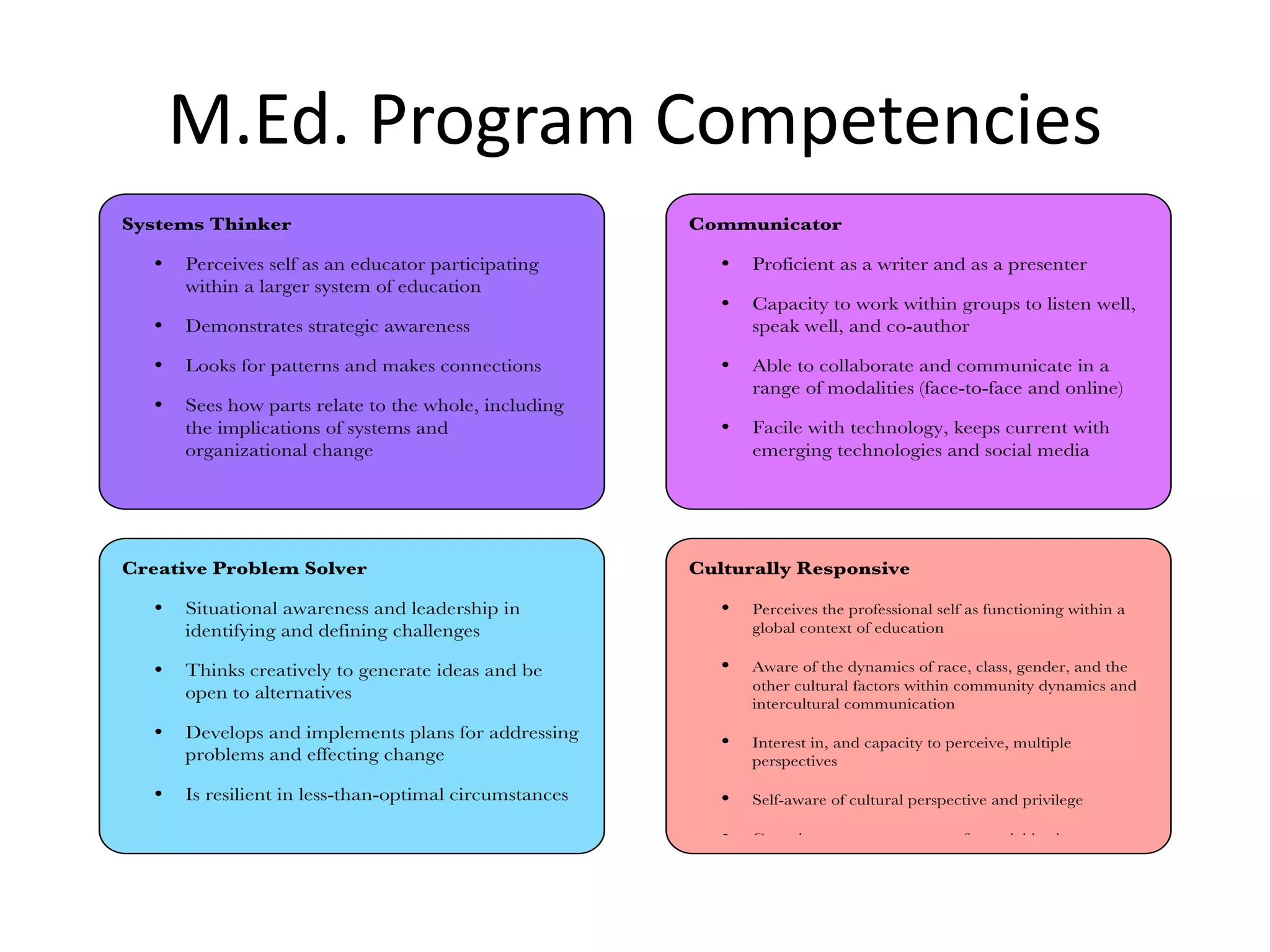
– Identify Program Competencies
• September – May 2013: Curriculum Redesign
– Market Analysis
– Author Concentration Missions, Identify Competencies
– Curriculum Mapping to Missions/Competencies
– Plan Courses & Identify Signature Assignments
– Develop Process to Document Learning through Portfolios
• September 2013: Implementation
Curriculum map
Program competencies
• Mission driven
– The Master of Education program at Northeastern
University develops educators with the skills and
intellectual acumen to be effective, to question
systemic norms, and to anticipate and shape a
more equitable, globally connected society.
Competencies
• Professionally grounded
– Preparation focused on concentration-specific
trajectories
– Students delve deeply into current landscape and
recent developments in a given education sector
– Students gain professional competencies and also
build a deeper understanding of the content
– Develop professional identities
– Program allows for flexibility and foresight as students
prepare to meet specialized professional educational
landscapes of the future
Program competencies
• A distinctive program
– Integrates practice with scholarship
– Embraces next generation online and mobile
learning
– Explores lifelong learning and global contexts
– Generates a portfolio of exemplary work that
demonstrates vision and leadership in the field
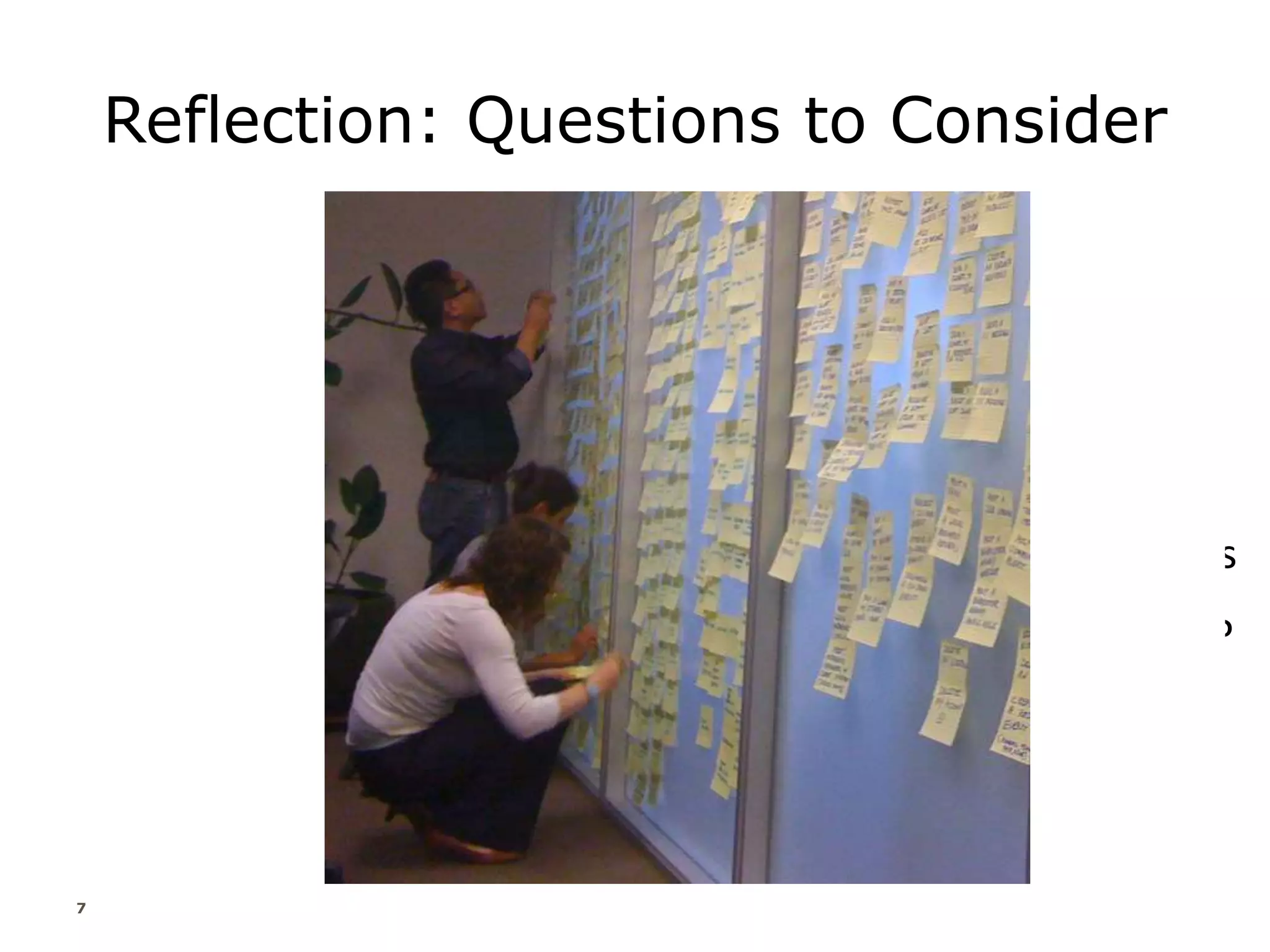
Reflection: Questions to Consider
What contributions are you preparing students to make to
society and/or to their profession?
What expertise, abilities, and characteristics will the graduates
of your program need to be able to make these contributions?
7
M.Ed. Program Competencies
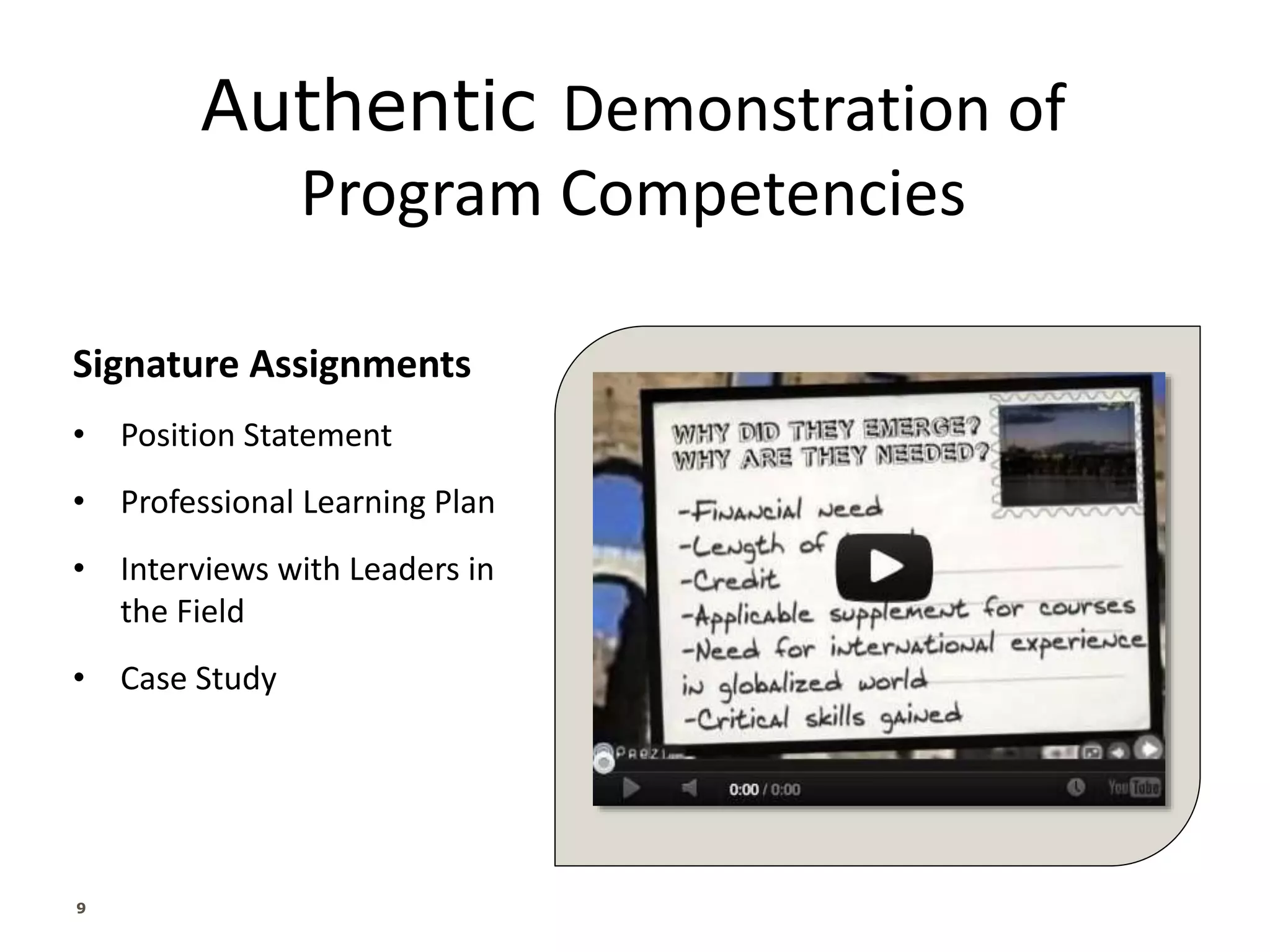
Authentic Demonstration of
Program Competencies
9
Signature Assignments
• Position Statement
• Professional Learning Plan
• Interviews with Leaders in
the Field
• Case Study
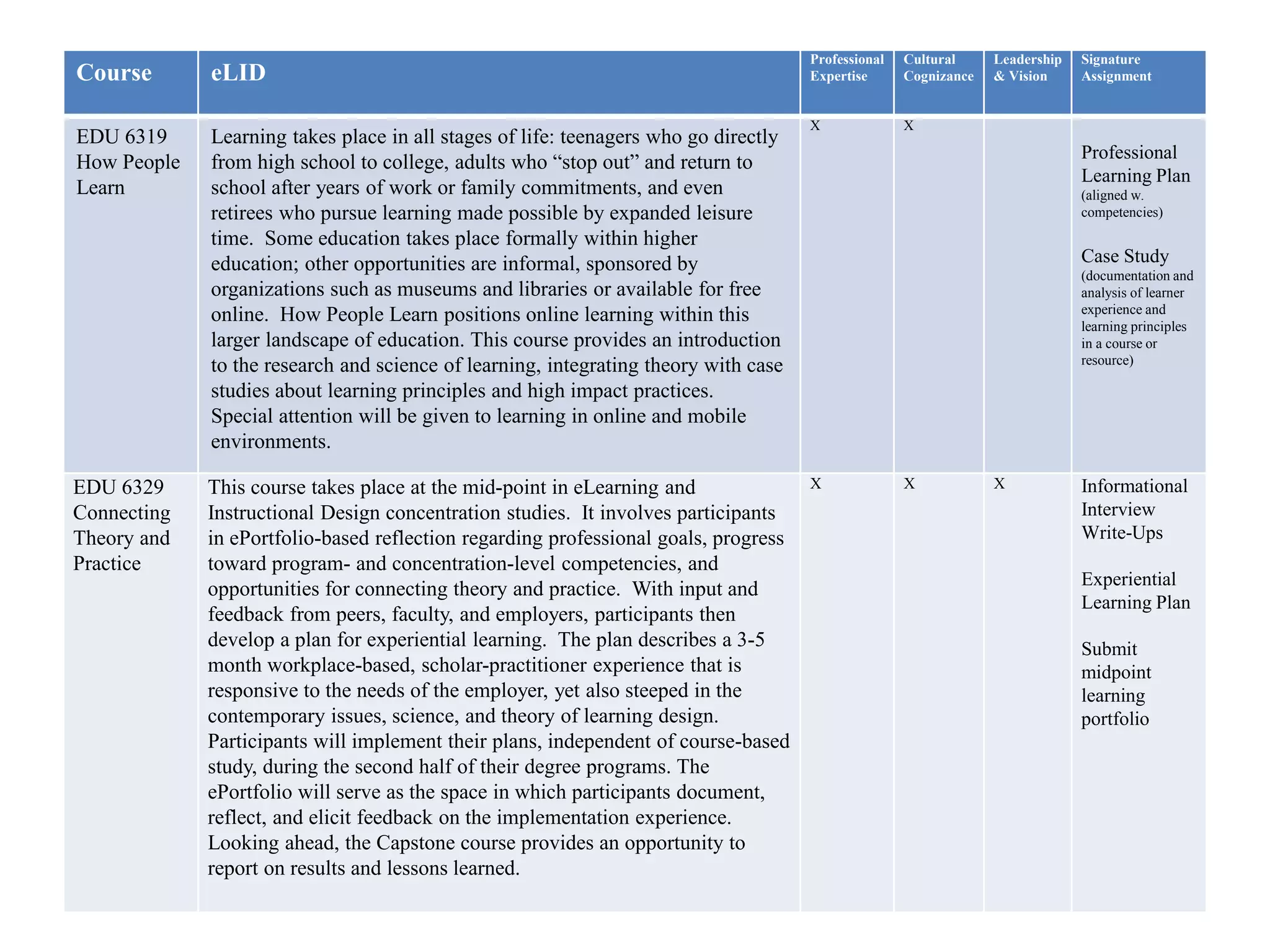
Course eLID
Professional
Expertise
Cultural
Cognizance
Leadership
& Vision
Signature
Assignment
EDU 6319
How People
Learn
Learning takes place in all stages of life: teenagers who go directly
from high school to college, adults who “stop out” and return to
school after years of work or family commitments, and even
retirees who pursue learning made possible by expanded leisure
time. Some education takes place formally within higher
education; other opportunities are informal, sponsored by
organizations such as museums and libraries or available for free
online. How People Learn positions online learning within this
larger landscape of education. This course provides an introduction
to the research and science of learning, integrating theory with case
studies about learning principles and high impact practices.
Special attention will be given to learning in online and mobile
environments.
X X
Professional
Learning Plan
(aligned w.
competencies)
Case Study
(documentation and
analysis of learner
experience and
learning principles
in a course or
resource)
EDU 6329
Connecting
Theory and
Practice
This course takes place at the mid-point in eLearning and
Instructional Design concentration studies. It involves participants
in ePortfolio-based reflection regarding professional goals, progress
toward program- and concentration-level competencies, and
opportunities for connecting theory and practice. With input and
feedback from peers, faculty, and employers, participants then
develop a plan for experiential learning. The plan describes a 3-5
month workplace-based, scholar-practitioner experience that is
responsive to the needs of the employer, yet also steeped in the
contemporary issues, science, and theory of learning design.
Participants will implement their plans, independent of course-based
study, during the second half of their degree programs. The
ePortfolio will serve as the space in which participants document,
reflect, and elicit feedback on the implementation experience.
Looking ahead, the Capstone course provides an opportunity to
report on results and lessons learned.
X X X Informational
Interview
Write-Ups
Experiential
Learning Plan
Submit
midpoint
learning
portfolio
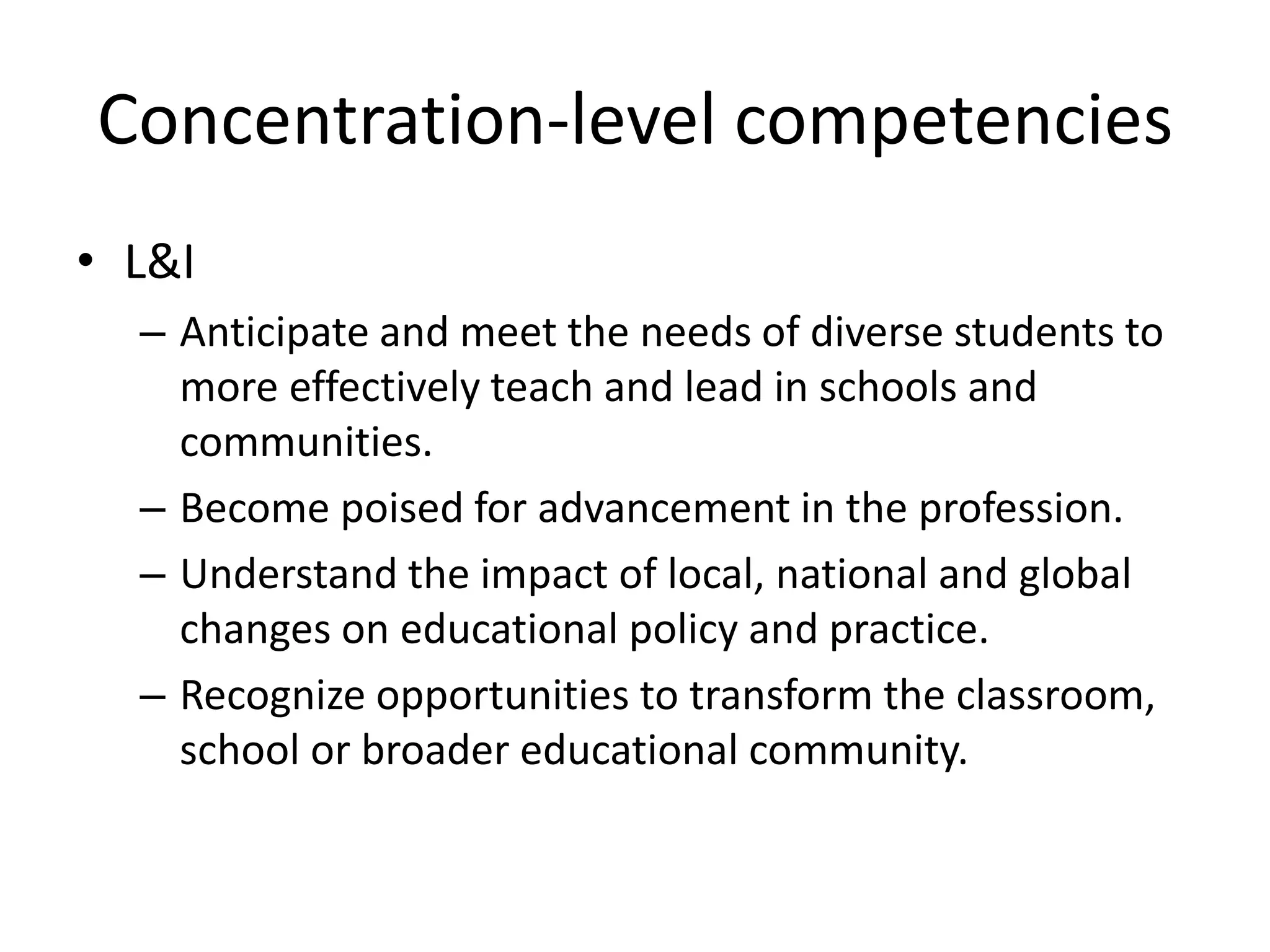
Concentration-level competencies
• L&I
– Anticipate and meet the needs of diverse students to
more effectively teach and lead in schools and
communities.
– Become poised for advancement in the profession.
– Understand the impact of local, national and global
changes on educational policy and practice.
– Recognize opportunities to transform the classroom,
school or broader educational community.
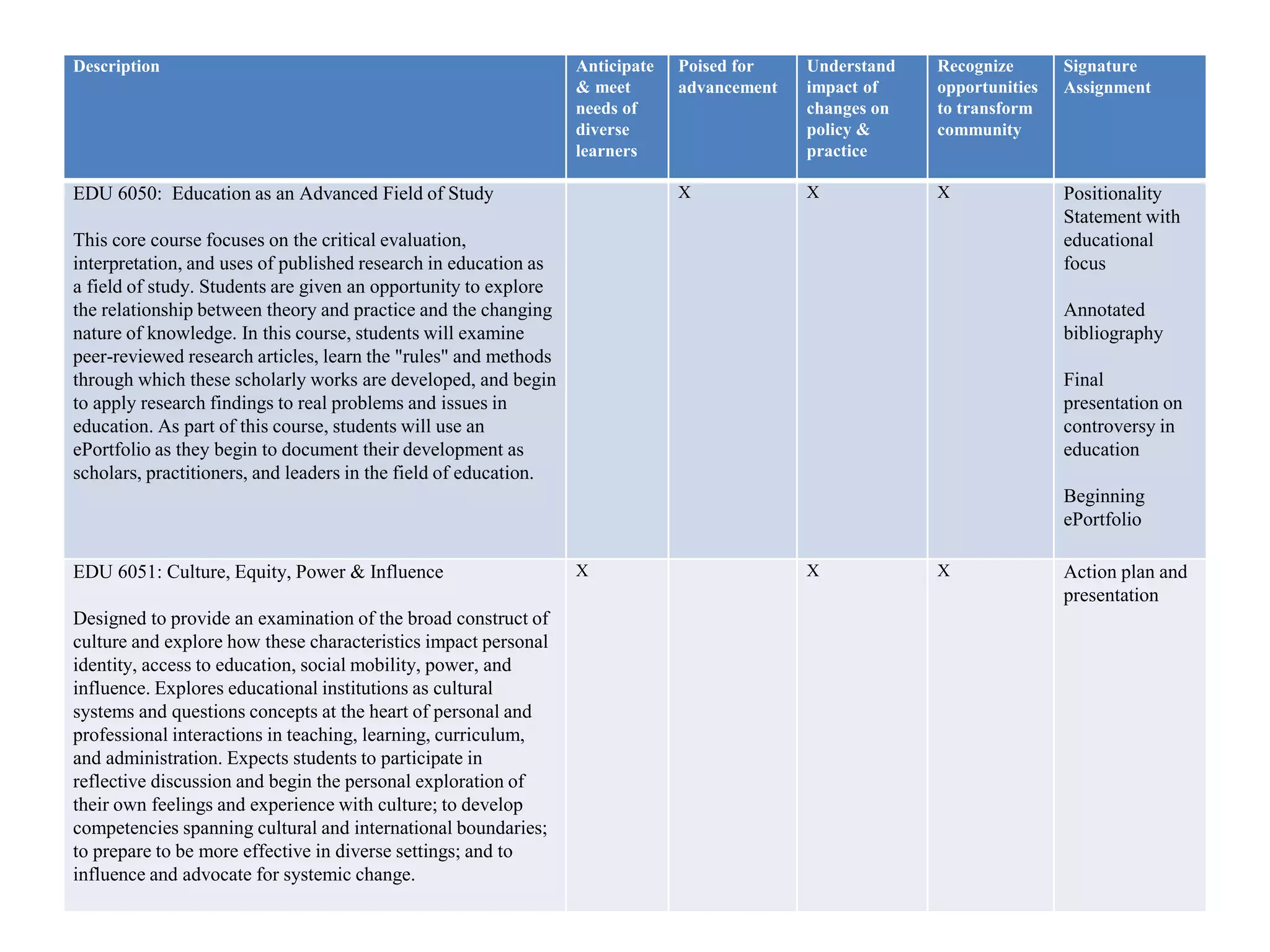
Description Anticipate
& meet
needs of
diverse
learners
Poised for
advancement
Understand
impact of
changes on
policy &
practice
Recognize
opportunities
to transform
community
Signature
Assignment
EDU 6050: Education as an Advanced Field of Study
This core course focuses on the critical evaluation,
interpretation, and uses of published research in education as
a field of study. Students are given an opportunity to explore
the relationship between theory and practice and the changing
nature of knowledge. In this course, students will examine
peer-reviewed research articles, learn the "rules" and methods
through which these scholarly works are developed, and begin
to apply research findings to real problems and issues in
education. As part of this course, students will use an
ePortfolio as they begin to document their development as
scholars, practitioners, and leaders in the field of education.
X X X Positionality
Statement with
educational
focus
Annotated
bibliography
Final
presentation on
controversy in
education
Beginning
ePortfolio
EDU 6051: Culture, Equity, Power & Influence
Designed to provide an examination of the broad construct of
culture and explore how these characteristics impact personal
identity, access to education, social mobility, power, and
influence. Explores educational institutions as cultural
systems and questions concepts at the heart of personal and
professional interactions in teaching, learning, curriculum,
and administration. Expects students to participate in
reflective discussion and begin the personal exploration of
their own feelings and experience with culture; to develop
competencies spanning cultural and international boundaries;
to prepare to be more effective in diverse settings; and to
influence and advocate for systemic change.
X X X Action plan and
presentation
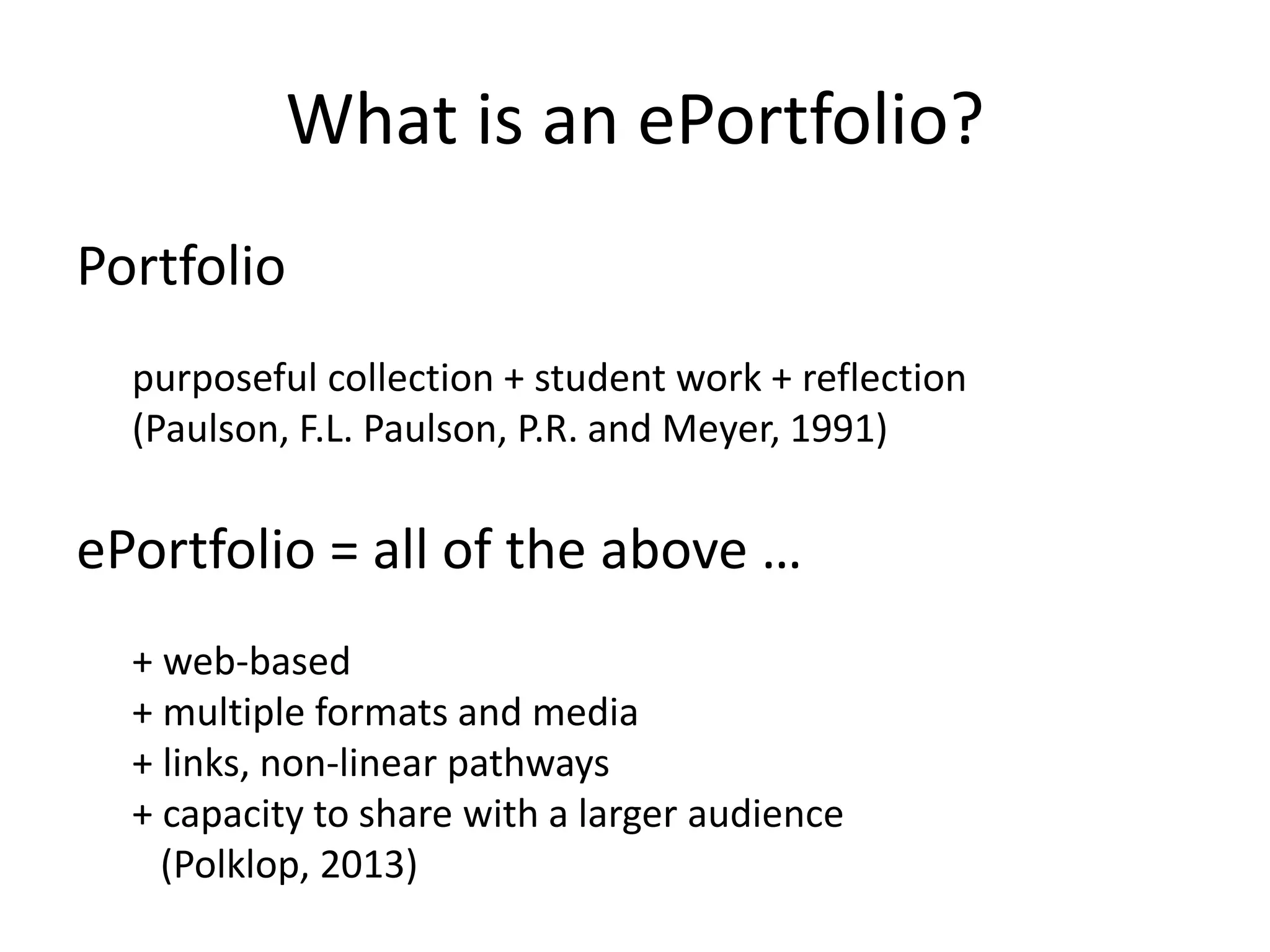
What is an ePortfolio?
Portfolio
purposeful collection + student work + reflection
(Paulson, F.L. Paulson, P.R. and Meyer, 1991)
ePortfolio = all of the above …
+ web-based
+ multiple formats and media
+ links, non-linear pathways
+ capacity to share with a larger audience
(Polklop, 2013)
Two Faces of ePortfolios
Quantitative & Qualitative
Learning Portfolio
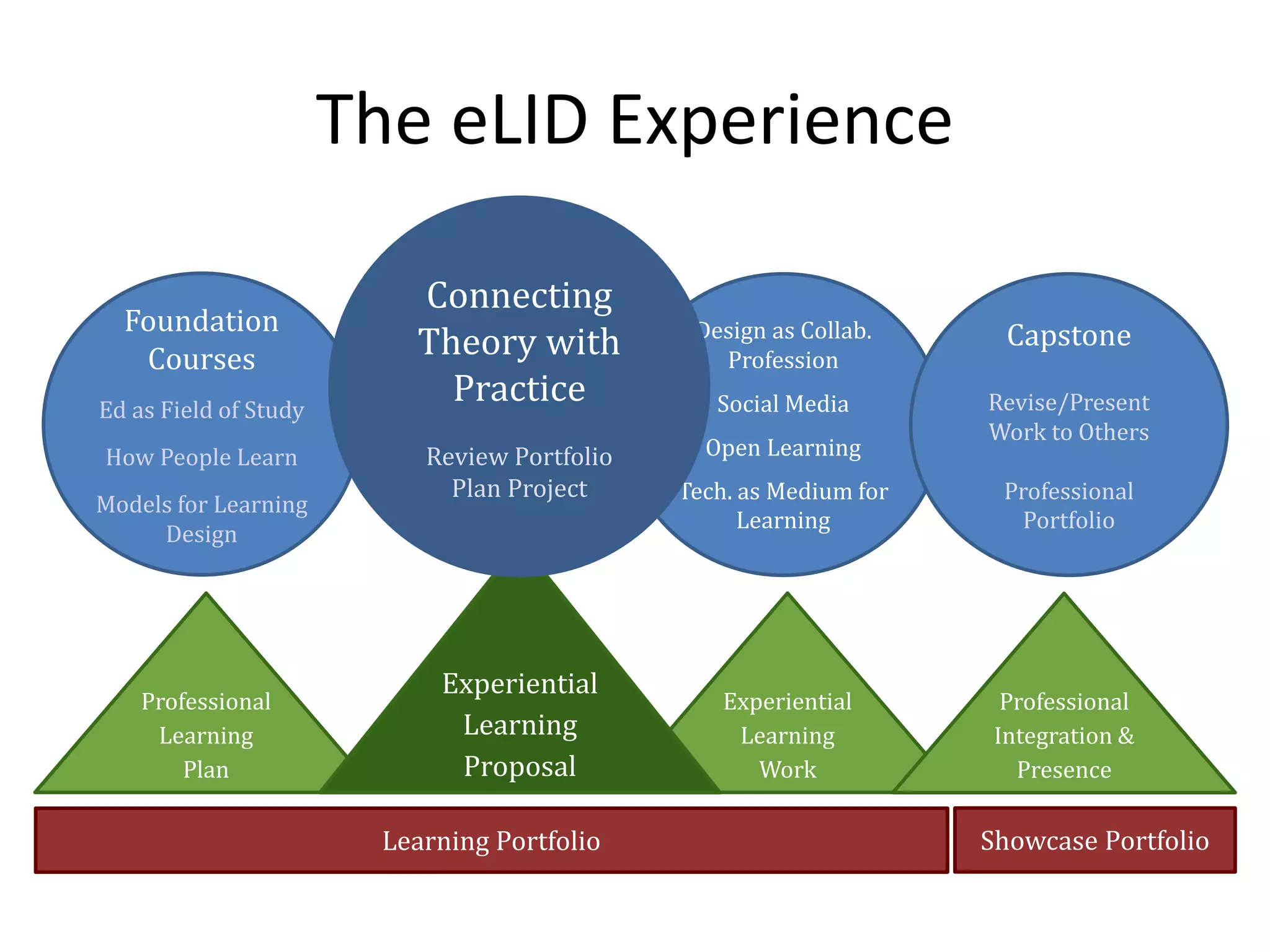
The eLID Experience
Foundation
Courses
Ed as Field of Study
How People Learn
Models for Learning
Design
Professional
Learning
Plan
Showcase Portfolio
Experiential
Learning
Proposal
Connecting
Theory with
Practice
Review Portfolio
Plan Project
Design as Collab.
Profession
Social Media
Open Learning
Tech. as Medium for
Learning
Capstone
Revise/Present
Work to Others
Professional
Portfolio
Experiential
Learning
Work
Professional
Integration &
Presence
The eLID Experience
Experiential
Learning
Proposal
Experiential
Learning
Work
Professional
Integration &
Presence
Professional
Learning
Plan
Connecting
Theory with
Practice
Review Portfolio
Plan Project
Design as Collab.
Profession
Social Media
Open Learning
Tech. as Medium for
Learning
Capstone
Revise/Present
Work to Others
Professional
Portfolio
Foundation
Courses
Ed as Field of Study
How People Learn
Models for Learning
Design
Learning Portfolio Showcase Portfolio
The eLID Experience
Professional
Learning
Plan
Showcase Portfolio
Experiential
Learning
Work
Professional
Integration &
Presence
Experiential
Learning
Proposal
Foundation
Courses
Ed as Field of Study
How People Learn
Models for Learning
Design
Design as Collab.
Profession
Social Media
Open Learning
Tech. as Medium for
Learning
Capstone
Revise/Present
Work to Others
Professional
Portfolio
Connecting
Theory with
Practice
Review Portfolio
Plan Project
Learning Portfolio
The eLID Experience
Learning Portfolio
Foundation
Courses
Ed as Field of Study
How People Learn
Models for Learning
Design
Professional
Learning
Plan
Showcase Portfolio
Experiential
Learning
Proposal
Connecting
Theory with
Practice
Review Portfolio
Plan Project
Capstone
Revise/Present
Work to Others
Professional
Portfolio
Professional
Integration &
Presence
Experiential
Learning
Work
Design as a
Collaborative
Profession
Social Media
Open Learning
Technology as
Medium for Learning
The eLID Experience
Learning Portfolio
Foundation
Courses
Ed as Field of Study
How People Learn
Models for Learning
Design
Professional
Learning
Plan
Showcase Portfolio
Experiential
Learning
Proposal
Connecting
Theory with
Practice
Review Portfolio
Plan Project
Design as Collab.
Profession
Social Media
Open Learning
Tech. as Medium for
Learning
Experiential
Learning
Work
Professional
Integration &
Presence
Capstone
Revise/Present Work
to Others
Professional Portfolio
The eLID Experience
Foundation
Courses
Ed as Field of Study
How People Learn
Models for Learning
Design
Professional
Learning
Plan
Showcase Portfolio
Experiential
Learning
Proposal
Connecting
Theory with
Practice
Review Portfolio
Plan Project
Design as Collab.
Profession
Social Media
Open Learning
Tech. as Medium for
Learning
Capstone
Revise/Present
Work to Others
Professional
Portfolio
Experiential
Learning
Work
Professional
Integration &
Presence
Learning Portfolio
The eLID Experience
Learning Portfolio
Foundation
Courses
Ed as Field of Study
How People Learn
Models for Learning
Design
Professional
Learning
Plan
Experiential
Learning
Proposal
Connecting
Theory with
Practice
Review Portfolio
Plan Project
Design as Collab.
Profession
Social Media
Open Learning
Tech. as Medium for
Learning
Capstone
Revise/Present
Work to Others
Professional
Portfolio
Experiential
Learning
Work
Professional
Integration &
Presence
Showcase
Portfolio
The eLID Experience
The eLID Experience

Masters Program Redesign

  • 1.
    Masters Curriculum Redesign MyaMangawang Lydia Young Gail Matthews-DeNatale December 2013
  • 2.
    Overview • August 2012:Redesign Kick-Off Retreat – Author Mission Statement – Identify Program Competencies • September – May 2013: Curriculum Redesign – Market Analysis – Author Concentration Missions, Identify Competencies – Curriculum Mapping to Missions/Competencies – Plan Courses & Identify Signature Assignments – Develop Process to Document Learning through Portfolios • September 2013: Implementation
  • 3.
  • 4.
    Program competencies • Missiondriven – The Master of Education program at Northeastern University develops educators with the skills and intellectual acumen to be effective, to question systemic norms, and to anticipate and shape a more equitable, globally connected society.
  • 5.
    Competencies • Professionally grounded –Preparation focused on concentration-specific trajectories – Students delve deeply into current landscape and recent developments in a given education sector – Students gain professional competencies and also build a deeper understanding of the content – Develop professional identities – Program allows for flexibility and foresight as students prepare to meet specialized professional educational landscapes of the future
  • 6.
    Program competencies • Adistinctive program – Integrates practice with scholarship – Embraces next generation online and mobile learning – Explores lifelong learning and global contexts – Generates a portfolio of exemplary work that demonstrates vision and leadership in the field
  • 7.
    Reflection: Questions toConsider What contributions are you preparing students to make to society and/or to their profession? What expertise, abilities, and characteristics will the graduates of your program need to be able to make these contributions? 7
  • 8.
  • 9.
    Authentic Demonstration of ProgramCompetencies 9 Signature Assignments • Position Statement • Professional Learning Plan • Interviews with Leaders in the Field • Case Study
  • 10.
    Course eLID Professional Expertise Cultural Cognizance Leadership & Vision Signature Assignment EDU6319 How People Learn Learning takes place in all stages of life: teenagers who go directly from high school to college, adults who “stop out” and return to school after years of work or family commitments, and even retirees who pursue learning made possible by expanded leisure time. Some education takes place formally within higher education; other opportunities are informal, sponsored by organizations such as museums and libraries or available for free online. How People Learn positions online learning within this larger landscape of education. This course provides an introduction to the research and science of learning, integrating theory with case studies about learning principles and high impact practices. Special attention will be given to learning in online and mobile environments. X X Professional Learning Plan (aligned w. competencies) Case Study (documentation and analysis of learner experience and learning principles in a course or resource) EDU 6329 Connecting Theory and Practice This course takes place at the mid-point in eLearning and Instructional Design concentration studies. It involves participants in ePortfolio-based reflection regarding professional goals, progress toward program- and concentration-level competencies, and opportunities for connecting theory and practice. With input and feedback from peers, faculty, and employers, participants then develop a plan for experiential learning. The plan describes a 3-5 month workplace-based, scholar-practitioner experience that is responsive to the needs of the employer, yet also steeped in the contemporary issues, science, and theory of learning design. Participants will implement their plans, independent of course-based study, during the second half of their degree programs. The ePortfolio will serve as the space in which participants document, reflect, and elicit feedback on the implementation experience. Looking ahead, the Capstone course provides an opportunity to report on results and lessons learned. X X X Informational Interview Write-Ups Experiential Learning Plan Submit midpoint learning portfolio
  • 11.
    Concentration-level competencies • L&I –Anticipate and meet the needs of diverse students to more effectively teach and lead in schools and communities. – Become poised for advancement in the profession. – Understand the impact of local, national and global changes on educational policy and practice. – Recognize opportunities to transform the classroom, school or broader educational community.
  • 12.
    Description Anticipate & meet needsof diverse learners Poised for advancement Understand impact of changes on policy & practice Recognize opportunities to transform community Signature Assignment EDU 6050: Education as an Advanced Field of Study This core course focuses on the critical evaluation, interpretation, and uses of published research in education as a field of study. Students are given an opportunity to explore the relationship between theory and practice and the changing nature of knowledge. In this course, students will examine peer-reviewed research articles, learn the "rules" and methods through which these scholarly works are developed, and begin to apply research findings to real problems and issues in education. As part of this course, students will use an ePortfolio as they begin to document their development as scholars, practitioners, and leaders in the field of education. X X X Positionality Statement with educational focus Annotated bibliography Final presentation on controversy in education Beginning ePortfolio EDU 6051: Culture, Equity, Power & Influence Designed to provide an examination of the broad construct of culture and explore how these characteristics impact personal identity, access to education, social mobility, power, and influence. Explores educational institutions as cultural systems and questions concepts at the heart of personal and professional interactions in teaching, learning, curriculum, and administration. Expects students to participate in reflective discussion and begin the personal exploration of their own feelings and experience with culture; to develop competencies spanning cultural and international boundaries; to prepare to be more effective in diverse settings; and to influence and advocate for systemic change. X X X Action plan and presentation
  • 13.
    What is anePortfolio? Portfolio purposeful collection + student work + reflection (Paulson, F.L. Paulson, P.R. and Meyer, 1991) ePortfolio = all of the above … + web-based + multiple formats and media + links, non-linear pathways + capacity to share with a larger audience (Polklop, 2013)
  • 15.
    Two Faces ofePortfolios
  • 16.
  • 20.
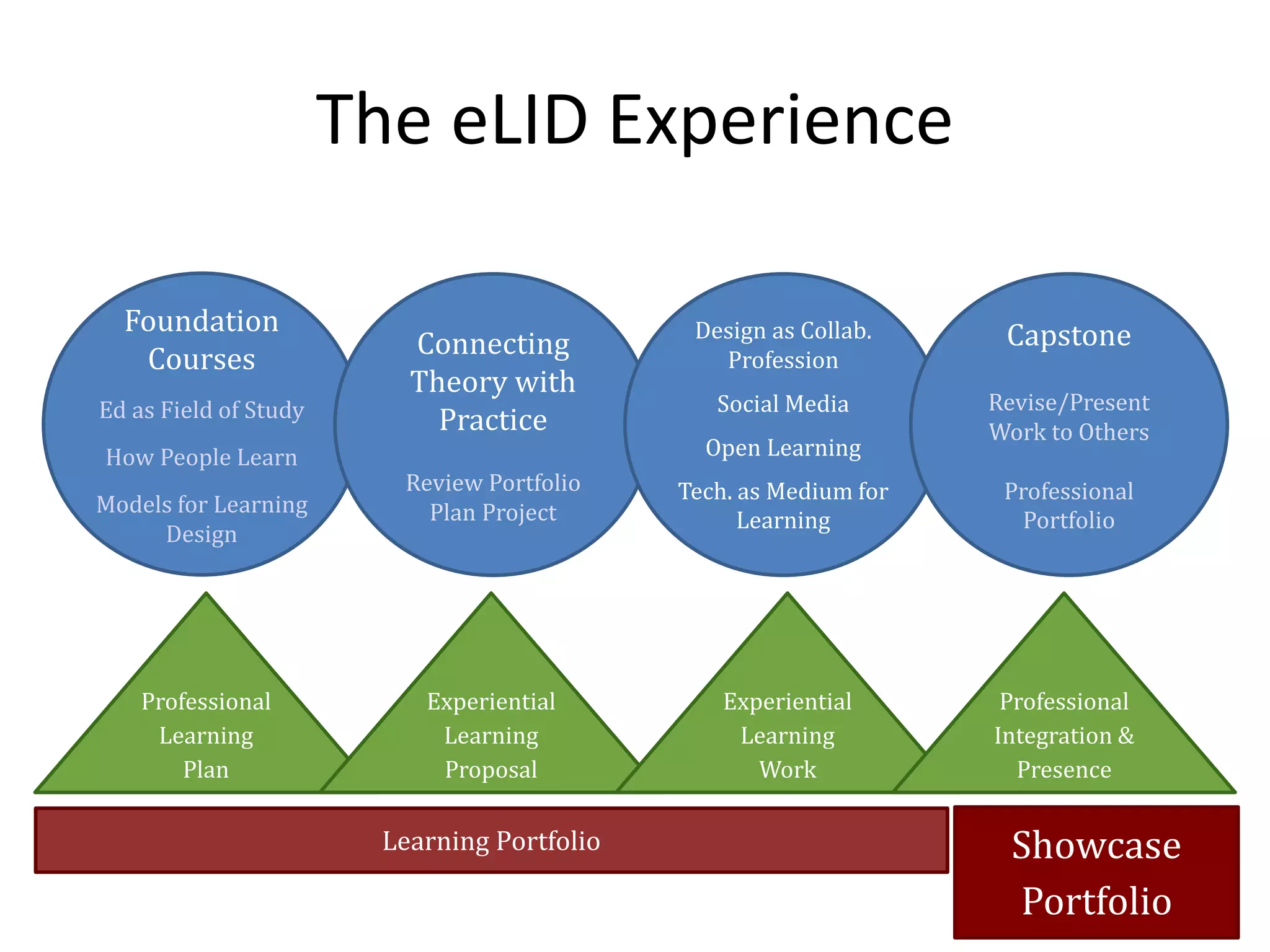
    Learning Portfolio The eLIDExperience Foundation Courses Ed as Field of Study How People Learn Models for Learning Design Professional Learning Plan Showcase Portfolio Experiential Learning Proposal Connecting Theory with Practice Review Portfolio Plan Project Design as Collab. Profession Social Media Open Learning Tech. as Medium for Learning Capstone Revise/Present Work to Others Professional Portfolio Experiential Learning Work Professional Integration & Presence
  • 21.
    The eLID Experience Experiential Learning Proposal Experiential Learning Work Professional Integration& Presence Professional Learning Plan Connecting Theory with Practice Review Portfolio Plan Project Design as Collab. Profession Social Media Open Learning Tech. as Medium for Learning Capstone Revise/Present Work to Others Professional Portfolio Foundation Courses Ed as Field of Study How People Learn Models for Learning Design Learning Portfolio Showcase Portfolio
  • 22.
    The eLID Experience Professional Learning Plan ShowcasePortfolio Experiential Learning Work Professional Integration & Presence Experiential Learning Proposal Foundation Courses Ed as Field of Study How People Learn Models for Learning Design Design as Collab. Profession Social Media Open Learning Tech. as Medium for Learning Capstone Revise/Present Work to Others Professional Portfolio Connecting Theory with Practice Review Portfolio Plan Project Learning Portfolio
  • 23.
    The eLID Experience LearningPortfolio Foundation Courses Ed as Field of Study How People Learn Models for Learning Design Professional Learning Plan Showcase Portfolio Experiential Learning Proposal Connecting Theory with Practice Review Portfolio Plan Project Capstone Revise/Present Work to Others Professional Portfolio Professional Integration & Presence Experiential Learning Work Design as a Collaborative Profession Social Media Open Learning Technology as Medium for Learning
  • 24.
    The eLID Experience LearningPortfolio Foundation Courses Ed as Field of Study How People Learn Models for Learning Design Professional Learning Plan Showcase Portfolio Experiential Learning Proposal Connecting Theory with Practice Review Portfolio Plan Project Design as Collab. Profession Social Media Open Learning Tech. as Medium for Learning Experiential Learning Work Professional Integration & Presence Capstone Revise/Present Work to Others Professional Portfolio
  • 25.
    The eLID Experience Foundation Courses Edas Field of Study How People Learn Models for Learning Design Professional Learning Plan Showcase Portfolio Experiential Learning Proposal Connecting Theory with Practice Review Portfolio Plan Project Design as Collab. Profession Social Media Open Learning Tech. as Medium for Learning Capstone Revise/Present Work to Others Professional Portfolio Experiential Learning Work Professional Integration & Presence Learning Portfolio
  • 26.
    The eLID Experience LearningPortfolio Foundation Courses Ed as Field of Study How People Learn Models for Learning Design Professional Learning Plan Experiential Learning Proposal Connecting Theory with Practice Review Portfolio Plan Project Design as Collab. Profession Social Media Open Learning Tech. as Medium for Learning Capstone Revise/Present Work to Others Professional Portfolio Experiential Learning Work Professional Integration & Presence Showcase Portfolio
  • 27.
  • 28.

Editor's Notes

  • #8 We took the many ideas, similar to those that you just brainstormed, and used a yellow sticky process to post, sort, group, consolidate, and articulate our most important competencies. Here’s what we came up with Image Source: http://www.flickr.com/photos/38869431@N00/3703735824/
  • #10 Each course has one or two signature assignments that are 1) authentic work to the profession, 2) connect theory with practice, and 3) are designed to evidence competencies. They incorporate the signature assignment, often with a written reflection, into their ePortfolios. This is the final piece of work in each course – faculty view and assess the signature assignment within the larger context of their goals and other coursework A signature assignment in one course can be revisited in future courses. For example, informational interviews in one course can be revisited in planning opportunities for experiential learning. The module developed in one course can be revisited to develop learning objects that are embedded in the module.
  • #13 L&I example of concentration competencies & how they map on to the Foundational courses
  • #14 Portfolios are not new – they’ve been part of art education and writing education for many years. As Peter Elbow says, if you automatically learned from experience, all old people would be smart. You learn from reflecting on experience The web format makes it possible to explicitly link the learning that takes pace inside/outside school, at the workplace, etc. The multimedia format makes it possible to reflect different ways of knowing, and to take a holistic approach to many modes of “communication” It’s important to note that most eP software allows the author to set levels of access, from public to within school to private For example, a portfolio could be private during the early phases while a student is documenting learning, and then gradually made more public as they develop and improve You can also have more than one portfolio – more than one audience
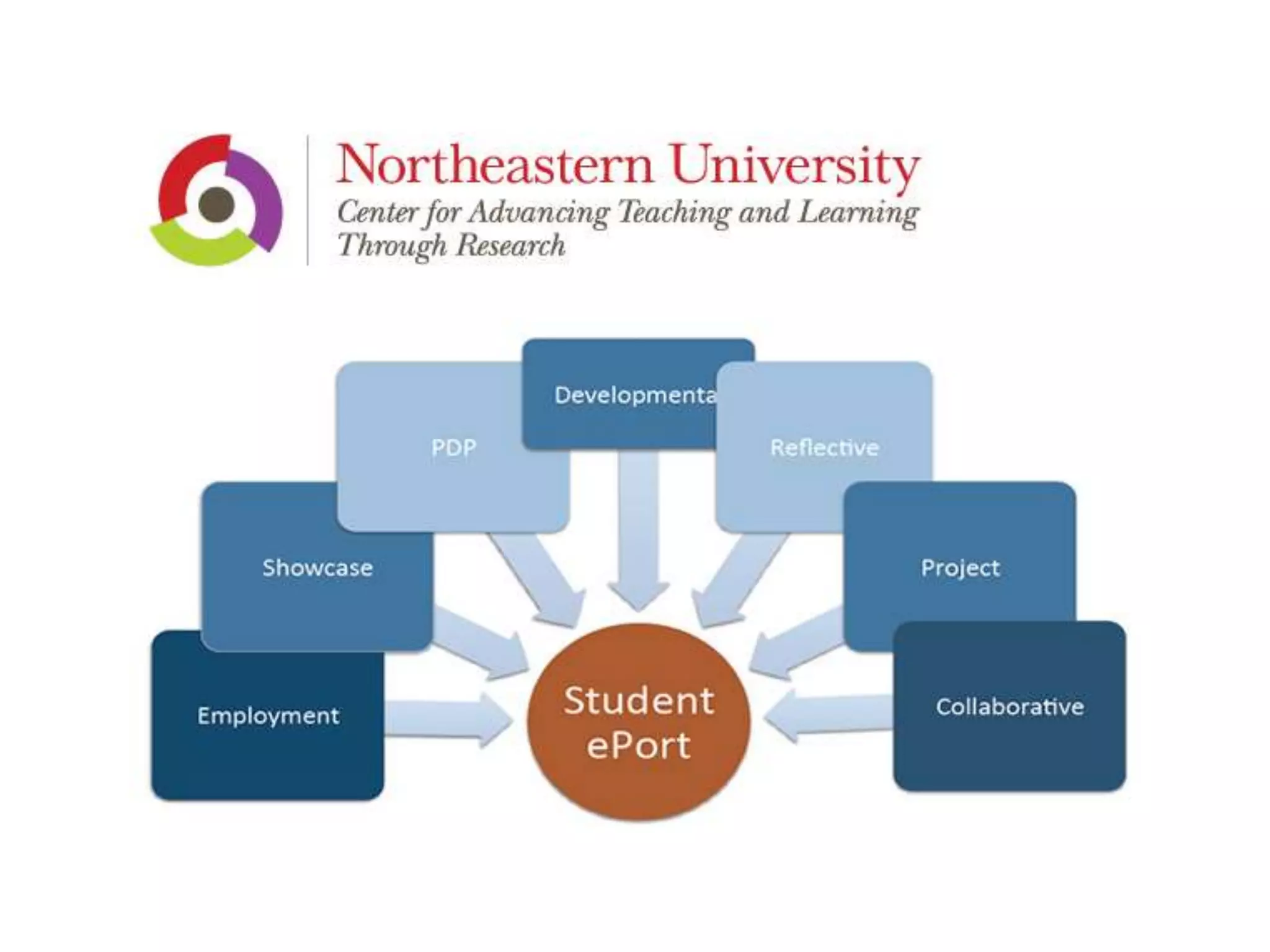
  • #15 Northeastern Center for Advancing Teaching and Learning Through Research Presentation developed by Laurie Poklop, who did her dissertation on ePortfolios at Northeastern. Her recent work focuses on ePortfolios as a new genre of writing (or genres of writing, because depending on the scenario there are different audiences) This schema focuses on the many uses to which an ePortfolio can be put. It also has implications for the viewership, sense of audience, and representation of self. Some are self-focused, such as those for reflection, developmental learning, professional development, and imply assessment interactions with programs and faculty. Some imply extensive work with peers, such as the project or collaborative portfolios. Some are externally facing, such as the showcase and employment portfolio.
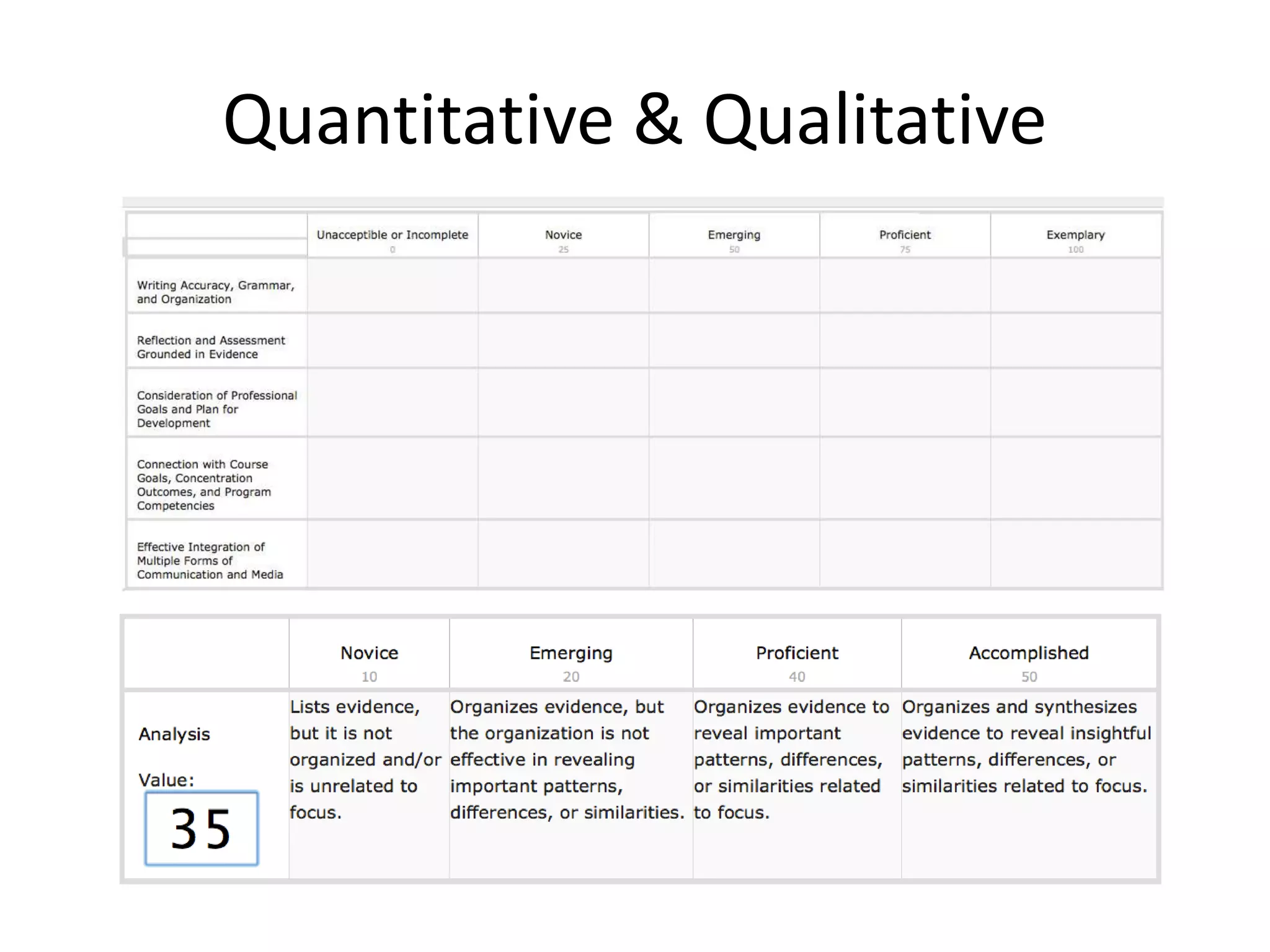
  • #16 Today’s audience represents a range of interests and perspectives, from marketing to institutional research. With this in mind I want to take a minute to point out that one ePortfolio, or one set of ePortfolios, can serve two purposes: documenting evidence of learning for the purpose of program improvement, and documenting/reflecting upon experiences for the purpose of improving student learning and engagement. Standardized Aids evaluation & comparison – makes the process easier for teachers, programs, and accreditors, and licensing boards Gives the impression that the ePortfolio is determined by the institution Personalized Increases creative expression, engagement, and sense of ownership by the student Gives the impression that the ePortfolio is determined by the author We need both for ePortfolios to achieve their potential for improving learning (for students and programs)
  • #17 Today’s audience represents a range of interests and perspectives, from marketing to institutional research. With this in mind I want to take a minute to point out that one ePortfolio, or one set of ePortfolios, can serve two purposes: documenting evidence of learning for the purpose of program improvement, and documenting/reflecting upon experiences for the purpose of improving student learning and engagement.
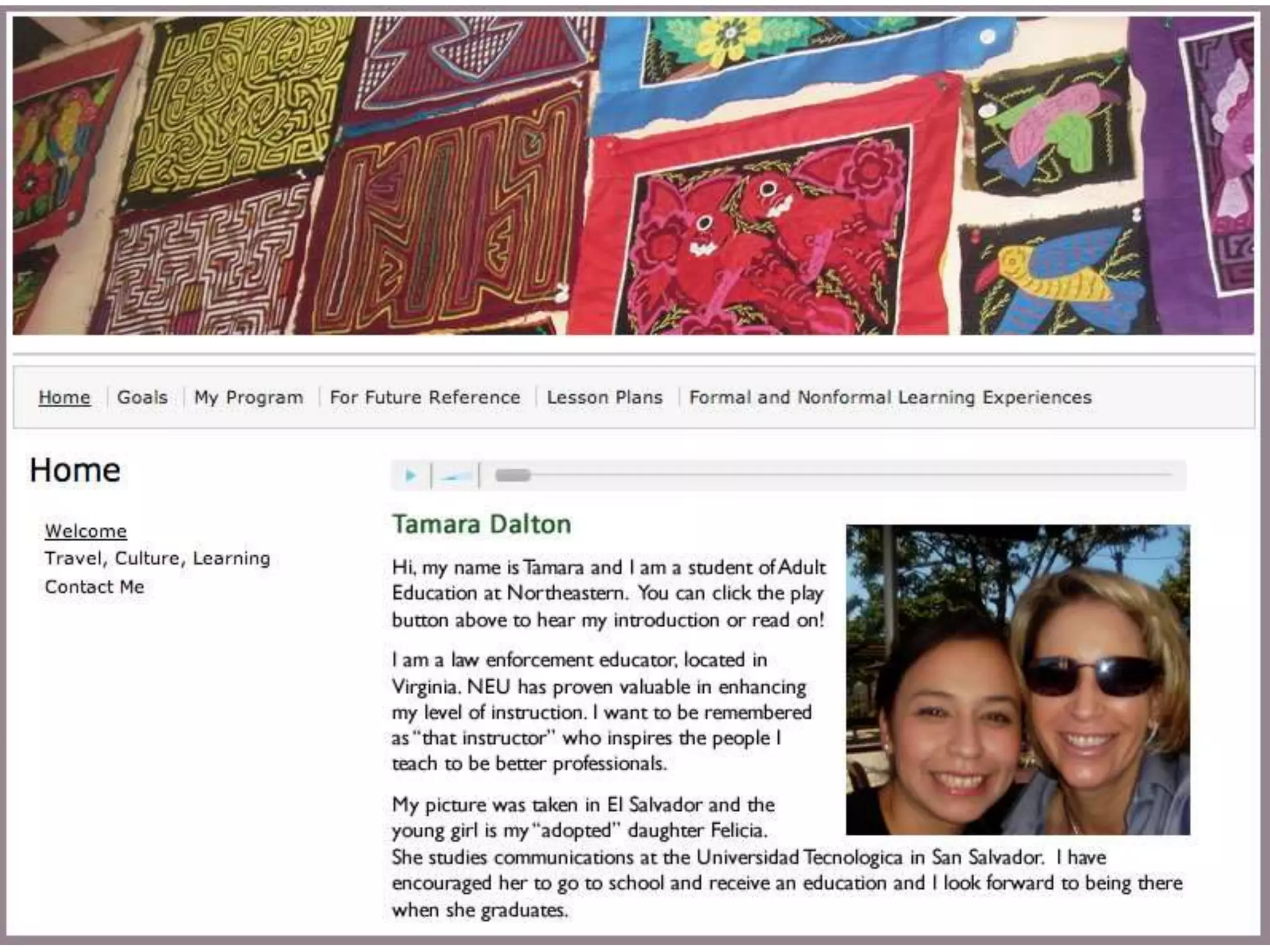
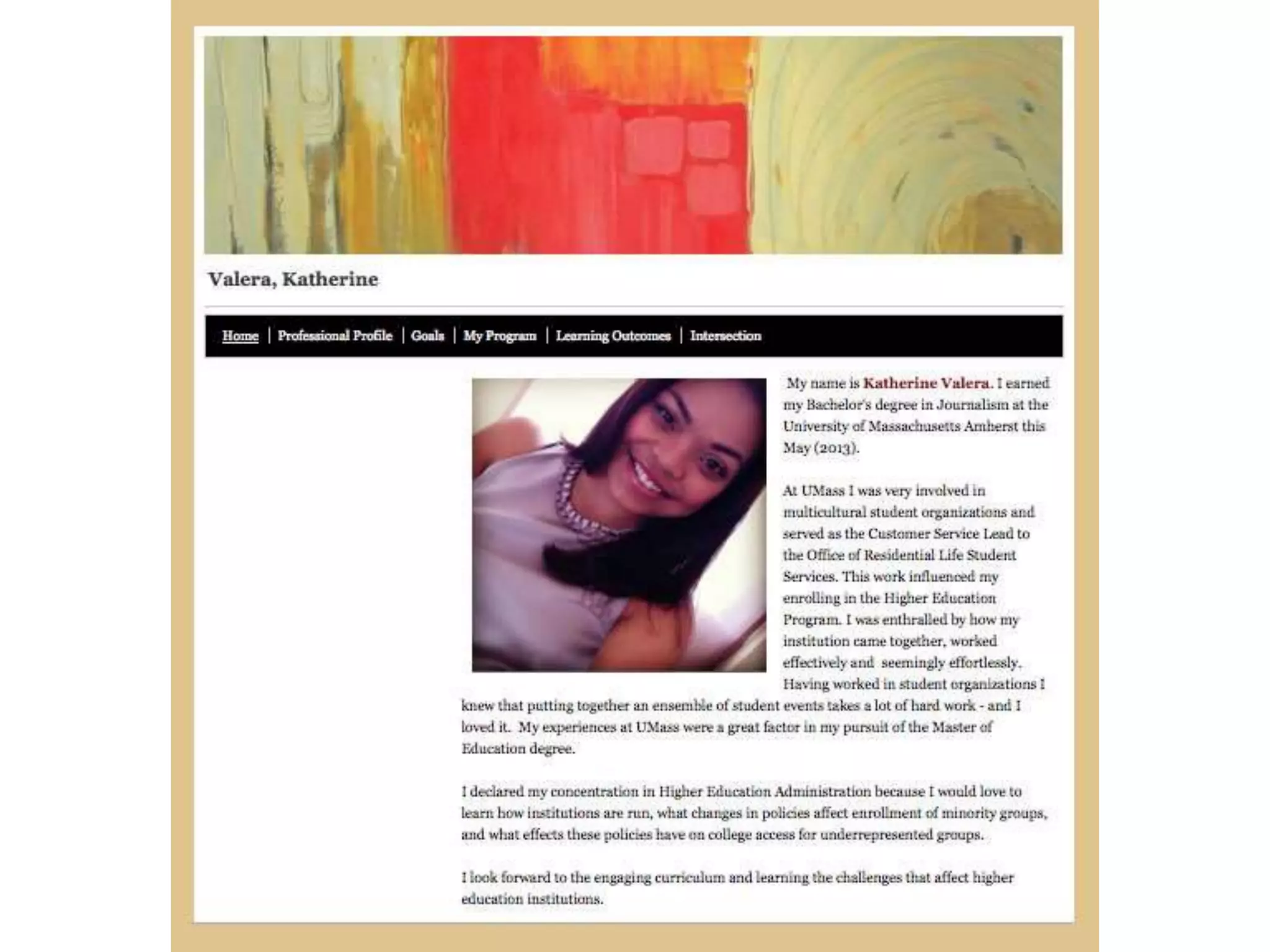
  • #20 That’s just one portfolio. It provides insight into the individual student that could be very valuable to faculty and advisors. What happens when we view the portfolios in aggregate, as a body of work? What do they tell us about our community of learners? How can we use the process of inquiry to ask questions, look for patterns, grapple with the implications of their difference and similarity, and consider what they need from us?
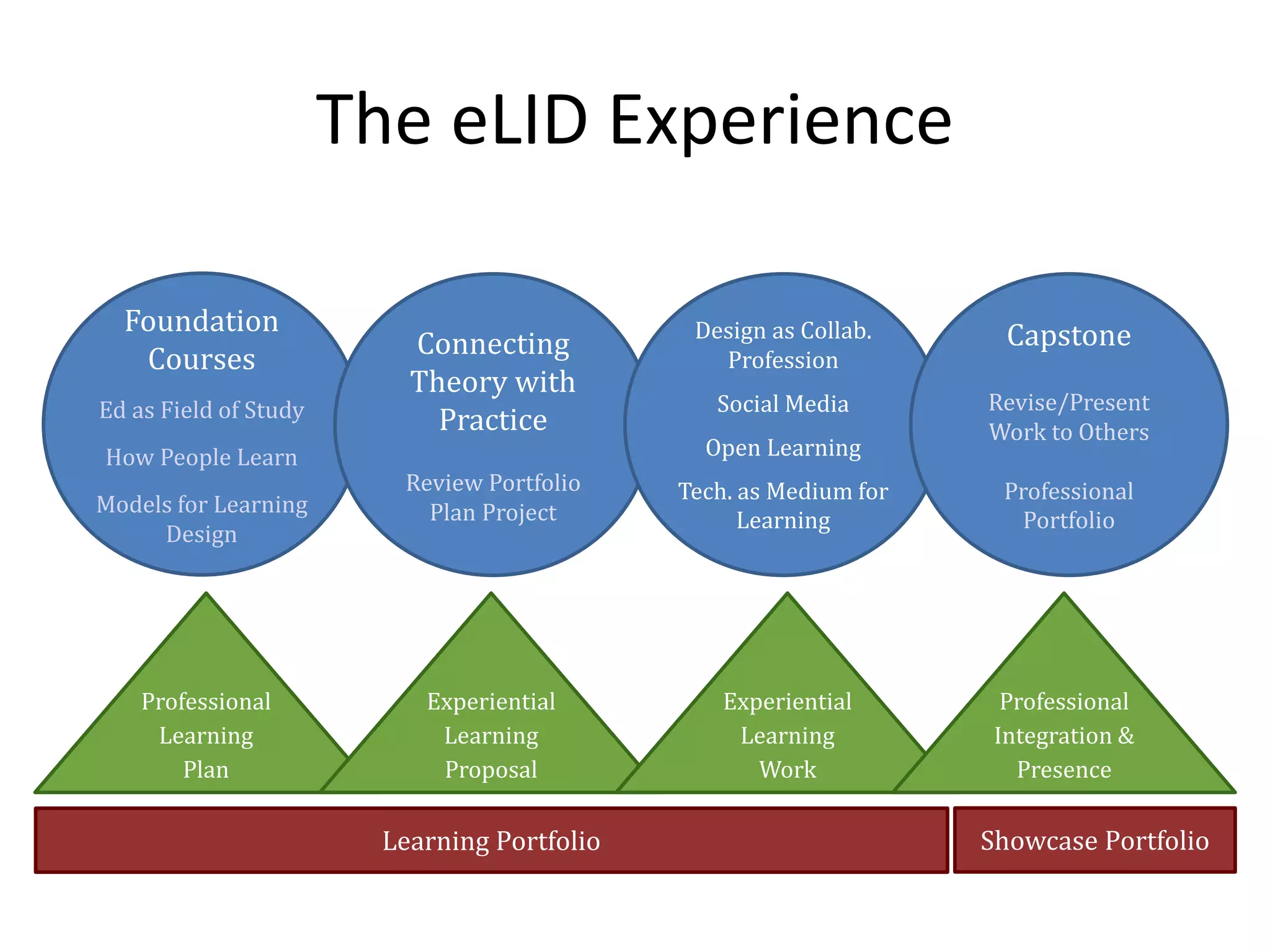
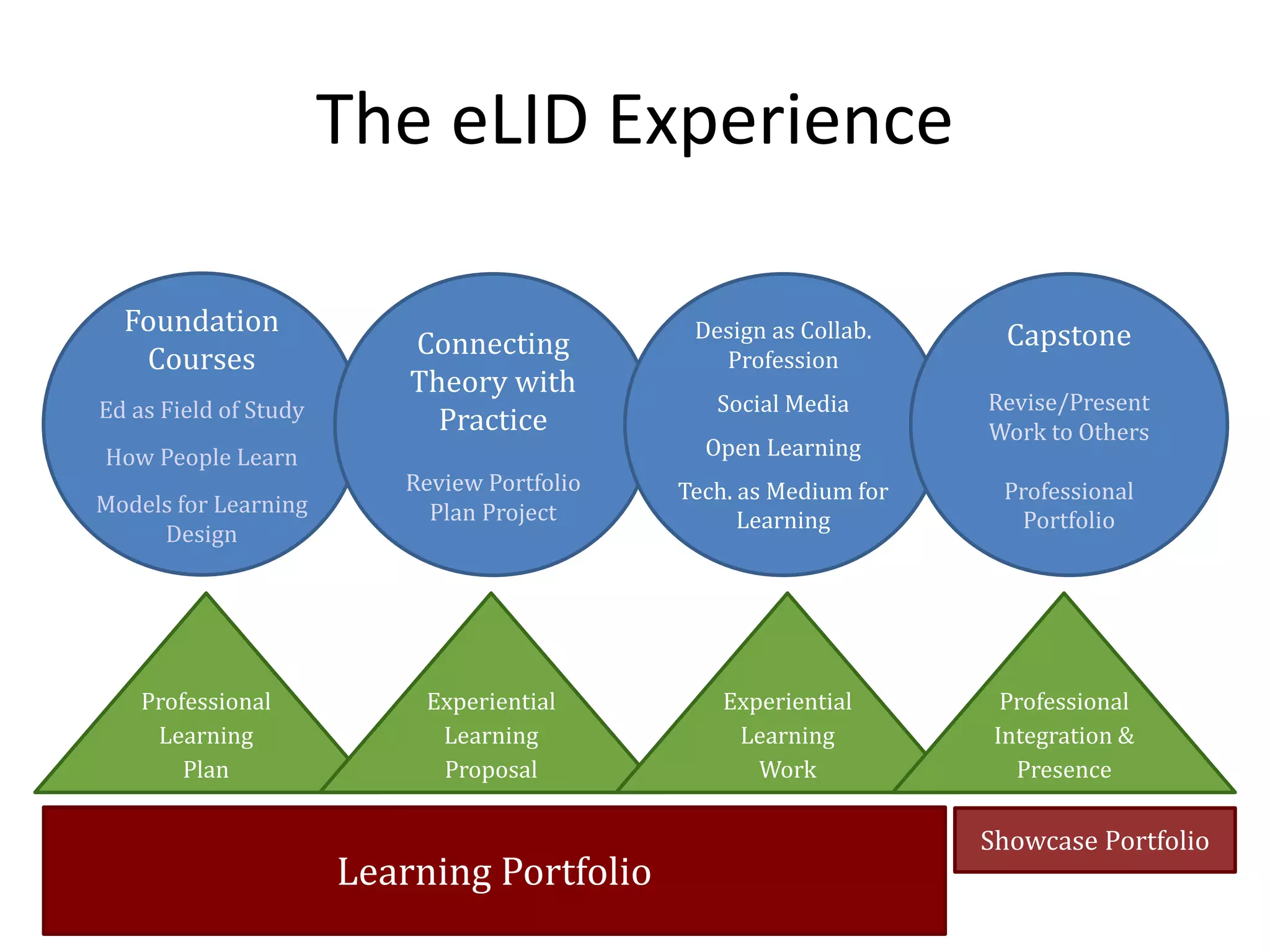
  • #21 This visual serves as a metaphor for the program. The blue circles are clouds of content, concepts, skills, and theories – the formal curriculum The triangles are the forest through which you will journey, the professional work in which you put learning into practice ePortfolio serves a different purpose, depending on where they are in the program, but it also provides continuity It’s the ground that supports the passage – also helpful for connecting school & work.
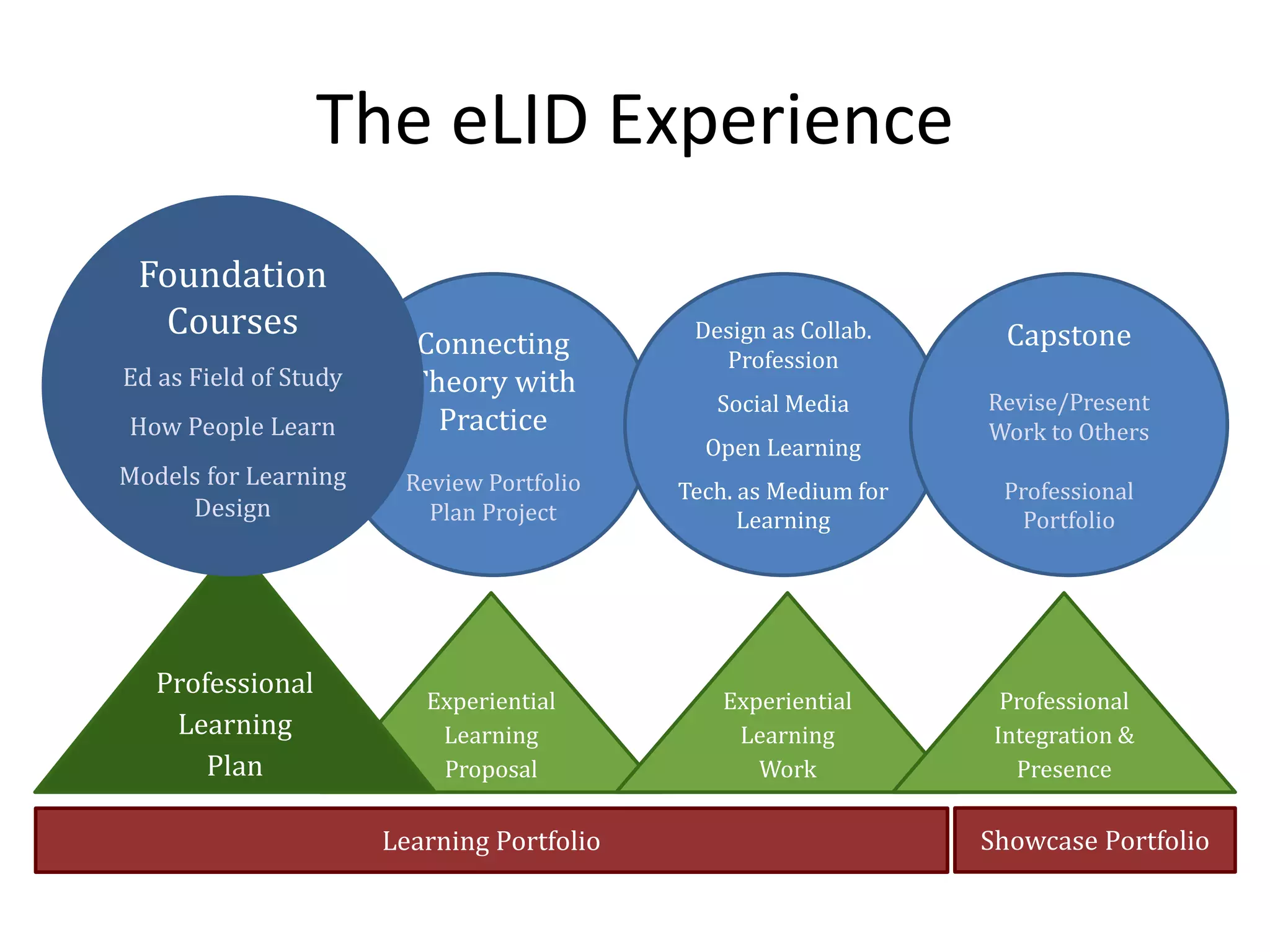
  • #22 As mentioned before, in Education as an Advanced Field of Study students learn how to access research to keep your finger on the pulse of recent developments in the field, how to forge connections between their individual passions (positions) and pressing concerns in their profession, how to use research to improve practice. This is also where they become oriented to the portfolio component In the second course, How People Learn, they take a look at the program competencies, consider strengths and opportunities for growth, and develop a professional learning plan. Instead of being handed a grid or rubric (standards-based eP), they use the research skills they gained in Ed as Advanced to investigate publications and studies on the profession, flesh out their own rubric – in this way they have an opportunity to make the competencies their own. The goal is to strike a balance between standards and professional personalization
  • #23 1/3 of the way through your program, they take a course entitled “connecting theory with practice” during which they Review portfolio of work, consider what have learned about eLearning research and theory, Work with faculty and an employer to develop an experiential learning plan for a significant piece of work to complete as their biggest accomplishment in the program. They can elect to do this with your current employer, or we will help them connect with a professional setting to do this work.
  • #24 They carry out experiential work independently for the duration of the program, in parallel with your other courses, but they won’t be totally on their own. As with C2L’s partner portfolios They document your work in eP and the program holds periodic virtual gatherings – Using a process similar to C2L’s Jam structure to share work, discuss discoveries and challenges with both peers and faculty, & receive feedback It’s called Online Experiential Learning or Virtual Co-op
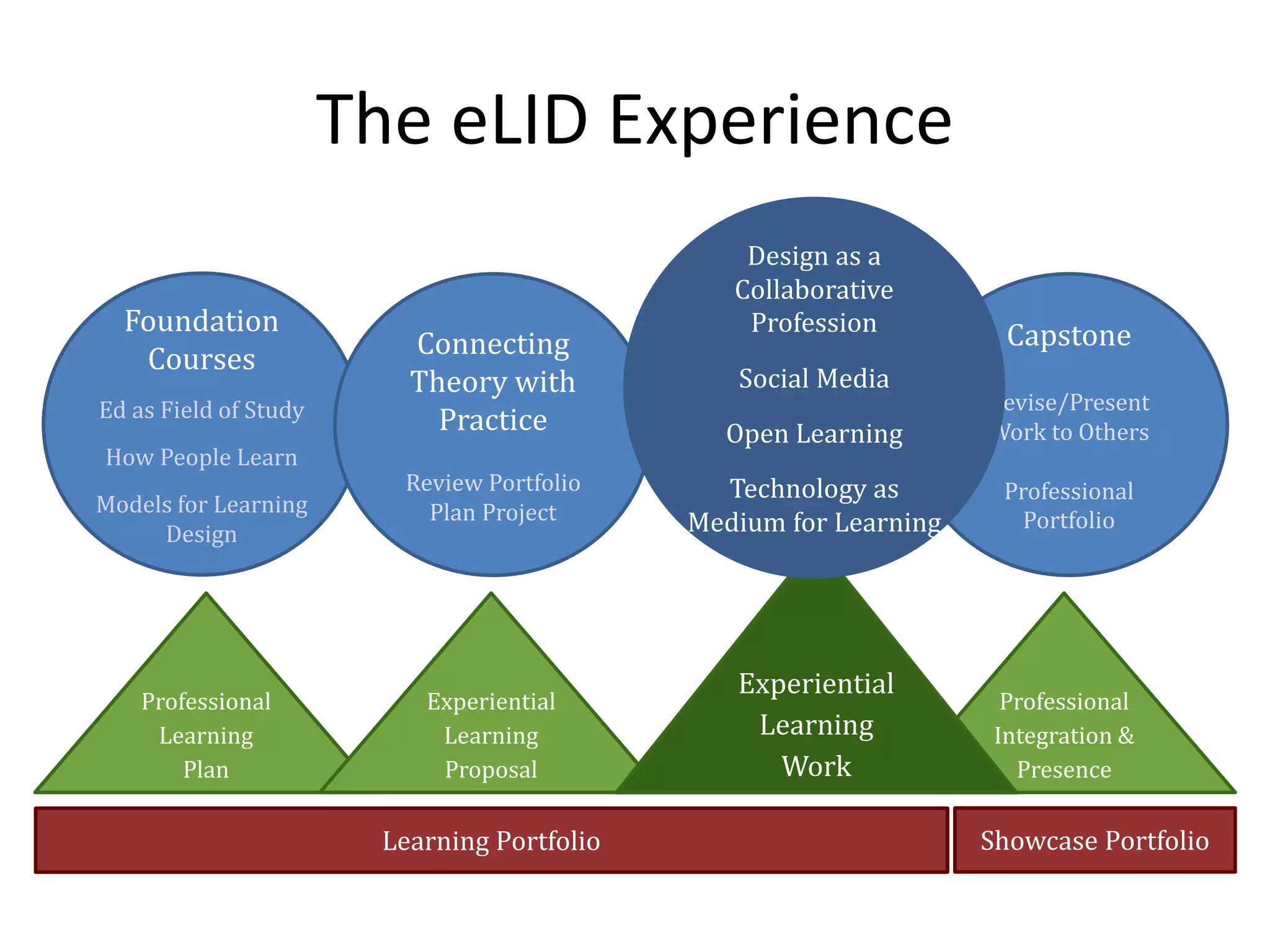
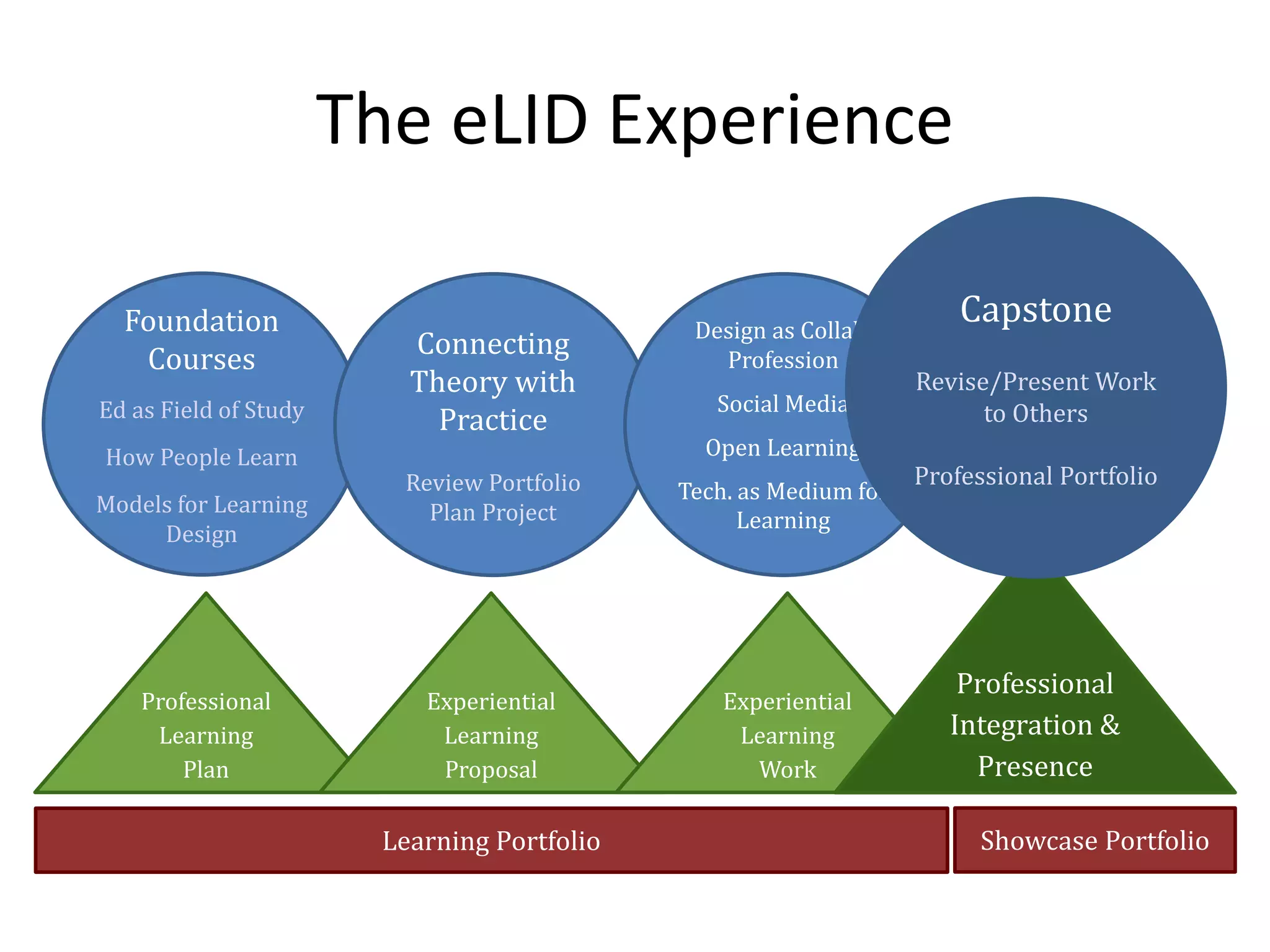
  • #25 During the capstone course they bring it all together. They will use Melissa Peet’s Integrative Knowledge Portfolio workshop process to turn their program-based portfolio into a portfolio that speaks to their core professional strengths This also includes consideration of their presence and substance in social media – which can also be embedded in their portfolios. If they choose to port it to another platform that is okay, too. They Presenting their experiential work with peers, faculty, employers, and even the general public if they wish.
  • #26 The portfolio process is designed to help students synthesize the formative work that they create during the program ….
  • #27 And develop an integrated, contextually cognizant, and self-aware professional presence that includes exemplary work