Veronica Diaz, PhD Maricopa Community Colleges Mojave Community College, August 15, 2008
Introductions
5-Minute University
Today’s seminar Overview of blended learning  Design and development process Implementation  Faculty development and blended learning  Resources
 
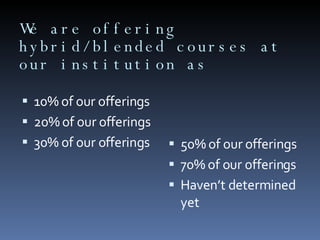
We are offering hybrid/blended courses at our institution as 10% of our offerings  20% of our offerings  30% of our offerings  50% of our offerings  70% of our offerings  Haven’t determined yet
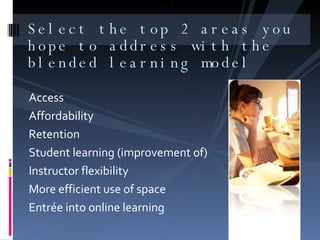
Select the top 2 areas you hope to address with the blended learning model Access  Affordability  Retention Student learning (improvement of) Instructor flexibility  More efficient use of space Entrée into online learning
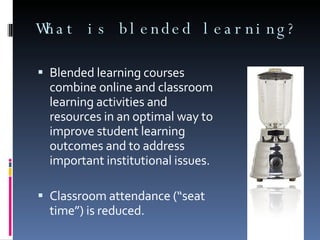
What is blended learning? Blended learning courses combine online and classroom learning activities and resources in an optimal way to improve student learning outcomes and to address important institutional issues. Classroom attendance (“seat time”) is reduced.
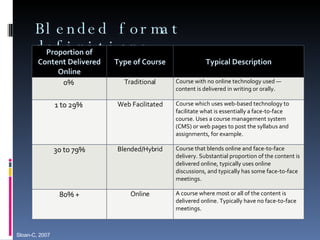
Blended format definitions Sloan-C, 2007 Proportion of Content Delivered Online Type of Course Typical Description 0%  Traditional Course with no online technology used — content is delivered in writing or orally. 1 to 29%  Web Facilitated Course which uses web-based technology to facilitate what is essentially a face-to-face course. Uses a course management system (CMS) or web pages to post the syllabus and assignments, for example. 30 to 79% Blended/Hybrid Course that blends online and face-to-face delivery. Substantial proportion of the content is delivered online, typically uses online discussions, and typically has some face-to-face meetings. 80% + Online A course where most or all of the content is delivered online. Typically have no face-to-face meetings.
 
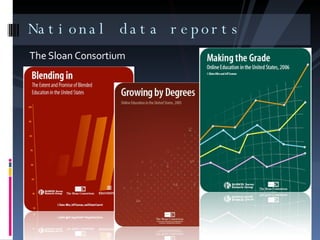
The Sloan Consortium National data reports
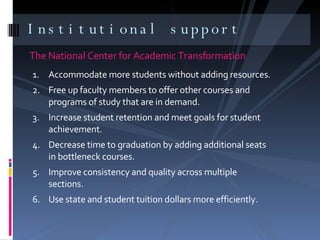
The National Center for Academic Transformation Institutional support Accommodate more students without adding resources. Free up faculty members to offer other courses and programs of study that are in demand. Increase student retention and meet goals for student achievement. Decrease time to graduation by adding additional seats in bottleneck courses. Improve consistency and quality across multiple sections. Use state and student tuition dollars more efficiently.
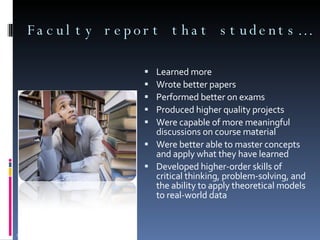
Faculty report that students… Learned more Wrote better papers Performed better on exams Produced higher quality projects Were capable of more meaningful discussions on course material Were better able to master concepts and apply what they have learned  Developed higher-order skills of critical thinking, problem-solving, and the ability to apply theoretical models to real-world data Source: University of Central Florida Data, 2007
The Optimal Model Teaching Opportunities Allows for many diverse solutions to course problems Enables the incorporation of new types of interactive and independent learning activities  Variety of online and in-class teaching strategies Learn technologies while you learn your material  Student Engagement Potential to increase and extend instructor-student and student-student connectivity  Communicate online and face-to-face Discussions started in class may be continued online Students who rarely take part in class discussions are more likely to participate online Integration of out-of- and in-class activities allows more effective use of traditional class time
Blended learning and the net generation learner A safe way to explore online learning Attractive alternative to F2F instruction A good match for the Net Gen’s visual, exploratory, participative learning preferences Improved student engagement and achievement
 
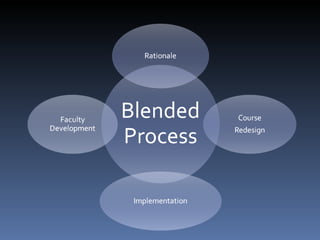
Blended learning process  NCAT Successful Course  Redesign Principles Redesign the whole course. Encourage active learning. Provide students with individualized assistance. Build in ongoing assessment and prompt (automated) feedback. Ensure sufficient time on task and monitor student progress.
Redesign overview Break the course down into discrete, specific learning objectives  Ask: which objectives are best met online?  Ask: which objectives are best met F2F?  Strategies: how will you integrate the online portion with the F2F portion?  Strategies: how will you make students accountable for the online portion?
What the faculty might think  Overwhelmed at redesign process See online work as an add-on Assume classroom is for lecture, online for discussion and activities, and finals for assessment Believe they must cover the same amount of material Temptation to make only incremental changes Temptation to create a course and a half Temptation to redesign just the out-of-class components and add some technology  Temptation to ignore opportunities for greater depth Others??
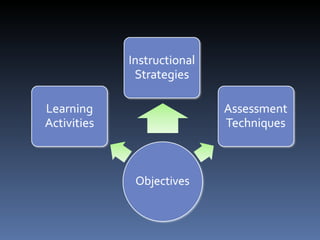
Why Objectives? Clear statement of what students will be able to do when they are finished with an instructional component Focuses on student performance Provides structure: beginning, middle, and end What are the core concepts your students must learn for each module? What do they need to know? What do they need to be able to do? What will they know as a result of my instruction?
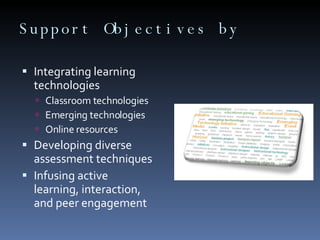
Support Objectives by Integrating learning technologies  Classroom technologies Emerging technologies  Online resources  Developing diverse assessment techniques  Infusing active learning, interaction, and peer engagement
Why Modules? Easier to find course content Support consistency Allows students to focus on content rather than form Content becomes manageable  Prevents information overload “ 7 +/-2 rule” Source: Blending In, March 2007
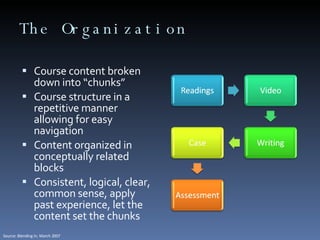
The Organization Course content broken down into “chunks”  Course structure in a repetitive manner allowing for easy navigation Content organized in conceptually related blocks Consistent, logical, clear, common sense, apply past experience, let the content set the chunks Source: Blending In, March 2007
Course Organization Dates Topic Readings  Section Unit Module
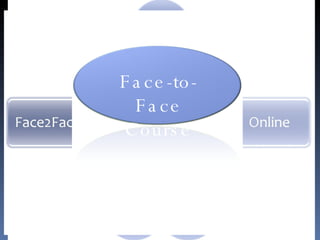
Face-to-Face Course
 
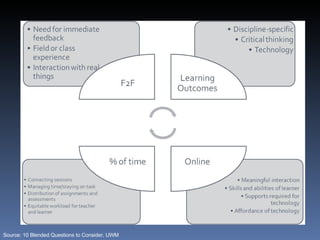
Source: 10 Blended Questions to Consider, UWM
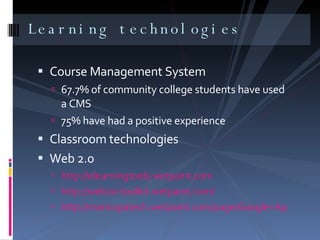
Learning technologies  Course Management System  67.7% of community college students have used a CMS 75% have had a positive experience  Classroom technologies Web 2.0 http://elearningtools.wetpaint.com http://web20-toolkit.wetpaint.com/ http://maricopatech.wetpaint.com/page/Google+Apps?t=anon
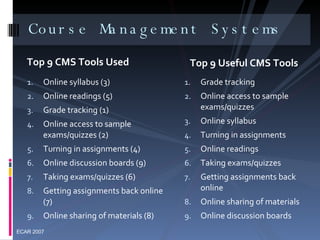
Top 9 CMS Tools Used Course Management Systems Online syllabus (3) Online readings (5) Grade tracking (1) Online access to sample exams/quizzes (2)  Turning in assignments (4) Online discussion boards (9) Taking exams/quizzes (6) Getting assignments back online (7) Online sharing of materials (8) Top 9 Useful CMS Tools Grade tracking  Online access to sample exams/quizzes  Online syllabus Turning in assignments  Online readings Taking exams/quizzes  Getting assignments back online  Online sharing of materials Online discussion boards ECAR 2007
Blended course examples American National Government  (UCF)  Introductory Astronomy  (UCB)  Economic Statistics  (UIUC)  General Chemistry  (UI)  Intermediate Spanish Transition  (UTK)  General Chemistry  (UWM)  College Composition  (Tallahassee CC) Computer Literacy  (U of Buffalo, SUNY)  English Composition  (BYU)  General Psychology  (CSU Pomona)  Computer Programming  (Drexel U) Elementary Statistics  (Penn State U)  Introductory Spanish  (Portland State U)  Elementary Algebra  (Riverside CC)
6 Innovative Practices Creating "Small" Within "Large"  Undergraduate Learning Assistants (ULAs) Freshmen Don’t Do Optional Modularization New Instructional Roles Avoiding “Either/Or” Choices http://www.center.rpi.edu/PlanRes/Innov_CrRedPractices.htm
Supporting the faculty  Release time: 1-2 semesters  Role models and examples  Learning technologies Disciplinary communities of practice Technology has added a layer of “policing” New learning environment is rich in and out of classroom Intellectual property issues
 
Implementation best practices  Ongoing institutional commitment to the redesign Initial and ongoing faculty consensus  Support instructors, and other support staff  Technological infrastructure  and support for students and faculty  Quality assurance: peer review  http://www.qualitymatters.org/index.htm http://www.qualitymatters.org/Rubric.htm   Faculty disciplinary communities of practice
Blended learning costs Faculty  Redesign time Release time during pilot semester Orienting and development  Course redesign  Media specialists  Instructional designers Instructional technologists  Infrastructure Labs Wireless Software IT Helpdesk Resources online  Student  Readiness  Advising Orientation
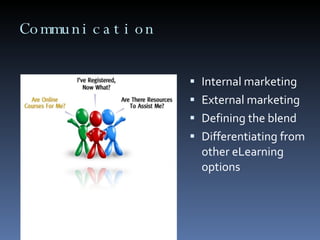
Communication  Internal marketing  External marketing Defining the blend Differentiating from other eLearning options
Student readiness assessment Formal  Informal  eLearning website  Screening surveys  Pre and post enrollment with feedback Debunking incorrect impressions  FAQs  Examples  Pros/Cons  Testimonials
Assessing readiness for  Skills (reading)  Learning styles Work and study habits Technical requirements (hardware, software, connectivity)  Need and immediacy for course Feedback preferences  Ability to self-help (when things are difficult)  Attitude toward the nature of learning online
Readiness Means… Determining who is ready  Ready now = start course  Not ready now =  Getting ready via tutorials, etc. or  Redirecting to other delivery modes  UCF Learning Online
 
Faculty development options Mandatory vs required  Application to teach  Release time  Reassigned time  Mentors  Course development One at a time  Best of breed  Central training  Department training  2 step process Experiential  Overview  Summer institute
Possible components  What is blended learning  Learning objectives  Modules Course redesign strategies Classroom assessment and techniques Rubrics Learning technology Online discussion  Building community Student readiness Student success  Student crisis points Student teams and other collaborations Academic integrity online Copyright issues
Blended Learning Resources  Blended Learning associations or organizations that support the blended/hybrid instructional delivery model.  http://del.icio.us/drvdiaz/associations&orgs Sloan-C Workshops  Conferences  Resources  EDUCAUSE Resources Conferences, Seminars, and Institutes  EDUCAUSE Learning Initiative  Conferences and meetings Resources
Veronica M. Diaz, PhD [email_address] http://www.mcli.dist.maricopa.edu/diaz/   Questions and answers

MCC Blended Learning

  • 1.
    Veronica Diaz, PhDMaricopa Community Colleges Mojave Community College, August 15, 2008
  • 2.
  • 3.
  • 4.
    Today’s seminar Overviewof blended learning Design and development process Implementation Faculty development and blended learning Resources
  • 5.
  • 6.
    We are offeringhybrid/blended courses at our institution as 10% of our offerings 20% of our offerings 30% of our offerings 50% of our offerings 70% of our offerings Haven’t determined yet
  • 7.
    Select the top2 areas you hope to address with the blended learning model Access Affordability Retention Student learning (improvement of) Instructor flexibility More efficient use of space Entrée into online learning
  • 8.
    What is blendedlearning? Blended learning courses combine online and classroom learning activities and resources in an optimal way to improve student learning outcomes and to address important institutional issues. Classroom attendance (“seat time”) is reduced.
  • 9.
    Blended format definitionsSloan-C, 2007 Proportion of Content Delivered Online Type of Course Typical Description 0% Traditional Course with no online technology used — content is delivered in writing or orally. 1 to 29% Web Facilitated Course which uses web-based technology to facilitate what is essentially a face-to-face course. Uses a course management system (CMS) or web pages to post the syllabus and assignments, for example. 30 to 79% Blended/Hybrid Course that blends online and face-to-face delivery. Substantial proportion of the content is delivered online, typically uses online discussions, and typically has some face-to-face meetings. 80% + Online A course where most or all of the content is delivered online. Typically have no face-to-face meetings.
  • 10.
  • 11.
    The Sloan ConsortiumNational data reports
  • 12.
    The National Centerfor Academic Transformation Institutional support Accommodate more students without adding resources. Free up faculty members to offer other courses and programs of study that are in demand. Increase student retention and meet goals for student achievement. Decrease time to graduation by adding additional seats in bottleneck courses. Improve consistency and quality across multiple sections. Use state and student tuition dollars more efficiently.
  • 13.
    Faculty report thatstudents… Learned more Wrote better papers Performed better on exams Produced higher quality projects Were capable of more meaningful discussions on course material Were better able to master concepts and apply what they have learned Developed higher-order skills of critical thinking, problem-solving, and the ability to apply theoretical models to real-world data Source: University of Central Florida Data, 2007
  • 14.
    The Optimal ModelTeaching Opportunities Allows for many diverse solutions to course problems Enables the incorporation of new types of interactive and independent learning activities Variety of online and in-class teaching strategies Learn technologies while you learn your material Student Engagement Potential to increase and extend instructor-student and student-student connectivity Communicate online and face-to-face Discussions started in class may be continued online Students who rarely take part in class discussions are more likely to participate online Integration of out-of- and in-class activities allows more effective use of traditional class time
  • 15.
    Blended learning andthe net generation learner A safe way to explore online learning Attractive alternative to F2F instruction A good match for the Net Gen’s visual, exploratory, participative learning preferences Improved student engagement and achievement
  • 16.
  • 17.
    Blended learning process NCAT Successful Course Redesign Principles Redesign the whole course. Encourage active learning. Provide students with individualized assistance. Build in ongoing assessment and prompt (automated) feedback. Ensure sufficient time on task and monitor student progress.
  • 18.
    Redesign overview Breakthe course down into discrete, specific learning objectives Ask: which objectives are best met online? Ask: which objectives are best met F2F? Strategies: how will you integrate the online portion with the F2F portion? Strategies: how will you make students accountable for the online portion?
  • 19.
    What the facultymight think Overwhelmed at redesign process See online work as an add-on Assume classroom is for lecture, online for discussion and activities, and finals for assessment Believe they must cover the same amount of material Temptation to make only incremental changes Temptation to create a course and a half Temptation to redesign just the out-of-class components and add some technology Temptation to ignore opportunities for greater depth Others??
  • 20.
    Why Objectives? Clearstatement of what students will be able to do when they are finished with an instructional component Focuses on student performance Provides structure: beginning, middle, and end What are the core concepts your students must learn for each module? What do they need to know? What do they need to be able to do? What will they know as a result of my instruction?
  • 21.
    Support Objectives byIntegrating learning technologies Classroom technologies Emerging technologies Online resources Developing diverse assessment techniques Infusing active learning, interaction, and peer engagement
  • 22.
    Why Modules? Easierto find course content Support consistency Allows students to focus on content rather than form Content becomes manageable Prevents information overload “ 7 +/-2 rule” Source: Blending In, March 2007
  • 23.
    The Organization Coursecontent broken down into “chunks” Course structure in a repetitive manner allowing for easy navigation Content organized in conceptually related blocks Consistent, logical, clear, common sense, apply past experience, let the content set the chunks Source: Blending In, March 2007
  • 24.
    Course Organization DatesTopic Readings Section Unit Module
  • 25.
  • 26.
  • 27.
    Source: 10 BlendedQuestions to Consider, UWM
  • 28.
    Learning technologies Course Management System 67.7% of community college students have used a CMS 75% have had a positive experience Classroom technologies Web 2.0 http://elearningtools.wetpaint.com http://web20-toolkit.wetpaint.com/ http://maricopatech.wetpaint.com/page/Google+Apps?t=anon
  • 29.
    Top 9 CMSTools Used Course Management Systems Online syllabus (3) Online readings (5) Grade tracking (1) Online access to sample exams/quizzes (2) Turning in assignments (4) Online discussion boards (9) Taking exams/quizzes (6) Getting assignments back online (7) Online sharing of materials (8) Top 9 Useful CMS Tools Grade tracking Online access to sample exams/quizzes Online syllabus Turning in assignments Online readings Taking exams/quizzes Getting assignments back online Online sharing of materials Online discussion boards ECAR 2007
  • 30.
    Blended course examplesAmerican National Government (UCF) Introductory Astronomy (UCB) Economic Statistics (UIUC) General Chemistry (UI) Intermediate Spanish Transition (UTK) General Chemistry (UWM) College Composition (Tallahassee CC) Computer Literacy (U of Buffalo, SUNY) English Composition (BYU) General Psychology (CSU Pomona) Computer Programming (Drexel U) Elementary Statistics (Penn State U) Introductory Spanish (Portland State U) Elementary Algebra (Riverside CC)
  • 31.
    6 Innovative PracticesCreating "Small" Within "Large" Undergraduate Learning Assistants (ULAs) Freshmen Don’t Do Optional Modularization New Instructional Roles Avoiding “Either/Or” Choices http://www.center.rpi.edu/PlanRes/Innov_CrRedPractices.htm
  • 32.
    Supporting the faculty Release time: 1-2 semesters Role models and examples Learning technologies Disciplinary communities of practice Technology has added a layer of “policing” New learning environment is rich in and out of classroom Intellectual property issues
  • 33.
  • 34.
    Implementation best practices Ongoing institutional commitment to the redesign Initial and ongoing faculty consensus Support instructors, and other support staff Technological infrastructure and support for students and faculty Quality assurance: peer review http://www.qualitymatters.org/index.htm http://www.qualitymatters.org/Rubric.htm Faculty disciplinary communities of practice
  • 35.
    Blended learning costsFaculty Redesign time Release time during pilot semester Orienting and development Course redesign Media specialists Instructional designers Instructional technologists Infrastructure Labs Wireless Software IT Helpdesk Resources online Student Readiness Advising Orientation
  • 36.
    Communication Internalmarketing External marketing Defining the blend Differentiating from other eLearning options
  • 37.
    Student readiness assessmentFormal Informal eLearning website Screening surveys Pre and post enrollment with feedback Debunking incorrect impressions FAQs Examples Pros/Cons Testimonials
  • 38.
    Assessing readiness for Skills (reading) Learning styles Work and study habits Technical requirements (hardware, software, connectivity) Need and immediacy for course Feedback preferences Ability to self-help (when things are difficult) Attitude toward the nature of learning online
  • 39.
    Readiness Means… Determiningwho is ready Ready now = start course Not ready now = Getting ready via tutorials, etc. or Redirecting to other delivery modes UCF Learning Online
  • 40.
  • 41.
    Faculty development optionsMandatory vs required Application to teach Release time Reassigned time Mentors Course development One at a time Best of breed Central training Department training 2 step process Experiential Overview Summer institute
  • 42.
    Possible components What is blended learning Learning objectives Modules Course redesign strategies Classroom assessment and techniques Rubrics Learning technology Online discussion Building community Student readiness Student success Student crisis points Student teams and other collaborations Academic integrity online Copyright issues
  • 43.
    Blended Learning Resources Blended Learning associations or organizations that support the blended/hybrid instructional delivery model. http://del.icio.us/drvdiaz/associations&orgs Sloan-C Workshops Conferences Resources EDUCAUSE Resources Conferences, Seminars, and Institutes EDUCAUSE Learning Initiative Conferences and meetings Resources
  • 44.
    Veronica M. Diaz,PhD [email_address] http://www.mcli.dist.maricopa.edu/diaz/ Questions and answers

Editor's Notes