BIOTRANSFORMATION
Dr.RENJU.S.RAVI MD
OVERVIEW
 Definition
 Consequences
 Types
 Phase I/II in detail
 Enzyme Induction/Inhibition
 First Pass Metabolism
 Xenobiotics- substances foreign to body
 include- Drugs, Processed food, Food additives, Cosmetic
products, Environmental pollutants, Agrochemicals,
 Phytoallexins (dietary plant toxins)
Biotransformation needed for detoxification& protect the
body from ingested toxins.
INTRODUCTION
Definition
 Chemical alteration of drug in the body.
 Non polar lipid soluble compounds are made
polar lipid insoluble, so that they are easily
excreted.
 Drugs which do not undergo biotransformation –
Streptomycin, neostigmine….(highly polar
drugs)
 SITES
Primary site – Liver
Others – Kidney, Intestine, Lungs, Plasma…
Drug Biotransformation –
convert lipophilic / hydrophobic drug
(to enter cells) to hydrophilic
metabolites.
Advantages
 Termination of drug action - (↓ toxicity)
 Reduced lipophilicity.
 Renal / biliary excretion ↑ - (↓renal reabs)
 Absorbed drugs – 3 changes
Metabolic changes by Enzymes
( Microsomal, Cytoplasmic, Mitochondrial)
Spontaneous Molecular rearrangement –
HOFMANN ELIMINATION
Excreted unchanged (highly polar drugs) -
Aminoglycosides,Methotrexate,Neostigmine
CONSEQUENCES
A) Drug inactivation - inactive or less active
Propranolol,Pentobarbitone,Morphine,
Chloramphenicol,Paracetamol,Ibuprofen,
lignocaine
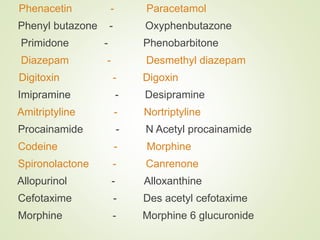
 B) Active drug to Active metabolite- active
metabolite
Effect is due to parent drug and its active
metabolite
Phenacetin - Paracetamol
Phenyl butazone - Oxyphenbutazone
Primidone - Phenobarbitone
Diazepam - Desmethyl diazepam
Digitoxin - Digoxin
Imipramine - Desipramine
Amitriptyline - Nortriptyline
Procainamide - N Acetyl procainamide
Codeine - Morphine
Spironolactone - Canrenone
Allopurinol - Alloxanthine
Cefotaxime - Des acetyl cefotaxime
Morphine - Morphine 6 glucuronide
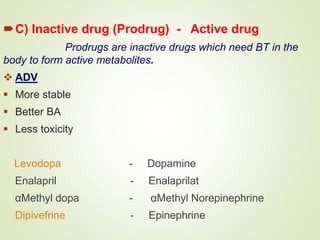
C) Inactive drug (Prodrug) - Active drug
Prodrugs are inactive drugs which need BT in the
body to form active metabolites.
 ADV
 More stable
 Better BA
 Less toxicity
Levodopa - Dopamine
Enalapril - Enalaprilat
αMethyl dopa - αMethyl Norepinephrine
Dipivefrine - Epinephrine
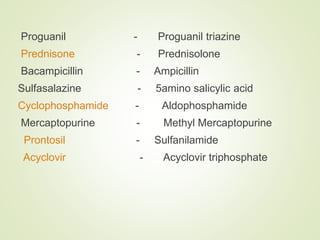
Proguanil - Proguanil triazine
Prednisone - Prednisolone
Bacampicillin - Ampicillin
Sulfasalazine - 5amino salicylic acid
Cyclophosphamide - Aldophosphamide
Mercaptopurine - Methyl Mercaptopurine
Prontosil - Sulfanilamide
Acyclovir - Acyclovir triphosphate
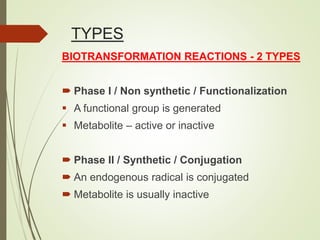
TYPES
BIOTRANSFORMATION REACTIONS - 2 TYPES
 Phase I / Non synthetic / Functionalization
 A functional group is generated
 Metabolite – active or inactive
 Phase II / Synthetic / Conjugation
 An endogenous radical is conjugated
 Metabolite is usually inactive
Phase I Reactions
 Oxidation
 Reduction
 Hydrolysis
 Cyclization
 Decyclization
Phase II Reactions
 Glucuronide conjugation
 Acetylation
 Methylation
 Sulfate conjugation
 Glycine conjugation
 Glutathione conjugation
 Ribonucleotide / Ribonucleoside synthesis
PHASE I REACTIONS
a) OXIDATION
 Addition of Oxygen / negatively charged
radical or removal of Hydrogen / Positively
charged radical
 Oxidation is the main process of metabolism
 Produces unstable intermediates - Epoxides,
Superoxides, Quinones
 Oxidation – 9 types
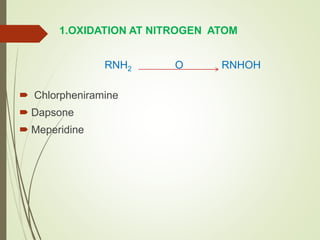
1.OXIDATION AT NITROGEN ATOM
RNH2 O RNHOH
 Chlorpheniramine
 Dapsone
 Meperidine
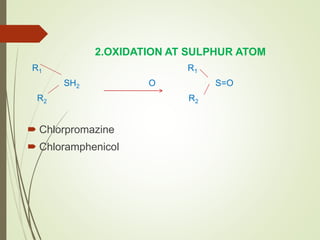
2.OXIDATION AT SULPHUR ATOM
R1 R1
SH2 O S=O
R2 R2
 Chlorpromazine
 Chloramphenicol
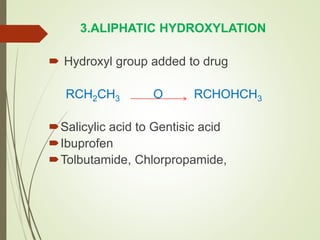
3.ALIPHATIC HYDROXYLATION
 Hydroxyl group added to drug
RCH2CH3 O RCHOHCH3
Salicylic acid to Gentisic acid
Ibuprofen
Tolbutamide, Chlorpropamide,
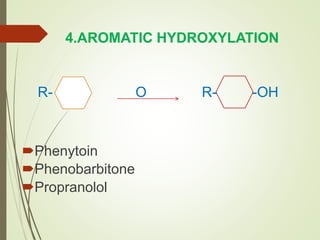
4.AROMATIC HYDROXYLATION
R- O R- -OH
Phenytoin
Phenobarbitone
Propranolol
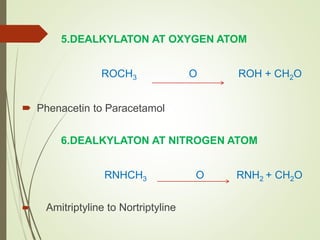
5.DEALKYLATON AT OXYGEN ATOM
ROCH3 O ROH + CH2O
 Phenacetin to Paracetamol
6.DEALKYLATON AT NITROGEN ATOM
RNHCH3 O RNH2 + CH2O
 Amitriptyline to Nortriptyline
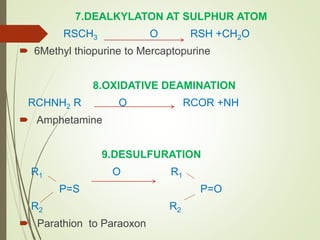
7.DEALKYLATON AT SULPHUR ATOM
RSCH3 O RSH +CH2O
 6Methyl thiopurine to Mercaptopurine
8.OXIDATIVE DEAMINATION
RCHNH2 R O RCOR +NH
 Amphetamine
9.DESULFURATION
R1 O R1
P=S P=O
R2 R2
 Parathion to Paraoxon
Main enzymes are the Oxygenases -
MICROSOMAL MONOOXYGENASES in liver
( Cytochrome p450/CYP )- drugs
CYP( 450)s require NADPH & Oxygen
Drug Metabolizing Enzymes – 2 types
 Microsomal – CYP 450, UDPGT
 Non microsomal – Flavoprotein oxidases,esterases…
NONMICROSOMAL OXIDATION
Mitochondrial enzymes -MAO—Oxidative
deamination of Adrenaline,5HT,Tyramine
Cytoplasmic enzymes - Dehydrogenases-
Alcohol oxidation to Acetaldehyde & Acetic
acid
Plasma oxidative enzymes- Histaminase,
Xanthine oxidase
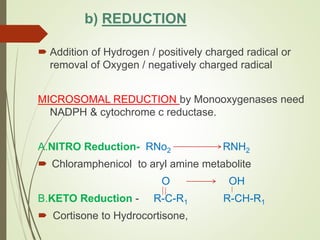
b) REDUCTION
 Addition of Hydrogen / positively charged radical or
removal of Oxygen / negatively charged radical
MICROSOMAL REDUCTION by Monooxygenases need
NADPH & cytochrome c reductase.
A.NITRO Reduction- RNo2 RNH2
 Chloramphenicol to aryl amine metabolite
O OH
B.KETO Reduction - R-C-R1 R-CH-R1
 Cortisone to Hydrocortisone,
C. AZO Reduction
 Prontosil to Sulfanilamide
NON MICROSOMAL REDUCTION
 Chloral hydrate to Trichloro ethanol,
c) HYDROLYSIS
 Drug is split combining with water
 Ester + water Esterases Alcohol & Acid
 Microsomal hydrolysis
Pethidine to meperidinic acid
 Non microsomal hydrolysis –
Esterases,Amidases & Peptidases
Atropine to Tropic acid
d) CYCLIZATION
 Formation of ring structure from a straight chain
compound. Eg: Proguanil
e) DE CYCLIZATION
 Ring structure opened
 Phenytoin, Barbiturates
PHASE II REACTIONS CONJUGATION
/ TRANSFER
 Drug / phase I metabolite combines with
endogenous substance derived from
carbohydrates/ proteins.
 covalent bond formation between functional group
of drug & endogenous substrate
 Endogenous-Glucuronic acid,Amino acids,
Sulfates,Acetates,Glutathione
 Represent terminal inactivation – True detoxification
reactions.
 Conjugates-
hydrophilic,
ionized,
↑mol.weight,
inactive
 Excreted in urine/ bile/ faeces.
 Phase II- need energy
 7 types of reactions
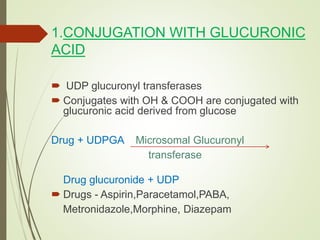
1.CONJUGATION WITH GLUCURONIC
ACID
 UDP glucuronyl transferases
 Conjugates with OH & COOH are conjugated with
glucuronic acid derived from glucose
Drug + UDPGA Microsomal Glucuronyl
transferase
Drug glucuronide + UDP
 Drugs - Aspirin,Paracetamol,PABA,
Metronidazole,Morphine, Diazepam
 ↑Mol.weight – favours biliary excretion
 Drug glucuronides excreted in bile are hydrolyzed
by intestinal microfloral enzymes - parent drug
released - reabsorbed into systemic circulation-
↓excretion ↑duration of action
- Oral contraceptives, Phenolphthalein
 Endogenous substrates - Steroid,Thyroxine,Bilirubin
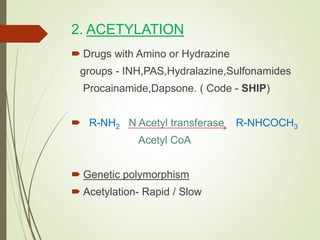
2. ACETYLATION
 Drugs with Amino or Hydrazine
groups - INH,PAS,Hydralazine,Sulfonamides
Procainamide,Dapsone. ( Code - SHIP)
 R-NH2 N Acetyl transferase R-NHCOCH3
Acetyl CoA
 Genetic polymorphism
 Acetylation- Rapid / Slow
3. CONJUGATION WITH SULFATE
 Drug groups-Amino, Hydroxyl
 Cytoplasmic Enzymes - Sulfotransferases /
Sulfokinases.
 Methyl dopa, Steroids,
Chloramphenicol, Warfarin
4. CONJUGATION WITH GLYCINE
 Drug group – Carboxylic acid
 Salicylic acid , Benzoic acid
5. CONJUGATION WITH GLUTATHIONE
 Drug groups-Epoxide, Quinone
 Toxic metabolites of Paracetamol, Ethacrynic acid
 Cytoplasmic Enzyme - Glutathione S- Transferase
6. METHYLATION
 Drugs with Amino & Phenol groups
 Histamine, Adrenaline, Nicotinic acid,
Dopamine, Methyl dopa, Captopril
 Enzyme- Methyl transferase
 Endogenous substance- Cysteine, Methionine
7. RIBONUCLEOTIDE /RIBONUCLEOSIDE
SYNTHESIS
 Action of Purine & Pyrimidine antimetabolites
 6 Mercaptopurine
INHIBITION OF DRUG METABOLISM
 One drug can inhibit the metabolism of another
drug
 ↑ in circulating levels of slowly metabolised drug
 Prolongation or potentiation of its effects
 Consequences
 Precipitate toxicity of the object drug.
 can be therapeutically beneficial. Eg:
aversion of alcohol with disulfiram, Reversal of
SKM paralysis of d-tc by neostigmine.
 Valproate
 Ketoconazole
 Cimetidine
 Ciprofloxacin
 Erythromycin
 INH
 Code – Vitamin K cannot cause enzyme
inhibition.
MICROSOMAL ENZYME INDUCTION
 Drugs, insecticides, carcinogens will induce
the synthesis of microsomal enzyme proteins
 Accelerated metabolism and reduced
pharmacological response
 Consequences
 Drug- drug interactions
 Can lead to toxicity. Eg: Alcoholics more
prone to hepatotoxicity of paracetamol due to↑
production of NABQI , Pptn of a/c intermittent
porphyria by barbiturates.
 Therapeutic benefit. Eg: To treat neonatal
jaundice
 Decreased duration of action. Eg: OCP failure
 Griseofulvin
 Phenytoin, Primidone
 Rifampicin
 Smoking
 Carbamazepine
 Phenobarbitone
 Code - GPRS Cell Phone
First Pass Metabolism
 Presystemic metabolism/ First pass effect
 Metabolism of a drug during its passage from the
site of absorption into the systemic circulation.
 ↓ed BA
 ↓ed therapeutic response
 SITES
 Gut wall
 Gut lumen
 Liver (major site)
 Lungs
 Skin
Attributes of drugs with FPM
Oral dose is higher than sublingual or parenteral.
Marked individual variation in oral dose –
difference in extent of FPM.
Oral BA is increased in patents with severe liver
disease.
Drugs with FPM usually have short plasma t1/2.
Oral BA is increased if another drug competing
with it in first pass metabolism is given
concurrently. Eg: CPZ & Propranolol
THANK YOU

Biotransformation (Drug Metabolism)

  • 1.
  • 2.
    OVERVIEW  Definition  Consequences Types  Phase I/II in detail  Enzyme Induction/Inhibition  First Pass Metabolism
  • 3.
     Xenobiotics- substancesforeign to body  include- Drugs, Processed food, Food additives, Cosmetic products, Environmental pollutants, Agrochemicals,  Phytoallexins (dietary plant toxins) Biotransformation needed for detoxification& protect the body from ingested toxins. INTRODUCTION
  • 4.
    Definition  Chemical alterationof drug in the body.  Non polar lipid soluble compounds are made polar lipid insoluble, so that they are easily excreted.  Drugs which do not undergo biotransformation – Streptomycin, neostigmine….(highly polar drugs)  SITES Primary site – Liver Others – Kidney, Intestine, Lungs, Plasma…
  • 5.
    Drug Biotransformation – convertlipophilic / hydrophobic drug (to enter cells) to hydrophilic metabolites. Advantages  Termination of drug action - (↓ toxicity)  Reduced lipophilicity.  Renal / biliary excretion ↑ - (↓renal reabs)
  • 6.
     Absorbed drugs– 3 changes Metabolic changes by Enzymes ( Microsomal, Cytoplasmic, Mitochondrial) Spontaneous Molecular rearrangement – HOFMANN ELIMINATION Excreted unchanged (highly polar drugs) - Aminoglycosides,Methotrexate,Neostigmine
  • 7.
    CONSEQUENCES A) Drug inactivation- inactive or less active Propranolol,Pentobarbitone,Morphine, Chloramphenicol,Paracetamol,Ibuprofen, lignocaine  B) Active drug to Active metabolite- active metabolite Effect is due to parent drug and its active metabolite
  • 8.
    Phenacetin - Paracetamol Phenylbutazone - Oxyphenbutazone Primidone - Phenobarbitone Diazepam - Desmethyl diazepam Digitoxin - Digoxin Imipramine - Desipramine Amitriptyline - Nortriptyline Procainamide - N Acetyl procainamide Codeine - Morphine Spironolactone - Canrenone Allopurinol - Alloxanthine Cefotaxime - Des acetyl cefotaxime Morphine - Morphine 6 glucuronide
  • 9.
    C) Inactive drug(Prodrug) - Active drug Prodrugs are inactive drugs which need BT in the body to form active metabolites.  ADV  More stable  Better BA  Less toxicity Levodopa - Dopamine Enalapril - Enalaprilat αMethyl dopa - αMethyl Norepinephrine Dipivefrine - Epinephrine
  • 10.
    Proguanil - Proguaniltriazine Prednisone - Prednisolone Bacampicillin - Ampicillin Sulfasalazine - 5amino salicylic acid Cyclophosphamide - Aldophosphamide Mercaptopurine - Methyl Mercaptopurine Prontosil - Sulfanilamide Acyclovir - Acyclovir triphosphate
  • 11.
    TYPES BIOTRANSFORMATION REACTIONS -2 TYPES  Phase I / Non synthetic / Functionalization  A functional group is generated  Metabolite – active or inactive  Phase II / Synthetic / Conjugation  An endogenous radical is conjugated  Metabolite is usually inactive
  • 12.
    Phase I Reactions Oxidation  Reduction  Hydrolysis  Cyclization  Decyclization
  • 13.
    Phase II Reactions Glucuronide conjugation  Acetylation  Methylation  Sulfate conjugation  Glycine conjugation  Glutathione conjugation  Ribonucleotide / Ribonucleoside synthesis
  • 14.
    PHASE I REACTIONS a)OXIDATION  Addition of Oxygen / negatively charged radical or removal of Hydrogen / Positively charged radical  Oxidation is the main process of metabolism  Produces unstable intermediates - Epoxides, Superoxides, Quinones  Oxidation – 9 types
  • 15.
    1.OXIDATION AT NITROGENATOM RNH2 O RNHOH  Chlorpheniramine  Dapsone  Meperidine
  • 16.
    2.OXIDATION AT SULPHURATOM R1 R1 SH2 O S=O R2 R2  Chlorpromazine  Chloramphenicol
  • 17.
    3.ALIPHATIC HYDROXYLATION  Hydroxylgroup added to drug RCH2CH3 O RCHOHCH3 Salicylic acid to Gentisic acid Ibuprofen Tolbutamide, Chlorpropamide,
  • 18.
    4.AROMATIC HYDROXYLATION R- OR- -OH Phenytoin Phenobarbitone Propranolol
  • 19.
    5.DEALKYLATON AT OXYGENATOM ROCH3 O ROH + CH2O  Phenacetin to Paracetamol 6.DEALKYLATON AT NITROGEN ATOM RNHCH3 O RNH2 + CH2O  Amitriptyline to Nortriptyline
  • 20.
    7.DEALKYLATON AT SULPHURATOM RSCH3 O RSH +CH2O  6Methyl thiopurine to Mercaptopurine 8.OXIDATIVE DEAMINATION RCHNH2 R O RCOR +NH  Amphetamine 9.DESULFURATION R1 O R1 P=S P=O R2 R2  Parathion to Paraoxon
  • 21.
    Main enzymes arethe Oxygenases - MICROSOMAL MONOOXYGENASES in liver ( Cytochrome p450/CYP )- drugs CYP( 450)s require NADPH & Oxygen Drug Metabolizing Enzymes – 2 types  Microsomal – CYP 450, UDPGT  Non microsomal – Flavoprotein oxidases,esterases…
  • 22.
    NONMICROSOMAL OXIDATION Mitochondrial enzymes-MAO—Oxidative deamination of Adrenaline,5HT,Tyramine Cytoplasmic enzymes - Dehydrogenases- Alcohol oxidation to Acetaldehyde & Acetic acid Plasma oxidative enzymes- Histaminase, Xanthine oxidase
  • 23.
    b) REDUCTION  Additionof Hydrogen / positively charged radical or removal of Oxygen / negatively charged radical MICROSOMAL REDUCTION by Monooxygenases need NADPH & cytochrome c reductase. A.NITRO Reduction- RNo2 RNH2  Chloramphenicol to aryl amine metabolite O OH B.KETO Reduction - R-C-R1 R-CH-R1  Cortisone to Hydrocortisone,
  • 24.
    C. AZO Reduction Prontosil to Sulfanilamide NON MICROSOMAL REDUCTION  Chloral hydrate to Trichloro ethanol,
  • 25.
    c) HYDROLYSIS  Drugis split combining with water  Ester + water Esterases Alcohol & Acid  Microsomal hydrolysis Pethidine to meperidinic acid  Non microsomal hydrolysis – Esterases,Amidases & Peptidases Atropine to Tropic acid
  • 26.
    d) CYCLIZATION  Formationof ring structure from a straight chain compound. Eg: Proguanil e) DE CYCLIZATION  Ring structure opened  Phenytoin, Barbiturates
  • 27.
    PHASE II REACTIONSCONJUGATION / TRANSFER  Drug / phase I metabolite combines with endogenous substance derived from carbohydrates/ proteins.  covalent bond formation between functional group of drug & endogenous substrate  Endogenous-Glucuronic acid,Amino acids, Sulfates,Acetates,Glutathione  Represent terminal inactivation – True detoxification reactions.
  • 28.
     Conjugates- hydrophilic, ionized, ↑mol.weight, inactive  Excretedin urine/ bile/ faeces.  Phase II- need energy  7 types of reactions
  • 29.
    1.CONJUGATION WITH GLUCURONIC ACID UDP glucuronyl transferases  Conjugates with OH & COOH are conjugated with glucuronic acid derived from glucose Drug + UDPGA Microsomal Glucuronyl transferase Drug glucuronide + UDP  Drugs - Aspirin,Paracetamol,PABA, Metronidazole,Morphine, Diazepam
  • 30.
     ↑Mol.weight –favours biliary excretion  Drug glucuronides excreted in bile are hydrolyzed by intestinal microfloral enzymes - parent drug released - reabsorbed into systemic circulation- ↓excretion ↑duration of action - Oral contraceptives, Phenolphthalein  Endogenous substrates - Steroid,Thyroxine,Bilirubin
  • 31.
    2. ACETYLATION  Drugswith Amino or Hydrazine groups - INH,PAS,Hydralazine,Sulfonamides Procainamide,Dapsone. ( Code - SHIP)  R-NH2 N Acetyl transferase R-NHCOCH3 Acetyl CoA  Genetic polymorphism  Acetylation- Rapid / Slow
  • 32.
    3. CONJUGATION WITHSULFATE  Drug groups-Amino, Hydroxyl  Cytoplasmic Enzymes - Sulfotransferases / Sulfokinases.  Methyl dopa, Steroids, Chloramphenicol, Warfarin
  • 33.
    4. CONJUGATION WITHGLYCINE  Drug group – Carboxylic acid  Salicylic acid , Benzoic acid 5. CONJUGATION WITH GLUTATHIONE  Drug groups-Epoxide, Quinone  Toxic metabolites of Paracetamol, Ethacrynic acid  Cytoplasmic Enzyme - Glutathione S- Transferase
  • 34.
    6. METHYLATION  Drugswith Amino & Phenol groups  Histamine, Adrenaline, Nicotinic acid, Dopamine, Methyl dopa, Captopril  Enzyme- Methyl transferase  Endogenous substance- Cysteine, Methionine
  • 35.
    7. RIBONUCLEOTIDE /RIBONUCLEOSIDE SYNTHESIS Action of Purine & Pyrimidine antimetabolites  6 Mercaptopurine
  • 36.
    INHIBITION OF DRUGMETABOLISM  One drug can inhibit the metabolism of another drug  ↑ in circulating levels of slowly metabolised drug  Prolongation or potentiation of its effects  Consequences  Precipitate toxicity of the object drug.  can be therapeutically beneficial. Eg: aversion of alcohol with disulfiram, Reversal of SKM paralysis of d-tc by neostigmine.
  • 37.
     Valproate  Ketoconazole Cimetidine  Ciprofloxacin  Erythromycin  INH  Code – Vitamin K cannot cause enzyme inhibition.
  • 38.
    MICROSOMAL ENZYME INDUCTION Drugs, insecticides, carcinogens will induce the synthesis of microsomal enzyme proteins  Accelerated metabolism and reduced pharmacological response  Consequences  Drug- drug interactions  Can lead to toxicity. Eg: Alcoholics more prone to hepatotoxicity of paracetamol due to↑ production of NABQI , Pptn of a/c intermittent porphyria by barbiturates.
  • 39.
     Therapeutic benefit.Eg: To treat neonatal jaundice  Decreased duration of action. Eg: OCP failure  Griseofulvin  Phenytoin, Primidone  Rifampicin  Smoking  Carbamazepine  Phenobarbitone  Code - GPRS Cell Phone
  • 40.
    First Pass Metabolism Presystemic metabolism/ First pass effect  Metabolism of a drug during its passage from the site of absorption into the systemic circulation.  ↓ed BA  ↓ed therapeutic response  SITES  Gut wall  Gut lumen  Liver (major site)  Lungs  Skin
  • 41.
    Attributes of drugswith FPM Oral dose is higher than sublingual or parenteral. Marked individual variation in oral dose – difference in extent of FPM. Oral BA is increased in patents with severe liver disease. Drugs with FPM usually have short plasma t1/2. Oral BA is increased if another drug competing with it in first pass metabolism is given concurrently. Eg: CPZ & Propranolol
  • 42.