Ann Marris Montessori School By: Sir Nolie
ault
Convection- the total rising and sinking
of the molten rocks in the mantle
-a fracture in the crust of a planet or
moon accompanied by a displacement
of one side of the fracture with respect
to the outer usually in a direction
parallel to the fracture
Depending on the movement under the crust
faults are classified into different kinds.
FAULT
Dip- slip Strike-slip Oblique -Slip
Normal
Reverse
Right-lateral Left-lateral
Active and Inactive Fault
-An active fault is likely to cause another
earthquake sometime in the future.
--faults are considered to be active if they have
moved one or more times in at least 10,000
years.
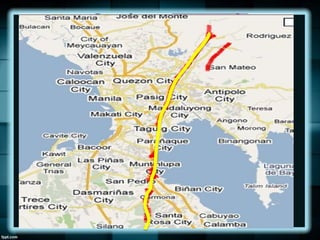
* Example is the Philippine West Valley
Fault Line System and the Philippine Fault
Classification of Faults
Dip-Slip
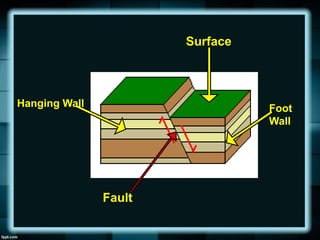
A dip-slip fault occurs when the ground
breaks into two parts, having an angle about
45°- 65° with the surface. The lower broken
pieces is the footwall while the higher piece
is the hanging wall.
Surface
Hanging Wall Foot
Wall
Fault
Normal Dip-slip Fault
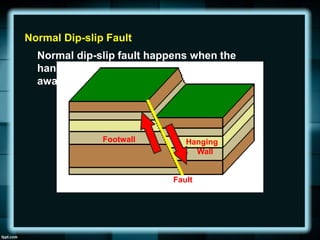
Normal dip-slip fault happens when the
hanging wall slowly moves downward and
away from the foot wall.
Footwall Hanging
Wall
Fault
Reverse Dip-slip Fault
When the hanging wall moves up and above
the foot wall, reverse dip-slip fault occurs.
Footwall
Hanging
Wall
Fault
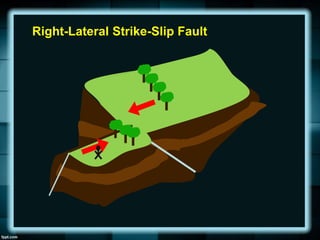
Strike-slip Fault
-rocks along the fault are colliding past
each other, causing a sort of dislocation
in nearby land areas.
-at first, a strike-slip fault looks like a
shallow crack on the ground. But
because of weathering and continuous
friction and movement between faults,
earthquake occurs.
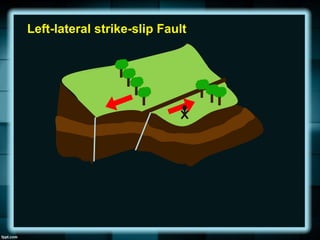
Left-lateral strike-slip Fault
Right-Lateral Strike-Slip Fault
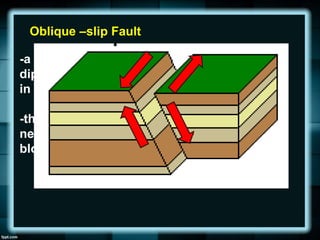
Oblique –slip Fault
-a combination of movements causing, a
dip-slip fault and a strike –slip fault results
in an oblique-slip fault.
-this fault is produced if one block moves
neither downward or upward while the other
block moves to the left or to the right.
Always Remember
“The Earth’s crust can
change quickly, and
earthquake causes these
changes.”

Fault (Science 8)

  • 1.
    Ann Marris MontessoriSchool By: Sir Nolie ault
  • 2.
    Convection- the totalrising and sinking of the molten rocks in the mantle -a fracture in the crust of a planet or moon accompanied by a displacement of one side of the fracture with respect to the outer usually in a direction parallel to the fracture
  • 3.
    Depending on themovement under the crust faults are classified into different kinds. FAULT Dip- slip Strike-slip Oblique -Slip Normal Reverse Right-lateral Left-lateral
  • 4.
    Active and InactiveFault -An active fault is likely to cause another earthquake sometime in the future. --faults are considered to be active if they have moved one or more times in at least 10,000 years. * Example is the Philippine West Valley Fault Line System and the Philippine Fault
  • 6.
    Classification of Faults Dip-Slip Adip-slip fault occurs when the ground breaks into two parts, having an angle about 45°- 65° with the surface. The lower broken pieces is the footwall while the higher piece is the hanging wall.
  • 7.
  • 8.
    Normal Dip-slip Fault Normaldip-slip fault happens when the hanging wall slowly moves downward and away from the foot wall. Footwall Hanging Wall Fault
  • 9.
    Reverse Dip-slip Fault Whenthe hanging wall moves up and above the foot wall, reverse dip-slip fault occurs. Footwall Hanging Wall Fault
  • 10.
    Strike-slip Fault -rocks alongthe fault are colliding past each other, causing a sort of dislocation in nearby land areas. -at first, a strike-slip fault looks like a shallow crack on the ground. But because of weathering and continuous friction and movement between faults, earthquake occurs.
  • 11.
  • 12.
  • 13.
    Oblique –slip Fault -acombination of movements causing, a dip-slip fault and a strike –slip fault results in an oblique-slip fault. -this fault is produced if one block moves neither downward or upward while the other block moves to the left or to the right.
  • 14.
    Always Remember “The Earth’scrust can change quickly, and earthquake causes these changes.”