INTRODUCING PLANTS
PLANTS  -  THE BASICS A huge variety of plants in the world Live in almost every habitat Can survive the harshest environments The link between the sun and all other living things Maintain the balance of atmospheric gases
MORE PLANT BASICS They regulate the water content of the soil They provide habitats for other organisms And ……….
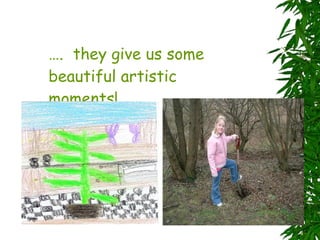
… .  they give us some beautiful artistic moments!
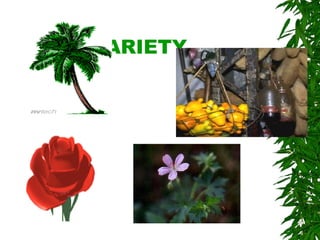
VARIETY
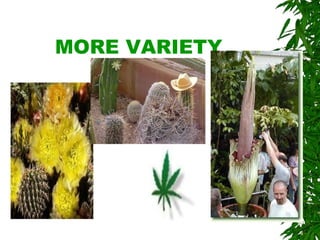
MORE VARIETY
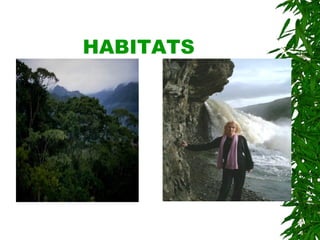
HABITATS
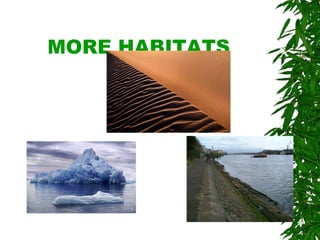
MORE HABITATS
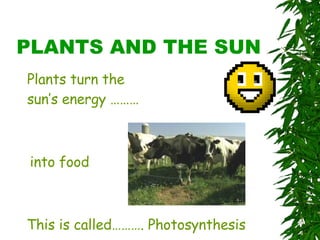
PLANTS AND THE SUN Plants turn the sun’s energy ……… into food This is called………. Photosynthesis
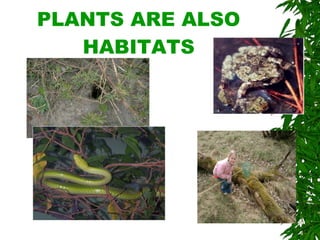
PLANTS ARE ALSO HABITATS
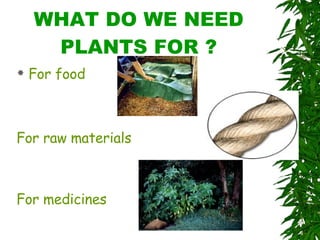
WHAT DO WE NEED PLANTS FOR ? For food For raw materials For medicines
PLANTS AS FOODS Cereals such as rice,maize,and wheat form the staple foods of most countries Vegetables and fruits add variety to our diets Herbs,spices,sugar,tea,coffee and nuts are all plants and…… we get chocolate from  plants !!!!!
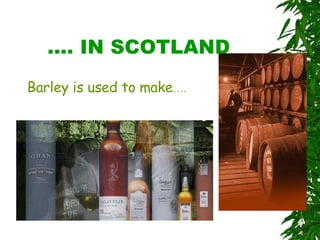
…. IN SCOTLAND Barley is used to make ….
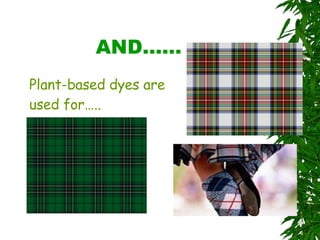
AND…… Plant-based dyes are used for…..
PLANTS AS MEDICINES Known about since 2000BC Used for pain relief, reducing fever, sedation and upset stomach, and curing infections Many are used for treating cancer ……And many more medicinal uses
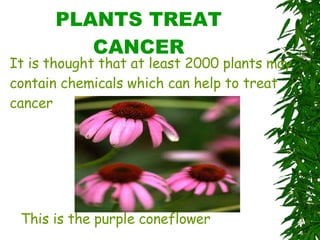
PLANTS TREAT CANCER It is thought that at least 2000 plants may contain chemicals which can help to treat cancer This is the purple coneflower
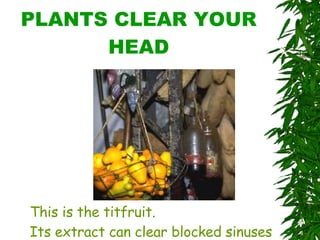
PLANTS CLEAR YOUR HEAD This is the titfruit.  Its extract can clear blocked sinuses
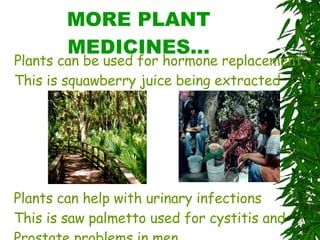
MORE PLANT MEDICINES… Plants can be used for hormone replacement This is squawberry juice being extracted Plants can help with urinary infections This is saw palmetto used for cystitis and  Prostate problems in men
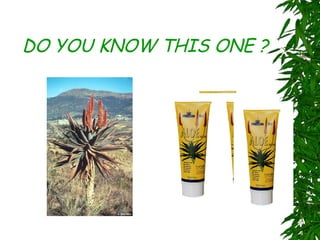
DO YOU KNOW THIS ONE ?
PLANTS AS MATERIALS Cotton for clothes and linens Jute and hemp for rope Trees for timber Rape seeds for oil Seaweeds for alginates How many more can you think of ?
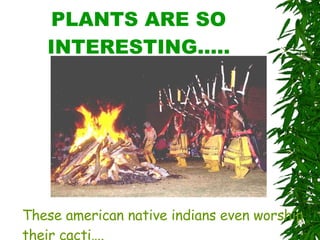
PLANTS ARE SO INTERESTING….. These american native indians even worship their cacti….
SO…… PLANTS ARE ? Much more complex and varied than you knew
“ World of plants” will show you how and why .
Ecological loss Tropical rainforests have the greatest variety of plants on earth There loss is disastrous For every type of plant that becomes extinct a wide variety of other dependent organisms are also endangered. For every species of plant that becomes extinct,four species of animal also die out,upsetting the balance of life on earth
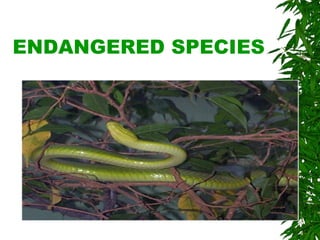
ENDANGERED SPECIES
 
FOOD PLANTS MOST OF THE WORLDS FOOD COMES FROM A VERY FEW TYPES OF PLANTS AS THE POPULATION INCREASES,THEN SOME OTHER TYPES OF PLANT WHICH ARE NOT WELL KNOWN MIGHT PROVIDE FOOD
EVEN FLOWERS !
MEDICINAL PLANTS Many important medicines come from plants In the future,possible medicines may never be discovered if the plants are made extinct by destroying the rainforests.
WILD PLANTS…… Wild plants also contain many different characteristics … .and different genes which could be useful in the future. … .. So its important to protect the wild varieties for possible future use. THIS IS CALLED A GENETIC STOREHOUSE
GENETIC STOREHOUSE Cultivated plants have been bred to be very alike They contain almost exactly the same genes If a new disease infected one,it could easily damage all of them Wild varieties are often resistant to many different diseases It is possible to cross-breed them with cultivated plants to increase the resistance to disease
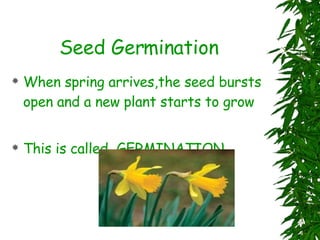
Seed Germination When spring arrives,the seed bursts open and a new plant starts to grow This is called  GERMINATION
What’s in a seed ? Seeds usually have a hard coat.  This is also called  the  TESTA It’s a tough,fibrous layer which protects the internal structures of the seed Lets have a look at the inside of a seed
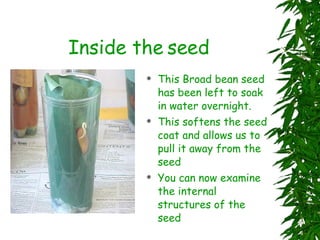
Inside the seed This Broad bean seed has been left to soak in water overnight. This softens the seed coat and allows us to pull it away from the seed You can now examine the internal structures of the seed
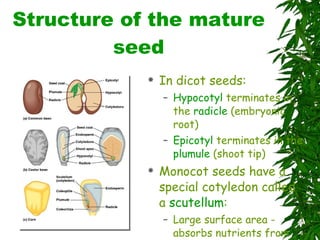
Structure of the mature seed In dicot seeds: Hypocotyl  terminates in the  radicle  (embryonic root) Epicotyl  terminates in the  plumule  (shoot tip) Monocot seeds have a special cotyledon called a  scutellum : Large surface area - absorbs nutrients from endosperm during germination Embryo enclosed in sheath: Coleoptile  protects the shoot Coleorhiza  protects the root
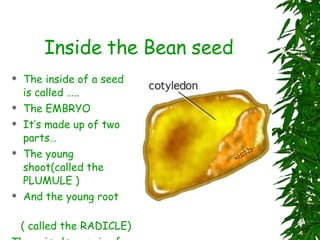
Inside the Bean seed The inside of a seed is called ….. The EMBRYO It’s made up of two parts… The young shoot(called the PLUMULE ) And the young root  ( called the RADICLE) There is also a pair of seed leaves (called COTYLEDONS) they act as a food store
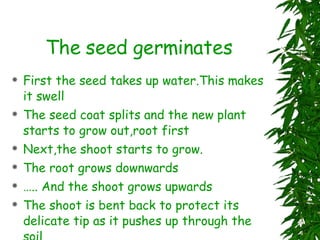
The seed germinates First the seed takes up water.This makes it swell The seed coat splits and the new plant starts to grow out,root first Next,the shoot starts to grow. The root grows downwards  … .. And the shoot grows upwards The shoot is bent back to protect its delicate tip as it pushes up through the soil
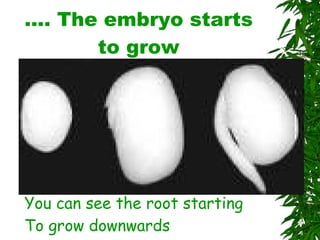
…. The embryo starts to grow You can see the root starting  To grow downwards
Germination continues…. The root tip is protected from damage as it grows down through the soil by a mass of cells called the Root Cap The root grows tiny side branches to help anchor the young plant into the ground These hairs also increase the surface area for absorbtion
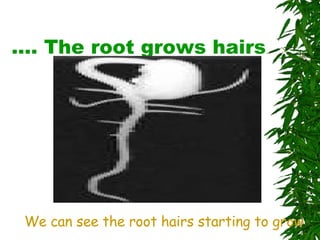
…. The root grows hairs We can see the root hairs starting to grow
Roots – function and structure Hold plant in position Absorb water and minerals from the soil Specialised cells to increase surface area for water intake
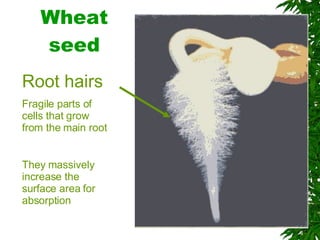
Wheat seed Root hairs   Fragile parts of cells that grow from the main root They massively increase the surface area for absorption
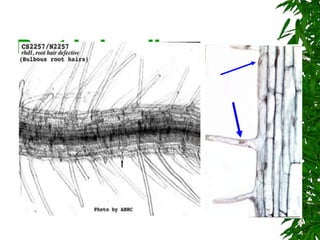
Root hair cells  (x150)
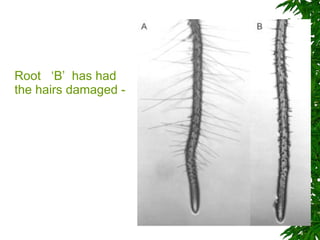
Root  ‘B’  has had the hairs damaged -
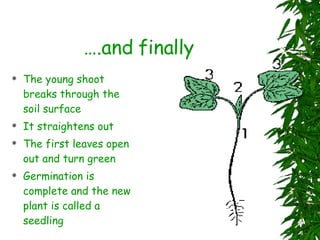
… .and finally The young shoot breaks through the soil surface It straightens out The first leaves open out and turn green Germination is complete and the new plant is called a seedling
Factors affecting germination Temperature. Warmth is needed by most seeds.This is why they don’t germinate until the spring Water is needed for the seed to swell and burst open. It is also necessary for the stored food to be made soluble and moved to the growing embryo Oxygen is needed for the embryo to respire.It supplies the embryo with the energy to grow and develop
What about light ? Most seeds will germinate in light or dark conditions However some will only germinate in one or the other. The amount of light needed may be very small.One quick flash is enough in some cases All plants need light once the shoot breaks through the surface of the soil. This is to make the leaves open out and form CHLOROPHYLL FOR PHOTOSYNTHESIS
CRESS SEEDS GERMINATING
REPRODUCTION IN FLOWERING PLANTS
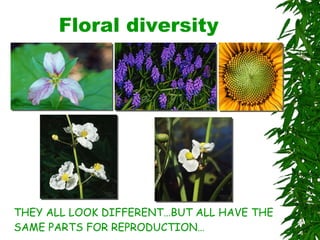
Floral diversity THEY ALL LOOK DIFFERENT…BUT ALL HAVE THE SAME PARTS FOR REPRODUCTION…
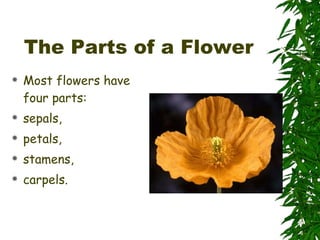
The Parts of a Flower Most flowers have four parts: sepals, petals, stamens, carpels.
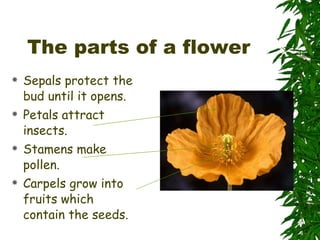
The parts of a flower Sepals protect the bud until it opens. Petals attract insects. Stamens make pollen. Carpels grow into fruits which contain the seeds.
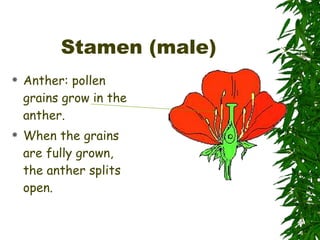
Stamen (male) Anther: pollen grains grow in the anther. When the grains are fully grown, the anther splits open.
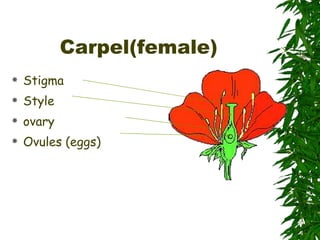
Carpel(female) Stigma Style ovary Ovules (eggs)
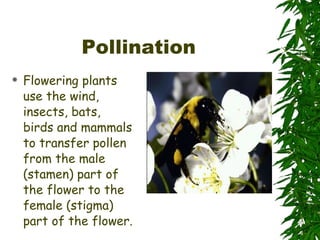
Pollination Flowering plants use the wind, insects, bats, birds and mammals to transfer pollen from the male (stamen) part of the flower to the female (stigma) part of the flower.
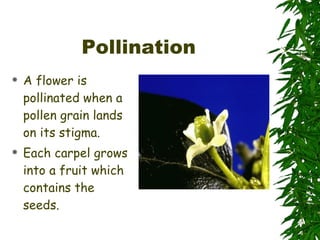
Pollination A flower is pollinated when a pollen grain lands on its stigma. Each carpel grows into a fruit which contains the seeds.
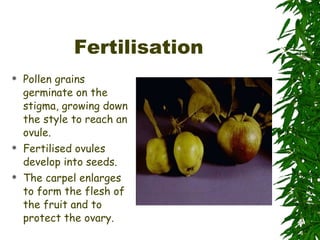
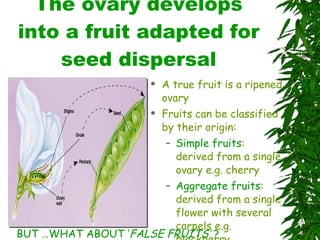
Fertilisation Pollen grains germinate on the stigma, growing down the style to reach an ovule. Fertilised ovules develop into seeds. The carpel enlarges to form the flesh of the fruit and to protect the ovary.
The ovary develops into a fruit adapted for seed dispersal A true fruit is a ripened ovary Fruits can be classified by their origin: Simple fruits : derived from a single ovary e.g. cherry Aggregate fruits : derived from a single flower with several carpels e.g. blackberry BUT …WHAT ABOUT ‘ FALSE FRUITS’  ?
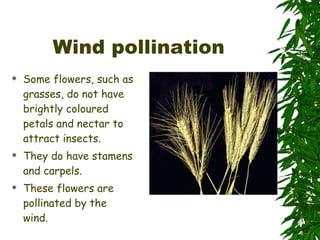
Wind pollination Some flowers, such as grasses, do not have brightly coloured petals and nectar to attract insects. They do have stamens and carpels. These flowers are pollinated by the wind.
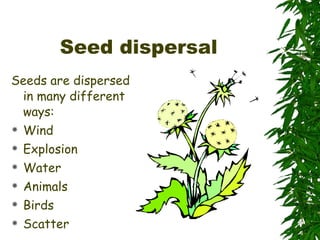
Seed dispersal Seeds are dispersed in many different ways: Wind Explosion Water Animals Birds Scatter
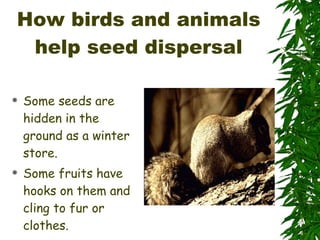
How birds and animals help seed dispersal Some seeds are hidden in the ground as a winter store. Some fruits have hooks on them and cling to fur or clothes.
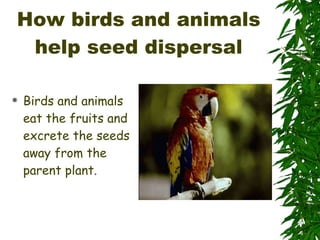
How birds and animals help seed dispersal Birds and animals eat the fruits and excrete the seeds away from the parent plant.
ASEXUAL REPRODUCTION Plants can be produced by a single parent No need for sex cells and fertilisation Because of this, there will be NO variation and new plants formed will be…. GENETICALLY IDENTICAL to one another AND to their parent Asexual reproduction in plants is known as VEGETATIVE PROPAGATION.
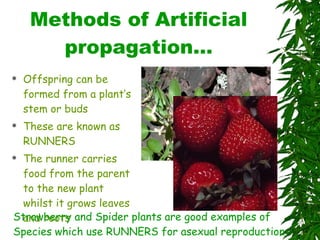
Methods of Artificial propagation… Offspring can be formed from a plant’s stem or buds These are known as RUNNERS The runner carries food from the parent to the new plant whilst it grows leaves and roots Strawberry and Spider plants are good examples of Species which use RUNNERS for asexual reproduction
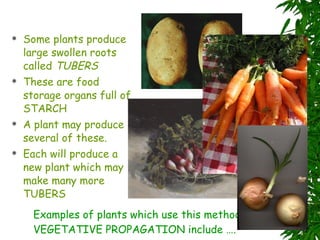
Some plants produce large swollen roots called  TUBERS These are food storage organs full of STARCH A plant may produce several of these. Each will produce a new plant which may make many more TUBERS Examples of plants which use this method of VEGETATIVE PROPAGATION include ….
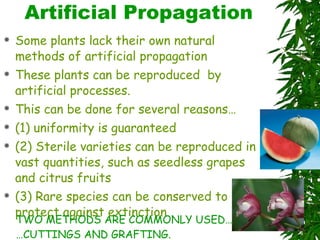
Artificial Propagation Some plants lack their own natural methods of artificial propagation These plants can be reproduced  by artificial processes. This can be done for several reasons…  (1) uniformity is guaranteed (2) Sterile varieties can be reproduced in vast quantities, such as seedless grapes and citrus fruits (3) Rare species can be conserved to protect against extinction TWO METHODS ARE COMMONLY USED… … CUTTINGS AND GRAFTING.
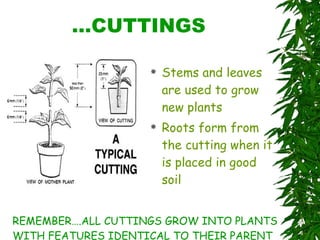
…CUTTINGS Stems and leaves are used to grow new plants Roots form from the cutting when it is placed in good soil REMEMBER….ALL CUTTINGS GROW INTO PLANTS WITH FEATURES IDENTICAL TO THEIR PARENT
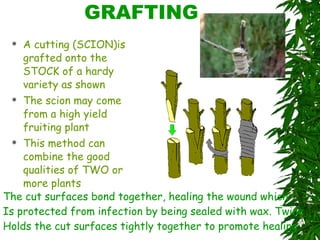
GRAFTING A cutting (SCION)is grafted onto the STOCK of a hardy variety as shown The scion may come from a high yield fruiting plant This method can combine the good qualities of TWO or more plants  The cut surfaces bond together, healing the wound which Is protected from infection by being sealed with wax. Twine Holds the cut surfaces tightly together to promote healing
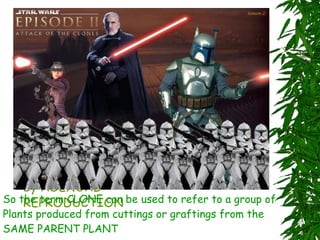
Are these plants  clones  YES…THEY ARE A CLONE is a group of organisms which have exactly the same genetic info and have been produced from a common ancestor by ASEXUAL REPRODUCTION So the term CLONE can be used to refer to a group of  Plants produced from cuttings or graftings from the  SAME PARENT PLANT
There are two film clips coming next They show cutting and grafting taking place in the south of the USA Please be patient…they take a few seconds to load You can only see them if you are watching this presentation on a computer logged on to the internet
 
 
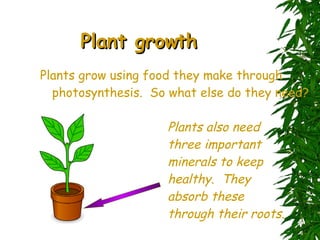
Plant growth Plants grow using food they make through photosynthesis.  So what else do they need? Plants also need three important minerals to keep healthy.  They absorb these through their roots.
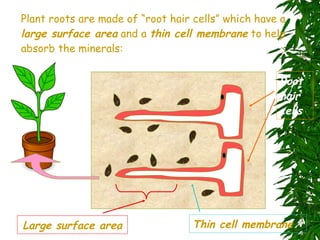
Root hair cells Plant roots are made of “root hair cells” which have a  large surface area  and a  thin cell membrane  to help absorb the minerals: Thin cell membrane Large surface area
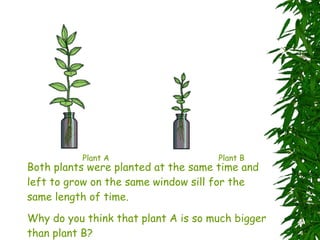
Plant A Plant B Both plants were planted at the same time and left to grow on the same window sill for the same length of time.  Why do you think that plant A is so much bigger than plant B?
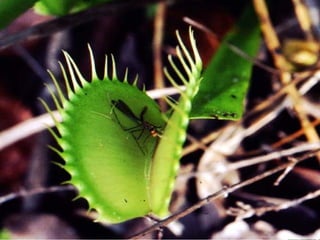
How do plants get the minerals they need? The plant takes in minerals from the soil. It absorbs these minerals through their roots.  Remember a plant does not get food from the soil it is capable of making its own food Some plants which grow on poor soil have evolved a clever way to get the nutrients they need.  Where do you think they get them from?
 
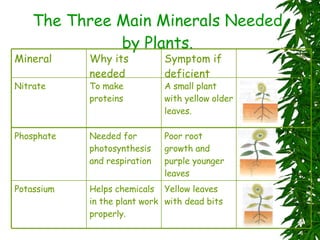
The three main types of nutrient are: Nitrates  – used to make proteins Phosphates  – used to provide phosphorus to help photosynthesis and respiration Potassium  – helps the enzymes that are needed for photosynthesis and respiration
Lack of the three minerals would lead to a “Deficiency Symptom”: Lack of nitrates: Small plant, yellow leaves Lack of phosphates: Small roots and purple leaves Lack of potassium: Yellow leaves with dead bits
The Three Main Minerals Needed by Plants. A small plant with yellow older leaves. To make proteins Nitrate Symptom if deficient Why its needed Mineral Yellow leaves with dead bits Helps chemicals in the plant work properly. Potassium Poor root growth and purple younger leaves Needed for photosynthesis and respiration Phosphate
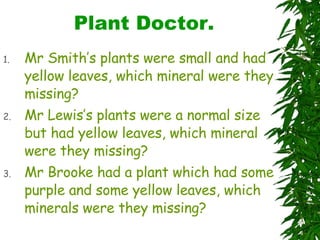
Plant Doctor. Mr Smith’s plants were small and had yellow leaves, which mineral were they missing? Mr Lewis’s plants were a normal size but had yellow leaves, which mineral were they missing?  Mr Brooke had a plant which had some purple and some yellow leaves, which minerals were they missing?
The Transport System There are a set of tube-like tissues that go up and down the leaf stem and shoots that transport the other essential ingredients for photosynthesis : water and minerals There are two tubes called  xylem  and  phloem  tissues.
The Transport System The  xylem  brings up the water from the roots The  phloem  takes away the sugars made by the chloroplasts to places where the energy is needed The tubes are in the middle of the leaf so that there are near all the cells to bring up water and to take away sugars.
 
The transport system The transport system is far less elaborate than in mammals due to: plants are less active and therefore ‘supplies’ don’t run out so quickly because of the branching system, gases for respiration and photosynthesis. Can be obtained from diffusion in the air two separate systems; xylem and phloem
Xylem Xylem carries the water and minerals It is made of many hollow dead cells joined end to end of which the end cell wall has disappeared to form a long tube  Xylem vessels run from root to every leaf Xylem vessels contain no cytoplasm or nuclei Their walls are made of cellulose and lignin Lignin is very strong and so xylem help keep the plant upright
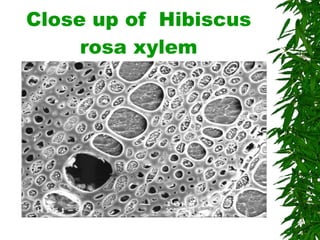
Close up of  Hibiscus rosa xylem
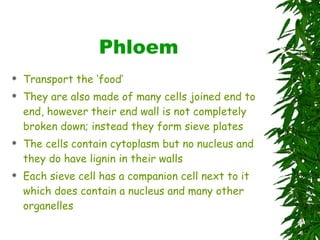
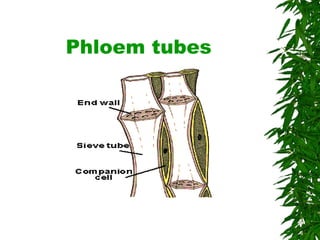
Phloem Transport the ‘food’ They are also made of many cells joined end to end, however their end wall is not completely broken down; instead they form sieve plates The cells contain cytoplasm but no nucleus and they do have lignin in their walls Each sieve cell has a companion cell next to it which does contain a nucleus and many other organelles
Phloem tubes
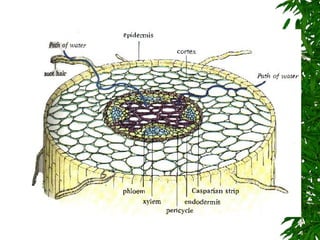
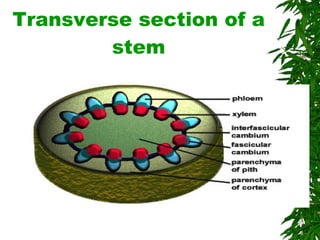
Vascular bundles Xylem and phloem tubes are normally found close together, when they are this is called a vascular bundle In a root vascular tissue is found at the centre In a shoot they are found near the outside edge to help support the plant
Transverse section of a stem
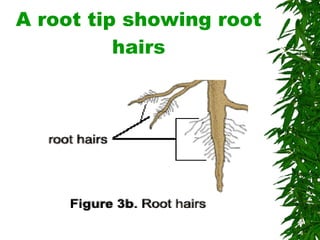
The transport of water Plants take in water from the soil through the root hairs and is carried in the xylem throughout the plant Water gets into root hair by osmosis. The cytoplasm and cell sap inside it are quite concentrated solutions and the water in soil is normally quite dilute Water therefore diffuses down its concentration gradient through a partially permeable membrane
A root tip showing root hairs
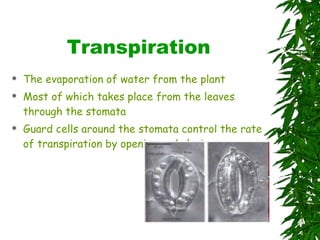
Transpiration The evaporation of water from the plant Most of which takes place from the leaves through the stomata Guard cells around the stomata control the rate of transpiration by opening and closing
Transpiration When water is lost through transpiration water from the xylem vessel in the leaf will travel to the cells to replace it Water is constantly being taken from the top of the xylem vessel to supply the cells in the leaves This reduces the pressure at the top of the xylem so water flows up This process is known as the transpiration stream
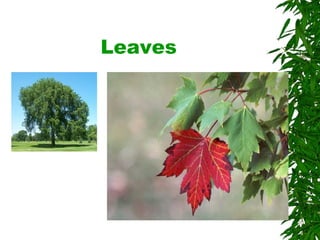
Leaves
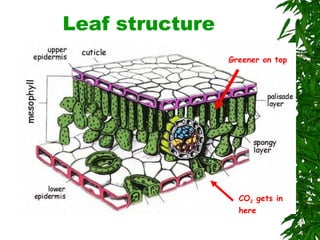
THE LEAF! A leaf is an example of a plant organ It is composed of many tissues that work  together . The tissues are designed to maximise the levels of photosynthesis.
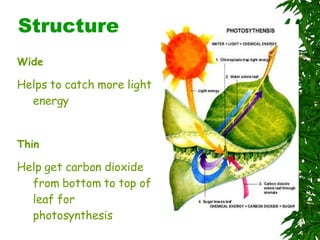
Function of leaves Trap light energy for photosynthesis Producing sugar from photosynthesis Exchange of gases –  oxygen and carbon dioxide
Structure Wide Helps to catch more light energy Thin Help get carbon dioxide from bottom to top of leaf for photosynthesis
Leaf structure Greener on top CO 2  gets in here
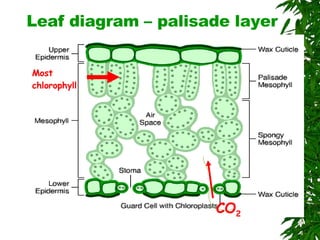
Leaf diagram – palisade layer CO 2 Most chlorophyll
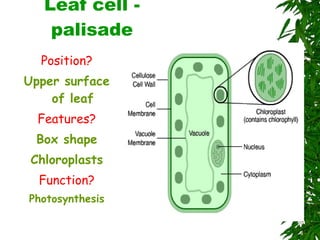
Leaf cell - palisade Position? Upper surface of leaf Features? Box shape Chloroplasts Function? Photosynthesis
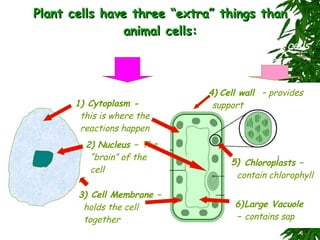
Plant cells have three “extra” things than animal cells: Both types of cell have these: Only plant cells have these: 4) Cell wall   – provides support Large Vacuole –  contains sap Chloroplasts –  contain chlorophyll 1) 5) 6) 2) 3) Cell Membrane –  holds the cell together Cytoplasm -  this is where the reactions happen Nucleus –  The “brain” of the cell
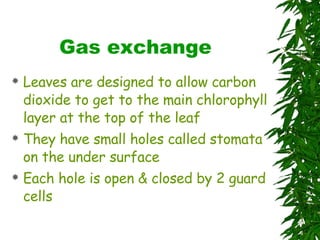
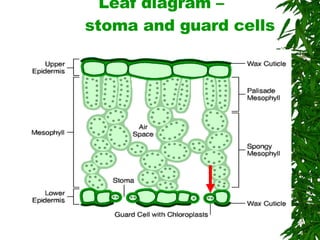
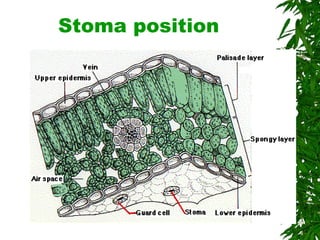
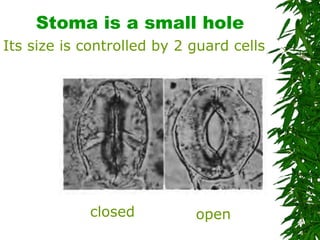
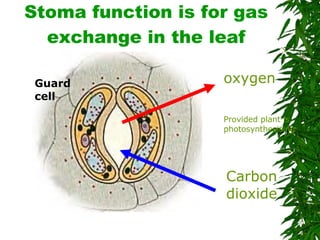
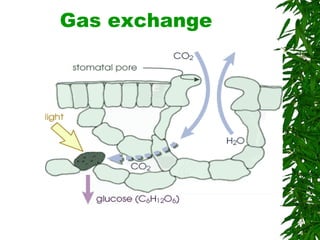
Gas exchange  Leaves are designed to allow carbon dioxide to get to the main chlorophyll layer at the top of the leaf They have small holes called stomata on the under surface Each hole is open & closed by 2 guard cells
Leaf diagram –  stoma and guard cells
Stoma position
Stoma is a small hole Its size is controlled by 2 guard cells closed open
Stoma function is for gas exchange in the leaf Carbon dioxide oxygen Guard cell Provided plant is photosynthesising
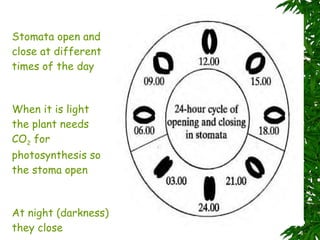
Stomata open and close at different times of the day When it is light the plant needs CO 2  for photosynthesis so the stoma open At night (darkness) they close
Gas exchange
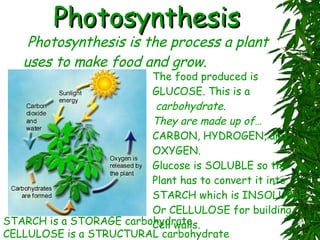
Photosynthesis A  Photosynthesis is the process a plant uses to make food and grow. The food produced is GLUCOSE. This is a carbohydrate. They are made up of… CARBON, HYDROGEN, and OXYGEN. Glucose is SOLUBLE so the Plant has to convert it into STARCH which is INSOLUBLE Or CELLULOSE for building Cell walls. STARCH is a STORAGE carbohydrate CELLULOSE is a STRUCTURAL carbohydrate
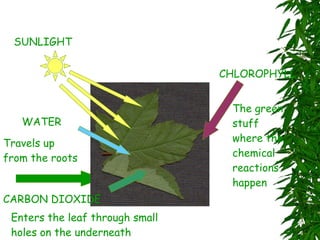
Four things are needed for photosynthesis: Travels up from the roots WATER CARBON DIOXIDE Enters the leaf through small holes on the underneath SUNLIGHT Gives the plant energy CHLOROPHYLL The green stuff where the chemical reactions happen
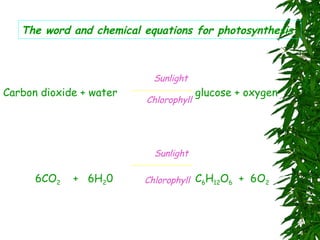
The word and chemical equations for photosynthesis: Carbon dioxide + water  glucose + oxygen 6CO 2   +  6H 2 0 C 6 H 12 O 6   +  6O 2 Sunlight Chlorophyll Sunlight Chlorophyll
Four factors affect photosynthesis: Light  – if there is more light photosynthesis happens faster Water  – if there is not enough water photosynthesis slows down Temperature  – the best temperature is about 30 0 C – anything above 40 0 C will slow photosynthesis right down CO 2   – if there is more carbon dioxide photosynthesis will happen quicker These are known as  LIMITING FACTORS because Lack of any one or more will slow down photosynthesis

The World Of Plants Std Grade

  • 1.
  • 2.
    PLANTS - THE BASICS A huge variety of plants in the world Live in almost every habitat Can survive the harshest environments The link between the sun and all other living things Maintain the balance of atmospheric gases
  • 3.
    MORE PLANT BASICSThey regulate the water content of the soil They provide habitats for other organisms And ……….
  • 4.
    … . they give us some beautiful artistic moments!
  • 5.
  • 6.
  • 7.
  • 8.
  • 9.
    PLANTS AND THESUN Plants turn the sun’s energy ……… into food This is called………. Photosynthesis
  • 10.
  • 11.
    WHAT DO WENEED PLANTS FOR ? For food For raw materials For medicines
  • 12.
    PLANTS AS FOODSCereals such as rice,maize,and wheat form the staple foods of most countries Vegetables and fruits add variety to our diets Herbs,spices,sugar,tea,coffee and nuts are all plants and…… we get chocolate from plants !!!!!
  • 13.
    …. IN SCOTLANDBarley is used to make ….
  • 14.
    AND…… Plant-based dyesare used for…..
  • 15.
    PLANTS AS MEDICINESKnown about since 2000BC Used for pain relief, reducing fever, sedation and upset stomach, and curing infections Many are used for treating cancer ……And many more medicinal uses
  • 16.
    PLANTS TREAT CANCERIt is thought that at least 2000 plants may contain chemicals which can help to treat cancer This is the purple coneflower
  • 17.
    PLANTS CLEAR YOURHEAD This is the titfruit. Its extract can clear blocked sinuses
  • 18.
    MORE PLANT MEDICINES…Plants can be used for hormone replacement This is squawberry juice being extracted Plants can help with urinary infections This is saw palmetto used for cystitis and Prostate problems in men
  • 19.
    DO YOU KNOWTHIS ONE ?
  • 20.
    PLANTS AS MATERIALSCotton for clothes and linens Jute and hemp for rope Trees for timber Rape seeds for oil Seaweeds for alginates How many more can you think of ?
  • 21.
    PLANTS ARE SOINTERESTING….. These american native indians even worship their cacti….
  • 22.
    SO…… PLANTS ARE? Much more complex and varied than you knew
  • 23.
    “ World ofplants” will show you how and why .
  • 24.
    Ecological loss Tropicalrainforests have the greatest variety of plants on earth There loss is disastrous For every type of plant that becomes extinct a wide variety of other dependent organisms are also endangered. For every species of plant that becomes extinct,four species of animal also die out,upsetting the balance of life on earth
  • 25.
  • 26.
  • 27.
    FOOD PLANTS MOSTOF THE WORLDS FOOD COMES FROM A VERY FEW TYPES OF PLANTS AS THE POPULATION INCREASES,THEN SOME OTHER TYPES OF PLANT WHICH ARE NOT WELL KNOWN MIGHT PROVIDE FOOD
  • 28.
  • 29.
    MEDICINAL PLANTS Manyimportant medicines come from plants In the future,possible medicines may never be discovered if the plants are made extinct by destroying the rainforests.
  • 30.
    WILD PLANTS…… Wildplants also contain many different characteristics … .and different genes which could be useful in the future. … .. So its important to protect the wild varieties for possible future use. THIS IS CALLED A GENETIC STOREHOUSE
  • 31.
    GENETIC STOREHOUSE Cultivatedplants have been bred to be very alike They contain almost exactly the same genes If a new disease infected one,it could easily damage all of them Wild varieties are often resistant to many different diseases It is possible to cross-breed them with cultivated plants to increase the resistance to disease
  • 32.
    Seed Germination Whenspring arrives,the seed bursts open and a new plant starts to grow This is called GERMINATION
  • 33.
    What’s in aseed ? Seeds usually have a hard coat. This is also called the TESTA It’s a tough,fibrous layer which protects the internal structures of the seed Lets have a look at the inside of a seed
  • 34.
    Inside the seedThis Broad bean seed has been left to soak in water overnight. This softens the seed coat and allows us to pull it away from the seed You can now examine the internal structures of the seed
  • 35.
    Structure of themature seed In dicot seeds: Hypocotyl terminates in the radicle (embryonic root) Epicotyl terminates in the plumule (shoot tip) Monocot seeds have a special cotyledon called a scutellum : Large surface area - absorbs nutrients from endosperm during germination Embryo enclosed in sheath: Coleoptile protects the shoot Coleorhiza protects the root
  • 36.
    Inside the Beanseed The inside of a seed is called ….. The EMBRYO It’s made up of two parts… The young shoot(called the PLUMULE ) And the young root ( called the RADICLE) There is also a pair of seed leaves (called COTYLEDONS) they act as a food store
  • 37.
    The seed germinatesFirst the seed takes up water.This makes it swell The seed coat splits and the new plant starts to grow out,root first Next,the shoot starts to grow. The root grows downwards … .. And the shoot grows upwards The shoot is bent back to protect its delicate tip as it pushes up through the soil
  • 38.
    …. The embryostarts to grow You can see the root starting To grow downwards
  • 39.
    Germination continues…. Theroot tip is protected from damage as it grows down through the soil by a mass of cells called the Root Cap The root grows tiny side branches to help anchor the young plant into the ground These hairs also increase the surface area for absorbtion
  • 40.
    …. The rootgrows hairs We can see the root hairs starting to grow
  • 41.
    Roots – functionand structure Hold plant in position Absorb water and minerals from the soil Specialised cells to increase surface area for water intake
  • 42.
    Wheat seed Roothairs Fragile parts of cells that grow from the main root They massively increase the surface area for absorption
  • 43.
  • 44.
    Root ‘B’ has had the hairs damaged -
  • 45.
    … .and finallyThe young shoot breaks through the soil surface It straightens out The first leaves open out and turn green Germination is complete and the new plant is called a seedling
  • 46.
    Factors affecting germinationTemperature. Warmth is needed by most seeds.This is why they don’t germinate until the spring Water is needed for the seed to swell and burst open. It is also necessary for the stored food to be made soluble and moved to the growing embryo Oxygen is needed for the embryo to respire.It supplies the embryo with the energy to grow and develop
  • 47.
    What about light? Most seeds will germinate in light or dark conditions However some will only germinate in one or the other. The amount of light needed may be very small.One quick flash is enough in some cases All plants need light once the shoot breaks through the surface of the soil. This is to make the leaves open out and form CHLOROPHYLL FOR PHOTOSYNTHESIS
  • 48.
  • 49.
  • 50.
    Floral diversity THEYALL LOOK DIFFERENT…BUT ALL HAVE THE SAME PARTS FOR REPRODUCTION…
  • 51.
    The Parts ofa Flower Most flowers have four parts: sepals, petals, stamens, carpels.
  • 52.
    The parts ofa flower Sepals protect the bud until it opens. Petals attract insects. Stamens make pollen. Carpels grow into fruits which contain the seeds.
  • 53.
    Stamen (male) Anther:pollen grains grow in the anther. When the grains are fully grown, the anther splits open.
  • 54.
    Carpel(female) Stigma Styleovary Ovules (eggs)
  • 55.
    Pollination Flowering plantsuse the wind, insects, bats, birds and mammals to transfer pollen from the male (stamen) part of the flower to the female (stigma) part of the flower.
  • 56.
    Pollination A floweris pollinated when a pollen grain lands on its stigma. Each carpel grows into a fruit which contains the seeds.
  • 57.
    Fertilisation Pollen grainsgerminate on the stigma, growing down the style to reach an ovule. Fertilised ovules develop into seeds. The carpel enlarges to form the flesh of the fruit and to protect the ovary.
  • 58.
    The ovary developsinto a fruit adapted for seed dispersal A true fruit is a ripened ovary Fruits can be classified by their origin: Simple fruits : derived from a single ovary e.g. cherry Aggregate fruits : derived from a single flower with several carpels e.g. blackberry BUT …WHAT ABOUT ‘ FALSE FRUITS’ ?
  • 59.
    Wind pollination Someflowers, such as grasses, do not have brightly coloured petals and nectar to attract insects. They do have stamens and carpels. These flowers are pollinated by the wind.
  • 60.
    Seed dispersal Seedsare dispersed in many different ways: Wind Explosion Water Animals Birds Scatter
  • 61.
    How birds andanimals help seed dispersal Some seeds are hidden in the ground as a winter store. Some fruits have hooks on them and cling to fur or clothes.
  • 62.
    How birds andanimals help seed dispersal Birds and animals eat the fruits and excrete the seeds away from the parent plant.
  • 63.
    ASEXUAL REPRODUCTION Plantscan be produced by a single parent No need for sex cells and fertilisation Because of this, there will be NO variation and new plants formed will be…. GENETICALLY IDENTICAL to one another AND to their parent Asexual reproduction in plants is known as VEGETATIVE PROPAGATION.
  • 64.
    Methods of Artificialpropagation… Offspring can be formed from a plant’s stem or buds These are known as RUNNERS The runner carries food from the parent to the new plant whilst it grows leaves and roots Strawberry and Spider plants are good examples of Species which use RUNNERS for asexual reproduction
  • 65.
    Some plants producelarge swollen roots called TUBERS These are food storage organs full of STARCH A plant may produce several of these. Each will produce a new plant which may make many more TUBERS Examples of plants which use this method of VEGETATIVE PROPAGATION include ….
  • 66.
    Artificial Propagation Someplants lack their own natural methods of artificial propagation These plants can be reproduced by artificial processes. This can be done for several reasons… (1) uniformity is guaranteed (2) Sterile varieties can be reproduced in vast quantities, such as seedless grapes and citrus fruits (3) Rare species can be conserved to protect against extinction TWO METHODS ARE COMMONLY USED… … CUTTINGS AND GRAFTING.
  • 67.
    …CUTTINGS Stems andleaves are used to grow new plants Roots form from the cutting when it is placed in good soil REMEMBER….ALL CUTTINGS GROW INTO PLANTS WITH FEATURES IDENTICAL TO THEIR PARENT
  • 68.
    GRAFTING A cutting(SCION)is grafted onto the STOCK of a hardy variety as shown The scion may come from a high yield fruiting plant This method can combine the good qualities of TWO or more plants The cut surfaces bond together, healing the wound which Is protected from infection by being sealed with wax. Twine Holds the cut surfaces tightly together to promote healing
  • 69.
    Are these plants clones YES…THEY ARE A CLONE is a group of organisms which have exactly the same genetic info and have been produced from a common ancestor by ASEXUAL REPRODUCTION So the term CLONE can be used to refer to a group of Plants produced from cuttings or graftings from the SAME PARENT PLANT
  • 70.
    There are twofilm clips coming next They show cutting and grafting taking place in the south of the USA Please be patient…they take a few seconds to load You can only see them if you are watching this presentation on a computer logged on to the internet
  • 71.
  • 72.
  • 73.
    Plant growth Plantsgrow using food they make through photosynthesis. So what else do they need? Plants also need three important minerals to keep healthy. They absorb these through their roots.
  • 74.
    Root hair cellsPlant roots are made of “root hair cells” which have a large surface area and a thin cell membrane to help absorb the minerals: Thin cell membrane Large surface area
  • 75.
    Plant A PlantB Both plants were planted at the same time and left to grow on the same window sill for the same length of time. Why do you think that plant A is so much bigger than plant B?
  • 76.
    How do plantsget the minerals they need? The plant takes in minerals from the soil. It absorbs these minerals through their roots. Remember a plant does not get food from the soil it is capable of making its own food Some plants which grow on poor soil have evolved a clever way to get the nutrients they need. Where do you think they get them from?
  • 77.
  • 78.
    The three maintypes of nutrient are: Nitrates – used to make proteins Phosphates – used to provide phosphorus to help photosynthesis and respiration Potassium – helps the enzymes that are needed for photosynthesis and respiration
  • 79.
    Lack of thethree minerals would lead to a “Deficiency Symptom”: Lack of nitrates: Small plant, yellow leaves Lack of phosphates: Small roots and purple leaves Lack of potassium: Yellow leaves with dead bits
  • 80.
    The Three MainMinerals Needed by Plants. A small plant with yellow older leaves. To make proteins Nitrate Symptom if deficient Why its needed Mineral Yellow leaves with dead bits Helps chemicals in the plant work properly. Potassium Poor root growth and purple younger leaves Needed for photosynthesis and respiration Phosphate
  • 81.
    Plant Doctor. MrSmith’s plants were small and had yellow leaves, which mineral were they missing? Mr Lewis’s plants were a normal size but had yellow leaves, which mineral were they missing? Mr Brooke had a plant which had some purple and some yellow leaves, which minerals were they missing?
  • 82.
    The Transport SystemThere are a set of tube-like tissues that go up and down the leaf stem and shoots that transport the other essential ingredients for photosynthesis : water and minerals There are two tubes called xylem and phloem tissues.
  • 83.
    The Transport SystemThe xylem brings up the water from the roots The phloem takes away the sugars made by the chloroplasts to places where the energy is needed The tubes are in the middle of the leaf so that there are near all the cells to bring up water and to take away sugars.
  • 84.
  • 85.
    The transport systemThe transport system is far less elaborate than in mammals due to: plants are less active and therefore ‘supplies’ don’t run out so quickly because of the branching system, gases for respiration and photosynthesis. Can be obtained from diffusion in the air two separate systems; xylem and phloem
  • 86.
    Xylem Xylem carriesthe water and minerals It is made of many hollow dead cells joined end to end of which the end cell wall has disappeared to form a long tube Xylem vessels run from root to every leaf Xylem vessels contain no cytoplasm or nuclei Their walls are made of cellulose and lignin Lignin is very strong and so xylem help keep the plant upright
  • 87.
    Close up of Hibiscus rosa xylem
  • 88.
    Phloem Transport the‘food’ They are also made of many cells joined end to end, however their end wall is not completely broken down; instead they form sieve plates The cells contain cytoplasm but no nucleus and they do have lignin in their walls Each sieve cell has a companion cell next to it which does contain a nucleus and many other organelles
  • 89.
  • 90.
    Vascular bundles Xylemand phloem tubes are normally found close together, when they are this is called a vascular bundle In a root vascular tissue is found at the centre In a shoot they are found near the outside edge to help support the plant
  • 91.
  • 92.
    The transport ofwater Plants take in water from the soil through the root hairs and is carried in the xylem throughout the plant Water gets into root hair by osmosis. The cytoplasm and cell sap inside it are quite concentrated solutions and the water in soil is normally quite dilute Water therefore diffuses down its concentration gradient through a partially permeable membrane
  • 93.
    A root tipshowing root hairs
  • 94.
    Transpiration The evaporationof water from the plant Most of which takes place from the leaves through the stomata Guard cells around the stomata control the rate of transpiration by opening and closing
  • 95.
    Transpiration When wateris lost through transpiration water from the xylem vessel in the leaf will travel to the cells to replace it Water is constantly being taken from the top of the xylem vessel to supply the cells in the leaves This reduces the pressure at the top of the xylem so water flows up This process is known as the transpiration stream
  • 96.
  • 97.
    THE LEAF! Aleaf is an example of a plant organ It is composed of many tissues that work together . The tissues are designed to maximise the levels of photosynthesis.
  • 98.
    Function of leavesTrap light energy for photosynthesis Producing sugar from photosynthesis Exchange of gases – oxygen and carbon dioxide
  • 99.
    Structure Wide Helpsto catch more light energy Thin Help get carbon dioxide from bottom to top of leaf for photosynthesis
  • 100.
    Leaf structure Greeneron top CO 2 gets in here
  • 101.
    Leaf diagram –palisade layer CO 2 Most chlorophyll
  • 102.
    Leaf cell -palisade Position? Upper surface of leaf Features? Box shape Chloroplasts Function? Photosynthesis
  • 103.
    Plant cells havethree “extra” things than animal cells: Both types of cell have these: Only plant cells have these: 4) Cell wall – provides support Large Vacuole – contains sap Chloroplasts – contain chlorophyll 1) 5) 6) 2) 3) Cell Membrane – holds the cell together Cytoplasm - this is where the reactions happen Nucleus – The “brain” of the cell
  • 104.
    Gas exchange Leaves are designed to allow carbon dioxide to get to the main chlorophyll layer at the top of the leaf They have small holes called stomata on the under surface Each hole is open & closed by 2 guard cells
  • 105.
    Leaf diagram – stoma and guard cells
  • 106.
  • 107.
    Stoma is asmall hole Its size is controlled by 2 guard cells closed open
  • 108.
    Stoma function isfor gas exchange in the leaf Carbon dioxide oxygen Guard cell Provided plant is photosynthesising
  • 109.
    Stomata open andclose at different times of the day When it is light the plant needs CO 2 for photosynthesis so the stoma open At night (darkness) they close
  • 110.
  • 111.
    Photosynthesis A Photosynthesis is the process a plant uses to make food and grow. The food produced is GLUCOSE. This is a carbohydrate. They are made up of… CARBON, HYDROGEN, and OXYGEN. Glucose is SOLUBLE so the Plant has to convert it into STARCH which is INSOLUBLE Or CELLULOSE for building Cell walls. STARCH is a STORAGE carbohydrate CELLULOSE is a STRUCTURAL carbohydrate
  • 112.
    Four things areneeded for photosynthesis: Travels up from the roots WATER CARBON DIOXIDE Enters the leaf through small holes on the underneath SUNLIGHT Gives the plant energy CHLOROPHYLL The green stuff where the chemical reactions happen
  • 113.
    The word andchemical equations for photosynthesis: Carbon dioxide + water glucose + oxygen 6CO 2 + 6H 2 0 C 6 H 12 O 6 + 6O 2 Sunlight Chlorophyll Sunlight Chlorophyll
  • 114.
    Four factors affectphotosynthesis: Light – if there is more light photosynthesis happens faster Water – if there is not enough water photosynthesis slows down Temperature – the best temperature is about 30 0 C – anything above 40 0 C will slow photosynthesis right down CO 2 – if there is more carbon dioxide photosynthesis will happen quicker These are known as LIMITING FACTORS because Lack of any one or more will slow down photosynthesis