www.foodafactoflife.org.uk © Food – a fact of life 2019
Microorganisms in food production
www.foodafactoflife.org.uk © Food – a fact of life 2019
Microorganisms and food
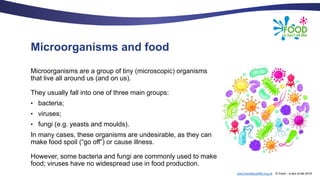
Microorganisms are a group of tiny (microscopic) organisms
that live all around us (and on us).
They usually fall into one of three main groups:
• bacteria;
• viruses;
• fungi (e.g. yeasts and moulds).
In many cases, these organisms are undesirable, as they can
make food spoil (“go off”) or cause illness.
However, some bacteria and fungi are commonly used to make
food; viruses have no widespread use in food production.
www.foodafactoflife.org.uk © Food – a fact of life 2019
History of microorganism use in foods
Microorganisms have been used to make food for millennia.
Cheese, yogurt and bread all rely on fermentation by
microorganisms in their production, as do alcoholic drinks,
such as wine and beer.
It is thought that beer production may have started as early
as 7000 BC and cheese consumed as early as 3000 BC.
The techniques used to make these products in modern
times are more advanced and more carefully controlled, but
the principles remain largely the same.
www.foodafactoflife.org.uk © Food – a fact of life 2019
Bread
Bread has been a staple food item in many cultures for
thousands of years.
There are different ways of making bread, some of which
do not involve microorganisms, but most breads utilise
yeasts, which are single-celled fungi.
These yeasts ferment sugars to ethanol and carbon
dioxide. The carbon dioxide helps the bread to rise.
Some breads (e.g. sourdough) also use bacteria called
‘lactic acid bacteria’, which provide the distinctive sour
taste.
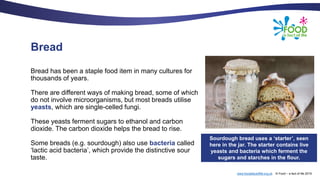
Sourdough bread uses a ‘starter’, seen
here in the jar. The starter contains live
yeasts and bacteria which ferment the
sugars and starches in the flour.
www.foodafactoflife.org.uk © Food – a fact of life 2019
Dairy products
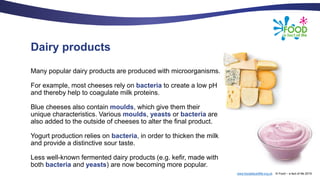
Many popular dairy products are produced with microorganisms.
For example, most cheeses rely on bacteria to create a low pH
and thereby help to coagulate milk proteins.
Blue cheeses also contain moulds, which give them their
unique characteristics. Various moulds, yeasts or bacteria are
also added to the outside of cheeses to alter the final product.
Yogurt production relies on bacteria, in order to thicken the milk
and provide a distinctive sour taste.
Less well-known fermented dairy products (e.g. kefir, made with
both bacteria and yeasts) are now becoming more popular.
www.foodafactoflife.org.uk © Food – a fact of life 2019
Alcoholic drinks
Alcoholic drinks rely on microorganisms producing ethanol through
fermentation. This is typically performed by yeasts.
Yeasts ferment sugars, forming ethanol and carbon dioxide.
Sometimes the carbon dioxide is released, leading to a ‘still’ drink.
However, sparkling wines and many beers retain carbon dioxide,
which helps to form bubbles or foam.
Wines often also rely on bacteria. These bacteria ferment malic acid
into lactic acid. This stops the wine from tasting sour and unpleasant.
www.foodafactoflife.org.uk © Food – a fact of life 2019
Soy-based products
Soybeans are used to create a wide array of products,
particularly in East-Asian cuisine.
Some of these products rely on fermentation. For example,
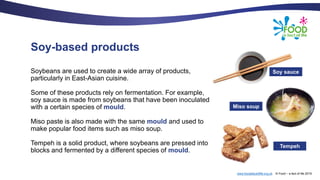
soy sauce is made from soybeans that have been inoculated
with a certain species of mould.
Miso paste is also made with the same mould and used to
make popular food items such as miso soup.
Tempeh is a solid product, where soybeans are pressed into
blocks and fermented by a different species of mould.
Soy sauce
Miso soup
Tempeh
www.foodafactoflife.org.uk © Food – a fact of life 2019
Fermented meat and fish
Although not commonly consumed in the UK, fermented
meat and fish products are more common in some other
countries.
Some salamis are made with bacteria which can lower the
pH of the meat and prevent spoilage. Some also use
mould to cover the salami for protection. However, not all
salamis are made using fermentation.
Fish fermented by bacteria is eaten more commonly in
some Scandinavian countries and Central to East Asia. Surströmming
(fermented herring) is a
traditional Scandinavian food
Traditional salami
www.foodafactoflife.org.uk © Food – a fact of life 2019
Vegetables
Kimchi is a traditional food in Korea and is made from
various vegetables which are fermented by bacteria.
Sauerkraut is made by fermenting cabbage with bacteria
that are naturally present on the leaves. Although the word
sauerkraut is German, many countries make very similar
foods under different names.
Pickles can be made by fermenting vegetables in brine.
Bacteria then create acid which lowers the pH and
preserves the contents. However, many pickles are instead
made by directly adding vinegar to reduce the pH.
Kimchi
Pickled gherkins
www.foodafactoflife.org.uk © Food – a fact of life 2019
Condiments and sauces
A number of condiments and sauces rely on
microorganisms for their distinctive flavours. These
include:
• yeast extracts – created by destroying yeast cells,
which then digest themselves;
• Worcestershire and fish sauces also rely on
fermentation by bacteria;
• Some (but not all) hot sauces also use fermentation for
a richer flavour;
• Vinegar is made using fermentation of various starting
materials, such as wine, cider or fruit juice, by acetic
acid bacteria.
Yeast extract
Hot (chilli) sauce
Worcestershire
sauce
www.foodafactoflife.org.uk © Food – a fact of life 2019
Drinks
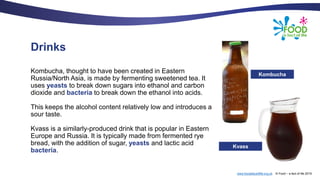
Kombucha, thought to have been created in Eastern
Russia/North Asia, is made by fermenting sweetened tea. It
uses yeasts to break down sugars into ethanol and carbon
dioxide and bacteria to break down the ethanol into acids.
This keeps the alcohol content relatively low and introduces a
sour taste.
Kvass is a similarly-produced drink that is popular in Eastern
Europe and Russia. It is typically made from fermented rye
bread, with the addition of sugar, yeasts and lactic acid
bacteria.
Kombucha
Kvass
www.foodafactoflife.org.uk © Food – a fact of life 2019
Mycoprotein
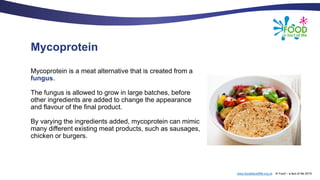
Mycoprotein is a meat alternative that is created from a
fungus.
The fungus is allowed to grow in large batches, before
other ingredients are added to change the appearance
and flavour of the final product.
By varying the ingredients added, mycoprotein can mimic
many different existing meat products, such as sausages,
chicken or burgers.
www.foodafactoflife.org.uk © Food – a fact of life 2019
Chocolate
Chocolate originally comes from cocoa beans. These
beans are not able to be used to make chocolate until
they have been fermented.
Naturally occurring yeasts and bacteria complete this
process over a period of 6-10 days.
The fermentation destroys the unwanted seed coating of
the bean and prevents it from being able to grow.
Importantly, it also begins to form some of the desirable
flavours that are recognisable in chocolate.
www.foodafactoflife.org.uk © Food – a fact of life 2019
Microorganisms in food production
For further information, go to:
www.foodafactoflife.org.uk

microorganisms-in-food-production.pptx

  • 1.
    www.foodafactoflife.org.uk © Food– a fact of life 2019 Microorganisms in food production
  • 2.
    www.foodafactoflife.org.uk © Food– a fact of life 2019 Microorganisms and food Microorganisms are a group of tiny (microscopic) organisms that live all around us (and on us). They usually fall into one of three main groups: • bacteria; • viruses; • fungi (e.g. yeasts and moulds). In many cases, these organisms are undesirable, as they can make food spoil (“go off”) or cause illness. However, some bacteria and fungi are commonly used to make food; viruses have no widespread use in food production.
  • 3.
    www.foodafactoflife.org.uk © Food– a fact of life 2019 History of microorganism use in foods Microorganisms have been used to make food for millennia. Cheese, yogurt and bread all rely on fermentation by microorganisms in their production, as do alcoholic drinks, such as wine and beer. It is thought that beer production may have started as early as 7000 BC and cheese consumed as early as 3000 BC. The techniques used to make these products in modern times are more advanced and more carefully controlled, but the principles remain largely the same.
  • 4.
    www.foodafactoflife.org.uk © Food– a fact of life 2019 Bread Bread has been a staple food item in many cultures for thousands of years. There are different ways of making bread, some of which do not involve microorganisms, but most breads utilise yeasts, which are single-celled fungi. These yeasts ferment sugars to ethanol and carbon dioxide. The carbon dioxide helps the bread to rise. Some breads (e.g. sourdough) also use bacteria called ‘lactic acid bacteria’, which provide the distinctive sour taste. Sourdough bread uses a ‘starter’, seen here in the jar. The starter contains live yeasts and bacteria which ferment the sugars and starches in the flour.
  • 5.
    www.foodafactoflife.org.uk © Food– a fact of life 2019 Dairy products Many popular dairy products are produced with microorganisms. For example, most cheeses rely on bacteria to create a low pH and thereby help to coagulate milk proteins. Blue cheeses also contain moulds, which give them their unique characteristics. Various moulds, yeasts or bacteria are also added to the outside of cheeses to alter the final product. Yogurt production relies on bacteria, in order to thicken the milk and provide a distinctive sour taste. Less well-known fermented dairy products (e.g. kefir, made with both bacteria and yeasts) are now becoming more popular.
  • 6.
    www.foodafactoflife.org.uk © Food– a fact of life 2019 Alcoholic drinks Alcoholic drinks rely on microorganisms producing ethanol through fermentation. This is typically performed by yeasts. Yeasts ferment sugars, forming ethanol and carbon dioxide. Sometimes the carbon dioxide is released, leading to a ‘still’ drink. However, sparkling wines and many beers retain carbon dioxide, which helps to form bubbles or foam. Wines often also rely on bacteria. These bacteria ferment malic acid into lactic acid. This stops the wine from tasting sour and unpleasant.
  • 7.
    www.foodafactoflife.org.uk © Food– a fact of life 2019 Soy-based products Soybeans are used to create a wide array of products, particularly in East-Asian cuisine. Some of these products rely on fermentation. For example, soy sauce is made from soybeans that have been inoculated with a certain species of mould. Miso paste is also made with the same mould and used to make popular food items such as miso soup. Tempeh is a solid product, where soybeans are pressed into blocks and fermented by a different species of mould. Soy sauce Miso soup Tempeh
  • 8.
    www.foodafactoflife.org.uk © Food– a fact of life 2019 Fermented meat and fish Although not commonly consumed in the UK, fermented meat and fish products are more common in some other countries. Some salamis are made with bacteria which can lower the pH of the meat and prevent spoilage. Some also use mould to cover the salami for protection. However, not all salamis are made using fermentation. Fish fermented by bacteria is eaten more commonly in some Scandinavian countries and Central to East Asia. Surströmming (fermented herring) is a traditional Scandinavian food Traditional salami
  • 9.
    www.foodafactoflife.org.uk © Food– a fact of life 2019 Vegetables Kimchi is a traditional food in Korea and is made from various vegetables which are fermented by bacteria. Sauerkraut is made by fermenting cabbage with bacteria that are naturally present on the leaves. Although the word sauerkraut is German, many countries make very similar foods under different names. Pickles can be made by fermenting vegetables in brine. Bacteria then create acid which lowers the pH and preserves the contents. However, many pickles are instead made by directly adding vinegar to reduce the pH. Kimchi Pickled gherkins
  • 10.
    www.foodafactoflife.org.uk © Food– a fact of life 2019 Condiments and sauces A number of condiments and sauces rely on microorganisms for their distinctive flavours. These include: • yeast extracts – created by destroying yeast cells, which then digest themselves; • Worcestershire and fish sauces also rely on fermentation by bacteria; • Some (but not all) hot sauces also use fermentation for a richer flavour; • Vinegar is made using fermentation of various starting materials, such as wine, cider or fruit juice, by acetic acid bacteria. Yeast extract Hot (chilli) sauce Worcestershire sauce
  • 11.
    www.foodafactoflife.org.uk © Food– a fact of life 2019 Drinks Kombucha, thought to have been created in Eastern Russia/North Asia, is made by fermenting sweetened tea. It uses yeasts to break down sugars into ethanol and carbon dioxide and bacteria to break down the ethanol into acids. This keeps the alcohol content relatively low and introduces a sour taste. Kvass is a similarly-produced drink that is popular in Eastern Europe and Russia. It is typically made from fermented rye bread, with the addition of sugar, yeasts and lactic acid bacteria. Kombucha Kvass
  • 12.
    www.foodafactoflife.org.uk © Food– a fact of life 2019 Mycoprotein Mycoprotein is a meat alternative that is created from a fungus. The fungus is allowed to grow in large batches, before other ingredients are added to change the appearance and flavour of the final product. By varying the ingredients added, mycoprotein can mimic many different existing meat products, such as sausages, chicken or burgers.
  • 13.
    www.foodafactoflife.org.uk © Food– a fact of life 2019 Chocolate Chocolate originally comes from cocoa beans. These beans are not able to be used to make chocolate until they have been fermented. Naturally occurring yeasts and bacteria complete this process over a period of 6-10 days. The fermentation destroys the unwanted seed coating of the bean and prevents it from being able to grow. Importantly, it also begins to form some of the desirable flavours that are recognisable in chocolate.
  • 14.
    www.foodafactoflife.org.uk © Food– a fact of life 2019 Microorganisms in food production For further information, go to: www.foodafactoflife.org.uk