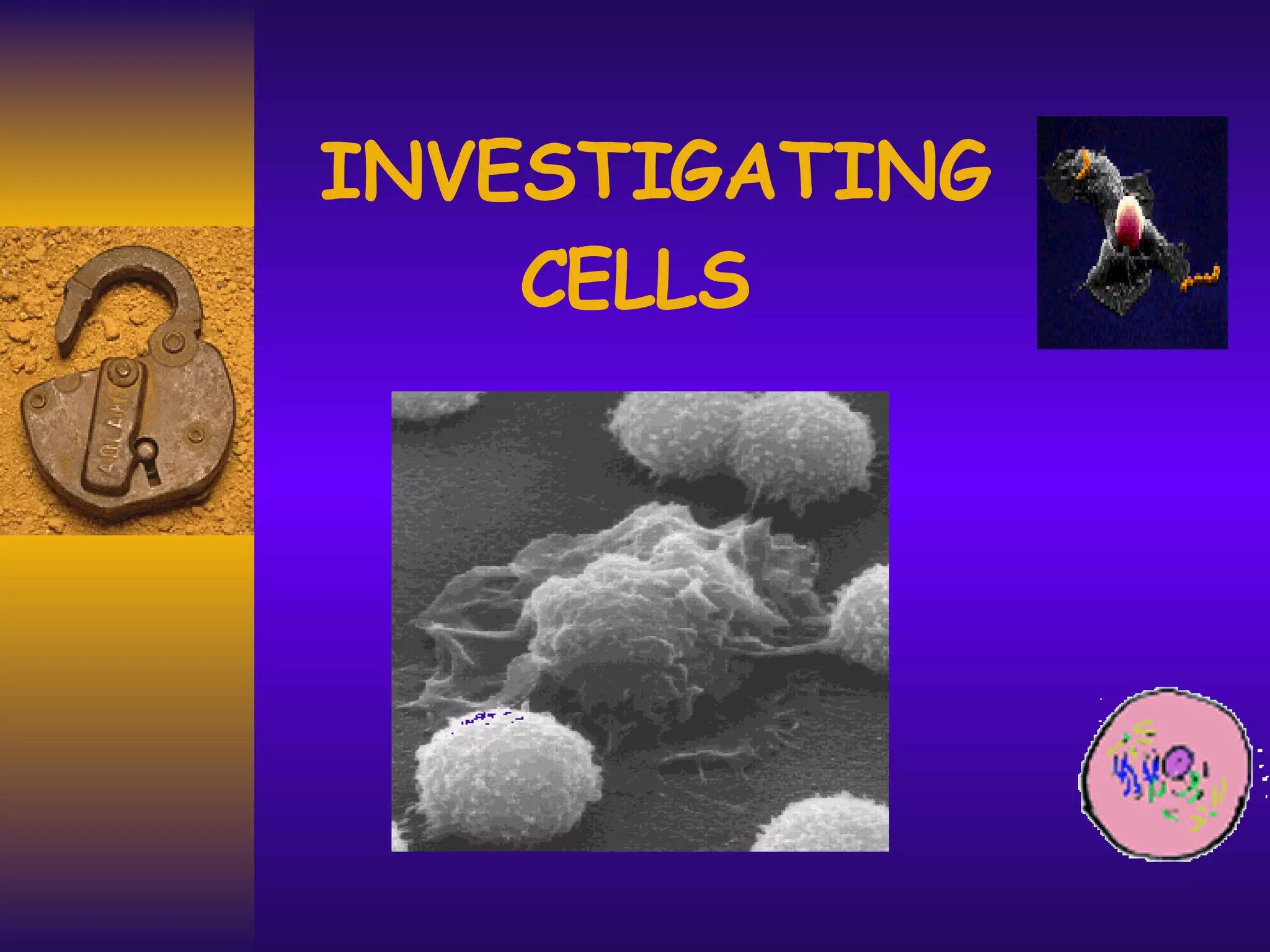
INVESTIGATING    CELLS
This unit is divided into five sub-topics.  Investigating……… Diffusion Living cells Cell division
Enzymes And Aerobic respiration
SUB-TOPIC A... Investigating living cells
Overview  In the same way that there are different kinds of cells inside you, different organisms have different types of cells. Trees have different cells than you and so do monkeys. Each of those cells is different in some way.
What Is a Microscope? Name derived from Greek words:  micro meaning “small” and scope “to see” Used to see details invisible to the naked eye A valuable tool for the biologist Research in cell biology Medical diagnoses and tests Observation of microbes
What Is a Microscope? Light microscope.Transmitted light passes through a specimen on a glass slide, through two or more magnifying lenses (ocular lens & objective lens), and appears as an enlarged image.
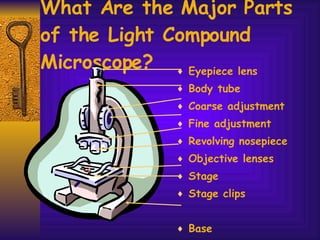
What Are the Major Parts of the Light Compound Microscope? Eyepiece lens Body tube Coarse adjustment  Fine adjustment Revolving nosepiece Objective lenses Stage Stage clips Base
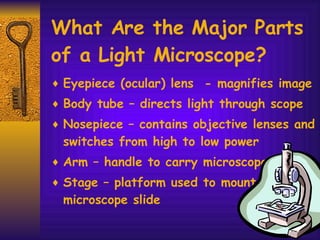
What Are the Major Parts of a Light Microscope? Eyepiece (ocular) lens  - magnifies image Body tube – directs light through scope Nosepiece – contains objective lenses and switches from high to low power Arm – handle to carry microscope Stage – platform used to mount microscope slide
What Are the Major Parts of a Light Microscope?  Mechanical stage adjustment knobs – moves slide across stage to view different areas of specimen Objective lenses – high & low power, magnifies image Coarse adjustment knob – rough focusing Fine adjustment knob – fine focusing
How do you use a microscope? -rules for microscope use Use two hands to carry the  microscope Lens paper only to clean lenses Always begin with low power Fine focus only when using high power Return scope to assigned place with low power in place, and cord neatly wrapped.
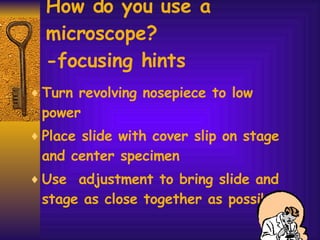
How do you use a microscope? -focusing hints Turn revolving nosepiece to low power Place slide with cover slip on stage and center specimen Use  adjustment to bring slide and stage as close together as possible
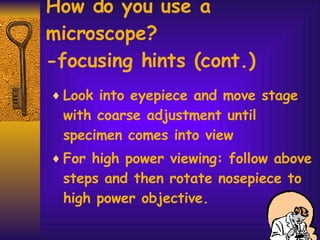
How do you use a microscope? -focusing hints (cont.) Look into eyepiece and move stage with coarse adjustment until specimen comes into view For high power viewing: follow above steps and then rotate nosepiece to high power objective.
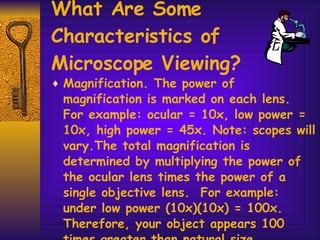
What Are Some Characteristics of Microscope Viewing? Magnification. The power of magnification is marked on each lens.  For example: ocular = 10x, low power = 10x, high power = 45x. Note: scopes will vary.The total magnification is determined by multiplying the power of the ocular lens times the power of a single objective lens.  For example: under low power (10x)(10x) = 100x.  Therefore, your object appears 100 times greater than natural size.
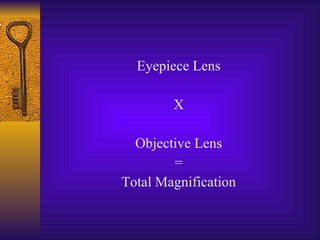
Eyepiece Lens X Objective Lens = Total Magnification
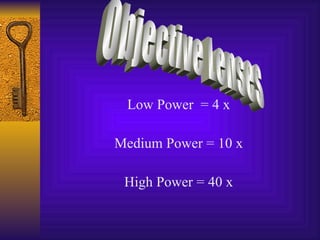
Low Power  = 4 x Medium Power = 10 x High Power = 40 x Objective Lenses
Vocabulary Review Magnification – enlargement of image Resolution – clarity of image Transmitted light – light that passes through a specimen Reflected light – light that bounces off a specimen Now lets have a look at some cell stuff !!!!
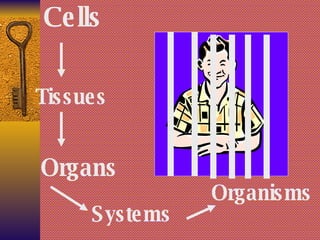
Cells Tissues Organs Systems Organisms
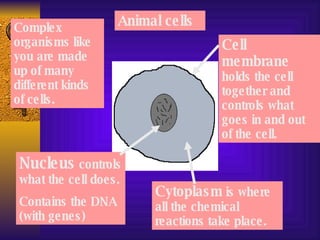
Animal cells Complex organisms like you are made up of many different kinds of cells. Nucleus  controls what the cell does. Contains the DNA (with genes)  Cytoplasm  is where all the chemical reactions take place. Cell membrane  holds the cell together and controls what goes in and out of the cell.
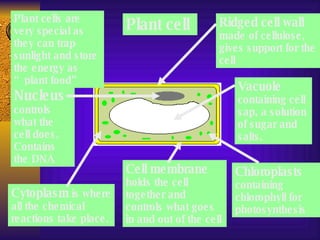
Plant cell Plant cells are very special as they can trap sunlight and store the energy as “plant food” Nucleus  controls what the cell does. Contains the DNA Cytoplasm  is where all the chemical reactions take place. Cell membrane  holds the cell together and controls what goes in and out of the cell Chloroplasts  containing chlorophyll for photosynthesis Vacuole  containing cell sap, a solution of sugar and salts. Ridged cell wall  made of cellulose, gives support for the cell
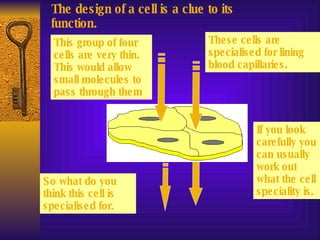
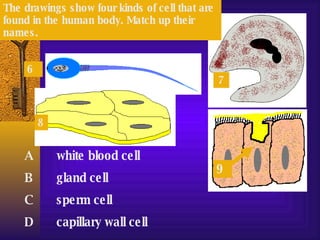
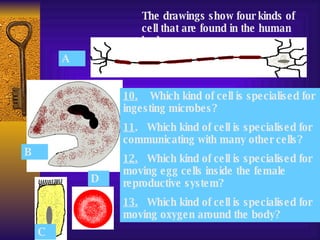
The design of a cell is a clue to its function. This group of four cells are very thin. This would allow small molecules to pass through them So what do you think this cell is specialised for. These cells are specialised for lining blood capillaries. If you look carefully you can usually work out what the cell speciality is.
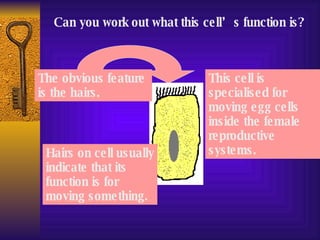
Can you work out what this cell’s function is? The obvious feature is the hairs. Hairs on cell usually indicate that its function is for moving something. This cell is specialised for moving egg cells inside the female reproductive systems.
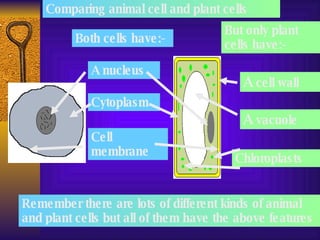
Comparing animal cell and plant cells Both cells have:- A nucleus Cytoplasm Cell membrane But only plant cells have:- A  cell wall A  vacuole Chloroplasts Remember there are lots of different kinds of animal and plant cells but all of them have the above features
6 7 8 9 A white blood cell B gland cell C sperm cell D capillary wall cell The drawings show four kinds of cell that are found in the human body. Match up their names.
The drawings show four kinds of cell that are found in the human body. A B C D 10.   Which kind of cell is specialised for ingesting microbes? 11 .  Which kind of cell is specialised for communicating with many other cells? 12.   Which kind of cell is specialised for moving egg cells inside the female reproductive system? 13.   Which kind of cell is specialised for moving oxygen around the body?
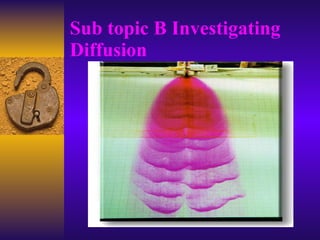
Sub topic B Investigating Diffusion
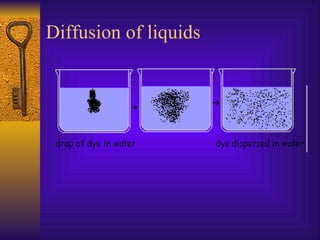
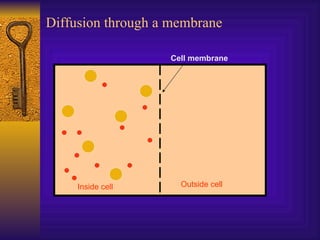
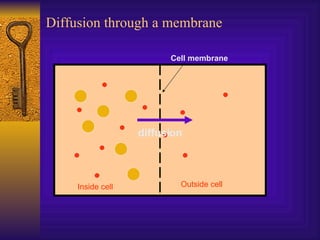
What is Diffusion ???? Molecules in a liquid and a gas move about freely all the time Molecules move from areas where they are numerous to areas where there aren’t so many of them So… Diffusion is… The movement of a substance from an area Of high concentration to one of Low concentration
So Which things can diffuse? Dissolved foods(eg. Amino-acids, glucose,fatty acids) Oxygen Carbon Dioxide Water Diffusion is important because it is the process By which USEFUL molecules enter the body Cells and waste products are REMOVED
Diffusion of liquids
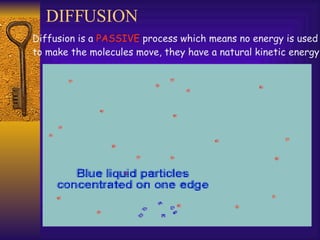
DIFFUSION Diffusion is a  PASSIVE  process which means no energy is used to make the molecules move, they have a natural kinetic energy.
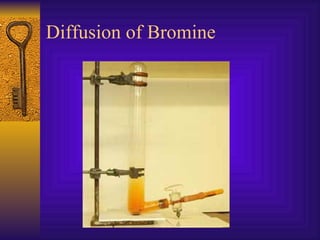
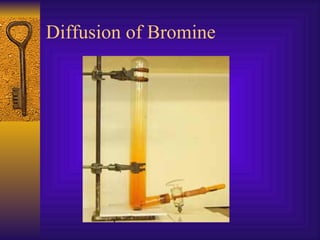
Diffusion of Bromine
Diffusion through a membrane Cell membrane Inside cell Outside cell
Diffusion through a membrane Cell membrane Inside cell Outside cell diffusion
Diffusion through a membrane Cell membrane Inside cell Outside cell EQUILIBRIUM
Diffusion The raw materials and end products of respiration get  INTO  and  OUT  of cells by  DIFFUSION DIFFUSION  is the movement of molecules from an area of  HIGH  concentration to an area of  LOW  concentration until  EVENLY SPREAD Examples : O 2  and  Glucose  move from  high conc  in blood to  low conc  in cells (where they get used in respiration) CO 2  moves from  high conc  in cells (where it is produced in respiration) to  low conc  in blood
An example of diffusion…in YOU Oxygen moves from HIGH concentration(in the AIR) to a LOWER concentration(in the Blood) The CELL MEMBRANEs control this movement into and out of the cell It is said to move DOWN A CONCENTRATION GRADIENT
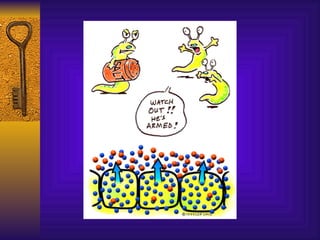
Osmosis : The  net movement  of water molecules along a concentration gradient from an area of  high water concentration  (HWC) to an area of  low water concentration  (LWC) through a  selectively permeable membrane . Osmosis is just a special case of DIFFUSION
More on Membranes… PERMEABLE means “allows anything to pass through” Membranes allow small molecules to pass through (like water) …  but prevent larger molecules from passing through This is called SELECTIVELY PERMEABLE
Passing water… Pure water has the highest water concentration possible As more salt/sugar is dissolved,the water concentration DECREASES A concentration gradient may be caused REMEMBER: Osmosis is the movement of water  Molecules from high to low concentration DOWN A CONCENTRATION GRADIENT
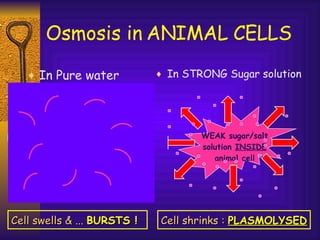
Osmosis in animal cells Animal cells are surrounded by only ? …… .. A MEMBRANE If too much water enters by OSMOSIS,what will happen ? …… they will swell up and BURST If too much water leaves by OSMOSIS,what will happen ? ……  they will shrivel up
Osmosis in ANIMAL CELLS In Pure water In STRONG Sugar solution WEAK sugar/salt solution  INSIDE  animal cell Cell swells & ...  BURSTS ! WEAK sugar/salt solution  INSIDE  animal cell Cell shrinks :  PLASMOLYSED
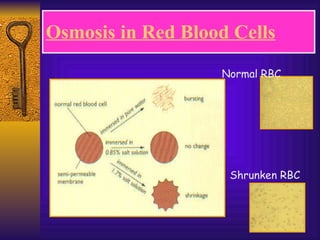
Osmosis in Red Blood Cells Shrunken RBC Normal RBC
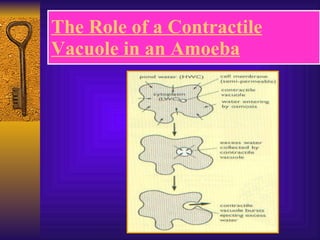
The Role of a Contractile Vacuole in an Amoeba
Osmosis in Plant cells Plant cells have a strong cell wall outside the membrane This all prevents them swelling up too much They become STIFF and HARD ( like a FOOTBALL)  … .we call this  TURGID If they lose water they become LIMP AND FLOPPY (like a ball with no air in it) Because the membrane has shrunk away from the cell wall We call this a PLASMOLYSED  cell
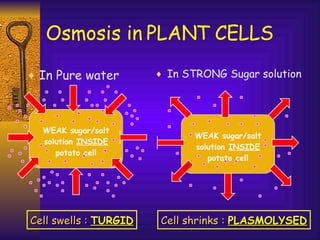
Osmosis in PLANT CELLS In Pure water In STRONG Sugar solution WEAK sugar/salt solution  INSIDE  potato cell Cell swells :  TURGID WEAK sugar/salt solution  INSIDE  potato cell Cell shrinks :  PLASMOLYSED
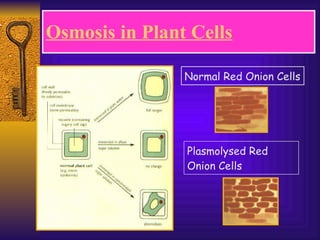
Osmosis in Plant Cells Normal Red Onion Cells Plasmolysed Red Onion Cells
Important  Terms Turgid  - the term used to describe a plant cell which has swollen due to entry of water by osmosis. Plasmolysed  - the term used to describe a plant cell whose contents have shrunk due to loss of water by osmosis.
Hypotonic (HWC)  - a region of lower water concentration (to the surroundings) Hypertonic (LWC)  - a region of higher water concentration. Isotonic  - a region where there are equal water concentrations on either side of a membrane. Some Important Terms
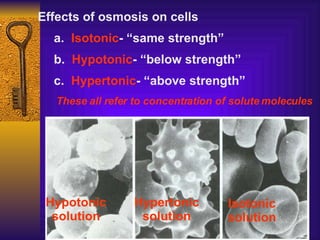
Effects of osmosis on cells a.  Isotonic - “same strength” b.  Hypotonic - “below strength” c.  Hypertonic - “above strength” These all refer to concentration of solute molecules Isotonic solution Hypotonic solution Hypertonic solution
Osmosis Osmosis is a special type of  diffusion Osmosis is the movement of  WATER  from where it is in  high concentration  to where it is in  low concentration  across a  selectively permeable membrane  (cell membrane) During  OSMOSIS , water can either leave or enter a cell depending on the  STRENGTH  of solution surrounding it ( be careful here!) REMEMBER :  All cells contain a weak salt/sugar solution.
 
Sub-topic C Investigating Cell Division
All cells of plants and animals grow to a certain size and then divide. The size of the plants and animal varies, not so much in the cell size, but in the number of cells the organism has.
Human has about 100 trillion cells   (100,000,000,000,000 or  10 14 )
Why are there no giant cells ( since there are giant animals) Largest cell in humans is the sciatic nerve in leg -approximately 2 meters long. If a cell becomes too big, its surface area would be too small to allow food or oxygen to enter or waste products to leave.
Why Cells Divide Cell size is limited Cells cannot keep growing indefinitely Replacement of damaged cells Growth - embryo Sexual reproduction - meiosis
Cell Cycle and Mitosis Before a cell divides it must copy DNA Genes are found on chromosomes Chroma - colored body Soma - body First noticed when staining cells  To look at under microscope Only visible sometimes Chromatin - combo of DNA & protein
Mitosis  is a process of cell division that increases the number of body cells in an individual organism.  Mitosis ensures genetic continuity.  The genetic materials in the parent duplicate and then divide into two identical sets.  After this the cytoplasm divides as well.
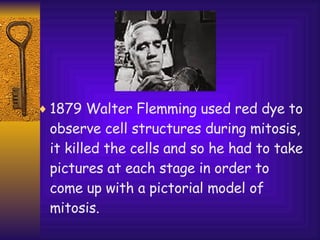
1879 Walter Flemming used red dye to observe cell structures during mitosis, it killed the cells and so he had to take pictures at each stage in order to come up with a pictorial model of mitosis.
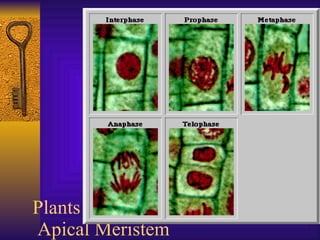
  Same as animals except: -plants develop a cell plate ( wall) between  daughter cells. Mitosis in Plants
Sexual   Reproduction Each parent contributes genes to the offspring. each offspring has a different set of inherited traits from the parents different also than any other members of its own species. Gives offspring a better chance of surviving in a changing environment.
Involves specialized haploid reproductive cells called  gametes  female -  egg , male -  sperm When male and female gametes unite, a fertilized egg, or  zygote , is formed.  The zygote can develop into a complete mature organism. The cell division in sexual reproduction is called  meiosis .
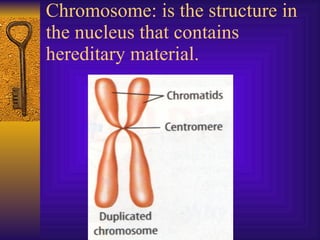
Chromosome: is the structure in the nucleus that contains hereditary material.
 
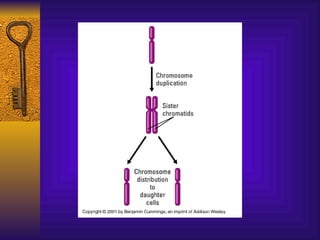
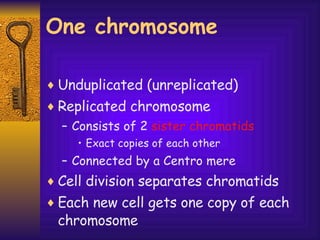
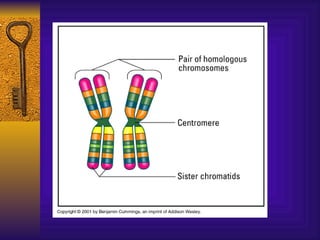
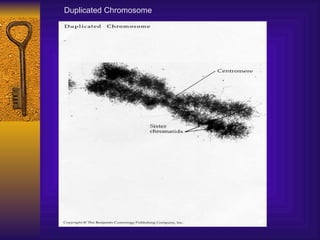
One chromosome Unduplicated (unreplicated) Replicated chromosome Consists of 2  sister chromatids Exact copies of each other Connected by a Centro mere Cell division separates chromatids  Each new cell gets one copy of each chromosome
 
Duplicated Chromosome
Mitosis  Mitosis is the process by which new body cell are produced for: Growth Replacing damaged or old cells.  This is a complex process  requiring different stages
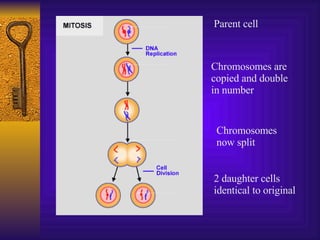
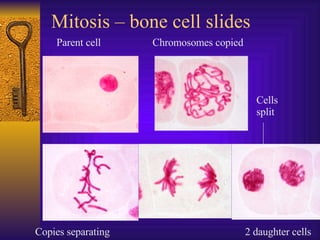
2 daughter cells identical to original Parent cell Chromosomes are copied and double in number Chromosomes now split
Mitosis All daughter cells contain the same genetic information from the original parent cell from which it was copied. Every different type cell in your body contains the  same  genes, but only some act to make the cells specialise – e.g. into nerve or muscle tissue.
Mitosis – bone cell slides 2 4 5 Parent cell Chromosomes copied Copies separating 2 daughter cells Cells split
Plants  Apical Meristem
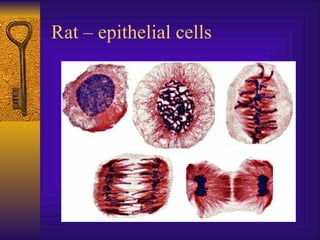
Rat – epithelial cells
 
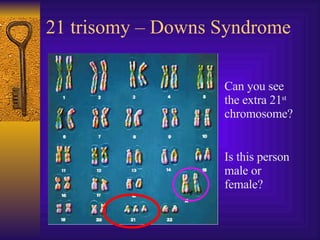
21 trisomy – Downs Syndrome Can you see the extra 21 st  chromosome? Is this person male or female?
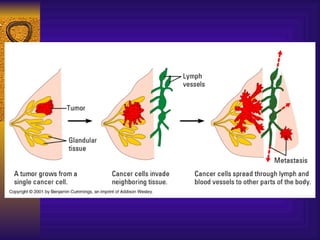
Cancer Cell cycle control system Enzymes in cell control when and where cells divide Malfunction in system means cells divide at inappropriate times and places Benign tumor  - abnormal mass of essentially normal cells Stay at original site, don’t move Cancer uncontrolled cell division
Cancer   Problem not only uncontrolled division Metastisis  Cancer cells can move to other sites New tumor at that site Three treatments Surgery to remove tumor Radiation  Chemotherapy Last two aimed at controlling division
 
Cancer treatments Radiation  Disrupts cell division Most actively dividing cells are tumor Can damage normal cells- ovaries / testes Chemotherapy Some disrupt cell division  Taxo l  freezes spindle Vinblastine  prevents spindle formation
Sub-Topic D... Investigating Enzymes What they do and how they do it !
What are Enzymes ? Living things work at fairly low temperatures They need many chemical reactions to keep them alive So… where do enzymes fit in ? They are “BIOLOGICAL CATALYSTS”  Where are they found ? In ALL LIVING CELLS A catalyst is a substance which speeds Up a reaction but is unchanged by it !
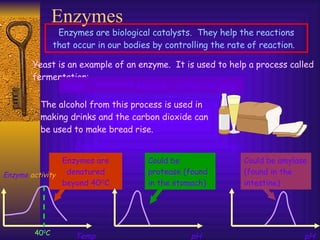
Enzymes Enzymes are biological catalysts.  They help the reactions that occur in our bodies by controlling the rate of reaction.  Yeast is an example of an enzyme.  It is used to help a process called fermentation: The alcohol from this process is used in making drinks and the carbon dioxide can be used to make bread rise. Enzymes work best in certain conditions: Enzymes are denatured beyond 40 O C Sugar  Alcohol + carbon dioxide Enzyme  activity Temp pH pH 40 0 C Could be protease (found in the stomach) Could be amylase (found in the intestine)
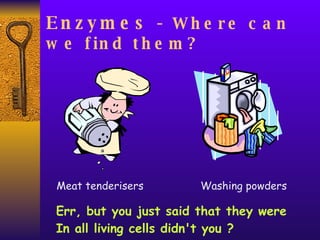
Enzymes -  Where can we find them? Meat tenderisers Washing powders Err, but you just said that they were In all living cells didn't you ?
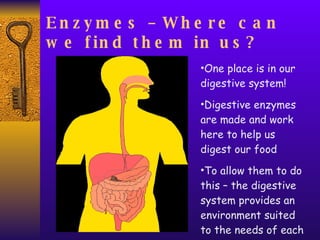
Enzymes – Where can we find them in us? One place is in our digestive system! Digestive enzymes are made and work here to help us digest our food To allow them to do this – the digestive system provides an environment suited to the needs of each enzyme.
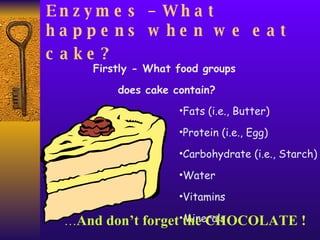
Enzymes – What happens when we eat cake?   Firstly - What food groups  does cake contain? Fats (i.e., Butter) Protein (i.e., Egg) Carbohydrate (i.e., Starch) Water Vitamins Minerals … And don’t forget the CHOCOLATE !
A bit about chemical reactions.. They either involve the BREAKDOWN of big molecules into smaller ones Or they BUILD UP smaller molecules into bigger ones This is called  a SYNTHESIS reaction Without enzymes,the chemical reactions In living cells would be far too slow To keep life going ! !
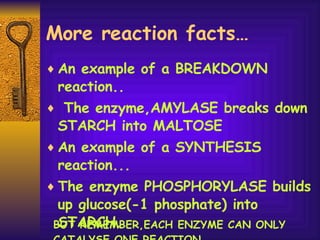
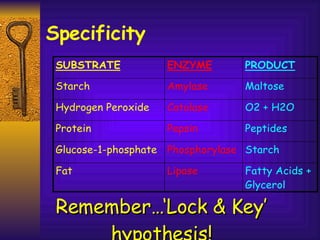
More reaction facts… An example of a BREAKDOWN reaction.. The enzyme,AMYLASE breaks down STARCH into MALTOSE An example of a SYNTHESIS reaction... The enzyme PHOSPHORYLASE builds up glucose(-1 phosphate) into STARCH. BUT REMEMBER,EACH ENZYME CAN ONLY CATALYSE ONE REACTION.
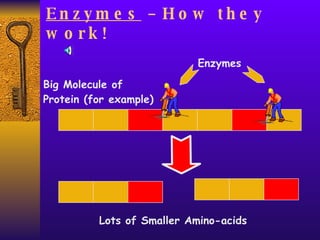
Enzymes  – How they work! Enzymes Big Molecule of Protein (for example) Lots of Smaller Amino-acids
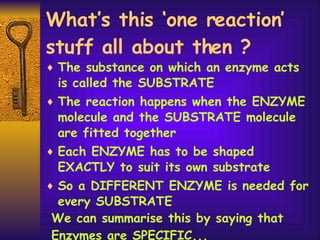
What’s this ‘one reaction’ stuff all about then ? The substance on which an enzyme acts is called the SUBSTRATE The reaction happens when the ENZYME molecule and the SUBSTRATE molecule are fitted together Each ENZYME has to be shaped EXACTLY to suit its own substrate So a DIFFERENT ENZYME is needed for every SUBSTRATE We can summarise this by saying that  Enzymes are SPECIFIC...
We call this the lock-key hypothesis!!
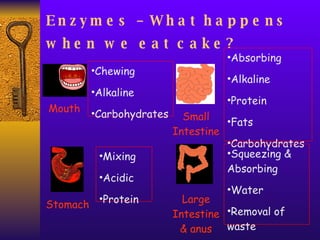
Enzymes – What happens when we eat cake?   Mouth Stomach Small Intestine Large Intestine & anus Chewing Alkaline Carbohydrates Mixing Acidic Protein Absorbing Alkaline Protein Fats Carbohydrates Squeezing & Absorbing Water Removal of waste
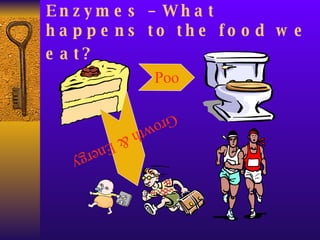
Enzymes – What happens to the food we eat?   Poo Growth & Energy
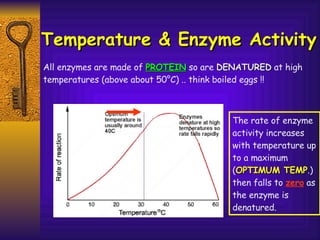
ENZYMES ARE... Made of protein So they are DENATURED at high temperatures (above about 50 oC ) Their rate of activity increases with temp. up to a maximum,then falls to zero as the enzyme is denatured Also affected by pH (each enzyme has its own range of pH in which it will work i.e Pepsin only works between pH 1 - 4 Where do we find Pepsin  in the body ?
Enzymes in living cells Enzymes are  PROTEINS  which are present in  ALL LIVING CELLS.  They act as biological  CATALYSTS  by  SPEEDING UP  chemical reactions without being used up itself. Why do we need enzymes ?   most cells work at  relatively low temperatures  and their chemical reactions ( e.g.  respiration, digestion, photosynthesis ) would be  too slow  to sustain life without the help of enzymes !
Specificity Remember…‘Lock & Key’ hypothesis!
Temperature & Enzyme Activity All enzymes are made of  PROTEIN  so are  DENATURED  at high temperatures (above about 50°C) .. think boiled eggs !! The rate of enzyme activity increases with temperature up to a maximum ( OPTIMUM TEMP .) then falls to  zero  as the enzyme is denatured.
pH & Enzyme Activity pH  also affects the rate of enzyme activity. Each enzyme has its own  range of pH  in which it will work.  Examples :   the enzyme  PEPSIN  only works between (pH 1-4) pH 1 - pH 4  (acidic)  the enzyme  CATALASE  only works between (pH 8-11) pH 7 - pH 11  (alkaline) Optimum  = "the best” ... The enzyme is working at its  very fastest
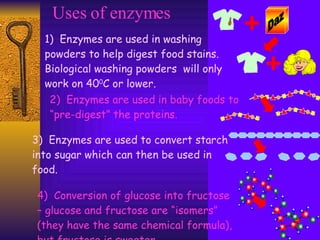
Uses of enzymes 1)  Enzymes are used in washing powders to help digest food stains.  Biological washing powders  will only work on 40 0 C or lower. 2)  Enzymes are used in baby foods to “pre-digest” the proteins. 3)  Enzymes are used to convert starch into sugar which can then be used in food. 4)  Conversion of glucose into fructose – glucose and fructose are “isomers” (they have the same chemical formula), but fructose is sweeter. Daz
And finally... ‘ Optimum’ is a useful word which means ‘best’ So we call the TEMPERATURE and the pH which makes an ENZYME work at its very fastest, the OPTIMUM for that enzyme.
SUB-TOPIC E... Investigating Aerobic Respiration
Respiration Respiration is not just breathing in and out. Respiration takes place in all plant and animal cells for 24 hours a day. Respiration is the process of converting glucose into energy. It takes place in all plant and animal cells. There are two types of respiration: Aerobic respiration  Anaerobic respiration
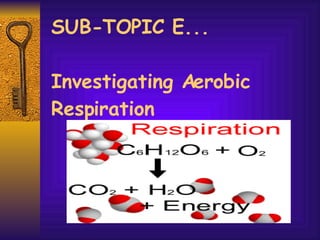
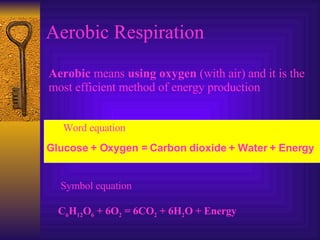
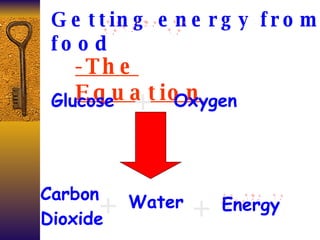
Aerobic Respiration Aerobic  means  using oxygen  (with air) and it is the most efficient method of energy production Word equation Glucose + Oxygen = Carbon dioxide + Water + Energy Symbol equation C 6 H 12 O 6  + 6O 2  = 6CO 2  + 6H 2 O + Energy
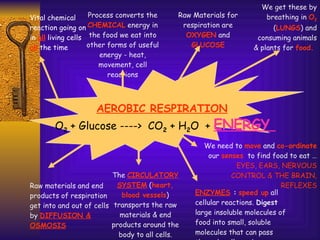
O 2  + Glucose ---->  CO 2  + H 2 O  +   ENERGY  AEROBIC RESPIRATION Vital chemical reaction going on in  all  living cells  all  the time Process converts the  CHEMICAL  energy in the food we eat into other forms of useful energy - heat, movement, cell reactions Raw Materials for respiration are  OXYGEN  and  GLUCOSE We get these by breathing in  O 2  ( LUNGS ) and consuming animals & plants for  food.  ENZYMES  :   speed up  all cellular reactions.  Digest  large insoluble molecules of food into small, soluble molecules that can pass through cell membranes Raw materials and end products of respiration get into and out of cells by  DIFFUSION & OSMOSIS The  CIRCULATORY SYSTEM  ( heart, blood vessels ) transports the raw materials & end products around the body to all cells. We need to  move  and  co-ordinate  our  senses   to find food to eat …  EYES, EARS, NERVOUS CONTROL & THE BRAIN, REFLEXES
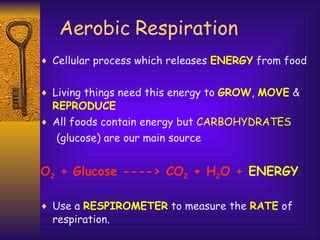
Aerobic Respiration Cellular process which releases  ENERGY  from food Living things need this energy to  GROW ,  MOVE  &  REPRODUCE All foods contain energy but  CARBOHYDRATES (glucose) are our main source O 2  + Glucose ----> CO 2  + H 2 O +   ENERGY  Use a  RESPIROMETER  to measure the  RATE  of respiration.
Getting energy from food
Getting energy from food -The Equation + Glucose Oxygen Carbon Dioxide Water Energy + +
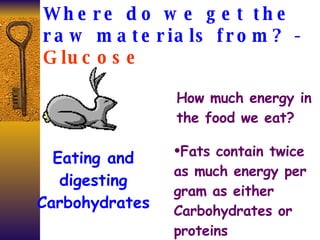
Where do we get the raw materials from? -  Glucose Eating and digesting Carbohydrates  How much energy in the food we eat? Fats contain twice as much energy per gram as either Carbohydrates or proteins
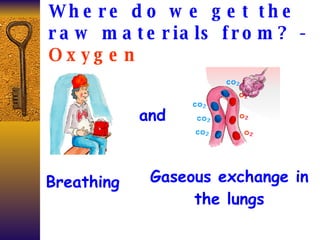
Where do we get the raw materials from? -  Oxygen Breathing Gaseous exchange in the lungs and
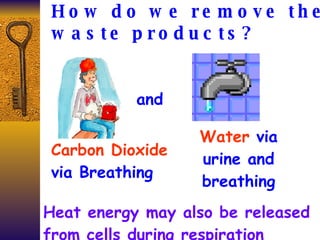
How do we remove the waste products? Carbon Dioxide  via Breathing Water  via urine and breathing and Heat energy may also be released from cells during respiration
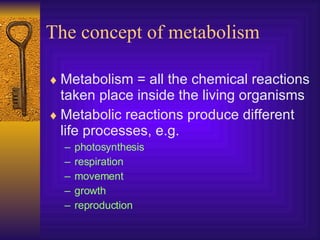
The concept of metabolism Metabolism = all the chemical reactions taken place inside the living organisms Metabolic reactions produce different life processes, e.g.  photosynthesis respiration movement growth reproduction
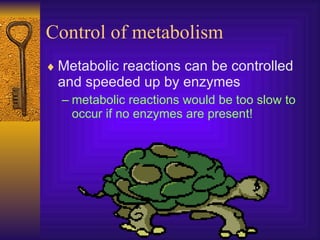
Control of metabolism Metabolic reactions can be controlled and speeded up by enzymes metabolic reactions would be too slow to occur if no enzymes are present!
Remember… Energy is important as the heat produced enables ENZYMES to work more quickly Some reactions need energy to get them started (ACTIVATION ENERGY) Some reactions need energy to keep them going GOOD LUCK WITH YOUR TEST !!!!

Investigating Cells

  • 1.
  • 2.
    This unit isdivided into five sub-topics. Investigating……… Diffusion Living cells Cell division
  • 3.
  • 4.
  • 5.
    Overview Inthe same way that there are different kinds of cells inside you, different organisms have different types of cells. Trees have different cells than you and so do monkeys. Each of those cells is different in some way.
  • 6.
    What Is aMicroscope? Name derived from Greek words: micro meaning “small” and scope “to see” Used to see details invisible to the naked eye A valuable tool for the biologist Research in cell biology Medical diagnoses and tests Observation of microbes
  • 7.
    What Is aMicroscope? Light microscope.Transmitted light passes through a specimen on a glass slide, through two or more magnifying lenses (ocular lens & objective lens), and appears as an enlarged image.
  • 8.
    What Are theMajor Parts of the Light Compound Microscope? Eyepiece lens Body tube Coarse adjustment Fine adjustment Revolving nosepiece Objective lenses Stage Stage clips Base
  • 9.
    What Are theMajor Parts of a Light Microscope? Eyepiece (ocular) lens - magnifies image Body tube – directs light through scope Nosepiece – contains objective lenses and switches from high to low power Arm – handle to carry microscope Stage – platform used to mount microscope slide
  • 10.
    What Are theMajor Parts of a Light Microscope? Mechanical stage adjustment knobs – moves slide across stage to view different areas of specimen Objective lenses – high & low power, magnifies image Coarse adjustment knob – rough focusing Fine adjustment knob – fine focusing
  • 11.
    How do youuse a microscope? -rules for microscope use Use two hands to carry the microscope Lens paper only to clean lenses Always begin with low power Fine focus only when using high power Return scope to assigned place with low power in place, and cord neatly wrapped.
  • 12.
    How do youuse a microscope? -focusing hints Turn revolving nosepiece to low power Place slide with cover slip on stage and center specimen Use adjustment to bring slide and stage as close together as possible
  • 13.
    How do youuse a microscope? -focusing hints (cont.) Look into eyepiece and move stage with coarse adjustment until specimen comes into view For high power viewing: follow above steps and then rotate nosepiece to high power objective.
  • 14.
    What Are SomeCharacteristics of Microscope Viewing? Magnification. The power of magnification is marked on each lens. For example: ocular = 10x, low power = 10x, high power = 45x. Note: scopes will vary.The total magnification is determined by multiplying the power of the ocular lens times the power of a single objective lens. For example: under low power (10x)(10x) = 100x. Therefore, your object appears 100 times greater than natural size.
  • 15.
    Eyepiece Lens XObjective Lens = Total Magnification
  • 16.
    Low Power = 4 x Medium Power = 10 x High Power = 40 x Objective Lenses
  • 17.
    Vocabulary Review Magnification– enlargement of image Resolution – clarity of image Transmitted light – light that passes through a specimen Reflected light – light that bounces off a specimen Now lets have a look at some cell stuff !!!!
  • 18.
    Cells Tissues OrgansSystems Organisms
  • 19.
    Animal cells Complexorganisms like you are made up of many different kinds of cells. Nucleus controls what the cell does. Contains the DNA (with genes) Cytoplasm is where all the chemical reactions take place. Cell membrane holds the cell together and controls what goes in and out of the cell.
  • 20.
    Plant cell Plantcells are very special as they can trap sunlight and store the energy as “plant food” Nucleus controls what the cell does. Contains the DNA Cytoplasm is where all the chemical reactions take place. Cell membrane holds the cell together and controls what goes in and out of the cell Chloroplasts containing chlorophyll for photosynthesis Vacuole containing cell sap, a solution of sugar and salts. Ridged cell wall made of cellulose, gives support for the cell
  • 21.
    The design ofa cell is a clue to its function. This group of four cells are very thin. This would allow small molecules to pass through them So what do you think this cell is specialised for. These cells are specialised for lining blood capillaries. If you look carefully you can usually work out what the cell speciality is.
  • 22.
    Can you workout what this cell’s function is? The obvious feature is the hairs. Hairs on cell usually indicate that its function is for moving something. This cell is specialised for moving egg cells inside the female reproductive systems.
  • 23.
    Comparing animal celland plant cells Both cells have:- A nucleus Cytoplasm Cell membrane But only plant cells have:- A cell wall A vacuole Chloroplasts Remember there are lots of different kinds of animal and plant cells but all of them have the above features
  • 24.
    6 7 89 A white blood cell B gland cell C sperm cell D capillary wall cell The drawings show four kinds of cell that are found in the human body. Match up their names.
  • 25.
    The drawings showfour kinds of cell that are found in the human body. A B C D 10. Which kind of cell is specialised for ingesting microbes? 11 . Which kind of cell is specialised for communicating with many other cells? 12. Which kind of cell is specialised for moving egg cells inside the female reproductive system? 13. Which kind of cell is specialised for moving oxygen around the body?
  • 26.
    Sub topic BInvestigating Diffusion
  • 27.
    What is Diffusion???? Molecules in a liquid and a gas move about freely all the time Molecules move from areas where they are numerous to areas where there aren’t so many of them So… Diffusion is… The movement of a substance from an area Of high concentration to one of Low concentration
  • 28.
    So Which thingscan diffuse? Dissolved foods(eg. Amino-acids, glucose,fatty acids) Oxygen Carbon Dioxide Water Diffusion is important because it is the process By which USEFUL molecules enter the body Cells and waste products are REMOVED
  • 29.
  • 30.
    DIFFUSION Diffusion isa PASSIVE process which means no energy is used to make the molecules move, they have a natural kinetic energy.
  • 31.
  • 32.
  • 33.
    Diffusion through amembrane Cell membrane Inside cell Outside cell
  • 34.
    Diffusion through amembrane Cell membrane Inside cell Outside cell diffusion
  • 35.
    Diffusion through amembrane Cell membrane Inside cell Outside cell EQUILIBRIUM
  • 36.
    Diffusion The rawmaterials and end products of respiration get INTO and OUT of cells by DIFFUSION DIFFUSION is the movement of molecules from an area of HIGH concentration to an area of LOW concentration until EVENLY SPREAD Examples : O 2 and Glucose move from high conc in blood to low conc in cells (where they get used in respiration) CO 2 moves from high conc in cells (where it is produced in respiration) to low conc in blood
  • 37.
    An example ofdiffusion…in YOU Oxygen moves from HIGH concentration(in the AIR) to a LOWER concentration(in the Blood) The CELL MEMBRANEs control this movement into and out of the cell It is said to move DOWN A CONCENTRATION GRADIENT
  • 38.
    Osmosis : The net movement of water molecules along a concentration gradient from an area of high water concentration (HWC) to an area of low water concentration (LWC) through a selectively permeable membrane . Osmosis is just a special case of DIFFUSION
  • 39.
    More on Membranes…PERMEABLE means “allows anything to pass through” Membranes allow small molecules to pass through (like water) … but prevent larger molecules from passing through This is called SELECTIVELY PERMEABLE
  • 40.
    Passing water… Purewater has the highest water concentration possible As more salt/sugar is dissolved,the water concentration DECREASES A concentration gradient may be caused REMEMBER: Osmosis is the movement of water Molecules from high to low concentration DOWN A CONCENTRATION GRADIENT
  • 41.
    Osmosis in animalcells Animal cells are surrounded by only ? …… .. A MEMBRANE If too much water enters by OSMOSIS,what will happen ? …… they will swell up and BURST If too much water leaves by OSMOSIS,what will happen ? …… they will shrivel up
  • 42.
    Osmosis in ANIMALCELLS In Pure water In STRONG Sugar solution WEAK sugar/salt solution INSIDE animal cell Cell swells & ... BURSTS ! WEAK sugar/salt solution INSIDE animal cell Cell shrinks : PLASMOLYSED
  • 43.
    Osmosis in RedBlood Cells Shrunken RBC Normal RBC
  • 44.
    The Role ofa Contractile Vacuole in an Amoeba
  • 45.
    Osmosis in Plantcells Plant cells have a strong cell wall outside the membrane This all prevents them swelling up too much They become STIFF and HARD ( like a FOOTBALL) … .we call this TURGID If they lose water they become LIMP AND FLOPPY (like a ball with no air in it) Because the membrane has shrunk away from the cell wall We call this a PLASMOLYSED cell
  • 46.
    Osmosis in PLANTCELLS In Pure water In STRONG Sugar solution WEAK sugar/salt solution INSIDE potato cell Cell swells : TURGID WEAK sugar/salt solution INSIDE potato cell Cell shrinks : PLASMOLYSED
  • 47.
    Osmosis in PlantCells Normal Red Onion Cells Plasmolysed Red Onion Cells
  • 48.
    Important TermsTurgid - the term used to describe a plant cell which has swollen due to entry of water by osmosis. Plasmolysed - the term used to describe a plant cell whose contents have shrunk due to loss of water by osmosis.
  • 49.
    Hypotonic (HWC) - a region of lower water concentration (to the surroundings) Hypertonic (LWC) - a region of higher water concentration. Isotonic - a region where there are equal water concentrations on either side of a membrane. Some Important Terms
  • 50.
    Effects of osmosison cells a. Isotonic - “same strength” b. Hypotonic - “below strength” c. Hypertonic - “above strength” These all refer to concentration of solute molecules Isotonic solution Hypotonic solution Hypertonic solution
  • 51.
    Osmosis Osmosis isa special type of diffusion Osmosis is the movement of WATER from where it is in high concentration to where it is in low concentration across a selectively permeable membrane (cell membrane) During OSMOSIS , water can either leave or enter a cell depending on the STRENGTH of solution surrounding it ( be careful here!) REMEMBER : All cells contain a weak salt/sugar solution.
  • 52.
  • 53.
  • 54.
    All cells ofplants and animals grow to a certain size and then divide. The size of the plants and animal varies, not so much in the cell size, but in the number of cells the organism has.
  • 55.
    Human has about100 trillion cells (100,000,000,000,000 or 10 14 )
  • 56.
    Why are thereno giant cells ( since there are giant animals) Largest cell in humans is the sciatic nerve in leg -approximately 2 meters long. If a cell becomes too big, its surface area would be too small to allow food or oxygen to enter or waste products to leave.
  • 57.
    Why Cells DivideCell size is limited Cells cannot keep growing indefinitely Replacement of damaged cells Growth - embryo Sexual reproduction - meiosis
  • 58.
    Cell Cycle andMitosis Before a cell divides it must copy DNA Genes are found on chromosomes Chroma - colored body Soma - body First noticed when staining cells To look at under microscope Only visible sometimes Chromatin - combo of DNA & protein
  • 59.
    Mitosis isa process of cell division that increases the number of body cells in an individual organism. Mitosis ensures genetic continuity. The genetic materials in the parent duplicate and then divide into two identical sets. After this the cytoplasm divides as well.
  • 60.
    1879 Walter Flemmingused red dye to observe cell structures during mitosis, it killed the cells and so he had to take pictures at each stage in order to come up with a pictorial model of mitosis.
  • 61.
    Sameas animals except: -plants develop a cell plate ( wall) between daughter cells. Mitosis in Plants
  • 62.
    Sexual Reproduction Each parent contributes genes to the offspring. each offspring has a different set of inherited traits from the parents different also than any other members of its own species. Gives offspring a better chance of surviving in a changing environment.
  • 63.
    Involves specialized haploidreproductive cells called gametes female - egg , male - sperm When male and female gametes unite, a fertilized egg, or zygote , is formed.  The zygote can develop into a complete mature organism. The cell division in sexual reproduction is called meiosis .
  • 64.
    Chromosome: is thestructure in the nucleus that contains hereditary material.
  • 65.
  • 66.
    One chromosome Unduplicated(unreplicated) Replicated chromosome Consists of 2 sister chromatids Exact copies of each other Connected by a Centro mere Cell division separates chromatids Each new cell gets one copy of each chromosome
  • 67.
  • 68.
  • 69.
    Mitosis Mitosisis the process by which new body cell are produced for: Growth Replacing damaged or old cells. This is a complex process requiring different stages
  • 70.
    2 daughter cellsidentical to original Parent cell Chromosomes are copied and double in number Chromosomes now split
  • 71.
    Mitosis All daughtercells contain the same genetic information from the original parent cell from which it was copied. Every different type cell in your body contains the same genes, but only some act to make the cells specialise – e.g. into nerve or muscle tissue.
  • 72.
    Mitosis – bonecell slides 2 4 5 Parent cell Chromosomes copied Copies separating 2 daughter cells Cells split
  • 73.
    Plants ApicalMeristem
  • 74.
  • 75.
  • 76.
    21 trisomy –Downs Syndrome Can you see the extra 21 st chromosome? Is this person male or female?
  • 77.
    Cancer Cell cyclecontrol system Enzymes in cell control when and where cells divide Malfunction in system means cells divide at inappropriate times and places Benign tumor - abnormal mass of essentially normal cells Stay at original site, don’t move Cancer uncontrolled cell division
  • 78.
    Cancer Problem not only uncontrolled division Metastisis Cancer cells can move to other sites New tumor at that site Three treatments Surgery to remove tumor Radiation Chemotherapy Last two aimed at controlling division
  • 79.
  • 80.
    Cancer treatments Radiation Disrupts cell division Most actively dividing cells are tumor Can damage normal cells- ovaries / testes Chemotherapy Some disrupt cell division Taxo l freezes spindle Vinblastine prevents spindle formation
  • 81.
    Sub-Topic D... InvestigatingEnzymes What they do and how they do it !
  • 82.
    What are Enzymes? Living things work at fairly low temperatures They need many chemical reactions to keep them alive So… where do enzymes fit in ? They are “BIOLOGICAL CATALYSTS” Where are they found ? In ALL LIVING CELLS A catalyst is a substance which speeds Up a reaction but is unchanged by it !
  • 83.
    Enzymes Enzymes arebiological catalysts. They help the reactions that occur in our bodies by controlling the rate of reaction. Yeast is an example of an enzyme. It is used to help a process called fermentation: The alcohol from this process is used in making drinks and the carbon dioxide can be used to make bread rise. Enzymes work best in certain conditions: Enzymes are denatured beyond 40 O C Sugar Alcohol + carbon dioxide Enzyme activity Temp pH pH 40 0 C Could be protease (found in the stomach) Could be amylase (found in the intestine)
  • 84.
    Enzymes - Where can we find them? Meat tenderisers Washing powders Err, but you just said that they were In all living cells didn't you ?
  • 85.
    Enzymes – Wherecan we find them in us? One place is in our digestive system! Digestive enzymes are made and work here to help us digest our food To allow them to do this – the digestive system provides an environment suited to the needs of each enzyme.
  • 86.
    Enzymes – Whathappens when we eat cake? Firstly - What food groups does cake contain? Fats (i.e., Butter) Protein (i.e., Egg) Carbohydrate (i.e., Starch) Water Vitamins Minerals … And don’t forget the CHOCOLATE !
  • 87.
    A bit aboutchemical reactions.. They either involve the BREAKDOWN of big molecules into smaller ones Or they BUILD UP smaller molecules into bigger ones This is called a SYNTHESIS reaction Without enzymes,the chemical reactions In living cells would be far too slow To keep life going ! !
  • 88.
    More reaction facts…An example of a BREAKDOWN reaction.. The enzyme,AMYLASE breaks down STARCH into MALTOSE An example of a SYNTHESIS reaction... The enzyme PHOSPHORYLASE builds up glucose(-1 phosphate) into STARCH. BUT REMEMBER,EACH ENZYME CAN ONLY CATALYSE ONE REACTION.
  • 89.
    Enzymes –How they work! Enzymes Big Molecule of Protein (for example) Lots of Smaller Amino-acids
  • 90.
    What’s this ‘onereaction’ stuff all about then ? The substance on which an enzyme acts is called the SUBSTRATE The reaction happens when the ENZYME molecule and the SUBSTRATE molecule are fitted together Each ENZYME has to be shaped EXACTLY to suit its own substrate So a DIFFERENT ENZYME is needed for every SUBSTRATE We can summarise this by saying that Enzymes are SPECIFIC...
  • 91.
    We call thisthe lock-key hypothesis!!
  • 92.
    Enzymes – Whathappens when we eat cake? Mouth Stomach Small Intestine Large Intestine & anus Chewing Alkaline Carbohydrates Mixing Acidic Protein Absorbing Alkaline Protein Fats Carbohydrates Squeezing & Absorbing Water Removal of waste
  • 93.
    Enzymes – Whathappens to the food we eat? Poo Growth & Energy
  • 94.
    ENZYMES ARE... Madeof protein So they are DENATURED at high temperatures (above about 50 oC ) Their rate of activity increases with temp. up to a maximum,then falls to zero as the enzyme is denatured Also affected by pH (each enzyme has its own range of pH in which it will work i.e Pepsin only works between pH 1 - 4 Where do we find Pepsin in the body ?
  • 95.
    Enzymes in livingcells Enzymes are PROTEINS which are present in ALL LIVING CELLS. They act as biological CATALYSTS by SPEEDING UP chemical reactions without being used up itself. Why do we need enzymes ? most cells work at relatively low temperatures and their chemical reactions ( e.g. respiration, digestion, photosynthesis ) would be too slow to sustain life without the help of enzymes !
  • 96.
  • 97.
    Temperature & EnzymeActivity All enzymes are made of PROTEIN so are DENATURED at high temperatures (above about 50°C) .. think boiled eggs !! The rate of enzyme activity increases with temperature up to a maximum ( OPTIMUM TEMP .) then falls to zero as the enzyme is denatured.
  • 98.
    pH & EnzymeActivity pH also affects the rate of enzyme activity. Each enzyme has its own range of pH in which it will work. Examples : the enzyme PEPSIN only works between (pH 1-4) pH 1 - pH 4 (acidic) the enzyme CATALASE only works between (pH 8-11) pH 7 - pH 11 (alkaline) Optimum = "the best” ... The enzyme is working at its very fastest
  • 99.
    Uses of enzymes1) Enzymes are used in washing powders to help digest food stains. Biological washing powders will only work on 40 0 C or lower. 2) Enzymes are used in baby foods to “pre-digest” the proteins. 3) Enzymes are used to convert starch into sugar which can then be used in food. 4) Conversion of glucose into fructose – glucose and fructose are “isomers” (they have the same chemical formula), but fructose is sweeter. Daz
  • 100.
    And finally... ‘Optimum’ is a useful word which means ‘best’ So we call the TEMPERATURE and the pH which makes an ENZYME work at its very fastest, the OPTIMUM for that enzyme.
  • 101.
    SUB-TOPIC E... InvestigatingAerobic Respiration
  • 102.
    Respiration Respiration isnot just breathing in and out. Respiration takes place in all plant and animal cells for 24 hours a day. Respiration is the process of converting glucose into energy. It takes place in all plant and animal cells. There are two types of respiration: Aerobic respiration Anaerobic respiration
  • 103.
    Aerobic Respiration Aerobic means using oxygen (with air) and it is the most efficient method of energy production Word equation Glucose + Oxygen = Carbon dioxide + Water + Energy Symbol equation C 6 H 12 O 6 + 6O 2 = 6CO 2 + 6H 2 O + Energy
  • 104.
    O 2 + Glucose ----> CO 2 + H 2 O + ENERGY AEROBIC RESPIRATION Vital chemical reaction going on in all living cells all the time Process converts the CHEMICAL energy in the food we eat into other forms of useful energy - heat, movement, cell reactions Raw Materials for respiration are OXYGEN and GLUCOSE We get these by breathing in O 2 ( LUNGS ) and consuming animals & plants for food. ENZYMES : speed up all cellular reactions. Digest large insoluble molecules of food into small, soluble molecules that can pass through cell membranes Raw materials and end products of respiration get into and out of cells by DIFFUSION & OSMOSIS The CIRCULATORY SYSTEM ( heart, blood vessels ) transports the raw materials & end products around the body to all cells. We need to move and co-ordinate our senses to find food to eat … EYES, EARS, NERVOUS CONTROL & THE BRAIN, REFLEXES
  • 105.
    Aerobic Respiration Cellularprocess which releases ENERGY from food Living things need this energy to GROW , MOVE & REPRODUCE All foods contain energy but CARBOHYDRATES (glucose) are our main source O 2 + Glucose ----> CO 2 + H 2 O + ENERGY Use a RESPIROMETER to measure the RATE of respiration.
  • 106.
  • 107.
    Getting energy fromfood -The Equation + Glucose Oxygen Carbon Dioxide Water Energy + +
  • 108.
    Where do weget the raw materials from? - Glucose Eating and digesting Carbohydrates How much energy in the food we eat? Fats contain twice as much energy per gram as either Carbohydrates or proteins
  • 109.
    Where do weget the raw materials from? - Oxygen Breathing Gaseous exchange in the lungs and
  • 110.
    How do weremove the waste products? Carbon Dioxide via Breathing Water via urine and breathing and Heat energy may also be released from cells during respiration
  • 111.
    The concept ofmetabolism Metabolism = all the chemical reactions taken place inside the living organisms Metabolic reactions produce different life processes, e.g. photosynthesis respiration movement growth reproduction
  • 112.
    Control of metabolismMetabolic reactions can be controlled and speeded up by enzymes metabolic reactions would be too slow to occur if no enzymes are present!
  • 113.
    Remember… Energy isimportant as the heat produced enables ENZYMES to work more quickly Some reactions need energy to get them started (ACTIVATION ENERGY) Some reactions need energy to keep them going GOOD LUCK WITH YOUR TEST !!!!