Metabolomics: The Basics
The Pyramid of Life
25,000 Genes25,000 Genes
2500 Enzymes2500 Enzymes
1400
Chemicals
Metabolomics
Proteomics
Genomics
Perturbation Primary Molecules
Secondary Molecules
Resorption
Dilution
Filtration
Concentration
Metabolomics
Chemical Fingerprint
Metabonomics & Metabolomics
• Metabonomics:The quantitative measurement
of the time-related “total” metabolic response
of vertebrates to pathophysiological
(nutritional, xenobiotic, surgical or toxic
stimuli)
• Metabolomics:The quantitative measurement
of the metabolic profiles of model organisms
to characterize their phenotype or phenotypic
response to genetic or nutritional
perturbations
Metabolomics Is GrowingGrowth in Metabolomics
0
20
40
60
80
100
120
140
160
180
200
1998
1999
2000
2001
2002
2003
2004
2005
Year
#References
What is a Metabolite?
• Any organic molecule detectable in the
body with a MW < 1000 Da
• Includes peptides, oligonucleotides,
sugars, nucelosides, organic acids,
ketones, aldehydes, amines, amino
acids, lipids, steroids, alkaloids and
drugs (xenobiotics)
• Includes human & microbial products
• Concentration > 1µM
Why 1 µM?
• Equals ~200 ng/mL
• Limit of detection by NMR
• Limit of facile isolation/separation by
many analytical methods
• Excludes environmental pollutants
• Most IEM indicators and other disease
indicators have concentrations >1 µM
• Need to draw the line somewhere
Why Are Metabolites
Relevant?
Metabolites are the Canaries of the Genome
Why is Metabolomics
Relevant?
• Generate metabolic “signatures”
• Monitor/measure metabolite flux
• Monitor enzyme/pathway kinetics
• Assess/identify phenotypes
• Monitor gene/environment interactions
• Track effects from toxins/drugs/surgery
• Monitor consequences from gene KOs
• Identify functions of unknown genes
Medical Metabolomics
• Generate metabolic “signatures” for
disease states or host responses
• Obtain a more “holistic” view of
metabolism (and treatment)
• Accelerate assessment & diagnosis
• More rapidly and accurately (and cheaply)
assess/identify disease phenotypes
• Monitor gene/environment interactions
• Rapidly track effects from drugs/surgery
Traditional Metabolite
Analysis
HPLC, GC, CE, MS
Problems with Traditional
Methods
• Requires separation followed by
identification (coupled methodology)
• Requires optimization of separation
conditions each time
• Often requires multiple separations
• Slow (up to 72 hours per sample)
• Manually intensive (constant
supervision, high skill, tedious)
What’s the Difference
Between Metabolomics and
Traditional Clinical
Chemistry?
Throughput
(more metabolites, greater
accuracy, higher speed)
New Metabolomics
Approaches
Advantages
• Measure multiple (10’s to 100’s) of
metabolites at once – no separation!!
• Allows metabolic profiles or
“fingerprints” to be generated
• Mostly automated, relatively little
sample preparation or derivitization
• Can be quantitative (esp. NMR)
• Analysis & results in < 60 s
NMR versus MS
• Quantitative, fast
• Requires no work
up or separation
• Allows ID of 300+
cmpds at once
• Good for CHO’s
• Not sensitive
• Needs MS or 2D
NMR for positive ID
• Very fast
• Very sensitive
• Allows analysis or
ID of 3000+ cmpds
at once
• Not quantitative
• Not good for CHOs
• Requires work-up
• Needs NMR for ID
2 Routes to Metabolomics
1234567ppm
hippurate urea
allantoin creatinine
hippurate
2-oxoglutarate
citrate
TMAO
succinatefumarate
water
creatinine
taurine
1234567ppm
-25
-20
-15
-10
-5
0
5
10
15
20
25
-30 -20 -10 0 10
PC1
PC2
PAP
ANIT
Control
Quantitative
Methods
Chemometric (Pattern)
Methods
Quantitative vs. Chemometric
• Identifies compounds
• Quantifies compds
• Concentration range
of 1 µM to 1 M
• Handles wide range of
samples/conditions
• Allows identification of
diagnostic patterns
• Limited by DB size
• No compound ID
• No compound conc.
• No compound
concentration range
• Requires strict sample
uniformity
• Allows identification
of diagnostic patterns
• Limited by training set
Mixture
Compound A
Compound B
Compound C
Principles of Quantitative
Metabolomics
Quantitative Metabolomics with
Eclipse
Sample Compound List
• (+)-(-)-Methylsuccinic Acid
• 2,5-Dihydroxyphenylacetic Acid
• 2-hydroxy-3-methylbutyric acid
• 2-Oxoglutaric acid
• 3-Hydroxy-3-methylglutaric acid
• 3-Indoxyl Sulfate
• 5-Hydroxyindole-3-acetic Acid
• Acetamide
• Acetic Acid
• Acetoacetic Acid
• Acetone
• Acetyl-L-carnitine
• Alpha-Glucose
• Alpha-ketoisocaproic acid
• Benzoic Acid
• Betaine
• Beta-Lactose
• Citric Acid
• Creatine
• Creatinine
• D(-)Fructose
• D-(+)-Glyceric Acid
• D(+)-Xylose
• Dimethylamine
• DL-B-Aminoisobutyric Acid
• DL-Carnitine
• DL-Citrulline
• DL-Malic Acid
• Ethanol
• Formic Acid
• Fumaric Acid
• Gamma-Amino-N-Butyric Acid
• Gamma-Hydroxybutyric Acid
• Gentisic Acid
• Glutaric acid
• Glycerol
• Glycine
• Glycolic Acid
• Hippuric acid
• Homovanillic acid
• Hypoxanthine
• Imidazole
• Inositol
• isovaleric acid
• L(-) Fucose
• L-alanine
• L-asparagine
• L-aspartic acid
• L-Histidine
• L-homocitrulline
• L-Isoleucine
• L-Lactic Acid
• L-Lysine
• L-Methionine
• L-phenylalanine
• L-Serine
• L-Threonine
• L-Valine
• Malonic Acid
• Methylamine
• Mono-methylmalonate
• N,N-dimethylglycine
• N-Butyric Acid
• Pimelic Acid
• Propionic Acid
• Pyruvic Acid
• Salicylic acid
• Sarcosine
• Succinic Acid
• Sucrose
• Taurine
• trans-4-hydroxy-L-Proline
• Trimethylamine
• Trimethylamine-N-Oxide
• Urea
Metabolic Profiling: The
Possibilities
• Genetic Disease Tests
• Nutritional Analysis
• Clinical Blood Analysis
• Clinical Urinalysis
• Cholesterol Testing
• Drug Compliance
• Dialysis Monitoring
• MRS and fMRI
• Toxicology Testing
• Clinical Trial Testing
• Fermentation Monitoring
• Food & Beverage Tests
• Nutraceutical Analysis
• Drug Phenotyping
• Water Quality Testing
• Organ Transplantation
-25
-20
-15
-10
-5
0
5
10
15
20
25
-30 -20 -10 0 10
PC1
PC2
PAP
ANIT
Control
ANIT
PAP
Control
Principal Component Analysis
Metabolomics and Drug
Toxicology
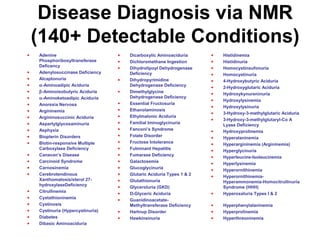
Disease Diagnosis via NMR
(140+ Detectable Conditions)
• Adenine
Phosphoribosyltransferase
Deficency
• Adenylosuccinase Deficiency
• Alcaptonuria
• α-Aminoadipic Aciduria
• β-Aminoisobutyric Aciduria
• α-Aminoketoadipic Aciduria
• Anorexia Nervosa
• Argininemia
• Argininosuccinic Aciduria
• Aspartylglycosaminuria
• Asphyxia
• Biopterin Disorders
• Biotin-responsive Multiple
Carboxylase Deficiency
• Canavan’s Disease
• Carcinoid Syndrome
• Carnosinemia
• Cerebrotendinous
Xanthomatosis/sterol 27-
hydroxylaseDeficiency
• Citrullinemia
• Cystathioninemia
• Cystinosis
• Cystinuria (Hypercystinuria)
• Diabetes
• Dibasic Aminoaciduria
• Dicarboxylic Aminoaciduria
• Dichloromethane Ingestion
• Dihydrolipoyl Dehydrogenase
Deficiency
• Dihydropyrimidine
Dehydrogenase Deficiency
• Dimethylglycine
Dehydrogenase Deficiency
• Essential Fructosuria
• Ethanolaminosis
• Ethylmalonic Aciduria
• Familial Iminoglycinuria
• Fanconi’s Syndrome
• Folate Disorder
• Fructose Intolerance
• Fulminant Hepatitis
• Fumarase Deficiency
• Galactosemia
• Glucoglycinuria
• Glutaric Aciduria Types 1 & 2
• Glutathionuria
• Glyceroluria (GKD)
• D-Glyceric Aciduria
• Guanidinoacetate-
Methyltransferase Deficiency
• Hartnup Disorder
• Hawkinsinuria
• Histidinemia
• Histidinuria
• Homocystinsufonuria
• Homocystinuria
• 4-Hydroxybutyric Aciduria
• 2-Hydroxyglutaric Aciduria
• Hydroxykynureninuria
• Hydroxylysinemia
• Hydroxylysinuria
• 3-Hydroxy-3-methylglutaric Aciduria
• 3-Hydroxy-3-methylglutaryl-Co A
Lyase Deficiency
• Hydroxyprolinemia
• Hyperalaninemia
• Hyperargininemia (Argininemia)
• Hyperglycinuria
• Hyperleucine-Isoleucinemia
• Hyperlysinemia
• Hyperornithinemia
• Hyperornithinemia-
Hyperammonemia-Homocitrullinuria
Syndrome (HHH)
• Hyperoxaluria Types I & 2
• Hyperphenylalaninemia
• Hyperprolinemia
• Hyperthreoninemia
Applications in Clinical Analysis
• 14 propionic acidemia
• 11 methylmalonic aciduria
• 11 cystinuria
• 6 alkaptonuria
• 4 glutaric aciduria I
• 3 pyruvate decarboxylase deficiency
• 3 ketosis
• 3 Hartnup disorder
• 3 cystinosis
• 3 neuroblastoma
• 3 phenylketonuria
• 3 ethanol toxicity
• 3 glycerol kinase deficiency
• 3 HMG CoA lyase deficiency
• 2 carbamoyl PO4 synthetase deficiency
• 96% sensitivity and 100%
specificity in ID of
abnormal from normal by
metabolite concentrations
• 95.5% sensitivity and
92.4% specificity in ID of
disease or condition by
characteristic metabolite
concentrations
• 120 sec per sample
Clinical Chemistry 47, 1918-1921 (2001).
Applications in
Metabolite Imaging
N-acetyl-aspartateLactate
Glutamate
Citrate
Alanine
Metabolic Microarrays
AceticAcid
Betaine
Carnitine
CitricAcid
Creatinine
Dimethylglycine
Dimethylamine
HippulricAcid
LacticAcid
SuccinicAcid
Trimethylamine
Trimn-N-Oxide
Urea
Lactose
SubericAcid
SebacicAcid
HomovanillicAcid
Threonine
Alanine
Glycine
Glucose
Patient 1
Patient 2
Patient 3
Patient 4
Patient 5
Patient 6
Patient 7
Patient 8
Patient 9
Patient 10
Patient 11
Patient 12
Patient 13
Patient 14
Patient 15
Normal
Below Normal
Above Norrmal
Absent
Metabolomics and IVF
http://www.youtube.com/watch?v=vhDb0rq0MLw
Why Metabolomics For
Transplants?
• Relatively non-invasive (no need for
biopsy, just collect urine, blood or bile)
• Can be quite organ specific
• Very fast (<60 s for an answer) & cheap
• Metabolic changes happen in seconds,
gene, protein and tissue changes
happen in minutes, hours or days
• Allows easy longitudinal monitoring of
patient (or organ) function (pre&post op)
Applications In Transplantation
Organ Condition Metabolite(s) Increased Metabolite(s) Decreased
Kidney (Human) Chronic Renal
Failure
TMAO, Dimethylamine, Urea,
Creatinine (serum)
Kidney (Rat) Renal Damage
(chemical)
Acetone, Lactate, Ethanol,
Succinate, TMAO,
Dimethylamine, Taurine
(urine & serum)
Citrate, Glucose, Urea
Allantoin (urine & serum)
Kidney (Human) Graft Dysfunction TMAO, Dimetheylamine
Lactate, Acetate, Succinate,
Glycine, Alanine, (urine)
Kidney (Rat) Graft Dysfunction
Reperfusion Injury
TMAO, Citrate, Lactate,
Dimetheylamine, Acetate (urine)
Kidney (Rat) Reperfusion Injury
(ischemia)
TMAO, Allantoin (serum)
Kidney (Human) Graft Dysfunction
CsA toxicity
TMAO, Alanine, Lactate,
Citrate (urine & serum)
Kidney (Mouse) Nephrectomy Methionine, Citrulline, Arginine,
Alanine (urine & serum)
Serine
(serum)
Kidney (Mouse) Nephrectomy Guanidinosuccinate,
Guanidine, Creatinine,
Guanidinovalearate,
(urine & serum)
Guanidinoacetate (urine)
Kidney (Human) Acute Rejection Nitrates, Nitrites, Nitric oxide
metabolites (urine)
Applications In Transplantation
Organ Condition Metabolite(s) Increased Metabolite(s) Decreased 2
2
Liver (Rat) Reperfusion Injury Citrate, Succinate, Ketone bodies (good
function)
Citrate, Succinate, Ketone bodies
(poor function)
Liver (Human) Ischemia Methylarginine
Dimethylarginine
(liver catheter)
Liver (Human) Graft Dysfunction Glutamine (serum & urine) Urea (urine)
Liver (Human) Post-transplant Phosphatidylcholine (bile)
Heart (Human) Rejection Nitrate (urine)
Heart (Human) Rejection General lipids, Lipoproteins, VLDL, LDL,
Phosphatidylcholine (serum)
Heart (Mouse) Acute Rejection Phosphocreatine, PO4
(in vivo)
Heart (Human) Ischemia Phosphocreatine, PO4
(in vivo)
Heart (Human) Congestive Heart
Failure
N-acetylaspartate,
Creatine, Choline
Myo-inositol (in vivo)
Metabolites & Function
• Serum Creatinine
– Late stage organ stress and tissue breakdown
• TMAO
– Early stage buffering response
• Creatine, methyl-histidine, taurine, glycine
– Tissue damage, muscle breakdown, remodelling
• Citrate, lactate, acetate, acetone
– Oxidative stress, apoptosis, anoxia, ischemia
• Histamine, chlorotyrosine, thromoxane, NO3
– Immune response, inflammation
Why NOT Metabolomics For
Transplants?
• Still an early stage technology – not
“ready for prime time”
• Metabolites are not always organ
specific and not always as informative
as protein or gene measures
• Still defining signature metabolites and
their meaning
• Still don’t have a complete list of
human metabolites
Human Metabolome Project
• Purpose is to facilitate Metabolomics
• Objective is to improve
– Disease identification
– Disease prognosis & prediction
– Disease monitoring
– Drug metabolism and toxicology
– Linkage between metabolome & genome
– Development of software for metabolomics
Concluding Comments
• Metabolomics is rapidly becoming the
“new clinical chemistry”
• Metabolomics complements genomics,
proteomics and histology
• Metabolomics allows probing of rapid
physiological changes or events that
are not as easily detected by
microarrays or histological methods
• Canada is actually leading the way (at
least for now) in this field

Biotech2012 spring 3_metabolomics

  • 1.
  • 2.
    The Pyramid ofLife 25,000 Genes25,000 Genes 2500 Enzymes2500 Enzymes 1400 Chemicals Metabolomics Proteomics Genomics
  • 3.
    Perturbation Primary Molecules SecondaryMolecules Resorption Dilution Filtration Concentration Metabolomics Chemical Fingerprint
  • 4.
    Metabonomics & Metabolomics •Metabonomics:The quantitative measurement of the time-related “total” metabolic response of vertebrates to pathophysiological (nutritional, xenobiotic, surgical or toxic stimuli) • Metabolomics:The quantitative measurement of the metabolic profiles of model organisms to characterize their phenotype or phenotypic response to genetic or nutritional perturbations
  • 5.
    Metabolomics Is GrowingGrowthin Metabolomics 0 20 40 60 80 100 120 140 160 180 200 1998 1999 2000 2001 2002 2003 2004 2005 Year #References
  • 6.
    What is aMetabolite? • Any organic molecule detectable in the body with a MW < 1000 Da • Includes peptides, oligonucleotides, sugars, nucelosides, organic acids, ketones, aldehydes, amines, amino acids, lipids, steroids, alkaloids and drugs (xenobiotics) • Includes human & microbial products • Concentration > 1µM
  • 7.
    Why 1 µM? •Equals ~200 ng/mL • Limit of detection by NMR • Limit of facile isolation/separation by many analytical methods • Excludes environmental pollutants • Most IEM indicators and other disease indicators have concentrations >1 µM • Need to draw the line somewhere
  • 8.
    Why Are Metabolites Relevant? Metabolitesare the Canaries of the Genome
  • 9.
    Why is Metabolomics Relevant? •Generate metabolic “signatures” • Monitor/measure metabolite flux • Monitor enzyme/pathway kinetics • Assess/identify phenotypes • Monitor gene/environment interactions • Track effects from toxins/drugs/surgery • Monitor consequences from gene KOs • Identify functions of unknown genes
  • 10.
    Medical Metabolomics • Generatemetabolic “signatures” for disease states or host responses • Obtain a more “holistic” view of metabolism (and treatment) • Accelerate assessment & diagnosis • More rapidly and accurately (and cheaply) assess/identify disease phenotypes • Monitor gene/environment interactions • Rapidly track effects from drugs/surgery
  • 11.
  • 12.
    Problems with Traditional Methods •Requires separation followed by identification (coupled methodology) • Requires optimization of separation conditions each time • Often requires multiple separations • Slow (up to 72 hours per sample) • Manually intensive (constant supervision, high skill, tedious)
  • 13.
    What’s the Difference BetweenMetabolomics and Traditional Clinical Chemistry? Throughput (more metabolites, greater accuracy, higher speed)
  • 14.
  • 15.
    Advantages • Measure multiple(10’s to 100’s) of metabolites at once – no separation!! • Allows metabolic profiles or “fingerprints” to be generated • Mostly automated, relatively little sample preparation or derivitization • Can be quantitative (esp. NMR) • Analysis & results in < 60 s
  • 16.
    NMR versus MS •Quantitative, fast • Requires no work up or separation • Allows ID of 300+ cmpds at once • Good for CHO’s • Not sensitive • Needs MS or 2D NMR for positive ID • Very fast • Very sensitive • Allows analysis or ID of 3000+ cmpds at once • Not quantitative • Not good for CHOs • Requires work-up • Needs NMR for ID
  • 17.
    2 Routes toMetabolomics 1234567ppm hippurate urea allantoin creatinine hippurate 2-oxoglutarate citrate TMAO succinatefumarate water creatinine taurine 1234567ppm -25 -20 -15 -10 -5 0 5 10 15 20 25 -30 -20 -10 0 10 PC1 PC2 PAP ANIT Control Quantitative Methods Chemometric (Pattern) Methods
  • 18.
    Quantitative vs. Chemometric •Identifies compounds • Quantifies compds • Concentration range of 1 µM to 1 M • Handles wide range of samples/conditions • Allows identification of diagnostic patterns • Limited by DB size • No compound ID • No compound conc. • No compound concentration range • Requires strict sample uniformity • Allows identification of diagnostic patterns • Limited by training set
  • 19.
    Mixture Compound A Compound B CompoundC Principles of Quantitative Metabolomics
  • 20.
  • 21.
    Sample Compound List •(+)-(-)-Methylsuccinic Acid • 2,5-Dihydroxyphenylacetic Acid • 2-hydroxy-3-methylbutyric acid • 2-Oxoglutaric acid • 3-Hydroxy-3-methylglutaric acid • 3-Indoxyl Sulfate • 5-Hydroxyindole-3-acetic Acid • Acetamide • Acetic Acid • Acetoacetic Acid • Acetone • Acetyl-L-carnitine • Alpha-Glucose • Alpha-ketoisocaproic acid • Benzoic Acid • Betaine • Beta-Lactose • Citric Acid • Creatine • Creatinine • D(-)Fructose • D-(+)-Glyceric Acid • D(+)-Xylose • Dimethylamine • DL-B-Aminoisobutyric Acid • DL-Carnitine • DL-Citrulline • DL-Malic Acid • Ethanol • Formic Acid • Fumaric Acid • Gamma-Amino-N-Butyric Acid • Gamma-Hydroxybutyric Acid • Gentisic Acid • Glutaric acid • Glycerol • Glycine • Glycolic Acid • Hippuric acid • Homovanillic acid • Hypoxanthine • Imidazole • Inositol • isovaleric acid • L(-) Fucose • L-alanine • L-asparagine • L-aspartic acid • L-Histidine • L-homocitrulline • L-Isoleucine • L-Lactic Acid • L-Lysine • L-Methionine • L-phenylalanine • L-Serine • L-Threonine • L-Valine • Malonic Acid • Methylamine • Mono-methylmalonate • N,N-dimethylglycine • N-Butyric Acid • Pimelic Acid • Propionic Acid • Pyruvic Acid • Salicylic acid • Sarcosine • Succinic Acid • Sucrose • Taurine • trans-4-hydroxy-L-Proline • Trimethylamine • Trimethylamine-N-Oxide • Urea
  • 22.
    Metabolic Profiling: The Possibilities •Genetic Disease Tests • Nutritional Analysis • Clinical Blood Analysis • Clinical Urinalysis • Cholesterol Testing • Drug Compliance • Dialysis Monitoring • MRS and fMRI • Toxicology Testing • Clinical Trial Testing • Fermentation Monitoring • Food & Beverage Tests • Nutraceutical Analysis • Drug Phenotyping • Water Quality Testing • Organ Transplantation
  • 23.
    -25 -20 -15 -10 -5 0 5 10 15 20 25 -30 -20 -100 10 PC1 PC2 PAP ANIT Control ANIT PAP Control Principal Component Analysis Metabolomics and Drug Toxicology
  • 24.
    Disease Diagnosis viaNMR (140+ Detectable Conditions) • Adenine Phosphoribosyltransferase Deficency • Adenylosuccinase Deficiency • Alcaptonuria • α-Aminoadipic Aciduria • β-Aminoisobutyric Aciduria • α-Aminoketoadipic Aciduria • Anorexia Nervosa • Argininemia • Argininosuccinic Aciduria • Aspartylglycosaminuria • Asphyxia • Biopterin Disorders • Biotin-responsive Multiple Carboxylase Deficiency • Canavan’s Disease • Carcinoid Syndrome • Carnosinemia • Cerebrotendinous Xanthomatosis/sterol 27- hydroxylaseDeficiency • Citrullinemia • Cystathioninemia • Cystinosis • Cystinuria (Hypercystinuria) • Diabetes • Dibasic Aminoaciduria • Dicarboxylic Aminoaciduria • Dichloromethane Ingestion • Dihydrolipoyl Dehydrogenase Deficiency • Dihydropyrimidine Dehydrogenase Deficiency • Dimethylglycine Dehydrogenase Deficiency • Essential Fructosuria • Ethanolaminosis • Ethylmalonic Aciduria • Familial Iminoglycinuria • Fanconi’s Syndrome • Folate Disorder • Fructose Intolerance • Fulminant Hepatitis • Fumarase Deficiency • Galactosemia • Glucoglycinuria • Glutaric Aciduria Types 1 & 2 • Glutathionuria • Glyceroluria (GKD) • D-Glyceric Aciduria • Guanidinoacetate- Methyltransferase Deficiency • Hartnup Disorder • Hawkinsinuria • Histidinemia • Histidinuria • Homocystinsufonuria • Homocystinuria • 4-Hydroxybutyric Aciduria • 2-Hydroxyglutaric Aciduria • Hydroxykynureninuria • Hydroxylysinemia • Hydroxylysinuria • 3-Hydroxy-3-methylglutaric Aciduria • 3-Hydroxy-3-methylglutaryl-Co A Lyase Deficiency • Hydroxyprolinemia • Hyperalaninemia • Hyperargininemia (Argininemia) • Hyperglycinuria • Hyperleucine-Isoleucinemia • Hyperlysinemia • Hyperornithinemia • Hyperornithinemia- Hyperammonemia-Homocitrullinuria Syndrome (HHH) • Hyperoxaluria Types I & 2 • Hyperphenylalaninemia • Hyperprolinemia • Hyperthreoninemia
  • 25.
    Applications in ClinicalAnalysis • 14 propionic acidemia • 11 methylmalonic aciduria • 11 cystinuria • 6 alkaptonuria • 4 glutaric aciduria I • 3 pyruvate decarboxylase deficiency • 3 ketosis • 3 Hartnup disorder • 3 cystinosis • 3 neuroblastoma • 3 phenylketonuria • 3 ethanol toxicity • 3 glycerol kinase deficiency • 3 HMG CoA lyase deficiency • 2 carbamoyl PO4 synthetase deficiency • 96% sensitivity and 100% specificity in ID of abnormal from normal by metabolite concentrations • 95.5% sensitivity and 92.4% specificity in ID of disease or condition by characteristic metabolite concentrations • 120 sec per sample Clinical Chemistry 47, 1918-1921 (2001).
  • 26.
  • 27.
  • 28.
  • 29.
    Why Metabolomics For Transplants? •Relatively non-invasive (no need for biopsy, just collect urine, blood or bile) • Can be quite organ specific • Very fast (<60 s for an answer) & cheap • Metabolic changes happen in seconds, gene, protein and tissue changes happen in minutes, hours or days • Allows easy longitudinal monitoring of patient (or organ) function (pre&post op)
  • 30.
    Applications In Transplantation OrganCondition Metabolite(s) Increased Metabolite(s) Decreased Kidney (Human) Chronic Renal Failure TMAO, Dimethylamine, Urea, Creatinine (serum) Kidney (Rat) Renal Damage (chemical) Acetone, Lactate, Ethanol, Succinate, TMAO, Dimethylamine, Taurine (urine & serum) Citrate, Glucose, Urea Allantoin (urine & serum) Kidney (Human) Graft Dysfunction TMAO, Dimetheylamine Lactate, Acetate, Succinate, Glycine, Alanine, (urine) Kidney (Rat) Graft Dysfunction Reperfusion Injury TMAO, Citrate, Lactate, Dimetheylamine, Acetate (urine) Kidney (Rat) Reperfusion Injury (ischemia) TMAO, Allantoin (serum) Kidney (Human) Graft Dysfunction CsA toxicity TMAO, Alanine, Lactate, Citrate (urine & serum) Kidney (Mouse) Nephrectomy Methionine, Citrulline, Arginine, Alanine (urine & serum) Serine (serum) Kidney (Mouse) Nephrectomy Guanidinosuccinate, Guanidine, Creatinine, Guanidinovalearate, (urine & serum) Guanidinoacetate (urine) Kidney (Human) Acute Rejection Nitrates, Nitrites, Nitric oxide metabolites (urine)
  • 31.
    Applications In Transplantation OrganCondition Metabolite(s) Increased Metabolite(s) Decreased 2 2 Liver (Rat) Reperfusion Injury Citrate, Succinate, Ketone bodies (good function) Citrate, Succinate, Ketone bodies (poor function) Liver (Human) Ischemia Methylarginine Dimethylarginine (liver catheter) Liver (Human) Graft Dysfunction Glutamine (serum & urine) Urea (urine) Liver (Human) Post-transplant Phosphatidylcholine (bile) Heart (Human) Rejection Nitrate (urine) Heart (Human) Rejection General lipids, Lipoproteins, VLDL, LDL, Phosphatidylcholine (serum) Heart (Mouse) Acute Rejection Phosphocreatine, PO4 (in vivo) Heart (Human) Ischemia Phosphocreatine, PO4 (in vivo) Heart (Human) Congestive Heart Failure N-acetylaspartate, Creatine, Choline Myo-inositol (in vivo)
  • 32.
    Metabolites & Function •Serum Creatinine – Late stage organ stress and tissue breakdown • TMAO – Early stage buffering response • Creatine, methyl-histidine, taurine, glycine – Tissue damage, muscle breakdown, remodelling • Citrate, lactate, acetate, acetone – Oxidative stress, apoptosis, anoxia, ischemia • Histamine, chlorotyrosine, thromoxane, NO3 – Immune response, inflammation
  • 33.
    Why NOT MetabolomicsFor Transplants? • Still an early stage technology – not “ready for prime time” • Metabolites are not always organ specific and not always as informative as protein or gene measures • Still defining signature metabolites and their meaning • Still don’t have a complete list of human metabolites
  • 34.
    Human Metabolome Project •Purpose is to facilitate Metabolomics • Objective is to improve – Disease identification – Disease prognosis & prediction – Disease monitoring – Drug metabolism and toxicology – Linkage between metabolome & genome – Development of software for metabolomics
  • 35.
    Concluding Comments • Metabolomicsis rapidly becoming the “new clinical chemistry” • Metabolomics complements genomics, proteomics and histology • Metabolomics allows probing of rapid physiological changes or events that are not as easily detected by microarrays or histological methods • Canada is actually leading the way (at least for now) in this field