By
SATHISHKUMAR G
(sathishsak111@gmail.com)
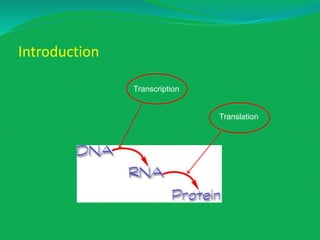
Introduction
Transcription
Translation
Fact
• Genome ~ 26,000-
31,000 protein
encoding genes
• Human proteins ≥
1 million
Zimmermann J and Brown LR. (2001)
Proteomics and the proteome
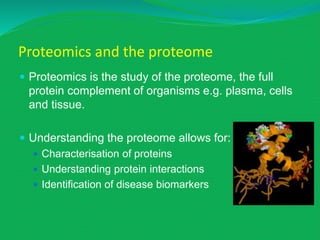
 Proteomics is the study of the proteome, the full
protein complement of organisms e.g. plasma, cells
and tissue.
 Understanding the proteome allows for:
 Characterisation of proteins
 Understanding protein interactions
 Identification of disease biomarkers
Advantages of proteomics
 Unlike related fields like genomics, proteomics
allows for the study of post-translational
modifications and interactions.
 This facilitates the study of:
 Splice variants
 PTMs
 PHOSPHOPROTEOMICS
 Differential expression: biomarkers
Biomarkers
• Biomarkers are biological indicators of a disease.
• They are useful both
for diagnosis, prognosis and
response to therapy
• 2 major types; biomarkers of
exposure and biomarkers of
disease
Existing biomarkers
Reliable QUANTITATION
Patients plasma (comorbidity)
Abundant proteins
Throughput
Large data files
Maintaining system
performance over a long
period of analyses
Avoiding contamination
Normalisation
Maximising number of
confidently assigned proteins
What to do with low
confidence proteins
Protein degradation
Data archiving and management
Challenges
Experimental design
 A mass spectrometer is an instrument that measures the
masses of individual molecules that have been converted
to ions; i.e., molecules that have been electrically
charged.
Mass Spectrometry
How is a mass spectrometer used?
A mass spectrometer is used to help scientists:
1. Identify molecules present in solids, liquids, and gases
2. Determine the quantity of each type of molecule.
3. Determine which atoms comprise a molecule and how
they are arranged
How does a mass spectrometer work?
 Mass spectrometry has three specific steps:
 Ionisation
 Analysis
 Detection
 ANALYTES must be both charged and in the gas
phase.
S S
S
S
S2+
S2+
S3+
S+
S2+
S2+
S+ S3+
m/z
Mass spectrometry and Proteomics
 Large macromolecules like proteins and peptides were
traditionally very difficult to vaporise.
 Many traditional ionisation techniques lead to
unpredictable fragmentation of ANALYTES, complicating
identification.
 The advent of Electrospray ionisation (ESI) and matrix
assisted laser desorption ionisation (MALDI) allowed for
the gentle vaporisation and ionisation of large
biomolecules.
Potential biomarker
 Validation
 Immunoassay
 Western blot
 Multiple Reaction Monitoring (MRM)
 proteomics

proteomics

  • 1.
  • 2.
  • 3.
    Fact • Genome ~26,000- 31,000 protein encoding genes • Human proteins ≥ 1 million Zimmermann J and Brown LR. (2001)
  • 4.
    Proteomics and theproteome  Proteomics is the study of the proteome, the full protein complement of organisms e.g. plasma, cells and tissue.  Understanding the proteome allows for:  Characterisation of proteins  Understanding protein interactions  Identification of disease biomarkers
  • 5.
    Advantages of proteomics Unlike related fields like genomics, proteomics allows for the study of post-translational modifications and interactions.  This facilitates the study of:  Splice variants  PTMs  PHOSPHOPROTEOMICS  Differential expression: biomarkers
  • 6.
    Biomarkers • Biomarkers arebiological indicators of a disease. • They are useful both for diagnosis, prognosis and response to therapy • 2 major types; biomarkers of exposure and biomarkers of disease
  • 7.
  • 8.
    Reliable QUANTITATION Patients plasma(comorbidity) Abundant proteins Throughput Large data files Maintaining system performance over a long period of analyses Avoiding contamination Normalisation Maximising number of confidently assigned proteins What to do with low confidence proteins Protein degradation Data archiving and management Challenges Experimental design
  • 9.
     A massspectrometer is an instrument that measures the masses of individual molecules that have been converted to ions; i.e., molecules that have been electrically charged. Mass Spectrometry
  • 10.
    How is amass spectrometer used? A mass spectrometer is used to help scientists: 1. Identify molecules present in solids, liquids, and gases 2. Determine the quantity of each type of molecule. 3. Determine which atoms comprise a molecule and how they are arranged
  • 11.
    How does amass spectrometer work?  Mass spectrometry has three specific steps:  Ionisation  Analysis  Detection  ANALYTES must be both charged and in the gas phase. S S S S S2+ S2+ S3+ S+ S2+ S2+ S+ S3+ m/z
  • 12.
    Mass spectrometry andProteomics  Large macromolecules like proteins and peptides were traditionally very difficult to vaporise.  Many traditional ionisation techniques lead to unpredictable fragmentation of ANALYTES, complicating identification.  The advent of Electrospray ionisation (ESI) and matrix assisted laser desorption ionisation (MALDI) allowed for the gentle vaporisation and ionisation of large biomolecules.
  • 13.
    Potential biomarker  Validation Immunoassay  Western blot  Multiple Reaction Monitoring (MRM)

Editor's Notes

  • #4 Whereas there are ∼26,000–31,000 protein-encoding genes (14), the total number of human proteins, including splice variants and essential posttranslational modifications, has been estimated to be close to one million (76, 254). The area of the circle that is within the reach of Leonardo da Vinci's Vitruvian Man corresponds to these images.
  • #7 Molecular alterations that are measurable in biological media such as human tissues, cells or fluids There are two major types of biomarkers: biomarkers of exposure, which are used in risk prediction, and biomarkers of disease, which are used in screening and diagnosis and monitoring of disease progression.