Georgios Theodoridis
Dept. Chemistry
Aristotle University
Thessaloniki
“Metabolic Profiling: Limitations,
Challenges, Perspectives for the
Analytical Chemist ”
AUTh bioAnalytical group
Fundamental/Developmental work
‘’Standardising Metabolomics’’ Excellence Grant GSRT
• Validation
• New Methods (Targeted, Untargeted) DOES IT WORK?
• New Chromatographic Materials
Clinical Studies
• Rheumatoid Arthritis Fleming Institute Prof. G. Kollias
• Physical Exercise Prof. V. Mougios AUTh
• Frailty/Ageing Prof. V. Mougios AUTh
• EmbryoMetabolomics http://www.embryometabolomics.eu/
• Sepsis/NEC newborns with Hippokrateion Hosp. Intens. Care Unit
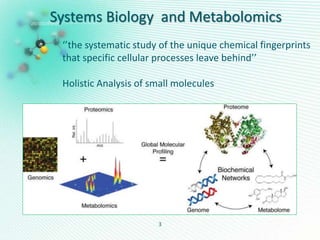
Systems Biology and Metabolomics
3
‘’the systematic study of the unique chemical fingerprints
that specific cellular processes leave behind’’
Holistic Analysis of small molecules
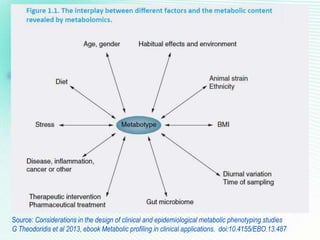
Source: Considerations in the design of clinical and epidemiological metabolic phenotyping studies
G Theodoridis et al 2013, ebook Metabolic profiling in clinical applications. doi:10.4155/EBO.13.487
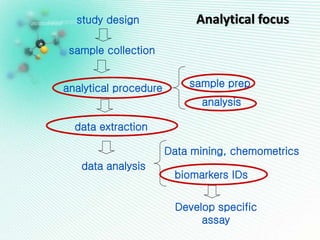
analytical procedure
sample collection
data extraction
data analysis
study design
Data mining, chemometrics
biomarkers IDs
sample prep
analysis
Analytical focus
Develop specific
assay
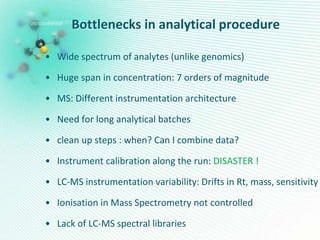
Bottlenecks in analytical procedure
• Wide spectrum of analytes (unlike genomics)
• Huge span in concentration: 7 orders of magnitude
• MS: Different instrumentation architecture
• Need for long analytical batches
• clean up steps : when? Can I combine data?
• Instrument calibration along the run: DISASTER !
• LC-MS instrumentation variability: Drifts in Rt, mass, sensitivity
• Ionisation in Mass Spectrometry not controlled
• Lack of LC-MS spectral libraries
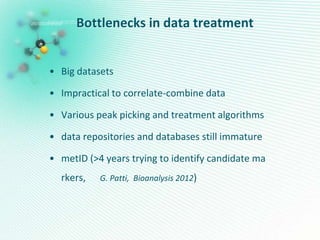
Bottlenecks in data treatment
• Big datasets
• Impractical to correlate-combine data
• Various peak picking and treatment algorithms
• data repositories and databases still immature
• metID (>4 years trying to identify candidate ma
rkers, G. Patti, Bioanalysis 2012)
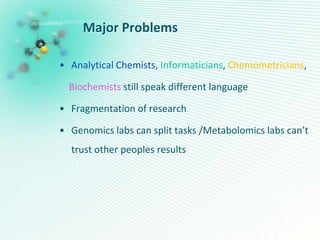
Major Problems
• Analytical Chemists, Informaticians, Chemometricians,
Biochemists still speak different language
• Fragmentation of research
• Genomics labs can split tasks /Metabolomics labs can’t
trust other peoples results
Way to go?
Standardization & Harmonisation
Establishing SOPs
• Data quality, QC procedures
• Instrument performance and maintenance
• Sample collection/storage
• Sample treatment
• Data acquisition protocols
• Data manipulation
• Reporting
QC procedures
• How can we validate a metabolic profiling method
when we don’t know the analytes that will be analysed?
• How can precision and reproducibility be assessed when we
don’t know what we are measuring?
• How can we report data quality?
• What analytical protocols should be adapted ?
• Which method is good?
QC procedures
Integration of “classical” analytical strategies
with unbiased data analysis
• Implementation of QC
Pooled sample, Injected in-between samples
• Synthetic mixtures injections
• Randomisation of injection order
• Technical replicates and other measures…
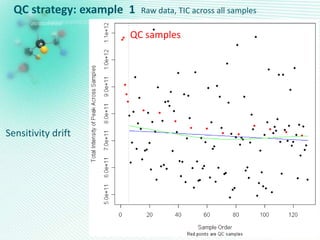
QC strategy: example 1 Raw data, TIC across all samples
QC samples
Sensitivity drift
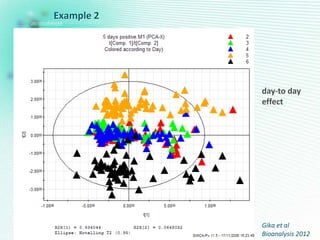
Example 2
day-to day
effect
Gika et al
Bioanalysis 2012
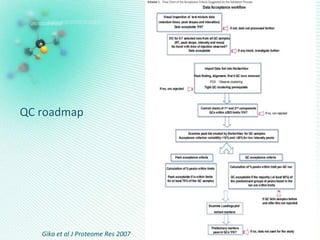
QC roadmap
Gika et al J Proteome Res 2007
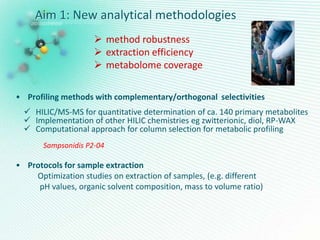
Aim 1: New analytical methodologies
• Profiling methods with complementary/orthogonal selectivities
Sampsonidis P2-04
• Protocols for sample extraction
Optimization studies on extraction of samples, (e.g. different
pH values, organic solvent composition, mass to volume ratio)
 method robustness
 extraction efficiency
 metabolome coverage
 HILIC/MS-MS for quantitative determination of ca. 140 primary metabolites
 Implementation of other HILIC chemistries eg zwitterionic, diol, RP-WAX
 Computational approach for column selection for metabolic profiling
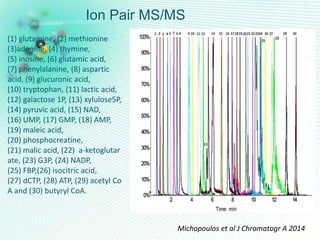
Ion Pair MS/MS
(1) glutamine, (2) methionine
(3)adenine, (4) thymine,
(5) inosine, (6) glutamic acid,
(7) phenylalanine, (8) aspartic
acid, (9) glucuronic acid,
(10) tryptophan, (11) lactic acid,
(12) galactose 1P, (13) xylulose5P,
(14) pyruvic acid, (15) NAD,
(16) UMP, (17) GMP, (18) AMP,
(19) maleic acid,
(20) phosphocreatine,
(21) malic acid, (22) a-ketoglutar
ate, (23) G3P, (24) NADP,
(25) FBP,(26) isocitric acid,
(27) dCTP, (28) ATP, (29) acetyl Co
A and (30) butyryl CoA.
Michopoulos et al J Chromatogr A 2014
Sample Preparation and Stability
17
Blood:
• Dried Blood Spots (F. Michopoulos Bioanalysis 2012, F. Michopoulos J Proteome Res 2011)
• Turbulent Flow Chromatography (J. Sep. Sci. 2010),
• protein precipitation (J Proteome Res 2011) …
Urine:
• Urine stability over freezing and freeze thaw cycles (J Chromatogr A 2008)
Protocols: Nature Protocols Want et al 2010 urine, 2013 tissue
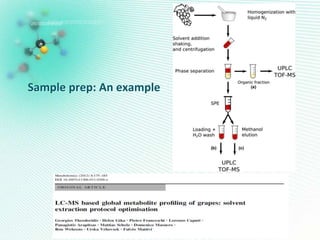
Sample prep: An example
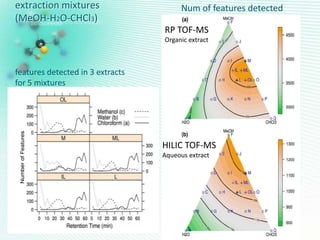
extraction mixtures
(MeOH-H2O-CHCl3)
RP TOF-MS
Organic extract
HILIC TOF-MS
Aqueous extract
Num of features detected
features detected in 3 extracts
for 5 mixtures
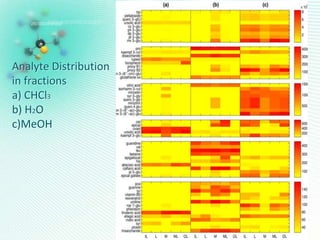
Analyte Distribution
in fractions
a) CHCl3
b) H2O
c)MeOH
Aim 2: Data extraction
• Evaluation of various data extraction software free and commercial:
XCMS, MarkerLynx, MarkerView, Profiler and others in metabonomics studies
• Spiking experiments (comparison of sensitivity and reliability of the data
treatment software) A. Pechlivanis, MSc Study 2009, AUTh
• Intranet platform for the extraction of information from MS-profiling data
(rules for monitoring and reporting the various alterations and parameter
selection to improve standardization in data extraction and reporting)
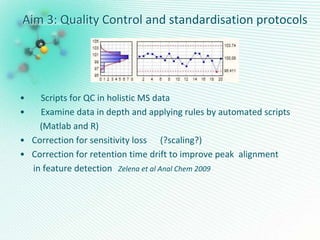
Aim 3: Quality Control and standardisation protocols
• Scripts for QC in holistic MS data
• Examine data in depth and applying rules by automated scripts
(Matlab and R)
• Correction for sensitivity loss (?scaling?)
• Correction for retention time drift to improve peak alignment
in feature detection Zelena et al Anal Chem 2009
Aim 4: Data fusion
• Software tools to fuse data from different methods
LC-MS/MS + GC-MS
LC-MS/MS + NMR
HILIC-MS + RPLC-MS
+evi ESi/ -evi ESI
• link data
• combine into one table of features or metabolites (?)
Aim 5: Metabolite Identification
MetID the major bottleneck in LC-MS metabonomics
• scripts for adduct identification to reduce the
number of detected features :
+Na+, + NH4+ , dimers etc
• MS spectra by analysis of standards (in-house MS
database).
• Scripts for automated searches in local and internet-
based spectral/biochemistry libraries.
• Compare isotope patterns between peaks in samples
and standards
Aim 6 : Retention Time Prediction
• Incorporating Rt data to assists MetID
• Use of data from orthogonal chromatographic systems:
chemical information (polarity, LogP etc)
• Rule out candidate IDs
• Retention time prediction algorithm in HILIC
Gika et al Anal Bioanal Chem 2012, Gika et al J. Sep. Sci 2011
Fasoula OP12, P2-03
• software to organise the necessary analyses and data
treatment for metID within an easy to use platform.
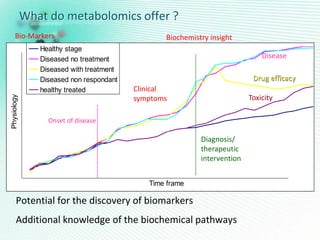
What do metabolomics offer ?
Biochemistry insight
Bio-Markers
Time frame
Physiology
Healthy stage
Diseased no treatment
Diseased with treatment
Diseased non respondant
healthy treated
Drug efficacy
Disease
Toxicity
Onset of disease
Clinical
symptoms
Diagnosis/
therapeutic
intervention
Potential for the discovery of biomarkers
Additional knowledge of the biochemical pathways
Perspective
• Metabolites downstream the biochemical pathway compared
to genes, proteins, closer to phenotype
• Can describe effects of xenobiotics (e.g. pharmaceuticals) and
host-guest interactions (e.g mammals with gut microflora)
• Describes ongoing phenomena
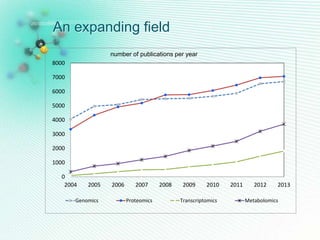
An expanding field
0
1000
2000
3000
4000
5000
6000
7000
8000
2004 2005 2006 2007 2008 2009 2010 2011 2012 2013
number of publications per year
Genomics Proteomics Transcriptomics Metabolomics
Call
• Metabolomics is analytically dependent
• Metabolomis grows and provides openings for analytical chemists
Auth
• Dr. G. Theodoridis
• Dr. H. Gika
• Prof. A. Papa
• Dr. N. Raikos
• C. Virgiliou MSc
• O. Deda MSc
• Dr. C. Zisi
• S. Fasoula MSc
• A. C. Hatzioannou MSc
• D. Palachanis MSc
• I. Sampsonidis MSc
External collaborators
• I. D. Wilson Imperial college London UK
• P. Vorkas Imperial college London UK
• P. Francheshi IASMA Trento Italy
The group
Funding

Metabolic Profiling_techniques and approaches.ppt

  • 1.
    Georgios Theodoridis Dept. Chemistry AristotleUniversity Thessaloniki “Metabolic Profiling: Limitations, Challenges, Perspectives for the Analytical Chemist ”
  • 2.
    AUTh bioAnalytical group Fundamental/Developmentalwork ‘’Standardising Metabolomics’’ Excellence Grant GSRT • Validation • New Methods (Targeted, Untargeted) DOES IT WORK? • New Chromatographic Materials Clinical Studies • Rheumatoid Arthritis Fleming Institute Prof. G. Kollias • Physical Exercise Prof. V. Mougios AUTh • Frailty/Ageing Prof. V. Mougios AUTh • EmbryoMetabolomics http://www.embryometabolomics.eu/ • Sepsis/NEC newborns with Hippokrateion Hosp. Intens. Care Unit
  • 3.
    Systems Biology andMetabolomics 3 ‘’the systematic study of the unique chemical fingerprints that specific cellular processes leave behind’’ Holistic Analysis of small molecules
  • 4.
    Source: Considerations inthe design of clinical and epidemiological metabolic phenotyping studies G Theodoridis et al 2013, ebook Metabolic profiling in clinical applications. doi:10.4155/EBO.13.487
  • 5.
    analytical procedure sample collection dataextraction data analysis study design Data mining, chemometrics biomarkers IDs sample prep analysis Analytical focus Develop specific assay
  • 6.
    Bottlenecks in analyticalprocedure • Wide spectrum of analytes (unlike genomics) • Huge span in concentration: 7 orders of magnitude • MS: Different instrumentation architecture • Need for long analytical batches • clean up steps : when? Can I combine data? • Instrument calibration along the run: DISASTER ! • LC-MS instrumentation variability: Drifts in Rt, mass, sensitivity • Ionisation in Mass Spectrometry not controlled • Lack of LC-MS spectral libraries
  • 7.
    Bottlenecks in datatreatment • Big datasets • Impractical to correlate-combine data • Various peak picking and treatment algorithms • data repositories and databases still immature • metID (>4 years trying to identify candidate ma rkers, G. Patti, Bioanalysis 2012)
  • 8.
    Major Problems • AnalyticalChemists, Informaticians, Chemometricians, Biochemists still speak different language • Fragmentation of research • Genomics labs can split tasks /Metabolomics labs can’t trust other peoples results
  • 9.
    Way to go? Standardization& Harmonisation Establishing SOPs • Data quality, QC procedures • Instrument performance and maintenance • Sample collection/storage • Sample treatment • Data acquisition protocols • Data manipulation • Reporting
  • 10.
    QC procedures • Howcan we validate a metabolic profiling method when we don’t know the analytes that will be analysed? • How can precision and reproducibility be assessed when we don’t know what we are measuring? • How can we report data quality? • What analytical protocols should be adapted ? • Which method is good?
  • 11.
    QC procedures Integration of“classical” analytical strategies with unbiased data analysis • Implementation of QC Pooled sample, Injected in-between samples • Synthetic mixtures injections • Randomisation of injection order • Technical replicates and other measures…
  • 12.
    QC strategy: example1 Raw data, TIC across all samples QC samples Sensitivity drift
  • 13.
    Example 2 day-to day effect Gikaet al Bioanalysis 2012
  • 14.
    QC roadmap Gika etal J Proteome Res 2007
  • 15.
    Aim 1: Newanalytical methodologies • Profiling methods with complementary/orthogonal selectivities Sampsonidis P2-04 • Protocols for sample extraction Optimization studies on extraction of samples, (e.g. different pH values, organic solvent composition, mass to volume ratio)  method robustness  extraction efficiency  metabolome coverage  HILIC/MS-MS for quantitative determination of ca. 140 primary metabolites  Implementation of other HILIC chemistries eg zwitterionic, diol, RP-WAX  Computational approach for column selection for metabolic profiling
  • 16.
    Ion Pair MS/MS (1)glutamine, (2) methionine (3)adenine, (4) thymine, (5) inosine, (6) glutamic acid, (7) phenylalanine, (8) aspartic acid, (9) glucuronic acid, (10) tryptophan, (11) lactic acid, (12) galactose 1P, (13) xylulose5P, (14) pyruvic acid, (15) NAD, (16) UMP, (17) GMP, (18) AMP, (19) maleic acid, (20) phosphocreatine, (21) malic acid, (22) a-ketoglutar ate, (23) G3P, (24) NADP, (25) FBP,(26) isocitric acid, (27) dCTP, (28) ATP, (29) acetyl Co A and (30) butyryl CoA. Michopoulos et al J Chromatogr A 2014
  • 17.
    Sample Preparation andStability 17 Blood: • Dried Blood Spots (F. Michopoulos Bioanalysis 2012, F. Michopoulos J Proteome Res 2011) • Turbulent Flow Chromatography (J. Sep. Sci. 2010), • protein precipitation (J Proteome Res 2011) … Urine: • Urine stability over freezing and freeze thaw cycles (J Chromatogr A 2008) Protocols: Nature Protocols Want et al 2010 urine, 2013 tissue
  • 18.
  • 19.
    extraction mixtures (MeOH-H2O-CHCl3) RP TOF-MS Organicextract HILIC TOF-MS Aqueous extract Num of features detected features detected in 3 extracts for 5 mixtures
  • 20.
  • 21.
    Aim 2: Dataextraction • Evaluation of various data extraction software free and commercial: XCMS, MarkerLynx, MarkerView, Profiler and others in metabonomics studies • Spiking experiments (comparison of sensitivity and reliability of the data treatment software) A. Pechlivanis, MSc Study 2009, AUTh • Intranet platform for the extraction of information from MS-profiling data (rules for monitoring and reporting the various alterations and parameter selection to improve standardization in data extraction and reporting)
  • 22.
    Aim 3: QualityControl and standardisation protocols • Scripts for QC in holistic MS data • Examine data in depth and applying rules by automated scripts (Matlab and R) • Correction for sensitivity loss (?scaling?) • Correction for retention time drift to improve peak alignment in feature detection Zelena et al Anal Chem 2009
  • 23.
    Aim 4: Datafusion • Software tools to fuse data from different methods LC-MS/MS + GC-MS LC-MS/MS + NMR HILIC-MS + RPLC-MS +evi ESi/ -evi ESI • link data • combine into one table of features or metabolites (?)
  • 24.
    Aim 5: MetaboliteIdentification MetID the major bottleneck in LC-MS metabonomics • scripts for adduct identification to reduce the number of detected features : +Na+, + NH4+ , dimers etc • MS spectra by analysis of standards (in-house MS database). • Scripts for automated searches in local and internet- based spectral/biochemistry libraries. • Compare isotope patterns between peaks in samples and standards
  • 25.
    Aim 6 :Retention Time Prediction • Incorporating Rt data to assists MetID • Use of data from orthogonal chromatographic systems: chemical information (polarity, LogP etc) • Rule out candidate IDs • Retention time prediction algorithm in HILIC Gika et al Anal Bioanal Chem 2012, Gika et al J. Sep. Sci 2011 Fasoula OP12, P2-03 • software to organise the necessary analyses and data treatment for metID within an easy to use platform.
  • 26.
    What do metabolomicsoffer ? Biochemistry insight Bio-Markers Time frame Physiology Healthy stage Diseased no treatment Diseased with treatment Diseased non respondant healthy treated Drug efficacy Disease Toxicity Onset of disease Clinical symptoms Diagnosis/ therapeutic intervention Potential for the discovery of biomarkers Additional knowledge of the biochemical pathways
  • 27.
    Perspective • Metabolites downstreamthe biochemical pathway compared to genes, proteins, closer to phenotype • Can describe effects of xenobiotics (e.g. pharmaceuticals) and host-guest interactions (e.g mammals with gut microflora) • Describes ongoing phenomena
  • 28.
    An expanding field 0 1000 2000 3000 4000 5000 6000 7000 8000 20042005 2006 2007 2008 2009 2010 2011 2012 2013 number of publications per year Genomics Proteomics Transcriptomics Metabolomics
  • 29.
    Call • Metabolomics isanalytically dependent • Metabolomis grows and provides openings for analytical chemists
  • 30.
    Auth • Dr. G.Theodoridis • Dr. H. Gika • Prof. A. Papa • Dr. N. Raikos • C. Virgiliou MSc • O. Deda MSc • Dr. C. Zisi • S. Fasoula MSc • A. C. Hatzioannou MSc • D. Palachanis MSc • I. Sampsonidis MSc External collaborators • I. D. Wilson Imperial college London UK • P. Vorkas Imperial college London UK • P. Francheshi IASMA Trento Italy The group Funding