What is
metabolomics?.
Metabolomics is the scientific study of chemical processes involving
metabolites. Specifically, metabolomics is the study of the small
molecule metabolites
The rapidly emerging field of metabolomics combines strategies
to identify and quantify cellular metabolites using sophisticated
analytical technologies with the application of statistical and
multivariant methods for information extraction and data
interpretation.
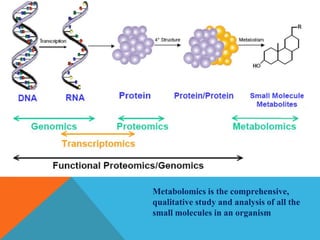
Metabolomics is the comprehensive,
qualitative study and analysis of all the
small molecules in an organism
origin
sThe idea that biological fluids reflect the health of an individual has existed for
a long time.
 Ancient Chinese doctors used ants for the evaluation of urine of patients to
detect whether the urine contained high levels of glucose, and hence detect
diabetes.
 In the Middle Ages, "urine charts" were used to link the colours , tastes and
smells of urine to various medical conditions, which are metabolic in origin
 The concept that individuals might have a "metabolic profile" that could be
reflected in the makeup of their biological fluids was introduced by Roger
Williams in the late 1940s, who used paper chromatography to suggest
characteristic metabolic patterns in urine and saliva were associated with
diseases such as schizophrenia
 The term "metabolic profile" was introduced by Horning, et al. in 1971 after
they demonstrated that gas chromatography-mass spectrometry (GC-MS)
could be used to measure compounds present in human urine and tissue
extracts.
The Horning group, along with that of Linus Pauling and Arthur B. Robinson
led the development of GC-MS methods to monitor the metabolites present in
urine through the 1970s.
In 1974, Seeley et al. demonstrated using NMR spectroscopy to detect
metabolites in unmodified biological samples. This first study on muscle
highlighted that the 90% of cellular ATP is complexed with magnesium
NMR continues to be a leading analytical tool to investigate metabolism
In 2005, the first metabolomics web database, METLIN for characterizing
human metabolites was developed in the Scripps Research Institute and till
September 2015, METLIN contains over 240,000 metabolites
On 23 January 2007, the Human Metabolome Project, led by Dr.
David Wishart of the University of Alberta
Metabolome refers to the complete set of small-molecule
metabolites (such as metabolic intermediates, hormones and other signaling
molecules, and secondary metabolites) to be found within a biological sample,
such as a single organism.
Metabolites are the intermediates and products of metabolism.
Within the context of metabolomics, a metabolite is usually defined as any
molecule less than 1 kDa in size.
ANALYSIS OF METABOLOMICS DATA
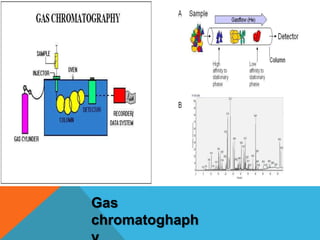
Gas
chromatoghaph
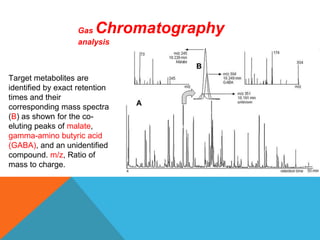
Target metabolites are
identified by exact retention
times and their
corresponding mass spectra
(B) as shown for the co-
eluting peaks of malate,
gamma-amino butyric acid
(GABA), and an unidentified
compound. m/z, Ratio of
mass to charge.
Gas Chromatography
analysis
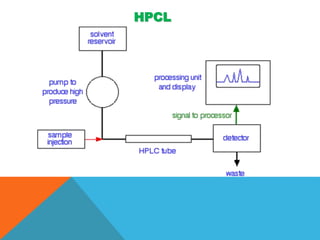
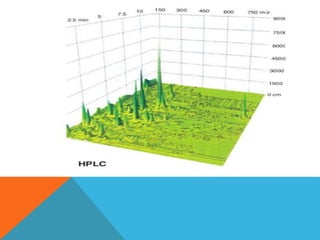
HPCL
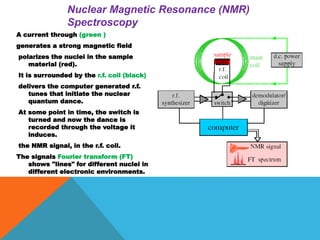
A current through (green )
generates a strong magnetic field
polarizes the nuclei in the sample
material (red).
It is surrounded by the r.f. coil (black)
delivers the computer generated r.f.
tunes that initiate the nuclear
quantum dance.
At some point in time, the switch is
turned and now the dance is
recorded through the voltage it
induces.
the NMR signal, in the r.f. coil.
The signals Fourier transform (FT)
shows "lines" for different nuclei in
different electronic environments.
Nuclear Magnetic Resonance (NMR)
Spectroscopy
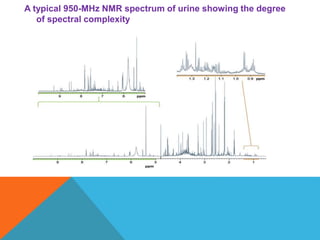
A typical 950-MHz NMR spectrum of urine showing the degree
of spectral complexity
 Drug assessment
 Clinical toxicology
 Nutrigenomics
 Functional genomics
MAIN
APPLICATIONS

Metabolomics

  • 2.
    What is metabolomics?. Metabolomics isthe scientific study of chemical processes involving metabolites. Specifically, metabolomics is the study of the small molecule metabolites The rapidly emerging field of metabolomics combines strategies to identify and quantify cellular metabolites using sophisticated analytical technologies with the application of statistical and multivariant methods for information extraction and data interpretation.
  • 3.
    Metabolomics is thecomprehensive, qualitative study and analysis of all the small molecules in an organism
  • 4.
    origin sThe idea thatbiological fluids reflect the health of an individual has existed for a long time.  Ancient Chinese doctors used ants for the evaluation of urine of patients to detect whether the urine contained high levels of glucose, and hence detect diabetes.  In the Middle Ages, "urine charts" were used to link the colours , tastes and smells of urine to various medical conditions, which are metabolic in origin  The concept that individuals might have a "metabolic profile" that could be reflected in the makeup of their biological fluids was introduced by Roger Williams in the late 1940s, who used paper chromatography to suggest characteristic metabolic patterns in urine and saliva were associated with diseases such as schizophrenia  The term "metabolic profile" was introduced by Horning, et al. in 1971 after they demonstrated that gas chromatography-mass spectrometry (GC-MS) could be used to measure compounds present in human urine and tissue extracts. The Horning group, along with that of Linus Pauling and Arthur B. Robinson led the development of GC-MS methods to monitor the metabolites present in urine through the 1970s.
  • 5.
    In 1974, Seeleyet al. demonstrated using NMR spectroscopy to detect metabolites in unmodified biological samples. This first study on muscle highlighted that the 90% of cellular ATP is complexed with magnesium NMR continues to be a leading analytical tool to investigate metabolism In 2005, the first metabolomics web database, METLIN for characterizing human metabolites was developed in the Scripps Research Institute and till September 2015, METLIN contains over 240,000 metabolites On 23 January 2007, the Human Metabolome Project, led by Dr. David Wishart of the University of Alberta
  • 6.
    Metabolome refers tothe complete set of small-molecule metabolites (such as metabolic intermediates, hormones and other signaling molecules, and secondary metabolites) to be found within a biological sample, such as a single organism. Metabolites are the intermediates and products of metabolism. Within the context of metabolomics, a metabolite is usually defined as any molecule less than 1 kDa in size.
  • 7.
  • 8.
  • 9.
    Target metabolites are identifiedby exact retention times and their corresponding mass spectra (B) as shown for the co- eluting peaks of malate, gamma-amino butyric acid (GABA), and an unidentified compound. m/z, Ratio of mass to charge. Gas Chromatography analysis
  • 10.
  • 12.
    A current through(green ) generates a strong magnetic field polarizes the nuclei in the sample material (red). It is surrounded by the r.f. coil (black) delivers the computer generated r.f. tunes that initiate the nuclear quantum dance. At some point in time, the switch is turned and now the dance is recorded through the voltage it induces. the NMR signal, in the r.f. coil. The signals Fourier transform (FT) shows "lines" for different nuclei in different electronic environments. Nuclear Magnetic Resonance (NMR) Spectroscopy
  • 13.
    A typical 950-MHzNMR spectrum of urine showing the degree of spectral complexity
  • 14.
     Drug assessment Clinical toxicology  Nutrigenomics  Functional genomics MAIN APPLICATIONS