TAXONOMY
Activity 14
Lesson Targets:
At the end of the lesson, the students CAN:
1. Identify the unique/distinctive characteristics of a
specific taxon relative to other taxa.
1.1 describe the Linnaean system of classification;
1.2 classify organisms into a hierarchy; and
1.3 identify unknown organisms using dichotomous
keys.
What is/are the
meaning of your
NAME/S?
Essential Ideas
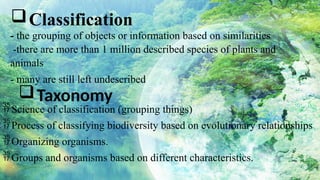
- the grouping of objects or information based on similarities
-there are more than 1 million described species of plants and
animals
- many are still left undescribed
Classification
Taxonomy
Science of classification (grouping things)
Process of classifying biodiversity based on evolutionary relationships
Organizing organisms.
Groups and organisms based on different characteristics.
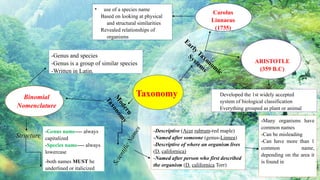
Taxonomy Developed the 1st widely accepted
system of biological classification
Everything grouped as plant or animal
M
o
d
e
r
n
T
a
x
o
n
o
m
y
Binomial
Nomenclature
-Genus and species
-Genus is a group of similar species
-Written in Latin.
Structure
-Genus name---- always
capitalized
-Species name---- always
lowercase
-both names MUST be
underlined or italicized
S
c
i
e
n
t
i
f
i
c
N
a
m
e
s
-Descriptive (Acer rubrum-red maple)
-Named after someone (genus-Linnea)
-Descriptive of where an organism lives
(D. californica)
-Named after person who first described
the organism (D. californica Torr)
-Many organisms have
common names
-Can be misleading
-Can have more than 1
common name,
depending on the area it
is found in
Early Taxonom
ic
System
s
ARISTOTLE
(359 B.C)
Carolus
Linnaeus
(1735)
• use of a species name
Based on looking at physical
and structural similarities
Revealed relationships of
organisms
Taxonomy
7
T
A
X
O
N
O
M
I
C
C
A
T
E
G
O
R
I
E
S
M
o
d
e
r
n
T
a
x
o
n
o
m
y
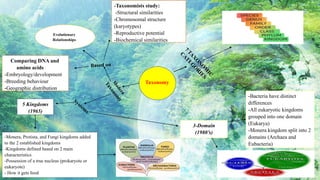
Based on
-Taxonomists study:
-Structural similarities
-Chromosomal structure
(karyotypes)
-Reproductive potential
-Biochemical similarities
Evolutionary
Relationships
Comparing DNA and
amino acids
-Embryology/development
-Breeding behaviour
-Geographic distribution
System
s
5 Kingdoms
(1965)
-Monera, Protista, and Fungi kingdoms added
to the 2 established kingdoms
-Kingdoms defined based on 2 main
characteristics
-Possession of a true nucleus (prokaryote or
eukaryote)
- How it gets food
3-Domain
(1980’s)
-Bacteria have distinct
differences
-All eukaryotic kingdoms
grouped into one domain
(Eukarya)
-Monera kingdom split into 2
domains (Archaea and
Eubacteria)
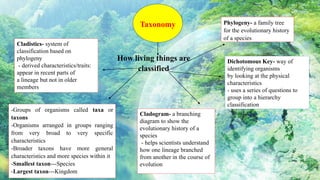
Taxonomy
How living things are
classified
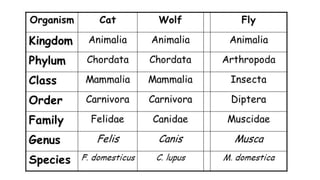
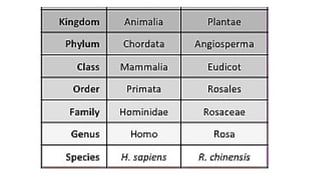
-Groups of organisms called taxa or
taxons
-Organisms arranged in groups ranging
from very broad to very specific
characteristics
-Broader taxons have more general
characteristics and more species within it
-Smallest taxon---Species
-Largest taxon---Kingdom
Phylogeny- a family tree
for the evolutionary history
of a species
Dichotomous Key- way of
identifying organisms
by looking at the physical
characteristics
- uses a series of questions to
group into a hierarchy
classification
Cladogram- a branching
diagram to show the
evolutionary history of a
species
- helps scientists understand
how one lineage branched
from another in the course of
evolution
Cladistics- system of
classification based on
phylogeny
- derived characteristics/traits:
appear in recent parts of
a lineage but not in older
members
Learning experiences
A. Clarifying Understanding
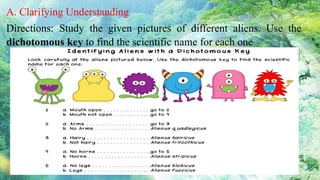
Directions: Study the given pictures of different aliens. Use the
dichotomous key to find the scientific name for each one
1. What is the importance of using of
scientific names instead of common
names?
2. Is there a need to classify organism/s?
Yes or No? Why?
B. Processing Questions
“Things Change. And friends leave. Life doesn’t
stop for anybody”
Stephen Chbosky. The perks of being a wallflower
C. Lifelong Learning
You have learned about the evidences of evolution.
Relate this quote on the changes that happened in the past
and that will happen in the future. Are changes good or
bad? Justify your answer.
Framing Concepts
Any Questions?
Clarifications?

Taxonomy Phylogenic Tree Activity-14.pptx

  • 1.
  • 2.
    Lesson Targets: At theend of the lesson, the students CAN: 1. Identify the unique/distinctive characteristics of a specific taxon relative to other taxa. 1.1 describe the Linnaean system of classification; 1.2 classify organisms into a hierarchy; and 1.3 identify unknown organisms using dichotomous keys.
  • 3.
    What is/are the meaningof your NAME/S?
  • 4.
  • 5.
    - the groupingof objects or information based on similarities -there are more than 1 million described species of plants and animals - many are still left undescribed Classification Taxonomy Science of classification (grouping things) Process of classifying biodiversity based on evolutionary relationships Organizing organisms. Groups and organisms based on different characteristics.
  • 6.
    Taxonomy Developed the1st widely accepted system of biological classification Everything grouped as plant or animal M o d e r n T a x o n o m y Binomial Nomenclature -Genus and species -Genus is a group of similar species -Written in Latin. Structure -Genus name---- always capitalized -Species name---- always lowercase -both names MUST be underlined or italicized S c i e n t i f i c N a m e s -Descriptive (Acer rubrum-red maple) -Named after someone (genus-Linnea) -Descriptive of where an organism lives (D. californica) -Named after person who first described the organism (D. californica Torr) -Many organisms have common names -Can be misleading -Can have more than 1 common name, depending on the area it is found in Early Taxonom ic System s ARISTOTLE (359 B.C) Carolus Linnaeus (1735) • use of a species name Based on looking at physical and structural similarities Revealed relationships of organisms
  • 7.
    Taxonomy 7 T A X O N O M I C C A T E G O R I E S M o d e r n T a x o n o m y Based on -Taxonomists study: -Structuralsimilarities -Chromosomal structure (karyotypes) -Reproductive potential -Biochemical similarities Evolutionary Relationships Comparing DNA and amino acids -Embryology/development -Breeding behaviour -Geographic distribution System s 5 Kingdoms (1965) -Monera, Protista, and Fungi kingdoms added to the 2 established kingdoms -Kingdoms defined based on 2 main characteristics -Possession of a true nucleus (prokaryote or eukaryote) - How it gets food 3-Domain (1980’s) -Bacteria have distinct differences -All eukaryotic kingdoms grouped into one domain (Eukarya) -Monera kingdom split into 2 domains (Archaea and Eubacteria)
  • 8.
    Taxonomy How living thingsare classified -Groups of organisms called taxa or taxons -Organisms arranged in groups ranging from very broad to very specific characteristics -Broader taxons have more general characteristics and more species within it -Smallest taxon---Species -Largest taxon---Kingdom Phylogeny- a family tree for the evolutionary history of a species Dichotomous Key- way of identifying organisms by looking at the physical characteristics - uses a series of questions to group into a hierarchy classification Cladogram- a branching diagram to show the evolutionary history of a species - helps scientists understand how one lineage branched from another in the course of evolution Cladistics- system of classification based on phylogeny - derived characteristics/traits: appear in recent parts of a lineage but not in older members
  • 11.
  • 12.
    A. Clarifying Understanding Directions:Study the given pictures of different aliens. Use the dichotomous key to find the scientific name for each one
  • 13.
    1. What isthe importance of using of scientific names instead of common names? 2. Is there a need to classify organism/s? Yes or No? Why? B. Processing Questions
  • 15.
    “Things Change. Andfriends leave. Life doesn’t stop for anybody” Stephen Chbosky. The perks of being a wallflower C. Lifelong Learning You have learned about the evidences of evolution. Relate this quote on the changes that happened in the past and that will happen in the future. Are changes good or bad? Justify your answer.
  • 16.
  • 17.