



1
Flow of thoughts for the day
Generics & Biosimilars
Generic Act
Generics
Biologics R&D
Need for biosimilars
Affordability Act
Goal post
Interchangeability
2
Generics
&
Biosimilars
Every secret starts small..
By Kamalasundar
Moderated by Dr.Ravichandra
3
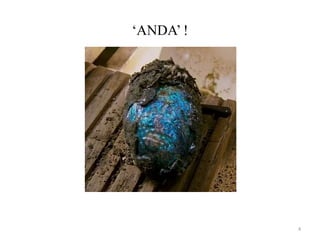
‘ANDA’ !
4
5
6
7
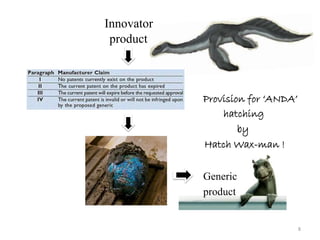
Innovator
product
Provision for ‘ANDA’
hatching
by
Hatch Wax-man !
Generic
product
8
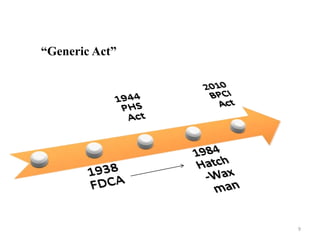
“Generic Act”
9
• 1984 Drug Price Competition and Patent Term Restoration Act
(Hatch‐Waxman Act)
• Hatch‐Waxman balanced the originator‐molecule
manufacturers meaningful period of patent protection to
recover development costs with public expectation of less
expensive alternatives
10
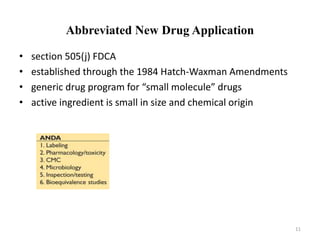
Abbreviated New Drug Application
• section 505(j) FDCA
• established through the 1984 Hatch-Waxman Amendments
• generic drug program for “small molecule” drugs
• active ingredient is small in size and chemical origin
11
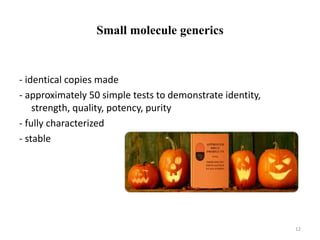
Small molecule generics
‐ identical copies made
‐ approximately 50 simple tests to demonstrate identity,
strength, quality, potency, purity
‐ fully characterized
‐ stable
12
- scientifically demonstrate that generic product is
bioequivalent
- in healthy volunteers  measure bioavailability of generic
drug  comparative to the innovator drug
- deliver same amount of active ingredients into human
bloodstream in same amount of time using the same route of
administration as innovator drug
13
Wealth is Health ?
14
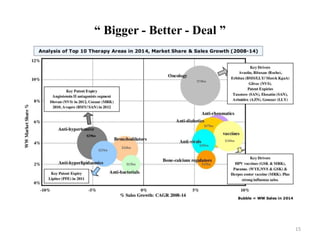
“ Bigger - Better - Deal ”
15
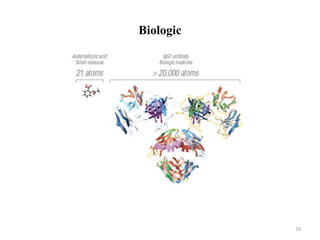
Biologic
16
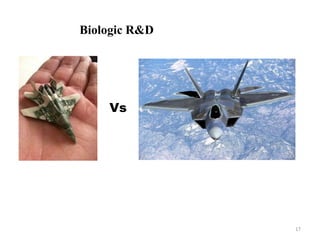
Biologic R&D
Vs
17
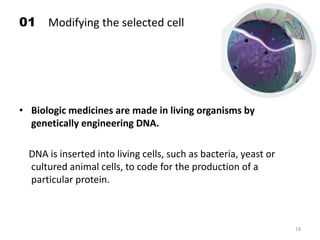
01 Modifying the selected cell
• Biologic medicines are made in living organisms by
genetically engineering DNA.
DNA is inserted into living cells, such as bacteria, yeast or
cultured animal cells, to code for the production of a
particular protein.
18
02 Growing a cell line from
modified cell
• The most effective cell line is selected for expansion.
During selection, the cells that can produce the biologic most
effectively are identified.
This cell line is unique to each manufacturer and is the source
of all future products.
19
03
Growing a large number of
cells from the cell line to produce
the desired protein
• The unique cell line is grown in bioreactors and carefully
monitored.
20
04
• Separating the protein from the cells through filtration or
centrifugation
• Purifying the collected protein through chromatography
• Purified bulk drug  characterisation and stability
21
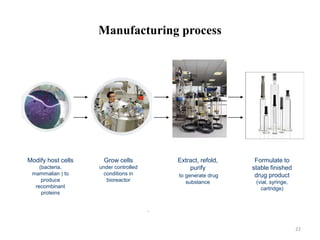
Manufacturing process
Modify host cells
(bacteria,
mammalian ) to
produce
recombinant
proteins
Extract, refold,
purify
to generate drug
substance
Formulate to
stable finished
drug product
(vial, syringe,
cartridge)
Grow cells
under controlled
conditions in
bioreactor
.
22
• Biological ‐ manufacturer must ensure product consistency,
quality, and purity by ensuring that the manufacturing process
remains substantially the same over time.
23
• Manufacturing and quality control issues can impact patient
safety and result in a loss of confidence in the quality of
biologics.
• They can also cause product recalls and drug shortages, which
can have profound effects on patients, treatment practices
and overall confidence in biologics.
24
• A biologic medicine typically has around 250 in-process tests
during manufacturing, compared with around 50 tests for a
small molecule, to demonstrate safety and equivalent efficacy
and to ensure safe, reliable production of therapies for
patients.
25
• With expanding demand for good-quality biologics comes
challenge of bearing with healthcare expenditure.
• Regulated introduction of generic biologics into market can
increase access to much needed biologic medicines and
reduce costs.
26
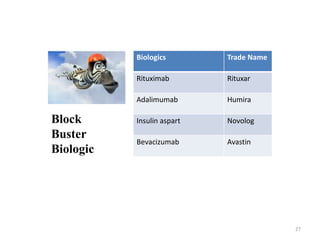
Block
Buster
Biologic
Biologics Trade Name
Rituximab Rituxar
Adalimumab Humira
Insulin aspart Novolog
Bevacizumab Avastin
27
Exclusivity
• application for follow-on biologic may not be submitted until
4 years after the date of first licensure of the reference
product.
• application for follow-on biologic may not be approved until
12 years after the date of first licensure of reference
product.
28
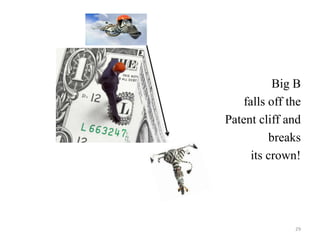
Big B
falls off the
Patent cliff and
breaks
its crown!
29
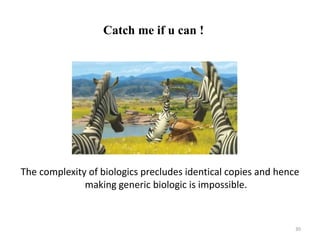
Catch me if u can !
The complexity of biologics precludes identical copies and hence
making generic biologic is impossible.
30
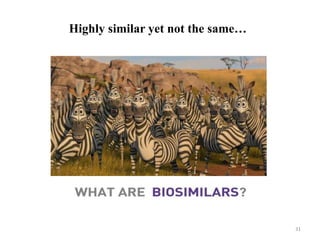
Highly similar yet not the same…
31
32
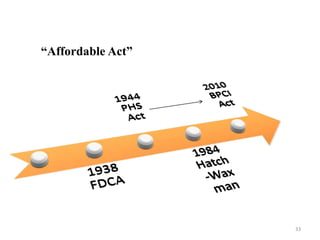
“Affordable Act”
33
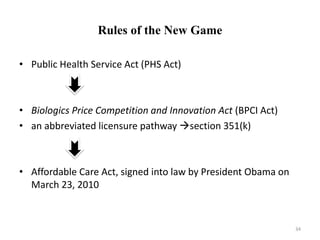
Rules of the New Game
• Public Health Service Act (PHS Act)
• Biologics Price Competition and Innovation Act (BPCI Act)
• an abbreviated licensure pathway section 351(k)
• Affordable Care Act, signed into law by President Obama on
March 23, 2010
34
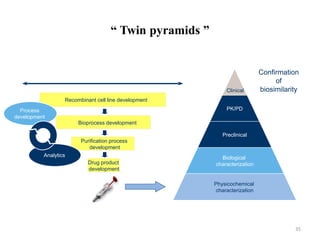
“ Twin pyramids ”
Purification process
development
Bioprocess development
Recombinant cell line development
Drug product
development
PK/PD
Preclinical
Biological
characterization
Physicochemical
characterization
Clinical
Process
development
Analytics
Confirmation
of
biosimilarity
35
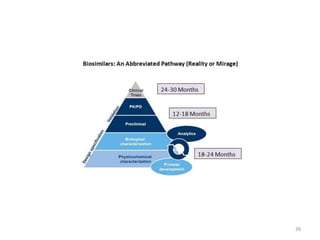
“ Biosimilar Goalpost ”
36
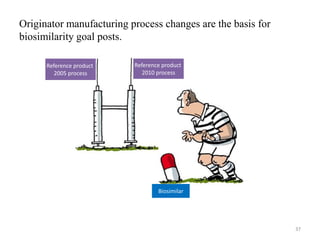
Originator manufacturing process changes are the basis for
biosimilarity goal posts.
Reference product
2005 process
Reference product
2010 process
Biosimilar
37
38
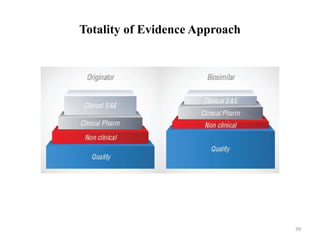
Totality of Evidence Approach
39
Made in India Insulin
• Bowing to the stringent criteria required by the EU,
India-based Marvel Life Sciences officially notified the
Committee for Medicinal Products for Human Use (CHMP)
of EMA in December 2007, that it would withdraw its
applications for marketing authorisations for their
biosimilar human insulins, as they were unable to meet the
standards for comparability set by the CHMP.
40
• This ‘Marvel insulin episode’ is critical from an Indian
perspective as ‘alternative’ biological insulin continue to flood
the Indian market, despite the fact that in the EU has not yet
approved a biosimilar insulin.
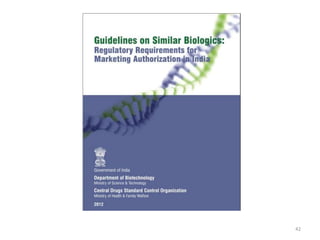
• ‘Similar biologics guidelines’  15 September 2012
41
42
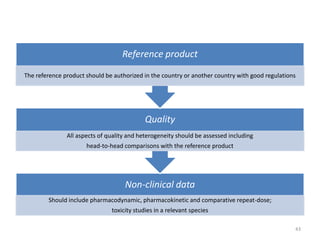
Non-clinical data
Should include pharmacodynamic, pharmacokinetic and comparative repeat-dose;
toxicity studies in a relevant species
Quality
All aspects of quality and heterogeneity should be assessed including
head-to-head comparisons with the reference product
Reference product
The reference product should be authorized in the country or another country with good regulations
43
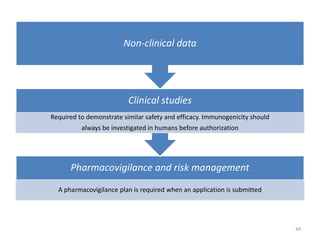
Pharmacovigilance and risk management
A pharmacovigilance plan is required when an application is submitted
Clinical studies
Required to demonstrate similar safety and efficacy. Immunogenicity should
always be investigated in humans before authorization
Non-clinical data
44
ADR
• Incidence of pure red cell aplasia following a minor change in
the packaging process of epoetin alfa (erythropoietin, EPO)
made the world sit up and look at biopharmaceutical products
with more caution.
• It also prompted drug regulatory authorities to establish strict
guidelines for evaluating biopharmaceuticals and biosimilar
products.
45
Naming, tracking and tracing medicines
• Currently, the International Nonproprietary Name (INN) for a
new biosimilar may be the same as that of the original
biologic medicine.
• In such a case, with INN (without a distinguishable name),
when prescribing a biologic medicine, the treating physician
may not know precisely which medicine a pharmacist gave
the patient.
46
Interchangeability
• An application for interchangeability can be concurrent or
subsequent to the application for a biosimilar product under
351(k) of the BPCIA.
FDA criteria
• The biologic product should be biosimilar to the reference
biologic product
• It can be expected to produce the same clinical results as the
reference product in any given patient.
47
• For a biological product that is administered more than once
to an individual, the risk in terms of safety or diminished
efficacy of alternating or switching between use of the
biological product and the reference product should not be
greater than the risk of using the reference product without
such alternation or switch.
48
49
Unfair field
dominated by
Big players !
50
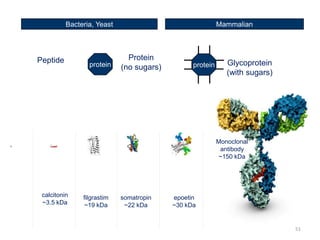
protein protein
Protein
(no sugars)
Monoclonal
antibody
~150 kDa
Glycoprotein
(with sugars)
MammalianBacteria, Yeast
calcitonin
~3.5 kDa
epoetin
~30 kDa
somatropin
~22 kDa
Peptide
filgrastim
~19 kDa
51
Thank you
52
Bibliography
• www.FDA.gov
• www.amgen.com
• www.sandoz.com
• Images from Internet
53

Generics and Biologics

  • 1.
  • 2.
    Flow of thoughtsfor the day Generics & Biosimilars Generic Act Generics Biologics R&D Need for biosimilars Affordability Act Goal post Interchangeability 2
  • 3.
    Generics & Biosimilars Every secret startssmall.. By Kamalasundar Moderated by Dr.Ravichandra 3
  • 4.
  • 5.
  • 6.
  • 7.
  • 8.
  • 9.
  • 10.
    • 1984 DrugPrice Competition and Patent Term Restoration Act (Hatch‐Waxman Act) • Hatch‐Waxman balanced the originator‐molecule manufacturers meaningful period of patent protection to recover development costs with public expectation of less expensive alternatives 10
  • 11.
    Abbreviated New DrugApplication • section 505(j) FDCA • established through the 1984 Hatch-Waxman Amendments • generic drug program for “small molecule” drugs • active ingredient is small in size and chemical origin 11
  • 12.
    Small molecule generics ‐identical copies made ‐ approximately 50 simple tests to demonstrate identity, strength, quality, potency, purity ‐ fully characterized ‐ stable 12
  • 13.
    - scientifically demonstratethat generic product is bioequivalent - in healthy volunteers  measure bioavailability of generic drug  comparative to the innovator drug - deliver same amount of active ingredients into human bloodstream in same amount of time using the same route of administration as innovator drug 13
  • 14.
  • 15.
    “ Bigger -Better - Deal ” 15
  • 16.
  • 17.
  • 18.
    01 Modifying theselected cell • Biologic medicines are made in living organisms by genetically engineering DNA. DNA is inserted into living cells, such as bacteria, yeast or cultured animal cells, to code for the production of a particular protein. 18
  • 19.
    02 Growing acell line from modified cell • The most effective cell line is selected for expansion. During selection, the cells that can produce the biologic most effectively are identified. This cell line is unique to each manufacturer and is the source of all future products. 19
  • 20.
    03 Growing a largenumber of cells from the cell line to produce the desired protein • The unique cell line is grown in bioreactors and carefully monitored. 20
  • 21.
    04 • Separating theprotein from the cells through filtration or centrifugation • Purifying the collected protein through chromatography • Purified bulk drug  characterisation and stability 21
  • 22.
    Manufacturing process Modify hostcells (bacteria, mammalian ) to produce recombinant proteins Extract, refold, purify to generate drug substance Formulate to stable finished drug product (vial, syringe, cartridge) Grow cells under controlled conditions in bioreactor . 22
  • 23.
    • Biological ‐manufacturer must ensure product consistency, quality, and purity by ensuring that the manufacturing process remains substantially the same over time. 23
  • 24.
    • Manufacturing andquality control issues can impact patient safety and result in a loss of confidence in the quality of biologics. • They can also cause product recalls and drug shortages, which can have profound effects on patients, treatment practices and overall confidence in biologics. 24
  • 25.
    • A biologicmedicine typically has around 250 in-process tests during manufacturing, compared with around 50 tests for a small molecule, to demonstrate safety and equivalent efficacy and to ensure safe, reliable production of therapies for patients. 25
  • 26.
    • With expandingdemand for good-quality biologics comes challenge of bearing with healthcare expenditure. • Regulated introduction of generic biologics into market can increase access to much needed biologic medicines and reduce costs. 26
  • 27.
    Block Buster Biologic Biologics Trade Name RituximabRituxar Adalimumab Humira Insulin aspart Novolog Bevacizumab Avastin 27
  • 28.
    Exclusivity • application forfollow-on biologic may not be submitted until 4 years after the date of first licensure of the reference product. • application for follow-on biologic may not be approved until 12 years after the date of first licensure of reference product. 28
  • 29.
    Big B falls offthe Patent cliff and breaks its crown! 29
  • 30.
    Catch me ifu can ! The complexity of biologics precludes identical copies and hence making generic biologic is impossible. 30
  • 31.
    Highly similar yetnot the same… 31
  • 32.
  • 33.
  • 34.
    Rules of theNew Game • Public Health Service Act (PHS Act) • Biologics Price Competition and Innovation Act (BPCI Act) • an abbreviated licensure pathway section 351(k) • Affordable Care Act, signed into law by President Obama on March 23, 2010 34
  • 35.
    “ Twin pyramids” Purification process development Bioprocess development Recombinant cell line development Drug product development PK/PD Preclinical Biological characterization Physicochemical characterization Clinical Process development Analytics Confirmation of biosimilarity 35
  • 36.
  • 37.
    Originator manufacturing processchanges are the basis for biosimilarity goal posts. Reference product 2005 process Reference product 2010 process Biosimilar 37
  • 38.
  • 39.
  • 40.
    Made in IndiaInsulin • Bowing to the stringent criteria required by the EU, India-based Marvel Life Sciences officially notified the Committee for Medicinal Products for Human Use (CHMP) of EMA in December 2007, that it would withdraw its applications for marketing authorisations for their biosimilar human insulins, as they were unable to meet the standards for comparability set by the CHMP. 40
  • 41.
    • This ‘Marvelinsulin episode’ is critical from an Indian perspective as ‘alternative’ biological insulin continue to flood the Indian market, despite the fact that in the EU has not yet approved a biosimilar insulin. • ‘Similar biologics guidelines’  15 September 2012 41
  • 42.
  • 43.
    Non-clinical data Should includepharmacodynamic, pharmacokinetic and comparative repeat-dose; toxicity studies in a relevant species Quality All aspects of quality and heterogeneity should be assessed including head-to-head comparisons with the reference product Reference product The reference product should be authorized in the country or another country with good regulations 43
  • 44.
    Pharmacovigilance and riskmanagement A pharmacovigilance plan is required when an application is submitted Clinical studies Required to demonstrate similar safety and efficacy. Immunogenicity should always be investigated in humans before authorization Non-clinical data 44
  • 45.
    ADR • Incidence ofpure red cell aplasia following a minor change in the packaging process of epoetin alfa (erythropoietin, EPO) made the world sit up and look at biopharmaceutical products with more caution. • It also prompted drug regulatory authorities to establish strict guidelines for evaluating biopharmaceuticals and biosimilar products. 45
  • 46.
    Naming, tracking andtracing medicines • Currently, the International Nonproprietary Name (INN) for a new biosimilar may be the same as that of the original biologic medicine. • In such a case, with INN (without a distinguishable name), when prescribing a biologic medicine, the treating physician may not know precisely which medicine a pharmacist gave the patient. 46
  • 47.
    Interchangeability • An applicationfor interchangeability can be concurrent or subsequent to the application for a biosimilar product under 351(k) of the BPCIA. FDA criteria • The biologic product should be biosimilar to the reference biologic product • It can be expected to produce the same clinical results as the reference product in any given patient. 47
  • 48.
    • For abiological product that is administered more than once to an individual, the risk in terms of safety or diminished efficacy of alternating or switching between use of the biological product and the reference product should not be greater than the risk of using the reference product without such alternation or switch. 48
  • 49.
  • 50.
  • 51.
    protein protein Protein (no sugars) Monoclonal antibody ~150kDa Glycoprotein (with sugars) MammalianBacteria, Yeast calcitonin ~3.5 kDa epoetin ~30 kDa somatropin ~22 kDa Peptide filgrastim ~19 kDa 51
  • 52.
  • 53.
    Bibliography • www.FDA.gov • www.amgen.com •www.sandoz.com • Images from Internet 53