BIOSIMILARS
PRESENTED BY- ANKITA PRIYADARSHINI SAHOO
M.PHARM (1ST YEAR)
CONTENTS
o WHAT IS GENERIC
o WHAT IS BIOLOGIC
o WHAT IS BIOSIMILAR
o BIOSIMILAR DEVELOPING PROCESS
o USES, ADVANTAGES & LIMITATION OF
BIOSIMILAR
o BIOSIMILAR APPROVAL PATHWAY IN
INDIA
o STATUS OF REGULATIONS FOR
BIOSIMILARS GLOBALLY
WHAT IS GENERICS?
• Chemically & therapeutically equivalent to the branded, original, low
molecular weight chemical drugs whose patents have expired
• Identical to the original product
• Most countries already have well-established scientific standards &
legal mechanisms for authorizing generics
WHAT IS A BIOLOGIC?
• A therapeutic agent manufactured in a living system such
as a micro-organism, or plant or animal cells using
recombinant DNA technology.
• Very large, complex molecules or mixtures of molecules.
WHAT IS BIOSIMILAR?
• A bio-therapeutic product which is similar in terms of
quality, safety and efficacy to an already licensed
reference bio-therapeutic product
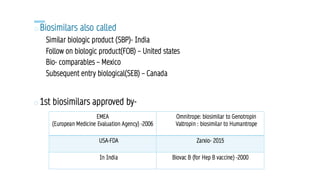
o Biosimilars also called
Similar biologic product (SBP)- India
Follow on biologic product(FOB) – United states
Bio- comparables – Mexico
Subsequent entry biological(SEB) – Canada
o 1st biosimilars approved by-
EMEA
(European Medicine Evaluation Agency) -2006
Omnitrope: biosimilar to Genotropin
Valtropin : biosimilar to Humantrope
USA-FDA Zarxio- 2015
In India Biovac B (for Hep B vaccine) -2000
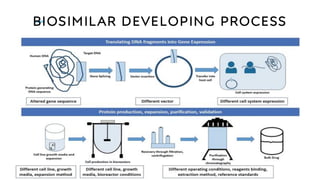
BIOSIMILAR DEVELOPING PROCESS
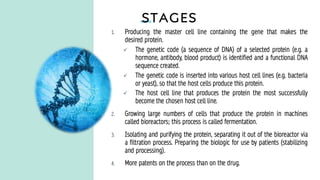
STAGES
1. Producing the master cell line containing the gene that makes the
desired protein.
✓ The genetic code (a sequence of DNA) of a selected protein (e.g. a
hormone, antibody, blood product) is identified and a functional DNA
sequence created.
✓ The genetic code is inserted into various host cell lines (e.g. bacteria
or yeast), so that the host cells produce this protein.
✓ The host cell line that produces the protein the most successfully
become the chosen host cell line.
2. Growing large numbers of cells that produce the protein in machines
called bioreactors; this process is called fermentation.
3. Isolating and purifying the protein, separating it out of the bioreactor via
a filtration process. Preparing the biologic for use by patients (stabilizing
and processing).
4. More patents on the process than on the drug.
USES OF BIOSIMILARS
• Blood conditions: leuko/neutro/pancytopenias
• Cancers: Colon & Breast Cancer or NHL(Non-Hodgkin lymphoma)
• Immune system disorders: Rheumatoid arthritis, Psoriasis &
Crohn's disease
• Neurological disorders
• Multiple Sclerosis
ADVANTAGES
• Treatment cost with biosimilar is lesser than innovators biological drug.
• Biopharmaceuticals represent one of the fastest-growing segments of
pharmaceuticals industry and by 2011, they are expected to represent 50% of the
market.
• Patent of original product is going to expire and therefore opportunity for generic
versions of biopharmaceutical is very large.
• The operating profit margin of traditional generic drugs is roughly 20%, but
depending on the biosimilar product, profit margins have the potential to be
somewhat higher, as much as 30%.
LIMITATION
The main concerns raised regarding biosimilar are immunogenicity, efficacy,
adverse effects when switching from a biologic to a biosimilar , and possible
long-term effects. This issue has been well documented in two recent 2017
trials, comparing the implications of switching from an infliximab innovator to
biosimilar , over the span of one year in IBD patients.
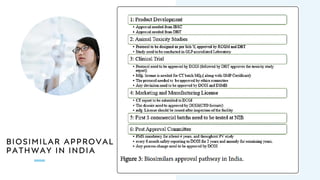
BIOSIMILAR APPROVAL
PATHWAY IN INDIA
STATUS OF REGULATIONS FOR
BIOSIMILARS GLOBALLY
• Strong need for regulations governing biosimilars.
• Implementation of an abbreviated licensure pathway for
biological products presents challenges, given the
associated scientific & technical complexities.
• US & India have recently covered these under their
respective Acts by bringing in applicable guidelines for
their evaluation & overall regulation.
WHO GUIDELINES
• Scientific basis for the evaluation & regulation of
biosimilars was discussed & agreement for developing
WHO Guidelines was reached at the first ‘WHO informal
consultation on Regulatory evaluation of Therapeutic
Biological Medicinal Products’ held in Geneva, 2007.
• Published guidelines on Evaluation of Similar Biological
Products with detailed recommendations on clinical
development in October 2009.
REGULATORY FRAMEWORK IN EU
• Guidelines on similar biological products containing
biotechnology-derived proteins as active substance
were adopted by European Medicines Agency (EMEA) in
June 2006.
• Issued product specific biosimilar guidelines.
• In European Union, the first patent on
biopharmaceuticals expired in 2001 & first biosimilar
medicine was approved by EMEA in 2006.
REGULATORY FRAMEWORK IN INDIA
o Similar biologics are regulated as per:
• The Drugs and Cosmetics Act, 1940
• The Drugs Cosmetics Rules, 1945
o Rules for the manufacture, use, import, export & storage of hazardous
microorganisms/genetically engineered organisms or cells, 1989.
Notified under the Environment Protection Act.
o Apart from Central Drugs Standard Control Organization(CDSCO), the
office of Drug Controller General of India(DCGI) two other competent
authorities are involved in the approval process
1. Review Committee on Genetic Manipulation RCGM)
• Works under Department of Biotechnology (DBT)
• Regulates import, export, carrying out research, preclinical permission, No
objection certificate for clinical trial (CT).
2. Genetic Engineering Approval Committee(GEAC)
• Functions under the Department of Environment (DoE)
• Statutory body for review & approval of activities involving large scale use of
genetically engineered organisms & their products.
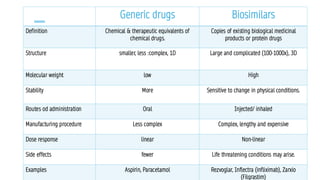
Generic drugs Biosimilars
Definition Chemical & therapeutic equivalents of
chemical drugs.
Copies of existing biological medicinal
products or protein drugs
Structure smaller, less :complex, 1D Large and complicated (100-1000x), 3D
Molecular weight low High
Stability More Sensitive to change in physical conditions.
Routes od administration Oral Injected/ inhaled
Manufacturing procedure Less complex Complex, lengthy and expensive
Dose response linear Non-linear
Side effects fewer Life threatening conditions may arise.
Examples Aspirin, Paracetamol Rezvoglar, Inflectra (infliximab), Zarxio
(Filgrastim)
THANK YOU

biosimilars and difference between chemical generic and biosimilars

  • 1.
    BIOSIMILARS PRESENTED BY- ANKITAPRIYADARSHINI SAHOO M.PHARM (1ST YEAR)
  • 2.
    CONTENTS o WHAT ISGENERIC o WHAT IS BIOLOGIC o WHAT IS BIOSIMILAR o BIOSIMILAR DEVELOPING PROCESS o USES, ADVANTAGES & LIMITATION OF BIOSIMILAR o BIOSIMILAR APPROVAL PATHWAY IN INDIA o STATUS OF REGULATIONS FOR BIOSIMILARS GLOBALLY
  • 3.
    WHAT IS GENERICS? •Chemically & therapeutically equivalent to the branded, original, low molecular weight chemical drugs whose patents have expired • Identical to the original product • Most countries already have well-established scientific standards & legal mechanisms for authorizing generics
  • 4.
    WHAT IS ABIOLOGIC? • A therapeutic agent manufactured in a living system such as a micro-organism, or plant or animal cells using recombinant DNA technology. • Very large, complex molecules or mixtures of molecules.
  • 5.
    WHAT IS BIOSIMILAR? •A bio-therapeutic product which is similar in terms of quality, safety and efficacy to an already licensed reference bio-therapeutic product
  • 6.
    o Biosimilars alsocalled Similar biologic product (SBP)- India Follow on biologic product(FOB) – United states Bio- comparables – Mexico Subsequent entry biological(SEB) – Canada o 1st biosimilars approved by- EMEA (European Medicine Evaluation Agency) -2006 Omnitrope: biosimilar to Genotropin Valtropin : biosimilar to Humantrope USA-FDA Zarxio- 2015 In India Biovac B (for Hep B vaccine) -2000
  • 7.
  • 8.
    STAGES 1. Producing themaster cell line containing the gene that makes the desired protein. ✓ The genetic code (a sequence of DNA) of a selected protein (e.g. a hormone, antibody, blood product) is identified and a functional DNA sequence created. ✓ The genetic code is inserted into various host cell lines (e.g. bacteria or yeast), so that the host cells produce this protein. ✓ The host cell line that produces the protein the most successfully become the chosen host cell line. 2. Growing large numbers of cells that produce the protein in machines called bioreactors; this process is called fermentation. 3. Isolating and purifying the protein, separating it out of the bioreactor via a filtration process. Preparing the biologic for use by patients (stabilizing and processing). 4. More patents on the process than on the drug.
  • 9.
    USES OF BIOSIMILARS •Blood conditions: leuko/neutro/pancytopenias • Cancers: Colon & Breast Cancer or NHL(Non-Hodgkin lymphoma) • Immune system disorders: Rheumatoid arthritis, Psoriasis & Crohn's disease • Neurological disorders • Multiple Sclerosis
  • 10.
    ADVANTAGES • Treatment costwith biosimilar is lesser than innovators biological drug. • Biopharmaceuticals represent one of the fastest-growing segments of pharmaceuticals industry and by 2011, they are expected to represent 50% of the market. • Patent of original product is going to expire and therefore opportunity for generic versions of biopharmaceutical is very large. • The operating profit margin of traditional generic drugs is roughly 20%, but depending on the biosimilar product, profit margins have the potential to be somewhat higher, as much as 30%.
  • 11.
    LIMITATION The main concernsraised regarding biosimilar are immunogenicity, efficacy, adverse effects when switching from a biologic to a biosimilar , and possible long-term effects. This issue has been well documented in two recent 2017 trials, comparing the implications of switching from an infliximab innovator to biosimilar , over the span of one year in IBD patients.
  • 12.
  • 13.
    STATUS OF REGULATIONSFOR BIOSIMILARS GLOBALLY • Strong need for regulations governing biosimilars. • Implementation of an abbreviated licensure pathway for biological products presents challenges, given the associated scientific & technical complexities. • US & India have recently covered these under their respective Acts by bringing in applicable guidelines for their evaluation & overall regulation.
  • 14.
    WHO GUIDELINES • Scientificbasis for the evaluation & regulation of biosimilars was discussed & agreement for developing WHO Guidelines was reached at the first ‘WHO informal consultation on Regulatory evaluation of Therapeutic Biological Medicinal Products’ held in Geneva, 2007. • Published guidelines on Evaluation of Similar Biological Products with detailed recommendations on clinical development in October 2009.
  • 15.
    REGULATORY FRAMEWORK INEU • Guidelines on similar biological products containing biotechnology-derived proteins as active substance were adopted by European Medicines Agency (EMEA) in June 2006. • Issued product specific biosimilar guidelines. • In European Union, the first patent on biopharmaceuticals expired in 2001 & first biosimilar medicine was approved by EMEA in 2006.
  • 16.
    REGULATORY FRAMEWORK ININDIA o Similar biologics are regulated as per: • The Drugs and Cosmetics Act, 1940 • The Drugs Cosmetics Rules, 1945 o Rules for the manufacture, use, import, export & storage of hazardous microorganisms/genetically engineered organisms or cells, 1989. Notified under the Environment Protection Act. o Apart from Central Drugs Standard Control Organization(CDSCO), the office of Drug Controller General of India(DCGI) two other competent authorities are involved in the approval process 1. Review Committee on Genetic Manipulation RCGM) • Works under Department of Biotechnology (DBT) • Regulates import, export, carrying out research, preclinical permission, No objection certificate for clinical trial (CT). 2. Genetic Engineering Approval Committee(GEAC) • Functions under the Department of Environment (DoE) • Statutory body for review & approval of activities involving large scale use of genetically engineered organisms & their products.
  • 17.
    Generic drugs Biosimilars DefinitionChemical & therapeutic equivalents of chemical drugs. Copies of existing biological medicinal products or protein drugs Structure smaller, less :complex, 1D Large and complicated (100-1000x), 3D Molecular weight low High Stability More Sensitive to change in physical conditions. Routes od administration Oral Injected/ inhaled Manufacturing procedure Less complex Complex, lengthy and expensive Dose response linear Non-linear Side effects fewer Life threatening conditions may arise. Examples Aspirin, Paracetamol Rezvoglar, Inflectra (infliximab), Zarxio (Filgrastim)
  • 18.