FACILITATED BY—
DR. M.P. VENKATESH
ASST. PROFFESOR
REGULATORY AFFAIRS
GROUP
DEPT. OF
PHARMACEUTICS
JSSCP, MYSURU
PRESENTED BY—
MANISH KUMAR
1ST YEAR M
.PHARM
JSSCP, MYSURU
1
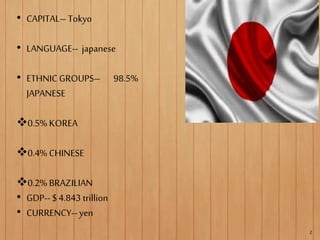
• CAPITAL– Tokyo
• LANGUAGE-- japanese
• ETHNIC GROUPS– 98.5%
JAPANESE
0.5% KOREA
0.4% CHINESE
0.2% BRAZILIAN
• GDP-- $ 4.843 trillion
• CURRENCY--yen
2
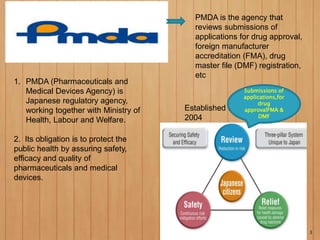
1. PMDA (Pharmaceuticals and
Medical Devices Agency) is
Japanese regulatory agency,
working together with Ministry of
Health, Labour and Welfare.
2. Its obligation is to protect the
public health by assuring safety,
efficacy and quality of
pharmaceuticals and medical
devices.
PMDA is the agency that
reviews submissions of
applications for drug approval,
foreign manufacturer
accreditation (FMA), drug
master file (DMF) registration,
etc
Established in 1 april
2004
3
Submissions of
applications,for
drug
approvalFMA &
DMF
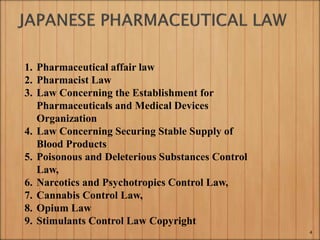
1. Pharmaceutical affair law
2. Pharmacist Law
3. Law Concerning the Establishment for
Pharmaceuticals and Medical Devices
Organization
4. Law Concerning Securing Stable Supply of
Blood Products
5. Poisonous and Deleterious Substances Control
Law,
6. Narcotics and Psychotropics Control Law,
7. Cannabis Control Law,
8. Opium Law
9. Stimulants Control Law Copyright
4
5
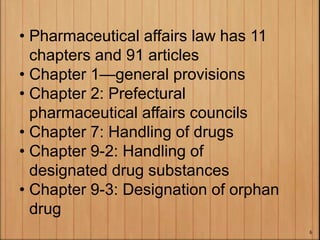
• Pharmaceutical affairs law has 11
chapters and 91 articles
• Chapter 1—general provisions
• Chapter 2: Prefectural
pharmaceutical affairs councils
• Chapter 7: Handling of drugs
• Chapter 9-2: Handling of
designated drug substances
• Chapter 9-3: Designation of orphan
drug
6
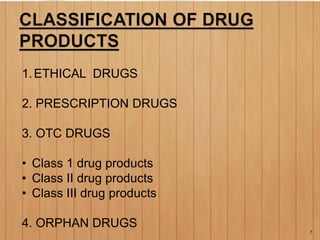
1.ETHICAL DRUGS
2. PRESCRIPTION DRUGS
3. OTC DRUGS
• Class 1 drug products
• Class II drug products
• Class III drug products
4. ORPHAN DRUGS
7
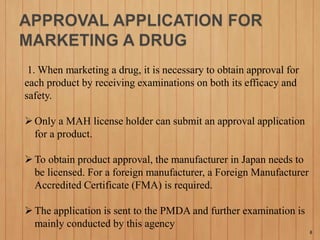
1. When marketing a drug, it is necessary to obtain approval for
each product by receiving examinations on both its efficacy and
safety.
Only a MAH license holder can submit an approval application
for a product.
To obtain product approval, the manufacturer in Japan needs to
be licensed. For a foreign manufacturer, a Foreign Manufacturer
Accredited Certificate (FMA) is required.
The application is sent to the PMDA and further examination is
mainly conducted by this agency
8
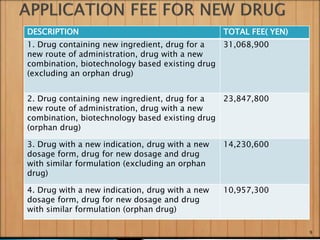
DESCRIPTION TOTAL FEE( YEN)
1. Drug containing new ingredient, drug for a
new route of administration, drug with a new
combination, biotechnology based existing drug
(excluding an orphan drug)
31,068,900
2. Drug containing new ingredient, drug for a
new route of administration, drug with a new
combination, biotechnology based existing drug
(orphan drug)
23,847,800
3. Drug with a new indication, drug with a new
dosage form, drug for new dosage and drug
with similar formulation (excluding an orphan
drug)
14,230,600
4. Drug with a new indication, drug with a new
dosage form, drug for new dosage and drug
with similar formulation (orphan drug)
10,957,300
9
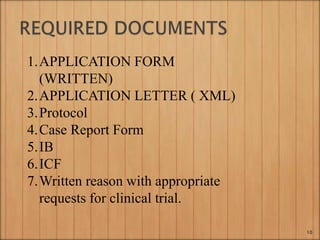
1.APPLICATION FORM
(WRITTEN)
2.APPLICATION LETTER ( XML)
3.Protocol
4.Case Report Form
5.IB
6.ICF
7.Written reason with appropriate
requests for clinical trial.
10
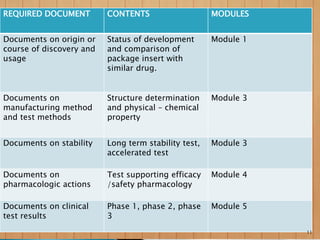
REQUIRED DOCUMENT CONTENTS MODULES
Documents on origin or
course of discovery and
usage
Status of development
and comparison of
package insert with
similar drug.
Module 1
Documents on
manufacturing method
and test methods
Structure determination
and physical – chemical
property
Module 3
Documents on stability Long term stability test,
accelerated test
Module 3
Documents on
pharmacologic actions
Test supporting efficacy
/safety pharmacology
Module 4
Documents on clinical
test results
Phase 1, phase 2, phase
3
Module 5
11
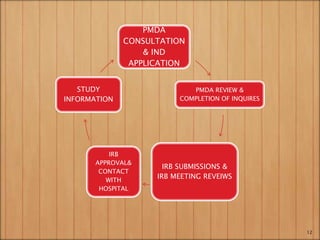
PMDA
CONSULTATION
& IND
APPLICATION
PMDA REVIEW &
COMPLETION OF INQUIRES
IRB SUBMISSIONS &
IRB MEETING REVEIWS
IRB
APPROVAL&
CONTACT
WITH
HOSPITAL
STUDY
INFORMATION
12
13
14
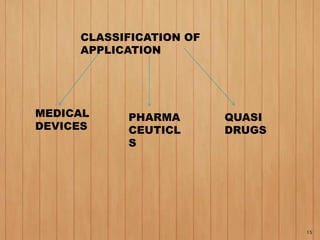
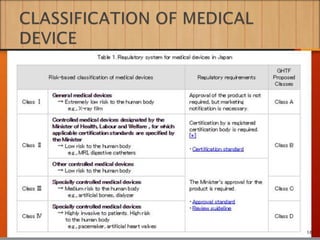
CLASSIFICATION OF
APPLICATION
QUASI
DRUGS
PHARMA
CEUTICL
S
MEDICAL
DEVICES
15
16
• Registration of medical devices and
pharmaceuticals in Japan is complicated, and high
costs and long timeframes. In some cases,
Japanese regulators require clinical trials in
Japan to be conducted.
• Product registration in Japan needs to be pursued
carefully and only after determining that there is a
strong market demand for your product
17
18
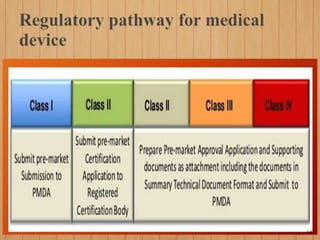
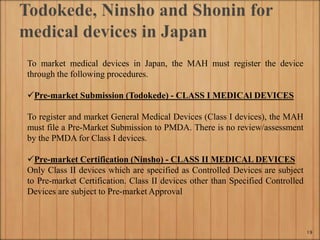
To market medical devices in Japan, the MAH must register the device
through the following procedures.
Pre-market Submission (Todokede) - CLASS I MEDICAl DEVICES
To register and market General Medical Devices (Class I devices), the MAH
must file a Pre-Market Submission to PMDA. There is no review/assessment
by the PMDA for Class I devices.
Pre-market Certification (Ninsho) - CLASS II MEDICAL DEVICES
Only Class II devices which are specified as Controlled Devices are subject
to Pre-market Certification. Class II devices other than Specified Controlled
Devices are subject to Pre-market Approval
19
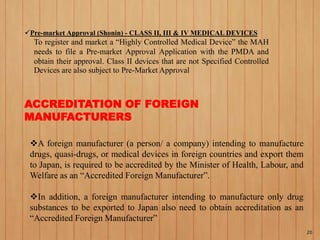
Pre-market Approval (Shonin) - CLASS II, III & IV MEDICAL DEVICES
To register and market a “Highly Controlled Medical Device” the MAH
needs to file a Pre-market Approval Application with the PMDA and
obtain their approval. Class II devices that are not Specified Controlled
Devices are also subject to Pre-Market Approval
ACCREDITATION OF FOREIGN
MANUFACTURERS
A foreign manufacturer (a person/ a company) intending to manufacture
drugs, quasi-drugs, or medical devices in foreign countries and export them
to Japan, is required to be accredited by the Minister of Health, Labour, and
Welfare as an “Accredited Foreign Manufacturer”.
In addition, a foreign manufacturer intending to manufacture only drug
substances to be exported to Japan also need to obtain accreditation as an
“Accredited Foreign Manufacturer”
20
An “Applicant” is required to submit “Application for
Accreditation” (Form No. 18 in the PAL Enforcement
Regulations) that is addressed to the Minister, and
“Application for Accreditation Examination” [Form No.16-
(2)]
Documents to Be Attached to Accreditation Application:-
A medical certificate from a physician which indicates
whether or not an “Applicant” has mental disorders or is
addicted to narcotics, cannabis, opium or stimulant drugs.
 A curriculum vitae of the person who is responsible to the
manufacturing establishment
21
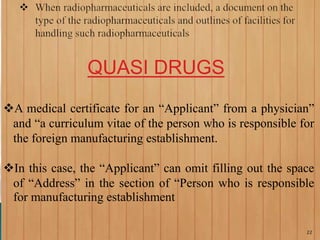
QUASI DRUGS
A medical certificate for an “Applicant” from a physician”
and “a curriculum vitae of the person who is responsible for
the foreign manufacturing establishment.
In this case, the “Applicant” can omit filling out the space
of “Address” in the section of “Person who is responsible
for manufacturing establishment
22
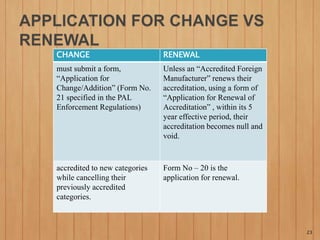
CHANGE RENEWAL
must submit a form,
“Application for
Change/Addition” (Form No.
21 specified in the PAL
Enforcement Regulations)
Unless an “Accredited Foreign
Manufacturer” renews their
accreditation, using a form of
“Application for Renewal of
Accreditation” , within its 5
year effective period, their
accreditation becomes null and
void.
accredited to new categories
while cancelling their
previously accredited
categories.
Form No – 20 is the
application for renewal.
23
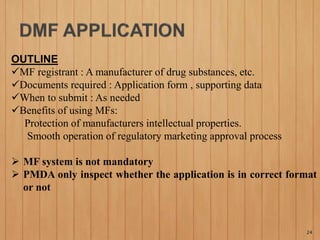
OUTLINE
MF registrant : A manufacturer of drug substances, etc.
Documents required : Application form , supporting data
When to submit : As needed
Benefits of using MFs:
Protection of manufacturers intellectual properties.
Smooth operation of regulatory marketing approval process
 MF system is not mandatory
 PMDA only inspect whether the application is in correct format
or not
24
Quasi drugs developed in Japan for the
prevention of treatment of
HYPERPIGMENTATION DISORDERS
IT causes excess production of melanin which
causes irregular hyperpigmentation of skin
which further causes melasma
• now approved by MHLW
25
 Pharmaceutical product materials(materials
of pharmaceutical products with special
dosage form, etc.)
 Excipients (new excipients , new pre-mix
excipients)
 Materials for medical devices.
 Drug substances, intermediates
 Containers, packaging materials.
26
1. http://www.pacificbridgemedical.com/regulatory-
services/registration/japan/#
2. http://www.emergogroup.com/services/japan/medical-
device-approval-japan
3. http://www.pmda.go.jp/english/service/pdf/acc/applica
tion.pdf
4. http://www.pmda.go.jp/english/service/pdf/acc/examin
atio.pdf
5. http://www.std.pmda.go.jp/stdDB/index_e.html
27
28

Drug approval process in japan

  • 1.
    FACILITATED BY— DR. M.P.VENKATESH ASST. PROFFESOR REGULATORY AFFAIRS GROUP DEPT. OF PHARMACEUTICS JSSCP, MYSURU PRESENTED BY— MANISH KUMAR 1ST YEAR M .PHARM JSSCP, MYSURU 1
  • 2.
    • CAPITAL– Tokyo •LANGUAGE-- japanese • ETHNIC GROUPS– 98.5% JAPANESE 0.5% KOREA 0.4% CHINESE 0.2% BRAZILIAN • GDP-- $ 4.843 trillion • CURRENCY--yen 2
  • 3.
    1. PMDA (Pharmaceuticalsand Medical Devices Agency) is Japanese regulatory agency, working together with Ministry of Health, Labour and Welfare. 2. Its obligation is to protect the public health by assuring safety, efficacy and quality of pharmaceuticals and medical devices. PMDA is the agency that reviews submissions of applications for drug approval, foreign manufacturer accreditation (FMA), drug master file (DMF) registration, etc Established in 1 april 2004 3 Submissions of applications,for drug approvalFMA & DMF
  • 4.
    1. Pharmaceutical affairlaw 2. Pharmacist Law 3. Law Concerning the Establishment for Pharmaceuticals and Medical Devices Organization 4. Law Concerning Securing Stable Supply of Blood Products 5. Poisonous and Deleterious Substances Control Law, 6. Narcotics and Psychotropics Control Law, 7. Cannabis Control Law, 8. Opium Law 9. Stimulants Control Law Copyright 4
  • 5.
  • 6.
    • Pharmaceutical affairslaw has 11 chapters and 91 articles • Chapter 1—general provisions • Chapter 2: Prefectural pharmaceutical affairs councils • Chapter 7: Handling of drugs • Chapter 9-2: Handling of designated drug substances • Chapter 9-3: Designation of orphan drug 6
  • 7.
    1.ETHICAL DRUGS 2. PRESCRIPTIONDRUGS 3. OTC DRUGS • Class 1 drug products • Class II drug products • Class III drug products 4. ORPHAN DRUGS 7
  • 8.
    1. When marketinga drug, it is necessary to obtain approval for each product by receiving examinations on both its efficacy and safety. Only a MAH license holder can submit an approval application for a product. To obtain product approval, the manufacturer in Japan needs to be licensed. For a foreign manufacturer, a Foreign Manufacturer Accredited Certificate (FMA) is required. The application is sent to the PMDA and further examination is mainly conducted by this agency 8
  • 9.
    DESCRIPTION TOTAL FEE(YEN) 1. Drug containing new ingredient, drug for a new route of administration, drug with a new combination, biotechnology based existing drug (excluding an orphan drug) 31,068,900 2. Drug containing new ingredient, drug for a new route of administration, drug with a new combination, biotechnology based existing drug (orphan drug) 23,847,800 3. Drug with a new indication, drug with a new dosage form, drug for new dosage and drug with similar formulation (excluding an orphan drug) 14,230,600 4. Drug with a new indication, drug with a new dosage form, drug for new dosage and drug with similar formulation (orphan drug) 10,957,300 9
  • 10.
    1.APPLICATION FORM (WRITTEN) 2.APPLICATION LETTER( XML) 3.Protocol 4.Case Report Form 5.IB 6.ICF 7.Written reason with appropriate requests for clinical trial. 10
  • 11.
    REQUIRED DOCUMENT CONTENTSMODULES Documents on origin or course of discovery and usage Status of development and comparison of package insert with similar drug. Module 1 Documents on manufacturing method and test methods Structure determination and physical – chemical property Module 3 Documents on stability Long term stability test, accelerated test Module 3 Documents on pharmacologic actions Test supporting efficacy /safety pharmacology Module 4 Documents on clinical test results Phase 1, phase 2, phase 3 Module 5 11
  • 12.
    PMDA CONSULTATION & IND APPLICATION PMDA REVIEW& COMPLETION OF INQUIRES IRB SUBMISSIONS & IRB MEETING REVEIWS IRB APPROVAL& CONTACT WITH HOSPITAL STUDY INFORMATION 12
  • 13.
  • 14.
  • 15.
  • 16.
  • 17.
    • Registration ofmedical devices and pharmaceuticals in Japan is complicated, and high costs and long timeframes. In some cases, Japanese regulators require clinical trials in Japan to be conducted. • Product registration in Japan needs to be pursued carefully and only after determining that there is a strong market demand for your product 17
  • 18.
  • 19.
    To market medicaldevices in Japan, the MAH must register the device through the following procedures. Pre-market Submission (Todokede) - CLASS I MEDICAl DEVICES To register and market General Medical Devices (Class I devices), the MAH must file a Pre-Market Submission to PMDA. There is no review/assessment by the PMDA for Class I devices. Pre-market Certification (Ninsho) - CLASS II MEDICAL DEVICES Only Class II devices which are specified as Controlled Devices are subject to Pre-market Certification. Class II devices other than Specified Controlled Devices are subject to Pre-market Approval 19
  • 20.
    Pre-market Approval (Shonin)- CLASS II, III & IV MEDICAL DEVICES To register and market a “Highly Controlled Medical Device” the MAH needs to file a Pre-market Approval Application with the PMDA and obtain their approval. Class II devices that are not Specified Controlled Devices are also subject to Pre-Market Approval ACCREDITATION OF FOREIGN MANUFACTURERS A foreign manufacturer (a person/ a company) intending to manufacture drugs, quasi-drugs, or medical devices in foreign countries and export them to Japan, is required to be accredited by the Minister of Health, Labour, and Welfare as an “Accredited Foreign Manufacturer”. In addition, a foreign manufacturer intending to manufacture only drug substances to be exported to Japan also need to obtain accreditation as an “Accredited Foreign Manufacturer” 20
  • 21.
    An “Applicant” isrequired to submit “Application for Accreditation” (Form No. 18 in the PAL Enforcement Regulations) that is addressed to the Minister, and “Application for Accreditation Examination” [Form No.16- (2)] Documents to Be Attached to Accreditation Application:- A medical certificate from a physician which indicates whether or not an “Applicant” has mental disorders or is addicted to narcotics, cannabis, opium or stimulant drugs.  A curriculum vitae of the person who is responsible to the manufacturing establishment 21
  • 22.
    QUASI DRUGS A medicalcertificate for an “Applicant” from a physician” and “a curriculum vitae of the person who is responsible for the foreign manufacturing establishment. In this case, the “Applicant” can omit filling out the space of “Address” in the section of “Person who is responsible for manufacturing establishment 22
  • 23.
    CHANGE RENEWAL must submita form, “Application for Change/Addition” (Form No. 21 specified in the PAL Enforcement Regulations) Unless an “Accredited Foreign Manufacturer” renews their accreditation, using a form of “Application for Renewal of Accreditation” , within its 5 year effective period, their accreditation becomes null and void. accredited to new categories while cancelling their previously accredited categories. Form No – 20 is the application for renewal. 23
  • 24.
    OUTLINE MF registrant :A manufacturer of drug substances, etc. Documents required : Application form , supporting data When to submit : As needed Benefits of using MFs: Protection of manufacturers intellectual properties. Smooth operation of regulatory marketing approval process  MF system is not mandatory  PMDA only inspect whether the application is in correct format or not 24
  • 25.
    Quasi drugs developedin Japan for the prevention of treatment of HYPERPIGMENTATION DISORDERS IT causes excess production of melanin which causes irregular hyperpigmentation of skin which further causes melasma • now approved by MHLW 25
  • 26.
     Pharmaceutical productmaterials(materials of pharmaceutical products with special dosage form, etc.)  Excipients (new excipients , new pre-mix excipients)  Materials for medical devices.  Drug substances, intermediates  Containers, packaging materials. 26
  • 27.
    1. http://www.pacificbridgemedical.com/regulatory- services/registration/japan/# 2. http://www.emergogroup.com/services/japan/medical- device-approval-japan 3.http://www.pmda.go.jp/english/service/pdf/acc/applica tion.pdf 4. http://www.pmda.go.jp/english/service/pdf/acc/examin atio.pdf 5. http://www.std.pmda.go.jp/stdDB/index_e.html 27
  • 28.