Biotechnology has led to the development of more and more
Biologics. But the process is complex and expensive.
Developing a cheaper yet equally efficacious and safe
biological product has become a necessity. This has led to the
development of Biosimilars.
What is a Biosimilar?
Term By Definition
SBP (Similar Biologic
Product)
WHO Similar to an already licensed reference
biotherapeutic product in terms of
quality, safety & efficacy
FOB
(Follow-On Biologic)
US-
FDA
Highly similar to the reference product
without clinically meaningful differences
in safety, purity and potency
SEB
(Subsequent Entry
Biologic)
Canada Drug that enters the market subsequent
to a version previously authorized in
Canada with demonstrated similarity to
a reference biologic drug
Recombinant Non-glycosylated
Proteins
• Insulin
• Human Growth Hormones
• Granulocyte Colony-
stimulating Factor (G-CSF)
• Interferons
Recombinant Glycosylated
Proteins
• Erythropoietin
• Monoclonal Antibodies
• Follitropin
Recombinant Peptides
• Glucagon
• PTH
• Biovac B (Hepatitis B vaccine) - India.2000
• Omnitrope (Somatropin) – EMA.2006
• Zarixo (Filgastrim) USFDA.2015
Drug Number
Filgastrim 6
Peg-filgastrim 4
Erythropoietin 4
Insulin Glargine 4
Interferon α 2b 4
Rituximab 3
Darbepoetin 3
Teriperatide (PTH) 3
Structural and
manufacturing complexities
Different
companies,
different
processes
Manufacturing
process of
Innovator
molecule -
undisclosed
Mimic the activity and safety of
the original biologic.
They are not chemically identical.
They are not necessarily produced
in the same way.
“Represent a different means to a similar end.”
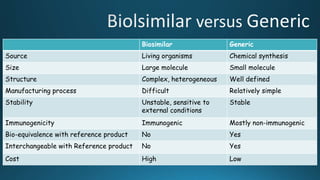
Biosimilar Generic
Source Living organisms Chemical synthesis
Size Large molecule Small molecule
Structure Complex, heterogeneous Well defined
Manufacturing process Difficult Relatively simple
Stability Unstable, sensitive to
external conditions
Stable
Immunogenicity Immunogenic Mostly non-immunogenic
Bio-equivalence with reference product No Yes
Interchangeable with Reference product No Yes
Cost High Low
Insulin Glargine
Lantus Sanofi Rs. 2714
Basalog Biocon Rs. 1380
Rituximab
MabThera Roche Rs. 16,ooo
Reditux Dr. Reddy’s Lab Rs. 9999
 Sequential process
 Demonstrate the similarity with regard to Reference
Biologic (RB)
 By extensive characterization studies revealing molecular
& quality attributes
 Ensuring that the product meets acceptable levels of
safety, efficacy & quality to affirm public health
Phase I
followed
by Phase
III trials
Non-
clinical and
Toxicology
Studies
Drug
Substance
Production
Clone
Selection
Reverse
Genetics
ACCESSTHE REFERENCE PRODUCT AT EVERY STEP
The approach established for generic medicines is not
suitable for development, evaluation and licensing of
similar biotherapeutic products (SBPs), since
biotherapeutics consist of relatively large and complex
proteins that are difficult to characterise.
April 2010, the Expert Committee
on Biological Standardization
(ECBS) established written
standards.
‘Guidelines on Similar Biological Medicinal Products’, October 2005.
Amended version came into effect on 30 April 2015.
26 March, 2016
Central Drugs Standard Control Organisation (CDSCO),
Ministry of Health and Family Welfare, Government of India,
announced the release of proposed revised guidance for
‘similar biologics' in India.
• Drugs and Cosmetics Act, 1940
• Drugs and Cosmetics Rules, 1945
• Rules for manufacture, use, import, export and storage
of hazardous micro-organisms/genetically engineered
organisms or cells, 1989
• Environment (Protection) Act, 1986
CDSCO
GEAC
RCGM
IBSC
• Biosafety on‐site
• Initial review of
applications to be
recommended to RCGM.
• Authorizing conduct of
research
• Exchange of genetically
engineered cell banks for
research and
development
• Review of data up to
preclinical evaluation
• Review of applications
and approval of activities
where final drug product
contains genetically
Modified organisms/
living modified
organisms.
• Approval of clinical trials
as well as new drugs.
• Clinical trial approval
• Permission for import of
drugs for clinical trial
• Export of clinical samples
for biochemical and
immunological analysis
• Permission for marketing
and manufacturing
Product Development
Animal Study
Clinical Trial
Licensing
Marketing
P
R
O
C
E
S
S
Structural and functional
comparability of similar
biologic and reference
biologic can be characterized
to a high degree of
confidence by
physicochemical and in vitro
techniques
The similar biologic is
comparable to reference
biologic in all preclinical
evaluations conducted
PK / PD study has demonstrated comparability and has preferentially
been done in an in-patient setting with safety measurement
(including immunogenicity) for adequate period justified by the
applicant and efficacy/PD measurements
A comprehensive post-marketing risk management plan has been
presented that will gather additional safety data with a specific
emphasis on gathering immunogenicity data
Single arm study in at least 100 evaluable
subjects
Biosimilars
Biosimilars
Biosimilars
Biosimilars
Biosimilars
Biosimilars
Biosimilars
Biosimilars

Biosimilars

  • 5.
    Biotechnology has ledto the development of more and more Biologics. But the process is complex and expensive. Developing a cheaper yet equally efficacious and safe biological product has become a necessity. This has led to the development of Biosimilars.
  • 7.
    What is aBiosimilar?
  • 8.
    Term By Definition SBP(Similar Biologic Product) WHO Similar to an already licensed reference biotherapeutic product in terms of quality, safety & efficacy FOB (Follow-On Biologic) US- FDA Highly similar to the reference product without clinically meaningful differences in safety, purity and potency SEB (Subsequent Entry Biologic) Canada Drug that enters the market subsequent to a version previously authorized in Canada with demonstrated similarity to a reference biologic drug
  • 10.
    Recombinant Non-glycosylated Proteins • Insulin •Human Growth Hormones • Granulocyte Colony- stimulating Factor (G-CSF) • Interferons Recombinant Glycosylated Proteins • Erythropoietin • Monoclonal Antibodies • Follitropin Recombinant Peptides • Glucagon • PTH
  • 11.
    • Biovac B(Hepatitis B vaccine) - India.2000 • Omnitrope (Somatropin) – EMA.2006 • Zarixo (Filgastrim) USFDA.2015
  • 12.
    Drug Number Filgastrim 6 Peg-filgastrim4 Erythropoietin 4 Insulin Glargine 4 Interferon α 2b 4 Rituximab 3 Darbepoetin 3 Teriperatide (PTH) 3
  • 13.
    Structural and manufacturing complexities Different companies, different processes Manufacturing processof Innovator molecule - undisclosed Mimic the activity and safety of the original biologic. They are not chemically identical. They are not necessarily produced in the same way. “Represent a different means to a similar end.”
  • 14.
    Biosimilar Generic Source Livingorganisms Chemical synthesis Size Large molecule Small molecule Structure Complex, heterogeneous Well defined Manufacturing process Difficult Relatively simple Stability Unstable, sensitive to external conditions Stable Immunogenicity Immunogenic Mostly non-immunogenic Bio-equivalence with reference product No Yes Interchangeable with Reference product No Yes Cost High Low
  • 15.
    Insulin Glargine Lantus SanofiRs. 2714 Basalog Biocon Rs. 1380 Rituximab MabThera Roche Rs. 16,ooo Reditux Dr. Reddy’s Lab Rs. 9999
  • 16.
     Sequential process Demonstrate the similarity with regard to Reference Biologic (RB)  By extensive characterization studies revealing molecular & quality attributes  Ensuring that the product meets acceptable levels of safety, efficacy & quality to affirm public health
  • 17.
    Phase I followed by Phase IIItrials Non- clinical and Toxicology Studies Drug Substance Production Clone Selection Reverse Genetics ACCESSTHE REFERENCE PRODUCT AT EVERY STEP
  • 18.
    The approach establishedfor generic medicines is not suitable for development, evaluation and licensing of similar biotherapeutic products (SBPs), since biotherapeutics consist of relatively large and complex proteins that are difficult to characterise. April 2010, the Expert Committee on Biological Standardization (ECBS) established written standards.
  • 19.
    ‘Guidelines on SimilarBiological Medicinal Products’, October 2005. Amended version came into effect on 30 April 2015.
  • 21.
    26 March, 2016 CentralDrugs Standard Control Organisation (CDSCO), Ministry of Health and Family Welfare, Government of India, announced the release of proposed revised guidance for ‘similar biologics' in India.
  • 22.
    • Drugs andCosmetics Act, 1940 • Drugs and Cosmetics Rules, 1945 • Rules for manufacture, use, import, export and storage of hazardous micro-organisms/genetically engineered organisms or cells, 1989 • Environment (Protection) Act, 1986
  • 24.
    CDSCO GEAC RCGM IBSC • Biosafety on‐site •Initial review of applications to be recommended to RCGM. • Authorizing conduct of research • Exchange of genetically engineered cell banks for research and development • Review of data up to preclinical evaluation • Review of applications and approval of activities where final drug product contains genetically Modified organisms/ living modified organisms. • Approval of clinical trials as well as new drugs. • Clinical trial approval • Permission for import of drugs for clinical trial • Export of clinical samples for biochemical and immunological analysis • Permission for marketing and manufacturing
  • 25.
    Product Development Animal Study ClinicalTrial Licensing Marketing P R O C E S S
  • 42.
    Structural and functional comparabilityof similar biologic and reference biologic can be characterized to a high degree of confidence by physicochemical and in vitro techniques The similar biologic is comparable to reference biologic in all preclinical evaluations conducted
  • 43.
    PK / PDstudy has demonstrated comparability and has preferentially been done in an in-patient setting with safety measurement (including immunogenicity) for adequate period justified by the applicant and efficacy/PD measurements A comprehensive post-marketing risk management plan has been presented that will gather additional safety data with a specific emphasis on gathering immunogenicity data
  • 44.
    Single arm studyin at least 100 evaluable subjects

Editor's Notes

  • #4 Center for Drug Evaluation and Research (CDER) and the Center for Biologics Evaluation and Research (CBER)
  • #5 Lets make some profit from this!!
  • #6 Read more at: http://economictimes.indiatimes.com/articleshow/51032054.cms?utm_source=contentofinterest&utm_medium=text&utm_campaign=cppst
  • #8 Biobetters are new molecular entities that are related to existing biologics by target or action, but they are deliberately altered to improve disposition, safety, efficacy, or manufacturing attributes. Me too – A drug that is structurally very similar to already known drugs, with only minor differences Interchangeable drug - drug: contains the same amount of the same active ingredients, possesses comparable pharmacokinetic properties, has the same clinically significant formulation characteristics,1 and is to be administered in the same way as the drug prescribed.
  • #9 A biosimilar is a biological product that is highly similar to a US-licensed reference biological product notwithstanding minor differences in clinically inactive components, and for which there are no clinically meaningful differences between the biological product and the reference product in terms of the safety, purity, and potency of the product. – USFDA
  • #10 India – Similar Biologic
  • #12 A separate pdf is uploaded. List of biosimilars approved and marketed in India
  • #13 Inflectra (infliximab dyyb) – April 2016. second biosimilar by USFDA Now EMA 23 Now India 63
  • #14 Others – abciximab, fsh, rhCG, etanercept, infliximab, r-h-GM-CSF, inf β 1a, peg inf α 2b.
  • #19 Reverse Genetics - (Cell Line and Clone Development) Analytical studies should demonstrate that the product is “highly similar” to the reference biological agent, animal studies must show safety and efficacy, and clinical studies (including assessment of immunogenicity, pharmacokinetics, and pharmacodynamics) must prove the purity, safety, and efficacy of a biosimilar candidate. Comparative phase III studies must be done in a sensitive, representative indication (usually, for cancer agents, with surrogate or intermediate outcomes rather than overall survival) and do not have to be repeated for other specific clinical indications once a drug is approved.
  • #21 Japan 2009
  • #22 COMMITTEE FOR MEDICINAL PRODUCTS FOR HUMAN USE (CHMP); Oct 2005
  • #23 ‘Biologics Price Competition and Innovation Act of 2009. SEC. 7002. APPROVAL PATHWAY FOR BIOSIMILAR BIOLOGICAL PRODUCTS. signed into law as part of the Patient Protection and Affordable Care Act, 2010 created a pathway for the approval of biologic products that are similar to or interchangeable with a U.S. Food and Drug Administration (FDA)–approved complex molecule.
  • #24 and Department of Biotechnology (DBT), Ministry of Science and Technology, Government of India, Sept 2012
  • #27 Institutional BioSafety Committee (IBSC) Review Committee on Genetic Manipulation (RCGM) Genetic Engineering Appraisal Committee (GEAC) Central Drugs Standard Control Organization (CDSCO)
  • #28 Manufacturing Marketing IBSC, DBT  Protocol (Sch Y), GLP guidelines, DBT  DCGI, IEC  Report To DCGI  PMS (for alteast 4 years), PV (for ever) to DCGI
  • #29 Cant use a SP as a RP. Same RP to be used through out. Molecular biology considerations, Upstream process development, Downstream process development Analytical methods, Product characterization, Specifications, Stability
  • #30 ICH – International Council for Harmonization of Technical requirements for pharmaceuticals for human use. Licensed on the basis of safety, quality and efficacy.
  • #32 , viz., Cell line, cell culture, vector, gene sequences, promoters, used. – medium, pH, humidity, oxygenation, agitation, rate of cell growth. (Glycosylation, oxidation, deamidation, phosphorylation) Cell lines, if disclosed, should be used; if not, then appropriate cell lines can be used, with proper justification. Yield – product per unit cell mass.
  • #33 Analytical experiments (at least thrice) – (mass spectrophotmertry, PAGE, ion exchange chromtograpy. Sample of applicants recombinant product, reference product, positive standard and negative control, wherever relevant. Acceptance limits. structure– primary and higher structure, amino acid sequence, post-translational changes BA– assays to characterize the activity and mechanism(s) of action and clinical effects. immunological– specificity, affinity, binding strength, Fc function. (in case of antibodies) impurtiries – product related, host cell related, process related. Stability – in comditions in which it is going to be stored. Effect of ph, temp, humidity, etc. Everything is in comparison with the reference product. Container and conditions where it will be stored.
  • #34 Different cell lines, diff manufacturing process, MOA unsure, toxic s/e unsure
  • #35 GLP – Good Laboratory Practice Sent to RCGM
  • #36 In vitro cell based bioassay In vivo studies, if in vitro assays are not available or do not reflect clinically relevant pharmacodynamic activity.
  • #37 Receptor binding assay.
  • #38 Human equivalent doses. Recover period – depends.
  • #40 Antibody type (neutralizing/binding) and titre Confirm if antibodies have an impact of safety and efficacy and quality. The consequences of unwanted immunogenicity may vary considerably, ranging from clinically irrelevant to serious and life-threatening. Although neutralizing antibodies directly alter the pharmacodynamic effect of a product (i.e. by directly blocking active site of the protein), binding antibodies often affect pharmacokinetics and thereby also influence pharmacodynamics. Thus, an altered effect of the product due to anti-product antibody formation might be a composite of pharmacokinetic, pharmacodynamic and safety effects
  • #42 Parallel arm – long t1/2, formation of antibodies or if study is don’t in patients Cross over – short t1/2
  • #43 Choosing the right population is important. Eg. Type 1 dm or gh deficiency drug naïve children.
  • #44 Since humans act differently to proteins compared to animals. Sufficient duration. Euglycemic clamp More than one safety and efficacy study may be required and the similar biologic will be treated as a “stand-alone product” if the similar biologic is not comparable to reference biologic in all preclinical evaluations conducted and /or the PK/PD studies have not demonstrated comparability.
  • #47 For a product which is found Similar in pre‐clinical, in‐vitro characterisation having established PK methods and a PD marker that is surrogate of efficacy, the residual risk is significantly reduced in the Phase I study if equivalence is demonstrated for both PK and PD.
  • #50 As compared to that used for manufacturing phase III clinical trial batches In the US, a New Drug Application (NDA) or Biologic Licence Application (BLA) is filed with the US Food and Drug Administration (FDA). In Europe, a Marketing Authorization Application (MAA) is filed with the European Medicines Agency (EMA), or local competent authority, dependent on the approval route being used
  • #51 Where, who? PSUR – 4 years, 2 years 6 monthly, 2 years annually. ADR within 15 days of initial receipt Predefined, single arm, 200 patients. Completed within 2 years. If immunogenicity has been evaluated in clinical studies, then not mandatory.
  • #52 Designated authority should be indicated.
  • #53 Efficacy – Hb levels, MCA for graft rejection. Safety (immunogenicity) - Between 1999 and 2004, a total of 191 patients with epoetin-associated PRCA were identified in Australia, Canada, and certain countries of Europe and Asia, 95 percent of which were observed among hemodialysis patients who received several months of subcutaneous Eprex (Johnson & Johnson) -  causation was attributed to formulations without human serum albumin (HSA), subcutaneous administration, and uncoated rubber stoppers. Pharmacovigilance. Naming and labelling – unique or INN (international non-proprietary name) Purple book (USA) – list of approved biosimilars