REGULATORY REQUIREMENTS FOR THE PRODUCT
APPROVAL OF BIOLOGICS
Presented By,
Tanuja yadav
M.pharmacy
Drug Regulatory Affairs
CONTENTS
 INTRODUCTION
 SOURCES AND TYPES OF BIOLOGICS
 DIFFERENCES BETWEEN BIOLOGICS AND CHEMICAL DRUGS
 REGULATORY AUTHORITY FOR BIOLOGICS
 DEVELOPMENT AND APPROVAL PROCESS
 BIOLOGICAL LICENSE APPLICATION (BLA)
 COMPARISON BETWEEN US AND EUROPIAN GUIDELINES
REGARDING BIOLOGICS
 CONCLUSION
 REFERENCES
A.U COLLEGE OF PHARMACEUTICAL
SCIENCES
2
INTRODUCTION
• WHAT ARE BIOLOGICS?
Biologics are the products manufactured, extracted from or semi synthesized from a
biological source which are regulated by FDA and are used to prevent cure and treat diseases and
medical conditions.
These are generally large, complex molecules produced through biotechnology in a living
system such as a microorganism, plant cell or animal cell.
 These could be made of sugars, proteins, nucleic acids or complex combinations of these
substances or may be living entities.
These are complex mixtures that are not easily identifiable and charcterized these tend to be
heat sensitive and susceptible to microbial contamination hence, it is necessary to use aspetic
principles from intial manufacturing process.
EXAMPLES: Botox, Herceptin, Vaccines, Enbrel
A.U COLLEGE OF PHARMACEUTICAL
SCIENCES
3
SOURCES AND TYPES OF BIOLOGICS
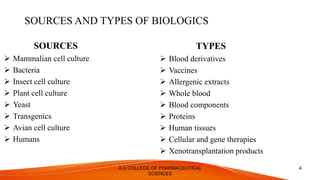
SOURCES
 Mammalian cell culture
 Bacteria
 Insect cell culture
 Plant cell culture
 Yeast
 Transgenics
 Avian cell culture
 Humans
TYPES
 Blood derivatives
 Vaccines
 Allergenic extracts
 Whole blood
 Blood components
 Proteins
 Human tissues
 Cellular and gene therapies
 Xenotransplantation products
A.U COLLEGE OF PHARMACEUTICAL
SCIENCES
4
DIFFERENCES BETWEEN BIOLOGICS AND CHEMICAL
DRUGS
A.U COLLEGE OF PHARMACEUTICAL
SCIENCES
5
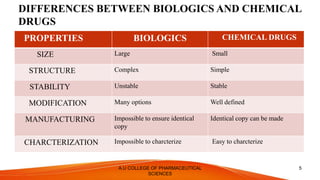
PROPERTIES BIOLOGICS CHEMICAL DRUGS
SIZE Large Small
STRUCTURE Complex Simple
STABILITY Unstable Stable
MODIFICATION Many options Well defined
MANUFACTURING Impossible to ensure identical
copy
Identical copy can be made
CHARCTERIZATION Impossible to charcterize Easy to charcterize
REGULATORYAUTHORITY FOR BIOLOGICS
 Center for biologics evalution and research (CBER) is the center within FDA that
regulates biological products for human use under applicable Federal laws including the
Public Health Services Act (PHS) and the Federal, Food, Drug and Cosmetics Act
 CBER protects and advances the public health by ensuring that biological products are
safe and effective.
 FDA's regulatory authority for the approval of biologics resides in (PHS) Act. Biologics
are subjected to regulation under Federal, Food, Drug And Cosmetics act (FD&C) Act.
 Some medical devices which are used to produce biologics are regulated by CBER
under FD&C Act's medical device amendments of 1976.
 FDA also reviews new biological products and new indications and usage for already
approved products on the market for the treatment of known diseases.
 It protects against threats of emerging infectious diseases.
 It provides the public with information to promote safe and appropriate use.
A.U COLLEGE OF PHARMACEUTICAL
SCIENCES
6
DEVELOPMENT AND APPROVAL PROCESS
 Advertising and Labeling
 Investigational New Drug Application (IND) or Device exemption process (IDE)
 Expanded Access
 Premarket Approval (PMA)
 Biologics License Application (BLA)
 New Drug Application Process (NDA)
 Biologics Approvals By Year
A.U COLLEGE OF PHARMACEUTICAL
SCIENCES
7
BIOLOGICS LICENSE APPLICATION (BLA)
 The Biologics License Application (BLA) is a request for permission introduce or deliver
for introduction a Biologic product into the market
 It is mainly regulated by 21 CFR 600-800. It is submitted by any legal person or entity
who engaged in manufacture or an applicant for a license who takes responsibilty for
compliance with product and establishment of standards.
 A Biologic License application generally applies to vaccines and other Allergenic drug
products and cellular and genetic therapies.
 Form 356h specifies the requirements for a BLA . It mainly includes the following:
1. Applicant information
2. Product / manufacturing information
3. Pre clinical studies
4. Labelling
A.U COLLEGE OF PHARMACEUTICAL
SCIENCES
8
BIOLOGIC LICENSE
APPLICATION (BLA)
A.U COLLEGE OF PHARMACEUTICAL
SCIENCES
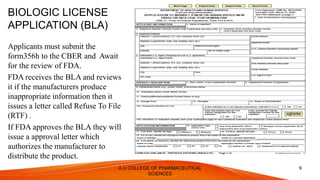
Applicants must submit the
form356h to the CBER and Await
for the review of FDA.
FDA receives the BLA and reviews
it if the manufacturers produce
inappropriate information then it
issues a letter called Refuse To File
(RTF) .
If FDA approves the BLA they will
issue a approval letter which
authorizes the manufacturer to
distribute the product.
9
A.U COLLEGE OF PHARMACEUTICAL
SCIENCES
10
UNITED STATES EUROPE
REGULATORY BODY Food And Administration (FDA)
FDA adopted the S6 Guidance
European Medicines Evaluation
Agency (EMEA)
CHMP has adopted ICH S6 guideline
APPROVAL STANDARD Biological Lisence Application
(BLA)
Marketing Authorization Application
(MAA)
PRECLINICAL STUDIES
SPECIES SELECTION
IMMUNOGENICITY
Chimpanzee
Elicit immune response
Rodent and Non Rodent species
Sponser should measure ADA'S
STUDY DESIGN Pharmacodynamic studies Pharmacokinetic and
Pharmacodynamic studies
A.U COLLEGE OF PHARMACEUTICAL
SCIENCES
11
CARCINOGENICITY
REPRODUCTIVE AND
DEVELOPMENTAL TOXICITY
Inappropriate
May or May not be recommended
Inappropriate
Fertility studies,Embryo -Fetal
development,Pre and Postnatal
development studies (PPND)
CLINICAL STUDIES Involves 3 phases(Phase I,II,III)
It must have IND in effect
Begins only when FDA approves it
Must comply with GCP as described
in E6 Guideline which the CHMP
has adopted
PHASE I Frequently involve administration to
patients rather than healthy
volunteers
Done for maximum tolerated dose ,
Product's metabolism,
Pharmacology,and safety at high
doses
Initial Safety, and Tolerability,PK
and PD activity
A.U COLLEGE OF PHARMACEUTICAL
SCIENCES
12
PHASE II Evalution of Safety and Short term
Adverse Events
Safety and Efficacy
PHASE III Begin If preliminary Evidence of
effectiveness is shown during Phase
II
Therapautic confirmatory studies and
Explore the Dose Response
Relationships
Conclusion
 The study introduces the legal and regulatory aspects pertaining to biologics in the united
states and european union.
 The Drug approvals in the US, Europe are the most demanding in the world .
 The main objective of the rules governing medicinal products in US , Europe is to safe
guard the public health
 It is the role of regulatory authorities to ensure that pharmaceutical companies shall
comply with regulations mentioned above .
A.U COLLEGE OF PHARMACEUTICAL
SCIENCES
13
REFERENCES
www.fda.gov
www.fda.gov/biologicsbloodvaccines/develepomentapprovalprocess.
www.fdagroup-com.cdn.ampproject.org.
https://www.cov.com>files>
https://www. ema.europa.eu/
A.U COLLEGE OF PHARMACEUTICAL
SCIENCES
14

Biologics ppt

  • 1.
    REGULATORY REQUIREMENTS FORTHE PRODUCT APPROVAL OF BIOLOGICS Presented By, Tanuja yadav M.pharmacy Drug Regulatory Affairs
  • 2.
    CONTENTS  INTRODUCTION  SOURCESAND TYPES OF BIOLOGICS  DIFFERENCES BETWEEN BIOLOGICS AND CHEMICAL DRUGS  REGULATORY AUTHORITY FOR BIOLOGICS  DEVELOPMENT AND APPROVAL PROCESS  BIOLOGICAL LICENSE APPLICATION (BLA)  COMPARISON BETWEEN US AND EUROPIAN GUIDELINES REGARDING BIOLOGICS  CONCLUSION  REFERENCES A.U COLLEGE OF PHARMACEUTICAL SCIENCES 2
  • 3.
    INTRODUCTION • WHAT AREBIOLOGICS? Biologics are the products manufactured, extracted from or semi synthesized from a biological source which are regulated by FDA and are used to prevent cure and treat diseases and medical conditions. These are generally large, complex molecules produced through biotechnology in a living system such as a microorganism, plant cell or animal cell.  These could be made of sugars, proteins, nucleic acids or complex combinations of these substances or may be living entities. These are complex mixtures that are not easily identifiable and charcterized these tend to be heat sensitive and susceptible to microbial contamination hence, it is necessary to use aspetic principles from intial manufacturing process. EXAMPLES: Botox, Herceptin, Vaccines, Enbrel A.U COLLEGE OF PHARMACEUTICAL SCIENCES 3
  • 4.
    SOURCES AND TYPESOF BIOLOGICS SOURCES  Mammalian cell culture  Bacteria  Insect cell culture  Plant cell culture  Yeast  Transgenics  Avian cell culture  Humans TYPES  Blood derivatives  Vaccines  Allergenic extracts  Whole blood  Blood components  Proteins  Human tissues  Cellular and gene therapies  Xenotransplantation products A.U COLLEGE OF PHARMACEUTICAL SCIENCES 4
  • 5.
    DIFFERENCES BETWEEN BIOLOGICSAND CHEMICAL DRUGS A.U COLLEGE OF PHARMACEUTICAL SCIENCES 5 PROPERTIES BIOLOGICS CHEMICAL DRUGS SIZE Large Small STRUCTURE Complex Simple STABILITY Unstable Stable MODIFICATION Many options Well defined MANUFACTURING Impossible to ensure identical copy Identical copy can be made CHARCTERIZATION Impossible to charcterize Easy to charcterize
  • 6.
    REGULATORYAUTHORITY FOR BIOLOGICS Center for biologics evalution and research (CBER) is the center within FDA that regulates biological products for human use under applicable Federal laws including the Public Health Services Act (PHS) and the Federal, Food, Drug and Cosmetics Act  CBER protects and advances the public health by ensuring that biological products are safe and effective.  FDA's regulatory authority for the approval of biologics resides in (PHS) Act. Biologics are subjected to regulation under Federal, Food, Drug And Cosmetics act (FD&C) Act.  Some medical devices which are used to produce biologics are regulated by CBER under FD&C Act's medical device amendments of 1976.  FDA also reviews new biological products and new indications and usage for already approved products on the market for the treatment of known diseases.  It protects against threats of emerging infectious diseases.  It provides the public with information to promote safe and appropriate use. A.U COLLEGE OF PHARMACEUTICAL SCIENCES 6
  • 7.
    DEVELOPMENT AND APPROVALPROCESS  Advertising and Labeling  Investigational New Drug Application (IND) or Device exemption process (IDE)  Expanded Access  Premarket Approval (PMA)  Biologics License Application (BLA)  New Drug Application Process (NDA)  Biologics Approvals By Year A.U COLLEGE OF PHARMACEUTICAL SCIENCES 7
  • 8.
    BIOLOGICS LICENSE APPLICATION(BLA)  The Biologics License Application (BLA) is a request for permission introduce or deliver for introduction a Biologic product into the market  It is mainly regulated by 21 CFR 600-800. It is submitted by any legal person or entity who engaged in manufacture or an applicant for a license who takes responsibilty for compliance with product and establishment of standards.  A Biologic License application generally applies to vaccines and other Allergenic drug products and cellular and genetic therapies.  Form 356h specifies the requirements for a BLA . It mainly includes the following: 1. Applicant information 2. Product / manufacturing information 3. Pre clinical studies 4. Labelling A.U COLLEGE OF PHARMACEUTICAL SCIENCES 8
  • 9.
    BIOLOGIC LICENSE APPLICATION (BLA) A.UCOLLEGE OF PHARMACEUTICAL SCIENCES Applicants must submit the form356h to the CBER and Await for the review of FDA. FDA receives the BLA and reviews it if the manufacturers produce inappropriate information then it issues a letter called Refuse To File (RTF) . If FDA approves the BLA they will issue a approval letter which authorizes the manufacturer to distribute the product. 9
  • 10.
    A.U COLLEGE OFPHARMACEUTICAL SCIENCES 10 UNITED STATES EUROPE REGULATORY BODY Food And Administration (FDA) FDA adopted the S6 Guidance European Medicines Evaluation Agency (EMEA) CHMP has adopted ICH S6 guideline APPROVAL STANDARD Biological Lisence Application (BLA) Marketing Authorization Application (MAA) PRECLINICAL STUDIES SPECIES SELECTION IMMUNOGENICITY Chimpanzee Elicit immune response Rodent and Non Rodent species Sponser should measure ADA'S STUDY DESIGN Pharmacodynamic studies Pharmacokinetic and Pharmacodynamic studies
  • 11.
    A.U COLLEGE OFPHARMACEUTICAL SCIENCES 11 CARCINOGENICITY REPRODUCTIVE AND DEVELOPMENTAL TOXICITY Inappropriate May or May not be recommended Inappropriate Fertility studies,Embryo -Fetal development,Pre and Postnatal development studies (PPND) CLINICAL STUDIES Involves 3 phases(Phase I,II,III) It must have IND in effect Begins only when FDA approves it Must comply with GCP as described in E6 Guideline which the CHMP has adopted PHASE I Frequently involve administration to patients rather than healthy volunteers Done for maximum tolerated dose , Product's metabolism, Pharmacology,and safety at high doses Initial Safety, and Tolerability,PK and PD activity
  • 12.
    A.U COLLEGE OFPHARMACEUTICAL SCIENCES 12 PHASE II Evalution of Safety and Short term Adverse Events Safety and Efficacy PHASE III Begin If preliminary Evidence of effectiveness is shown during Phase II Therapautic confirmatory studies and Explore the Dose Response Relationships
  • 13.
    Conclusion  The studyintroduces the legal and regulatory aspects pertaining to biologics in the united states and european union.  The Drug approvals in the US, Europe are the most demanding in the world .  The main objective of the rules governing medicinal products in US , Europe is to safe guard the public health  It is the role of regulatory authorities to ensure that pharmaceutical companies shall comply with regulations mentioned above . A.U COLLEGE OF PHARMACEUTICAL SCIENCES 13
  • 14.