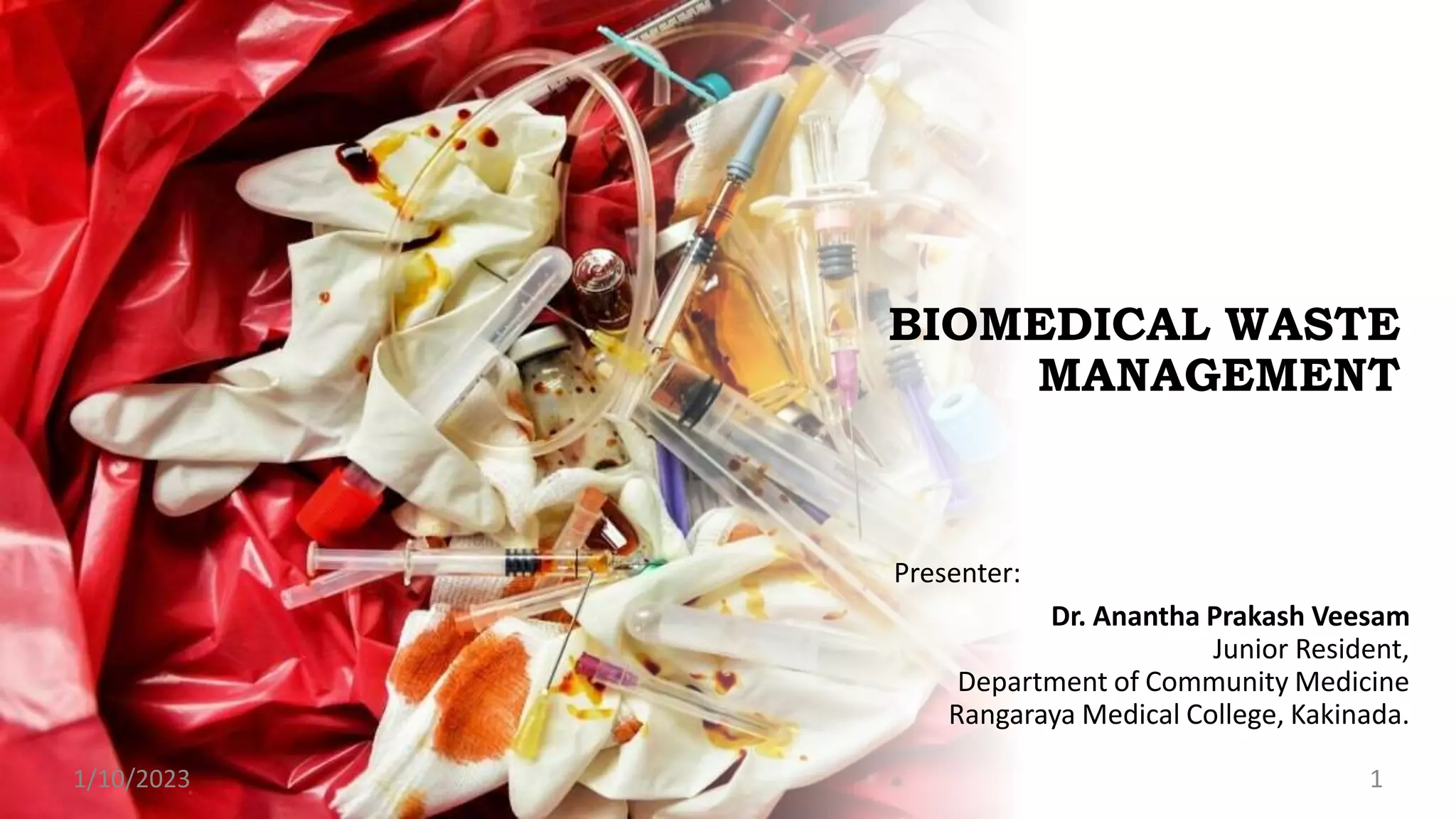
BIOMEDICAL WASTE
MANAGEMENT
Presenter:
Dr. Anantha Prakash Veesam
Junior Resident,
Department of Community Medicine
Rangaraya Medical College, Kakinada.
1/10/2023 1
Specific
Learning
Objectives
• At the end of session, the learner shall be
able to know about:
 Classify hospital waste
 Describe various methods of treatment of
hospital waste
1/10/2023 2
INTRODUCTION
• Since beginning, the hospitals are known for the
treatment of sick people, but we are unaware
about the adverse effects of the garbage and
filth generated by them on human body and
environment.
1/10/2023 3
MAGNITUDE OF PROBLEM
1/10/2023 4
Developed
countries:
generate 1 to 5
kg/bed/day
INDIA:
Hospitals
generate roughly
1-2 kg/bed/day
According to
WHO
• 85% non-
infectious/ non-
hazardous waste,
• 10% infective
waste,
• 5% non-infectious
but hazardous.
Classification
of
Bio‐Medical
Waste
1/10/2023 5
SOURCES OF
BIO MEDICAL
WASTE
• Hospitals
• Medical laboratories
• Blood banks
• Mortuaries
• Animal houses etc.
• Such a waste can also be generated at home if health
care is being provided there to a patient (e.g.
injection, dressing material etc.)
1/10/2023 6
1/10/2023 7
Biomedical Waste Management Rules, 2016
(BMWM Rules, 2016)
By Ministry of
Environment Forest &
Climate Change in
March 2016.
SCHEDULES-
I to VI
FORMS-
I to VI
RULES-
1 to 17
1/10/2023 8
CATEGORIES OF BIO‐MEDICAL WASTE
Category Waste Category Treatment & Disposal
Category No. I Human Anatomical Waste (human tissues, organs, body
parts)
incineration/deep
burial
Category No. 2 Animal Waste (animal tissues, organs, body parts carcasses,
bleeding parts, fluid, blood and experimental animals used in
research, waste generated by veterinary hospitals colleges,
discharge from hospitals, animal houses)
incineration/ deep
burial
Category No 3 Microbiology & Biotechnology Waste (wastes from
laboratory cultures, stocks or specimens of micro‐ organisms
live or attenuated vaccines, wastes from production of
biologicals, toxins, dishes and devices used for transfer of
cultures)
local autoclaving/micro‐
waving/incineration
Category No 4 Waste sharps (needles, syringes, scalpels, blades, glass, etc.
that may cause puncture and cuts. This includes both used
and unused sharps)
disinfection (chemical
treatment/autoclaving/
microwaving and
mutilation/shredding
Category No 5 Discarded Medicines and Cytotoxic drugs (wastes
comprising of outdated, contaminated and discarded
medicines)
incineration@/destruction
and drugs disposal in
secured landfills
1/10/2023 9
Category Waste Category Treatment & Disposal
Category No 6 Soiled Waste (Items contaminated with blood,
and body fluids including cotton, dressings, soiled
plaster casts, lines, beddings, other material
contaminated with blood)
Incineration/
autoclaving/microwaving
Category No. 7 Solid Waste (wastes generated from
disposable items other than the waste sharps
such as tubings, catheters, intravenous sets)
disinfection by chemical treatment/
autoclaving/ microwaving and
mutilation/ shredding
Category No. 8 Liquid Waste (waste generated from
laboratory and washing, cleaning, house‐
keeping and disinfecting activities).
disinfection by chemical treatment
and discharge into drains
Category No. 9 Incineration Ash (ash from incineration of any
bio‐medical waste)
disposal in municipal landfill
Category No. 10 Chemical Waste (chemicals used in production
of biologicals, chemicals used in disinfection, as
insecticides, etc.)
Chemical discharge into drains for
liquids and secured landfill for solids
CATEGORIES OF BIO‐MEDICAL WASTE
1/10/2023 10
Steps For Waste
Management
SEGREGATION
COLLECTION AND
STORAGE
TRANSPORTATION
TREATMENT AND
DISPODSAL
1/10/2023 11
SEGREGATION-
Color coding
1/10/2023 12
COLLECTION
AND
STORAGE
1/10/2023 13
1 2
4
3
2
TRANSPORT TO FINAL DISPOSAL SITE
• Transportation from health
care establishment to the site
of final disposal in a closed
motor vehicle (truck,
tractor‐trolley etc.) is
desirable as it prevents
spillage of waste on the way.
• Vehicles used for
transport of BMW must
have the “Bio‐Hazard”
symbol and these vehicles
should not be used for
any other purpose.
Note: Label shall be non‐washable & prominently visible
1/10/2023 14
TRANSPORTATION
1/10/2023 15
DISPOSAL OF
BIOMEDICAL
WASTE
Deep burial:
• Category 1 and 2 only
• In cities having less than 5 lakh population &
rural area.
Autoclave and microwave treatment
• Standards for the autoclaving and microwaving
are also mentioned in the Biomedical waste
(Management and Handling) Rules 1998.
• All equipment installed/shared should meet
these specifications.
• Category 3, 4, 6 and 7 can be treated by these
techniques.
1/10/2023 16
DISPOSAL
OF
BIOMEDIC
AL WASTE
Shredding:
• The plastic (I.V. bottles, I.V. sets, syringes,
catheters etc.), sharps (needles, blades, glass
etc) should be shredded but only after
chemical treatment/microwaving/autoclaving.
• Needle destroyers can be used for disposal of
needles directly without chemical treatment.
Land disposal:
• Open dumps
• Secured/Sanitary landfill: advantages.
• The incinerator ash, discarded medicines,
cytotoxic substances and solid chemical waste
should be treated by this option.
1/10/2023 17
AUTOCLAVE
INCINERATOR
1/10/2023 18
Let the waste of the
SICK not
contaminate the
lives of the
HEALTHY
1/10/2023 19

Biomedical Waste Management.pptx

  • 1.
    BIOMEDICAL WASTE MANAGEMENT Presenter: Dr. AnanthaPrakash Veesam Junior Resident, Department of Community Medicine Rangaraya Medical College, Kakinada. 1/10/2023 1
  • 2.
    Specific Learning Objectives • At theend of session, the learner shall be able to know about:  Classify hospital waste  Describe various methods of treatment of hospital waste 1/10/2023 2
  • 3.
    INTRODUCTION • Since beginning,the hospitals are known for the treatment of sick people, but we are unaware about the adverse effects of the garbage and filth generated by them on human body and environment. 1/10/2023 3
  • 4.
    MAGNITUDE OF PROBLEM 1/10/20234 Developed countries: generate 1 to 5 kg/bed/day INDIA: Hospitals generate roughly 1-2 kg/bed/day According to WHO • 85% non- infectious/ non- hazardous waste, • 10% infective waste, • 5% non-infectious but hazardous.
  • 5.
  • 6.
    SOURCES OF BIO MEDICAL WASTE •Hospitals • Medical laboratories • Blood banks • Mortuaries • Animal houses etc. • Such a waste can also be generated at home if health care is being provided there to a patient (e.g. injection, dressing material etc.) 1/10/2023 6
  • 7.
  • 8.
    Biomedical Waste ManagementRules, 2016 (BMWM Rules, 2016) By Ministry of Environment Forest & Climate Change in March 2016. SCHEDULES- I to VI FORMS- I to VI RULES- 1 to 17 1/10/2023 8
  • 9.
    CATEGORIES OF BIO‐MEDICALWASTE Category Waste Category Treatment & Disposal Category No. I Human Anatomical Waste (human tissues, organs, body parts) incineration/deep burial Category No. 2 Animal Waste (animal tissues, organs, body parts carcasses, bleeding parts, fluid, blood and experimental animals used in research, waste generated by veterinary hospitals colleges, discharge from hospitals, animal houses) incineration/ deep burial Category No 3 Microbiology & Biotechnology Waste (wastes from laboratory cultures, stocks or specimens of micro‐ organisms live or attenuated vaccines, wastes from production of biologicals, toxins, dishes and devices used for transfer of cultures) local autoclaving/micro‐ waving/incineration Category No 4 Waste sharps (needles, syringes, scalpels, blades, glass, etc. that may cause puncture and cuts. This includes both used and unused sharps) disinfection (chemical treatment/autoclaving/ microwaving and mutilation/shredding Category No 5 Discarded Medicines and Cytotoxic drugs (wastes comprising of outdated, contaminated and discarded medicines) incineration@/destruction and drugs disposal in secured landfills 1/10/2023 9
  • 10.
    Category Waste CategoryTreatment & Disposal Category No 6 Soiled Waste (Items contaminated with blood, and body fluids including cotton, dressings, soiled plaster casts, lines, beddings, other material contaminated with blood) Incineration/ autoclaving/microwaving Category No. 7 Solid Waste (wastes generated from disposable items other than the waste sharps such as tubings, catheters, intravenous sets) disinfection by chemical treatment/ autoclaving/ microwaving and mutilation/ shredding Category No. 8 Liquid Waste (waste generated from laboratory and washing, cleaning, house‐ keeping and disinfecting activities). disinfection by chemical treatment and discharge into drains Category No. 9 Incineration Ash (ash from incineration of any bio‐medical waste) disposal in municipal landfill Category No. 10 Chemical Waste (chemicals used in production of biologicals, chemicals used in disinfection, as insecticides, etc.) Chemical discharge into drains for liquids and secured landfill for solids CATEGORIES OF BIO‐MEDICAL WASTE 1/10/2023 10
  • 11.
    Steps For Waste Management SEGREGATION COLLECTIONAND STORAGE TRANSPORTATION TREATMENT AND DISPODSAL 1/10/2023 11
  • 12.
  • 13.
  • 14.
    TRANSPORT TO FINALDISPOSAL SITE • Transportation from health care establishment to the site of final disposal in a closed motor vehicle (truck, tractor‐trolley etc.) is desirable as it prevents spillage of waste on the way. • Vehicles used for transport of BMW must have the “Bio‐Hazard” symbol and these vehicles should not be used for any other purpose. Note: Label shall be non‐washable & prominently visible 1/10/2023 14
  • 15.
  • 16.
    DISPOSAL OF BIOMEDICAL WASTE Deep burial: •Category 1 and 2 only • In cities having less than 5 lakh population & rural area. Autoclave and microwave treatment • Standards for the autoclaving and microwaving are also mentioned in the Biomedical waste (Management and Handling) Rules 1998. • All equipment installed/shared should meet these specifications. • Category 3, 4, 6 and 7 can be treated by these techniques. 1/10/2023 16
  • 17.
    DISPOSAL OF BIOMEDIC AL WASTE Shredding: • Theplastic (I.V. bottles, I.V. sets, syringes, catheters etc.), sharps (needles, blades, glass etc) should be shredded but only after chemical treatment/microwaving/autoclaving. • Needle destroyers can be used for disposal of needles directly without chemical treatment. Land disposal: • Open dumps • Secured/Sanitary landfill: advantages. • The incinerator ash, discarded medicines, cytotoxic substances and solid chemical waste should be treated by this option. 1/10/2023 17
  • 18.
  • 19.
    Let the wasteof the SICK not contaminate the lives of the HEALTHY 1/10/2023 19