All will be able to:
•State and explain the factors that effect projectile motion
•Explain angular motion including the conservation of angular momentum and
the relationship between the moment of inertia and angular velocity
Some will also be able to:
•Apply this knowledge to exam questions
Learning
Outcomes are:
Projectile motion:
Angle of release
Parabolic curve
Horizontal component
Vertical component
Height of release
Speed of release
Angular motion:
Footfall
Negative impulse
Positive impulse
Zero impulse
(Force time graphs to
show acceleration,
deceleration and
constant velocity)
Define the following terms and give an equation or applied exam
as applicable:
Angular velocity, angular acceleration, angular momentum
Moment of inertia, angular, moment, moment arm, resistance arm
Effort arm, principle of moments, angular movement
Conservation of angular movement
Radian, relationship between moment of inertia and angular
velocity
he final stage of an endurance race often involves a sprint finis
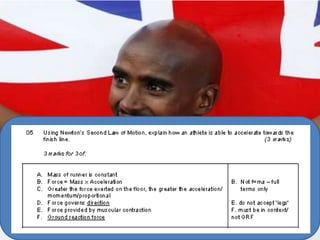
5 Using Newton’s Second Law of Motion, explain how an athlet
s able to accelerate towards the finish line. (3 marks)
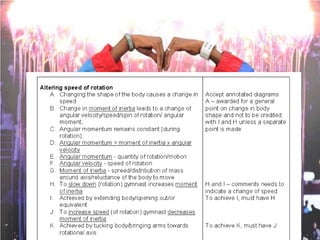
Explain how a gymnast can alter the
speed of rotation during flight (7)
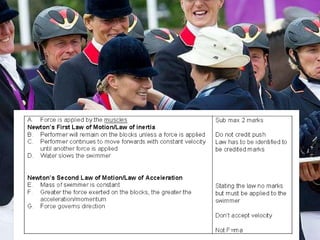
Using ‘Newton’s First’
and ‘Second Laws of
Motion’, explain how
the swimmer dives off
the starting blocks. (4
marks)
Biomechanics 2013 part 2

Biomechanics 2013 part 2

  • 2.
    All will beable to: •State and explain the factors that effect projectile motion •Explain angular motion including the conservation of angular momentum and the relationship between the moment of inertia and angular velocity Some will also be able to: •Apply this knowledge to exam questions Learning Outcomes are:
  • 3.
    Projectile motion: Angle ofrelease Parabolic curve Horizontal component Vertical component Height of release Speed of release Angular motion: Footfall Negative impulse Positive impulse Zero impulse (Force time graphs to show acceleration, deceleration and constant velocity) Define the following terms and give an equation or applied exam as applicable: Angular velocity, angular acceleration, angular momentum Moment of inertia, angular, moment, moment arm, resistance arm Effort arm, principle of moments, angular movement Conservation of angular movement Radian, relationship between moment of inertia and angular velocity
  • 4.
    he final stageof an endurance race often involves a sprint finis 5 Using Newton’s Second Law of Motion, explain how an athlet s able to accelerate towards the finish line. (3 marks) Explain how a gymnast can alter the speed of rotation during flight (7) Using ‘Newton’s First’ and ‘Second Laws of Motion’, explain how the swimmer dives off the starting blocks. (4 marks)