What is Projectile
Motion?
Projectile
• A projectile is an object upon
which the only force acting is
gravity.
• Any object that is given an initial
velocity and then follows a path
determined entirely by
gravitational acceleration.
Projectile Motion
• Projectile is a combination of
uniform horizontal motion and free
fall motion.
• Trajectory- curved path of a
projectile
• Range (R)- horizontal
displacement, dependent on the
angle of projection
Projectile Motion
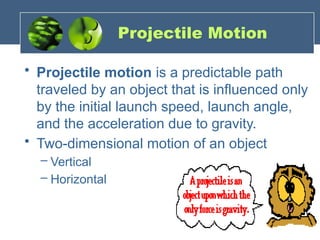
• Projectile motion is a predictable path
traveled by an object that is influenced only
by the initial launch speed, launch angle,
and the acceleration due to gravity.
• Two-dimensional motion of an object
– Vertical
– Horizontal
Projectile Motion
• Italian Scientist Galileo Galilei first
describe projectile motion as having
two components: horizontal and
vertical.
Types of Projectile
Motion
• Horizontal
– Motion of a ball rolling freely
along a level surface
– Horizontal velocity is ALWAYS
constant
• Vertical
– Motion of a freely falling object
– Force due to gravity
– Vertical component of velocity
changes with time
• Parabolic
– Path traced by an object
accelerating only in the vertical
direction while moving at
constant horizontal velocity
Types of Projectile
Motion
• If air resistance is neglected, a projectile
moves horizontally at a constant speed
and simultaneously travels vertically with
an acceleration equal to g, which is 9.8
m/s²
• Note: the motion of freely falling
body is a special case of projectile
motion where the horizontal velocity
is 0.
Horizontal “Velocity”
Component
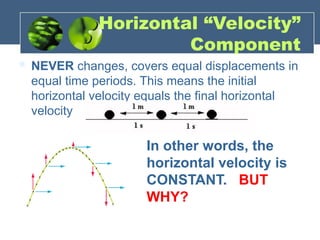
 NEVER changes, covers equal displacements in
equal time periods. This means the initial
horizontal velocity equals the final horizontal
velocity
In other words, the
horizontal velocity is
CONSTANT. BUT
WHY?
Vertical “Velocity”
Component
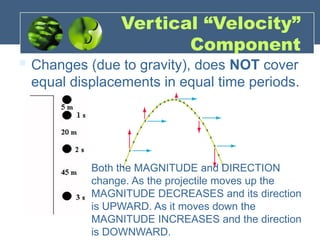
 Changes (due to gravity), does NOT cover
equal displacements in equal time periods.
Both the MAGNITUDE and DIRECTION
change. As the projectile moves up the
MAGNITUDE DECREASES and its direction
is UPWARD. As it moves down the
MAGNITUDE INCREASES and the direction
is DOWNWARD.
Projectile Launched
at an Angle
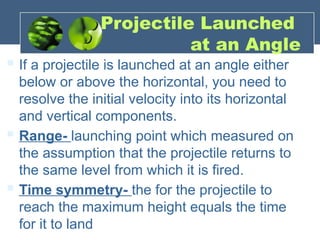
 If a projectile is launched at an angle either
below or above the horizontal, you need to
resolve the initial velocity into its horizontal
and vertical components.
 Range- launching point which measured on
the assumption that the projectile returns to
the same level from which it is fired.
 Time symmetry- the for the projectile to
reach the maximum height equals the time
for it to land
Projectile Launched
at an Angle
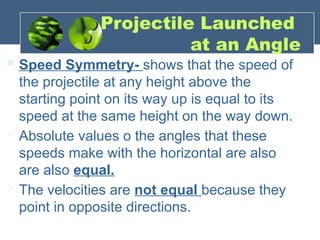
 Speed Symmetry- shows that the speed of
the projectile at any height above the
starting point on its way up is equal to its
speed at the same height on the way down.
 Absolute values o the angles that these
speeds make with the horizontal are also
are also equal.
 The velocities are not equal because they
point in opposite directions.
Examples of Projectile
Motion
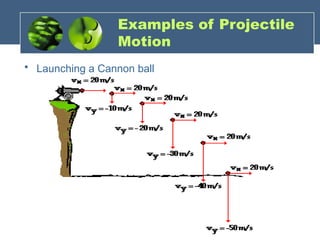
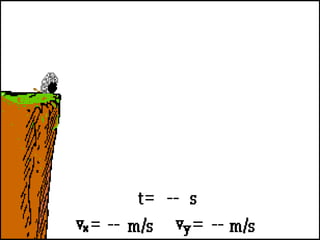
• Launching a Cannon ball
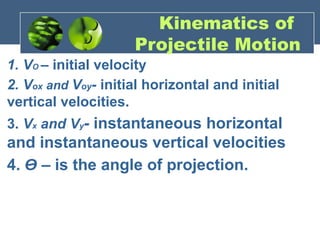
Kinematics of
Projectile Motion
1. VO – initial velocity
2. Vox and Voy- initial horizontal and initial
vertical velocities.
3. Vx and Vy- instantaneous horizontal
and instantaneous vertical velocities
4. Ѳ – is the angle of projection.
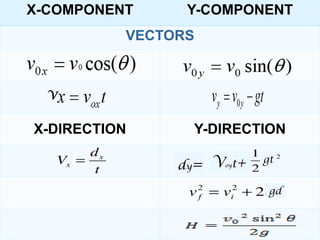
X-COMPONENT Y-COMPONENT
VECTORS
X-DIRECTION Y-DIRECTION
V
dy= Voyt+ gt
gd
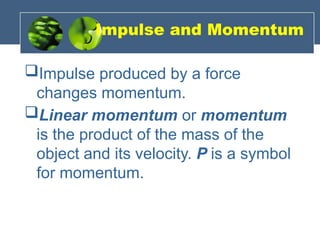
Impulse and Momentum
Impulse produced by a force
changes momentum.
Linear momentum or momentum
is the product of the mass of the
object and its velocity. P is a symbol
for momentum.
Impulse and Momentum
It is a vector quantity and an SI
unit of kg•m/s.
p=mv
Every moving object has
momentum, which may be large
or small depending on the
object’s mass and velocity.
Sample Problem
Which has a greater
momentum: a cheetah with a mass
of about 74kg and a running speed
of up to 31m/s, or an elephant with
a mass of 7000kg running at
18km/hr?
Sample Problem
A delivery truck carrying 75 cavans of rice is
traveling at 10.0 m/s. The mass of the truck and
one cavan of rice are 3000kg and 50kg,
respectively. The driver of the truck has a mass of
85kg.
(a) What is the momentum of the truck with the
driver and the cavans of rice?
(b) At a certain grocery, the driver unloaded 8
cavans. What is the new momentum of the
truck with the driver and the cavans of rice if
the driver maintains the same speed?
Impulse-Momentum
Theorem
Impulse- the product of force and
the time it acts on an object.
Impulse is represented by a capital
letter I.
I = Ft
Note: Newton’s Law of Acceleration
Impulse-Momentum
Theorem
 Impulse produced by a force changes
momentum. It is a vector quantity and SI
unit is N*s.
 A force acting on an object for a time
interval ∆t changes the momentum of the
object.
 Change in momentum of a system is equal
to the impulse of the force it experience.
Note: Newton’s Law of Acceleration
Impulse-Momentum
Theorem
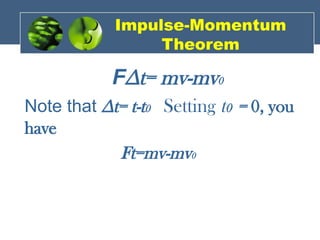
F∆t= mv-mv0
Note that ∆t= t-t0 Setting t0 = 0, you
have
Ft=mv-mv0
Sample Problem
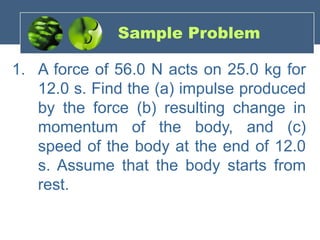
1. A force of 56.0 N acts on 25.0 kg for
12.0 s. Find the (a) impulse produced
by the force (b) resulting change in
momentum of the body, and (c)
speed of the body at the end of 12.0
s. Assume that the body starts from
rest.
Sample Problem
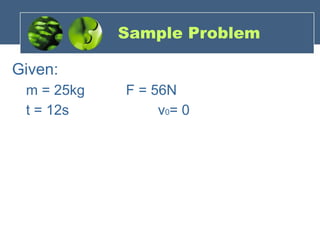
Given:
m = 25kg F = 56N
t = 12s v0= 0
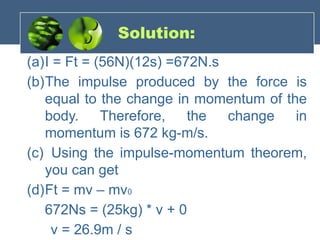
Solution:
(a)I = Ft = (56N)(12s) =672N.s
(b)The impulse produced by the force is
equal to the change in momentum of the
body. Therefore, the change in
momentum is 672 kg-m/s.
(c) Using the impulse-momentum theorem,
you can get
(d)Ft = mv – mv0
672Ns = (25kg) * v + 0
v = 26.9m / s

Projectile Motion Grade 9 Science - Physics 4th Quarter

  • 1.
  • 2.
    Projectile • A projectileis an object upon which the only force acting is gravity. • Any object that is given an initial velocity and then follows a path determined entirely by gravitational acceleration.
  • 3.
    Projectile Motion • Projectileis a combination of uniform horizontal motion and free fall motion. • Trajectory- curved path of a projectile • Range (R)- horizontal displacement, dependent on the angle of projection
  • 4.
    Projectile Motion • Projectilemotion is a predictable path traveled by an object that is influenced only by the initial launch speed, launch angle, and the acceleration due to gravity. • Two-dimensional motion of an object – Vertical – Horizontal
  • 5.
    Projectile Motion • ItalianScientist Galileo Galilei first describe projectile motion as having two components: horizontal and vertical.
  • 6.
    Types of Projectile Motion •Horizontal – Motion of a ball rolling freely along a level surface – Horizontal velocity is ALWAYS constant • Vertical – Motion of a freely falling object – Force due to gravity – Vertical component of velocity changes with time • Parabolic – Path traced by an object accelerating only in the vertical direction while moving at constant horizontal velocity
  • 7.
    Types of Projectile Motion •If air resistance is neglected, a projectile moves horizontally at a constant speed and simultaneously travels vertically with an acceleration equal to g, which is 9.8 m/s² • Note: the motion of freely falling body is a special case of projectile motion where the horizontal velocity is 0.
  • 8.
    Horizontal “Velocity” Component  NEVERchanges, covers equal displacements in equal time periods. This means the initial horizontal velocity equals the final horizontal velocity In other words, the horizontal velocity is CONSTANT. BUT WHY?
  • 9.
    Vertical “Velocity” Component  Changes(due to gravity), does NOT cover equal displacements in equal time periods. Both the MAGNITUDE and DIRECTION change. As the projectile moves up the MAGNITUDE DECREASES and its direction is UPWARD. As it moves down the MAGNITUDE INCREASES and the direction is DOWNWARD.
  • 10.
    Projectile Launched at anAngle  If a projectile is launched at an angle either below or above the horizontal, you need to resolve the initial velocity into its horizontal and vertical components.  Range- launching point which measured on the assumption that the projectile returns to the same level from which it is fired.  Time symmetry- the for the projectile to reach the maximum height equals the time for it to land
  • 11.
    Projectile Launched at anAngle  Speed Symmetry- shows that the speed of the projectile at any height above the starting point on its way up is equal to its speed at the same height on the way down.  Absolute values o the angles that these speeds make with the horizontal are also are also equal.  The velocities are not equal because they point in opposite directions.
  • 12.
    Examples of Projectile Motion •Launching a Cannon ball
  • 14.
    Kinematics of Projectile Motion 1.VO – initial velocity 2. Vox and Voy- initial horizontal and initial vertical velocities. 3. Vx and Vy- instantaneous horizontal and instantaneous vertical velocities 4. Ѳ – is the angle of projection.
  • 15.
  • 16.
    Impulse and Momentum Impulseproduced by a force changes momentum. Linear momentum or momentum is the product of the mass of the object and its velocity. P is a symbol for momentum.
  • 17.
    Impulse and Momentum Itis a vector quantity and an SI unit of kg•m/s. p=mv Every moving object has momentum, which may be large or small depending on the object’s mass and velocity.
  • 18.
    Sample Problem Which hasa greater momentum: a cheetah with a mass of about 74kg and a running speed of up to 31m/s, or an elephant with a mass of 7000kg running at 18km/hr?
  • 19.
    Sample Problem A deliverytruck carrying 75 cavans of rice is traveling at 10.0 m/s. The mass of the truck and one cavan of rice are 3000kg and 50kg, respectively. The driver of the truck has a mass of 85kg. (a) What is the momentum of the truck with the driver and the cavans of rice? (b) At a certain grocery, the driver unloaded 8 cavans. What is the new momentum of the truck with the driver and the cavans of rice if the driver maintains the same speed?
  • 20.
    Impulse-Momentum Theorem Impulse- the productof force and the time it acts on an object. Impulse is represented by a capital letter I. I = Ft Note: Newton’s Law of Acceleration
  • 21.
    Impulse-Momentum Theorem  Impulse producedby a force changes momentum. It is a vector quantity and SI unit is N*s.  A force acting on an object for a time interval ∆t changes the momentum of the object.  Change in momentum of a system is equal to the impulse of the force it experience. Note: Newton’s Law of Acceleration
  • 22.
    Impulse-Momentum Theorem F∆t= mv-mv0 Note that∆t= t-t0 Setting t0 = 0, you have Ft=mv-mv0
  • 23.
    Sample Problem 1. Aforce of 56.0 N acts on 25.0 kg for 12.0 s. Find the (a) impulse produced by the force (b) resulting change in momentum of the body, and (c) speed of the body at the end of 12.0 s. Assume that the body starts from rest.
  • 24.
    Sample Problem Given: m =25kg F = 56N t = 12s v0= 0
  • 25.
    Solution: (a)I = Ft= (56N)(12s) =672N.s (b)The impulse produced by the force is equal to the change in momentum of the body. Therefore, the change in momentum is 672 kg-m/s. (c) Using the impulse-momentum theorem, you can get (d)Ft = mv – mv0 672Ns = (25kg) * v + 0 v = 26.9m / s

Editor's Notes

  • #2 There are variety of ex. Of projectiles. An object dropped from rest is a projectile (provided that the influence of air resistance is negligible). An object that is throen vertically upward is also a projectile (provided that the influence of air resistance is negligibe). A projectile is a ny object that once prjected or dropped continues un motion by its own inertia and is influenced only by the downward force of gravity. By definition, a projecti;e has a single force that acts upon it the force of gravity . If there were any other frcw acting upon an object , then that object would not be a projectile. By definition, a projectile is any object upon which the only force is gravity Simply put, a projectile is any object that is given an initial velocity and then follows a path determined entirely by gravitational acceleration. Regardless of whether you're launching a balloon, a baseball, or an arrow, all projectiles follow a very predictable path, making them a great tool for studying kinematics.
  • #4 Projectile motion is a predictable path traveled by an object that is influenced only by the initial launch speed, launch angle, and the acceleration due to gravity. You can try it out from where you're sitting. Pick up an object, and gently toss it up and away from you. It will rise as it flies away from you, reach a maximum height, and then start falling down to the floor. Toss a few more objects while you're at it. As long as you're not tossing pieces of paper or feathers, the projectile paths should be similar. We'll touch on this concept a bit later.