1.3.b – Linear, angular & projectile motion
Learning objectives
To be able to describe linear motion and the descriptors affecting it.
To understand graphical representation of linear motion.
To be able to explain angular motion around axes of rotation.
To understand the definitions, calculations and units of measurement
for angular motion descriptors.
To be able to explain the relationship between moment of inertia,
angular velocity and momentum.
To be able to describe the factors affecting fluid mechanics and
projectile motion.
To evaluate the impact of the Bernoulli principle and the Magnus force
on an object.
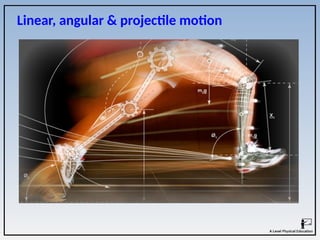
Linear, angular & projectile motion
Biomechanics is the study of human movement and the effect of
force and motion.
Linear Motion
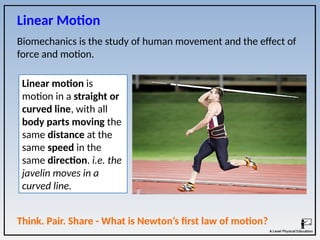
Linear motion is
motion in a straight or
curved line, with all
body parts moving the
same distance at the
same speed in the
same direction. i.e. the
javelin moves in a
curved line.
Think. Pair. Share - What is Newton’s first law of motion?
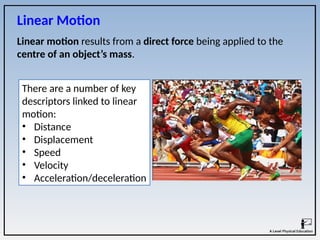
Linear motion results from a direct force being applied to the
centre of an object’s mass.
Linear Motion
There are a number of key
descriptors linked to linear
motion:
• Distance
• Displacement
• Speed
• Velocity
• Acceleration/deceleration
These measurements can be split into two groups:
Scalar quantities are described in terms of size or magnitude
- mass, inertia, distance and speed are scalar quantities.
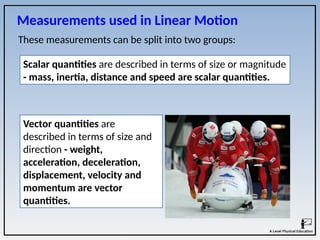
Vector quantities are
described in terms of size and
direction - weight,
acceleration, deceleration,
displacement, velocity and
momentum are vector
quantities.
Measurements used in Linear Motion
Distance and displacement are measurements that are used to
describe a body's motion.
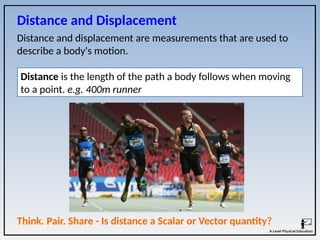
Distance is the length of the path a body follows when moving
to a point. e.g. 400m runner
Think. Pair. Share - Is distance a Scalar or Vector quantity?
Distance and Displacement
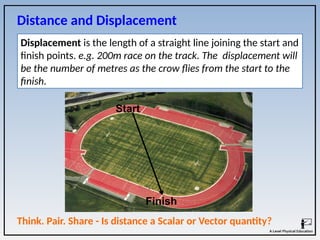
Displacement is the length of a straight line joining the start and
finish points. e.g. 200m race on the track. The displacement will
be the number of metres as the crow flies from the start to the
finish.
Start
Finish
Distance and Displacement
Think. Pair. Share - Is distance a Scalar or Vector quantity?
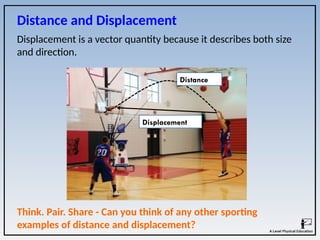
Displacement is a vector quantity because it describes both size
and direction.
Distance
Displacement
Distance and Displacement
Think. Pair. Share - Can you think of any other sporting
examples of distance and displacement?
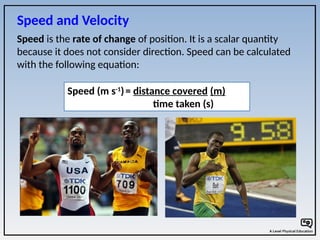
Speed is the rate of change of position. It is a scalar quantity
because it does not consider direction. Speed can be calculated
with the following equation:
Speed (m s-1
)= distance covered (m)
time taken (s)
Speed and Velocity
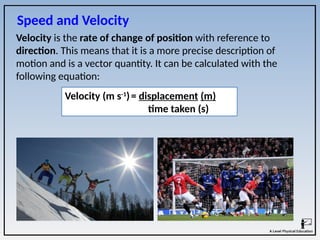
Velocity is the rate of change of position with reference to
direction. This means that it is a more precise description of
motion and is a vector quantity. It can be calculated with the
following equation:
Velocity (m s-1
)= displacement (m)
time taken (s)
Speed and Velocity
Both these terms can be defined as ...
Acceleration and Deceleration
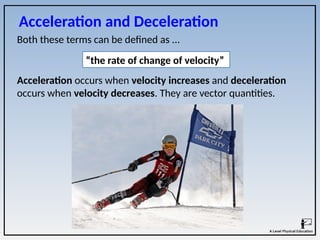
Acceleration occurs when velocity increases and deceleration
occurs when velocity decreases. They are vector quantities.
“the rate of change of velocity”
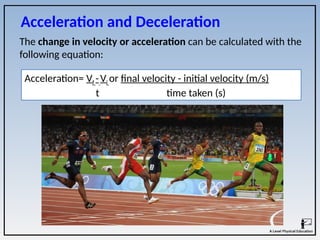
The change in velocity or acceleration can be calculated with the
following equation:
Acceleration and Deceleration
Acceleration= Vf -Vi or final velocity - initial velocity (m/s)
t time taken (s)
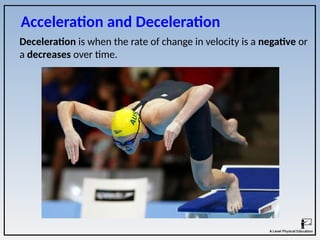
Deceleration is when the rate of change in velocity is a negative or
a decreases over time.
Acceleration and Deceleration
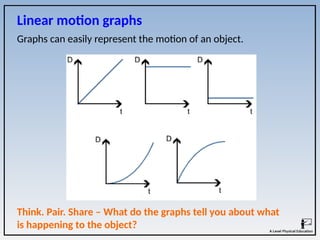
Graphs can easily represent the motion of an object.
Linear motion graphs
Think. Pair. Share – What do the graphs tell you about what
is happening to the object?
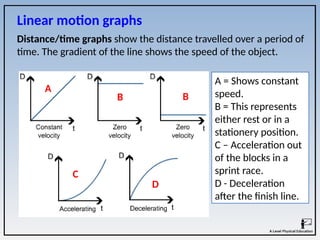
Distance/time graphs show the distance travelled over a period of
time. The gradient of the line shows the speed of the object.
Linear motion graphs
A = Shows constant
speed.
B = This represents
either rest or in a
stationery position.
C – Acceleration out
of the blocks in a
sprint race.
D - Deceleration
after the finish line.
A
B B
C
D
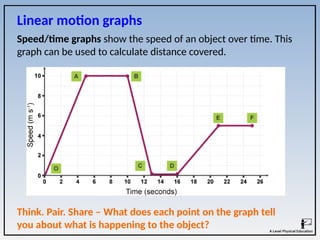
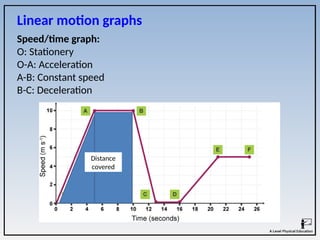
Speed/time graphs show the speed of an object over time. This
graph can be used to calculate distance covered.
Linear motion graphs
Think. Pair. Share – What does each point on the graph tell
you about what is happening to the object?
Speed/time graph:
O: Stationery
O-A: Acceleration
A-B: Constant speed
B-C: Deceleration
Linear motion graphs
Distance
covered
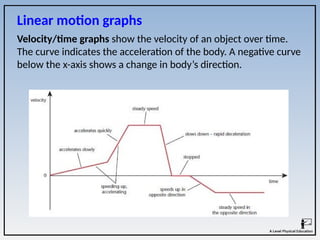
Velocity/time graphs show the velocity of an object over time.
The curve indicates the acceleration of the body. A negative curve
below the x-axis shows a change in body’s direction.
Linear motion graphs
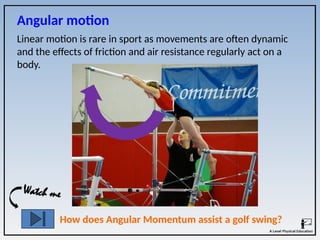
Linear motion is rare in sport as movements are often dynamic
and the effects of friction and air resistance regularly act on a
body.
Angular motion
How does Angular Momentum assist a golf swing?
Watch me
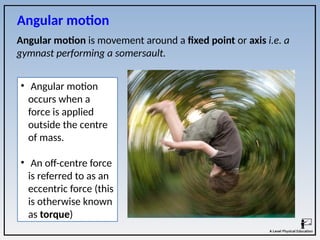
Angular motion is movement around a fixed point or axis i.e. a
gymnast performing a somersault.
• Angular motion
occurs when a
force is applied
outside the centre
of mass.
• An off-centre force
is referred to as an
eccentric force (this
is otherwise known
as torque)
Angular motion
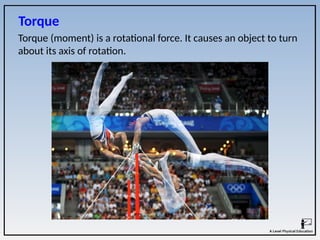
Torque (moment) is a rotational force. It causes an object to turn
about its axis of rotation.
Torque
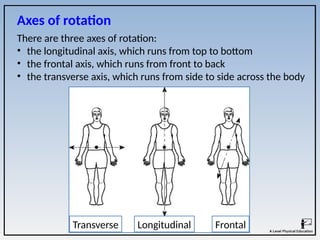
There are three axes of rotation:
• the longitudinal axis, which runs from top to bottom
• the frontal axis, which runs from front to back
• the transverse axis, which runs from side to side across the body
Transverse Longitudinal Frontal
Axes of rotation
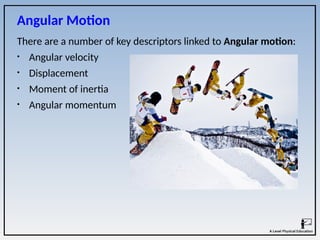
There are a number of key descriptors linked to Angular motion:
• Angular velocity
• Displacement
• Moment of inertia
• Angular momentum
Angular Motion
Angular Motion Quantities
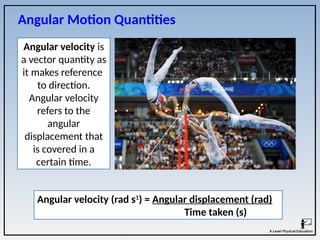
Angular velocity is
a vector quantity as
it makes reference
to direction.
Angular velocity
refers to the
angular
displacement that
is covered in a
certain time.
Angular velocity (rad s1
) = Angular displacement (rad)
Time taken (s)
Angular Motion Quantities
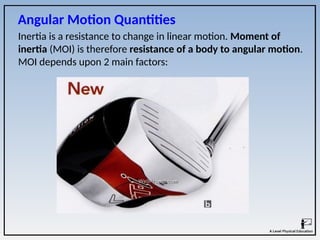
Inertia is a resistance to change in linear motion. Moment of
inertia (MOI) is therefore resistance of a body to angular motion.
MOI depends upon 2 main factors:
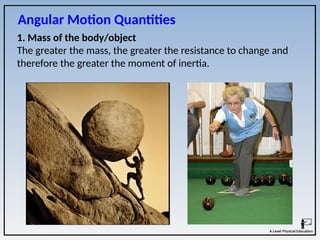
1. Mass of the body/object
The greater the mass, the greater the resistance to change and
therefore the greater the moment of inertia.
Angular Motion Quantities
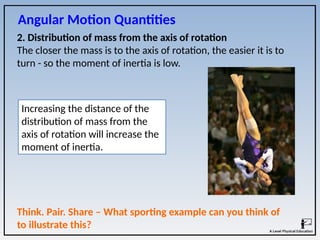
2. Distribution of mass from the axis of rotation
The closer the mass is to the axis of rotation, the easier it is to
turn - so the moment of inertia is low.
Increasing the distance of the
distribution of mass from the
axis of rotation will increase the
moment of inertia.
Angular Motion Quantities
Think. Pair. Share – What sporting example can you think of
to illustrate this?
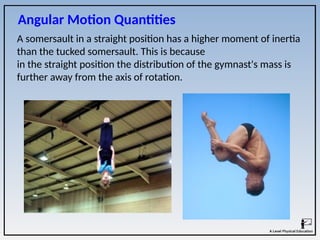
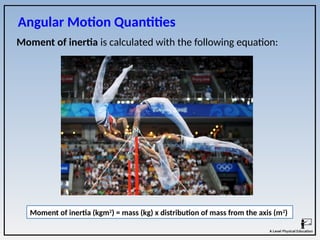
A somersault in a straight position has a higher moment of inertia
than the tucked somersault. This is because
in the straight position the distribution of the gymnast's mass is
further away from the axis of rotation.
Angular Motion Quantities
Moment of inertia (kgm2
) = mass (kg) x distribution of mass from the axis (m2
)
Moment of inertia is calculated with the following equation:
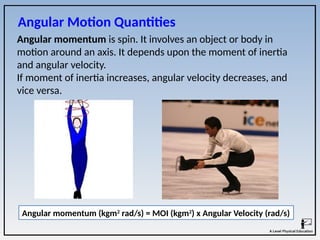
Angular momentum is spin. It involves an object or body in
motion around an axis. It depends upon the moment of inertia
and angular velocity.
If moment of inertia increases, angular velocity decreases, and
vice versa.
Angular Motion Quantities
Angular momentum (kgm2
rad/s) = MOI (kgm2
) x Angular Velocity (rad/s)
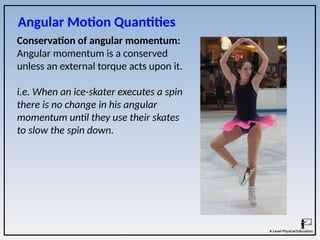
Conservation of angular momentum:
Angular momentum is a conserved
unless an external torque acts upon it.
i.e. When an ice-skater executes a spin
there is no change in his angular
momentum until they use their skates
to slow the spin down.
Angular Motion Quantities
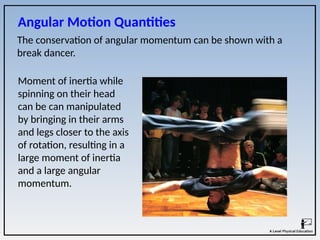
The conservation of angular momentum can be shown with a
break dancer.
Angular Motion Quantities
Moment of inertia while
spinning on their head
can be can manipulated
by bringing in their arms
and legs closer to the axis
of rotation, resulting in a
large moment of inertia
and a large angular
momentum.
Newton’s Laws of Motion and Angular Motion
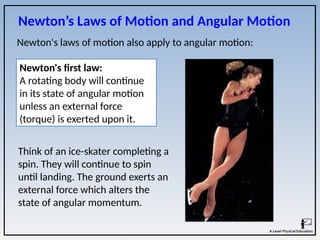
Newton's laws of motion also apply to angular motion:
Think of an ice-skater completing a
spin. They will continue to spin
until landing. The ground exerts an
external force which alters the
state of angular momentum.
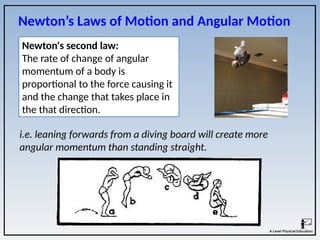
Newton's first law:
A rotating body will continue
in its state of angular motion
unless an external force
(torque) is exerted upon it.
i.e. leaning forwards from a diving board will create more
angular momentum than standing straight.
Newton's second law:
The rate of change of angular
momentum of a body is
proportional to the force causing it
and the change that takes place in
the that direction.
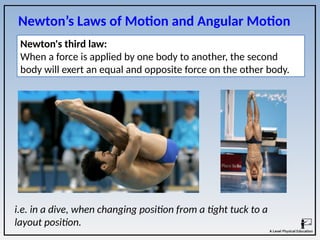
Newton’s Laws of Motion and Angular Motion
i.e. in a dive, when changing position from a tight tuck to a
layout position.
Newton's third law:
When a force is applied by one body to another, the second
body will exert an equal and opposite force on the other body.
Newton’s Laws of Motion and Angular Motion
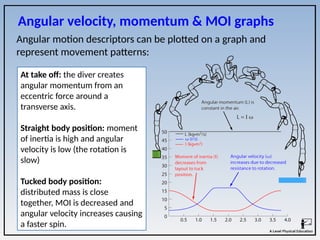
Angular velocity, momentum & MOI graphs
Angular motion descriptors can be plotted on a graph and
represent movement patterns:
At take off: the diver creates
angular momentum from an
eccentric force around a
transverse axis.
Straight body position: moment
of inertia is high and angular
velocity is low (the rotation is
slow)
Tucked body position:
distributed mass is close
together, MOI is decreased and
angular velocity increases causing
a faster spin.
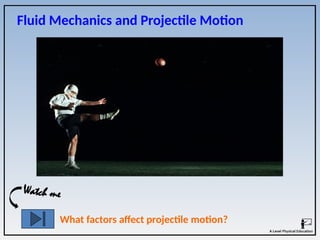
Fluid Mechanics and Projectile Motion
What factors affect projectile motion?
Watch me
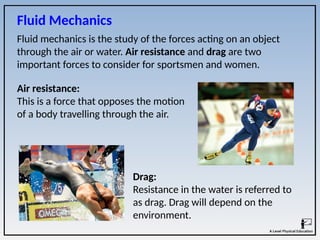
Fluid mechanics is the study of the forces acting on an object
through the air or water. Air resistance and drag are two
important forces to consider for sportsmen and women.
Fluid Mechanics
Air resistance:
This is a force that opposes the motion
of a body travelling through the air.
Drag:
Resistance in the water is referred to
as drag. Drag will depend on the
environment.
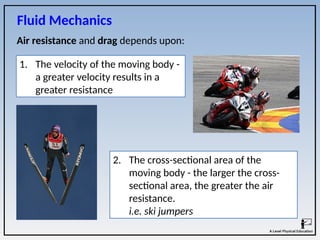
Air resistance and drag depends upon:
1. The velocity of the moving body -
a greater velocity results in a
greater resistance
2. The cross-sectional area of the
moving body - the larger the cross-
sectional area, the greater the air
resistance.
i.e. ski jumpers
Fluid Mechanics
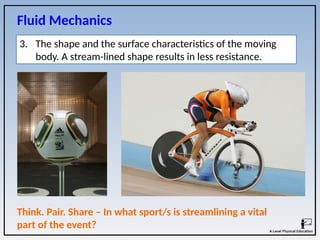
3. The shape and the surface characteristics of the moving
body. A stream-lined shape results in less resistance.
Fluid Mechanics
Think. Pair. Share – In what sport/s is streamlining a vital
part of the event?
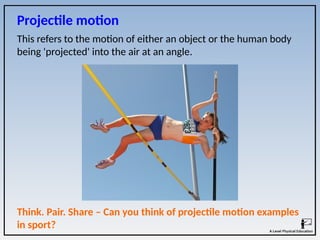
This refers to the motion of either an object or the human body
being 'projected' into the air at an angle.
Projectile motion
Think. Pair. Share – Can you think of projectile motion examples
in sport?
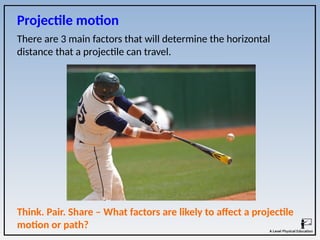
Think. Pair. Share – What factors are likely to affect a projectile
motion or path?
Projectile motion
There are 3 main factors that will determine the horizontal
distance that a projectile can travel.
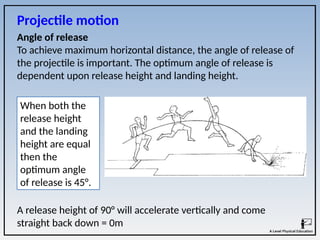
Angle of release
To achieve maximum horizontal distance, the angle of release of
the projectile is important. The optimum angle of release is
dependent upon release height and landing height.
When both the
release height
and the landing
height are equal
then the
optimum angle
of release is 45°.
Projectile motion
A release height of 90° will accelerate vertically and come
straight back down = 0m
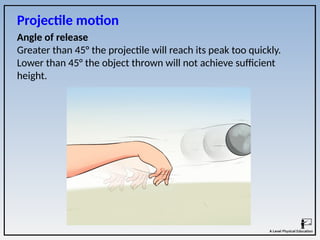
Angle of release
Greater than 45° the projectile will reach its peak too quickly.
Lower than 45° the object thrown will not achieve sufficient
height.
Projectile motion
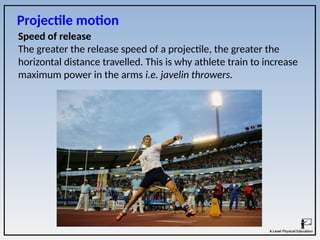
Speed of release
The greater the release speed of a projectile, the greater the
horizontal distance travelled. This is why athlete train to increase
maximum power in the arms i.e. javelin throwers.
Projectile motion
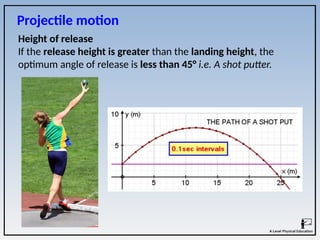
Height of release
If the release height is greater than the landing height, the
optimum angle of release is less than 45° i.e. A shot putter.
Projectile motion
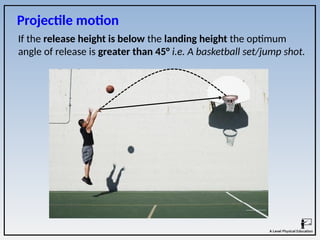
If the release height is below the landing height the optimum
angle of release is greater than 45° i.e. A basketball set/jump shot.
Projectile motion
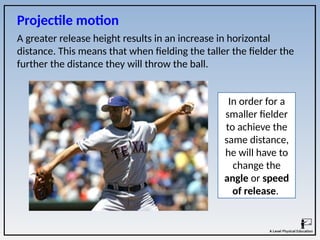
A greater release height results in an increase in horizontal
distance. This means that when fielding the taller the fielder the
further the distance they will throw the ball.
In order for a
smaller fielder
to achieve the
same distance,
he will have to
change the
angle or speed
of release.
Projectile motion
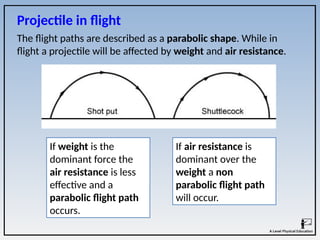
The flight paths are described as a parabolic shape. While in
flight a projectile will be affected by weight and air resistance.
If weight is the
dominant force the
air resistance is less
effective and a
parabolic flight path
occurs.
Projectile in flight
If air resistance is
dominant over the
weight a non
parabolic flight path
will occur.
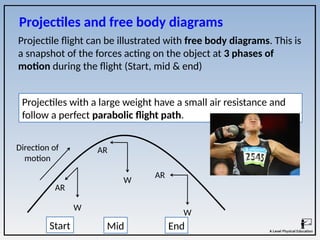
Projectile flight can be illustrated with free body diagrams. This is
a snapshot of the forces acting on the object at 3 phases of
motion during the flight (Start, mid & end)
Direction of
motion
W
AR
W
AR
W
AR
Projectiles and free body diagrams
Projectiles with a large weight have a small air resistance and
follow a perfect parabolic flight path.
Start Mid End
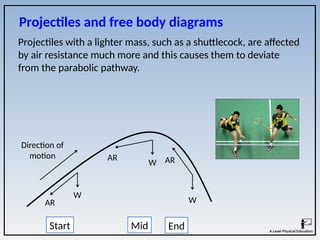
Projectiles with a lighter mass, such as a shuttlecock, are affected
by air resistance much more and this causes them to deviate
from the parabolic pathway.
Projectiles and free body diagrams
Direction of
motion
W
AR
W
AR
W
AR
Start Mid End
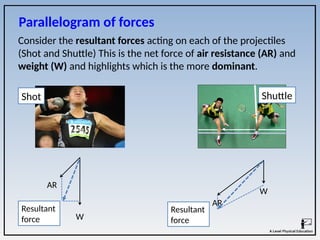
Consider the resultant forces acting on each of the projectiles
(Shot and Shuttle) This is the net force of air resistance (AR) and
weight (W) and highlights which is the more dominant.
W
AR
Parallelogram of forces
Shot Shuttle
W
AR
Resultant
force
Resultant
force
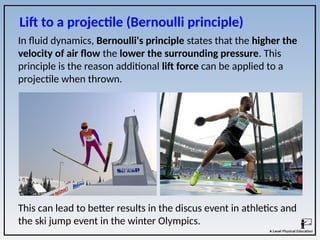
This can lead to better results in the discus event in athletics and
the ski jump event in the winter Olympics.
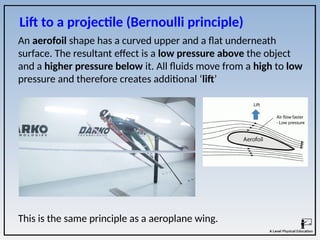
Lift to a projectile (Bernoulli principle)
In fluid dynamics, Bernoulli's principle states that the higher the
velocity of air flow the lower the surrounding pressure. This
principle is the reason additional lift force can be applied to a
projectile when thrown.
This is the same principle as a aeroplane wing.
Lift to a projectile (Bernoulli principle)
An aerofoil shape has a curved upper and a flat underneath
surface. The resultant effect is a low pressure above the object
and a higher pressure below it. All fluids move from a high to low
pressure and therefore creates additional ‘lift’
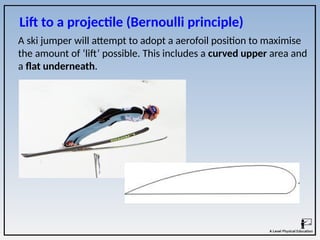
Lift to a projectile (Bernoulli principle)
A ski jumper will attempt to adopt a aerofoil position to maximise
the amount of ‘lift’ possible. This includes a curved upper area and
a flat underneath.
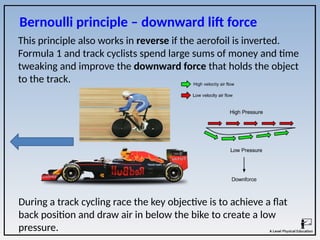
Bernoulli principle – downward lift force
This principle also works in reverse if the aerofoil is inverted.
Formula 1 and track cyclists spend large sums of money and time
tweaking and improve the downward force that holds the object
to the track.
During a track cycling race the key objective is to achieve a flat
back position and draw air in below the bike to create a low
pressure.
What is the Magnus force?
Watch me
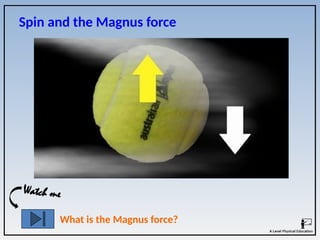
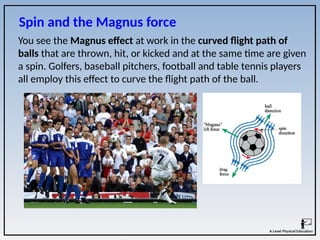
Spin and the Magnus force
You see the Magnus effect at work in the curved flight path of
balls that are thrown, hit, or kicked and at the same time are given
a spin. Golfers, baseball pitchers, football and table tennis players
all employ this effect to curve the flight path of the ball.
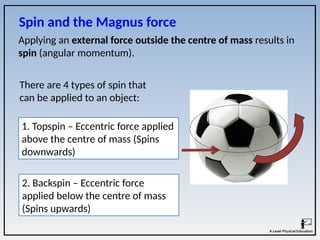
Applying an external force outside the centre of mass results in
spin (angular momentum).
Spin and the Magnus force
There are 4 types of spin that
can be applied to an object:
1. Topspin – Eccentric force applied
above the centre of mass (Spins
downwards)
2. Backspin – Eccentric force
applied below the centre of mass
(Spins upwards)
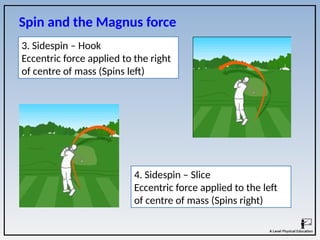
Spin and the Magnus force
3. Sidespin – Hook
Eccentric force applied to the right
of centre of mass (Spins left)
4. Sidespin – Slice
Eccentric force applied to the left
of centre of mass (Spins right)
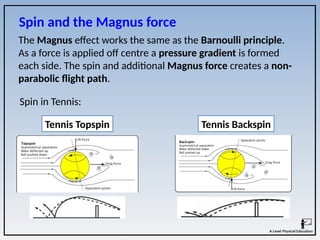
The Magnus effect works the same as the Barnoulli principle.
As a force is applied off centre a pressure gradient is formed
each side. The spin and additional Magnus force creates a non-
parabolic flight path.
Spin and the Magnus force
Tennis Topspin Tennis Backspin
Spin in Tennis:
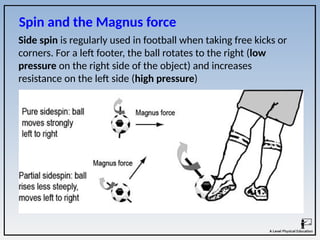
Side spin is regularly used in football when taking free kicks or
corners. For a left footer, the ball rotates to the right (low
pressure on the right side of the object) and increases
resistance on the left side (high pressure)
Spin and the Magnus force
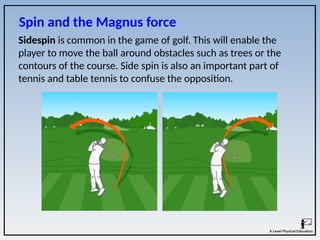
Sidespin is common in the game of golf. This will enable the
player to move the ball around obstacles such as trees or the
contours of the course. Side spin is also an important part of
tennis and table tennis to confuse the opposition.
Spin and the Magnus force
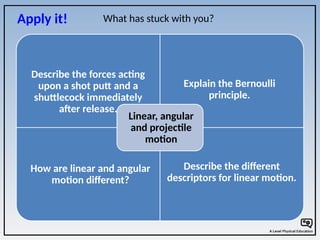
Describe the forces acting
upon a shot putt and a
shuttlecock immediately
after release.
Explain the Bernoulli
principle.
How are linear and angular
motion different?
Describe the different
descriptors for linear motion.
Linear, angular
and projectile
motion
Apply it! What has stuck with you?
Exam questions
1. A footballer taking a free kick may apply sidespin to the ball to
make it swerve. Draw and label an airflow diagram of the ball in
flight. Explain how spin causes the flight path of the ball to
deviate. [5]
Practice it!
Exam questions
2. Fig.3 shows a gymnast performing a back somersault. Explain
how angular velocity is controlled by the gymnast during take-off,
flight and landing. [6]
Practice it!
Exam questions
3. Identify two factors that affect the horizontal distance travelled
by a projectile. [2]
Practice it!
Marks Scheme:
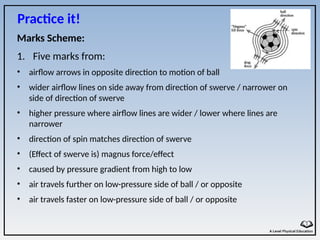
1. Five marks from:
• airflow arrows in opposite direction to motion of ball
• wider airflow lines on side away from direction of swerve / narrower on
side of direction of swerve
• higher pressure where airflow lines are wider / lower where lines are
narrower
• direction of spin matches direction of swerve
• (Effect of swerve is) magnus force/effect
• caused by pressure gradient from high to low
• air travels further on low-pressure side of ball / or opposite
• air travels faster on low-pressure side of ball / or opposite
Practice it!
Marks Scheme:
2. Six marks from:
• (analogue of Newton 1) A body will continue to rotate with constant angular momentum
unless acted upon by an external torque/moment (AO1)
• (momentum) Principle of conservation of angular momentum (AO1)
• (AM) AM = Iw / angular momentum = moment of inertia x angular velocity (AO1)
• (take-off) gymnast generates angular momentum off floor (AO2)
• (MI) Moment of inertia high as body is extended (AO2)
• (AV) therefore angular velocity (w) / rate of spin is low (AO2)
• (flight - MI) MI is reduced as body is tucked (AO2)
• (AV) therefore angular velocity / rate of spin increases (AO2)
• (entry - MI) MI is increased as body is extended (AO2)
• (AV) therefore angular velocity / rate of spin is reduced (AO2)
• to prevent over rotation / controlled landing (AO2)
Practice it!
Marks Scheme:
3. Two marks from:
• height of release
• speed/velocity of release
• angle of release
• air resistance/shape of object/spin of the object
Practice it!

Linear-angular-projectile-motion (1).pptx

  • 1.
    1.3.b – Linear,angular & projectile motion Learning objectives To be able to describe linear motion and the descriptors affecting it. To understand graphical representation of linear motion. To be able to explain angular motion around axes of rotation. To understand the definitions, calculations and units of measurement for angular motion descriptors. To be able to explain the relationship between moment of inertia, angular velocity and momentum. To be able to describe the factors affecting fluid mechanics and projectile motion. To evaluate the impact of the Bernoulli principle and the Magnus force on an object.
  • 2.
    Linear, angular &projectile motion
  • 3.
    Biomechanics is thestudy of human movement and the effect of force and motion. Linear Motion Linear motion is motion in a straight or curved line, with all body parts moving the same distance at the same speed in the same direction. i.e. the javelin moves in a curved line. Think. Pair. Share - What is Newton’s first law of motion?
  • 4.
    Linear motion resultsfrom a direct force being applied to the centre of an object’s mass. Linear Motion There are a number of key descriptors linked to linear motion: • Distance • Displacement • Speed • Velocity • Acceleration/deceleration
  • 5.
    These measurements canbe split into two groups: Scalar quantities are described in terms of size or magnitude - mass, inertia, distance and speed are scalar quantities. Vector quantities are described in terms of size and direction - weight, acceleration, deceleration, displacement, velocity and momentum are vector quantities. Measurements used in Linear Motion
  • 6.
    Distance and displacementare measurements that are used to describe a body's motion. Distance is the length of the path a body follows when moving to a point. e.g. 400m runner Think. Pair. Share - Is distance a Scalar or Vector quantity? Distance and Displacement
  • 7.
    Displacement is thelength of a straight line joining the start and finish points. e.g. 200m race on the track. The displacement will be the number of metres as the crow flies from the start to the finish. Start Finish Distance and Displacement Think. Pair. Share - Is distance a Scalar or Vector quantity?
  • 8.
    Displacement is avector quantity because it describes both size and direction. Distance Displacement Distance and Displacement Think. Pair. Share - Can you think of any other sporting examples of distance and displacement?
  • 9.
    Speed is therate of change of position. It is a scalar quantity because it does not consider direction. Speed can be calculated with the following equation: Speed (m s-1 )= distance covered (m) time taken (s) Speed and Velocity
  • 10.
    Velocity is therate of change of position with reference to direction. This means that it is a more precise description of motion and is a vector quantity. It can be calculated with the following equation: Velocity (m s-1 )= displacement (m) time taken (s) Speed and Velocity
  • 11.
    Both these termscan be defined as ... Acceleration and Deceleration Acceleration occurs when velocity increases and deceleration occurs when velocity decreases. They are vector quantities. “the rate of change of velocity”
  • 12.
    The change invelocity or acceleration can be calculated with the following equation: Acceleration and Deceleration Acceleration= Vf -Vi or final velocity - initial velocity (m/s) t time taken (s)
  • 13.
    Deceleration is whenthe rate of change in velocity is a negative or a decreases over time. Acceleration and Deceleration
  • 14.
    Graphs can easilyrepresent the motion of an object. Linear motion graphs Think. Pair. Share – What do the graphs tell you about what is happening to the object?
  • 15.
    Distance/time graphs showthe distance travelled over a period of time. The gradient of the line shows the speed of the object. Linear motion graphs A = Shows constant speed. B = This represents either rest or in a stationery position. C – Acceleration out of the blocks in a sprint race. D - Deceleration after the finish line. A B B C D
  • 16.
    Speed/time graphs showthe speed of an object over time. This graph can be used to calculate distance covered. Linear motion graphs Think. Pair. Share – What does each point on the graph tell you about what is happening to the object?
  • 17.
    Speed/time graph: O: Stationery O-A:Acceleration A-B: Constant speed B-C: Deceleration Linear motion graphs Distance covered
  • 18.
    Velocity/time graphs showthe velocity of an object over time. The curve indicates the acceleration of the body. A negative curve below the x-axis shows a change in body’s direction. Linear motion graphs
  • 19.
    Linear motion israre in sport as movements are often dynamic and the effects of friction and air resistance regularly act on a body. Angular motion How does Angular Momentum assist a golf swing? Watch me
  • 20.
    Angular motion ismovement around a fixed point or axis i.e. a gymnast performing a somersault. • Angular motion occurs when a force is applied outside the centre of mass. • An off-centre force is referred to as an eccentric force (this is otherwise known as torque) Angular motion
  • 21.
    Torque (moment) isa rotational force. It causes an object to turn about its axis of rotation. Torque
  • 22.
    There are threeaxes of rotation: • the longitudinal axis, which runs from top to bottom • the frontal axis, which runs from front to back • the transverse axis, which runs from side to side across the body Transverse Longitudinal Frontal Axes of rotation
  • 23.
    There are anumber of key descriptors linked to Angular motion: • Angular velocity • Displacement • Moment of inertia • Angular momentum Angular Motion
  • 24.
    Angular Motion Quantities Angularvelocity is a vector quantity as it makes reference to direction. Angular velocity refers to the angular displacement that is covered in a certain time. Angular velocity (rad s1 ) = Angular displacement (rad) Time taken (s)
  • 25.
    Angular Motion Quantities Inertiais a resistance to change in linear motion. Moment of inertia (MOI) is therefore resistance of a body to angular motion. MOI depends upon 2 main factors:
  • 26.
    1. Mass ofthe body/object The greater the mass, the greater the resistance to change and therefore the greater the moment of inertia. Angular Motion Quantities
  • 27.
    2. Distribution ofmass from the axis of rotation The closer the mass is to the axis of rotation, the easier it is to turn - so the moment of inertia is low. Increasing the distance of the distribution of mass from the axis of rotation will increase the moment of inertia. Angular Motion Quantities Think. Pair. Share – What sporting example can you think of to illustrate this?
  • 28.
    A somersault ina straight position has a higher moment of inertia than the tucked somersault. This is because in the straight position the distribution of the gymnast's mass is further away from the axis of rotation. Angular Motion Quantities
  • 29.
    Angular Motion Quantities Momentof inertia (kgm2 ) = mass (kg) x distribution of mass from the axis (m2 ) Moment of inertia is calculated with the following equation:
  • 30.
    Angular momentum isspin. It involves an object or body in motion around an axis. It depends upon the moment of inertia and angular velocity. If moment of inertia increases, angular velocity decreases, and vice versa. Angular Motion Quantities Angular momentum (kgm2 rad/s) = MOI (kgm2 ) x Angular Velocity (rad/s)
  • 31.
    Conservation of angularmomentum: Angular momentum is a conserved unless an external torque acts upon it. i.e. When an ice-skater executes a spin there is no change in his angular momentum until they use their skates to slow the spin down. Angular Motion Quantities
  • 32.
    The conservation ofangular momentum can be shown with a break dancer. Angular Motion Quantities Moment of inertia while spinning on their head can be can manipulated by bringing in their arms and legs closer to the axis of rotation, resulting in a large moment of inertia and a large angular momentum.
  • 33.
    Newton’s Laws ofMotion and Angular Motion Newton's laws of motion also apply to angular motion: Think of an ice-skater completing a spin. They will continue to spin until landing. The ground exerts an external force which alters the state of angular momentum. Newton's first law: A rotating body will continue in its state of angular motion unless an external force (torque) is exerted upon it.
  • 34.
    i.e. leaning forwardsfrom a diving board will create more angular momentum than standing straight. Newton's second law: The rate of change of angular momentum of a body is proportional to the force causing it and the change that takes place in the that direction. Newton’s Laws of Motion and Angular Motion
  • 35.
    i.e. in adive, when changing position from a tight tuck to a layout position. Newton's third law: When a force is applied by one body to another, the second body will exert an equal and opposite force on the other body. Newton’s Laws of Motion and Angular Motion
  • 36.
    Angular velocity, momentum& MOI graphs Angular motion descriptors can be plotted on a graph and represent movement patterns: At take off: the diver creates angular momentum from an eccentric force around a transverse axis. Straight body position: moment of inertia is high and angular velocity is low (the rotation is slow) Tucked body position: distributed mass is close together, MOI is decreased and angular velocity increases causing a faster spin.
  • 37.
    Fluid Mechanics andProjectile Motion What factors affect projectile motion? Watch me
  • 38.
    Fluid mechanics isthe study of the forces acting on an object through the air or water. Air resistance and drag are two important forces to consider for sportsmen and women. Fluid Mechanics Air resistance: This is a force that opposes the motion of a body travelling through the air. Drag: Resistance in the water is referred to as drag. Drag will depend on the environment.
  • 39.
    Air resistance anddrag depends upon: 1. The velocity of the moving body - a greater velocity results in a greater resistance 2. The cross-sectional area of the moving body - the larger the cross- sectional area, the greater the air resistance. i.e. ski jumpers Fluid Mechanics
  • 40.
    3. The shapeand the surface characteristics of the moving body. A stream-lined shape results in less resistance. Fluid Mechanics Think. Pair. Share – In what sport/s is streamlining a vital part of the event?
  • 41.
    This refers tothe motion of either an object or the human body being 'projected' into the air at an angle. Projectile motion Think. Pair. Share – Can you think of projectile motion examples in sport?
  • 42.
    Think. Pair. Share– What factors are likely to affect a projectile motion or path? Projectile motion There are 3 main factors that will determine the horizontal distance that a projectile can travel.
  • 43.
    Angle of release Toachieve maximum horizontal distance, the angle of release of the projectile is important. The optimum angle of release is dependent upon release height and landing height. When both the release height and the landing height are equal then the optimum angle of release is 45°. Projectile motion A release height of 90° will accelerate vertically and come straight back down = 0m
  • 44.
    Angle of release Greaterthan 45° the projectile will reach its peak too quickly. Lower than 45° the object thrown will not achieve sufficient height. Projectile motion
  • 45.
    Speed of release Thegreater the release speed of a projectile, the greater the horizontal distance travelled. This is why athlete train to increase maximum power in the arms i.e. javelin throwers. Projectile motion
  • 46.
    Height of release Ifthe release height is greater than the landing height, the optimum angle of release is less than 45° i.e. A shot putter. Projectile motion
  • 47.
    If the releaseheight is below the landing height the optimum angle of release is greater than 45° i.e. A basketball set/jump shot. Projectile motion
  • 48.
    A greater releaseheight results in an increase in horizontal distance. This means that when fielding the taller the fielder the further the distance they will throw the ball. In order for a smaller fielder to achieve the same distance, he will have to change the angle or speed of release. Projectile motion
  • 49.
    The flight pathsare described as a parabolic shape. While in flight a projectile will be affected by weight and air resistance. If weight is the dominant force the air resistance is less effective and a parabolic flight path occurs. Projectile in flight If air resistance is dominant over the weight a non parabolic flight path will occur.
  • 50.
    Projectile flight canbe illustrated with free body diagrams. This is a snapshot of the forces acting on the object at 3 phases of motion during the flight (Start, mid & end) Direction of motion W AR W AR W AR Projectiles and free body diagrams Projectiles with a large weight have a small air resistance and follow a perfect parabolic flight path. Start Mid End
  • 51.
    Projectiles with alighter mass, such as a shuttlecock, are affected by air resistance much more and this causes them to deviate from the parabolic pathway. Projectiles and free body diagrams Direction of motion W AR W AR W AR Start Mid End
  • 52.
    Consider the resultantforces acting on each of the projectiles (Shot and Shuttle) This is the net force of air resistance (AR) and weight (W) and highlights which is the more dominant. W AR Parallelogram of forces Shot Shuttle W AR Resultant force Resultant force
  • 53.
    This can leadto better results in the discus event in athletics and the ski jump event in the winter Olympics. Lift to a projectile (Bernoulli principle) In fluid dynamics, Bernoulli's principle states that the higher the velocity of air flow the lower the surrounding pressure. This principle is the reason additional lift force can be applied to a projectile when thrown.
  • 54.
    This is thesame principle as a aeroplane wing. Lift to a projectile (Bernoulli principle) An aerofoil shape has a curved upper and a flat underneath surface. The resultant effect is a low pressure above the object and a higher pressure below it. All fluids move from a high to low pressure and therefore creates additional ‘lift’
  • 55.
    Lift to aprojectile (Bernoulli principle) A ski jumper will attempt to adopt a aerofoil position to maximise the amount of ‘lift’ possible. This includes a curved upper area and a flat underneath.
  • 56.
    Bernoulli principle –downward lift force This principle also works in reverse if the aerofoil is inverted. Formula 1 and track cyclists spend large sums of money and time tweaking and improve the downward force that holds the object to the track. During a track cycling race the key objective is to achieve a flat back position and draw air in below the bike to create a low pressure.
  • 57.
    What is theMagnus force? Watch me Spin and the Magnus force
  • 58.
    Spin and theMagnus force You see the Magnus effect at work in the curved flight path of balls that are thrown, hit, or kicked and at the same time are given a spin. Golfers, baseball pitchers, football and table tennis players all employ this effect to curve the flight path of the ball.
  • 59.
    Applying an externalforce outside the centre of mass results in spin (angular momentum). Spin and the Magnus force There are 4 types of spin that can be applied to an object: 1. Topspin – Eccentric force applied above the centre of mass (Spins downwards) 2. Backspin – Eccentric force applied below the centre of mass (Spins upwards)
  • 60.
    Spin and theMagnus force 3. Sidespin – Hook Eccentric force applied to the right of centre of mass (Spins left) 4. Sidespin – Slice Eccentric force applied to the left of centre of mass (Spins right)
  • 61.
    The Magnus effectworks the same as the Barnoulli principle. As a force is applied off centre a pressure gradient is formed each side. The spin and additional Magnus force creates a non- parabolic flight path. Spin and the Magnus force Tennis Topspin Tennis Backspin Spin in Tennis:
  • 62.
    Side spin isregularly used in football when taking free kicks or corners. For a left footer, the ball rotates to the right (low pressure on the right side of the object) and increases resistance on the left side (high pressure) Spin and the Magnus force
  • 63.
    Sidespin is commonin the game of golf. This will enable the player to move the ball around obstacles such as trees or the contours of the course. Side spin is also an important part of tennis and table tennis to confuse the opposition. Spin and the Magnus force
  • 64.
    Describe the forcesacting upon a shot putt and a shuttlecock immediately after release. Explain the Bernoulli principle. How are linear and angular motion different? Describe the different descriptors for linear motion. Linear, angular and projectile motion Apply it! What has stuck with you?
  • 65.
    Exam questions 1. Afootballer taking a free kick may apply sidespin to the ball to make it swerve. Draw and label an airflow diagram of the ball in flight. Explain how spin causes the flight path of the ball to deviate. [5] Practice it!
  • 66.
    Exam questions 2. Fig.3shows a gymnast performing a back somersault. Explain how angular velocity is controlled by the gymnast during take-off, flight and landing. [6] Practice it!
  • 67.
    Exam questions 3. Identifytwo factors that affect the horizontal distance travelled by a projectile. [2] Practice it!
  • 68.
    Marks Scheme: 1. Fivemarks from: • airflow arrows in opposite direction to motion of ball • wider airflow lines on side away from direction of swerve / narrower on side of direction of swerve • higher pressure where airflow lines are wider / lower where lines are narrower • direction of spin matches direction of swerve • (Effect of swerve is) magnus force/effect • caused by pressure gradient from high to low • air travels further on low-pressure side of ball / or opposite • air travels faster on low-pressure side of ball / or opposite Practice it!
  • 69.
    Marks Scheme: 2. Sixmarks from: • (analogue of Newton 1) A body will continue to rotate with constant angular momentum unless acted upon by an external torque/moment (AO1) • (momentum) Principle of conservation of angular momentum (AO1) • (AM) AM = Iw / angular momentum = moment of inertia x angular velocity (AO1) • (take-off) gymnast generates angular momentum off floor (AO2) • (MI) Moment of inertia high as body is extended (AO2) • (AV) therefore angular velocity (w) / rate of spin is low (AO2) • (flight - MI) MI is reduced as body is tucked (AO2) • (AV) therefore angular velocity / rate of spin increases (AO2) • (entry - MI) MI is increased as body is extended (AO2) • (AV) therefore angular velocity / rate of spin is reduced (AO2) • to prevent over rotation / controlled landing (AO2) Practice it!
  • 70.
    Marks Scheme: 3. Twomarks from: • height of release • speed/velocity of release • angle of release • air resistance/shape of object/spin of the object Practice it!

Editor's Notes