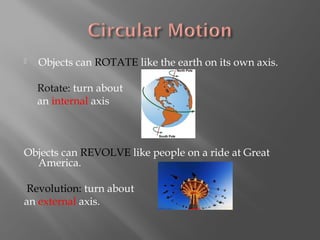
   Objects can ROTATE like the earth on its own axis.

    Rotate: turn about
    an internal axis


Objects can REVOLVE like people on a ride at Great
  America.

 Revolution: turn about
an external axis.
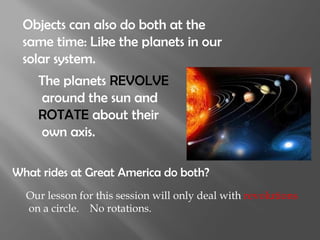
Objects can also do both at the
 same time: Like the planets in our
 solar system.
    The planets REVOLVE
    around the sun and
    ROTATE about their
    own axis.

What rides at Great America do both?
  Our lesson for this session will only deal with revolutions
  on a circle. No rotations.
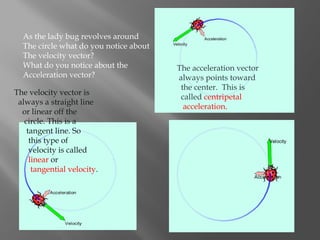
As the lady bug revolves around
  The circle what do you notice about
  The velocity vector?
  What do you notice about the          The acceleration vector
  Acceleration vector?                  always points toward
                                         the center. This is
The velocity vector is
                                         called centripetal
 always a straight line
                                          acceleration.
  or linear off the
   circle. This is a
    tangent line. So
     this type of
     velocity is called
     linear or
      tangential velocity.
Now lets get active to learn about the following terms:
1. Angular velocity,
2. tangential velocity,
3. Centripetal acceleration

Go to the website and click on the ladybug animation.
Have your guided practice available so you can use the
animation and collect some pieces of information.

http://www.cabrillo.edu/~jmccullough/Physics/Circular_Motion.html#
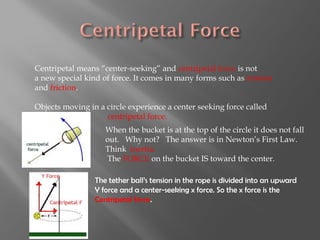
Centripetal means “center-seeking” and centripetal force is not
a new special kind of force. It comes in many forms such as tension
and friction.

Objects moving in a circle experience a center seeking force called
                    centripetal force.
                    When the bucket is at the top of the circle it does not fall
                    out. Why not? The answer is in Newton’s First Law.
                    Think inertia.
                    The FORCE on the bucket IS toward the center.

                 The tether ball’s tension in the rope is divided into an upward
                 Y force and a center-seeking x force. So the x force is the
                 Centripetal force.
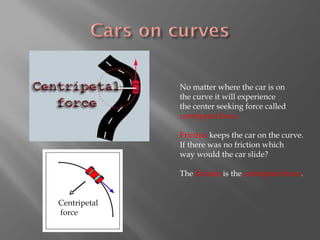
No matter where the car is on
              the curve it will experience
              the center seeking force called
              centripetal force.

              Friction keeps the car on the curve.
              If there was no friction which
              way would the car slide?

              The friction is the centripetal force.


Centripetal
force
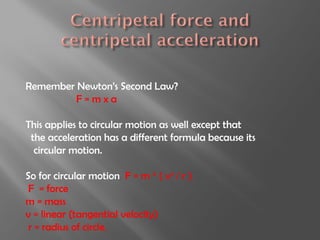
Remember Newton’s Second Law?
         F=mxa

This applies to circular motion as well except that
 the acceleration has a different formula because its
  circular motion.

So for circular motion F = m * ( v2 / r )
 F = force
m = mass
v = linear (tangential velocity)
 r = radius of circle.
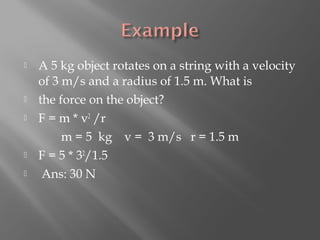
   A 5 kg object rotates on a string with a velocity
    of 3 m/s and a radius of 1.5 m. What is
   the force on the object?
   F = m * v2 /r
         m = 5 kg v = 3 m/s r = 1.5 m
   F = 5 * 32/1.5
    Ans: 30 N

Ch5 - circular motion and gravity conceptual

  • 2.
    Objects can ROTATE like the earth on its own axis. Rotate: turn about an internal axis Objects can REVOLVE like people on a ride at Great America. Revolution: turn about an external axis.
  • 3.
    Objects can alsodo both at the same time: Like the planets in our solar system. The planets REVOLVE around the sun and ROTATE about their own axis. What rides at Great America do both? Our lesson for this session will only deal with revolutions on a circle. No rotations.
  • 4.
    As the ladybug revolves around The circle what do you notice about The velocity vector? What do you notice about the The acceleration vector Acceleration vector? always points toward the center. This is The velocity vector is called centripetal always a straight line acceleration. or linear off the circle. This is a tangent line. So this type of velocity is called linear or tangential velocity.
  • 5.
    Now lets getactive to learn about the following terms: 1. Angular velocity, 2. tangential velocity, 3. Centripetal acceleration Go to the website and click on the ladybug animation. Have your guided practice available so you can use the animation and collect some pieces of information. http://www.cabrillo.edu/~jmccullough/Physics/Circular_Motion.html#
  • 6.
    Centripetal means “center-seeking”and centripetal force is not a new special kind of force. It comes in many forms such as tension and friction. Objects moving in a circle experience a center seeking force called centripetal force. When the bucket is at the top of the circle it does not fall out. Why not? The answer is in Newton’s First Law. Think inertia. The FORCE on the bucket IS toward the center. The tether ball’s tension in the rope is divided into an upward Y force and a center-seeking x force. So the x force is the Centripetal force.
  • 7.
    No matter wherethe car is on the curve it will experience the center seeking force called centripetal force. Friction keeps the car on the curve. If there was no friction which way would the car slide? The friction is the centripetal force. Centripetal force
  • 8.
    Remember Newton’s SecondLaw? F=mxa This applies to circular motion as well except that the acceleration has a different formula because its circular motion. So for circular motion F = m * ( v2 / r ) F = force m = mass v = linear (tangential velocity) r = radius of circle.
  • 9.
    A 5 kg object rotates on a string with a velocity of 3 m/s and a radius of 1.5 m. What is  the force on the object?  F = m * v2 /r m = 5 kg v = 3 m/s r = 1.5 m  F = 5 * 32/1.5  Ans: 30 N