WIND GENERATOR
Under the esteemed guidance of
Mr. G. Ravindra, M. Tech., (Ph. D.),
Asst. Professor,
Dept. of EEE, SVEC.
By
D. Subhash Reddy,
12121A0234.
DEPARTMENT OF ELECTRICALAND ELECTRONICS ENGINEERING
SREE VIDYANIKETHANENGINEERINGCOLLEGE
(An autonomous institution affiliated to JNTUA, Anantapuram)
Sree Sainath Nagar, Tirupati – 517 102
A Seminar on
Dept. of EEE
1
Contents
 Introduction
 Wind turbines
 Types of Wind Turbines
 Types of Generators in Wind Turbines
 Wind Energy Conversion Systems
 Advantages of Adjustable Speed Generators
 Disadvantages
 Conclusion
2
Introduction 3
 Wind turbines convert the kinetic energy present in the wind into mechanical energy by means of
producing torque.
 Among all the parts of a turbine the generator plays a vital role.
 In the present scenario, most wind turbine manufacturers now equip power generating units by induction
generators.
 They are operated either at fixed speed or adjustable speed.
 Adjustable speed generation is preferred over fixed speed generation.
Wind Turbine
 A wind turbine is a device that converts kinetic energy from the wind into electrical power.
 The modeling of a turbine includes parameters such as optimum tower height, control
systems, number of blades and blade shape.
 A quantitative measure of the wind power available at any location is called Wind Power
Density(WPD).
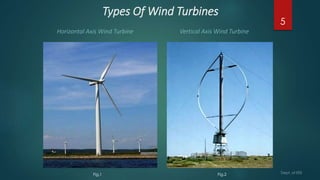
 Wind turbines are generally classified depending on their axis of rotation as:
 Horizontal axis type and
 Vertical axis type.
4
Types Of Wind Turbines
Horizontal Axis Wind Turbine Vertical Axis Wind Turbine
5
Fig.1 Fig.2
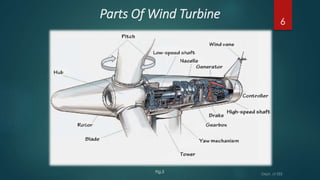
Parts Of Wind Turbine 6
Fig.3
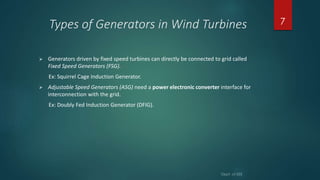
Types of Generators in Wind Turbines
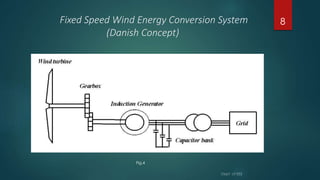
 Generators driven by fixed speed turbines can directly be connected to grid called
Fixed Speed Generators (FSG).
Ex: Squirrel Cage Induction Generator.
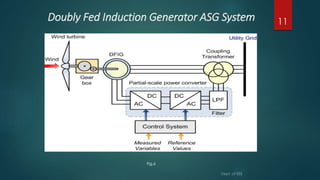
 Adjustable Speed Generators (ASG) need a power electronic converter interface for
interconnection with the grid.
Ex: Doubly Fed Induction Generator (DFIG).
7
Fixed Speed Wind Energy Conversion System
(Danish Concept)
8
Fig.4
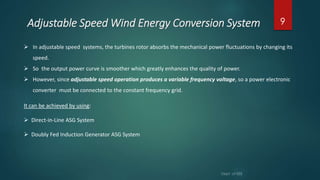
Adjustable Speed Wind Energy Conversion System
 In adjustable speed systems, the turbines rotor absorbs the mechanical power fluctuations by changing its
speed.
 So the output power curve is smoother which greatly enhances the quality of power.
 However, since adjustable speed operation produces a variable frequency voltage, so a power electronic
converter must be connected to the constant frequency grid.
It can be achieved by using:
 Direct-in-Line ASG System
 Doubly Fed Induction Generator ASG System
9
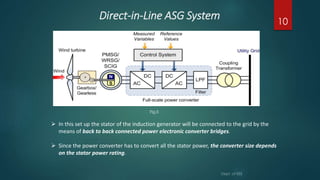
Direct-in-Line ASG System
 In this set up the stator of the induction generator will be connected to the grid by the
means of back to back connected power electronic converter bridges.
 Since the power converter has to convert all the stator power, the converter size depends
on the stator power rating.
10
Fig.5
11
Fig.6
Doubly Fed Induction Generator ASG System
Advantages of ASG over FSG
 Reduced acoustic noise, because low-speed operation is possible at low
power conditions.
 Improves system efficiency as turbine speed can be adjusted as a function
of wind speed to maximize output.
 Reduced mechanical stresses.
 Improved power quality.
12
Disadvantages of ASG 13
 Use of Power Converter makes the system expensive.
 The system efficiency mostly depends on the converter efficiency.
Conclusion 14
 Large scale wind power projects are an attractive alternative to conventional
capacity expansion as they are getting depleted.
 The use of adjustable speed generators utilizing wind power as input can become
a sustainable renewable energy resource in the coming future.
REFERENCES
[1] R. Pena, J. C. Clare, G. M. Asher, “Doubly-fed Induction Generator Using Back-to-back PWM Converters and Its
Application to Variable-speed Wind-energy Generation”, IEE hoc.-Electr. Power appl., Vol.143,no.3,pp.231-241,
1996.
[2] F. Blaabjerg, Z. Chen, and S. B. Kjaer, “Power electronics as efficient interface in dispersed power generation
systems”, IEEE Trans. Power Electron., Vol. 19, No. 5, pp. 1184–1194, Sep. 2004.
[3] T. Sun, Z. Chen, Frede Blaabjerg, “Voltage Recovery of Grid-connected Wind Turbines with DFIG After a Short-circuit
Fault”, 35th Annual IEEE Power Electronics Specialists Conference, 2004.
[4] http://www.intechopen.com/books
15
16

Wind generators

  • 1.
    WIND GENERATOR Under theesteemed guidance of Mr. G. Ravindra, M. Tech., (Ph. D.), Asst. Professor, Dept. of EEE, SVEC. By D. Subhash Reddy, 12121A0234. DEPARTMENT OF ELECTRICALAND ELECTRONICS ENGINEERING SREE VIDYANIKETHANENGINEERINGCOLLEGE (An autonomous institution affiliated to JNTUA, Anantapuram) Sree Sainath Nagar, Tirupati – 517 102 A Seminar on Dept. of EEE 1
  • 2.
    Contents  Introduction  Windturbines  Types of Wind Turbines  Types of Generators in Wind Turbines  Wind Energy Conversion Systems  Advantages of Adjustable Speed Generators  Disadvantages  Conclusion 2
  • 3.
    Introduction 3  Windturbines convert the kinetic energy present in the wind into mechanical energy by means of producing torque.  Among all the parts of a turbine the generator plays a vital role.  In the present scenario, most wind turbine manufacturers now equip power generating units by induction generators.  They are operated either at fixed speed or adjustable speed.  Adjustable speed generation is preferred over fixed speed generation.
  • 4.
    Wind Turbine  Awind turbine is a device that converts kinetic energy from the wind into electrical power.  The modeling of a turbine includes parameters such as optimum tower height, control systems, number of blades and blade shape.  A quantitative measure of the wind power available at any location is called Wind Power Density(WPD).  Wind turbines are generally classified depending on their axis of rotation as:  Horizontal axis type and  Vertical axis type. 4
  • 5.
    Types Of WindTurbines Horizontal Axis Wind Turbine Vertical Axis Wind Turbine 5 Fig.1 Fig.2
  • 6.
    Parts Of WindTurbine 6 Fig.3
  • 7.
    Types of Generatorsin Wind Turbines  Generators driven by fixed speed turbines can directly be connected to grid called Fixed Speed Generators (FSG). Ex: Squirrel Cage Induction Generator.  Adjustable Speed Generators (ASG) need a power electronic converter interface for interconnection with the grid. Ex: Doubly Fed Induction Generator (DFIG). 7
  • 8.
    Fixed Speed WindEnergy Conversion System (Danish Concept) 8 Fig.4
  • 9.
    Adjustable Speed WindEnergy Conversion System  In adjustable speed systems, the turbines rotor absorbs the mechanical power fluctuations by changing its speed.  So the output power curve is smoother which greatly enhances the quality of power.  However, since adjustable speed operation produces a variable frequency voltage, so a power electronic converter must be connected to the constant frequency grid. It can be achieved by using:  Direct-in-Line ASG System  Doubly Fed Induction Generator ASG System 9
  • 10.
    Direct-in-Line ASG System In this set up the stator of the induction generator will be connected to the grid by the means of back to back connected power electronic converter bridges.  Since the power converter has to convert all the stator power, the converter size depends on the stator power rating. 10 Fig.5
  • 11.
    11 Fig.6 Doubly Fed InductionGenerator ASG System
  • 12.
    Advantages of ASGover FSG  Reduced acoustic noise, because low-speed operation is possible at low power conditions.  Improves system efficiency as turbine speed can be adjusted as a function of wind speed to maximize output.  Reduced mechanical stresses.  Improved power quality. 12
  • 13.
    Disadvantages of ASG13  Use of Power Converter makes the system expensive.  The system efficiency mostly depends on the converter efficiency.
  • 14.
    Conclusion 14  Largescale wind power projects are an attractive alternative to conventional capacity expansion as they are getting depleted.  The use of adjustable speed generators utilizing wind power as input can become a sustainable renewable energy resource in the coming future.
  • 15.
    REFERENCES [1] R. Pena,J. C. Clare, G. M. Asher, “Doubly-fed Induction Generator Using Back-to-back PWM Converters and Its Application to Variable-speed Wind-energy Generation”, IEE hoc.-Electr. Power appl., Vol.143,no.3,pp.231-241, 1996. [2] F. Blaabjerg, Z. Chen, and S. B. Kjaer, “Power electronics as efficient interface in dispersed power generation systems”, IEEE Trans. Power Electron., Vol. 19, No. 5, pp. 1184–1194, Sep. 2004. [3] T. Sun, Z. Chen, Frede Blaabjerg, “Voltage Recovery of Grid-connected Wind Turbines with DFIG After a Short-circuit Fault”, 35th Annual IEEE Power Electronics Specialists Conference, 2004. [4] http://www.intechopen.com/books 15
  • 16.