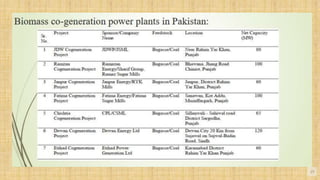
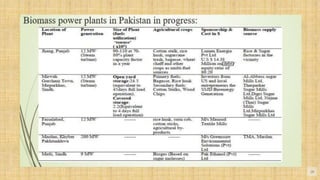
Biomass energy
Green Power renewable energy
Presented by:
Muhammad Zaeem Sarfraz
2
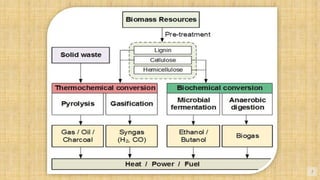
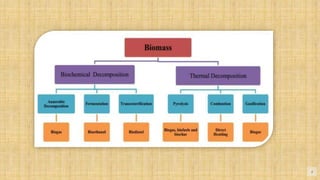
Introduction to Biomass
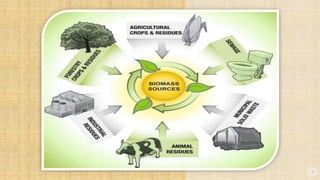
• Biomass is organic matter produced by plants – terrestrial and aquatic – and their
derivatives. It includes
• Forest crops and residues
• Animal manure
• Pakistan is a country where the energy required for domestic purpose such as
cooking is met from dried woods, twigs and leaves of plants and other dried organic
matter such as cow dung.
• This organic matter called as biomass is available freely as waste.
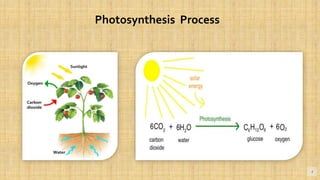
• It contains stored energy from the sun.
• It is a renewable energy source because we can always grow more trees and crops,
and waste will always exist.
• The biomass is fast renewable forms of energy and available freely as waste and
discarded matters.
3
4
Photosynthesis Process
5
6
7
Direct Combustion
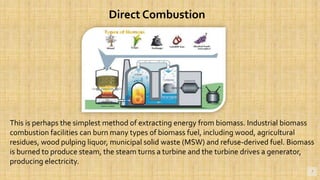
This is perhaps the simplest method of extracting energy from biomass. Industrial biomass
combustion facilities can burn many types of biomass fuel, including wood, agricultural
residues, wood pulping liquor, municipal solid waste (MSW) and refuse-derived fuel. Biomass
is burned to produce steam, the steam turns a turbine and the turbine drives a generator,
producing electricity.
8
Advantages & Disadvantages of direct combustion
• Biomass is easily available and can be grown with relative ease in all parts of the world.
• On a small scale there is most likely a net loss of energy as a lot of energy must be used
for growing the plant mass; biomass is difficult to store in the raw form.
• One of the disadvantages of biomass is that direct combustion of biomass can be
harmful to the environment as burning biomass releases carbon dioxide, which
contributes to the warming of the atmosphere and possible climatic change. Burning
also creates soot and other air pollutants.
• Over-collecting wood can destroy forests. Soils bared of trees erode easily and do not
hold rainfall. Increased runoff can cause flooding downstream.
• Biomass has less energy than a similar volume of fossil fuels
9
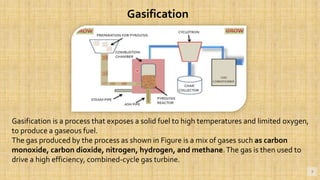
Gasification
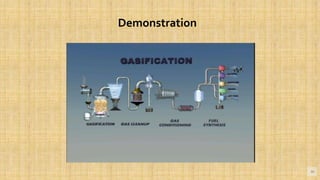
Gasification is a process that exposes a solid fuel to high temperatures and limited oxygen,
to produce a gaseous fuel.
The gas produced by the process as shown in Figure is a mix of gases such as carbon
monoxide, carbon dioxide, nitrogen, hydrogen, and methane.The gas is then used to
drive a high efficiency, combined-cycle gas turbine.
10
Demonstration
11
• Gasification has several advantages over burning solid fuel. One is convenience – one
of the resultant gases, methane, can be treated in a similar way as natural gas, and
used for the same purposes.
• Another advantage of gasification is that it produces a fuel that has had many
impurities removed and could therefore cause fewer pollution problems when burnt.
• Under suitable circumstances, it can also produce synthesis gas, a mixture of carbon
monoxide and hydrogen which can be used to make hydrocarbon (e.g., methane and
methanol) for replacing fossil fuels.
• cc
Advantages & Disadvantages of gasification
12
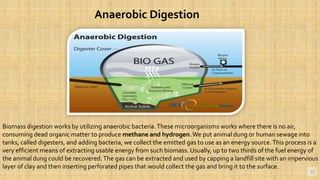
Anaerobic Digestion
Biomass digestion works by utilizing anaerobic bacteria.These microorganisms works where there is no air,
consuming dead organic matter to produce methane and hydrogen.We put animal dung or human sewage into
tanks, called digesters, and adding bacteria, we collect the emitted gas to use as an energy source.This process is a
very efficient means of extracting usable energy from such biomass. Usually, up to two thirds of the fuel energy of
the animal dung could be recovered.The gas can be extracted and used by capping a landfill site with an impervious
layer of clay and then inserting perforated pipes that would collect the gas and bring it to the surface.
13
Advantages & Disadvantages of Anaerobic Digestion
• Due to use ofAnaerobic bacteria they decompose organic matter and absorbs
all nutrients so the remaining waste of that material cant be used for cultivation.
• Over-collecting wood can destroy forests. Soils bared of trees erode easily and
do not hold rainfall. Increased runoff can cause flooding downstream.
• Narrow temperature control range.
• Methane can be used as Alternate fuel source (green solution).
• Lower operating cost.
• Sludge occupy less volume and easier to dry.
14
Demonstration
15
Pyrolysis
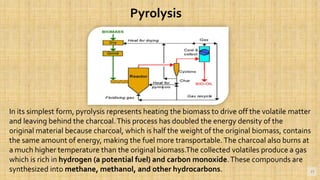
In its simplest form, pyrolysis represents heating the biomass to drive off the volatile matter
and leaving behind the charcoal.This process has doubled the energy density of the
original material because charcoal, which is half the weight of the original biomass, contains
the same amount of energy, making the fuel more transportable.The charcoal also burns at
a much higher temperature than the original biomass.The collected volatiles produce a gas
which is rich in hydrogen (a potential fuel) and carbon monoxide.These compounds are
synthesized into methane, methanol, and other hydrocarbons.
16
Advantages & Disadvantages of Pyrolysis
• The oil, which is easier to store and transport than solid biomass material, is
then burned like petroleum to generate electricity.
• Pyrolysis can also convert biomass into phenol oil, a chemical used to make
wood adhesives, molded plastics, and foam insulation.
• Not suitable for direct use in combustion engines. Alternatively the oil can be
upgraded to a special engine fuel or through gasification process to a syngas
and then bio diesel.
• Much higher density then woody material which reduces storage and
transport cost.
17
Demonstration
18
Fermentation
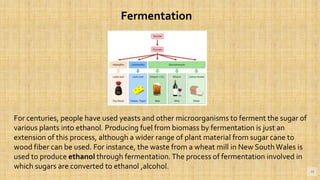
For centuries, people have used yeasts and other microorganisms to ferment the sugar of
various plants into ethanol. Producing fuel from biomass by fermentation is just an
extension of this process, although a wider range of plant material from sugar cane to
wood fiber can be used. For instance, the waste from a wheat mill in New SouthWales is
used to produce ethanol through fermentation.The process of fermentation involved in
which sugars are converted to ethanol ,alcohol.
19
Advantages & Disadvantages of Anaerobic Digestion
• When plant and animal wastes are used as fuel, they cannot be added to
the soil as fertilizer in fermentation microorganism does not absorb
nutrients so they can be used as fertilizers. Soil without fertilizer is
depleted of nutrients and produce fewer crops.
• This system is very expensive and maintenance is very costly.
20
21
22
23
24
Muhammad Zaeem Sarfraz
BS ElectricalTechnology
Bset01163093
Next time you flush the toilet ,you could be doing bit for green energy.
After being stored for 18 days, human waste will from today be
returning to homes in the form of renewable gas.
Thank you
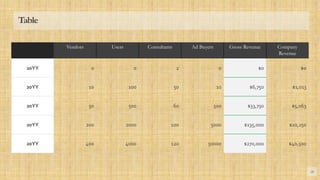
Table
Vendors Users Consultants Ad Buyers Gross Revenue Company
Revenue
20YY 0 0 2 0 $0 $0
20YY 10 100 50 10 $6,750 $1,013
20YY 50 500 60 500 $33,750 $5,063
20YY 200 2000 100 5000 $135,000 $20,250
20YY 400 4000 120 50000 $270,000 $40,500
26

Biomass Energy (Easily Explained)

  • 1.
    Biomass energy Green Powerrenewable energy Presented by: Muhammad Zaeem Sarfraz
  • 2.
    2 Introduction to Biomass •Biomass is organic matter produced by plants – terrestrial and aquatic – and their derivatives. It includes • Forest crops and residues • Animal manure • Pakistan is a country where the energy required for domestic purpose such as cooking is met from dried woods, twigs and leaves of plants and other dried organic matter such as cow dung. • This organic matter called as biomass is available freely as waste. • It contains stored energy from the sun. • It is a renewable energy source because we can always grow more trees and crops, and waste will always exist. • The biomass is fast renewable forms of energy and available freely as waste and discarded matters.
  • 3.
  • 4.
  • 5.
  • 6.
  • 7.
    7 Direct Combustion This isperhaps the simplest method of extracting energy from biomass. Industrial biomass combustion facilities can burn many types of biomass fuel, including wood, agricultural residues, wood pulping liquor, municipal solid waste (MSW) and refuse-derived fuel. Biomass is burned to produce steam, the steam turns a turbine and the turbine drives a generator, producing electricity.
  • 8.
    8 Advantages & Disadvantagesof direct combustion • Biomass is easily available and can be grown with relative ease in all parts of the world. • On a small scale there is most likely a net loss of energy as a lot of energy must be used for growing the plant mass; biomass is difficult to store in the raw form. • One of the disadvantages of biomass is that direct combustion of biomass can be harmful to the environment as burning biomass releases carbon dioxide, which contributes to the warming of the atmosphere and possible climatic change. Burning also creates soot and other air pollutants. • Over-collecting wood can destroy forests. Soils bared of trees erode easily and do not hold rainfall. Increased runoff can cause flooding downstream. • Biomass has less energy than a similar volume of fossil fuels
  • 9.
    9 Gasification Gasification is aprocess that exposes a solid fuel to high temperatures and limited oxygen, to produce a gaseous fuel. The gas produced by the process as shown in Figure is a mix of gases such as carbon monoxide, carbon dioxide, nitrogen, hydrogen, and methane.The gas is then used to drive a high efficiency, combined-cycle gas turbine.
  • 10.
  • 11.
    11 • Gasification hasseveral advantages over burning solid fuel. One is convenience – one of the resultant gases, methane, can be treated in a similar way as natural gas, and used for the same purposes. • Another advantage of gasification is that it produces a fuel that has had many impurities removed and could therefore cause fewer pollution problems when burnt. • Under suitable circumstances, it can also produce synthesis gas, a mixture of carbon monoxide and hydrogen which can be used to make hydrocarbon (e.g., methane and methanol) for replacing fossil fuels. • cc Advantages & Disadvantages of gasification
  • 12.
    12 Anaerobic Digestion Biomass digestionworks by utilizing anaerobic bacteria.These microorganisms works where there is no air, consuming dead organic matter to produce methane and hydrogen.We put animal dung or human sewage into tanks, called digesters, and adding bacteria, we collect the emitted gas to use as an energy source.This process is a very efficient means of extracting usable energy from such biomass. Usually, up to two thirds of the fuel energy of the animal dung could be recovered.The gas can be extracted and used by capping a landfill site with an impervious layer of clay and then inserting perforated pipes that would collect the gas and bring it to the surface.
  • 13.
    13 Advantages & Disadvantagesof Anaerobic Digestion • Due to use ofAnaerobic bacteria they decompose organic matter and absorbs all nutrients so the remaining waste of that material cant be used for cultivation. • Over-collecting wood can destroy forests. Soils bared of trees erode easily and do not hold rainfall. Increased runoff can cause flooding downstream. • Narrow temperature control range. • Methane can be used as Alternate fuel source (green solution). • Lower operating cost. • Sludge occupy less volume and easier to dry.
  • 14.
  • 15.
    15 Pyrolysis In its simplestform, pyrolysis represents heating the biomass to drive off the volatile matter and leaving behind the charcoal.This process has doubled the energy density of the original material because charcoal, which is half the weight of the original biomass, contains the same amount of energy, making the fuel more transportable.The charcoal also burns at a much higher temperature than the original biomass.The collected volatiles produce a gas which is rich in hydrogen (a potential fuel) and carbon monoxide.These compounds are synthesized into methane, methanol, and other hydrocarbons.
  • 16.
    16 Advantages & Disadvantagesof Pyrolysis • The oil, which is easier to store and transport than solid biomass material, is then burned like petroleum to generate electricity. • Pyrolysis can also convert biomass into phenol oil, a chemical used to make wood adhesives, molded plastics, and foam insulation. • Not suitable for direct use in combustion engines. Alternatively the oil can be upgraded to a special engine fuel or through gasification process to a syngas and then bio diesel. • Much higher density then woody material which reduces storage and transport cost.
  • 17.
  • 18.
    18 Fermentation For centuries, peoplehave used yeasts and other microorganisms to ferment the sugar of various plants into ethanol. Producing fuel from biomass by fermentation is just an extension of this process, although a wider range of plant material from sugar cane to wood fiber can be used. For instance, the waste from a wheat mill in New SouthWales is used to produce ethanol through fermentation.The process of fermentation involved in which sugars are converted to ethanol ,alcohol.
  • 19.
    19 Advantages & Disadvantagesof Anaerobic Digestion • When plant and animal wastes are used as fuel, they cannot be added to the soil as fertilizer in fermentation microorganism does not absorb nutrients so they can be used as fertilizers. Soil without fertilizer is depleted of nutrients and produce fewer crops. • This system is very expensive and maintenance is very costly.
  • 20.
  • 21.
  • 22.
  • 23.
  • 24.
  • 25.
    Muhammad Zaeem Sarfraz BSElectricalTechnology Bset01163093 Next time you flush the toilet ,you could be doing bit for green energy. After being stored for 18 days, human waste will from today be returning to homes in the form of renewable gas. Thank you
  • 26.
    Table Vendors Users ConsultantsAd Buyers Gross Revenue Company Revenue 20YY 0 0 2 0 $0 $0 20YY 10 100 50 10 $6,750 $1,013 20YY 50 500 60 500 $33,750 $5,063 20YY 200 2000 100 5000 $135,000 $20,250 20YY 400 4000 120 50000 $270,000 $40,500 26