Reproductive System In Plants
•Breeding procedure depends upon:
Mode of reproduction
Pollination of crop species
Cell Division
• Cell division id of 2 types:
1. Mitosis
2. Meiosis
MITOSIS:
• Cell increases in number
• Mitotic cell division takes place in somatic cells
resulting in growth of organism
• Two identical daughter cells produced from
mother cell.
• It has 5 stages: Interphase, Prophase,
metaphase, Anaphase, Telophase
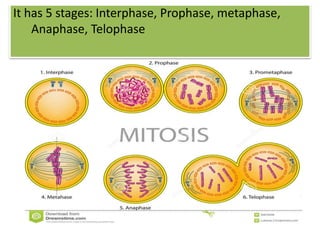
It has 5 stages: Interphase, Prophase, metaphase,
Anaphase, Telophase
Meiosis
• Meiotic cell division occurs in reproductive organs
during gamete formation
• Reduce the chromosome no. from diploid (2n) 
haploid (n)
• Two divisions of cytoplasm and one duplication of
chromosome occurs
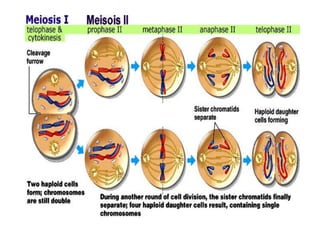
• 1st Meiotic division: Reductional Division 2
daughter cells formed with half chromosome
number
• 2nd meiotic division: Similar to mitotic division
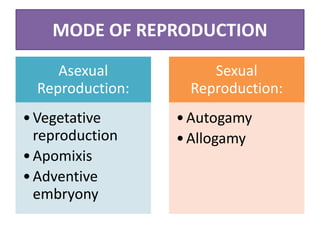
MODE OF REPRODUCTION
Asexual
Reproduction:
•Vegetative
reproduction
•Apomixis
•Adventive
embryony
Sexual
Reproduction:
•Autogamy
•Allogamy
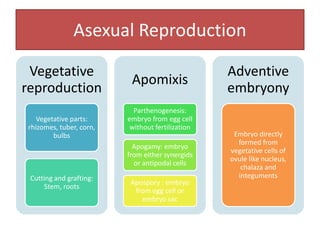
Asexual Reproduction
Vegetative
reproduction
Vegetative parts:
rhizomes, tuber, corn,
bulbs
Cutting and grafting:
Stem, roots
Apomixis
Parthenogenesis:
embryo from egg cell
without fertilization
Apogamy: embryo
from either synergids
or antipodal cells
Apospory : embryo
from egg cell or
embryo sac
Adventive
embryony
Embryo directly
formed from
vegetative cells of
ovule like nucleus,
chalaza and
integuments
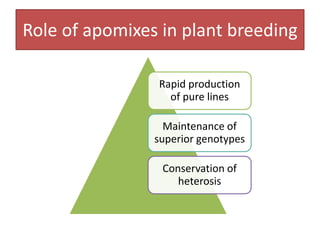
Role of apomixes in plant breeding
Rapid production
of pure lines
Maintenance of
superior genotypes
Conservation of
heterosis
Significance of asexual reproduction
• It leads to perpetuation of same genotype with
great conservation
• Large no. of genetically identical genotypes can
be obtained irrespective of degree of
heterozygosity
• Desirable clone can be maintained
• Mutation breeding is easy in vegetative produced
plants
• Polyploidy breeding is also very useful as induced
bud can be used as propagule and polyploidy can
be maintained
Sexual reproduction
Process involves fusion of male and female gametes to
form seed and it is also called Amphimixes
Flower has special structure for reproduction
• Androecium  Stamen
• Gynoecium Carpel
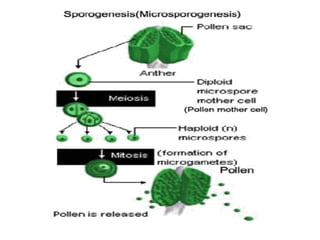
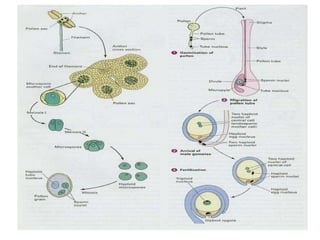
Sporogenesis: production of microspore and megaspore
• Microspores are produced in anthers  Microsporogenesis
• Megaspores are produced in ovule  Megasporogenesis
Microsporogenesis
• Anther has 4 pollen sacs, with numerous
pollen mother cells (PMCs)
meiosis
• Each PMC-------- 4 haploid cells
(microspores)pollen grains(by thickening of
cell wall)
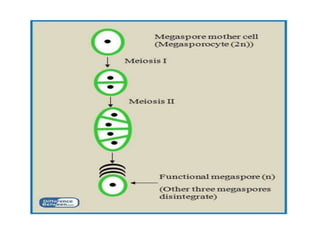
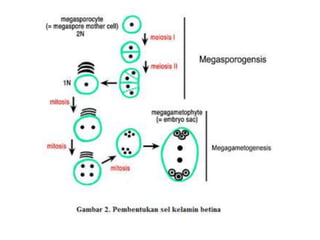
Megasporogenesis
• Occurs in ovules inside ovary
• Each single cell in ovule differentiates into
Megaspore Mother cell  undergo meiosis
4haploid megaspores 3 haploid megapores
degenerates
• One functional megaspore per ovule obtained
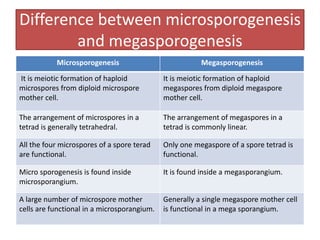
Difference between microsporogenesis
and megasporogenesis
Microsporogenesis Megasporogenesis
It is meiotic formation of haploid
microspores from diploid microspore
mother cell.
It is meiotic formation of haploid
megaspores from diploid megaspore
mother cell.
The arrangement of microspores in a
tetrad is generally tetrahedral.
The arrangement of megaspores in a
tetrad is commonly linear.
All the four microspores of a spore terad
are functional.
Only one megaspore of a spore tetrad is
functional.
Micro sporogenesis is found inside
microsporangium.
It is found inside a megasporangium.
A large number of microspore mother
cells are functional in a microsporangium.
Generally a single megaspore mother cell
is functional in a mega sporangium.
Gametogenesis
Production of male and female gametes in microspore and
megaspores.
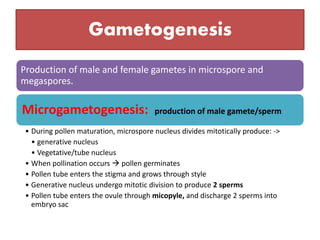
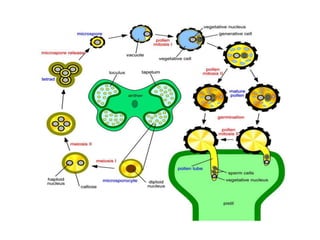
Microgametogenesis: production of male gamete/sperm
• During pollen maturation, microspore nucleus divides mitotically produce: ->
• generative nucleus
• Vegetative/tube nucleus
• When pollination occurs  pollen germinates
• Pollen tube enters the stigma and grows through style
• Generative nucleus undergo mitotic division to produce 2 sperms
• Pollen tube enters the ovule through micopyle, and discharge 2 sperms into
embryo sac
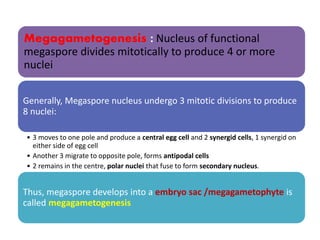
Megagametogenesis : Nucleus of functional
megaspore divides mitotically to produce 4 or more
nuclei
Generally, Megaspore nucleus undergo 3 mitotic divisions to produce
8 nuclei:
• 3 moves to one pole and produce a central egg cell and 2 synergid cells, 1 synergid on
either side of egg cell
• Another 3 migrate to opposite pole, forms antipodal cells
• 2 remains in the centre, polar nuclei that fuse to form secondary nucleus.
Thus, megaspore develops into a embryo sac /megagametophyte is
called megagametogenesis
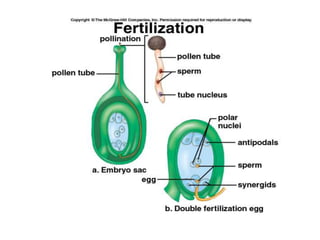
Fertilization
• Fusion of one of the sperm with egg cell produce diploid zygote is
fertilization
– Zygote divide mitotically to produce a diploid embryo
• Fusion of remaining sperm with secondary nucleus to form a
triploid primary endosperm nucleus is Triple fusion
– Triploid primary endosperm mitotically divide repeatedly to form
endosperm
– During seed development, endosperm provides nutrition to
developing embryo
• One male gametes unite with the eggs cell known as syngamy or
fertilization and another male gamete fuse with the pollar nuclei
known as triple fusion, when these two processes occurs
simultaneously known as double fertilization
Mode Of Pollination
Depending on nature of pollination plants can be categorized as self
and cross pollinated
Autogamy/ self fertilization: Transfer pollens from anther to stigma of
same plant
• Leads to homozygosity
• Several mechanism : bisexualiy, homogamy, cleistogamy, chasmogamy
Allogamy/ cross fertilization: pollen grains transfer from anther of
one plant to stigma of another plant.
• Leads to heterozygosity
• Several mechanism: monecy, dioecy, dichogarny, heterostyly, herkogamy, self
incompetibility, male sterlity
Autogamy/ self pollination
Bisexuality
• male and female organ on same plant
Homogamy
• anther and stigma of flower matures at same time
Cleistogamy
• pollination and fertilization occurs in unopened flower bud
• Wheat, oats and barley
Chasmogamy
• flower opens only after completion of pollination
• Wheat, oats, barley and rice
Allogamy / cross pollinated
Dicliny/unisexuality
• Monecy: Same plant but different male female flowers
• Maize, banana, castor and mango
• Dioecy: Staminate and pistillate flowers on different plants
• Papaya and spinach
Dichogamy
• Stamen and pistil of hermophrodite plant mature at different times
• Protandry: maize and sugarbeat (stamen mature before pistil)
• Protogyny: bajra (pistil mature first)
Heterostyly
• Styles and filament of flower are of different length
Herkogamy
• Due to physical barrier like hyline membranearound anther
• Inability of fertile pollen to fertilize the same flower
• Brassica, radish, rye and nicotiana
Self incompatibility
• Pollen grains are non functional
• Types: Genetic (GMS), Cytoplasmic (CMS), CGMS
and Transgenic
Male Sterility
Allogamy
Autogamous species
• Cereals: Rice, wheat, barley, oats
• Legumes: chickpea, pea, cowpea, lentils, green gram,
black gram soya bean, moth bean
• Oilseeds: Sesame, linseed
• Vegetables: tomato, okra, brinjal, peanut, chillies
Seed propagated
• potato
Vegetative propagated
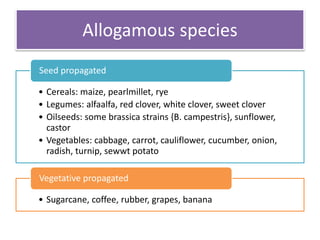
Allogamous species
• Cereals: maize, pearlmillet, rye
• Legumes: alfaalfa, red clover, white clover, sweet clover
• Oilseeds: some brassica strains {B. campestris}, sunflower,
castor
• Vegetables: cabbage, carrot, cauliflower, cucumber, onion,
radish, turnip, sewwt potato
Seed propagated
• Sugarcane, coffee, rubber, grapes, banana
Vegetative propagated
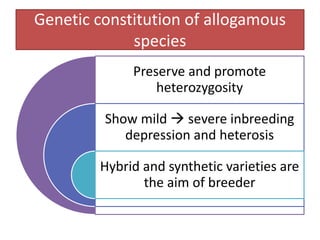
Genetic constitution of allogamous
species
Preserve and promote
heterozygosity
Show mild  severe inbreeding
depression and heterosis
Hybrid and synthetic varieties are
the aim of breeder
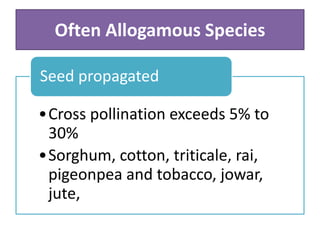
Often Allogamous Species
•Cross pollination exceeds 5% to
30%
•Sorghum, cotton, triticale, rai,
pigeonpea and tobacco, jowar,
jute,
Seed propagated
Relevance of Mode of Reproduction
• It determines:
– Genetic constitution
– Nature of gene action
– The ease in pollen control
– Stability of varieties after realease

Reproductive system in plants

  • 1.
    Reproductive System InPlants •Breeding procedure depends upon: Mode of reproduction Pollination of crop species
  • 2.
    Cell Division • Celldivision id of 2 types: 1. Mitosis 2. Meiosis MITOSIS: • Cell increases in number • Mitotic cell division takes place in somatic cells resulting in growth of organism • Two identical daughter cells produced from mother cell. • It has 5 stages: Interphase, Prophase, metaphase, Anaphase, Telophase
  • 3.
    It has 5stages: Interphase, Prophase, metaphase, Anaphase, Telophase
  • 4.
    Meiosis • Meiotic celldivision occurs in reproductive organs during gamete formation • Reduce the chromosome no. from diploid (2n)  haploid (n) • Two divisions of cytoplasm and one duplication of chromosome occurs • 1st Meiotic division: Reductional Division 2 daughter cells formed with half chromosome number • 2nd meiotic division: Similar to mitotic division
  • 6.
  • 7.
    Asexual Reproduction Vegetative reproduction Vegetative parts: rhizomes,tuber, corn, bulbs Cutting and grafting: Stem, roots Apomixis Parthenogenesis: embryo from egg cell without fertilization Apogamy: embryo from either synergids or antipodal cells Apospory : embryo from egg cell or embryo sac Adventive embryony Embryo directly formed from vegetative cells of ovule like nucleus, chalaza and integuments
  • 8.
    Role of apomixesin plant breeding Rapid production of pure lines Maintenance of superior genotypes Conservation of heterosis
  • 9.
    Significance of asexualreproduction • It leads to perpetuation of same genotype with great conservation • Large no. of genetically identical genotypes can be obtained irrespective of degree of heterozygosity • Desirable clone can be maintained • Mutation breeding is easy in vegetative produced plants • Polyploidy breeding is also very useful as induced bud can be used as propagule and polyploidy can be maintained
  • 10.
    Sexual reproduction Process involvesfusion of male and female gametes to form seed and it is also called Amphimixes Flower has special structure for reproduction • Androecium  Stamen • Gynoecium Carpel Sporogenesis: production of microspore and megaspore • Microspores are produced in anthers  Microsporogenesis • Megaspores are produced in ovule  Megasporogenesis
  • 11.
    Microsporogenesis • Anther has4 pollen sacs, with numerous pollen mother cells (PMCs) meiosis • Each PMC-------- 4 haploid cells (microspores)pollen grains(by thickening of cell wall)
  • 13.
    Megasporogenesis • Occurs inovules inside ovary • Each single cell in ovule differentiates into Megaspore Mother cell  undergo meiosis 4haploid megaspores 3 haploid megapores degenerates • One functional megaspore per ovule obtained
  • 15.
    Difference between microsporogenesis andmegasporogenesis Microsporogenesis Megasporogenesis It is meiotic formation of haploid microspores from diploid microspore mother cell. It is meiotic formation of haploid megaspores from diploid megaspore mother cell. The arrangement of microspores in a tetrad is generally tetrahedral. The arrangement of megaspores in a tetrad is commonly linear. All the four microspores of a spore terad are functional. Only one megaspore of a spore tetrad is functional. Micro sporogenesis is found inside microsporangium. It is found inside a megasporangium. A large number of microspore mother cells are functional in a microsporangium. Generally a single megaspore mother cell is functional in a mega sporangium.
  • 17.
    Gametogenesis Production of maleand female gametes in microspore and megaspores. Microgametogenesis: production of male gamete/sperm • During pollen maturation, microspore nucleus divides mitotically produce: -> • generative nucleus • Vegetative/tube nucleus • When pollination occurs  pollen germinates • Pollen tube enters the stigma and grows through style • Generative nucleus undergo mitotic division to produce 2 sperms • Pollen tube enters the ovule through micopyle, and discharge 2 sperms into embryo sac
  • 19.
    Megagametogenesis : Nucleusof functional megaspore divides mitotically to produce 4 or more nuclei Generally, Megaspore nucleus undergo 3 mitotic divisions to produce 8 nuclei: • 3 moves to one pole and produce a central egg cell and 2 synergid cells, 1 synergid on either side of egg cell • Another 3 migrate to opposite pole, forms antipodal cells • 2 remains in the centre, polar nuclei that fuse to form secondary nucleus. Thus, megaspore develops into a embryo sac /megagametophyte is called megagametogenesis
  • 21.
    Fertilization • Fusion ofone of the sperm with egg cell produce diploid zygote is fertilization – Zygote divide mitotically to produce a diploid embryo • Fusion of remaining sperm with secondary nucleus to form a triploid primary endosperm nucleus is Triple fusion – Triploid primary endosperm mitotically divide repeatedly to form endosperm – During seed development, endosperm provides nutrition to developing embryo • One male gametes unite with the eggs cell known as syngamy or fertilization and another male gamete fuse with the pollar nuclei known as triple fusion, when these two processes occurs simultaneously known as double fertilization
  • 23.
    Mode Of Pollination Dependingon nature of pollination plants can be categorized as self and cross pollinated Autogamy/ self fertilization: Transfer pollens from anther to stigma of same plant • Leads to homozygosity • Several mechanism : bisexualiy, homogamy, cleistogamy, chasmogamy Allogamy/ cross fertilization: pollen grains transfer from anther of one plant to stigma of another plant. • Leads to heterozygosity • Several mechanism: monecy, dioecy, dichogarny, heterostyly, herkogamy, self incompetibility, male sterlity
  • 24.
    Autogamy/ self pollination Bisexuality •male and female organ on same plant Homogamy • anther and stigma of flower matures at same time Cleistogamy • pollination and fertilization occurs in unopened flower bud • Wheat, oats and barley Chasmogamy • flower opens only after completion of pollination • Wheat, oats, barley and rice
  • 25.
    Allogamy / crosspollinated Dicliny/unisexuality • Monecy: Same plant but different male female flowers • Maize, banana, castor and mango • Dioecy: Staminate and pistillate flowers on different plants • Papaya and spinach Dichogamy • Stamen and pistil of hermophrodite plant mature at different times • Protandry: maize and sugarbeat (stamen mature before pistil) • Protogyny: bajra (pistil mature first) Heterostyly • Styles and filament of flower are of different length Herkogamy • Due to physical barrier like hyline membranearound anther
  • 26.
    • Inability offertile pollen to fertilize the same flower • Brassica, radish, rye and nicotiana Self incompatibility • Pollen grains are non functional • Types: Genetic (GMS), Cytoplasmic (CMS), CGMS and Transgenic Male Sterility Allogamy
  • 27.
    Autogamous species • Cereals:Rice, wheat, barley, oats • Legumes: chickpea, pea, cowpea, lentils, green gram, black gram soya bean, moth bean • Oilseeds: Sesame, linseed • Vegetables: tomato, okra, brinjal, peanut, chillies Seed propagated • potato Vegetative propagated
  • 28.
    Allogamous species • Cereals:maize, pearlmillet, rye • Legumes: alfaalfa, red clover, white clover, sweet clover • Oilseeds: some brassica strains {B. campestris}, sunflower, castor • Vegetables: cabbage, carrot, cauliflower, cucumber, onion, radish, turnip, sewwt potato Seed propagated • Sugarcane, coffee, rubber, grapes, banana Vegetative propagated
  • 29.
    Genetic constitution ofallogamous species Preserve and promote heterozygosity Show mild  severe inbreeding depression and heterosis Hybrid and synthetic varieties are the aim of breeder
  • 30.
    Often Allogamous Species •Crosspollination exceeds 5% to 30% •Sorghum, cotton, triticale, rai, pigeonpea and tobacco, jowar, jute, Seed propagated
  • 31.
    Relevance of Modeof Reproduction • It determines: – Genetic constitution – Nature of gene action – The ease in pollen control – Stability of varieties after realease