LEARNING MODULE 
BIOLOGY 
FORM 4 — 2008 EDITION 
Prepared by : 
NAME 
CLASS 
AL MUMIN HJ. AL KANTA 
SMK Agaseh, Lahad Datu, SABAH
DIRECTION & ORIENTATION 
1 
LEARNING MODULE - BIOLOGY FORM 4 
Gastro (stomach) 
Gaster juice is secreted by 
stomach wall. 
Hem (blood) 
Type of blood pigment are 
haemoglobin & haemoeritrin. 
Hepato (liver) 
Hepatic portal vein carry digested 
food from small intestine to the 
liver. 
Cardio (heart) 
Cardiovascular disease—heart 
attack. 
Reni, reno (kidney) 
Adrenaline is the hormone 
produced to prepare body to 
counter emergency such as fear 
and anger. 
Cerebro (brain) 
Cerebrum is the structure that 
control conscious actions.. 
Thrombo (coagulate) 
Thromboplastin & trombin 
(enzyme for blood coagulation). 
Min2009 
a, an, ar (without) 
e.g., anaerobic respiration. 
ad (above) 
e.g., Adrenal gland. 
aero (air) 
e.g., Aerobic respiration. 
anti (anti/fight) 
e.g., antibody & antitoxin. 
bi (two) 
e.g., bisep muscle & bicuspid 
valve. 
co (together) 
e.g., codominan gene. 
glyco (sugar) 
e.g., glycolysis & glycogen. 
homo (same) 
hydro (water) 
e.g., hydrolysis. 
hyper (high) 
e.g., hypertonic 
hypo (low) 
e.g., hypoglisemia (low 
concentration of glucose) 
macro (big/large) 
e.g., macronutrient. 
mono (one/single) 
e.g., monosaccharides (single 
sugar molecule) 
multi/poly (many) 
e.g., multicellular. 
peri (around) 
e.g., perisikel (plant tissue) 
pod (leg) 
e.g. pseudopodium. 
sub (below) 
e.g., submaksila gland. 
genesis/genetic (formation) 
e.g., oogenesis. 
lysis (break down) 
e.g., haemolysis (red blood cell 
burst) 
uria (urine) 
e.g., glycosuria. 
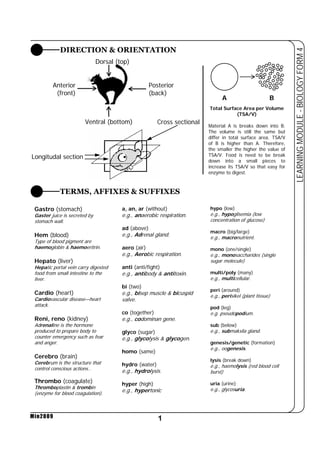
Anterior 
(front) 
Posterior 
(back) 
Longitudal section 
A B 
Total Surface Area per Volume 
(TSA/V) 
Material A is breaks down into B. 
The volume is still the same but 
differ in total surface area. TSA/V 
of B is higher than A. Therefore, 
the smaller the higher the value of 
TSA/V. Food is need to be break 
down into a small pieces to 
increase its TSA/V so that easy for 
enzyme to digest. 
Cross sectional 
Dorsal (top) 
Ventral (bottom) 
TERMS, AFFIXES & SUFFIXES
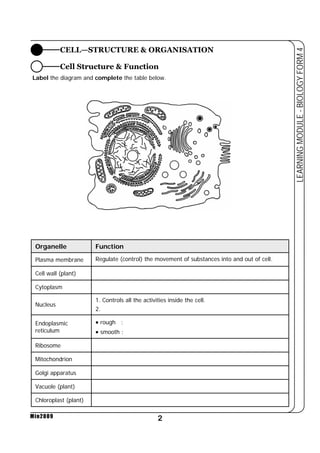
CELL—STRUCTURE & ORGANISATION 
Cell Structure & Function 
Label the diagram and complete the table below. 
Organelle Function 
Plasma membrane Regulate (control) the movement of substances into and out of cell. 
Cell wall (plant) 
Cytoplasm 
2 
LEARNING MODULE - BIOLOGY FORM 4 
Nucleus 
Min2009 
1. Controls all the activities inside the cell. 
2. 
Endoplasmic 
reticulum 
• rough : 
• smooth : 
Ribosome 
Mitochondrion 
Golgi apparatus 
Vacuole (plant) 
Chloroplast (plant)
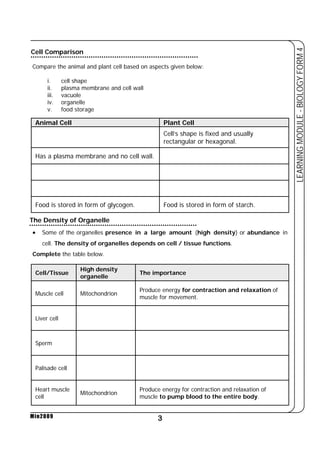
Cell Comparison 
Compare the animal and plant cell based on aspects given below: 
i. cell shape 
ii. plasma membrane and cell wall 
iii. vacuole 
iv. organelle 
v. food storage 
Animal Cell Plant Cell 
The Density of Organelle 
• Some of the organelles presence in a large amount (high density) or abundance in 
cell. The density of organelles depends on cell / tissue functions. 
3 
LEARNING MODULE - BIOLOGY FORM 4 
Complete the table below. 
Min2009 
Cell’s shape is fixed and usually 
rectangular or hexagonal. 
Has a plasma membrane and no cell wall. 
Food is stored in form of glycogen. Food is stored in form of starch. 
Cell/Tissue High density 
organelle The importance 
Muscle cell Mitochondrion Produce energy for contraction and relaxation of 
muscle for movement. 
Liver cell 
Sperm 
Palisade cell 
Heart muscle 
cell Mitochondrion Produce energy for contraction and relaxation of 
muscle to pump blood to the entire body.
Unicellular Organisms 
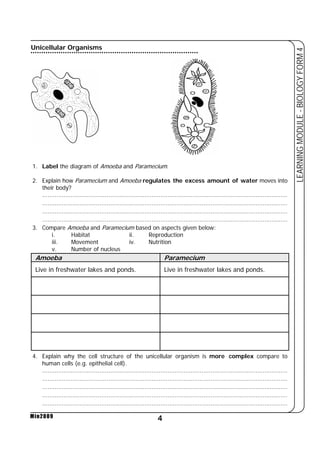
1. Label the diagram of Amoeba and Paramecium. 
2. Explain how Paramecium and Amoeba regulates the excess amount of water moves into 
their body? 
......................................................................................................................................... 
......................................................................................................................................... 
......................................................................................................................................... 
......................................................................................................................................... 
3. Compare Amoeba and Paramecium based on aspects given below: 
i. Habitat ii. Reproduction 
iii. Movement iv. Nutrition 
v. Number of nucleus 
Amoeba Paramecium 
Live in freshwater lakes and ponds. Live in freshwater lakes and ponds. 
4. Explain why the cell structure of the unicellular organism is more complex compare to 
human cells (e.g. epithelial cell). 
......................................................................................................................................... 
......................................................................................................................................... 
......................................................................................................................................... 
......................................................................................................................................... 
......................................................................................................................................... 
4 
LEARNING MODULE - BIOLOGY FORM 4 
Min2009
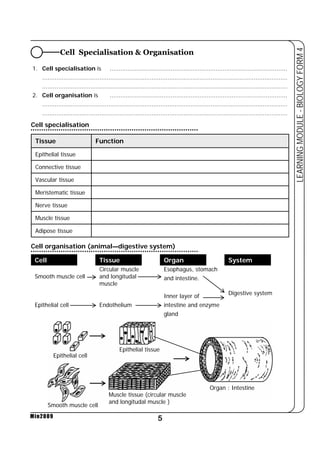
Cell Specialisation & Organisation 
1. Cell specialisation is ................................................................................................... 
......................................................................................................................................... 
......................................................................................................................................... 
2. Cell organisation is ................................................................................................... 
......................................................................................................................................... 
......................................................................................................................................... 
Cell Tissue Organ System 
5 
LEARNING MODULE - BIOLOGY FORM 4 
Tissue Function 
Epithelial tissue 
Connective tissue 
Vascular tissue 
Meristematic tissue 
Nerve tissue 
Muscle tissue 
Adipose tissue 
Smooth muscle cell 
Epithelial cell 
Min2009 
Circular muscle 
and longitudal 
muscle 
Endothelium 
Esophagus, stomach 
and intestine. 
Inner layer of 
intestine and enzyme 
gland 
Digestive system 
Epithelial cell 
Smooth muscle cell 
Epithelial tissue 
Muscle tissue (circular muscle 
and longitudal muscle ) 
Organ : Intestine 
Cell specialisation 
Cell organisation (animal—digestive system)
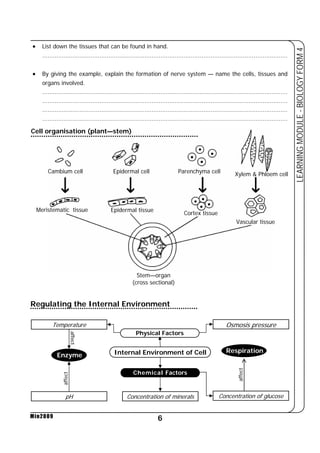
Cambium cell Epidermal cell Parenchyma cell Xylem & Phloem cell 
Meristematic tissue Epidermal tissue Cortex tissue 
Temperature Osmosis pressure 
Physical Factors 
6 
LEARNING MODULE - BIOLOGY FORM 4 
Min2009 
Vascular tissue 
Stem—organ 
(cross sectional) 
Cell organisation (plant—stem) 
Regulating the Internal Environment 
Internal Environment of Cell 
Chemical Factors 
Respiration 
affect 
Enzyme 
affect 
pH Concentration of minerals 
affect 
Concentration of glucose 
• List down the tissues that can be found in hand. 
......................................................................................................................................... 
• By giving the example, explain the formation of nerve system — name the cells, tissues and 
organs involved. 
......................................................................................................................................... 
......................................................................................................................................... 
......................................................................................................................................... 
.........................................................................................................................................
1. Why the internal environment of cells need to be maintained (constant)? 
......................................................................................................................................... 
......................................................................................................................................... 
......................................................................................................................................... 
2. Based on diagram, give the meaning of homeostasis 
......................................................................................................................................... 
......................................................................................................................................... 
......................................................................................................................................... 
7 
LEARNING MODULE - BIOLOGY FORM 4 
3. Explain the effect of factors given below. 
Factor Effect to the cell 
Temperature 
Concentration of 
mineral 
Min2009 
Environment with higher concentration (hypertonic) will caused water to 
move out of the cell. Cell become dehydrated and finally die. 
Concentration of 
glucose 
pH The increase or decrease of pH will caused enzyme to denatured. 
Chemical reaction will stop and cell die. 
Discussion 
Predict the effect of factors given below to onion cell; 
i. temperature 0 oC ................................................................................... 
ii. salt solution 50% ................................................................................... 
iii. solution with no glucose / sugar ................................................................................... 
iv. hydrochloric acid solution (pH 2.0) ...................................................................................
Substances listed below are essential to living things. Explain the importance substances to the 
cell. 
Substances Function (the importance to the cell) 
Glucose Source of energy. 
Amino acid 
Minerals 
Water 
Oxygen 
8 
LEARNING MODULE - BIOLOGY FORM 4 
Min2009 
MOVEMENT OF SUBSTANCES 
List out two substances that must be excreted or removed form the cell and their effect. 
Substances Effect if not excreted from the cell 
Structure of Plasma Membrane 
1. Why substances need to move (in or out) the plasma membrane? 
......................................................................................................................................... 
......................................................................................................................................... 
......................................................................................................................................... 
2. Explain the terms given below: 
i. polar .............................................................................................................. 
ii. non-polar .............................................................................................................. 
iii. hydrophobic .............................................................................................................. 
iv. hydrophilic .............................................................................................................. 
3. State the characteristics of substances given below: 
i. glucose .............................................................................................................. 
ii. amino acid .............................................................................................................. 
iii. sodium ions .............................................................................................................. 
iv. water .............................................................................................................. 
v. lipid .............................................................................................................. 
4. What is the meaning of selectively permeable? 
......................................................................................................................................... 
......................................................................................................................................... 
.........................................................................................................................................
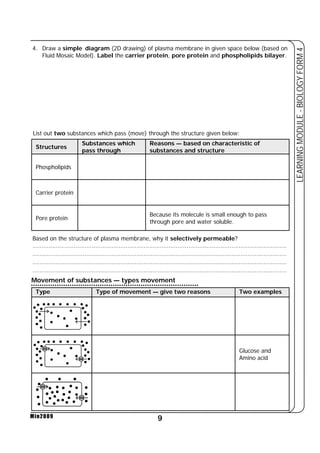
4. Draw a simple diagram (2D drawing) of plasma membrane in given space below (based on 
Fluid Mosaic Model). Label the carrier protein, pore protein and phospholipids bilayer. 
List out two substances which pass (move) through the structure given below: 
Structures Reasons — based on characteristic of 
Based on the structure of plasma membrane, why it selectively permeable? 
.............................................................................................................................................. 
.............................................................................................................................................. 
.............................................................................................................................................. 
.............................................................................................................................................. 
9 
LEARNING MODULE - BIOLOGY FORM 4 
Min2009 
substances and structure 
Phospholipids 
Carrier protein 
Pore protein Because its molecule is small enough to pass 
through pore and water soluble. 
Substances which 
pass through 
Movement of substances — types movement 
Type Type of movement — give two reasons Two examples 
Glucose and 
Amino acid
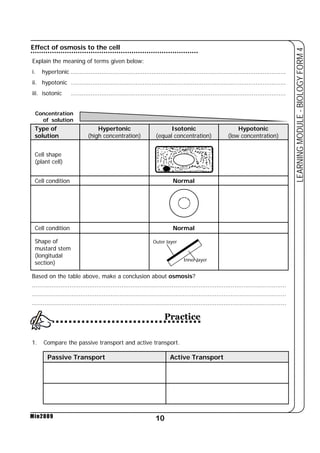
Effect of osmosis to the cell 
Explain the meaning of terms given below: 
i. hypertonic ........................................................................................................................ 
ii. hypotonic ........................................................................................................................ 
iii. isotonic ........................................................................................................................ 
1. Compare the passive transport and active transport. 
10 
LEARNING MODULE - BIOLOGY FORM 4 
Concentration 
of solution 
Type of 
solution 
Min2009 
Hypertonic 
(high concentration) 
Isotonic 
(equal concentration) 
Hypotonic 
(low concentration) 
Cell shape 
(plant cell) 
Cell condition Normal 
Shape of 
Outer layer 
mustard stem 
(longitudal 
section) 
Inner layer 
Based on the table above, make a conclusion about osmosis? 
.............................................................................................................................................. 
.............................................................................................................................................. 
.............................................................................................................................................. 
Practice 
Passive Transport Active Transport
2. What is the effect of the excess use of fertilizer to the plant? Why? 
....................................................................................................................................... 
....................................................................................................................................... 
....................................................................................................................................... 
3. Why fermented fruits are not rotten (busuk) easily? 
....................................................................................................................................... 
....................................................................................................................................... 
4. Vegetables are wilt (layu) if not soaked in the water. Why? 
....................................................................................................................................... 
....................................................................................................................................... 
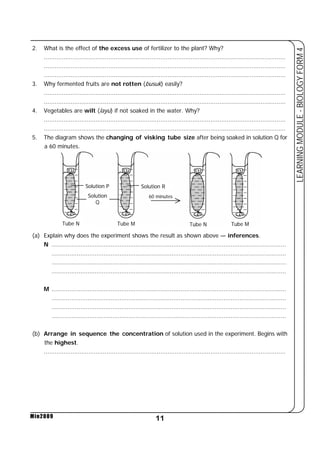
5. The diagram shows the changing of visking tube size after being soaked in solution Q for 
Solution P Solution R 
Solution 
Q 
60 minutes 
(a) Explain why does the experiment shows the result as shown above — inferences. 
N ................................................................................................................................... 
................................................................................................................................... 
................................................................................................................................... 
................................................................................................................................... 
M ................................................................................................................................... 
................................................................................................................................... 
................................................................................................................................... 
................................................................................................................................... 
(b) Arrange in sequence the concentration of solution used in the experiment. Begins with 
the highest. 
....................................................................................................................................... 
11 
LEARNING MODULE - BIOLOGY FORM 4 
a 60 minutes. 
Min2009 
Tube N Tube M Tube N Tube M
CHEMICAL COMPOSITION IN THE CELL 
What is: 
i. inorganic compound ................................................................................................... 
......................................................................................................................................... 
ii. organic compound ................................................................................................... 
......................................................................................................................................... 
State one the role of substances and organic compounds given below. 
Substances The importance (state one only) 
Nitrogen Synthesis of protein, nucleic acid and organic compounds. 
Sodium 
Organic 
compound The importance to the cells 
Carbohydrates 
Lipid 
Protein Formation of plasma membrane and cell growth. 
1 ......................................................................................................................................... 
2 ......................................................................................................................................... 
3 ......................................................................................................................................... 
4 ......................................................................................................................................... 
Carbo means carbon (C), while hydrates is water (H2O). Based on that meaning, what are the 
elements that made up carbohydrates? 
.............................................................................................................................................. 
12 
LEARNING MODULE - BIOLOGY FORM 4 
Sulphur 
Phosphorus 
Calsium 
Magnesium 
Nucleic acid 
Min2009 
Role of Water 
Carbohydrates
13 
LEARNING MODULE - BIOLOGY FORM 4 
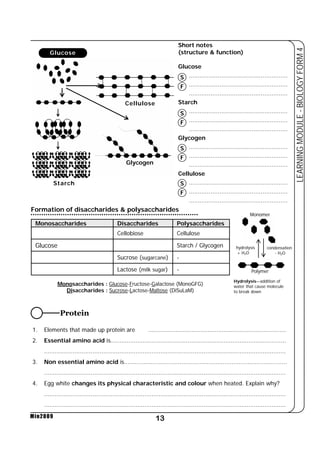
Glucose 
Min2009 
Short notes 
(structure & function) 
Glucose 
....................................................... 
....................................................... 
....................................................... 
S 
F 
Starch 
....................................................... 
....................................................... 
....................................................... 
S 
F 
Glycogen 
....................................................... 
....................................................... 
....................................................... 
S 
F 
Cellulose 
....................................................... 
....................................................... 
....................................................... 
Glycogen 
Starch 
Cellulose 
S 
F 
Monosaccharides Disaccharides Polysaccharides 
Cellobiose Cellulose 
Glucose Starch / Glycogen 
Sucrose (sugarcane) - 
Lactose (milk sugar) - 
Monosaccharides : Glucose-Fructose-Galactose (MonoGFG) 
Disaccharides : Sucrose-Lactose-Maltose (DiSuLaM) 
Monomer 
condensation 
Polymer 
- H2O 
hydrolysis 
+ H2O 
Formation of disaccharides & polysaccharides 
Hydrolysis—addition of 
water that cause molecule 
to break down 
Protein 
1. Elements that made up protein are ............................................................................. 
2. Essential amino acid is.................................................................................................. 
....................................................................................................................................... 
3. Non essential amino acid is........................................................................................... 
....................................................................................................................................... 
4. Egg white changes its physical characteristic and colour when heated. Explain why? 
....................................................................................................................................... 
.......................................................................................................................................
14 
LEARNING MODULE - BIOLOGY FORM 4 
Types protein based on function 
Level of protein structure & examples 
Min2009 
Essential amino acids 
1. Alanine 
2. Aspartic acid 
3. Glutamic acid 
4. Aspargine 
5. Gyicine 
6. Glutamine 
7. Proline 
8. Serine 
9. Sisteine 
10. Tyrosine 
Non essential amino 
acids 
1. Arginine 
2. Phenilalanine 
3. Histidine 
4. Isolucine 
5. Leucine 
6. Lysine 
7. Methionine 
8. Threonine 
9. Tryptophane 
10. Valine 
DON’T MEMORISE 
THIS LIST 
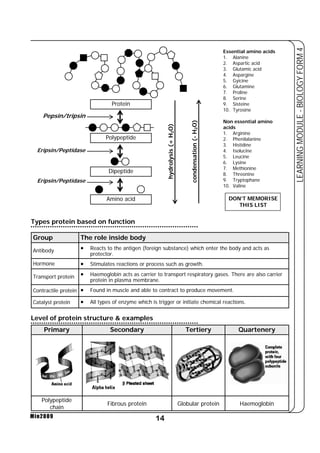
Protein 
Polypeptide 
Dipeptide 
Amino acid 
Pepsin/tripsin 
Eripsin/Peptidase 
Eripsin/Peptidase 
hydrolysis (+ H2O) 
condensation (- H2O) 
Group The role inside body 
Antibody • Reacts to the antigen (foreign substance) which enter the body and acts as 
protector. 
Hormone • Stimulates reactions or process such as growth. 
Transport protein • Haemoglobin acts as carrier to transport respiratory gases. There are also carrier 
protein in plasma membrane. 
Contractile protein • Found in muscle and able to contract to produce movement. 
Catalyst protein • All types of enzyme which is trigger or initiate chemical reactions. 
Primary Secondary Tertiery Quartenery 
Polypeptide 
chain Fibrous protein Globular protein Haemoglobin
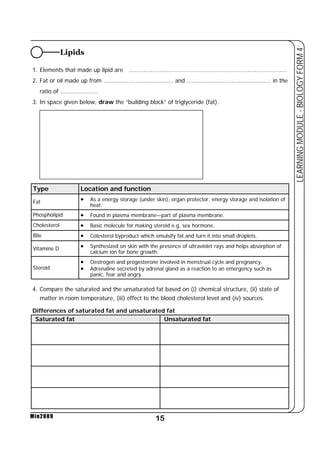
Lipids 
1. Elements that made up lipid are ........................................................................................ 
2. Fat or oil made up from ....................................... and ............................................... in the 
ratio of ..................... 
3. In space given below, draw the “building block” of triglyceride (fat). 
Type Location and function 
Fat • As a energy storage (under skin), organ protector, energy storage and isolation of 
4. Compare the saturated and the unsaturated fat based on (i) chemical structure, (ii) state of 
matter in room temperature, (iii) effect to the blood cholesterol level and (iv) sources. 
Differences of saturated fat and unsaturated fat 
15 
LEARNING MODULE - BIOLOGY FORM 4 
Min2009 
heat. 
Phospholipid • Found in plasma membrane—part of plasma membrane. 
Cholesterol • Basic molecule for making steroid e.g. sex hormone. 
Bile • Colesterol byproduct which emulsify fat and turn it into small droplets. 
Vitamine D • Synthesized on skin with the presence of ultraviolet rays and helps absorption of 
calcium ion for bone growth. 
Steroid 
• Oestrogen and progesterone involved in menstrual cycle and pregnancy. 
• Adrenaline secreted by adrenal gland as a reaction to an emergency such as 
panic, fear and angry. 
Saturated fat Unsaturated fat
Enzyme Substrate Gland 
16 
LEARNING MODULE - BIOLOGY FORM 4 
Min2009 
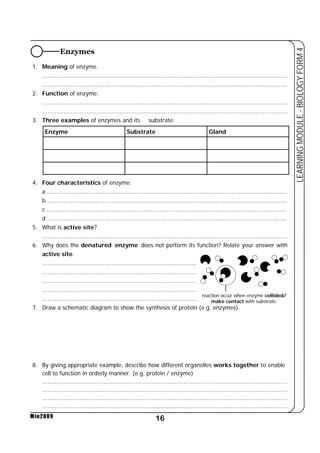
reaction occur when enzyme collided/ 
make contact with substrate. 
Enzymes 
1. Meaning of enzyme. 
......................................................................................................................................... 
......................................................................................................................................... 
2. Function of enzyme. 
......................................................................................................................................... 
......................................................................................................................................... 
3. Three examples of enzymes and its substrate: 
4. Four characteristics of enzyme: 
a ...................................................................................................................................... 
b ...................................................................................................................................... 
c ...................................................................................................................................... 
d ...................................................................................................................................... 
5. What is active site? 
......................................................................................................................................... 
6. Why does the denatured enzyme does not perform its function? Relate your answer with 
active site. 
...................................................................................... 
...................................................................................... 
...................................................................................... 
...................................................................................... 
...................................................................................... 
7. Draw a schematic diagram to show the synthesis of protein (e.g. enzymes). 
8. By giving appropriate example, describe how different organelles works together to enable 
cell to function in orderly manner. (e.g. protein / enzyme) 
......................................................................................................................................... 
......................................................................................................................................... 
......................................................................................................................................... 
.........................................................................................................................................
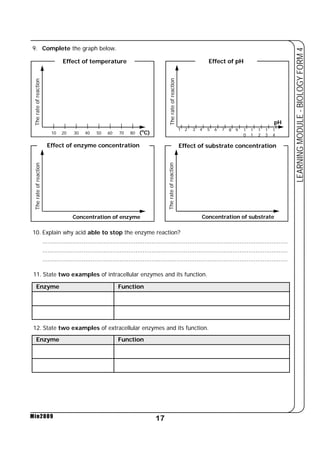
10 20 30 40 50 60 70 80 (oC) 1 2 3 4 5 6 7 8 9 1 
17 
LEARNING MODULE - BIOLOGY FORM 4 
Min2009 
Effect of substrate concentration 
Concentration of substrate 
The rate of reaction 
Concentration of enzyme 
The rate of reaction 
Effect of enzyme concentration 
The rate of reaction 
Effect of temperature Effect of pH 
pH 
The rate of reaction 
9. Complete the graph below. 
10. Explain why acid able to stop the enzyme reaction? 
......................................................................................................................................... 
......................................................................................................................................... 
......................................................................................................................................... 
11. State two examples of intracellular enzymes and its function. 
Enzyme Function 
12. State two examples of extracellular enzymes and its function. 
Enzyme Function 
0 
1 
1 
1 
2 
1 
3 
1 
4
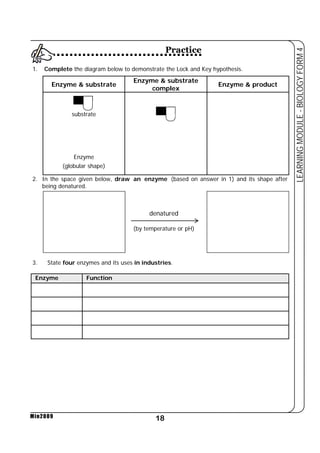
Practice 
1. Complete the diagram below to demonstrate the Lock and Key hypothesis. 
Enzyme & substrate Enzyme & substrate 
3. State four enzymes and its uses in industries. 
18 
LEARNING MODULE - BIOLOGY FORM 4 
Min2009 
complex Enzyme & product 
substrate 
Enzyme 
(globular shape) 
2. In the space given below, draw an enzyme (based on answer in 1) and its shape after 
being denatured. 
denatured 
(by temperature or pH) 
Enzyme Function
1. Give two reasons why cell is need to be divided (increase in number)? 
i. ................................................................................................................................... 
ii. ................................................................................................................................... 
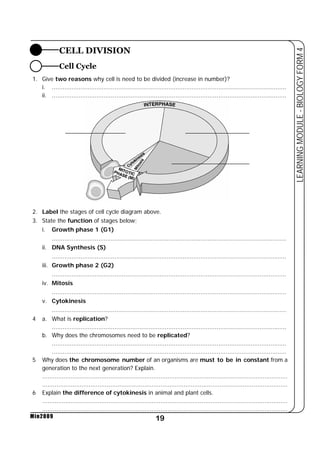
2. Label the stages of cell cycle diagram above. 
3. State the function of stages below; 
................................................................................................................................... 
................................................................................................................................... 
................................................................................................................................... 
................................................................................................................................... 
................................................................................................................................... 
................................................................................................................................... 
b. Why does the chromosomes need to be replicated? 
................................................................................................................................... 
................................................................................................................................... 
5 Why does the chromosome number of an organisms are must to be in constant from a 
generation to the next generation? Explain. 
......................................................................................................................................... 
......................................................................................................................................... 
6 Explain the difference of cytokinesis in animal and plant cells. 
......................................................................................................................................... 
......................................................................................................................................... 
19 
LEARNING MODULE - BIOLOGY FORM 4 
i. Growth phase 1 (G1) 
ii. DNA Synthesis (S) 
iii. Growth phase 2 (G2) 
iv. Mitosis 
v. Cytokinesis 
4 a. What is replication? 
Min2009 
CELL DIVISION 
Cell Cycle
20 
LEARNING MODULE - BIOLOGY FORM 4 
Min2009 
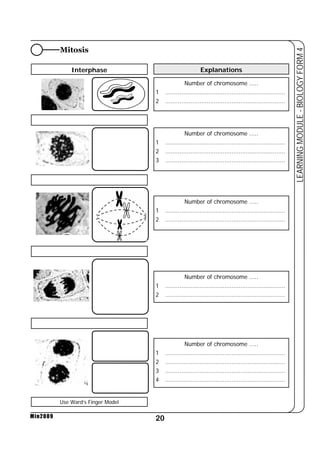
Mitosis 
Interphase Explanations 
Number of chromosome ..... 
1 ................................................................... 
2 ................................................................... 
Number of chromosome ..... 
1 ................................................................... 
2 ................................................................... 
3 ................................................................... 
Number of chromosome ..... 
1 ................................................................... 
2 ................................................................... 
Number of chromosome ..... 
1 ................................................................... 
2 ................................................................... 
Number of chromosome ..... 
1 ................................................................... 
2 ................................................................... 
3 ................................................................... 
4 ................................................................... 
Use Ward’s Finger Model
i. ................................................................................................................................... 
ii. ................................................................................................................................... 
iii. ................................................................................................................................... 
iv. ................................................................................................................................... 
Uncontrolled Mitosis—Cancer 
What is cancer? 
.............................................................................................................................................. 
.............................................................................................................................................. 
Causes of cancer 
i. ......................................................................................................................................... 
ii. ......................................................................................................................................... 
iii. ......................................................................................................................................... 
Treatments—explain 
i. surgery .................................................................................................................. 
ii. chemotherapy .................................................................................................................. 
iii. radiotherapy .................................................................................................................. 
Application of Mitosis 
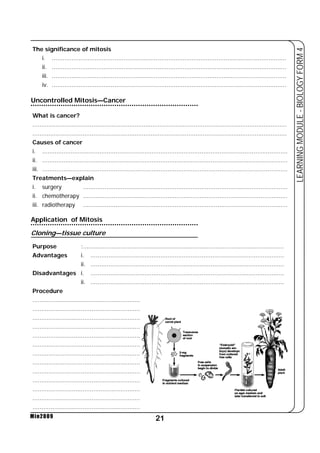
Cloning—tissue culture 
Purpose :................................................................................................................ 
Advantages i. ............................................................................................................ 
21 
LEARNING MODULE - BIOLOGY FORM 4 
The significance of mitosis 
Min2009 
ii. ............................................................................................................ 
Disadvantages i. ............................................................................................................ 
ii. ............................................................................................................ 
Procedure 
............................................................ 
............................................................ 
............................................................ 
............................................................ 
............................................................ 
............................................................ 
............................................................ 
............................................................ 
............................................................ 
............................................................ 
............................................................ 
............................................................ 
............................................................
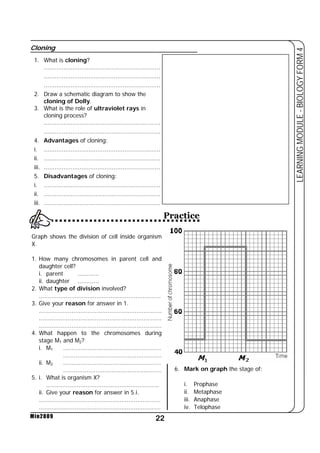
Graph shows the division of cell inside organism 
X. 
1. How many chromosomes in parent cell and 
daughter cell? 
i. parent ............ 
ii. daughter ............ 
2. What type of division involved? 
.................................................................... 
3. Give your reason for answer in 1. 
.................................................................... 
.................................................................... 
.................................................................... 
4. What happen to the chromosomes during 
stage M1 and M2? 
i. M1 ….................................................... 
22 
LEARNING MODULE - BIOLOGY FORM 4 
Min2009 
....................................................... 
ii. M2 ….................................................... 
....................................................... 
5. i. What is organism X? 
............................................................... 
ii. Give your reason for answer in 5.i. 
.................................................................... 
.................................................................... 
6. Mark on graph the stage of: 
i. Prophase 
ii. Metaphase 
iii. Anaphase 
iv. Telophase 
1. What is cloning? 
................................................................. 
................................................................. 
................................................................. 
2. Draw a schematic diagram to show the 
cloning of Dolly. 
3. What is the role of ultraviolet rays in 
cloning process? 
................................................................. 
................................................................. 
4. Advantages of cloning: 
i. ................................................................. 
ii. ................................................................. 
iii. ................................................................. 
5. Disadvantages of cloning: 
i. ................................................................. 
ii. ................................................................. 
iii. ................................................................. 
Practice 
Cloning
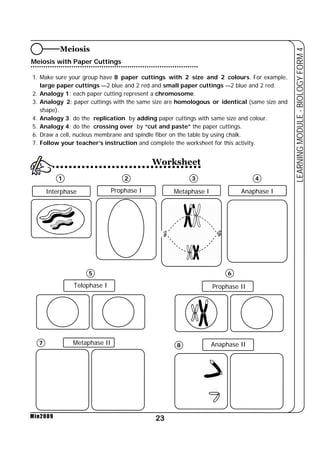
Meiosis with Paper Cuttings 
1. Make sure your group have 8 paper cuttings with 2 size and 2 colours. For example, 
large paper cuttings —2 blue and 2 red and small paper cuttings —2 blue and 2 red. 
2. Analogy 1: each paper cutting represent a chromosome. 
3. Analogy 2: paper cuttings with the same size are homologous or identical (same size and 
shape). 
4. Analogy 3: do the replication by adding paper cuttings with same size and colour. 
5. Analogy 4: do the crossing over by “cut and paste” the paper cuttings. 
6. Draw a cell, nucleus membrane and spindle fiber on the table by using chalk. 
7. Follow your teacher’s instruction and complete the worksheet for this activity. 
1 2 3 4 
5 6 
23 
LEARNING MODULE - BIOLOGY FORM 4 
Min2009 
Meiosis 
Worksheet 
Interphase Prophase I Metaphase I Anaphase I 
Telophase I Prophase II 
Metaphase II Anaphase II 
7 8
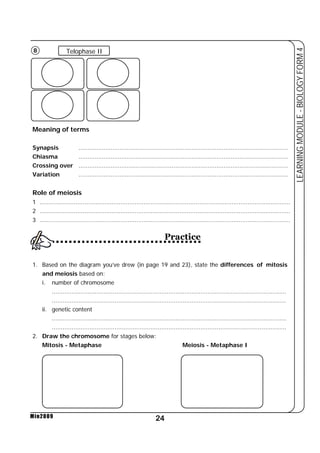
8 Telophase II 
Synapsis ..................................................................................................................... 
Chiasma ..................................................................................................................... 
Crossing over ..................................................................................................................... 
Variation ..................................................................................................................... 
Role of meiosis 
1 ............................................................................................................................................ 
2 ............................................................................................................................................ 
3 ............................................................................................................................................ 
24 
LEARNING MODULE - BIOLOGY FORM 4 
Meaning of terms 
Min2009 
Practice 
1. Based on the diagram you’ve drew (in page 19 and 23), state the differences of mitosis 
and meiosis based on: 
i. number of chromosome 
................................................................................................................................... 
................................................................................................................................... 
ii. genetic content 
................................................................................................................................... 
................................................................................................................................... 
2. Draw the chromosome for stages below: 
Mitosis - Metaphase Meiosis - Metaphase I
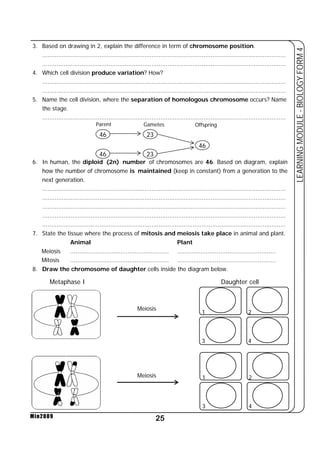
3. Based on drawing in 2, explain the difference in term of chromosome position. 
........................................................................................................................................ 
........................................................................................................................................ 
Parent Gametes Offspring 
25 
LEARNING MODULE - BIOLOGY FORM 4 
Min2009 
46 
46 
23 
23 
46 
4. Which cell division produce variation? How? 
........................................................................................................................................ 
........................................................................................................................................ 
5. Name the cell division, where the separation of homologous chromosome occurs? Name 
the stage. 
........................................................................................................................................ 
6. In human, the diploid (2n) number of chromosomes are 46. Based on diagram, explain 
how the number of chromosome is maintained (keep in constant) from a generation to the 
next generation. 
........................................................................................................................................ 
........................................................................................................................................ 
........................................................................................................................................ 
........................................................................................................................................ 
........................................................................................................................................ 
7. State the tissue where the process of mitosis and meiosis take place in animal and plant. 
Animal Plant 
Meiosis ....................................................... ....................................................... 
Mitosis ....................................................... ....................................................... 
8. Draw the chromosome of daughter cells inside the diagram below. 
Metaphase I Daughter cell 
Meiosis 
Meiosis 
1 
2 
3 4 
1 
2 
3 4
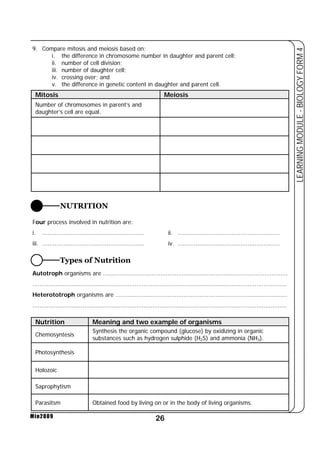
9. Compare mitosis and meiosis based on; 
i. the difference in chromosome number in daughter and parent cell; 
ii. number of cell division; 
iii. number of daughter cell; 
iv. crossing over; and 
v. the difference in genetic content in daughter and parent cell. 
Mitosis Meiosis 
Number of chromosomes in parent’s and 
daughter’s cell are equal. 
NUTRITION 
Four process involved in nutrition are: 
i. ......................................................... ii. ......................................................... 
iii. ......................................................... iv. ......................................................... 
Types of Nutrition 
Autotroph organisms are ....................................................................................................... 
.............................................................................................................................................. 
Heterototroph organisms are ................................................................................................ 
.............................................................................................................................................. 
Nutrition Meaning and two example of organisms 
Chemosyntesis Synthesis the organic compound (glucose) by oxidizing in organic 
26 
LEARNING MODULE - BIOLOGY FORM 4 
Min2009 
substances such as hydrogen sulphide (H2S) and ammonia (NH3). 
Photosynthesis 
Holozoic 
Saprophytism 
Parasitsm Obtained food by living on or in the body of living organisms.
Meaning of balanced diet * 
............................................................................................ 
............................................................................................ 
............................................................................................ 
The necessity of balanced diet 
............................................................................................ 
............................................................................................ 
............................................................................................ 
............................................................................................ 
1. How to prove that food contain / produce energy? Explain. 
......................................................................................................................................... 
......................................................................................................................................... 
......................................................................................................................................... 
2. State the class of foods which does not contain/produce energy. Explain why? 
......................................................................................................................................... 
......................................................................................................................................... 
27 
LEARNING MODULE - BIOLOGY FORM 4 
Body size 
Gender 
Age 
Occupation 
Min2009 
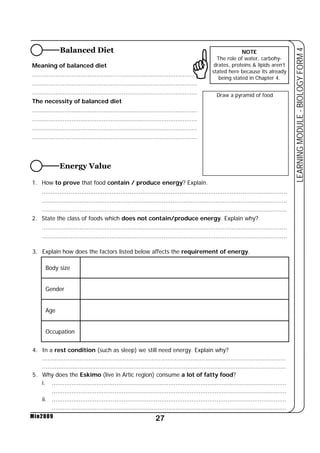
Balanced Diet 
Energy Value 
NOTE 
The role of water, carbohy-drates, 
proteins & lipids aren’t 
stated here because its already 
being stated in Chapter 4. 
Draw a pyramid of food 
3. Explain how does the factors listed below affects the requirement of energy. 
4. In a rest condition (such as sleep) we still need energy. Explain why? 
........................................................................................................................................ 
........................................................................................................................................ 
5. Why does the Eskimo (live in Artic region) consume a lot of fatty food? 
i. ................................................................................................................................... 
................................................................................................................................... 
ii. ................................................................................................................................... 
...................................................................................................................................
28 
LEARNING MODULE - BIOLOGY FORM 4 
Min2009 
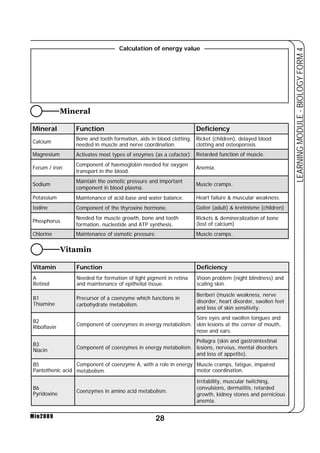
Calculation of energy value 
Mineral 
Mineral Function Deficiency 
Calcium Bone and tooth formation, aids in blood clotting, 
needed in muscle and nerve coordination. 
Ricket (children), delayed blood 
clotting and osteoporosis. 
Magnesium Activates most types of enzymes (as a cofactor) Retarded function of muscle. 
Ferum / iron Component of haemoglobin needed for oxygen 
transport in the blood. 
Anemia. 
Sodium Maintain the osmotic pressure and important 
component in blood plasma. 
Muscle cramps. 
Potassium Maintenance of acid-base and water balance. Heart failure & muscular weakness. 
Iodine Component of the thyroxine hormone. Goiter (adult) & kretinisme (children) 
Phosphorus Needed for muscle growth, bone and tooth 
formation, nucleotide and ATP synthesis. 
Rickets & demineralization of bone 
(lost of calcium) 
Chlorine Maintenance of osmotic pressure. Muscle cramps. 
Vitamin Function Deficiency 
A 
Needed for formation of light pigment in retina 
Retinol 
and maintenance of epithelial tissue. 
Vision problem (night blindness) and 
scaling skin. 
B1 
Thiamine 
Precursor of a coenzyme which functions in 
carbohydrate metabolism. 
Beriberi (muscle weakness, nerve 
disorder, heart disorder, swollen feet 
and loss of skin sensitivity. 
B2 
Riboflavin Component of coenzymes in energy metabolism. 
Sore eyes and swollen tongues and 
skin lesions at the corner of mouth, 
nose and ears. 
B3 
Niacin Component of coenzymes in energy metabolism. 
Pellagra (skin and gastrointestinal 
lesions, nervous, mental disorders 
and loss of appetite). 
B5 
Pantothenic acid 
Component of coenzyme A, with a role in energy 
metabolism. 
Muscle cramps, fatigue, impaired 
motor coordination. 
B6 
Pyridoxine Coenzymes in amino acid metabolism. 
Irritability, muscular twitching, 
convulsions, dermatitis, retarded 
growth, kidney stones and pernicious 
anemia. 
Vitamin
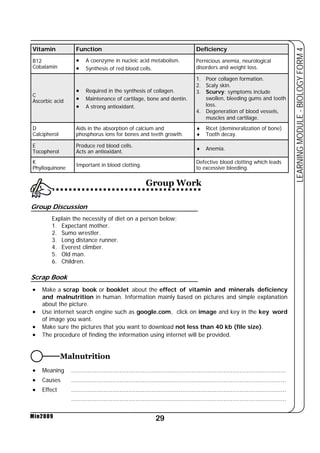
Vitamin Function Deficiency 
B12 
Cobalamin 
Group Work 
Explain the necessity of diet on a person below: 
1. Expectant mother. 
2. Sumo wrestler. 
3. Long distance runner. 
4. Everest climber. 
5. Old man. 
6. Children. 
29 
LEARNING MODULE - BIOLOGY FORM 4 
Group Discussion 
Scrap Book 
Min2009 
• A coenzyme in nucleic acid metabolism. 
• Synthesis of red blood cells. 
Pernicious anemia, neurological 
disorders and weight loss. 
C 
Ascorbic acid 
• Required in the synthesis of collagen. 
• Maintenance of cartilage, bone and dentin. 
• A strong antioxidant. 
1. Poor collagen formation. 
2. Scaly skin. 
3. Scurvy: symptoms include 
swollen, bleeding gums and tooth 
loss. 
4. Degeneration of blood vessels, 
muscles and cartilage. 
D 
Calcipherol 
Aids in the absorption of calcium and 
phosphorus ions for bones and teeth growth. 
♦ Ricet (demineralization of bone) 
♦ Tooth decay. 
E 
Tocopherol 
Produce red blood cells. 
Acts an antioxidant. ♦ Anemia. 
K 
Phylloquinone Important in blood clotting. Defective blood clotting which leads 
to excessive bleeding. 
• Make a scrap book or booklet about the effect of vitamin and minerals deficiency 
and malnutrition in human. Information mainly based on pictures and simple explanation 
about the picture. 
• Use internet search engine such as google.com, click on image and key in the key word 
of image you want. 
• Make sure the pictures that you want to download not less than 40 kb (file size). 
• The procedure of finding the information using internet will be provided. 
Malnutrition 
• Meaning ........................................................................................................................ 
• Causes ........................................................................................................................ 
• Effect ........................................................................................................................ 
........................................................................................................................
30 
LEARNING MODULE - BIOLOGY FORM 4 
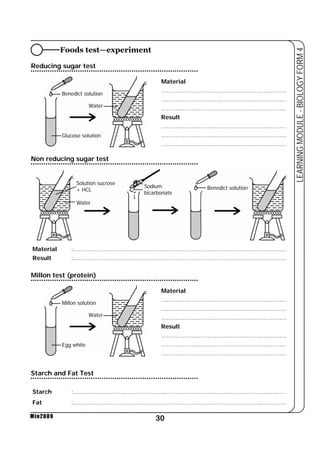
Foods test—experiment 
Reducing sugar test 
Starch and Fat Test 
Min2009 
Material 
...................................................................... 
...................................................................... 
...................................................................... 
Result 
...................................................................... 
...................................................................... 
...................................................................... 
Benedict solution 
Water 
Glucose solution 
Non reducing sugar test 
Sodium 
bicarbonate 
Solution sucrose 
+ HCL 
Water 
Benedict solution 
Material :....................................................................................................................... 
Result :....................................................................................................................... 
Millon test (protein) 
Material 
...................................................................... 
...................................................................... 
...................................................................... 
Result 
...................................................................... 
...................................................................... 
...................................................................... 
Millon solution 
Egg white 
Water 
Starch :....................................................................................................................... 
Fat :.......................................................................................................................
Food Digestion-Human 
1. Name two organic polymer (large molecule) found in food and its source. 
i ................................................................................................................................... 
ii ................................................................................................................................... 
2. Can organic polymer absorbed into blood stream / cells? Why? 
...................................................................................................................................... 
...................................................................................................................................... 
3. Why does the organic polymer need to be hydrolysed (break down) into its monomer? 
...................................................................................................................................... 
...................................................................................................................................... 
4. Why does the food need to be break down into a small pieces? 
...................................................................................................................................... 
...................................................................................................................................... 
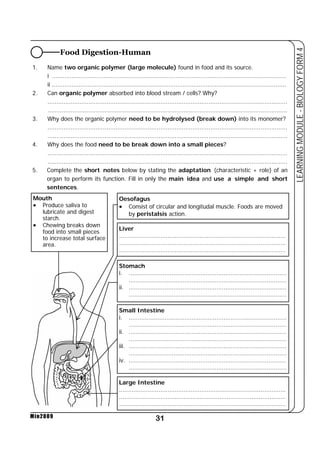
5. Complete the short notes below by stating the adaptation (characteristic + role) of an 
organ to perform its function. Fill in only the main idea and use a simple and short 
sentences. 
Liver 
............................................................................................. 
............................................................................................. 
............................................................................................. 
31 
LEARNING MODULE - BIOLOGY FORM 4 
Mouth 
• Produce saliva to 
lubricate and digest 
starch. 
• Chewing breaks down 
food into small pieces 
to increase total surface 
area. 
Min2009 
Oesofagus 
• Consist of circular and longitudal muscle. Foods are moved 
by peristalsis action. 
Stomach 
i. ........................................................................................ 
........................................................................................ 
ii. ........................................................................................ 
........................................................................................ 
Small Intestine 
i. ........................................................................................ 
........................................................................................ 
ii. ........................................................................................ 
........................................................................................ 
iii. ........................................................................................ 
........................................................................................ 
iv. ........................................................................................ 
........................................................................................ 
Large Intestine 
............................................................................................. 
............................................................................................. 
.............................................................................................
Digestive enzymes 
Gland Enzyme Substrate End product 
Salivary Amilase Starch 
Stomach Rennin 
(gastric juice) Pepsin 
Pancreas Amilase Starch 
(pancreatic juice) Trypsin 
32 
LEARNING MODULE - BIOLOGY FORM 4 
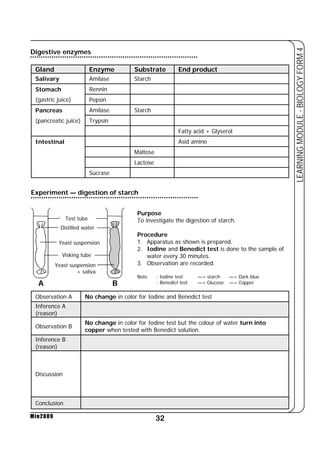
Experiment — digestion of starch 
Test tube 
Distilled water 
Yeast suspension 
Visking tube 
Yeast suspension 
Inference A 
(reason) 
Inference B 
(reason) 
Min2009 
Fatty acid + Glyserol 
Intestinal Asid amino 
Maltose 
Lactose 
Sucrase 
Purpose 
To investigate the digestion of starch. 
Procedure 
1. Apparatus as shown is prepared. 
2. Iodine and Benedict test is done to the sample of 
water every 30 minutes. 
3. Observation are recorded. 
Note : Iodine test —> starch —> Dark blue 
A B : Benedict test —> Glucose —> Copper 
Observation A No change in color for Iodine and Benedict test 
Observation B No change in color for Iodine test but the colour of water turn into 
copper when tested with Benedict solution. 
Discussion 
Conclusion 
+ saliva
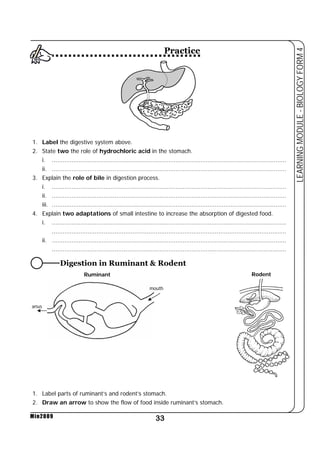
1. Label the digestive system above. 
2. State two the role of hydrochloric acid in the stomach. 
i. ................................................................................................................................... 
ii. ................................................................................................................................... 
3. Explain the role of bile in digestion process. 
i. ................................................................................................................................... 
ii. ................................................................................................................................... 
iii. ................................................................................................................................... 
4. Explain two adaptations of small intestine to increase the absorption of digested food. 
i. ................................................................................................................................... 
................................................................................................................................... 
ii. ................................................................................................................................... 
................................................................................................................................... 
33 
LEARNING MODULE - BIOLOGY FORM 4 
Min2009 
Ruminant 
1. Label parts of ruminant’s and rodent’s stomach. 
2. Draw an arrow to show the flow of food inside ruminant’s stomach. 
Rodent 
Practice 
Digestion in Ruminant & Rodent 
mouth 
anus
3. Animals unable to produce cellulase to digest cellulose (component of plant cell wall) 
into glucose. Explain how the ruminants digest the cellulose? 
......................................................................................................................................... 
......................................................................................................................................... 
4. Compare the digestive system of ruminant and rodent based on: 
Absorption & Assimilation of Digested Food 
34 
LEARNING MODULE - BIOLOGY FORM 4 
i. stomach structure 
Min2009 
................................................................................................................................... 
................................................................................................................................... 
ii. Digestion of cellulose 
................................................................................................................................... 
................................................................................................................................... 
................................................................................................................................... 
5. Why ruminant need more than one stomach? 
......................................................................................................................................... 
......................................................................................................................................... 
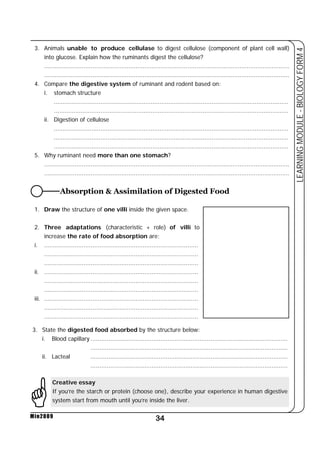
1. Draw the structure of one villi inside the given space. 
2. Three adaptations (characteristic + role) of villi to 
increase the rate of food absorption are; 
i. ...................................................................................... 
...................................................................................... 
...................................................................................... 
ii. ...................................................................................... 
...................................................................................... 
...................................................................................... 
iii. ...................................................................................... 
...................................................................................... 
...................................................................................... 
3. State the digested food absorbed by the structure below: 
i. Blood capillary .............................................................................................................. 
.............................................................................................................. 
ii. Lacteal .............................................................................................................. 
.............................................................................................................. 
Creative essay 
If you’re the starch or protein (choose one), describe your experience in human digestive 
system start from mouth until you’re inside the liver. 
*
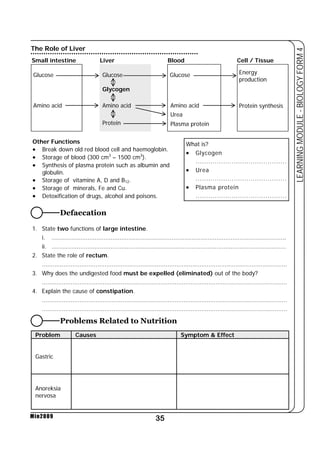
The Role of Liver 
Small intestine 
Glucose 
Amino acid 
Glycogen 
Other Functions 
• Break down old red blood cell and haemoglobin. 
• Storage of blood (300 cm3 – 1500 cm3). 
• Synthesis of plasma protein such as albumin and 
• Storage of vitamine A, D and B12. 
• Storage of minerals, Fe and Cu. 
• Detoxification of drugs, alcohol and poisons. 
35 
LEARNING MODULE - BIOLOGY FORM 4 
globulin. 
Min2009 
Liver 
Glucose 
Amino acid 
Protein 
Blood 
Glucose 
Amino acid 
Plasma protein 
Cell / Tissue 
Energy 
production 
Protein synthesis 
1. State two functions of large intestine. 
i. ................................................................................................................................... 
ii. ................................................................................................................................... 
2. State the role of rectum. 
......................................................................................................................................... 
3. Why does the undigested food must be expelled (eliminated) out of the body? 
......................................................................................................................................... 
4. Explain the cause of constipation. 
......................................................................................................................................... 
......................................................................................................................................... 
Problem Causes Symptom & Effect 
Gastric 
Anoreksia 
nervosa 
Urea 
Defaecation 
Problems Related to Nutrition 
What is? 
• Glycogen 
........................................... 
• Urea 
........................................... 
• Plasma protein 
...........................................
Problem Causes Symptom & Effect 
Obesity 
Belumia 
Nutrient Requirement in Plant 
1 Does the plant able to live only by using product of photosynthesis (starch)? Explain. 
............................................................................................................................................ 
............................................................................................................................................ 
2 What is nutrients / minerals? 
............................................................................................................................................ 
3 Complete the table below. 
Macronutrient Micronutrient 
Meaning 
Minerals 
The Role of Macronutrient 
Minerals Function Effect of deficiencies 
36 
LEARNING MODULE - BIOLOGY FORM 4 
Nitrogen (N) 
Min2009 
• Synthesis of protein, chlorophyll & 
nucleic acid (DNA & RNA) 
• Growth of leaf & stem 
♦ Yellowish & stunted leaves (chlorosis) 
Phosphorus (P) 
• Synthesis of protein & nucleic acid 
(DNA & RNA) 
• Enhanced cell division 
♦ Stunted growth 
♦ Poor root growth 
♦ Formation of dull, dark green leaves 
Potassium (K) • Synthesis of protein & starch 
♦ Stunted growth 
♦ Premature death of plants 
Calcium (Ca) • Growth of shoot & root 
♦ Stunted growth 
♦ Leaves become distort & cupped 
Sulphur (S) • Synthesis of protein 
♦ General yellowing of leaves or entire 
plant 
Magnesium (Mg) • Synthesis of chlorophyll (constituent) ♦ General yellowing of leaves
Lack (deficiencies) of mineral will cause several symptoms. Based on minerals and symptoms 
given below, explain why the symptom occur? 
1. Nitrogen—stunted growth 
........................................................................................................................................ 
2. Phosphorus—stunted growth 
........................................................................................................................................ 
3. Magnesium—yellowish leaves 
........................................................................................................................................ 
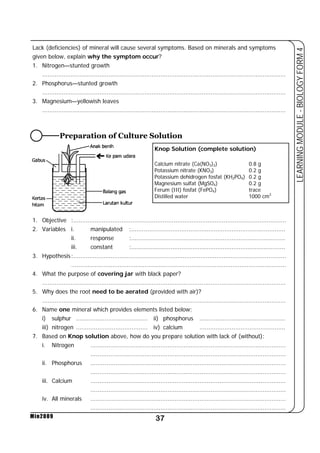
Preparation of Culture Solution 
37 
LEARNING MODULE - BIOLOGY FORM 4 
Min2009 
Knop Solution (complete solution) 
Calcium nitrate (Ca(NO3)2) 0.8 g 
Potassium nitrate (KNO3) 0.2 g 
Potassium dehidrogen fosfat (KH2PO4) 0.2 g 
Magnesium sulfat (MgSO4) 0.2 g 
Ferum (III) fosfat (FePO4) trace 
Distilled water 1000 cm3 
1. Objective :....................................................................................................................... 
2. Variables i. manipulated :...................................................................................... 
ii. response :...................................................................................... 
iii. constant :...................................................................................... 
3. Hypothesis :....................................................................................................................... 
........................................................................................................................ 
4. What the purpose of covering jar with black paper? 
........................................................................................................................................ 
5. Why does the root need to be aerated (provided with air)? 
........................................................................................................................................ 
6. Name one mineral which provides elements listed below; 
i) sulphur ........................................ ii) phosphorus ................................................ 
iii) nitrogen ........................................ iv) calcium ................................................ 
7. Based on Knop solution above, how do you prepare solution with lack of (without): 
i. Nitrogen ............................................................................................................. 
............................................................................................................. 
ii. Phosphorus ............................................................................................................. 
............................................................................................................. 
iii. Calcium ............................................................................................................. 
............................................................................................................. 
iv. All minerals ............................................................................................................. 
.............................................................................................................
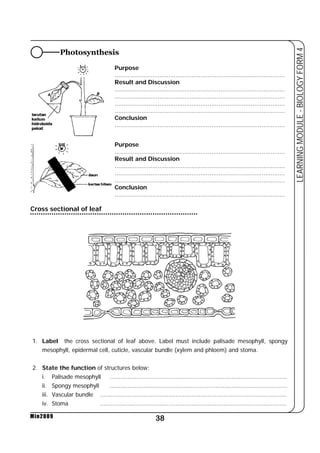
Photosynthesis 
1. Label the cross sectional of leaf above. Label must include palisade mesophyll, spongy 
mesophyll, epidermal cell, cuticle, vascular bundle (xylem and phloem) and stoma. 
i. Palisade mesophyll ................................................................................................... 
ii. Spongy mesophyll ................................................................................................... 
iii. Vascular bundle ........................................................................................................ 
iv. Stoma ........................................................................................................ 
38 
LEARNING MODULE - BIOLOGY FORM 4 
2. State the function of structures below: 
Min2009 
Purpose 
............................................................................................... 
Result and Discussion 
............................................................................................... 
............................................................................................... 
............................................................................................... 
............................................................................................... 
Conclusion 
............................................................................................... 
Purpose 
............................................................................................... 
Result and Discussion 
............................................................................................... 
............................................................................................... 
............................................................................................... 
Conclusion 
............................................................................................... 
Cross sectional of leaf
3. State three structural adaptations (characteristic + role) of leaf to increase the rate of 
photosynthesis. 
i. ................................................................................................................................... 
ii. ................................................................................................................................... 
iii. ................................................................................................................................... 
4. State the adaptations to carry out photosynthesis for plants given below: 
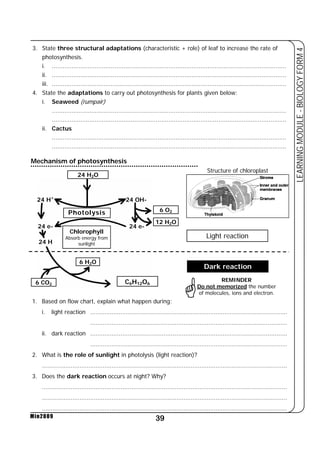
6 O2 
12 H2O 
39 
LEARNING MODULE - BIOLOGY FORM 4 
Mechanism of photosynthesis 
24 H+ 
24 e- 
24 H 
6 CO2 
Min2009 
* 
i. Seaweed (rumpair) 
................................................................................................................................... 
................................................................................................................................... 
ii. Cactus 
................................................................................................................................... 
................................................................................................................................... 
24 H2O 
Photolysis 
Chlorophyll 
Absorb energy from 
sunlight 
6 H2O 
24 OH- 
24 e- 
C6H12O6 
1. Based on flow chart, explain what happen during: 
Structure of chloroplast 
Light reaction 
Dark reaction 
REMINDER 
Do not memorized the number 
of molecules, ions and electron. 
i. light reaction .............................................................................................................. 
.............................................................................................................. 
ii. dark reaction .............................................................................................................. 
.............................................................................................................. 
2. What is the role of sunlight in photolysis (light reaction)? 
......................................................................................................................................... 
3. Does the dark reaction occurs at night? Why? 
......................................................................................................................................... 
......................................................................................................................................... 
.........................................................................................................................................
40 
LEARNING MODULE - BIOLOGY FORM 4 
Min2009 
+ 
4. Label the flow chart above to shows the summary of photosynthesis. 
5. Based on flow chart in page 39, summarized the chemical equation of photosynthesis. 
......................................................................................................................................... 
6. (a) What is the end product of photosynthesis that useful to the plant? 
................................................................................................................................... 
(b) State the two roles of substance stated in 5 (a). 
i. .............................................................................................................................. 
ii. .............................................................................................................................. 
7. Compare the light reaction and dark reaction based on: 
i. Substrate (substance used in reaction) 
ii. Site of reaction 
iii. End product 
iv. Time of reaction 
• Note : use complete sentences. 
Light reaction Dark reaction 
Occurred in grana. 
Light intensity 
Rate of photosynthesis 
Factor affecting photosynthesis 
10 20 30 40 50 60 70 80 (oC)
i) light intensity and rate of photosynthesis. 
..................................................................................................................................... 
..................................................................................................................................... 
..................................................................................................................................... 
ii) temperature and rate of photosynthesis 
..................................................................................................................................... 
..................................................................................................................................... 
..................................................................................................................................... 
3. Explain how the concentration of carbon dioxide become a limiting factor to the rate of 
photosynthesis. 
.......................................................................................................................................... 
.......................................................................................................................................... 
.......................................................................................................................................... 
.......................................................................................................................................... 
• Explain how methods listed below increase the quality and quantity of food production. 
................................................................................................................................... 
................................................................................................................................... 
................................................................................................................................... 
................................................................................................................................... 
................................................................................................................................... 
................................................................................................................................... 
................................................................................................................................... 
................................................................................................................................... 
................................................................................................................................... 
................................................................................................................................... 
................................................................................................................................... 
................................................................................................................................... 
................................................................................................................................... 
................................................................................................................................... 
................................................................................................................................... 
41 
LEARNING MODULE - BIOLOGY FORM 4 
1. Plot the graph in page 40. 
2. Explain the relation of; 
i. Hydrophonics 
ii. Aerophonics. 
iii. Breeding. 
iv. Tissue culture. 
v. Genetic engineering. 
Min2009 
Technology in Food Production 
Group discussion
Technology of Food Processing 
42 
LEARNING MODULE - BIOLOGY FORM 4 
Purpose 
1 ............................................................... 
............................................................... 
............................................................... 
2 ............................................................... 
............................................................... 
3 ............................................................... 
............................................................... 
4 ............................................................... 
............................................................... 
Min2009 
Canning 
Purpose 
To kill microorganisms and its spore (survive 
up to 120 oC). 
Method (temperature) 
Packed in cans and steamed with high 
temperature and high pressure. 
Advantages 
Keep food sterile (free from microorganisms) 
for a long period. 
Sample of food 
Sardines and pineapple 
Pasteuraization 
Purpose 
To destroy bacteria and keeping the flavour 
and nutrient 
Method (temperature) 
63 oC in 30 minutes or 72 oC in 15 seconds 
Advantages 
Bacteria are destroyed but the nutrient (eg. 
protein) undamaged. 
Sample of food 
Milk and fruits juice. 
Drying (dehydrat ion) 
Purpose 
................................................................. 
................................................................. 
................................................................. 
Method 
................................................................. 
................................................................. 
................................................................. 
Advantages 
................................................................. 
................................................................. 
Sample of food 
................................................................. 
Refrigeration 
Purpose 
................................................................. 
................................................................. 
Method 
................................................................. 
................................................................. 
................................................................. 
Advantages 
................................................................. 
................................................................. 
Sample of food 
................................................................. 
Vaccum packaging 
Purpose 
................................................................. 
................................................................. 
Method 
................................................................. 
................................................................. 
................................................................. 
Advantages 
................................................................. 
................................................................. 
Sample of food 
.................................................................
RESPIRATION 
1. What is the substance act as source of energy in living things? 
......................................................................................................................................... 
......................................................................................................................................... 
3. How to get energy from substance in 1 so that it can be use by living things? 
......................................................................................................................................... 
4. State three the role of energy to living things. 
i. ................................................................................................................................... 
ii. ................................................................................................................................... 
iii. ................................................................................................................................... 
5. State two cells/tissues in human body which used a lot of energy. Explain why? 
......................................................................................................................................... 
......................................................................................................................................... 
Aerobic & Anaerobic Respiration 
43 
LEARNING MODULE - BIOLOGY FORM 4 
2. Why substance in 1 contain energy? 
Min2009 
Glycolysis 
Break down of glucose 
Creb Cycle 
The process which produce a lot of 
energy. 
Note : do not memorized both terms. 
1. If you’re not breathing for a certain period of time, you will be weak, then 
unconscious and finally die. Based on biology fact, explain why does it happen? 
......................................................................................................................................... 
......................................................................................................................................... 
2. Sprinter athlete (such as 100m) hold their breathe while running. Can energy be 
produce in that condition (without air/oxygen)? Explain how? 
......................................................................................................................................... 
......................................................................................................................................... 
3. After reaching finishing line, the athlete will be puffing (breathing in a fast rate) and 
exhausted. After a while, he/she will be recovered and back into normal condition. Explain 
these phenomena based on biology fact. 
......................................................................................................................................... 
......................................................................................................................................... 
......................................................................................................................................... 
.........................................................................................................................................
Chemical Equation of Respiration 
Questions 1 
a. Why does the glucose solution need to be 
boiled? 
................................................................ 
................................................................ 
b. Which apparatus acts as control? Explain 
the purpose of using control. 
................................................................ 
................................................................ 
................................................................ 
c. What the purpose of using paraffin oil? 
................................................................ 
................................................................ 
................................................................ 
d. What gas being produced? Give your 
reason. 
................................................................ 
................................................................ 
................................................................ 
................................................................ 
44 
LEARNING MODULE - BIOLOGY FORM 4 
Min2009 
e. Name the other substance being produce. 
................................................................ 
................................................................ 
f. If paraffin layer is removed, what will you 
expect? 
................................................................ 
................................................................ 
................................................................ 
................................................................ 
g. How to increase the gas production? 
................................................................ 
................................................................ 
................................................................ 
................................................................ 
h. If yeast is replaced with bacteria, what is 
the expected result? 
................................................................ 
................................................................ 
................................................................ 
................................................................ 
Aerobic Respiration 
Anaerobic Respiration In Animal & Yeast 
Apparatus A 
Practice 
Apparatus B
2. Why does the unicellular organism such as yeast and bacteria are able to survive only 
by performing anaerobic respiration? [only produce small amount of energy] 
...................................................................................................................................... 
...................................................................................................................................... 
...................................................................................................................................... 
3. During flood, most of plant will die. Explain why? [based on respiration] 
...................................................................................................................................... 
...................................................................................................................................... 
4. Compare between aerobic respiration and anaerobic respiration based on: 
i) Substrate used 
ii) Product of reaction 
iii) The amount ATP produced 
iv) Site of reaction. 
Aerobic Respiration Anaerobic Respiration 
Substrate used is glucose Substrate used is glucose 
Respiratory Structure—Human 
45 
LEARNING MODULE - BIOLOGY FORM 4 
• Role of cartilage rings? 
................................................ 
................................................ 
................................................ 
• Function of epiglottis? 
................................................ 
................................................ 
................................................ 
• Function of diaphragm? 
................................................ 
................................................ 
................................................ 
Min2009 
epiglottis 
larynx 
lung
Explain the adaptations of alveolus to increase the 
efficiency of gaseous exchange. 
i. ............................................................................ 
............................................................................ 
............................................................................ 
ii. ............................................................................ 
............................................................................ 
............................................................................ 
iii. ............................................................................ 
............................................................................ 
............................................................................ 
Respiratory Structure—Animals 
Draw the cross sectional of alveolus 
Explain the adaptations of respiration structure (way to increase the TSA/V) to 
facilitate the gaseous exchange. 
Explain how the gaseous exchange. 
46 
LEARNING MODULE - BIOLOGY FORM 4 
Min2009 
Unicellular organism—Amoeba 
................................................................................................. 
................................................................................................. 
................................................................................................. 
................................................................................................. 
Earth worm 
................................................................................................. 
................................................................................................. 
................................................................................................. 
................................................................................................. 
spiracle 
trachea 
Insect-Cockroaches 
.................................................................................................................................... 
.................................................................................................................................... 
.................................................................................................................................... 
.................................................................................................................................... 
.................................................................................................................................... 
.................................................................................................................................... 
1 
2 
1 
2 
1 
2 
1 
2
1 
2 
gill arch 
Practice 
47 
LEARNING MODULE - BIOLOGY FORM 4 
gill arch 
operculum 
1 
2 
Min2009 
Frog 
........................................................................... 
........................................................................... 
........................................................................... 
........................................................................... 
........................................................................... 
........................................................................... 
Fish 
gill 
Gill raker 
draw gill filament 
......................................................................................................................................... 
......................................................................................................................................... 
......................................................................................................................................... 
......................................................................................................................................... 
1. Why does the unicellular organism do not require a respiratory structure? 
......................................................................................................................................... 
......................................................................................................................................... 
......................................................................................................................................... 
2. Crocodile is able to chase its prey for a limited distance/time only, continue chasing 
will cause death. Explain why? 
......................................................................................................................................... 
......................................................................................................................................... 
......................................................................................................................................... 
......................................................................................................................................... 
......................................................................................................................................... 
3. Whale use lungs for breathing. What happens if whale using gill for breathing? 
......................................................................................................................................... 
......................................................................................................................................... 
......................................................................................................................................... 
......................................................................................................................................... 
......................................................................................................................................... 
.........................................................................................................................................
Gaseous Exchange in Human 
Alveolus 
• Oxygen transported in form of .................................................... while carbon dioxide 
transported in form of .................................................., .................................................., 
and .................................................. 
• Haemoglobin is a ................................... which contain ............................... 
• The gaseous exchange between respiratory structure and blood involving ......................... 
• Diffusion occurred due to the ............................................................................................. 
• For example in alveolus, the partial pressure of oxygen is .............. then the blood 
inside the blood capillary. As a result, oxygen ............................. into the blood and 
combine with hemoglobin to form ........................................... 
• In tissue, partial pressure oxygen is ................... compare to blood inside blood 
capillary. As a result, ........................................... releases its oxygen. Oxygen 
then ....................... into the tissue. 
• Same condition is occur to the carbon dioxide. 
48 
LEARNING MODULE - BIOLOGY FORM 4 
........................................ 
Min2009 
Partial 
pressure 
O2  
CO2  
Partial 
pressure 
O2  
CO2  
Tissue 
O2 
O2 
CO2 
CO2 
1. Label the diagram above.
2. Explain the condition of structures below during inhalation. 
i. diaphragm ........................................................................................................... 
ii. intercostals muscle ........................................................................................................... 
iii. ribs ........................................................................................................... 
iv. lung ........................................................................................................... 
Regulatory Mechanism 
1. What happen to the breathing and heart beat rate after doing vigorous activity? 
......................................................................................................................................... 
2. Does the breathing and heart beat rate changed after reaction in 1? What happen? 
......................................................................................................................................... 
Regulation of carbon dioxide 
• Carbon dioxide in the blood is in form of carbonic acid. 
• The increase of carbonic acid will increase the acidity of blood (drop of pH) and this changes 
is detected by (or stimulate the) chemoreceptor of respiratory centre in medulla oblongata. 
• Respiratory centre send impulses to intercostals muscle and diaphragm muscle to 
increase the relaxation and contraction of muscles. Hence, the rate of breathing is 
increased. 
• As a result, more carbon dioxide expelled out of the body and partial pressure of carbon 
• The reduction of partial pressure will reduce the acidity (or carbonic acid) and pH value of 
Regulation of oxygen 
• Partial pressure of oxygen inside the blood is detected by carotid body and aortic bodies. 
• Low partial pressure of oxygen stimulate the chemoreceptor of carotid body and aortic 
• Carotid body and aortic bodies send impulses to the respiratory centre and the 
• The increase of breathing rate will increase the partial pressure of oxygen. 
• The increase of the partial pressure of oxygen, will cause the chemoreceptor not 
stimulated and the breathing rate return into normal. 
49 
LEARNING MODULE - BIOLOGY FORM 4 
dioxide in blood is decreased. 
blood is return into normal. 
bodies. 
breathing rate is increased. 
Min2009 
Respiratory centre 
Medulla oblongata 
Intercostals muscle 
Diaphragm 
Respiratory centre 
Chemoreceptor of medulla oblongata 
Chemoreceptor of carotid body 
Chemoreceptor of aortic bodies
Respiration in Plant 
1. State how the structures below gets its oxygen. 
i) leaf ....................................................................................................................... 
ii) stem ....................................................................................................................... 
iii) root ....................................................................................................................... 
2. Write down the chemical equation of anaerobic respiration in plant. 
......................................................................................................................................... 
3. Explain how submerged plant gets its oxygen. 
......................................................................................................................................... 
......................................................................................................................................... 
......................................................................................................................................... 
Compare based on: 
i. substrate ii. end product of reaction 
iii. condition for reaction iv. site of reaction / organelle involved 
v. occur in... 
Respiration Photosyntesis 
Use glucose and oxygen. Use carbon dioxide and water. 
50 
LEARNING MODULE - BIOLOGY FORM 4 
Min2009 
Cross sectional of leaf Cross sectional of lenticels 
Comparison—Respiration  Photosynthesis
Respiration  Photosynthesis 
Photosynthesis produce glucose and oxygen that required by 
respiration, and respiration produce carbon dioxide that 
required by photosynthesis. 
In darkness 
• Photosynthesis stop and plant carry out respiration—use 
glucose 
oxygen 
photosynthesis respiration 
carbon dioxide 
The increase of light intensity 
• The rate of photosynthesis increase due to the increase of light intensity. 
• Production of oxygen will increase. 
• Respiration still occur—oxygen is used and carbon dioxide is released. 
• Carbon dioxide from respiration is used in photosynthesis and oxygen produced by photosynthesis 
Compensation point (photosynthesis = respiration) 
• All carbon dioxide produced by respiration is used in photosynthesis, while all oxygen pro-duced 
by photosynthesis is used in respiration. 
• At compensation point, no excess amount of oxygen because the rate of oxygen production (by 
photosynthesis) is equal to the rate of oxygen usage (by respiration). 
• Same condition occurs to carbon dioxide, the rate of carbon dioxide production (by respiration) is 
equal to the rate of carbon dioxide usage (by photosynthesis). So, no excess amount of carbon 
dioxide. 
• At this point, all glucose produced by photosynthesis is used in respiration. As a result, no 
excess amount of glucose for storage (starch production). 
• So, the rate of photosynthesis must be higher then the rate of respiration to make sure 
there are excess amount of glucose for storage in form of starch. 
• Hence, the light intensity must be higher then compensation point, so that the rate of photosyn-thesis 
is higher then the rate of respiration. 
51 
LEARNING MODULE - BIOLOGY FORM 4 
oxygen and release carbon dioxide. 
is used in respiration. 
Min2009 
Intake of CO2 
increase 
Release of CO2 
increase 
light intensity 
light intensity 
volume of O2 
Graph 1 Graph 2 
1. Plot the graph above and mark the compensation point. 
2. Based on graph, how do you determine the compensation point? 
3. At low light intensity, certain plant become retarded or gradually die. Explain why? (based 
on compensation point)
Decomposer 
Producer Consumer 
Biotic Component 
Abiotic Component 
Pyramid of Number 
Forth trophic level 
(tertiary consumer) 
Third trophic level 
(secondary consumer) 
• Draw a food web based on pyramid of number above. 
death excursion  
defecation 
death excursion  
defecation 
death excursion  
Commensalism 
.......................................................................................................... 
.......................................................................................................... 
Mutualism 
.......................................................................................................... 
.......................................................................................................... 
52 
LEARNING MODULE - BIOLOGY FORM 4 
Min2009 
Ecosystem 
pH 
Temperature 
Light intensity 
Humidity 
Topography 
Microclimate 
First trophic level 
(producer) 
Second trophic level 
(primary consumer) 
Number of organism is decrease 
DYNAMIC ECOSYSTEM 
Energy Flow in Food Webs 
energy lost in 
respiration 
producer 10% herbivores 10% carnivores 10% top carnivores 
decomposer—fungi, bacteria, worm  scavenger 
defecation 
death 
energy lost in 
energy lost in 
respiration 
energy lost in 
respiration 
energy lost in 
respiration 
energy input 
(sunlight) 
90% 90% 90% 90% 
Interaction Between Biotic Component
Saprophytism 
.......................................................................................................... 
.......................................................................................................... 
Prey-Predator 
.......................................................................................................... 
.......................................................................................................... 
Parasitism 
.......................................................................................................... 
.......................................................................................................... 
Paramecium 
caudatum 
Colonisation  Succession 
53 
LEARNING MODULE - BIOLOGY FORM 4 
Investigate the effect of competition 
Experiment 
Discussion 
(why the curve 
is like that?) 
Min2009 
................................................................................................................... 
................................................................................................................... 
................................................................................................................... 
................................................................................................................... 
Conclusion 
................................................................................................................... 
................................................................................................................... 
Result 
(plot the 
graph) 
Separated population 
Days 
Population 
Mixed population 
Days 
Population 
Paramecium 
aurelia 
Paramecium aurelia + 
P. caudatum 
Experiment 1 Experiment 2 
Explain the terms below: 
i) habitat ...................................................................................................................... 
ii) species ...................................................................................................................... 
iii) niche ......................................................................................................................
iv) population ...................................................................................................................... 
v) community ...................................................................................................................... 
vi) ecosystem ...................................................................................................................... 
vii) colonisation ...................................................................................................................... 
viii) succession ...................................................................................................................... 
Colonisation  Succession in Pond 
54 
LEARNING MODULE - BIOLOGY FORM 4 
Min2009 
Deposition of dead/decayed organic material in basement 
cause pond getting shallow/reduce the depth—initiate the 
succession process 
• Explain the adaptation of; 
i) pioneer species (algae and submerged plant) 
Pioneer species 
algae and submerged plant 
die and submerge 
First successor species 
die and submerge 
Second successor species 
die and submerge 
Third successor species 
Climax community 
......................................................................................................................................... 
......................................................................................................................................... 
ii) primary successor species 
......................................................................................................................................... 
......................................................................................................................................... 
iii) secondary successor species 
......................................................................................................................................... 
......................................................................................................................................... 
• What are the changes that cause the succession in pond? 
......................................................................................................................................... 
.........................................................................................................................................
Map below shows the effect of succession in mangrove after 20 years. Complete the diagram 
below by using appropriate symbol. 
• What are the changes after 20 years? 
55 
LEARNING MODULE - BIOLOGY FORM 4 
A 
S 
R 
B 
Min2009 
The bank getting higher 
because of the deposition 
dead organic matter  mud. 
B 
• Avicennia sp. (pokok api-api putih) and Sonneratia sp. (pokok perepat) are the pioneer 
species in the muddy and sandy bank. This species are able to stands a high salinity, wave 
and wind. 
• The extensive root system traps and collects the sediment, including organic matter from 
decaying plant parts. The soil become more compact and firm (kukuh). 
• This condition favours the Rhizophora sp. Consequently, the Avicennia sp. and Sonneratia 
sp. are replace by Rhizophora. 
• The prop roots (akar jangkang) of the Rhizophora sp. traps silt (selut) and mud and 
creating firmer soil. 
• The ground (or bank) getting higher and less submerged by sea water. 
• The soil getting firm and hard and this condition favours the Brugueira sp. 
• Consequently, the Rhizophora sp. is replaced by Brugueira sp. 
• The root of Brugueira sp. traps silt and mud and further modified the soil structure. 
• Over the time, plants like nipah and Pandanus begin to replace the Brugueira sp. 
• The gradual transition and succession from a mangrove to a terrestrial forest and 
eventually to a tropical forest—a climax community. 
B 
B 
B 
B 
B 
B 
B 
B 
B 
B 
B 
B 
B 
Year 2000 Year 2020 
B B 
Colonisation  Succession in Mangrove 
Avicennia sp. 
Sonneratia sp. 
Rhizophora sp. 
Brugueira sp. 
Muddy and sand bank 
F Forest 
high tide 
low tide 
Year 2020 Year 2000
56 
LEARNING MODULE - BIOLOGY FORM 4 
Population Ecology 
Quadrate sampling technique 
Quadrate frame - metal / wood 
Quadrate frame—rope and stick 
Examples of Quadrate 
Example of coverage 
Min2009 
Capture, Mark, Release 
and Recapture Technique 
Quadrate for small organism 
(eg. fungus) 
Percentage coverage 
Total coverage of 
all quadrate 
X 100% 
Number of quadrate 
x quadrate area 
Density Frequency 
This technique is used to estimate 
the population of animal such as ant, 
birds and mammals by using ink/ 
ring/tag. Some precaution and 
assumption to be considered; 
• The mark not harmed to the 
animal or predator. 
• Animal captured randomly. 
• Let the animal free to mixed 
with original population. 
• Assumption — no migration 
and mortality due to disease. 
• Capture a large samples of 
animal. 
• The experiment is repeated 
to increase the validity 
(kesahan) of data. 
No. of org. in first sample x 
No. of org. in second sample 
No. of marked org. recaptured 
• The principle of both 
instruments; 
.............................................. 
.............................................. 
.............................................. 
.............................................. 
.............................................. 
.............................................. 
.............................................. 
• The difference; 
.............................................. 
.............................................. 
.............................................. 
.............................................. 
.............................................. 
.............................................. 
Sampling of soil organisms 
Tullgren Funnel 
Bearmann Funnel
The Effect of Abiotic Factors on Population 
.......................................................................................................................... 
.......................................................................................................................... 
.......................................................................................................................... 
.......................................................................................................................... 
.......................................................................................................................... 
.......................................................................................................................... 
57 
LEARNING MODULE - BIOLOGY FORM 4 
Factors Effect 
pH 
temperature 
humidity 
light 
intensity 
Definition 
The importance 
Min2009 
Kingdoms 
Protista 
Paramecium 
Amoeba 
Euglena 
...................... 
.......................... 
.......................... 
.......................... 
...................... 
Yeast 
Mold 
Mushroom 
...................... 
.......................... 
.......................... 
.......................... 
...................... 
.......................... 
.......................... 
.......................... 
Biodiversity
Classification of Organisms 
58 
LEARNING MODULE - BIOLOGY FORM 4 
Kingdom 
Phyllum 
Class 
Order 
Family 
Genus 
Species 
Min2009 
1. Why does an organisms must be 
classified? 
.................................................. 
.................................................. 
.................................................. 
.................................................. 
2. Why does the Latin language is 
used for naming the species? 
.................................................. 
.................................................. 
.................................................. 
.................................................. 
K 
P 
C 
O 
F 
G 
S 
Category Housefly Human Corn / Maize Rat 
Kingdom Animalia Animalia Plantae Animalia 
Phyllum Arthropoda Chordata Trachaeophyta Chordata 
Class Insecta Mamalia Angiospermae Mamalia 
Order Diptera Primate Glumnifloflorae Rodentia 
Family Muscidae Homonidae Maydeae Muroidae 
Genus Musca Homo Zea Rattus 
Species domestica sapiens mays rattus 
Law of scientific names — Linnaeus Binomial System 
• Species has two names - genus + species. 
• Genus begins with capital letter and species all small letter. 
• Written in italics (usually in printing) or underline (usually in hand writing). 
Local name Printing Hand writing 
Toad (katak puru) Bufo melanogaster Bufo melanogaster 
Cockroach (lipas rumah) Periplaneta americana Periplaneta americana 
Durian Durio zibethinus Durio zibethinus
59 
LEARNING MODULE - BIOLOGY FORM 4 
1. Label the bacteria structures. 
Label — capsule, cell wall, flagella, 
cytoplasm and genetic material-DNA/RNA. 
Min2009 
2. Label the virus structures. 
Label — capsid dan nucleic acid (genetic 
material-DNA/RNA) 
1 – binary fission-bacteria, 2 – Streptococcus, 3 – flagella-bacteria, 4 – bakteriofaj, 
5 – budding-yis, 6 – tobacco mosaic virus, 7 – bacteria spore. 
1 
2 
3 6 
4 
5 
7 
The Impact of Microorganisms 
Fungi 
................................................................... 
................................................................... 
................................................................... 
................................................................... 
................................................................... 
................................................................... 
................................................................... 
................................................................... 
Algae 
................................................................... 
................................................................... 
................................................................... 
................................................................... 
................................................................... 
................................................................... 
................................................................... 
................................................................... 
Fungi  Algae 
Bacteria  Virus
Bacteria 
Nucleic acid 
(DNA/RNA) 
Capsid (protein) + 
Capsule (spore)-protection 
No specified organelle 
Nutrition 
- auxotroph, parasite  
saprophyte 
Reproduction – binary fission 
Nucleus-DNA-no membrane 
Living – reproduce in 
host cell only. 
reminder 
.............................................................................................................................................. 
.............................................................................................................................................. 
.............................................................................................................................................. 
.............................................................................................................................................. 
60 
LEARNING MODULE - BIOLOGY FORM 4 
Min2009 
Amoeba 
Moves and captures its prey 
by using pseudopodium 
(false leg) also known as 
phagocytosis. 
Antibiotic effect 
A substances produces by 
microorganism to stunned/ 
stop/kill other microbe. 
Based on picture-the effect 
are vary. 
DNA – attack animals 
RNA – attack plants 
Cell wall – protein + 
polysaccharide (peptidoglycan) 
Respiration 
Aerobic 
Anaerobic 
Coccus 
diplococcus, 
streptococcus, 
staphilococcus 
Bacillus Vibrio 
Spirillum 
nutrition  
– no living Non-respiration 
Outer host cell—become crystallize 
All parasite 
The smallest 
Don’t use short form 
in answering the 
examination and test. 
Protozoa 
shapes 
* 
Flagella –movement
Experiment—handling microbe 
Precaution—experiment involving microbe 
In experiment involving microorganisms, apparatus must be free from microbe (sterile) to 
prevent contamination and the validity of an experiment. Several precautions and steps have 
to be taken during experiment; 
1. Wash your hand using antiseptic before and after the experiment. 
2. Table is cleaned by using antiseptic before and after the experiment. 
3. Food not allowed in the lab. 
4. Clean with antiseptic if the microbe culture is spilled. 
5. After the experiment, wash all apparatus with antiseptic. 
6. Don’t throw agar medium into the bin or sink. Discard by using antiseptic or burning. 
The formation of colony (spot) 
Term/scale used to describe the growth of microorganisms 
Cloudy — clear, light  heavy 
Numbers of colony — 2, 3, 4, .... 
Size of colony — measure the diameter 
61 
LEARNING MODULE - BIOLOGY FORM 4 
Min2009 
1. Agars is used in experiment involving microbes which 
contain agar and nutrient. What is the initial colour of 
agars? What happens after the microbe colonize (growing) 
in the agar? 
...................................................................................... 
...................................................................................... 
...................................................................................... 
2. The agars need to be sterile (free from microbe) before 
the experiment. Why? 
...................................................................................... 
...................................................................................... 
......................................................................................
Experiment— growing microbe 
1. Wash your thumb. 
2. Press (gently) the agar using your thumb. 
3. Mark your thumb and group members on Petri dish. 
4. Overturned the Petri dish and store in dark place. 
5. Live for 3 days and record the result—numbers, size and colour of the colony. 
Practice 
Experiment was carried out by growing the bacteria Bacillus subtilis (round and white colony) 
inside Petri dish which contain nutrient agar under different condition. Numbered of colony are 
measured after 24 hours. 
62 
LEARNING MODULE - BIOLOGY FORM 4 
Temperature factor 
Min2009 
Petri dish A Petri dish B Petri dish C 
Condition 
5 oC 
(refrigerator) 
37 oC 
(oven) 
60 oC 
(oven) 
Result 
Observation 
(state) 
1. State the inference for the observation in: 
i. Petri dish A ................................................................................................... 
................................................................................................... 
ii. Petri dish B ................................................................................................... 
................................................................................................... 
2. State the variables: 
i. manipulated ................................................................................................... 
ii. responding ................................................................................................... 
iii. constant ................................................................................................... 
3. State two hypothesis for this experiment. 
i. ................................................................................................................................. 
ii. ................................................................................................................................. 
4. What the meaning of growth based on this experiment (defining operationally). 
....................................................................................................................................... 
....................................................................................................................................... 
.......................................................................................................................................
1. What are the role of bacteria and protozoa in the alimentary canal of ruminant? 
......................................................................................................................................... 
......................................................................................................................................... 
2. “Microorganisms helps the human digestion system”. Explain this statement. 
......................................................................................................................................... 
......................................................................................................................................... 
......................................................................................................................................... 
3. Sate the role of Trichonympha in the alimentary canal of termite. 
......................................................................................................................................... 
Organism Q 
i. Bacretia X .............................................................. 
ii. Bacteria Y .............................................................. 
iii. Bacteria Z .............................................................. 
c. Give two example of organism Q and their role. 
................................................................................................................................... 
................................................................................................................................... 
d. What are the importance of nitrogen cycle to the human being? 
................................................................................................................................... 
................................................................................................................................... 
63 
LEARNING MODULE - BIOLOGY FORM 4 
4. a. Complete the diagram above. 
b. Name the: 
Min2009 
Useful Microorganisms 
Denitrifying bacteria 
death  
waste 
Organism P 
Bacteria X Bacteria Y 
Bacteria Z 
Animals 
SOIL 
absorb by...
64 
LEARNING MODULE - BIOLOGY FORM 4 
Min2009 
Harmful Microorganisms 
Pathogens Disease Method of transmission Signs and symptoms 
Protozoa 
(Plasmodium sp.) 
Malaria Vector. Anopheles sp. mosquito High fever, violent shiv-ering 
profuse sweating. 
Virus Dengue fever Vector: Aedes sp. mosquito Fever with severe body 
pain and rashes over 
parts of the body. 
Bacterium 
(Vibrio cholerae) 
Cholera 1. by drinking water or eating 
food contaminated with the 
cholera bacterium. 
2. faeces of an infected person. 
3. inadequate sewage treat-ment 
and improper treat-ment 
of drinking water. 
Profuse and watery di-arrhea, 
vomiting and leg 
cramps. 
Rapid loss of body fluids 
leads to dehydration and 
shock. 
Fungi Ringworm 
(Tinea corporis) 
Contagious and is spread through 
infected pets or through direct 
contact with infected individuals. 
Rashes on the body 
which look like red circular 
lesions with a scaly bor-der. 
These infected areas 
may be itchy. 
Bacteria related 
food poisoning is 
the most common 
for example, 
Salmonella sp. 
Food poisoning Contamination of cooked food 
and inappropriate handling and 
preparation of food. 
Diarrhea, nausea, chills, 
vomiting and fever within 
12 to 24 hours. 
Human 
Immunodefi-ciency 
Virus (HIV) 
Acquired Immune 
Deficiency Syn-drome 
(AIDS) 
1. Unprotected sex with an in-fected 
partner. 
2. Blood transfusion from an 
infected person. 
3. Transmission from a preg-nant 
mother to an unborn 
child. 
4. Contaminated syringes, nee-dles 
or other piercing instru-ments. 
People with AIDS often 
suffer diseases of the 
lungs, brain, eyes and 
other vital organs along 
with debilitating weight 
loss and diarrhea. 
Coronavirus Severe acute respi-ratory 
Syndrome (SARS) 
is a viral respiratory 
illness 
Through the respiration droplets 
released into the air when an 
infected person coughs or 
sneezes. 
High fever (body tem-perature 
of more than 
38.0 °C (100.4 °F). 
After two to seven days, 
SARS patients may de-velop 
a dry cough. Most 
patients develop pneumo-nia. 
Viruses Hepatitis A 
Hepatitis B 
by contaminated food or water 
and personal contact. 
contaminated 
blood or needles, as well as 
sexually 
Jaundice, inflammation 
of the liver, fever, fatigue, 
diminished appetite, nau-sea 
and abdominal pains. 
Severe - lead to liver 
cancer, liver failure, and 
eventually death.
Controlling Pathogen—Sterilization 
Meaning ........................................................................................................................ 
........................................................................................................................ 
Disinfectants 
Autoclave Heated over 120 oC to kill microbe and bacteria spore. 
Microorganism in Biotechnology 
65 
LEARNING MODULE - BIOLOGY FORM 4 
Method Explanation 
Antibiotics 
Antiseptics 
Min2009 
In medical use-sterilized the instruments. 
Production of Vaccine 
Mikroorganism .............................................................................................................. 
Role .............................................................................................................. 
.............................................................................................................. 
Production of Antibiotic 
Mikroorganism .............................................................................................................. 
Role .............................................................................................................. 
.............................................................................................................. 
Cleaning Oil Spills 
Mikroorganism ............................................................................................................. 
Role .............................................................................................................. 
.............................................................................................................. 
Waste Treatment 
Mikroorganism .............................................................................................................. 
Role .............................................................................................................. 
.............................................................................................................. 
Food Processing 
Mikroorganism .............................................................................................................. 
Role .............................................................................................................. 
.............................................................................................................. 
Bioplastic (biodegradable) Industry 
Mikroorganism .............................................................................................................. 
Role .............................................................................................................. 
.............................................................................................................. 
Production of Energy from Biomass-biogas  biofuel 
Mikroorganism .............................................................................................................. 
Role .............................................................................................................. 
..............................................................................................................
ENDANGERED ECOSYSTEM 
Group Project—Presentation 
66 
LEARNING MODULE - BIOLOGY FORM 4 
Min2009 
The effect of unplanned 
management 
Soil erosion 
Flash flood 
Landslides 
Global warming 
Climate change 
Thinning ozone layer 
Extinction of species 
Deforestation 
air Water 
Pollution 
noise Thermal 
Topic (one topic for each group) 
1. Soil erosion  landslides. 
2. Flash flood. 
3. Air pollution. 
4. Water pollution  eutrophication. 
5. Thermal pollution  radioactive pollution. 
6. Global warming  climate change. 
7. Thinning of ozone layer. 
8. Deforestation and extinction of species. 
Format of presentation — computer  booklet 
1. Introduction (meaning) 
2. Example (local / global) 
3. Source 
4. Effect 
5. Steps taken to overcome the problem. 
6. Closing (conclusion) 
NOTE : use picture in presentation  booklet. 
Search Engine 
www.yahoo.com 
www.altavista.com 
www.google.com 
Useful key word for internet searching 
soil erosion, flood, eutrofication, water pollution, air pollution, 
thermal pollution, global warming, green house effect, climate, 
world’s climate, el nino, la nina, deforestation, endangered 
species. 
Using search engine (Google 
 Ms Internet Explorer) 
Searching for text / 
document. 
• Key in key word, pres Enter. 
• Click on link you want or 
Right click, Open in New 
Window. 
• Save file— File, Save as... 
• Press Back Button to go to 
previous page. 
Searching for picture. 
• Click on Images. 
• Key in key word, pres Enter. 
• Click on picture you want or 
Right click, Open in New 
Window. 
• Right click on picture you 
want, Save Picture As... 
• Saving / downloading. 
• Press Back Button to go to 
previous page.
67 
LEARNING MODULE - BIOLOGY FORM 4 
Min2009 
Notes— based on presentation 
Type of hu- Causes (sources) Effect Ways to prevent 
man activities 
Soil erosion  
landslide 
Flash flood 
Thermal 
pollution 
Deforestation 
Extinction of 
species
The effect of polluted substances 
Pollutants Source Effect to the living things 
Global Warming—Green House Effect 
68 
LEARNING MODULE - BIOLOGY FORM 4 
Heavy metal 
Smoke  
haze 
(jerebu) 
Carbon 
monoxide Fossil fuel burning 
Oxides of 
sulphur Fossil fuel burning 
Oxides of 
nitrogen 
Radioative Nuclear power 
Min2009 
plant 
Water borne 
mikro-organism 
Chemical 
fertilizer Agriculture 
Pesticides 
(racun 
Agriculture 
perosak) 
Causes / source 
.............................................................................................................................................. 
.............................................................................................................................................. 
How it happen? 
.............................................................................................................................................. 
.............................................................................................................................................. 
.............................................................................................................................................. 
.............................................................................................................................................. 
Effect 
1 ......................................................................................................................................... 
2 ......................................................................................................................................... 
3 ......................................................................................................................................... 
4 .........................................................................................................................................
Nitrogen dioxide + water — Nitric acid 
Nitrogen monoxide + water — Nitrous 
acid + water — Nitric acid 
Sulphur dioxide + water — Sulphuric 
acid 
Thinning The Ozone Layer 
Note : high intensity of ultra violet light will damage DNA/nucleus/cells. 
69 
LEARNING MODULE - BIOLOGY FORM 4 
infrared red (heat) reflected to 
space 
CO2 absorbed the reflected 
ray (heat) 
EARTH 
Atmosphere 
Acid Rain 
oxygen molecule + oxygen atom — Ozone 
Min2009 
Ways to prevent 
1 .................................................................. 
.................................................................. 
2 .................................................................. 
.................................................................. 
3 .................................................................. 
.................................................................. 
4 .................................................................. 
.................................................................. 
NO2 gas 
NO gas 
SO2 gas 
Formation of acid rain—chemical equation 
Causes / source of acid rain gaseous 
....................................................................... 
....................................................................... 
Effects 
1 .................................................................. 
.................................................................. 
2 .................................................................. 
.................................................................. 
3 .................................................................. 
.................................................................. 
4 .................................................................. 
.................................................................. 
Source of CFC 
....................................................................... 
....................................................................... 
Effects 
1 .................................................................. 
.................................................................. 
2 .................................................................. 
.................................................................. 
3 .................................................................. 
.................................................................. 
4 .................................................................. 
.................................................................. 
Formation of ozone 
Destruction—by CFC 
CFC (strike by UV ray)—- chlorine atom 
Ozone + chlorine atom (CFC) 
— oxygen molecule + chlorine monoxide 
Chlorine monoxide + oxygen atom — 
oxygen molecule + chlorine atom
Ways to prevent thinning of ozone layer 
1 ......................................................................................................................................... 
2 ......................................................................................................................................... 
3 ......................................................................................................................................... 
4 ......................................................................................................................................... 
Biochemical Oxygen Demand (BOD) 
Definition 
.............................................................................................................................................. 
.............................................................................................................................................. 
Relationship with dissolved oxygen level 
.............................................................................................................................................. 
.............................................................................................................................................. 
Eksperiment-measuring BOD value 
• Blue methylene will decolorises in a sort time due to low 
level of dissolved oxygen where the oxygen usage by 
microbe is high. 
• This means the BOD value is high. 
• The increase usage of oxygen will reduce the oxygen level 
and increase the BOD value. [O2 È — BOD Ç] 
The effect of high BOD value to aquatic organism. 
.............................................................................................................................................. 
.............................................................................................................................................. 
.............................................................................................................................................. 
70 
LEARNING MODULE - BIOLOGY FORM 4 
Min2009 
Eutrophication occur due to the sudden increase of algae population 
and increased the BOD value (low level of dissolved oxygen). 
Explain that phenomena. [algae is producing oxygen trough photosynthesis] 
.............................................................................................................................................. 
.............................................................................................................................................. 
.............................................................................................................................................. 
.............................................................................................................................................. 
.............................................................................................................................................. 
Why the presence of organic waste or fertilizer will increase the BOD value? 
.............................................................................................................................................. 
.............................................................................................................................................. 
..............................................................................................................................................
Steps for Maintaining Stable Environment 
Why environment need to be maintained in stable condition? 
.............................................................................................................................................. 
.............................................................................................................................................. 
.............................................................................................................................................. 
.............................................................................................................................................. 
.............................................................................................................................................. 
.............................................................................................................................................. 
Implementation 
of lows 
Concept of 4 R 
Recycle-Reuse-Reduce-Renew 
• Converted into organic fertilizer (baja kompos). 
• Breakdown by mikroorganism for production of methane. 
• Used in palm oil plant to generate electricity. 
• Complete the combustion of fuel by converting/changing carbon monoxide and other 
hidrocarbons into carbon dioxide and water. 
• Filters the acid rain gaseous such as nitrogen dioxide, nitrogen monoxide and sulfur 
• To detect the source and level of pollution. 
71 
LEARNING MODULE - BIOLOGY FORM 4 
1. Palm oil waste 
2. Exhaust filter 
3. Funnel filter (penapis cerobong) 
dioxide. 
4. Fuel 
• Using unleaded petrol. 
• Using natural gas and biofuel. 
5. Recycle 
• Metal, paper and glass. 
6. Modern equipments 
Min2009 
Education The use of 
technology 
Preservation and 
conservation of 
the environment 
Land-Water- 
Forest-Mangrove 
Biological 
control 
The use of 
renewable 
energy 
Steps 
Technology-Prevention of Pollution 
The efficient 
use energy

Learning module biology form 4

  • 1.
    LEARNING MODULE BIOLOGY FORM 4 — 2008 EDITION Prepared by : NAME CLASS AL MUMIN HJ. AL KANTA SMK Agaseh, Lahad Datu, SABAH
  • 2.
    DIRECTION & ORIENTATION 1 LEARNING MODULE - BIOLOGY FORM 4 Gastro (stomach) Gaster juice is secreted by stomach wall. Hem (blood) Type of blood pigment are haemoglobin & haemoeritrin. Hepato (liver) Hepatic portal vein carry digested food from small intestine to the liver. Cardio (heart) Cardiovascular disease—heart attack. Reni, reno (kidney) Adrenaline is the hormone produced to prepare body to counter emergency such as fear and anger. Cerebro (brain) Cerebrum is the structure that control conscious actions.. Thrombo (coagulate) Thromboplastin & trombin (enzyme for blood coagulation). Min2009 a, an, ar (without) e.g., anaerobic respiration. ad (above) e.g., Adrenal gland. aero (air) e.g., Aerobic respiration. anti (anti/fight) e.g., antibody & antitoxin. bi (two) e.g., bisep muscle & bicuspid valve. co (together) e.g., codominan gene. glyco (sugar) e.g., glycolysis & glycogen. homo (same) hydro (water) e.g., hydrolysis. hyper (high) e.g., hypertonic hypo (low) e.g., hypoglisemia (low concentration of glucose) macro (big/large) e.g., macronutrient. mono (one/single) e.g., monosaccharides (single sugar molecule) multi/poly (many) e.g., multicellular. peri (around) e.g., perisikel (plant tissue) pod (leg) e.g. pseudopodium. sub (below) e.g., submaksila gland. genesis/genetic (formation) e.g., oogenesis. lysis (break down) e.g., haemolysis (red blood cell burst) uria (urine) e.g., glycosuria. Anterior (front) Posterior (back) Longitudal section A B Total Surface Area per Volume (TSA/V) Material A is breaks down into B. The volume is still the same but differ in total surface area. TSA/V of B is higher than A. Therefore, the smaller the higher the value of TSA/V. Food is need to be break down into a small pieces to increase its TSA/V so that easy for enzyme to digest. Cross sectional Dorsal (top) Ventral (bottom) TERMS, AFFIXES & SUFFIXES
  • 3.
    CELL—STRUCTURE & ORGANISATION Cell Structure & Function Label the diagram and complete the table below. Organelle Function Plasma membrane Regulate (control) the movement of substances into and out of cell. Cell wall (plant) Cytoplasm 2 LEARNING MODULE - BIOLOGY FORM 4 Nucleus Min2009 1. Controls all the activities inside the cell. 2. Endoplasmic reticulum • rough : • smooth : Ribosome Mitochondrion Golgi apparatus Vacuole (plant) Chloroplast (plant)
  • 4.
    Cell Comparison Comparethe animal and plant cell based on aspects given below: i. cell shape ii. plasma membrane and cell wall iii. vacuole iv. organelle v. food storage Animal Cell Plant Cell The Density of Organelle • Some of the organelles presence in a large amount (high density) or abundance in cell. The density of organelles depends on cell / tissue functions. 3 LEARNING MODULE - BIOLOGY FORM 4 Complete the table below. Min2009 Cell’s shape is fixed and usually rectangular or hexagonal. Has a plasma membrane and no cell wall. Food is stored in form of glycogen. Food is stored in form of starch. Cell/Tissue High density organelle The importance Muscle cell Mitochondrion Produce energy for contraction and relaxation of muscle for movement. Liver cell Sperm Palisade cell Heart muscle cell Mitochondrion Produce energy for contraction and relaxation of muscle to pump blood to the entire body.
  • 5.
    Unicellular Organisms 1.Label the diagram of Amoeba and Paramecium. 2. Explain how Paramecium and Amoeba regulates the excess amount of water moves into their body? ......................................................................................................................................... ......................................................................................................................................... ......................................................................................................................................... ......................................................................................................................................... 3. Compare Amoeba and Paramecium based on aspects given below: i. Habitat ii. Reproduction iii. Movement iv. Nutrition v. Number of nucleus Amoeba Paramecium Live in freshwater lakes and ponds. Live in freshwater lakes and ponds. 4. Explain why the cell structure of the unicellular organism is more complex compare to human cells (e.g. epithelial cell). ......................................................................................................................................... ......................................................................................................................................... ......................................................................................................................................... ......................................................................................................................................... ......................................................................................................................................... 4 LEARNING MODULE - BIOLOGY FORM 4 Min2009
  • 6.
    Cell Specialisation &Organisation 1. Cell specialisation is ................................................................................................... ......................................................................................................................................... ......................................................................................................................................... 2. Cell organisation is ................................................................................................... ......................................................................................................................................... ......................................................................................................................................... Cell Tissue Organ System 5 LEARNING MODULE - BIOLOGY FORM 4 Tissue Function Epithelial tissue Connective tissue Vascular tissue Meristematic tissue Nerve tissue Muscle tissue Adipose tissue Smooth muscle cell Epithelial cell Min2009 Circular muscle and longitudal muscle Endothelium Esophagus, stomach and intestine. Inner layer of intestine and enzyme gland Digestive system Epithelial cell Smooth muscle cell Epithelial tissue Muscle tissue (circular muscle and longitudal muscle ) Organ : Intestine Cell specialisation Cell organisation (animal—digestive system)
  • 7.
    Cambium cell Epidermalcell Parenchyma cell Xylem & Phloem cell Meristematic tissue Epidermal tissue Cortex tissue Temperature Osmosis pressure Physical Factors 6 LEARNING MODULE - BIOLOGY FORM 4 Min2009 Vascular tissue Stem—organ (cross sectional) Cell organisation (plant—stem) Regulating the Internal Environment Internal Environment of Cell Chemical Factors Respiration affect Enzyme affect pH Concentration of minerals affect Concentration of glucose • List down the tissues that can be found in hand. ......................................................................................................................................... • By giving the example, explain the formation of nerve system — name the cells, tissues and organs involved. ......................................................................................................................................... ......................................................................................................................................... ......................................................................................................................................... .........................................................................................................................................
  • 8.
    1. Why theinternal environment of cells need to be maintained (constant)? ......................................................................................................................................... ......................................................................................................................................... ......................................................................................................................................... 2. Based on diagram, give the meaning of homeostasis ......................................................................................................................................... ......................................................................................................................................... ......................................................................................................................................... 7 LEARNING MODULE - BIOLOGY FORM 4 3. Explain the effect of factors given below. Factor Effect to the cell Temperature Concentration of mineral Min2009 Environment with higher concentration (hypertonic) will caused water to move out of the cell. Cell become dehydrated and finally die. Concentration of glucose pH The increase or decrease of pH will caused enzyme to denatured. Chemical reaction will stop and cell die. Discussion Predict the effect of factors given below to onion cell; i. temperature 0 oC ................................................................................... ii. salt solution 50% ................................................................................... iii. solution with no glucose / sugar ................................................................................... iv. hydrochloric acid solution (pH 2.0) ...................................................................................
  • 9.
    Substances listed beloware essential to living things. Explain the importance substances to the cell. Substances Function (the importance to the cell) Glucose Source of energy. Amino acid Minerals Water Oxygen 8 LEARNING MODULE - BIOLOGY FORM 4 Min2009 MOVEMENT OF SUBSTANCES List out two substances that must be excreted or removed form the cell and their effect. Substances Effect if not excreted from the cell Structure of Plasma Membrane 1. Why substances need to move (in or out) the plasma membrane? ......................................................................................................................................... ......................................................................................................................................... ......................................................................................................................................... 2. Explain the terms given below: i. polar .............................................................................................................. ii. non-polar .............................................................................................................. iii. hydrophobic .............................................................................................................. iv. hydrophilic .............................................................................................................. 3. State the characteristics of substances given below: i. glucose .............................................................................................................. ii. amino acid .............................................................................................................. iii. sodium ions .............................................................................................................. iv. water .............................................................................................................. v. lipid .............................................................................................................. 4. What is the meaning of selectively permeable? ......................................................................................................................................... ......................................................................................................................................... .........................................................................................................................................
  • 10.
    4. Draw asimple diagram (2D drawing) of plasma membrane in given space below (based on Fluid Mosaic Model). Label the carrier protein, pore protein and phospholipids bilayer. List out two substances which pass (move) through the structure given below: Structures Reasons — based on characteristic of Based on the structure of plasma membrane, why it selectively permeable? .............................................................................................................................................. .............................................................................................................................................. .............................................................................................................................................. .............................................................................................................................................. 9 LEARNING MODULE - BIOLOGY FORM 4 Min2009 substances and structure Phospholipids Carrier protein Pore protein Because its molecule is small enough to pass through pore and water soluble. Substances which pass through Movement of substances — types movement Type Type of movement — give two reasons Two examples Glucose and Amino acid
  • 11.
    Effect of osmosisto the cell Explain the meaning of terms given below: i. hypertonic ........................................................................................................................ ii. hypotonic ........................................................................................................................ iii. isotonic ........................................................................................................................ 1. Compare the passive transport and active transport. 10 LEARNING MODULE - BIOLOGY FORM 4 Concentration of solution Type of solution Min2009 Hypertonic (high concentration) Isotonic (equal concentration) Hypotonic (low concentration) Cell shape (plant cell) Cell condition Normal Cell condition Normal Shape of Outer layer mustard stem (longitudal section) Inner layer Based on the table above, make a conclusion about osmosis? .............................................................................................................................................. .............................................................................................................................................. .............................................................................................................................................. Practice Passive Transport Active Transport
  • 12.
    2. What isthe effect of the excess use of fertilizer to the plant? Why? ....................................................................................................................................... ....................................................................................................................................... ....................................................................................................................................... 3. Why fermented fruits are not rotten (busuk) easily? ....................................................................................................................................... ....................................................................................................................................... 4. Vegetables are wilt (layu) if not soaked in the water. Why? ....................................................................................................................................... ....................................................................................................................................... 5. The diagram shows the changing of visking tube size after being soaked in solution Q for Solution P Solution R Solution Q 60 minutes (a) Explain why does the experiment shows the result as shown above — inferences. N ................................................................................................................................... ................................................................................................................................... ................................................................................................................................... ................................................................................................................................... M ................................................................................................................................... ................................................................................................................................... ................................................................................................................................... ................................................................................................................................... (b) Arrange in sequence the concentration of solution used in the experiment. Begins with the highest. ....................................................................................................................................... 11 LEARNING MODULE - BIOLOGY FORM 4 a 60 minutes. Min2009 Tube N Tube M Tube N Tube M
  • 13.
    CHEMICAL COMPOSITION INTHE CELL What is: i. inorganic compound ................................................................................................... ......................................................................................................................................... ii. organic compound ................................................................................................... ......................................................................................................................................... State one the role of substances and organic compounds given below. Substances The importance (state one only) Nitrogen Synthesis of protein, nucleic acid and organic compounds. Sodium Organic compound The importance to the cells Carbohydrates Lipid Protein Formation of plasma membrane and cell growth. 1 ......................................................................................................................................... 2 ......................................................................................................................................... 3 ......................................................................................................................................... 4 ......................................................................................................................................... Carbo means carbon (C), while hydrates is water (H2O). Based on that meaning, what are the elements that made up carbohydrates? .............................................................................................................................................. 12 LEARNING MODULE - BIOLOGY FORM 4 Sulphur Phosphorus Calsium Magnesium Nucleic acid Min2009 Role of Water Carbohydrates
  • 14.
    13 LEARNING MODULE- BIOLOGY FORM 4 Glucose Min2009 Short notes (structure & function) Glucose ....................................................... ....................................................... ....................................................... S F Starch ....................................................... ....................................................... ....................................................... S F Glycogen ....................................................... ....................................................... ....................................................... S F Cellulose ....................................................... ....................................................... ....................................................... Glycogen Starch Cellulose S F Monosaccharides Disaccharides Polysaccharides Cellobiose Cellulose Glucose Starch / Glycogen Sucrose (sugarcane) - Lactose (milk sugar) - Monosaccharides : Glucose-Fructose-Galactose (MonoGFG) Disaccharides : Sucrose-Lactose-Maltose (DiSuLaM) Monomer condensation Polymer - H2O hydrolysis + H2O Formation of disaccharides & polysaccharides Hydrolysis—addition of water that cause molecule to break down Protein 1. Elements that made up protein are ............................................................................. 2. Essential amino acid is.................................................................................................. ....................................................................................................................................... 3. Non essential amino acid is........................................................................................... ....................................................................................................................................... 4. Egg white changes its physical characteristic and colour when heated. Explain why? ....................................................................................................................................... .......................................................................................................................................
  • 15.
    14 LEARNING MODULE- BIOLOGY FORM 4 Types protein based on function Level of protein structure & examples Min2009 Essential amino acids 1. Alanine 2. Aspartic acid 3. Glutamic acid 4. Aspargine 5. Gyicine 6. Glutamine 7. Proline 8. Serine 9. Sisteine 10. Tyrosine Non essential amino acids 1. Arginine 2. Phenilalanine 3. Histidine 4. Isolucine 5. Leucine 6. Lysine 7. Methionine 8. Threonine 9. Tryptophane 10. Valine DON’T MEMORISE THIS LIST Protein Polypeptide Dipeptide Amino acid Pepsin/tripsin Eripsin/Peptidase Eripsin/Peptidase hydrolysis (+ H2O) condensation (- H2O) Group The role inside body Antibody • Reacts to the antigen (foreign substance) which enter the body and acts as protector. Hormone • Stimulates reactions or process such as growth. Transport protein • Haemoglobin acts as carrier to transport respiratory gases. There are also carrier protein in plasma membrane. Contractile protein • Found in muscle and able to contract to produce movement. Catalyst protein • All types of enzyme which is trigger or initiate chemical reactions. Primary Secondary Tertiery Quartenery Polypeptide chain Fibrous protein Globular protein Haemoglobin
  • 16.
    Lipids 1. Elementsthat made up lipid are ........................................................................................ 2. Fat or oil made up from ....................................... and ............................................... in the ratio of ..................... 3. In space given below, draw the “building block” of triglyceride (fat). Type Location and function Fat • As a energy storage (under skin), organ protector, energy storage and isolation of 4. Compare the saturated and the unsaturated fat based on (i) chemical structure, (ii) state of matter in room temperature, (iii) effect to the blood cholesterol level and (iv) sources. Differences of saturated fat and unsaturated fat 15 LEARNING MODULE - BIOLOGY FORM 4 Min2009 heat. Phospholipid • Found in plasma membrane—part of plasma membrane. Cholesterol • Basic molecule for making steroid e.g. sex hormone. Bile • Colesterol byproduct which emulsify fat and turn it into small droplets. Vitamine D • Synthesized on skin with the presence of ultraviolet rays and helps absorption of calcium ion for bone growth. Steroid • Oestrogen and progesterone involved in menstrual cycle and pregnancy. • Adrenaline secreted by adrenal gland as a reaction to an emergency such as panic, fear and angry. Saturated fat Unsaturated fat
  • 17.
    Enzyme Substrate Gland 16 LEARNING MODULE - BIOLOGY FORM 4 Min2009 reaction occur when enzyme collided/ make contact with substrate. Enzymes 1. Meaning of enzyme. ......................................................................................................................................... ......................................................................................................................................... 2. Function of enzyme. ......................................................................................................................................... ......................................................................................................................................... 3. Three examples of enzymes and its substrate: 4. Four characteristics of enzyme: a ...................................................................................................................................... b ...................................................................................................................................... c ...................................................................................................................................... d ...................................................................................................................................... 5. What is active site? ......................................................................................................................................... 6. Why does the denatured enzyme does not perform its function? Relate your answer with active site. ...................................................................................... ...................................................................................... ...................................................................................... ...................................................................................... ...................................................................................... 7. Draw a schematic diagram to show the synthesis of protein (e.g. enzymes). 8. By giving appropriate example, describe how different organelles works together to enable cell to function in orderly manner. (e.g. protein / enzyme) ......................................................................................................................................... ......................................................................................................................................... ......................................................................................................................................... .........................................................................................................................................
  • 18.
    10 20 3040 50 60 70 80 (oC) 1 2 3 4 5 6 7 8 9 1 17 LEARNING MODULE - BIOLOGY FORM 4 Min2009 Effect of substrate concentration Concentration of substrate The rate of reaction Concentration of enzyme The rate of reaction Effect of enzyme concentration The rate of reaction Effect of temperature Effect of pH pH The rate of reaction 9. Complete the graph below. 10. Explain why acid able to stop the enzyme reaction? ......................................................................................................................................... ......................................................................................................................................... ......................................................................................................................................... 11. State two examples of intracellular enzymes and its function. Enzyme Function 12. State two examples of extracellular enzymes and its function. Enzyme Function 0 1 1 1 2 1 3 1 4
  • 19.
    Practice 1. Completethe diagram below to demonstrate the Lock and Key hypothesis. Enzyme & substrate Enzyme & substrate 3. State four enzymes and its uses in industries. 18 LEARNING MODULE - BIOLOGY FORM 4 Min2009 complex Enzyme & product substrate Enzyme (globular shape) 2. In the space given below, draw an enzyme (based on answer in 1) and its shape after being denatured. denatured (by temperature or pH) Enzyme Function
  • 20.
    1. Give tworeasons why cell is need to be divided (increase in number)? i. ................................................................................................................................... ii. ................................................................................................................................... 2. Label the stages of cell cycle diagram above. 3. State the function of stages below; ................................................................................................................................... ................................................................................................................................... ................................................................................................................................... ................................................................................................................................... ................................................................................................................................... ................................................................................................................................... b. Why does the chromosomes need to be replicated? ................................................................................................................................... ................................................................................................................................... 5 Why does the chromosome number of an organisms are must to be in constant from a generation to the next generation? Explain. ......................................................................................................................................... ......................................................................................................................................... 6 Explain the difference of cytokinesis in animal and plant cells. ......................................................................................................................................... ......................................................................................................................................... 19 LEARNING MODULE - BIOLOGY FORM 4 i. Growth phase 1 (G1) ii. DNA Synthesis (S) iii. Growth phase 2 (G2) iv. Mitosis v. Cytokinesis 4 a. What is replication? Min2009 CELL DIVISION Cell Cycle
  • 21.
    20 LEARNING MODULE- BIOLOGY FORM 4 Min2009 Mitosis Interphase Explanations Number of chromosome ..... 1 ................................................................... 2 ................................................................... Number of chromosome ..... 1 ................................................................... 2 ................................................................... 3 ................................................................... Number of chromosome ..... 1 ................................................................... 2 ................................................................... Number of chromosome ..... 1 ................................................................... 2 ................................................................... Number of chromosome ..... 1 ................................................................... 2 ................................................................... 3 ................................................................... 4 ................................................................... Use Ward’s Finger Model
  • 22.
    i. ................................................................................................................................... ii.................................................................................................................................... iii. ................................................................................................................................... iv. ................................................................................................................................... Uncontrolled Mitosis—Cancer What is cancer? .............................................................................................................................................. .............................................................................................................................................. Causes of cancer i. ......................................................................................................................................... ii. ......................................................................................................................................... iii. ......................................................................................................................................... Treatments—explain i. surgery .................................................................................................................. ii. chemotherapy .................................................................................................................. iii. radiotherapy .................................................................................................................. Application of Mitosis Cloning—tissue culture Purpose :................................................................................................................ Advantages i. ............................................................................................................ 21 LEARNING MODULE - BIOLOGY FORM 4 The significance of mitosis Min2009 ii. ............................................................................................................ Disadvantages i. ............................................................................................................ ii. ............................................................................................................ Procedure ............................................................ ............................................................ ............................................................ ............................................................ ............................................................ ............................................................ ............................................................ ............................................................ ............................................................ ............................................................ ............................................................ ............................................................ ............................................................
  • 23.
    Graph shows thedivision of cell inside organism X. 1. How many chromosomes in parent cell and daughter cell? i. parent ............ ii. daughter ............ 2. What type of division involved? .................................................................... 3. Give your reason for answer in 1. .................................................................... .................................................................... .................................................................... 4. What happen to the chromosomes during stage M1 and M2? i. M1 ….................................................... 22 LEARNING MODULE - BIOLOGY FORM 4 Min2009 ....................................................... ii. M2 ….................................................... ....................................................... 5. i. What is organism X? ............................................................... ii. Give your reason for answer in 5.i. .................................................................... .................................................................... 6. Mark on graph the stage of: i. Prophase ii. Metaphase iii. Anaphase iv. Telophase 1. What is cloning? ................................................................. ................................................................. ................................................................. 2. Draw a schematic diagram to show the cloning of Dolly. 3. What is the role of ultraviolet rays in cloning process? ................................................................. ................................................................. 4. Advantages of cloning: i. ................................................................. ii. ................................................................. iii. ................................................................. 5. Disadvantages of cloning: i. ................................................................. ii. ................................................................. iii. ................................................................. Practice Cloning
  • 24.
    Meiosis with PaperCuttings 1. Make sure your group have 8 paper cuttings with 2 size and 2 colours. For example, large paper cuttings —2 blue and 2 red and small paper cuttings —2 blue and 2 red. 2. Analogy 1: each paper cutting represent a chromosome. 3. Analogy 2: paper cuttings with the same size are homologous or identical (same size and shape). 4. Analogy 3: do the replication by adding paper cuttings with same size and colour. 5. Analogy 4: do the crossing over by “cut and paste” the paper cuttings. 6. Draw a cell, nucleus membrane and spindle fiber on the table by using chalk. 7. Follow your teacher’s instruction and complete the worksheet for this activity. 1 2 3 4 5 6 23 LEARNING MODULE - BIOLOGY FORM 4 Min2009 Meiosis Worksheet Interphase Prophase I Metaphase I Anaphase I Telophase I Prophase II Metaphase II Anaphase II 7 8
  • 25.
    8 Telophase II Synapsis ..................................................................................................................... Chiasma ..................................................................................................................... Crossing over ..................................................................................................................... Variation ..................................................................................................................... Role of meiosis 1 ............................................................................................................................................ 2 ............................................................................................................................................ 3 ............................................................................................................................................ 24 LEARNING MODULE - BIOLOGY FORM 4 Meaning of terms Min2009 Practice 1. Based on the diagram you’ve drew (in page 19 and 23), state the differences of mitosis and meiosis based on: i. number of chromosome ................................................................................................................................... ................................................................................................................................... ii. genetic content ................................................................................................................................... ................................................................................................................................... 2. Draw the chromosome for stages below: Mitosis - Metaphase Meiosis - Metaphase I
  • 26.
    3. Based ondrawing in 2, explain the difference in term of chromosome position. ........................................................................................................................................ ........................................................................................................................................ Parent Gametes Offspring 25 LEARNING MODULE - BIOLOGY FORM 4 Min2009 46 46 23 23 46 4. Which cell division produce variation? How? ........................................................................................................................................ ........................................................................................................................................ 5. Name the cell division, where the separation of homologous chromosome occurs? Name the stage. ........................................................................................................................................ 6. In human, the diploid (2n) number of chromosomes are 46. Based on diagram, explain how the number of chromosome is maintained (keep in constant) from a generation to the next generation. ........................................................................................................................................ ........................................................................................................................................ ........................................................................................................................................ ........................................................................................................................................ ........................................................................................................................................ 7. State the tissue where the process of mitosis and meiosis take place in animal and plant. Animal Plant Meiosis ....................................................... ....................................................... Mitosis ....................................................... ....................................................... 8. Draw the chromosome of daughter cells inside the diagram below. Metaphase I Daughter cell Meiosis Meiosis 1 2 3 4 1 2 3 4
  • 27.
    9. Compare mitosisand meiosis based on; i. the difference in chromosome number in daughter and parent cell; ii. number of cell division; iii. number of daughter cell; iv. crossing over; and v. the difference in genetic content in daughter and parent cell. Mitosis Meiosis Number of chromosomes in parent’s and daughter’s cell are equal. NUTRITION Four process involved in nutrition are: i. ......................................................... ii. ......................................................... iii. ......................................................... iv. ......................................................... Types of Nutrition Autotroph organisms are ....................................................................................................... .............................................................................................................................................. Heterototroph organisms are ................................................................................................ .............................................................................................................................................. Nutrition Meaning and two example of organisms Chemosyntesis Synthesis the organic compound (glucose) by oxidizing in organic 26 LEARNING MODULE - BIOLOGY FORM 4 Min2009 substances such as hydrogen sulphide (H2S) and ammonia (NH3). Photosynthesis Holozoic Saprophytism Parasitsm Obtained food by living on or in the body of living organisms.
  • 28.
    Meaning of balanceddiet * ............................................................................................ ............................................................................................ ............................................................................................ The necessity of balanced diet ............................................................................................ ............................................................................................ ............................................................................................ ............................................................................................ 1. How to prove that food contain / produce energy? Explain. ......................................................................................................................................... ......................................................................................................................................... ......................................................................................................................................... 2. State the class of foods which does not contain/produce energy. Explain why? ......................................................................................................................................... ......................................................................................................................................... 27 LEARNING MODULE - BIOLOGY FORM 4 Body size Gender Age Occupation Min2009 Balanced Diet Energy Value NOTE The role of water, carbohy-drates, proteins & lipids aren’t stated here because its already being stated in Chapter 4. Draw a pyramid of food 3. Explain how does the factors listed below affects the requirement of energy. 4. In a rest condition (such as sleep) we still need energy. Explain why? ........................................................................................................................................ ........................................................................................................................................ 5. Why does the Eskimo (live in Artic region) consume a lot of fatty food? i. ................................................................................................................................... ................................................................................................................................... ii. ................................................................................................................................... ...................................................................................................................................
  • 29.
    28 LEARNING MODULE- BIOLOGY FORM 4 Min2009 Calculation of energy value Mineral Mineral Function Deficiency Calcium Bone and tooth formation, aids in blood clotting, needed in muscle and nerve coordination. Ricket (children), delayed blood clotting and osteoporosis. Magnesium Activates most types of enzymes (as a cofactor) Retarded function of muscle. Ferum / iron Component of haemoglobin needed for oxygen transport in the blood. Anemia. Sodium Maintain the osmotic pressure and important component in blood plasma. Muscle cramps. Potassium Maintenance of acid-base and water balance. Heart failure & muscular weakness. Iodine Component of the thyroxine hormone. Goiter (adult) & kretinisme (children) Phosphorus Needed for muscle growth, bone and tooth formation, nucleotide and ATP synthesis. Rickets & demineralization of bone (lost of calcium) Chlorine Maintenance of osmotic pressure. Muscle cramps. Vitamin Function Deficiency A Needed for formation of light pigment in retina Retinol and maintenance of epithelial tissue. Vision problem (night blindness) and scaling skin. B1 Thiamine Precursor of a coenzyme which functions in carbohydrate metabolism. Beriberi (muscle weakness, nerve disorder, heart disorder, swollen feet and loss of skin sensitivity. B2 Riboflavin Component of coenzymes in energy metabolism. Sore eyes and swollen tongues and skin lesions at the corner of mouth, nose and ears. B3 Niacin Component of coenzymes in energy metabolism. Pellagra (skin and gastrointestinal lesions, nervous, mental disorders and loss of appetite). B5 Pantothenic acid Component of coenzyme A, with a role in energy metabolism. Muscle cramps, fatigue, impaired motor coordination. B6 Pyridoxine Coenzymes in amino acid metabolism. Irritability, muscular twitching, convulsions, dermatitis, retarded growth, kidney stones and pernicious anemia. Vitamin
  • 30.
    Vitamin Function Deficiency B12 Cobalamin Group Work Explain the necessity of diet on a person below: 1. Expectant mother. 2. Sumo wrestler. 3. Long distance runner. 4. Everest climber. 5. Old man. 6. Children. 29 LEARNING MODULE - BIOLOGY FORM 4 Group Discussion Scrap Book Min2009 • A coenzyme in nucleic acid metabolism. • Synthesis of red blood cells. Pernicious anemia, neurological disorders and weight loss. C Ascorbic acid • Required in the synthesis of collagen. • Maintenance of cartilage, bone and dentin. • A strong antioxidant. 1. Poor collagen formation. 2. Scaly skin. 3. Scurvy: symptoms include swollen, bleeding gums and tooth loss. 4. Degeneration of blood vessels, muscles and cartilage. D Calcipherol Aids in the absorption of calcium and phosphorus ions for bones and teeth growth. ♦ Ricet (demineralization of bone) ♦ Tooth decay. E Tocopherol Produce red blood cells. Acts an antioxidant. ♦ Anemia. K Phylloquinone Important in blood clotting. Defective blood clotting which leads to excessive bleeding. • Make a scrap book or booklet about the effect of vitamin and minerals deficiency and malnutrition in human. Information mainly based on pictures and simple explanation about the picture. • Use internet search engine such as google.com, click on image and key in the key word of image you want. • Make sure the pictures that you want to download not less than 40 kb (file size). • The procedure of finding the information using internet will be provided. Malnutrition • Meaning ........................................................................................................................ • Causes ........................................................................................................................ • Effect ........................................................................................................................ ........................................................................................................................
  • 31.
    30 LEARNING MODULE- BIOLOGY FORM 4 Foods test—experiment Reducing sugar test Starch and Fat Test Min2009 Material ...................................................................... ...................................................................... ...................................................................... Result ...................................................................... ...................................................................... ...................................................................... Benedict solution Water Glucose solution Non reducing sugar test Sodium bicarbonate Solution sucrose + HCL Water Benedict solution Material :....................................................................................................................... Result :....................................................................................................................... Millon test (protein) Material ...................................................................... ...................................................................... ...................................................................... Result ...................................................................... ...................................................................... ...................................................................... Millon solution Egg white Water Starch :....................................................................................................................... Fat :.......................................................................................................................
  • 32.
    Food Digestion-Human 1.Name two organic polymer (large molecule) found in food and its source. i ................................................................................................................................... ii ................................................................................................................................... 2. Can organic polymer absorbed into blood stream / cells? Why? ...................................................................................................................................... ...................................................................................................................................... 3. Why does the organic polymer need to be hydrolysed (break down) into its monomer? ...................................................................................................................................... ...................................................................................................................................... 4. Why does the food need to be break down into a small pieces? ...................................................................................................................................... ...................................................................................................................................... 5. Complete the short notes below by stating the adaptation (characteristic + role) of an organ to perform its function. Fill in only the main idea and use a simple and short sentences. Liver ............................................................................................. ............................................................................................. ............................................................................................. 31 LEARNING MODULE - BIOLOGY FORM 4 Mouth • Produce saliva to lubricate and digest starch. • Chewing breaks down food into small pieces to increase total surface area. Min2009 Oesofagus • Consist of circular and longitudal muscle. Foods are moved by peristalsis action. Stomach i. ........................................................................................ ........................................................................................ ii. ........................................................................................ ........................................................................................ Small Intestine i. ........................................................................................ ........................................................................................ ii. ........................................................................................ ........................................................................................ iii. ........................................................................................ ........................................................................................ iv. ........................................................................................ ........................................................................................ Large Intestine ............................................................................................. ............................................................................................. .............................................................................................
  • 33.
    Digestive enzymes GlandEnzyme Substrate End product Salivary Amilase Starch Stomach Rennin (gastric juice) Pepsin Pancreas Amilase Starch (pancreatic juice) Trypsin 32 LEARNING MODULE - BIOLOGY FORM 4 Experiment — digestion of starch Test tube Distilled water Yeast suspension Visking tube Yeast suspension Inference A (reason) Inference B (reason) Min2009 Fatty acid + Glyserol Intestinal Asid amino Maltose Lactose Sucrase Purpose To investigate the digestion of starch. Procedure 1. Apparatus as shown is prepared. 2. Iodine and Benedict test is done to the sample of water every 30 minutes. 3. Observation are recorded. Note : Iodine test —> starch —> Dark blue A B : Benedict test —> Glucose —> Copper Observation A No change in color for Iodine and Benedict test Observation B No change in color for Iodine test but the colour of water turn into copper when tested with Benedict solution. Discussion Conclusion + saliva
  • 34.
    1. Label thedigestive system above. 2. State two the role of hydrochloric acid in the stomach. i. ................................................................................................................................... ii. ................................................................................................................................... 3. Explain the role of bile in digestion process. i. ................................................................................................................................... ii. ................................................................................................................................... iii. ................................................................................................................................... 4. Explain two adaptations of small intestine to increase the absorption of digested food. i. ................................................................................................................................... ................................................................................................................................... ii. ................................................................................................................................... ................................................................................................................................... 33 LEARNING MODULE - BIOLOGY FORM 4 Min2009 Ruminant 1. Label parts of ruminant’s and rodent’s stomach. 2. Draw an arrow to show the flow of food inside ruminant’s stomach. Rodent Practice Digestion in Ruminant & Rodent mouth anus
  • 35.
    3. Animals unableto produce cellulase to digest cellulose (component of plant cell wall) into glucose. Explain how the ruminants digest the cellulose? ......................................................................................................................................... ......................................................................................................................................... 4. Compare the digestive system of ruminant and rodent based on: Absorption & Assimilation of Digested Food 34 LEARNING MODULE - BIOLOGY FORM 4 i. stomach structure Min2009 ................................................................................................................................... ................................................................................................................................... ii. Digestion of cellulose ................................................................................................................................... ................................................................................................................................... ................................................................................................................................... 5. Why ruminant need more than one stomach? ......................................................................................................................................... ......................................................................................................................................... 1. Draw the structure of one villi inside the given space. 2. Three adaptations (characteristic + role) of villi to increase the rate of food absorption are; i. ...................................................................................... ...................................................................................... ...................................................................................... ii. ...................................................................................... ...................................................................................... ...................................................................................... iii. ...................................................................................... ...................................................................................... ...................................................................................... 3. State the digested food absorbed by the structure below: i. Blood capillary .............................................................................................................. .............................................................................................................. ii. Lacteal .............................................................................................................. .............................................................................................................. Creative essay If you’re the starch or protein (choose one), describe your experience in human digestive system start from mouth until you’re inside the liver. *
  • 36.
    The Role ofLiver Small intestine Glucose Amino acid Glycogen Other Functions • Break down old red blood cell and haemoglobin. • Storage of blood (300 cm3 – 1500 cm3). • Synthesis of plasma protein such as albumin and • Storage of vitamine A, D and B12. • Storage of minerals, Fe and Cu. • Detoxification of drugs, alcohol and poisons. 35 LEARNING MODULE - BIOLOGY FORM 4 globulin. Min2009 Liver Glucose Amino acid Protein Blood Glucose Amino acid Plasma protein Cell / Tissue Energy production Protein synthesis 1. State two functions of large intestine. i. ................................................................................................................................... ii. ................................................................................................................................... 2. State the role of rectum. ......................................................................................................................................... 3. Why does the undigested food must be expelled (eliminated) out of the body? ......................................................................................................................................... 4. Explain the cause of constipation. ......................................................................................................................................... ......................................................................................................................................... Problem Causes Symptom & Effect Gastric Anoreksia nervosa Urea Defaecation Problems Related to Nutrition What is? • Glycogen ........................................... • Urea ........................................... • Plasma protein ...........................................
  • 37.
    Problem Causes Symptom& Effect Obesity Belumia Nutrient Requirement in Plant 1 Does the plant able to live only by using product of photosynthesis (starch)? Explain. ............................................................................................................................................ ............................................................................................................................................ 2 What is nutrients / minerals? ............................................................................................................................................ 3 Complete the table below. Macronutrient Micronutrient Meaning Minerals The Role of Macronutrient Minerals Function Effect of deficiencies 36 LEARNING MODULE - BIOLOGY FORM 4 Nitrogen (N) Min2009 • Synthesis of protein, chlorophyll & nucleic acid (DNA & RNA) • Growth of leaf & stem ♦ Yellowish & stunted leaves (chlorosis) Phosphorus (P) • Synthesis of protein & nucleic acid (DNA & RNA) • Enhanced cell division ♦ Stunted growth ♦ Poor root growth ♦ Formation of dull, dark green leaves Potassium (K) • Synthesis of protein & starch ♦ Stunted growth ♦ Premature death of plants Calcium (Ca) • Growth of shoot & root ♦ Stunted growth ♦ Leaves become distort & cupped Sulphur (S) • Synthesis of protein ♦ General yellowing of leaves or entire plant Magnesium (Mg) • Synthesis of chlorophyll (constituent) ♦ General yellowing of leaves
  • 38.
    Lack (deficiencies) ofmineral will cause several symptoms. Based on minerals and symptoms given below, explain why the symptom occur? 1. Nitrogen—stunted growth ........................................................................................................................................ 2. Phosphorus—stunted growth ........................................................................................................................................ 3. Magnesium—yellowish leaves ........................................................................................................................................ Preparation of Culture Solution 37 LEARNING MODULE - BIOLOGY FORM 4 Min2009 Knop Solution (complete solution) Calcium nitrate (Ca(NO3)2) 0.8 g Potassium nitrate (KNO3) 0.2 g Potassium dehidrogen fosfat (KH2PO4) 0.2 g Magnesium sulfat (MgSO4) 0.2 g Ferum (III) fosfat (FePO4) trace Distilled water 1000 cm3 1. Objective :....................................................................................................................... 2. Variables i. manipulated :...................................................................................... ii. response :...................................................................................... iii. constant :...................................................................................... 3. Hypothesis :....................................................................................................................... ........................................................................................................................ 4. What the purpose of covering jar with black paper? ........................................................................................................................................ 5. Why does the root need to be aerated (provided with air)? ........................................................................................................................................ 6. Name one mineral which provides elements listed below; i) sulphur ........................................ ii) phosphorus ................................................ iii) nitrogen ........................................ iv) calcium ................................................ 7. Based on Knop solution above, how do you prepare solution with lack of (without): i. Nitrogen ............................................................................................................. ............................................................................................................. ii. Phosphorus ............................................................................................................. ............................................................................................................. iii. Calcium ............................................................................................................. ............................................................................................................. iv. All minerals ............................................................................................................. .............................................................................................................
  • 39.
    Photosynthesis 1. Labelthe cross sectional of leaf above. Label must include palisade mesophyll, spongy mesophyll, epidermal cell, cuticle, vascular bundle (xylem and phloem) and stoma. i. Palisade mesophyll ................................................................................................... ii. Spongy mesophyll ................................................................................................... iii. Vascular bundle ........................................................................................................ iv. Stoma ........................................................................................................ 38 LEARNING MODULE - BIOLOGY FORM 4 2. State the function of structures below: Min2009 Purpose ............................................................................................... Result and Discussion ............................................................................................... ............................................................................................... ............................................................................................... ............................................................................................... Conclusion ............................................................................................... Purpose ............................................................................................... Result and Discussion ............................................................................................... ............................................................................................... ............................................................................................... Conclusion ............................................................................................... Cross sectional of leaf
  • 40.
    3. State threestructural adaptations (characteristic + role) of leaf to increase the rate of photosynthesis. i. ................................................................................................................................... ii. ................................................................................................................................... iii. ................................................................................................................................... 4. State the adaptations to carry out photosynthesis for plants given below: 6 O2 12 H2O 39 LEARNING MODULE - BIOLOGY FORM 4 Mechanism of photosynthesis 24 H+ 24 e- 24 H 6 CO2 Min2009 * i. Seaweed (rumpair) ................................................................................................................................... ................................................................................................................................... ii. Cactus ................................................................................................................................... ................................................................................................................................... 24 H2O Photolysis Chlorophyll Absorb energy from sunlight 6 H2O 24 OH- 24 e- C6H12O6 1. Based on flow chart, explain what happen during: Structure of chloroplast Light reaction Dark reaction REMINDER Do not memorized the number of molecules, ions and electron. i. light reaction .............................................................................................................. .............................................................................................................. ii. dark reaction .............................................................................................................. .............................................................................................................. 2. What is the role of sunlight in photolysis (light reaction)? ......................................................................................................................................... 3. Does the dark reaction occurs at night? Why? ......................................................................................................................................... ......................................................................................................................................... .........................................................................................................................................
  • 41.
    40 LEARNING MODULE- BIOLOGY FORM 4 Min2009 + 4. Label the flow chart above to shows the summary of photosynthesis. 5. Based on flow chart in page 39, summarized the chemical equation of photosynthesis. ......................................................................................................................................... 6. (a) What is the end product of photosynthesis that useful to the plant? ................................................................................................................................... (b) State the two roles of substance stated in 5 (a). i. .............................................................................................................................. ii. .............................................................................................................................. 7. Compare the light reaction and dark reaction based on: i. Substrate (substance used in reaction) ii. Site of reaction iii. End product iv. Time of reaction • Note : use complete sentences. Light reaction Dark reaction Occurred in grana. Light intensity Rate of photosynthesis Rate of photosynthesis Factor affecting photosynthesis 10 20 30 40 50 60 70 80 (oC)
  • 42.
    i) light intensityand rate of photosynthesis. ..................................................................................................................................... ..................................................................................................................................... ..................................................................................................................................... ii) temperature and rate of photosynthesis ..................................................................................................................................... ..................................................................................................................................... ..................................................................................................................................... 3. Explain how the concentration of carbon dioxide become a limiting factor to the rate of photosynthesis. .......................................................................................................................................... .......................................................................................................................................... .......................................................................................................................................... .......................................................................................................................................... • Explain how methods listed below increase the quality and quantity of food production. ................................................................................................................................... ................................................................................................................................... ................................................................................................................................... ................................................................................................................................... ................................................................................................................................... ................................................................................................................................... ................................................................................................................................... ................................................................................................................................... ................................................................................................................................... ................................................................................................................................... ................................................................................................................................... ................................................................................................................................... ................................................................................................................................... ................................................................................................................................... ................................................................................................................................... 41 LEARNING MODULE - BIOLOGY FORM 4 1. Plot the graph in page 40. 2. Explain the relation of; i. Hydrophonics ii. Aerophonics. iii. Breeding. iv. Tissue culture. v. Genetic engineering. Min2009 Technology in Food Production Group discussion
  • 43.
    Technology of FoodProcessing 42 LEARNING MODULE - BIOLOGY FORM 4 Purpose 1 ............................................................... ............................................................... ............................................................... 2 ............................................................... ............................................................... 3 ............................................................... ............................................................... 4 ............................................................... ............................................................... Min2009 Canning Purpose To kill microorganisms and its spore (survive up to 120 oC). Method (temperature) Packed in cans and steamed with high temperature and high pressure. Advantages Keep food sterile (free from microorganisms) for a long period. Sample of food Sardines and pineapple Pasteuraization Purpose To destroy bacteria and keeping the flavour and nutrient Method (temperature) 63 oC in 30 minutes or 72 oC in 15 seconds Advantages Bacteria are destroyed but the nutrient (eg. protein) undamaged. Sample of food Milk and fruits juice. Drying (dehydrat ion) Purpose ................................................................. ................................................................. ................................................................. Method ................................................................. ................................................................. ................................................................. Advantages ................................................................. ................................................................. Sample of food ................................................................. Refrigeration Purpose ................................................................. ................................................................. Method ................................................................. ................................................................. ................................................................. Advantages ................................................................. ................................................................. Sample of food ................................................................. Vaccum packaging Purpose ................................................................. ................................................................. Method ................................................................. ................................................................. ................................................................. Advantages ................................................................. ................................................................. Sample of food .................................................................
  • 44.
    RESPIRATION 1. Whatis the substance act as source of energy in living things? ......................................................................................................................................... ......................................................................................................................................... 3. How to get energy from substance in 1 so that it can be use by living things? ......................................................................................................................................... 4. State three the role of energy to living things. i. ................................................................................................................................... ii. ................................................................................................................................... iii. ................................................................................................................................... 5. State two cells/tissues in human body which used a lot of energy. Explain why? ......................................................................................................................................... ......................................................................................................................................... Aerobic & Anaerobic Respiration 43 LEARNING MODULE - BIOLOGY FORM 4 2. Why substance in 1 contain energy? Min2009 Glycolysis Break down of glucose Creb Cycle The process which produce a lot of energy. Note : do not memorized both terms. 1. If you’re not breathing for a certain period of time, you will be weak, then unconscious and finally die. Based on biology fact, explain why does it happen? ......................................................................................................................................... ......................................................................................................................................... 2. Sprinter athlete (such as 100m) hold their breathe while running. Can energy be produce in that condition (without air/oxygen)? Explain how? ......................................................................................................................................... ......................................................................................................................................... 3. After reaching finishing line, the athlete will be puffing (breathing in a fast rate) and exhausted. After a while, he/she will be recovered and back into normal condition. Explain these phenomena based on biology fact. ......................................................................................................................................... ......................................................................................................................................... ......................................................................................................................................... .........................................................................................................................................
  • 45.
    Chemical Equation ofRespiration Questions 1 a. Why does the glucose solution need to be boiled? ................................................................ ................................................................ b. Which apparatus acts as control? Explain the purpose of using control. ................................................................ ................................................................ ................................................................ c. What the purpose of using paraffin oil? ................................................................ ................................................................ ................................................................ d. What gas being produced? Give your reason. ................................................................ ................................................................ ................................................................ ................................................................ 44 LEARNING MODULE - BIOLOGY FORM 4 Min2009 e. Name the other substance being produce. ................................................................ ................................................................ f. If paraffin layer is removed, what will you expect? ................................................................ ................................................................ ................................................................ ................................................................ g. How to increase the gas production? ................................................................ ................................................................ ................................................................ ................................................................ h. If yeast is replaced with bacteria, what is the expected result? ................................................................ ................................................................ ................................................................ ................................................................ Aerobic Respiration Anaerobic Respiration In Animal & Yeast Apparatus A Practice Apparatus B
  • 46.
    2. Why doesthe unicellular organism such as yeast and bacteria are able to survive only by performing anaerobic respiration? [only produce small amount of energy] ...................................................................................................................................... ...................................................................................................................................... ...................................................................................................................................... 3. During flood, most of plant will die. Explain why? [based on respiration] ...................................................................................................................................... ...................................................................................................................................... 4. Compare between aerobic respiration and anaerobic respiration based on: i) Substrate used ii) Product of reaction iii) The amount ATP produced iv) Site of reaction. Aerobic Respiration Anaerobic Respiration Substrate used is glucose Substrate used is glucose Respiratory Structure—Human 45 LEARNING MODULE - BIOLOGY FORM 4 • Role of cartilage rings? ................................................ ................................................ ................................................ • Function of epiglottis? ................................................ ................................................ ................................................ • Function of diaphragm? ................................................ ................................................ ................................................ Min2009 epiglottis larynx lung
  • 47.
    Explain the adaptationsof alveolus to increase the efficiency of gaseous exchange. i. ............................................................................ ............................................................................ ............................................................................ ii. ............................................................................ ............................................................................ ............................................................................ iii. ............................................................................ ............................................................................ ............................................................................ Respiratory Structure—Animals Draw the cross sectional of alveolus Explain the adaptations of respiration structure (way to increase the TSA/V) to facilitate the gaseous exchange. Explain how the gaseous exchange. 46 LEARNING MODULE - BIOLOGY FORM 4 Min2009 Unicellular organism—Amoeba ................................................................................................. ................................................................................................. ................................................................................................. ................................................................................................. Earth worm ................................................................................................. ................................................................................................. ................................................................................................. ................................................................................................. spiracle trachea Insect-Cockroaches .................................................................................................................................... .................................................................................................................................... .................................................................................................................................... .................................................................................................................................... .................................................................................................................................... .................................................................................................................................... 1 2 1 2 1 2 1 2
  • 48.
    1 2 gillarch Practice 47 LEARNING MODULE - BIOLOGY FORM 4 gill arch operculum 1 2 Min2009 Frog ........................................................................... ........................................................................... ........................................................................... ........................................................................... ........................................................................... ........................................................................... Fish gill Gill raker draw gill filament ......................................................................................................................................... ......................................................................................................................................... ......................................................................................................................................... ......................................................................................................................................... 1. Why does the unicellular organism do not require a respiratory structure? ......................................................................................................................................... ......................................................................................................................................... ......................................................................................................................................... 2. Crocodile is able to chase its prey for a limited distance/time only, continue chasing will cause death. Explain why? ......................................................................................................................................... ......................................................................................................................................... ......................................................................................................................................... ......................................................................................................................................... ......................................................................................................................................... 3. Whale use lungs for breathing. What happens if whale using gill for breathing? ......................................................................................................................................... ......................................................................................................................................... ......................................................................................................................................... ......................................................................................................................................... ......................................................................................................................................... .........................................................................................................................................
  • 49.
    Gaseous Exchange inHuman Alveolus • Oxygen transported in form of .................................................... while carbon dioxide transported in form of .................................................., .................................................., and .................................................. • Haemoglobin is a ................................... which contain ............................... • The gaseous exchange between respiratory structure and blood involving ......................... • Diffusion occurred due to the ............................................................................................. • For example in alveolus, the partial pressure of oxygen is .............. then the blood inside the blood capillary. As a result, oxygen ............................. into the blood and combine with hemoglobin to form ........................................... • In tissue, partial pressure oxygen is ................... compare to blood inside blood capillary. As a result, ........................................... releases its oxygen. Oxygen then ....................... into the tissue. • Same condition is occur to the carbon dioxide. 48 LEARNING MODULE - BIOLOGY FORM 4 ........................................ Min2009 Partial pressure O2 CO2 Partial pressure O2 CO2 Tissue O2 O2 CO2 CO2 1. Label the diagram above.
  • 50.
    2. Explain thecondition of structures below during inhalation. i. diaphragm ........................................................................................................... ii. intercostals muscle ........................................................................................................... iii. ribs ........................................................................................................... iv. lung ........................................................................................................... Regulatory Mechanism 1. What happen to the breathing and heart beat rate after doing vigorous activity? ......................................................................................................................................... 2. Does the breathing and heart beat rate changed after reaction in 1? What happen? ......................................................................................................................................... Regulation of carbon dioxide • Carbon dioxide in the blood is in form of carbonic acid. • The increase of carbonic acid will increase the acidity of blood (drop of pH) and this changes is detected by (or stimulate the) chemoreceptor of respiratory centre in medulla oblongata. • Respiratory centre send impulses to intercostals muscle and diaphragm muscle to increase the relaxation and contraction of muscles. Hence, the rate of breathing is increased. • As a result, more carbon dioxide expelled out of the body and partial pressure of carbon • The reduction of partial pressure will reduce the acidity (or carbonic acid) and pH value of Regulation of oxygen • Partial pressure of oxygen inside the blood is detected by carotid body and aortic bodies. • Low partial pressure of oxygen stimulate the chemoreceptor of carotid body and aortic • Carotid body and aortic bodies send impulses to the respiratory centre and the • The increase of breathing rate will increase the partial pressure of oxygen. • The increase of the partial pressure of oxygen, will cause the chemoreceptor not stimulated and the breathing rate return into normal. 49 LEARNING MODULE - BIOLOGY FORM 4 dioxide in blood is decreased. blood is return into normal. bodies. breathing rate is increased. Min2009 Respiratory centre Medulla oblongata Intercostals muscle Diaphragm Respiratory centre Chemoreceptor of medulla oblongata Chemoreceptor of carotid body Chemoreceptor of aortic bodies
  • 51.
    Respiration in Plant 1. State how the structures below gets its oxygen. i) leaf ....................................................................................................................... ii) stem ....................................................................................................................... iii) root ....................................................................................................................... 2. Write down the chemical equation of anaerobic respiration in plant. ......................................................................................................................................... 3. Explain how submerged plant gets its oxygen. ......................................................................................................................................... ......................................................................................................................................... ......................................................................................................................................... Compare based on: i. substrate ii. end product of reaction iii. condition for reaction iv. site of reaction / organelle involved v. occur in... Respiration Photosyntesis Use glucose and oxygen. Use carbon dioxide and water. 50 LEARNING MODULE - BIOLOGY FORM 4 Min2009 Cross sectional of leaf Cross sectional of lenticels Comparison—Respiration Photosynthesis
  • 52.
    Respiration Photosynthesis Photosynthesis produce glucose and oxygen that required by respiration, and respiration produce carbon dioxide that required by photosynthesis. In darkness • Photosynthesis stop and plant carry out respiration—use glucose oxygen photosynthesis respiration carbon dioxide The increase of light intensity • The rate of photosynthesis increase due to the increase of light intensity. • Production of oxygen will increase. • Respiration still occur—oxygen is used and carbon dioxide is released. • Carbon dioxide from respiration is used in photosynthesis and oxygen produced by photosynthesis Compensation point (photosynthesis = respiration) • All carbon dioxide produced by respiration is used in photosynthesis, while all oxygen pro-duced by photosynthesis is used in respiration. • At compensation point, no excess amount of oxygen because the rate of oxygen production (by photosynthesis) is equal to the rate of oxygen usage (by respiration). • Same condition occurs to carbon dioxide, the rate of carbon dioxide production (by respiration) is equal to the rate of carbon dioxide usage (by photosynthesis). So, no excess amount of carbon dioxide. • At this point, all glucose produced by photosynthesis is used in respiration. As a result, no excess amount of glucose for storage (starch production). • So, the rate of photosynthesis must be higher then the rate of respiration to make sure there are excess amount of glucose for storage in form of starch. • Hence, the light intensity must be higher then compensation point, so that the rate of photosyn-thesis is higher then the rate of respiration. 51 LEARNING MODULE - BIOLOGY FORM 4 oxygen and release carbon dioxide. is used in respiration. Min2009 Intake of CO2 increase Release of CO2 increase light intensity light intensity volume of O2 Graph 1 Graph 2 1. Plot the graph above and mark the compensation point. 2. Based on graph, how do you determine the compensation point? 3. At low light intensity, certain plant become retarded or gradually die. Explain why? (based on compensation point)
  • 53.
    Decomposer Producer Consumer Biotic Component Abiotic Component Pyramid of Number Forth trophic level (tertiary consumer) Third trophic level (secondary consumer) • Draw a food web based on pyramid of number above. death excursion defecation death excursion defecation death excursion Commensalism .......................................................................................................... .......................................................................................................... Mutualism .......................................................................................................... .......................................................................................................... 52 LEARNING MODULE - BIOLOGY FORM 4 Min2009 Ecosystem pH Temperature Light intensity Humidity Topography Microclimate First trophic level (producer) Second trophic level (primary consumer) Number of organism is decrease DYNAMIC ECOSYSTEM Energy Flow in Food Webs energy lost in respiration producer 10% herbivores 10% carnivores 10% top carnivores decomposer—fungi, bacteria, worm scavenger defecation death energy lost in energy lost in respiration energy lost in respiration energy lost in respiration energy input (sunlight) 90% 90% 90% 90% Interaction Between Biotic Component
  • 54.
    Saprophytism .......................................................................................................... .......................................................................................................... Prey-Predator .......................................................................................................... .......................................................................................................... Parasitism .......................................................................................................... .......................................................................................................... Paramecium caudatum Colonisation Succession 53 LEARNING MODULE - BIOLOGY FORM 4 Investigate the effect of competition Experiment Discussion (why the curve is like that?) Min2009 ................................................................................................................... ................................................................................................................... ................................................................................................................... ................................................................................................................... Conclusion ................................................................................................................... ................................................................................................................... Result (plot the graph) Separated population Days Population Mixed population Days Population Paramecium aurelia Paramecium aurelia + P. caudatum Experiment 1 Experiment 2 Explain the terms below: i) habitat ...................................................................................................................... ii) species ...................................................................................................................... iii) niche ......................................................................................................................
  • 55.
    iv) population ...................................................................................................................... v) community ...................................................................................................................... vi) ecosystem ...................................................................................................................... vii) colonisation ...................................................................................................................... viii) succession ...................................................................................................................... Colonisation Succession in Pond 54 LEARNING MODULE - BIOLOGY FORM 4 Min2009 Deposition of dead/decayed organic material in basement cause pond getting shallow/reduce the depth—initiate the succession process • Explain the adaptation of; i) pioneer species (algae and submerged plant) Pioneer species algae and submerged plant die and submerge First successor species die and submerge Second successor species die and submerge Third successor species Climax community ......................................................................................................................................... ......................................................................................................................................... ii) primary successor species ......................................................................................................................................... ......................................................................................................................................... iii) secondary successor species ......................................................................................................................................... ......................................................................................................................................... • What are the changes that cause the succession in pond? ......................................................................................................................................... .........................................................................................................................................
  • 56.
    Map below showsthe effect of succession in mangrove after 20 years. Complete the diagram below by using appropriate symbol. • What are the changes after 20 years? 55 LEARNING MODULE - BIOLOGY FORM 4 A S R B Min2009 The bank getting higher because of the deposition dead organic matter mud. B • Avicennia sp. (pokok api-api putih) and Sonneratia sp. (pokok perepat) are the pioneer species in the muddy and sandy bank. This species are able to stands a high salinity, wave and wind. • The extensive root system traps and collects the sediment, including organic matter from decaying plant parts. The soil become more compact and firm (kukuh). • This condition favours the Rhizophora sp. Consequently, the Avicennia sp. and Sonneratia sp. are replace by Rhizophora. • The prop roots (akar jangkang) of the Rhizophora sp. traps silt (selut) and mud and creating firmer soil. • The ground (or bank) getting higher and less submerged by sea water. • The soil getting firm and hard and this condition favours the Brugueira sp. • Consequently, the Rhizophora sp. is replaced by Brugueira sp. • The root of Brugueira sp. traps silt and mud and further modified the soil structure. • Over the time, plants like nipah and Pandanus begin to replace the Brugueira sp. • The gradual transition and succession from a mangrove to a terrestrial forest and eventually to a tropical forest—a climax community. B B B B B B B B B B B B B Year 2000 Year 2020 B B Colonisation Succession in Mangrove Avicennia sp. Sonneratia sp. Rhizophora sp. Brugueira sp. Muddy and sand bank F Forest high tide low tide Year 2020 Year 2000
  • 57.
    56 LEARNING MODULE- BIOLOGY FORM 4 Population Ecology Quadrate sampling technique Quadrate frame - metal / wood Quadrate frame—rope and stick Examples of Quadrate Example of coverage Min2009 Capture, Mark, Release and Recapture Technique Quadrate for small organism (eg. fungus) Percentage coverage Total coverage of all quadrate X 100% Number of quadrate x quadrate area Density Frequency This technique is used to estimate the population of animal such as ant, birds and mammals by using ink/ ring/tag. Some precaution and assumption to be considered; • The mark not harmed to the animal or predator. • Animal captured randomly. • Let the animal free to mixed with original population. • Assumption — no migration and mortality due to disease. • Capture a large samples of animal. • The experiment is repeated to increase the validity (kesahan) of data. No. of org. in first sample x No. of org. in second sample No. of marked org. recaptured • The principle of both instruments; .............................................. .............................................. .............................................. .............................................. .............................................. .............................................. .............................................. • The difference; .............................................. .............................................. .............................................. .............................................. .............................................. .............................................. Sampling of soil organisms Tullgren Funnel Bearmann Funnel
  • 58.
    The Effect ofAbiotic Factors on Population .......................................................................................................................... .......................................................................................................................... .......................................................................................................................... .......................................................................................................................... .......................................................................................................................... .......................................................................................................................... 57 LEARNING MODULE - BIOLOGY FORM 4 Factors Effect pH temperature humidity light intensity Definition The importance Min2009 Kingdoms Protista Paramecium Amoeba Euglena ...................... .......................... .......................... .......................... ...................... Yeast Mold Mushroom ...................... .......................... .......................... .......................... ...................... .......................... .......................... .......................... Biodiversity
  • 59.
    Classification of Organisms 58 LEARNING MODULE - BIOLOGY FORM 4 Kingdom Phyllum Class Order Family Genus Species Min2009 1. Why does an organisms must be classified? .................................................. .................................................. .................................................. .................................................. 2. Why does the Latin language is used for naming the species? .................................................. .................................................. .................................................. .................................................. K P C O F G S Category Housefly Human Corn / Maize Rat Kingdom Animalia Animalia Plantae Animalia Phyllum Arthropoda Chordata Trachaeophyta Chordata Class Insecta Mamalia Angiospermae Mamalia Order Diptera Primate Glumnifloflorae Rodentia Family Muscidae Homonidae Maydeae Muroidae Genus Musca Homo Zea Rattus Species domestica sapiens mays rattus Law of scientific names — Linnaeus Binomial System • Species has two names - genus + species. • Genus begins with capital letter and species all small letter. • Written in italics (usually in printing) or underline (usually in hand writing). Local name Printing Hand writing Toad (katak puru) Bufo melanogaster Bufo melanogaster Cockroach (lipas rumah) Periplaneta americana Periplaneta americana Durian Durio zibethinus Durio zibethinus
  • 60.
    59 LEARNING MODULE- BIOLOGY FORM 4 1. Label the bacteria structures. Label — capsule, cell wall, flagella, cytoplasm and genetic material-DNA/RNA. Min2009 2. Label the virus structures. Label — capsid dan nucleic acid (genetic material-DNA/RNA) 1 – binary fission-bacteria, 2 – Streptococcus, 3 – flagella-bacteria, 4 – bakteriofaj, 5 – budding-yis, 6 – tobacco mosaic virus, 7 – bacteria spore. 1 2 3 6 4 5 7 The Impact of Microorganisms Fungi ................................................................... ................................................................... ................................................................... ................................................................... ................................................................... ................................................................... ................................................................... ................................................................... Algae ................................................................... ................................................................... ................................................................... ................................................................... ................................................................... ................................................................... ................................................................... ................................................................... Fungi Algae Bacteria Virus
  • 61.
    Bacteria Nucleic acid (DNA/RNA) Capsid (protein) + Capsule (spore)-protection No specified organelle Nutrition - auxotroph, parasite saprophyte Reproduction – binary fission Nucleus-DNA-no membrane Living – reproduce in host cell only. reminder .............................................................................................................................................. .............................................................................................................................................. .............................................................................................................................................. .............................................................................................................................................. 60 LEARNING MODULE - BIOLOGY FORM 4 Min2009 Amoeba Moves and captures its prey by using pseudopodium (false leg) also known as phagocytosis. Antibiotic effect A substances produces by microorganism to stunned/ stop/kill other microbe. Based on picture-the effect are vary. DNA – attack animals RNA – attack plants Cell wall – protein + polysaccharide (peptidoglycan) Respiration Aerobic Anaerobic Coccus diplococcus, streptococcus, staphilococcus Bacillus Vibrio Spirillum nutrition – no living Non-respiration Outer host cell—become crystallize All parasite The smallest Don’t use short form in answering the examination and test. Protozoa shapes * Flagella –movement
  • 62.
    Experiment—handling microbe Precaution—experimentinvolving microbe In experiment involving microorganisms, apparatus must be free from microbe (sterile) to prevent contamination and the validity of an experiment. Several precautions and steps have to be taken during experiment; 1. Wash your hand using antiseptic before and after the experiment. 2. Table is cleaned by using antiseptic before and after the experiment. 3. Food not allowed in the lab. 4. Clean with antiseptic if the microbe culture is spilled. 5. After the experiment, wash all apparatus with antiseptic. 6. Don’t throw agar medium into the bin or sink. Discard by using antiseptic or burning. The formation of colony (spot) Term/scale used to describe the growth of microorganisms Cloudy — clear, light heavy Numbers of colony — 2, 3, 4, .... Size of colony — measure the diameter 61 LEARNING MODULE - BIOLOGY FORM 4 Min2009 1. Agars is used in experiment involving microbes which contain agar and nutrient. What is the initial colour of agars? What happens after the microbe colonize (growing) in the agar? ...................................................................................... ...................................................................................... ...................................................................................... 2. The agars need to be sterile (free from microbe) before the experiment. Why? ...................................................................................... ...................................................................................... ......................................................................................
  • 63.
    Experiment— growing microbe 1. Wash your thumb. 2. Press (gently) the agar using your thumb. 3. Mark your thumb and group members on Petri dish. 4. Overturned the Petri dish and store in dark place. 5. Live for 3 days and record the result—numbers, size and colour of the colony. Practice Experiment was carried out by growing the bacteria Bacillus subtilis (round and white colony) inside Petri dish which contain nutrient agar under different condition. Numbered of colony are measured after 24 hours. 62 LEARNING MODULE - BIOLOGY FORM 4 Temperature factor Min2009 Petri dish A Petri dish B Petri dish C Condition 5 oC (refrigerator) 37 oC (oven) 60 oC (oven) Result Observation (state) 1. State the inference for the observation in: i. Petri dish A ................................................................................................... ................................................................................................... ii. Petri dish B ................................................................................................... ................................................................................................... 2. State the variables: i. manipulated ................................................................................................... ii. responding ................................................................................................... iii. constant ................................................................................................... 3. State two hypothesis for this experiment. i. ................................................................................................................................. ii. ................................................................................................................................. 4. What the meaning of growth based on this experiment (defining operationally). ....................................................................................................................................... ....................................................................................................................................... .......................................................................................................................................
  • 64.
    1. What arethe role of bacteria and protozoa in the alimentary canal of ruminant? ......................................................................................................................................... ......................................................................................................................................... 2. “Microorganisms helps the human digestion system”. Explain this statement. ......................................................................................................................................... ......................................................................................................................................... ......................................................................................................................................... 3. Sate the role of Trichonympha in the alimentary canal of termite. ......................................................................................................................................... Organism Q i. Bacretia X .............................................................. ii. Bacteria Y .............................................................. iii. Bacteria Z .............................................................. c. Give two example of organism Q and their role. ................................................................................................................................... ................................................................................................................................... d. What are the importance of nitrogen cycle to the human being? ................................................................................................................................... ................................................................................................................................... 63 LEARNING MODULE - BIOLOGY FORM 4 4. a. Complete the diagram above. b. Name the: Min2009 Useful Microorganisms Denitrifying bacteria death waste Organism P Bacteria X Bacteria Y Bacteria Z Animals SOIL absorb by...
  • 65.
    64 LEARNING MODULE- BIOLOGY FORM 4 Min2009 Harmful Microorganisms Pathogens Disease Method of transmission Signs and symptoms Protozoa (Plasmodium sp.) Malaria Vector. Anopheles sp. mosquito High fever, violent shiv-ering profuse sweating. Virus Dengue fever Vector: Aedes sp. mosquito Fever with severe body pain and rashes over parts of the body. Bacterium (Vibrio cholerae) Cholera 1. by drinking water or eating food contaminated with the cholera bacterium. 2. faeces of an infected person. 3. inadequate sewage treat-ment and improper treat-ment of drinking water. Profuse and watery di-arrhea, vomiting and leg cramps. Rapid loss of body fluids leads to dehydration and shock. Fungi Ringworm (Tinea corporis) Contagious and is spread through infected pets or through direct contact with infected individuals. Rashes on the body which look like red circular lesions with a scaly bor-der. These infected areas may be itchy. Bacteria related food poisoning is the most common for example, Salmonella sp. Food poisoning Contamination of cooked food and inappropriate handling and preparation of food. Diarrhea, nausea, chills, vomiting and fever within 12 to 24 hours. Human Immunodefi-ciency Virus (HIV) Acquired Immune Deficiency Syn-drome (AIDS) 1. Unprotected sex with an in-fected partner. 2. Blood transfusion from an infected person. 3. Transmission from a preg-nant mother to an unborn child. 4. Contaminated syringes, nee-dles or other piercing instru-ments. People with AIDS often suffer diseases of the lungs, brain, eyes and other vital organs along with debilitating weight loss and diarrhea. Coronavirus Severe acute respi-ratory Syndrome (SARS) is a viral respiratory illness Through the respiration droplets released into the air when an infected person coughs or sneezes. High fever (body tem-perature of more than 38.0 °C (100.4 °F). After two to seven days, SARS patients may de-velop a dry cough. Most patients develop pneumo-nia. Viruses Hepatitis A Hepatitis B by contaminated food or water and personal contact. contaminated blood or needles, as well as sexually Jaundice, inflammation of the liver, fever, fatigue, diminished appetite, nau-sea and abdominal pains. Severe - lead to liver cancer, liver failure, and eventually death.
  • 66.
    Controlling Pathogen—Sterilization Meaning........................................................................................................................ ........................................................................................................................ Disinfectants Autoclave Heated over 120 oC to kill microbe and bacteria spore. Microorganism in Biotechnology 65 LEARNING MODULE - BIOLOGY FORM 4 Method Explanation Antibiotics Antiseptics Min2009 In medical use-sterilized the instruments. Production of Vaccine Mikroorganism .............................................................................................................. Role .............................................................................................................. .............................................................................................................. Production of Antibiotic Mikroorganism .............................................................................................................. Role .............................................................................................................. .............................................................................................................. Cleaning Oil Spills Mikroorganism ............................................................................................................. Role .............................................................................................................. .............................................................................................................. Waste Treatment Mikroorganism .............................................................................................................. Role .............................................................................................................. .............................................................................................................. Food Processing Mikroorganism .............................................................................................................. Role .............................................................................................................. .............................................................................................................. Bioplastic (biodegradable) Industry Mikroorganism .............................................................................................................. Role .............................................................................................................. .............................................................................................................. Production of Energy from Biomass-biogas biofuel Mikroorganism .............................................................................................................. Role .............................................................................................................. ..............................................................................................................
  • 67.
    ENDANGERED ECOSYSTEM GroupProject—Presentation 66 LEARNING MODULE - BIOLOGY FORM 4 Min2009 The effect of unplanned management Soil erosion Flash flood Landslides Global warming Climate change Thinning ozone layer Extinction of species Deforestation air Water Pollution noise Thermal Topic (one topic for each group) 1. Soil erosion landslides. 2. Flash flood. 3. Air pollution. 4. Water pollution eutrophication. 5. Thermal pollution radioactive pollution. 6. Global warming climate change. 7. Thinning of ozone layer. 8. Deforestation and extinction of species. Format of presentation — computer booklet 1. Introduction (meaning) 2. Example (local / global) 3. Source 4. Effect 5. Steps taken to overcome the problem. 6. Closing (conclusion) NOTE : use picture in presentation booklet. Search Engine www.yahoo.com www.altavista.com www.google.com Useful key word for internet searching soil erosion, flood, eutrofication, water pollution, air pollution, thermal pollution, global warming, green house effect, climate, world’s climate, el nino, la nina, deforestation, endangered species. Using search engine (Google Ms Internet Explorer) Searching for text / document. • Key in key word, pres Enter. • Click on link you want or Right click, Open in New Window. • Save file— File, Save as... • Press Back Button to go to previous page. Searching for picture. • Click on Images. • Key in key word, pres Enter. • Click on picture you want or Right click, Open in New Window. • Right click on picture you want, Save Picture As... • Saving / downloading. • Press Back Button to go to previous page.
  • 68.
    67 LEARNING MODULE- BIOLOGY FORM 4 Min2009 Notes— based on presentation Type of hu- Causes (sources) Effect Ways to prevent man activities Soil erosion landslide Flash flood Thermal pollution Deforestation Extinction of species
  • 69.
    The effect ofpolluted substances Pollutants Source Effect to the living things Global Warming—Green House Effect 68 LEARNING MODULE - BIOLOGY FORM 4 Heavy metal Smoke haze (jerebu) Carbon monoxide Fossil fuel burning Oxides of sulphur Fossil fuel burning Oxides of nitrogen Radioative Nuclear power Min2009 plant Water borne mikro-organism Chemical fertilizer Agriculture Pesticides (racun Agriculture perosak) Causes / source .............................................................................................................................................. .............................................................................................................................................. How it happen? .............................................................................................................................................. .............................................................................................................................................. .............................................................................................................................................. .............................................................................................................................................. Effect 1 ......................................................................................................................................... 2 ......................................................................................................................................... 3 ......................................................................................................................................... 4 .........................................................................................................................................
  • 70.
    Nitrogen dioxide +water — Nitric acid Nitrogen monoxide + water — Nitrous acid + water — Nitric acid Sulphur dioxide + water — Sulphuric acid Thinning The Ozone Layer Note : high intensity of ultra violet light will damage DNA/nucleus/cells. 69 LEARNING MODULE - BIOLOGY FORM 4 infrared red (heat) reflected to space CO2 absorbed the reflected ray (heat) EARTH Atmosphere Acid Rain oxygen molecule + oxygen atom — Ozone Min2009 Ways to prevent 1 .................................................................. .................................................................. 2 .................................................................. .................................................................. 3 .................................................................. .................................................................. 4 .................................................................. .................................................................. NO2 gas NO gas SO2 gas Formation of acid rain—chemical equation Causes / source of acid rain gaseous ....................................................................... ....................................................................... Effects 1 .................................................................. .................................................................. 2 .................................................................. .................................................................. 3 .................................................................. .................................................................. 4 .................................................................. .................................................................. Source of CFC ....................................................................... ....................................................................... Effects 1 .................................................................. .................................................................. 2 .................................................................. .................................................................. 3 .................................................................. .................................................................. 4 .................................................................. .................................................................. Formation of ozone Destruction—by CFC CFC (strike by UV ray)—- chlorine atom Ozone + chlorine atom (CFC) — oxygen molecule + chlorine monoxide Chlorine monoxide + oxygen atom — oxygen molecule + chlorine atom
  • 71.
    Ways to preventthinning of ozone layer 1 ......................................................................................................................................... 2 ......................................................................................................................................... 3 ......................................................................................................................................... 4 ......................................................................................................................................... Biochemical Oxygen Demand (BOD) Definition .............................................................................................................................................. .............................................................................................................................................. Relationship with dissolved oxygen level .............................................................................................................................................. .............................................................................................................................................. Eksperiment-measuring BOD value • Blue methylene will decolorises in a sort time due to low level of dissolved oxygen where the oxygen usage by microbe is high. • This means the BOD value is high. • The increase usage of oxygen will reduce the oxygen level and increase the BOD value. [O2 È — BOD Ç] The effect of high BOD value to aquatic organism. .............................................................................................................................................. .............................................................................................................................................. .............................................................................................................................................. 70 LEARNING MODULE - BIOLOGY FORM 4 Min2009 Eutrophication occur due to the sudden increase of algae population and increased the BOD value (low level of dissolved oxygen). Explain that phenomena. [algae is producing oxygen trough photosynthesis] .............................................................................................................................................. .............................................................................................................................................. .............................................................................................................................................. .............................................................................................................................................. .............................................................................................................................................. Why the presence of organic waste or fertilizer will increase the BOD value? .............................................................................................................................................. .............................................................................................................................................. ..............................................................................................................................................
  • 72.
    Steps for MaintainingStable Environment Why environment need to be maintained in stable condition? .............................................................................................................................................. .............................................................................................................................................. .............................................................................................................................................. .............................................................................................................................................. .............................................................................................................................................. .............................................................................................................................................. Implementation of lows Concept of 4 R Recycle-Reuse-Reduce-Renew • Converted into organic fertilizer (baja kompos). • Breakdown by mikroorganism for production of methane. • Used in palm oil plant to generate electricity. • Complete the combustion of fuel by converting/changing carbon monoxide and other hidrocarbons into carbon dioxide and water. • Filters the acid rain gaseous such as nitrogen dioxide, nitrogen monoxide and sulfur • To detect the source and level of pollution. 71 LEARNING MODULE - BIOLOGY FORM 4 1. Palm oil waste 2. Exhaust filter 3. Funnel filter (penapis cerobong) dioxide. 4. Fuel • Using unleaded petrol. • Using natural gas and biofuel. 5. Recycle • Metal, paper and glass. 6. Modern equipments Min2009 Education The use of technology Preservation and conservation of the environment Land-Water- Forest-Mangrove Biological control The use of renewable energy Steps Technology-Prevention of Pollution The efficient use energy