BIOLOGICAL OXIDATION AND ELECTRON
TRANSPORT CHAIN
DIPAK KUMAR SINGHA
ASST. PROFESSOR
CALCUTTA INSTITUTE OF
PHARMACEUTICAL TECHNOLOGY &
AHS
Stay at your Home
You are not alone
Prevent COVID-19
BIOLOGICAL OXIDATION AND ELECTRON
TRANSPORT CHAIN
The students must be able to answer questions on the
following topics:
➢ Stages of Oxidation of Foodstuffs
➢ Redox potentials
➢ Biological oxidation
➢ Enzymes and co-enzymes involved biological oxidation
➢ High energy compounds
➢ Organization of electron transport chain
➢ Oxidative Phosphorylation
➢ Chemiosmotic theory
➢ Proton pump
➢ ATP synthesis
➢ Inhibitors of ATP synthesis
Stages of Oxidation of Foodstuffs
First Stage
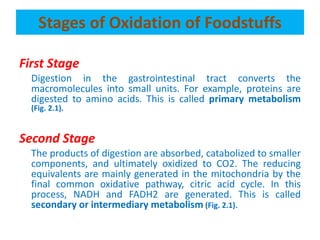
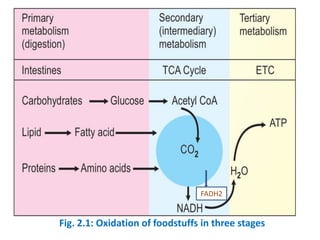
Digestion in the gastrointestinal tract converts the
macromolecules into small units. For example, proteins are
digested to amino acids. This is called primary metabolism
(Fig. 2.1).
Second Stage
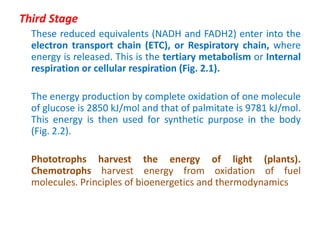
The products of digestion are absorbed, catabolized to smaller
components, and ultimately oxidized to CO2. The reducing
equivalents are mainly generated in the mitochondria by the
final common oxidative pathway, citric acid cycle. In this
process, NADH and FADH2 are generated. This is called
secondary or intermediary metabolism (Fig. 2.1).
Third Stage
These reduced equivalents (NADH and FADH2) enter into the
electron transport chain (ETC), or Respiratory chain, where
energy is released. This is the tertiary metabolism or Internal
respiration or cellular respiration (Fig. 2.1).
The energy production by complete oxidation of one molecule
of glucose is 2850 kJ/mol and that of palmitate is 9781 kJ/mol.
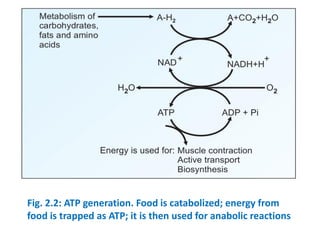
This energy is then used for synthetic purpose in the body
(Fig. 2.2).
Phototrophs harvest the energy of light (plants).
Chemotrophs harvest energy from oxidation of fuel
molecules. Principles of bioenergetics and thermodynamics
Fig. 2.1: Oxidation of foodstuffs in three stages
FADH2
Fig. 2.2: ATP generation. Food is catabolized; energy from
food is trapped as ATP; it is then used for anabolic reactions
Box 2.1: Summary of bioenergetics
• Bioenergetics or biochemical thermodynamics deals with the
study of energy changes (transfer and utilization)in biochemical
reactions. The reactions are broadly classified as exergonic
(energy releasing) and endergonic (energy consuming)
• Free energy
The energy actually available to do work ( utilizable)is kkown as
free energy. C hangesi n the free energy (G) are valuable in
predicting the feasibility of chemical reactions
1. Free energy is a measure of the energy available to perform useful
work
2. ΔG can predict the direction of a chemical reaction
3. Chemical reactions can be coupled, which allows an energetically
unfavorable reaction to conclusion
4. ΔG measured under physiological conditions may be different from
that at a standard state
REDOX POTENTIALS
Redox potential of a system is the electron transfer potential E0
‫׳‬. Oxidation is defined as the loss of electrons and reduction as
the gain in electrons.
When a substance exists both in the reduced state and in the
oxidized state, the pair is called a redox couple.
The redox potential of this couple is estimated by measuring
the electromotive force (EMF) of a sample half cell
connected to a standard half cell.
The sample half cell contains one molar solution each of the
reductant and oxidant.
The reference standard half cell has 1 M H+ solution in
equilibrium with hydrogen gas at one atmosphere pressure.
The reference half cell has a reduction potential of zero mV.
Negative and Positive Redox Potential
• The oxidation-reduction potential or, simply, redox potential,
is a quantitative measure of the tendency of a redox pair to
lose or gain electrons. The redox pairs are assigned specific
standard redox potential (Eo volts) at pH 7.0 and 25"C.
When a substance has lower affinity for electrons than
hydrogen, it has a negative redox potential. If the substance
has a positive redox potential, it has a higher affinity for
electrons than hydrogen. Thus NADH, a strong reducing agent,
has a negative redox potential (–0.32 V ), whereas a strong
oxidant like oxygen has a positive redox potential (+0.82 V).
Table 20.1 gives the redox potentials of some of the important
redox couples of the biological system. A summary is shown in
Box 20.1.
TABLE 2.1: Redox potentials
Oxidant Reductant Eo' (in V)
NAD+ NADH + H+ –0.32
Cytochrome b+++ Cytochrome b++ +0.07
Co-enzyme Q Coenzyme QH2 +0.10
Cytochrome c+++ Cytochrome c++ +0.22
Cytochrome a+++ Cytochrome a++ +0.29
O2 + 2H H2O +0.82
ANY
QUESTION?

Biological oxidation L1

  • 1.
    BIOLOGICAL OXIDATION ANDELECTRON TRANSPORT CHAIN DIPAK KUMAR SINGHA ASST. PROFESSOR CALCUTTA INSTITUTE OF PHARMACEUTICAL TECHNOLOGY & AHS Stay at your Home You are not alone Prevent COVID-19
  • 2.
    BIOLOGICAL OXIDATION ANDELECTRON TRANSPORT CHAIN The students must be able to answer questions on the following topics: ➢ Stages of Oxidation of Foodstuffs ➢ Redox potentials ➢ Biological oxidation ➢ Enzymes and co-enzymes involved biological oxidation ➢ High energy compounds ➢ Organization of electron transport chain ➢ Oxidative Phosphorylation ➢ Chemiosmotic theory ➢ Proton pump ➢ ATP synthesis ➢ Inhibitors of ATP synthesis
  • 3.
    Stages of Oxidationof Foodstuffs First Stage Digestion in the gastrointestinal tract converts the macromolecules into small units. For example, proteins are digested to amino acids. This is called primary metabolism (Fig. 2.1). Second Stage The products of digestion are absorbed, catabolized to smaller components, and ultimately oxidized to CO2. The reducing equivalents are mainly generated in the mitochondria by the final common oxidative pathway, citric acid cycle. In this process, NADH and FADH2 are generated. This is called secondary or intermediary metabolism (Fig. 2.1).
  • 4.
    Third Stage These reducedequivalents (NADH and FADH2) enter into the electron transport chain (ETC), or Respiratory chain, where energy is released. This is the tertiary metabolism or Internal respiration or cellular respiration (Fig. 2.1). The energy production by complete oxidation of one molecule of glucose is 2850 kJ/mol and that of palmitate is 9781 kJ/mol. This energy is then used for synthetic purpose in the body (Fig. 2.2). Phototrophs harvest the energy of light (plants). Chemotrophs harvest energy from oxidation of fuel molecules. Principles of bioenergetics and thermodynamics
  • 5.
    Fig. 2.1: Oxidationof foodstuffs in three stages FADH2
  • 6.
    Fig. 2.2: ATPgeneration. Food is catabolized; energy from food is trapped as ATP; it is then used for anabolic reactions
  • 7.
    Box 2.1: Summaryof bioenergetics • Bioenergetics or biochemical thermodynamics deals with the study of energy changes (transfer and utilization)in biochemical reactions. The reactions are broadly classified as exergonic (energy releasing) and endergonic (energy consuming) • Free energy The energy actually available to do work ( utilizable)is kkown as free energy. C hangesi n the free energy (G) are valuable in predicting the feasibility of chemical reactions 1. Free energy is a measure of the energy available to perform useful work 2. ΔG can predict the direction of a chemical reaction 3. Chemical reactions can be coupled, which allows an energetically unfavorable reaction to conclusion 4. ΔG measured under physiological conditions may be different from that at a standard state
  • 8.
    REDOX POTENTIALS Redox potentialof a system is the electron transfer potential E0 ‫׳‬. Oxidation is defined as the loss of electrons and reduction as the gain in electrons. When a substance exists both in the reduced state and in the oxidized state, the pair is called a redox couple. The redox potential of this couple is estimated by measuring the electromotive force (EMF) of a sample half cell connected to a standard half cell. The sample half cell contains one molar solution each of the reductant and oxidant. The reference standard half cell has 1 M H+ solution in equilibrium with hydrogen gas at one atmosphere pressure. The reference half cell has a reduction potential of zero mV.
  • 9.
    Negative and PositiveRedox Potential • The oxidation-reduction potential or, simply, redox potential, is a quantitative measure of the tendency of a redox pair to lose or gain electrons. The redox pairs are assigned specific standard redox potential (Eo volts) at pH 7.0 and 25"C. When a substance has lower affinity for electrons than hydrogen, it has a negative redox potential. If the substance has a positive redox potential, it has a higher affinity for electrons than hydrogen. Thus NADH, a strong reducing agent, has a negative redox potential (–0.32 V ), whereas a strong oxidant like oxygen has a positive redox potential (+0.82 V). Table 20.1 gives the redox potentials of some of the important redox couples of the biological system. A summary is shown in Box 20.1.
  • 10.
    TABLE 2.1: Redoxpotentials Oxidant Reductant Eo' (in V) NAD+ NADH + H+ –0.32 Cytochrome b+++ Cytochrome b++ +0.07 Co-enzyme Q Coenzyme QH2 +0.10 Cytochrome c+++ Cytochrome c++ +0.22 Cytochrome a+++ Cytochrome a++ +0.29 O2 + 2H H2O +0.82
  • 11.