Metabolism: Nucleotide metabolism
Lecture 16&17
Noor Ullah
B.Sc MLT, M.Sc Biochemistry, M.Phil Biochemistry/ Mol. Biology
PhD Scholar Biochemistry
Lecturer MLT, KMU IPMS
Nucleotide metabolism
• Nucleotides consist of a nitrogenous base, a pentose and a phosphate
• The pentose sugar is D-ribose in ribonucleotides of RNA while in
deoxyribonucleotides (deoxynucleotides) of DNA, the sugar is 2-deoxy D-ribose
• They are the structural components of nucleic acids (DNA, RNA), coenzymes, and
are involved in the regulation of several metabolic reactions.
2
3/6/2024 Khyber Medical University Institute of Paramedical Sciences
Biosynthesis of purine ribonucleotides
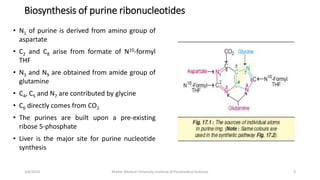
• N1 of purine is derived from amino group of
aspartate
• C2 and C8 arise from formate of N10-formyl
THF
• N3 and N9 are obtained from amide group of
glutamine
• C4, C5 and N7 are contributed by glycine
• C6 directly comes from CO2
• The purines are built upon a pre-existing
ribose 5-phosphate
• Liver is the major site for purine nucleotide
synthesis
3
3/6/2024 Khyber Medical University Institute of Paramedical Sciences
Biosynthesis of purine ribonucleotides
• Two pathways of nucleotide synthesis:
1. De novo synthesis: The synthesis of nucleotides begins with their metabolic
precursors: amino acids, ribose-5-phosphate, CO2, and one-carbon units
2. Salvage pathways: The synthesis of nucleotide by recycling the free bases or
nucleosides released from nucleic acid breakdown
4
3/6/2024 Khyber Medical University Institute of Paramedical Sciences
Biosynthesis of purine ribonucleotides
• De Novo synthesis:
• Site: Cytosol of liver
• Characteristics:
a. Purines are synthesized using ribose-5-phosphate (R-5-P) as the starting
material step by step.
b. PRPP(5-phosphoribosyl-1-pyrophosphate) is active donor of R-5-P
c. AMP and GMP are synthesized from IMP(Inosine-5'-Monophosphate)
5
3/6/2024 Khyber Medical University Institute of Paramedical Sciences
Synthesis of Inosine Monophosphate (IMP)
• Ribose phosphate is formed in pentose-phosphate pathway from glucose
• Basic pathway for biosynthesis of purine ribonucleotides starts from ribose-5-
phosphate (R-5-P)
• Purine ring is synthesized on ribose-5-phosphate by the way of gradual adding
of nitrogen and carbon atoms and cyclization.
• The pathway ends with the formation of a purine nucleotide called Inosine
monophosphate (IMP) which is the precursor of AMP and GMP which then
converted into ATP and GTP, respectively
• Requires 11 steps.
• Occurs primarily in the liver
6
3/6/2024 Khyber Medical University Institute of Paramedical Sciences
Synthesis of AMP and GMP from IMP
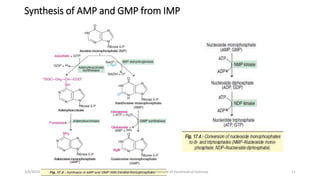
• Inosine monophosphate (IMP) is the immediate precursor for the formation of AMP and
GMP
• Aspartate condenses with IMP in the presence of GTP to produce adenylsuccinate
which, on cleavage, forms AMP
• IMP undergoes NAD+ dependent dehydrogenation to form xanthosine monophosphate
(XMP)
• Glutamine then transfers amide nitrogen to XMP to produce GMP
• 6-Mercaptopurine is an inhibitor of the synthesis of AMP and GMP
• It acts on the enzyme adenylsuccinase (of AMP pathway) and IMP dehydrogenase (of
GMP pathway)
7
3/6/2024 Khyber Medical University Institute of Paramedical Sciences
Regulation of de novo synthesis
• The significance of regulation:
1. Meet the need of the body, without wasting.
2. AMP and GMP control their respective synthesis from IMP by a feedback
mechanism, [GTP]=[ATP]
8
3/6/2024 Khyber Medical University Institute of Paramedical Sciences
Regulation of de novo synthesis
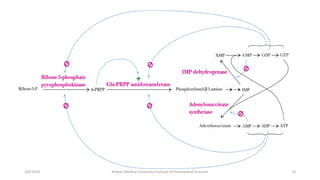
• Amido phosphoribosyl transferase catalyses the rate limiting step of the
pathway which is activated by activated by PRPP.
• So PRPP is an activator of the pathway. Increased PRPP leads to overproduction
of purine nucleotides.
• Inhibitors of the amidotransferase: The enzyme is inhibited by the final products
of the pathway (IMP, AMP and GMP)
9
3/6/2024 Khyber Medical University Institute of Paramedical Sciences
10
3/6/2024 Khyber Medical University Institute of Paramedical Sciences
Synthesis of AMP and GMP from IMP
11
3/6/2024 Khyber Medical University Institute of Paramedical Sciences
Salvage pathway for purines- Resynthesis of purine nucleotides
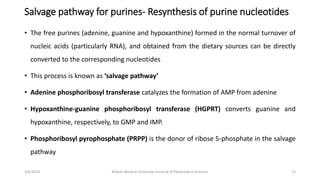
• The free purines (adenine, guanine and hypoxanthine) formed in the normal turnover of
nucleic acids (particularly RNA), and obtained from the dietary sources can be directly
converted to the corresponding nucleotides
• This process is known as ‘salvage pathway’
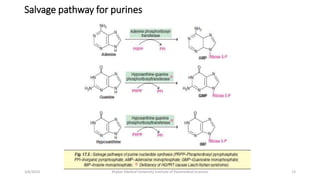
• Adenine phosphoribosyl transferase catalyzes the formation of AMP from adenine
• Hypoxanthine-guanine phosphoribosyl transferase (HGPRT) converts guanine and
hypoxanthine, respectively, to GMP and IMP.
• Phosphoribosyl pyrophosphate (PRPP) is the donor of ribose 5-phosphate in the salvage
pathway
12
3/6/2024 Khyber Medical University Institute of Paramedical Sciences
Salvage pathway for purines
13
3/6/2024 Khyber Medical University Institute of Paramedical Sciences
Significance of salvage pathway
• The salvage pathway is particularly important in certain tissues such as
erythrocytes, Bom marrow and brain where de novo synthesis of purine
nucleotides is not operative
• Save the fuel
• A defect in the enzyme HGPRT causes Lesch-Nyhan syndrome
14
3/6/2024 Khyber Medical University Institute of Paramedical Sciences
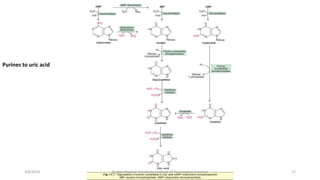
Degradation of purine nucleotides
• The end product of purine metabolism in humans is uric acid
1. The nucleotide monophosphates (AMP, IMP and GMP) are converted to their
respective nucleoside forms (adenosine, inosine and guanosine) by nucleotidase
2. The amino group, either from AMP or adenosine, can be removed to produce IMP or
inosine, respectively
3. Inosine and guanosine are, respectively, converted to hypoxanthine and guanine
(purine bases) by purine nucleoside phosphorylase
4. Adenosine is not degraded by this enzyme, hence it has to be converted to inosine.
15
3/6/2024 Khyber Medical University Institute of Paramedical Sciences
Degradation of purine nucleotides
5. Guanine undergoes deamination by guanase to form xanthine
6. Xanthine oxidase converts hypoxanthine to xanthine, and xanthine to uric
acid
• Xanthine oxidase liberates H2O2 which is harmful to the tissues. Catalase
cleaves H2O2 to H2O and O2
16
3/6/2024 Khyber Medical University Institute of Paramedical Sciences
17
Purines to uric acid
3/6/2024 Khyber Medical University Institute of Paramedical Sciences
Uric acid
• Uric acid (2,6,8-trioxypurine) is the final excretory product of purine metabolism
in humans
• Uric acid can serve as an important antioxidant by getting itself converted (non-
enzymatically) to allantoin
• It is believed that the antioxidant role of ascorbic acid in primates is replaced by
uric acid, since these animals have lost the ability to synthesize ascorbic acid
18
3/6/2024 Khyber Medical University Institute of Paramedical Sciences
Hyperuricemia and gout
• Normal serum concentration of uric acid in adults is 3-7 mg/dl
• The daily excretion of uric acid is about 500-700 mg
• Hyperuricemia- elevation in the serum uric acid concentration
• Gout is a metabolic disease associated with overproduction of uric acid
• At the physiological pH, uric acid is found in a more soluble form as sodium urate
19
3/6/2024 Khyber Medical University Institute of Paramedical Sciences
Hyperuricemia and gout
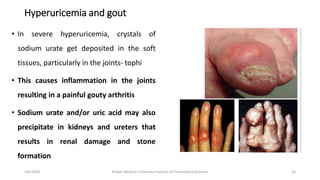
• In severe hyperuricemia, crystals of
sodium urate get deposited in the soft
tissues, particularly in the joints- tophi
• This causes inflammation in the joints
resulting in a painful gouty arthritis
• Sodium urate and/or uric acid may also
precipitate in kidneys and ureters that
results in renal damage and stone
formation
20
3/6/2024 Khyber Medical University Institute of Paramedical Sciences
Types of gout
• Primary gout: Overproduction of uric acid due to an inborn error of metabolism
• PRPP synthetase: In normal circumstances, PRPP synthetase is under feedback
control by purine nucleotides (ADP and GDP)
• Variant forms of PRPP synthetase are not subjected to feedback regulation—
leads to the increased production of purines
• PRPP glutamylamidotransferase: The lack of feedback control of this enzyme y
purine nucleotides also leads to their elevated synthesis.
21
3/6/2024 Khyber Medical University Institute of Paramedical Sciences
Types of gout
• HGPRT deficiency: Deficiency of this enzyme results in Lesch-Nyhan syndrome
• Glucose 6-phosphatase deficiency: In type I glycogen storage disease (von
Gierke’s), glucose 6-phosphate cannot be converted to glucose
• This leads to the increased utilization of glucose 6-phosphate by hexose
monophosphate shunt (HMP shunt), resulting in elevated levels of ribose 5-
phosphate and PRPP and, ultimately, purine overproduction
22
3/6/2024 Khyber Medical University Institute of Paramedical Sciences
Types of gout
• Secondary gout: Increased degradation of nucleic acids in various cancers
(leukemias, polycythemia, lymphomas, etc.) psoriasis and increased tissue
breakdown (trauma, starvation etc.)
• Pseudogout: This is caused by the deposition of calcium pyrophosphate crystals
in joints
• Serum uric acid concentration is normal in pseudogout
• The clinical manifestations of pseudogout are similar to gout
23
3/6/2024 Khyber Medical University Institute of Paramedical Sciences
Lesch- Nyhan syndrome
• First described by Michael Lesch and William L. Nyhan in 1964
• There is a defect or lack in the HGPRT enzyme
• Sex-linked metabolic disorder: only males
• The rate of purine synthesis is increased about 200-fold
• Loss of HGPRT → block (inhibit) salvage pathway of guanine and hypoxanthine → ↓ use of
PRPP in salvage pathway and ↑ de novo purine synthesis leading to overproduction of
purine nucleotides which by catabolism, will give increased levels of uric acid
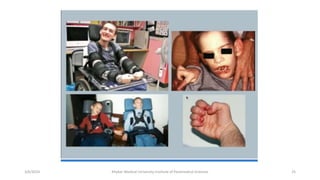
Symptoms: appear at age 3-6 months. The first symptom is orange colored crystals in the diaper of
the baby.
1- Hyperuricemia: in aggressive way than in gout.
2- urate kidney stones:
Some symptoms of unknown mechanism are:
3- mental retardation
4- involuntary movements of legs and arms
5- lack of muscle coordination
6- self mutilation (biting of fingers and lips leading to lip lesions). 24
3/6/2024 Khyber Medical University Institute of Paramedical Sciences
25
3/6/2024 Khyber Medical University Institute of Paramedical Sciences
Biosynthesis of pyrimidine ribonucleotides
• Aspartate, glutamine (amide group) and CO2 contribute to atoms in the formation
of pyrimidine ring
• Pyrimidine ring is first synthesized and then attached to ribose 5-phosphate
• This is in contrast to purine nucleotide synthesis wherein purine ring is built upon
a pre-existing ribose 5-phosphate
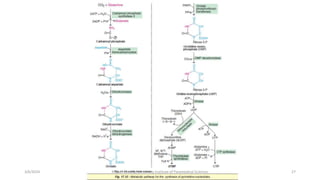
• The pathway of pyrimidine synthesis is given
26
3/6/2024 Khyber Medical University Institute of Paramedical Sciences
27
3/6/2024 Khyber Medical University Institute of Paramedical Sciences
Degradation of pyrimidine nucleotides
• The pyrimidine nucleotides undergo similar reactions (dephosphorylation,
deamination and cleavage of glycosidic bond) like that of purine nucleotides to
liberate the nitrogenous bases—cytosine, uracil and thymine
• The bases are then degraded to highly soluble products—β-alanine and β –
aminoisobutyrate
• These are the amino acids which undergo transamination and other reactions to
finally produce acetyl CoA and succinyl CoA
28
3/6/2024 Khyber Medical University Institute of Paramedical Sciences
Salvage pathway
• The pyrimidines (like purines) can also serve as precursors in the salvage pathway
to be converted to the respective nucleotides
• This reaction is catalyzed by pyrimidine phosphoribosyl transferase which
utilizes PRPP as the source of ribose 5-phosphate
29
3/6/2024 Khyber Medical University Institute of Paramedical Sciences

Nucleotide metabolism .biochemistry lecture

  • 1.
    Metabolism: Nucleotide metabolism Lecture16&17 Noor Ullah B.Sc MLT, M.Sc Biochemistry, M.Phil Biochemistry/ Mol. Biology PhD Scholar Biochemistry Lecturer MLT, KMU IPMS
  • 2.
    Nucleotide metabolism • Nucleotidesconsist of a nitrogenous base, a pentose and a phosphate • The pentose sugar is D-ribose in ribonucleotides of RNA while in deoxyribonucleotides (deoxynucleotides) of DNA, the sugar is 2-deoxy D-ribose • They are the structural components of nucleic acids (DNA, RNA), coenzymes, and are involved in the regulation of several metabolic reactions. 2 3/6/2024 Khyber Medical University Institute of Paramedical Sciences
  • 3.
    Biosynthesis of purineribonucleotides • N1 of purine is derived from amino group of aspartate • C2 and C8 arise from formate of N10-formyl THF • N3 and N9 are obtained from amide group of glutamine • C4, C5 and N7 are contributed by glycine • C6 directly comes from CO2 • The purines are built upon a pre-existing ribose 5-phosphate • Liver is the major site for purine nucleotide synthesis 3 3/6/2024 Khyber Medical University Institute of Paramedical Sciences
  • 4.
    Biosynthesis of purineribonucleotides • Two pathways of nucleotide synthesis: 1. De novo synthesis: The synthesis of nucleotides begins with their metabolic precursors: amino acids, ribose-5-phosphate, CO2, and one-carbon units 2. Salvage pathways: The synthesis of nucleotide by recycling the free bases or nucleosides released from nucleic acid breakdown 4 3/6/2024 Khyber Medical University Institute of Paramedical Sciences
  • 5.
    Biosynthesis of purineribonucleotides • De Novo synthesis: • Site: Cytosol of liver • Characteristics: a. Purines are synthesized using ribose-5-phosphate (R-5-P) as the starting material step by step. b. PRPP(5-phosphoribosyl-1-pyrophosphate) is active donor of R-5-P c. AMP and GMP are synthesized from IMP(Inosine-5'-Monophosphate) 5 3/6/2024 Khyber Medical University Institute of Paramedical Sciences
  • 6.
    Synthesis of InosineMonophosphate (IMP) • Ribose phosphate is formed in pentose-phosphate pathway from glucose • Basic pathway for biosynthesis of purine ribonucleotides starts from ribose-5- phosphate (R-5-P) • Purine ring is synthesized on ribose-5-phosphate by the way of gradual adding of nitrogen and carbon atoms and cyclization. • The pathway ends with the formation of a purine nucleotide called Inosine monophosphate (IMP) which is the precursor of AMP and GMP which then converted into ATP and GTP, respectively • Requires 11 steps. • Occurs primarily in the liver 6 3/6/2024 Khyber Medical University Institute of Paramedical Sciences
  • 7.
    Synthesis of AMPand GMP from IMP • Inosine monophosphate (IMP) is the immediate precursor for the formation of AMP and GMP • Aspartate condenses with IMP in the presence of GTP to produce adenylsuccinate which, on cleavage, forms AMP • IMP undergoes NAD+ dependent dehydrogenation to form xanthosine monophosphate (XMP) • Glutamine then transfers amide nitrogen to XMP to produce GMP • 6-Mercaptopurine is an inhibitor of the synthesis of AMP and GMP • It acts on the enzyme adenylsuccinase (of AMP pathway) and IMP dehydrogenase (of GMP pathway) 7 3/6/2024 Khyber Medical University Institute of Paramedical Sciences
  • 8.
    Regulation of denovo synthesis • The significance of regulation: 1. Meet the need of the body, without wasting. 2. AMP and GMP control their respective synthesis from IMP by a feedback mechanism, [GTP]=[ATP] 8 3/6/2024 Khyber Medical University Institute of Paramedical Sciences
  • 9.
    Regulation of denovo synthesis • Amido phosphoribosyl transferase catalyses the rate limiting step of the pathway which is activated by activated by PRPP. • So PRPP is an activator of the pathway. Increased PRPP leads to overproduction of purine nucleotides. • Inhibitors of the amidotransferase: The enzyme is inhibited by the final products of the pathway (IMP, AMP and GMP) 9 3/6/2024 Khyber Medical University Institute of Paramedical Sciences
  • 10.
    10 3/6/2024 Khyber MedicalUniversity Institute of Paramedical Sciences
  • 11.
    Synthesis of AMPand GMP from IMP 11 3/6/2024 Khyber Medical University Institute of Paramedical Sciences
  • 12.
    Salvage pathway forpurines- Resynthesis of purine nucleotides • The free purines (adenine, guanine and hypoxanthine) formed in the normal turnover of nucleic acids (particularly RNA), and obtained from the dietary sources can be directly converted to the corresponding nucleotides • This process is known as ‘salvage pathway’ • Adenine phosphoribosyl transferase catalyzes the formation of AMP from adenine • Hypoxanthine-guanine phosphoribosyl transferase (HGPRT) converts guanine and hypoxanthine, respectively, to GMP and IMP. • Phosphoribosyl pyrophosphate (PRPP) is the donor of ribose 5-phosphate in the salvage pathway 12 3/6/2024 Khyber Medical University Institute of Paramedical Sciences
  • 13.
    Salvage pathway forpurines 13 3/6/2024 Khyber Medical University Institute of Paramedical Sciences
  • 14.
    Significance of salvagepathway • The salvage pathway is particularly important in certain tissues such as erythrocytes, Bom marrow and brain where de novo synthesis of purine nucleotides is not operative • Save the fuel • A defect in the enzyme HGPRT causes Lesch-Nyhan syndrome 14 3/6/2024 Khyber Medical University Institute of Paramedical Sciences
  • 15.
    Degradation of purinenucleotides • The end product of purine metabolism in humans is uric acid 1. The nucleotide monophosphates (AMP, IMP and GMP) are converted to their respective nucleoside forms (adenosine, inosine and guanosine) by nucleotidase 2. The amino group, either from AMP or adenosine, can be removed to produce IMP or inosine, respectively 3. Inosine and guanosine are, respectively, converted to hypoxanthine and guanine (purine bases) by purine nucleoside phosphorylase 4. Adenosine is not degraded by this enzyme, hence it has to be converted to inosine. 15 3/6/2024 Khyber Medical University Institute of Paramedical Sciences
  • 16.
    Degradation of purinenucleotides 5. Guanine undergoes deamination by guanase to form xanthine 6. Xanthine oxidase converts hypoxanthine to xanthine, and xanthine to uric acid • Xanthine oxidase liberates H2O2 which is harmful to the tissues. Catalase cleaves H2O2 to H2O and O2 16 3/6/2024 Khyber Medical University Institute of Paramedical Sciences
  • 17.
    17 Purines to uricacid 3/6/2024 Khyber Medical University Institute of Paramedical Sciences
  • 18.
    Uric acid • Uricacid (2,6,8-trioxypurine) is the final excretory product of purine metabolism in humans • Uric acid can serve as an important antioxidant by getting itself converted (non- enzymatically) to allantoin • It is believed that the antioxidant role of ascorbic acid in primates is replaced by uric acid, since these animals have lost the ability to synthesize ascorbic acid 18 3/6/2024 Khyber Medical University Institute of Paramedical Sciences
  • 19.
    Hyperuricemia and gout •Normal serum concentration of uric acid in adults is 3-7 mg/dl • The daily excretion of uric acid is about 500-700 mg • Hyperuricemia- elevation in the serum uric acid concentration • Gout is a metabolic disease associated with overproduction of uric acid • At the physiological pH, uric acid is found in a more soluble form as sodium urate 19 3/6/2024 Khyber Medical University Institute of Paramedical Sciences
  • 20.
    Hyperuricemia and gout •In severe hyperuricemia, crystals of sodium urate get deposited in the soft tissues, particularly in the joints- tophi • This causes inflammation in the joints resulting in a painful gouty arthritis • Sodium urate and/or uric acid may also precipitate in kidneys and ureters that results in renal damage and stone formation 20 3/6/2024 Khyber Medical University Institute of Paramedical Sciences
  • 21.
    Types of gout •Primary gout: Overproduction of uric acid due to an inborn error of metabolism • PRPP synthetase: In normal circumstances, PRPP synthetase is under feedback control by purine nucleotides (ADP and GDP) • Variant forms of PRPP synthetase are not subjected to feedback regulation— leads to the increased production of purines • PRPP glutamylamidotransferase: The lack of feedback control of this enzyme y purine nucleotides also leads to their elevated synthesis. 21 3/6/2024 Khyber Medical University Institute of Paramedical Sciences
  • 22.
    Types of gout •HGPRT deficiency: Deficiency of this enzyme results in Lesch-Nyhan syndrome • Glucose 6-phosphatase deficiency: In type I glycogen storage disease (von Gierke’s), glucose 6-phosphate cannot be converted to glucose • This leads to the increased utilization of glucose 6-phosphate by hexose monophosphate shunt (HMP shunt), resulting in elevated levels of ribose 5- phosphate and PRPP and, ultimately, purine overproduction 22 3/6/2024 Khyber Medical University Institute of Paramedical Sciences
  • 23.
    Types of gout •Secondary gout: Increased degradation of nucleic acids in various cancers (leukemias, polycythemia, lymphomas, etc.) psoriasis and increased tissue breakdown (trauma, starvation etc.) • Pseudogout: This is caused by the deposition of calcium pyrophosphate crystals in joints • Serum uric acid concentration is normal in pseudogout • The clinical manifestations of pseudogout are similar to gout 23 3/6/2024 Khyber Medical University Institute of Paramedical Sciences
  • 24.
    Lesch- Nyhan syndrome •First described by Michael Lesch and William L. Nyhan in 1964 • There is a defect or lack in the HGPRT enzyme • Sex-linked metabolic disorder: only males • The rate of purine synthesis is increased about 200-fold • Loss of HGPRT → block (inhibit) salvage pathway of guanine and hypoxanthine → ↓ use of PRPP in salvage pathway and ↑ de novo purine synthesis leading to overproduction of purine nucleotides which by catabolism, will give increased levels of uric acid Symptoms: appear at age 3-6 months. The first symptom is orange colored crystals in the diaper of the baby. 1- Hyperuricemia: in aggressive way than in gout. 2- urate kidney stones: Some symptoms of unknown mechanism are: 3- mental retardation 4- involuntary movements of legs and arms 5- lack of muscle coordination 6- self mutilation (biting of fingers and lips leading to lip lesions). 24 3/6/2024 Khyber Medical University Institute of Paramedical Sciences
  • 25.
    25 3/6/2024 Khyber MedicalUniversity Institute of Paramedical Sciences
  • 26.
    Biosynthesis of pyrimidineribonucleotides • Aspartate, glutamine (amide group) and CO2 contribute to atoms in the formation of pyrimidine ring • Pyrimidine ring is first synthesized and then attached to ribose 5-phosphate • This is in contrast to purine nucleotide synthesis wherein purine ring is built upon a pre-existing ribose 5-phosphate • The pathway of pyrimidine synthesis is given 26 3/6/2024 Khyber Medical University Institute of Paramedical Sciences
  • 27.
    27 3/6/2024 Khyber MedicalUniversity Institute of Paramedical Sciences
  • 28.
    Degradation of pyrimidinenucleotides • The pyrimidine nucleotides undergo similar reactions (dephosphorylation, deamination and cleavage of glycosidic bond) like that of purine nucleotides to liberate the nitrogenous bases—cytosine, uracil and thymine • The bases are then degraded to highly soluble products—β-alanine and β – aminoisobutyrate • These are the amino acids which undergo transamination and other reactions to finally produce acetyl CoA and succinyl CoA 28 3/6/2024 Khyber Medical University Institute of Paramedical Sciences
  • 29.
    Salvage pathway • Thepyrimidines (like purines) can also serve as precursors in the salvage pathway to be converted to the respective nucleotides • This reaction is catalyzed by pyrimidine phosphoribosyl transferase which utilizes PRPP as the source of ribose 5-phosphate 29 3/6/2024 Khyber Medical University Institute of Paramedical Sciences