Lipoprotein Metabolism
Prepared by: Mohammad Reza Abdullahi
Master of Medical Sciences in Biochemistry
Kabul University of Medical Sciences
Allied Health Faculty
Medical Laboratory Technology Department
Contents
• Biomedical importance
• Composition of lipoproteins
• Classification of lipoproteins
• Apolipoprotein
• Metabolism of chylomicron
• Metabolism of VLDL
• Metabolism of LDL
• Metabolism of HDL
• Lipoprotein a
• Hyperlipoproteinemia
Medical Laboratory Technology Department 2
Biomedical importance
• Lipoproteins are spherical macromolecular complexes of lipids and
specific proteins (apolipoproteins).
• Transport of lipid in blood plasma
• Abnormalities of lipoprotein metabolism cause various hypo- or
hyperlipoproteinemias.
Medical Laboratory Technology Department 3
Composition of lipoproteins
• Lipoproteins are composed of a neutral lipid core (containing
triacylglycerol [TAG] and cholesteryl esters) surrounded by a shell of
amphipathic apolipoproteins , phospholipid, and unesterified (free)
cholesterol
• These amphipathic compounds are oriented so that
their polar portions are exposed on the surface of
the lipoprotein, thereby rendering the particle soluble
in aqueous solution
Medical Laboratory Technology Department 4
Classification of Lipoproteins
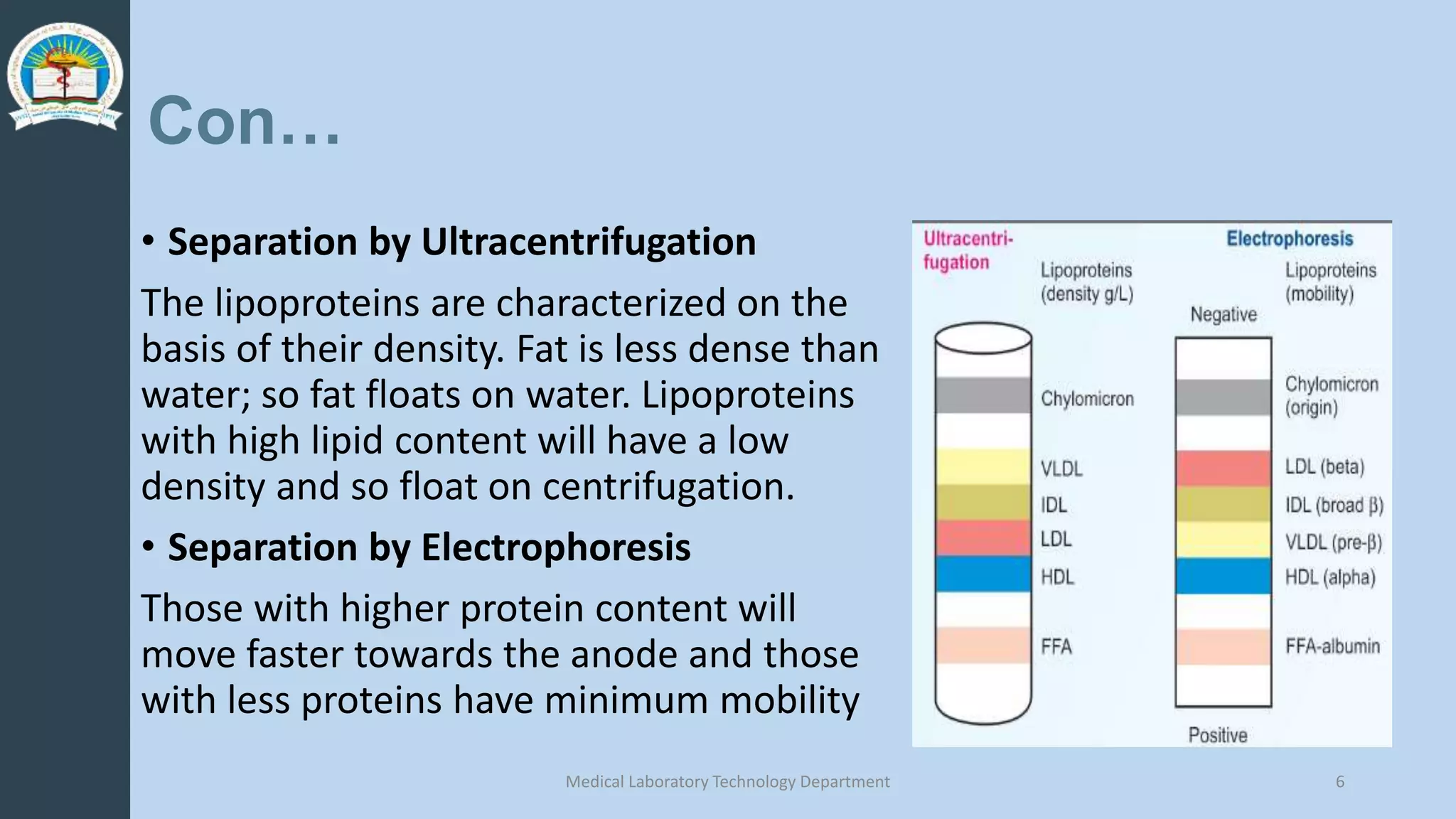
• Depending on the density (by ultra centrifugation) or
on the electrophoretic mobility, the lipoproteins in
plasma are classified into five major types
1. Chylomicrons—contains apoprotein B-48.
2. Very low density lipoproteins (VLDL) or pre-beta
lipoproteins. Main apoprotein is B-100.
3. Intermediate density lipoproteins (IDL) or broadbeta
lipoproteins
4. Low density lipoproteins (LDL) or beta-lipoproteins.
Major apoprotein in LDL is B-100.
5. High density lipoproteins (HDL) or alpha-lipoproteins.
Major apoprotein in HDL is apo-A.
Medical Laboratory Technology Department 5
Con…
• Separation by Ultracentrifugation
The lipoproteins are characterized on the
basis of their density. Fat is less dense than
water; so fat floats on water. Lipoproteins
with high lipid content will have a low
density and so float on centrifugation.
• Separation by Electrophoresis
Those with higher protein content will
move faster towards the anode and those
with less proteins have minimum mobility
Medical Laboratory Technology Department 6
Apolipoprotein
• The protein part of lipoprotein is called apolipoprotein (apo-Lp) or apoprotein
• Mostly synthesized in the liver
• Some apolipoproteins are integral and cannot be removed (eg, apo B), whereas
others are bound to the surface and are free to transfer to other lipoproteins, eg.
apos C and E).
• Functions:
1) They can form part of the structure of the lipoprotein, for example, apo B48 in
chylomicron and apo B100 in LDL
2) They are enzyme cofactors, for example, C-II for lipoprotein lipase, A-I for
lecithin:cholesterol acyltransferase, or enzyme inhibitors, for example, apo A-II
and apo C-III for lipoprotein lipase, apo C-I for cholesteryl ester transfer protein
3) They act as ligands for interaction with lipoprotein receptors in tissues, for
example, apo B-100 and apo E for the LDL receptor, A-I for the HDL receptor
Medical Laboratory Technology Department 7
Metabolism of Chylomicron
• Chylomicrons are assembled in intestinal mucosal cells and carry dietary (exogenous) TAG,
cholesterol, fat-soluble vitamins , and cholesteryl esters to the peripheral tissues.
1) Synthesis of apolipoproteins: Apo B-48 is unique to chylomicrons
2) Assembly of chylomicron: Assembly of the apolipoproteins and lipid into chylomicrons requires
microsomal triglyceride transfer protein (MTP)which loads apo B-48 with lipid.
3) Modification of nascent chylomicron particles: nascent chylomicron receaving apo E & CII from
HDL.
4) Degradation of triacylglycerol by lipoprotein lipase: LPL which is located in capillary walls of
most tissues hydrolysis TAG to FFA and glycerol.
5) Regulation of LPL activity: in the fed state (elevated insulin levels ), LPL synthesis is increased in
adipose but decreased in muscle tissue . Fasting (decreased insulin) favors LPL synthesis in
muscle .
6) Formation of chylomicron remnants: chylomicron loses 90% of its TAG and become smaller and
denser, apo CII returned to HDL and the particle called chylomicron remnant which taken by
hepatic cells (receptors in liver recognize apo E).
Medical Laboratory Technology Department 8
Medical Laboratory Technology Department 9
Metabolism of very low density
lipoproteins
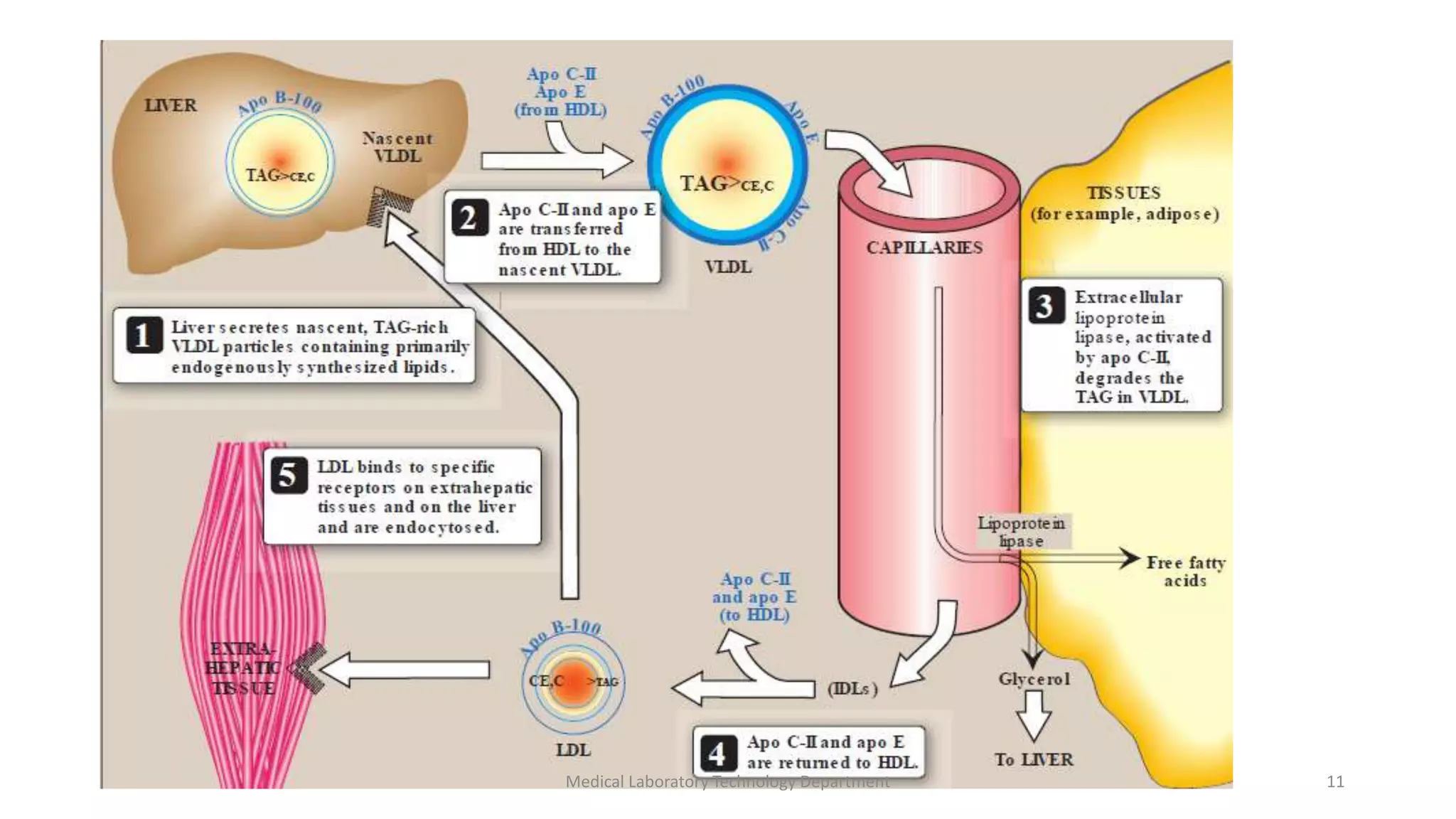
• VLDLs are produced in the liver. They are composed predominantly of
endogenous TAG (approximately 60%), and their function is to carry this
lipid from the liver to the peripheral tissues.
1) Release from liver: VLDLs are secreted directly into the blood by the
liver as nascent particles containing apo B-100. They must obtain apo
C-II and apo E from circulating HDL.
2) Modification in the circulation: TAG in VLDL degraded by LPL, causing
the VLDLs to decrease in size and become denser. apo C and E, are
returned to HDL, Additionally, some TAGs are transferred from VLDL
to HDL in an exchange reaction that concomitantly transfers
cholesteryl esters from HDL to VLDL. This exchange is accomplished
by cholesteryl ester transfer protein (CETP).
3) Conversion to low density lipoprotein: With these modifications, the
VLDL is converted in the plasma to IDL, then LDL.
Medical Laboratory Technology Department 10
Medical Laboratory Technology Department 11
Metabolism of low density lipoproteins
• The primary function of LDL particles is to provide cholesterol to the
peripheral tissues. They do so by binding to cell surface membrane LDL
receptors that recognize apo B-100.
• The LDL is taken up by peripheral tissues by receptor-mediated
endocytosis. LDL receptors are located in specialized regions called clathrin
coated pits. When the apo B-100 binds to the apo-B-100 receptor, the
receptor-LDL complex is internalized by endocytosis.
• The endosome vesicle thus formed fuses with lysosomes. The receptor is
recycled and returns to the cell surface. The LDL particle, along with
apoproteins and cholesterol ester are hydrolyzed by lysosomal hydrolases,
forming amino acids and free cholesterol. The free receptors can now
return to the membrane surface to bind further LDL molecules
Medical Laboratory Technology Department 12
Con…
• The free cholesterol is incorporated into plasma membranes or esterified
(by ACAT) and stored within the cell. In addition, it could be used for
synthesis of steroid hormones.
• The level of intracellular cholesterol is regulated through cholesterol-
induced suppression of LDL receptor synthesis and cholesterol-induced
inhibition of cholesterol synthesis.
• The increased level of intracellular cholesterol that results from LDL uptake
activates ACAT, thereby allowing the storage of excess cholesterol within
cells. However, the effect of cholesterol-induced suppression of LDL
receptor synthesis is to decrease the rate at which LDLs and IDLs are
removed from the serum. This can lead to excess circulating levels of
cholesterol. The excess cholesterol tends to be deposited within the
arteries, leading to atherosclerosis.
Medical Laboratory Technology Department 13
Medical Laboratory Technology Department 14
LDL and cardiovascular disease
• The LDL concentration in blood has positive correlation with incidence of
cardiovascular diseases.
• A fraction of cholesterol is taken up by macrophages; this is not a regulated
pathway. Increased levels of LDL or modification of LDL by glycation (as
seen in diabetes mellitus) or oxidation increases the fraction of cholesterol
taken up by macrophages.
• LDL infiltrates through arterial walls, and are taken up by macrophages or
scavenger cells. This is the starting event of atherosclerosis leading to
myocardial infarction.
• When these cells become engorged with cholesterol, foam cells are
formed, that get deposited in the sub-endothelial space triggering
formation of atheromatous plaque.
Medical Laboratory Technology Department 15
Medical Laboratory Technology Department 16
Metabolism of HDL
• HDL particles are formed in blood by the addition of lipid to apo A-1, an
apolipoprotein made by the liver and intestine and secreted into blood.
[HDLs are also formed within the liver and intestine.]
• HDL functions:
• Apolipoprotein supply:: Apo CII & apo E
• Uptake of unesterified cholesterol: Nascent HDL which is disk shaped particles take
up cholesterols from peripheral tissue.
• Esterification of cholesterol: cholestereol esterify to colesterol esters by LCAT.
Incresead cholesterol esters convert discoidal nascent HDL to spherical HDL3 and
HDL2. CETP moves some of cholestryl esters to VLDL in exchange for TAG.
• Reverse cholesterol transport: HDL transfer cholestrol from peripheral tissue to liver.
HDL is taken up by hepatic scavenger receptor B1. Hepatic lipase hydrolyzes HDL
phospholipid and TAG, and cholesterol esters are released into liver cells. The
cholesterol that reaches the liver is used for synthesis of bile acids or excreted as
such in bile. Therefor, HDL is called good cholesterol.
17
18
Clinical significance of HDL-C
• The level of HDL-C in serum is inversely related to the incidence of
myocardial infarction. As it is “anti-atherogenic” or “protective” in
nature, HDL is known as “good cholesterol” in common parlance.
• HDL-C level below 35 mg/dL increases the risk, while level above 60
mg/dL protects the person from coronary artery diseases.
19
Lipoprotein a or Lp (a)
• Lp (a) is structurally releated to LDL because both lipoproteins
possess one molecule of apo B-100 per particle with similar lipid
compositions. Unlike LDL, Lp(a) also contains a carbohydrate-rich
protein [apo(a)], which is covalently bound to the apo B-100 through
a disulfide linkage.
• Apo(a) is structurally homologous to plasminogen, the precursor of a
blood protease whose target is fibrin, the main protein component of
blood clots.
• It is hypothesized that elevated Lp(a) slows the breakdown of blood
clots that trigger heart attacks because it competes with plasminogen
for binding to fibrin.
20
Hyperlipoproteinemia
21
Reference
• Lippincott’s illustrated Reviews Biochemistry/[edited by] Denise R.
Ferrier- 6th edition
• Textbook of Biochemistry for Medical Students/[edited by] DM
Vasudevan, Sreekumari S, Kannan Vaidyanathan- 7th ed.
• Clinical chemistry : principles, techniques, and correlations/[edited by]
Michael L. Bishop, Edward P. Fody, Larry E. Schoeff.—8th ed.
• TIETZ FUNDAMENTALS OF CLINICAL CHEMISTRY/[edited by] Carl A.
Burtis, David E. Bruns- 7th edition
Medical Laboratory Technology Department 22
Thanks
For your
attention
Medical Laboratory Technology Department 23

Lipoprotein Metabolism.pptx

  • 1.
    Lipoprotein Metabolism Prepared by:Mohammad Reza Abdullahi Master of Medical Sciences in Biochemistry Kabul University of Medical Sciences Allied Health Faculty Medical Laboratory Technology Department
  • 2.
    Contents • Biomedical importance •Composition of lipoproteins • Classification of lipoproteins • Apolipoprotein • Metabolism of chylomicron • Metabolism of VLDL • Metabolism of LDL • Metabolism of HDL • Lipoprotein a • Hyperlipoproteinemia Medical Laboratory Technology Department 2
  • 3.
    Biomedical importance • Lipoproteinsare spherical macromolecular complexes of lipids and specific proteins (apolipoproteins). • Transport of lipid in blood plasma • Abnormalities of lipoprotein metabolism cause various hypo- or hyperlipoproteinemias. Medical Laboratory Technology Department 3
  • 4.
    Composition of lipoproteins •Lipoproteins are composed of a neutral lipid core (containing triacylglycerol [TAG] and cholesteryl esters) surrounded by a shell of amphipathic apolipoproteins , phospholipid, and unesterified (free) cholesterol • These amphipathic compounds are oriented so that their polar portions are exposed on the surface of the lipoprotein, thereby rendering the particle soluble in aqueous solution Medical Laboratory Technology Department 4
  • 5.
    Classification of Lipoproteins •Depending on the density (by ultra centrifugation) or on the electrophoretic mobility, the lipoproteins in plasma are classified into five major types 1. Chylomicrons—contains apoprotein B-48. 2. Very low density lipoproteins (VLDL) or pre-beta lipoproteins. Main apoprotein is B-100. 3. Intermediate density lipoproteins (IDL) or broadbeta lipoproteins 4. Low density lipoproteins (LDL) or beta-lipoproteins. Major apoprotein in LDL is B-100. 5. High density lipoproteins (HDL) or alpha-lipoproteins. Major apoprotein in HDL is apo-A. Medical Laboratory Technology Department 5
  • 6.
    Con… • Separation byUltracentrifugation The lipoproteins are characterized on the basis of their density. Fat is less dense than water; so fat floats on water. Lipoproteins with high lipid content will have a low density and so float on centrifugation. • Separation by Electrophoresis Those with higher protein content will move faster towards the anode and those with less proteins have minimum mobility Medical Laboratory Technology Department 6
  • 7.
    Apolipoprotein • The proteinpart of lipoprotein is called apolipoprotein (apo-Lp) or apoprotein • Mostly synthesized in the liver • Some apolipoproteins are integral and cannot be removed (eg, apo B), whereas others are bound to the surface and are free to transfer to other lipoproteins, eg. apos C and E). • Functions: 1) They can form part of the structure of the lipoprotein, for example, apo B48 in chylomicron and apo B100 in LDL 2) They are enzyme cofactors, for example, C-II for lipoprotein lipase, A-I for lecithin:cholesterol acyltransferase, or enzyme inhibitors, for example, apo A-II and apo C-III for lipoprotein lipase, apo C-I for cholesteryl ester transfer protein 3) They act as ligands for interaction with lipoprotein receptors in tissues, for example, apo B-100 and apo E for the LDL receptor, A-I for the HDL receptor Medical Laboratory Technology Department 7
  • 8.
    Metabolism of Chylomicron •Chylomicrons are assembled in intestinal mucosal cells and carry dietary (exogenous) TAG, cholesterol, fat-soluble vitamins , and cholesteryl esters to the peripheral tissues. 1) Synthesis of apolipoproteins: Apo B-48 is unique to chylomicrons 2) Assembly of chylomicron: Assembly of the apolipoproteins and lipid into chylomicrons requires microsomal triglyceride transfer protein (MTP)which loads apo B-48 with lipid. 3) Modification of nascent chylomicron particles: nascent chylomicron receaving apo E & CII from HDL. 4) Degradation of triacylglycerol by lipoprotein lipase: LPL which is located in capillary walls of most tissues hydrolysis TAG to FFA and glycerol. 5) Regulation of LPL activity: in the fed state (elevated insulin levels ), LPL synthesis is increased in adipose but decreased in muscle tissue . Fasting (decreased insulin) favors LPL synthesis in muscle . 6) Formation of chylomicron remnants: chylomicron loses 90% of its TAG and become smaller and denser, apo CII returned to HDL and the particle called chylomicron remnant which taken by hepatic cells (receptors in liver recognize apo E). Medical Laboratory Technology Department 8
  • 9.
  • 10.
    Metabolism of verylow density lipoproteins • VLDLs are produced in the liver. They are composed predominantly of endogenous TAG (approximately 60%), and their function is to carry this lipid from the liver to the peripheral tissues. 1) Release from liver: VLDLs are secreted directly into the blood by the liver as nascent particles containing apo B-100. They must obtain apo C-II and apo E from circulating HDL. 2) Modification in the circulation: TAG in VLDL degraded by LPL, causing the VLDLs to decrease in size and become denser. apo C and E, are returned to HDL, Additionally, some TAGs are transferred from VLDL to HDL in an exchange reaction that concomitantly transfers cholesteryl esters from HDL to VLDL. This exchange is accomplished by cholesteryl ester transfer protein (CETP). 3) Conversion to low density lipoprotein: With these modifications, the VLDL is converted in the plasma to IDL, then LDL. Medical Laboratory Technology Department 10
  • 11.
  • 12.
    Metabolism of lowdensity lipoproteins • The primary function of LDL particles is to provide cholesterol to the peripheral tissues. They do so by binding to cell surface membrane LDL receptors that recognize apo B-100. • The LDL is taken up by peripheral tissues by receptor-mediated endocytosis. LDL receptors are located in specialized regions called clathrin coated pits. When the apo B-100 binds to the apo-B-100 receptor, the receptor-LDL complex is internalized by endocytosis. • The endosome vesicle thus formed fuses with lysosomes. The receptor is recycled and returns to the cell surface. The LDL particle, along with apoproteins and cholesterol ester are hydrolyzed by lysosomal hydrolases, forming amino acids and free cholesterol. The free receptors can now return to the membrane surface to bind further LDL molecules Medical Laboratory Technology Department 12
  • 13.
    Con… • The freecholesterol is incorporated into plasma membranes or esterified (by ACAT) and stored within the cell. In addition, it could be used for synthesis of steroid hormones. • The level of intracellular cholesterol is regulated through cholesterol- induced suppression of LDL receptor synthesis and cholesterol-induced inhibition of cholesterol synthesis. • The increased level of intracellular cholesterol that results from LDL uptake activates ACAT, thereby allowing the storage of excess cholesterol within cells. However, the effect of cholesterol-induced suppression of LDL receptor synthesis is to decrease the rate at which LDLs and IDLs are removed from the serum. This can lead to excess circulating levels of cholesterol. The excess cholesterol tends to be deposited within the arteries, leading to atherosclerosis. Medical Laboratory Technology Department 13
  • 14.
  • 15.
    LDL and cardiovasculardisease • The LDL concentration in blood has positive correlation with incidence of cardiovascular diseases. • A fraction of cholesterol is taken up by macrophages; this is not a regulated pathway. Increased levels of LDL or modification of LDL by glycation (as seen in diabetes mellitus) or oxidation increases the fraction of cholesterol taken up by macrophages. • LDL infiltrates through arterial walls, and are taken up by macrophages or scavenger cells. This is the starting event of atherosclerosis leading to myocardial infarction. • When these cells become engorged with cholesterol, foam cells are formed, that get deposited in the sub-endothelial space triggering formation of atheromatous plaque. Medical Laboratory Technology Department 15
  • 16.
  • 17.
    Metabolism of HDL •HDL particles are formed in blood by the addition of lipid to apo A-1, an apolipoprotein made by the liver and intestine and secreted into blood. [HDLs are also formed within the liver and intestine.] • HDL functions: • Apolipoprotein supply:: Apo CII & apo E • Uptake of unesterified cholesterol: Nascent HDL which is disk shaped particles take up cholesterols from peripheral tissue. • Esterification of cholesterol: cholestereol esterify to colesterol esters by LCAT. Incresead cholesterol esters convert discoidal nascent HDL to spherical HDL3 and HDL2. CETP moves some of cholestryl esters to VLDL in exchange for TAG. • Reverse cholesterol transport: HDL transfer cholestrol from peripheral tissue to liver. HDL is taken up by hepatic scavenger receptor B1. Hepatic lipase hydrolyzes HDL phospholipid and TAG, and cholesterol esters are released into liver cells. The cholesterol that reaches the liver is used for synthesis of bile acids or excreted as such in bile. Therefor, HDL is called good cholesterol. 17
  • 18.
  • 19.
    Clinical significance ofHDL-C • The level of HDL-C in serum is inversely related to the incidence of myocardial infarction. As it is “anti-atherogenic” or “protective” in nature, HDL is known as “good cholesterol” in common parlance. • HDL-C level below 35 mg/dL increases the risk, while level above 60 mg/dL protects the person from coronary artery diseases. 19
  • 20.
    Lipoprotein a orLp (a) • Lp (a) is structurally releated to LDL because both lipoproteins possess one molecule of apo B-100 per particle with similar lipid compositions. Unlike LDL, Lp(a) also contains a carbohydrate-rich protein [apo(a)], which is covalently bound to the apo B-100 through a disulfide linkage. • Apo(a) is structurally homologous to plasminogen, the precursor of a blood protease whose target is fibrin, the main protein component of blood clots. • It is hypothesized that elevated Lp(a) slows the breakdown of blood clots that trigger heart attacks because it competes with plasminogen for binding to fibrin. 20
  • 21.
  • 22.
    Reference • Lippincott’s illustratedReviews Biochemistry/[edited by] Denise R. Ferrier- 6th edition • Textbook of Biochemistry for Medical Students/[edited by] DM Vasudevan, Sreekumari S, Kannan Vaidyanathan- 7th ed. • Clinical chemistry : principles, techniques, and correlations/[edited by] Michael L. Bishop, Edward P. Fody, Larry E. Schoeff.—8th ed. • TIETZ FUNDAMENTALS OF CLINICAL CHEMISTRY/[edited by] Carl A. Burtis, David E. Bruns- 7th edition Medical Laboratory Technology Department 22
  • 23.

Editor's Notes

  • #4 Fat absorbed from the diet and lipids synthesized by the liver and adipose tissue must be transported between the various tissues and organs for utilization and storage. Since lipids are insoluble in water, the problem of how to transport them in the aqueous blood plasma is solved by associating nonpolar lipids triacylglycerol and cholesteryl esters) with amphipathic lipids (phospholipids and cholesterol) and proteins to make water-miscible lipoproteins. Lipoproteins function both to keep their component lipids soluble as they transport them in the plasma and to provide an efficient mechanism for transporting their lipid contents to (and from) the tissues
  • #7 Those with high protein content will sediment easily and have a high density. Depending on the flotation constant (Sf), different fractions can be separated
  • #9 TAG accounts 90% of lipids in chylomicron. Read liponcott [Note: Patients with a deficiency of LPL or apo C-II (type 1 hyperlipoproteinemia, or familial LPL-deficiency) show a dramatic accumulation (1,000 mg/dl or greater) of chylomicron-TAG in the plasma (hypertriacylglycerolemia) even in the fasted state. These individuals are at increased risk for acute pancreatitis .]
  • #11 Abetalipoproteinemia is a rare hypolipoproteinemia caused by a defect in MTP, leading to an inability to load apo B with lipid. As a consequence , few VLDLs or chylomicrons a re formed, and TAGs accumulate in the liver and intestine.
  • #13 LDL particles contain much less TAG than their VLDL predecessors and have a high concentration of cholesterol and cholesteryl esters.
  • #14 expression of the gene for HMG CoA reductase is inhibited by high cholesterol. synthesis of new LDL receptor protein is reduced by decreasing the expression of the LDL receptor gene.
  • #16 macrophages possess high levels of scavenger receptor activity. These receptors , known as scavenge r receptor class A (SR-A), can bind a broad range of ligands and mediate the endocytosis of chemically modified LDL in which the lipid components or apo B have been oxidized. Unlike the LDL receptor, the scavenger receptor is not downregulated in response to increased intracellular cholesterol. Cholesteryl esters accumulate in macrophages and cause their transformation into “foam” cells , which participate in the formation of atherosclerotic plaque.
  • #18 HDL particles are excellent acceptors of unesterified cholesterol as a result of their high concentration of phospholipids , which are important solubilizers of cholesterol. Cholestero is actively pumped out of cells by the ABCA1 transporter onto lipid-poor apo A-I, which binds to cells. the liver selectively removes cholesteryl esters rom the lipid-rich spherical HDL via binding o the HDL to the SR-BI receptor and lets the lipid-depleted HDL return to the circulation or additional rounds o cholesterol removal from peripheral cells.