Protein Engineering by Directed Evolution
Ben Mair
 Enzymes are biological catalysts
 Vital area of biotechnology
 Can be used to create more sustainable and energy
efficient pathways to reactions
 Existing biological proteins are being engineered to
meet commercial needs
Protein Function
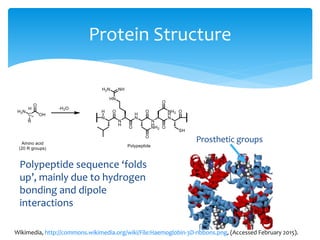
Protein Structure
Polypeptide sequence ‘folds
up’, mainly due to hydrogen
bonding and dipole
interactions
Prosthetic groups
Wikimedia, http://commons.wikimedia.org/wiki/File:Haemoglobin-3D-ribbons.png, (Accessed February 2015).
DNA Structure
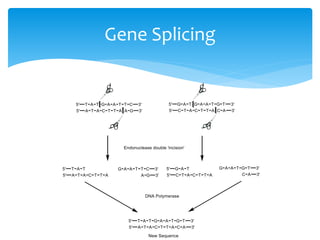
Gene Splicing
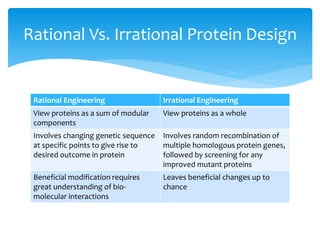
Rational Engineering Irrational Engineering
View proteins as a sum of modular
components
View proteins as a whole
Involves changing genetic sequence
at specific points to give rise to
desired outcome in protein
Involves random recombination of
multiple homologous protein genes,
followed by screening for any
improved mutant proteins
Beneficial modification requires
great understanding of bio-
molecular interactions
Leaves beneficial changes up to
chance
Rational Vs. Irrational Protein Design
DNA Replication
 Random recombination of genes leads to good
diversity
 However large population of mutant proteins no
longer functional
 Compromise with rational design is made by mapping
important intramolecular interactions in protein
Directed Evolution
SCHEMA Energy of Disruption
𝐸 𝛼𝛽 =
𝑖∈𝛼 𝑗∈𝛽
𝑐𝑖𝑗 𝑃𝑖𝑗
Where c accounts for broken
interactions and P accounts for
probability of disruption
Matrix algorithm used (RASPP)
SCHEMA-RASPP technique has
enabled productive results from
55% parental homology
C. A. Voigt, C. Martinez, Z. Wang, S. L. Mayo and F. H. Arnold, Nature Struc. Bio., 2002, 9, 553-558.
 Cytochrome P450 from Bacillus megaterium modified
to convert aliphatic alkanes into secondary alcohols
 Turnover rate increased (× 50) over 5 generations of
homologous recombination and screening
 Active site more complementary to favourable
substrates, allowing increased productivity
Exemplar Research: Cytochrome
P450
Exemplar Research: Cytochrome
P450
PNAS, http://www.pnas.org/content/99/10/6725/F8.expansion.html, (Accessed February 2015).
Not an economical way to produce alcohols:
 Translation of gene to protein has to be done in vivo.
Protein’s modifications make it toxic to cell
(production must be regulated)
 NADPH required as electron source for reduction of
P450, which is very expensive
Exemplar Research: Cytochrome
P450
 Limited knowledge on existing proteins
 Difficulty scaling up enzyme reactions for commercial
potential
 Restricted access to protein and gene libraries
between institutions
Current Problems with Directed Evolution

Protein engineering

  • 1.
    Protein Engineering byDirected Evolution Ben Mair
  • 2.
     Enzymes arebiological catalysts  Vital area of biotechnology  Can be used to create more sustainable and energy efficient pathways to reactions  Existing biological proteins are being engineered to meet commercial needs Protein Function
  • 3.
    Protein Structure Polypeptide sequence‘folds up’, mainly due to hydrogen bonding and dipole interactions Prosthetic groups Wikimedia, http://commons.wikimedia.org/wiki/File:Haemoglobin-3D-ribbons.png, (Accessed February 2015).
  • 4.
  • 5.
  • 6.
    Rational Engineering IrrationalEngineering View proteins as a sum of modular components View proteins as a whole Involves changing genetic sequence at specific points to give rise to desired outcome in protein Involves random recombination of multiple homologous protein genes, followed by screening for any improved mutant proteins Beneficial modification requires great understanding of bio- molecular interactions Leaves beneficial changes up to chance Rational Vs. Irrational Protein Design
  • 7.
  • 8.
     Random recombinationof genes leads to good diversity  However large population of mutant proteins no longer functional  Compromise with rational design is made by mapping important intramolecular interactions in protein Directed Evolution
  • 9.
    SCHEMA Energy ofDisruption 𝐸 𝛼𝛽 = 𝑖∈𝛼 𝑗∈𝛽 𝑐𝑖𝑗 𝑃𝑖𝑗 Where c accounts for broken interactions and P accounts for probability of disruption Matrix algorithm used (RASPP) SCHEMA-RASPP technique has enabled productive results from 55% parental homology C. A. Voigt, C. Martinez, Z. Wang, S. L. Mayo and F. H. Arnold, Nature Struc. Bio., 2002, 9, 553-558.
  • 10.
     Cytochrome P450from Bacillus megaterium modified to convert aliphatic alkanes into secondary alcohols  Turnover rate increased (× 50) over 5 generations of homologous recombination and screening  Active site more complementary to favourable substrates, allowing increased productivity Exemplar Research: Cytochrome P450
  • 11.
    Exemplar Research: Cytochrome P450 PNAS,http://www.pnas.org/content/99/10/6725/F8.expansion.html, (Accessed February 2015).
  • 12.
    Not an economicalway to produce alcohols:  Translation of gene to protein has to be done in vivo. Protein’s modifications make it toxic to cell (production must be regulated)  NADPH required as electron source for reduction of P450, which is very expensive Exemplar Research: Cytochrome P450
  • 13.
     Limited knowledgeon existing proteins  Difficulty scaling up enzyme reactions for commercial potential  Restricted access to protein and gene libraries between institutions Current Problems with Directed Evolution