SUBMITTED TO-
DR. ANUPAM DIXIT
DR. AHSAN KAMRAN
SUBMITTED BY-
NIHARIKA SRIVASTAVA
M.Sc. SEM II
UNIVERSITY OF ALLAHABAD
CENTRE OF RURAL TECHNOLOGY AND DEVELOPMENT
INTRODUCTION
 Biofertilizers are the substances which use
microorganisms to make soil more fertile.
 These fertilizers are not harmful to soil, under ground
water or remaining atmosphere like chemical fertilizers.
 It promotes growth by increasing the availability of primary
nutrients to the plant.
 They add nutrients through nitrogen fixation, solubilizing
phosphorus or through the synthesis of growth promoting
substances.
 They are actually formed by organic waste along with
the microbial mixture.
 By using these, a healthy crop can be grown without
damaging the sustainability and health of the soil.
 Biofertilizers promote ‘eco-friendly organic agro-input’
and reduces the use of chemical pesticides and
fertilizers.
TYPES OF BIOFERTILIZERS
 PHOSPHORUS BIOFERTILIZERS
Comparatively less amount required for plant growth.
No restriction for using a particular kind of biofertilizer for a
particular crop.
 COMPOST BIOFERTILIZERS
Made up from organic waste to enrich the soil fertility with
the help of microorganisms by the breakdown of organic
material.
 NITROGEN BIOFERTILIZERS
Type of crop and soil determines the kind of biofertilizer;
 Azotobacter- for non-legume plants
 Rhizobium- for leguminous plants
 BGA- for rice
 Acetobacter- for sugercane
 RHIZOBIUM
Lives in symbiotic association with legume roots.
Performs nitrogen fixation.
Most efficient bacterium for nitrogen fixation.
 AZOSPIRILLUM
Primarily lives in soil, rhizosphere and intercellular spaces of root
cortex of plants belonging to family graminioceae.
Though aerophillic in nature, it can proliferate in anaerobic
condions also.
Useful due to nitrogen fixation, growth promoting substance
production, disease resistance and drought tolerance.
 CYANOBACTERIA
Both free living and symbiotic (BGA) are used in rice cultivation in
our country.
BGA chiefly consist Nostoc, Anabaena, Aulosira.
 AZOTOBACTER
Its a free living aerobic nitrogen fixing bacteria.
Azotobacter chrococcum is the most dominating in this genera for
nitrogen fixation.
 AZZOLA
Free floating water fern
Fixes nitrogen with the association of Anabaena
Farmers are getting attracted towards these for paddy crops in third
world countries due to high yield of nitrogen in wetlands.
 PHOSPHATE SOLUBILIZING
MICROORGANISMS (PSM)
Several soil bacteria and fungi like, Pseudomonas, Bacillus,
Penicillium, Aspergillus, etc. secrets some organic acids and lowers
the pH of soil which solubilize the bound phosphate in their
surrounding.
 AM FUNGI
Arbuscular Mycorrhiza fungi are endosymbionts of the genera
Glomus, Gigaspora, Acaulospora, Sclerocysts and Endogone.
These fungi consist vesicles for storage and arbuscles for funnelling
the nutrients.
They transfer the nutrients ( phosphorus, zinc and sulphur) from
the soil to the root cortex of plant.
 PLANT GROWTH PROMOTING RHIZOBACTERIA
(PGPR)
These bacteria colonize in soil or in root cortex and are
beneficial to crops.
We can divide these in following categories:
 Bioprotectants- helps in suppression of plant disease
 Biofertilizers- improves nutrition acquisition
 Biostimulants – production of phytoharmones
PRODUCTION OF CARRIER BASED
BIOFERTILIZERS
This technique is chiefly used for the production of Rhizobium, Aospirillum,
Azotobacter and phosphobacteria.
The processing involves following steps:
 Culturing of microorganisms
Starter culture is made by adding Mother culture to the media at controlled
temperature and constant shaking till maximum cells are produced in lab.
for mass production, starter culture is used as mother culture.
 Processing of carrier material
These carry the inoculant from the commercial production unit to the agricultural
land. A carrier must have following qualities;
High organic content with zero toxic chemicals
Cheaper in cost and locally available
Water holding capacity more than 50%
Peat soil and lignite are the best carriers.
 Mixing of culture in carrier
bacterial culture is added in Neutralized, sterilized
carrier material 50% of water holding capacity.
 Packing and marketing
Now, they are packed in polybags on which name
of the bacteria, expiry date and method of use must
be written.
Inoculant is ready for marketing.
PRODUCTION OF BGA
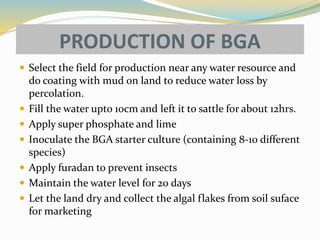
 Select the field for production near any water resource and
do coating with mud on land to reduce water loss by
percolation.
 Fill the water upto 10cm and left it to sattle for about 12hrs.
 Apply super phosphate and lime
 Inoculate the BGA starter culture (containing 8-10 different
species)
 Apply furadan to prevent insects
 Maintain the water level for 20 days
 Let the land dry and collect the algal flakes from soil suface
for marketing
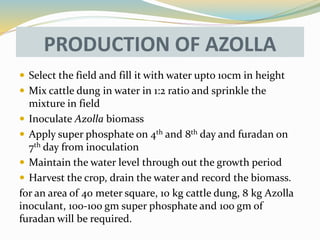
PRODUCTION OF AZOLLA
 Select the field and fill it with water upto 10cm in height
 Mix cattle dung in water in 1:2 ratio and sprinkle the
mixture in field
 Inoculate Azolla biomass
 Apply super phosphate on 4th and 8th day and furadan on
7th day from inoculation
 Maintain the water level through out the growth period
 Harvest the crop, drain the water and record the biomass.
for an area of 40 meter square, 10 kg cattle dung, 8 kg Azolla
inoculant, 100-100 gm super phosphate and 100 gm of
furadan will be required.
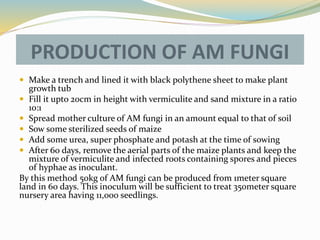
PRODUCTION OF AM FUNGI
 Make a trench and lined it with black polythene sheet to make plant
growth tub
 Fill it upto 20cm in height with vermiculite and sand mixture in a ratio
10:1
 Spread mother culture of AM fungi in an amount equal to that of soil
 Sow some sterilized seeds of maize
 Add some urea, super phosphate and potash at the time of sowing
 After 60 days, remove the aerial parts of the maize plants and keep the
mixture of vermiculite and infected roots containing spores and pieces
of hyphae as inoculant.
By this method 50kg of AM fungi can be produced from 1meter square
land in 60 days. This inoculum will be sufficient to treat 350meter square
nursery area having 11,000 seedlings.
 SEEDLING ROOT TIPS
This method is used for transplanted crops like rice.
Before shifting the plants in farmhouse, the seedlings are
planted in a solution (biofertilizer with water) for eight to ten
hours.
 SEED TREATMENT
Slurry of nitrogen and phosphorus fertilizers is made.
Seeds are dipped in this mixture for equal coating of
fertilizers.
Shade dry for about 30 minutes.
 SOIL TREATMENT
All the fertilizers along with the compost are thoroughly
mixed together.
This mixture is being kept for a night and then spread on the
soil where seeds have to be sown to increase the soil fertility.
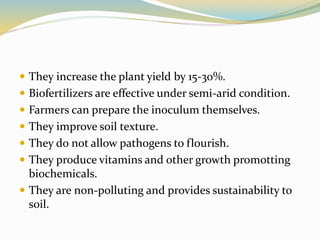
 They increase the plant yield by 15-30%.
 Biofertilizers are effective under semi-arid condition.
 Farmers can prepare the inoculum themselves.
 They improve soil texture.
 They do not allow pathogens to flourish.
 They produce vitamins and other growth promotting
biochemicals.
 They are non-polluting and provides sustainability to
soil.
THANKYOU

Biofertilizers

  • 1.
    SUBMITTED TO- DR. ANUPAMDIXIT DR. AHSAN KAMRAN SUBMITTED BY- NIHARIKA SRIVASTAVA M.Sc. SEM II UNIVERSITY OF ALLAHABAD CENTRE OF RURAL TECHNOLOGY AND DEVELOPMENT
  • 2.
    INTRODUCTION  Biofertilizers arethe substances which use microorganisms to make soil more fertile.  These fertilizers are not harmful to soil, under ground water or remaining atmosphere like chemical fertilizers.  It promotes growth by increasing the availability of primary nutrients to the plant.  They add nutrients through nitrogen fixation, solubilizing phosphorus or through the synthesis of growth promoting substances.
  • 3.
     They areactually formed by organic waste along with the microbial mixture.  By using these, a healthy crop can be grown without damaging the sustainability and health of the soil.  Biofertilizers promote ‘eco-friendly organic agro-input’ and reduces the use of chemical pesticides and fertilizers.
  • 4.
    TYPES OF BIOFERTILIZERS PHOSPHORUS BIOFERTILIZERS Comparatively less amount required for plant growth. No restriction for using a particular kind of biofertilizer for a particular crop.  COMPOST BIOFERTILIZERS Made up from organic waste to enrich the soil fertility with the help of microorganisms by the breakdown of organic material.
  • 5.
     NITROGEN BIOFERTILIZERS Typeof crop and soil determines the kind of biofertilizer;  Azotobacter- for non-legume plants  Rhizobium- for leguminous plants  BGA- for rice  Acetobacter- for sugercane
  • 7.
     RHIZOBIUM Lives insymbiotic association with legume roots. Performs nitrogen fixation. Most efficient bacterium for nitrogen fixation.  AZOSPIRILLUM Primarily lives in soil, rhizosphere and intercellular spaces of root cortex of plants belonging to family graminioceae. Though aerophillic in nature, it can proliferate in anaerobic condions also. Useful due to nitrogen fixation, growth promoting substance production, disease resistance and drought tolerance.
  • 8.
     CYANOBACTERIA Both freeliving and symbiotic (BGA) are used in rice cultivation in our country. BGA chiefly consist Nostoc, Anabaena, Aulosira.  AZOTOBACTER Its a free living aerobic nitrogen fixing bacteria. Azotobacter chrococcum is the most dominating in this genera for nitrogen fixation.  AZZOLA Free floating water fern Fixes nitrogen with the association of Anabaena Farmers are getting attracted towards these for paddy crops in third world countries due to high yield of nitrogen in wetlands.
  • 9.
     PHOSPHATE SOLUBILIZING MICROORGANISMS(PSM) Several soil bacteria and fungi like, Pseudomonas, Bacillus, Penicillium, Aspergillus, etc. secrets some organic acids and lowers the pH of soil which solubilize the bound phosphate in their surrounding.  AM FUNGI Arbuscular Mycorrhiza fungi are endosymbionts of the genera Glomus, Gigaspora, Acaulospora, Sclerocysts and Endogone. These fungi consist vesicles for storage and arbuscles for funnelling the nutrients. They transfer the nutrients ( phosphorus, zinc and sulphur) from the soil to the root cortex of plant.
  • 10.
     PLANT GROWTHPROMOTING RHIZOBACTERIA (PGPR) These bacteria colonize in soil or in root cortex and are beneficial to crops. We can divide these in following categories:  Bioprotectants- helps in suppression of plant disease  Biofertilizers- improves nutrition acquisition  Biostimulants – production of phytoharmones
  • 12.
    PRODUCTION OF CARRIERBASED BIOFERTILIZERS This technique is chiefly used for the production of Rhizobium, Aospirillum, Azotobacter and phosphobacteria. The processing involves following steps:  Culturing of microorganisms Starter culture is made by adding Mother culture to the media at controlled temperature and constant shaking till maximum cells are produced in lab. for mass production, starter culture is used as mother culture.  Processing of carrier material These carry the inoculant from the commercial production unit to the agricultural land. A carrier must have following qualities; High organic content with zero toxic chemicals Cheaper in cost and locally available Water holding capacity more than 50% Peat soil and lignite are the best carriers.
  • 13.
     Mixing ofculture in carrier bacterial culture is added in Neutralized, sterilized carrier material 50% of water holding capacity.  Packing and marketing Now, they are packed in polybags on which name of the bacteria, expiry date and method of use must be written. Inoculant is ready for marketing.
  • 14.
    PRODUCTION OF BGA Select the field for production near any water resource and do coating with mud on land to reduce water loss by percolation.  Fill the water upto 10cm and left it to sattle for about 12hrs.  Apply super phosphate and lime  Inoculate the BGA starter culture (containing 8-10 different species)  Apply furadan to prevent insects  Maintain the water level for 20 days  Let the land dry and collect the algal flakes from soil suface for marketing
  • 15.
    PRODUCTION OF AZOLLA Select the field and fill it with water upto 10cm in height  Mix cattle dung in water in 1:2 ratio and sprinkle the mixture in field  Inoculate Azolla biomass  Apply super phosphate on 4th and 8th day and furadan on 7th day from inoculation  Maintain the water level through out the growth period  Harvest the crop, drain the water and record the biomass. for an area of 40 meter square, 10 kg cattle dung, 8 kg Azolla inoculant, 100-100 gm super phosphate and 100 gm of furadan will be required.
  • 16.
    PRODUCTION OF AMFUNGI  Make a trench and lined it with black polythene sheet to make plant growth tub  Fill it upto 20cm in height with vermiculite and sand mixture in a ratio 10:1  Spread mother culture of AM fungi in an amount equal to that of soil  Sow some sterilized seeds of maize  Add some urea, super phosphate and potash at the time of sowing  After 60 days, remove the aerial parts of the maize plants and keep the mixture of vermiculite and infected roots containing spores and pieces of hyphae as inoculant. By this method 50kg of AM fungi can be produced from 1meter square land in 60 days. This inoculum will be sufficient to treat 350meter square nursery area having 11,000 seedlings.
  • 18.
     SEEDLING ROOTTIPS This method is used for transplanted crops like rice. Before shifting the plants in farmhouse, the seedlings are planted in a solution (biofertilizer with water) for eight to ten hours.  SEED TREATMENT Slurry of nitrogen and phosphorus fertilizers is made. Seeds are dipped in this mixture for equal coating of fertilizers. Shade dry for about 30 minutes.
  • 19.
     SOIL TREATMENT Allthe fertilizers along with the compost are thoroughly mixed together. This mixture is being kept for a night and then spread on the soil where seeds have to be sown to increase the soil fertility.
  • 21.
     They increasethe plant yield by 15-30%.  Biofertilizers are effective under semi-arid condition.  Farmers can prepare the inoculum themselves.  They improve soil texture.  They do not allow pathogens to flourish.  They produce vitamins and other growth promotting biochemicals.  They are non-polluting and provides sustainability to soil.
  • 22.