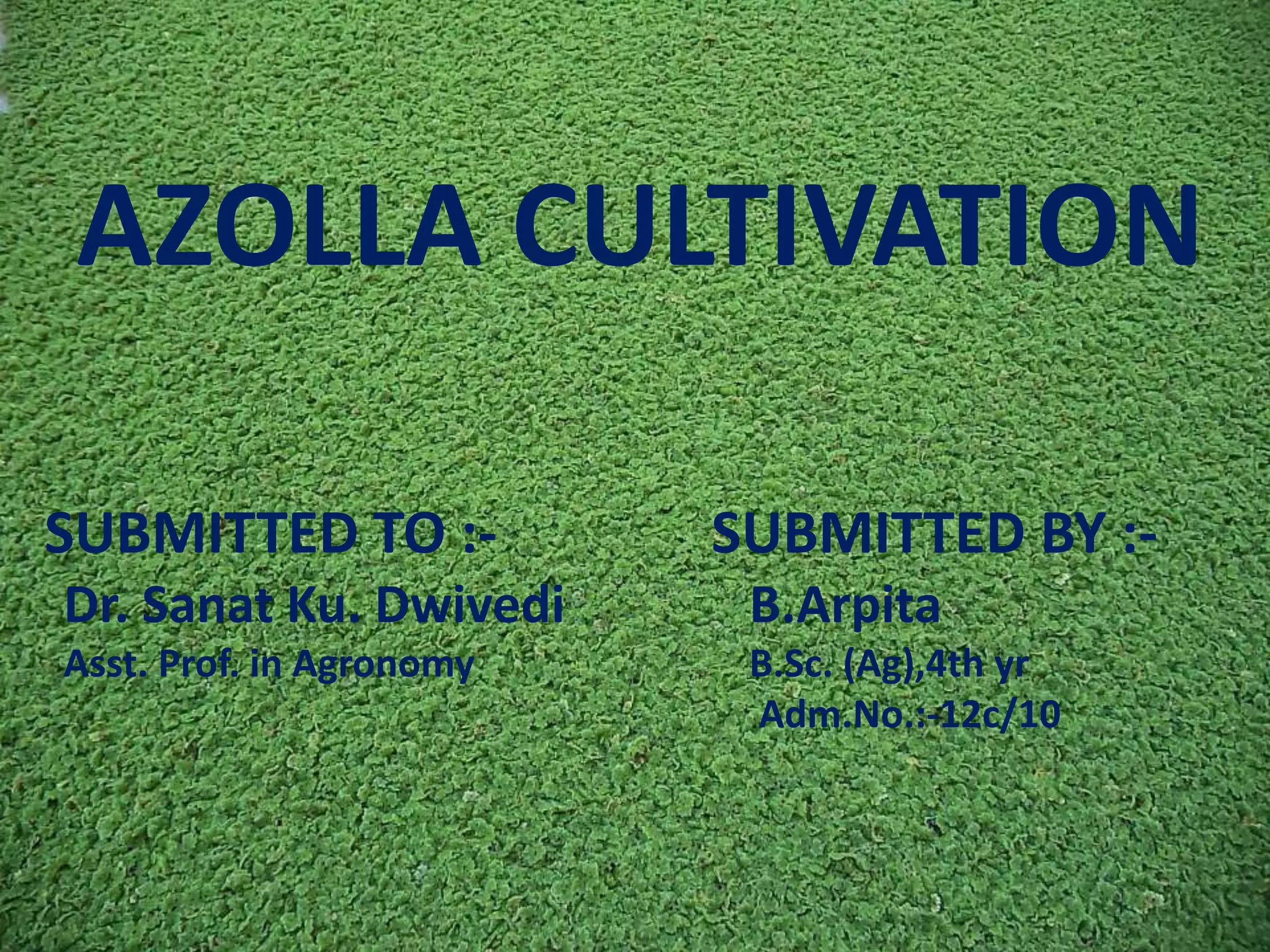
AZOLLA CULTIVATION
SUBMITTED TO :-
Dr. Sanat Ku. Dwivedi
Asst. Prof. in Agronomy
SUBMITTED BY :-
B.Arpita
B.Sc. (Ag),4th yr
Adm.No.:-12c/10
INTRODUCTION:-
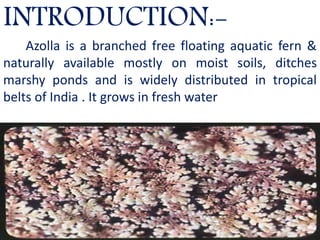
Azolla is a branched free floating aquatic fern &
naturally available mostly on moist soils, ditches
marshy ponds and is widely distributed in tropical
belts of India . It grows in fresh water
STRUCTURE OF AZOLLA:-
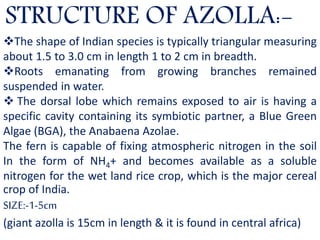
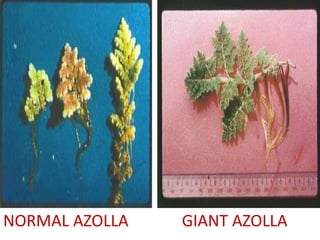
The shape of Indian species is typically triangular measuring
about 1.5 to 3.0 cm in length 1 to 2 cm in breadth.
Roots emanating from growing branches remained
suspended in water.
 The dorsal lobe which remains exposed to air is having a
specific cavity containing its symbiotic partner, a Blue Green
Algae (BGA), the Anabaena Azolae.
The fern is capable of fixing atmospheric nitrogen in the soil
In the form of NH4+ and becomes available as a soluble
nitrogen for the wet land rice crop, which is the major cereal
crop of India.
SIZE:-1-5cm
(giant azolla is 15cm in length & it is found in central africa)
NORMAL AZOLLA GIANT AZOLLA
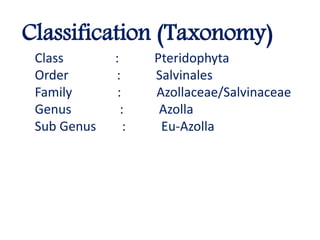
Classification (Taxonomy)
Class : Pteridophyta
Order : Salvinales
Family : Azollaceae/Salvinaceae
Genus : Azolla
Sub Genus : Eu-Azolla
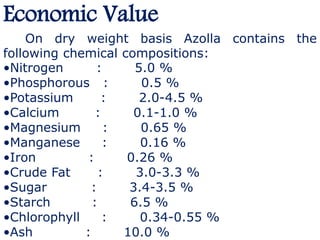
Economic Value
On dry weight basis Azolla contains the
following chemical compositions:
•Nitrogen : 5.0 %
•Phosphorous : 0.5 %
•Potassium : 2.0-4.5 %
•Calcium : 0.1-1.0 %
•Magnesium : 0.65 %
•Manganese : 0.16 %
•Iron : 0.26 %
•Crude Fat : 3.0-3.3 %
•Sugar : 3.4-3.5 %
•Starch : 6.5 %
•Chlorophyll : 0.34-0.55 %
•Ash : 10.0 %
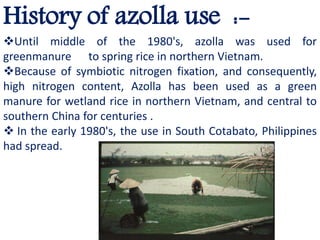
History of azolla use :-
Until middle of the 1980's, azolla was used for
greenmanure to spring rice in northern Vietnam.
Because of symbiotic nitrogen fixation, and consequently,
high nitrogen content, Azolla has been used as a green
manure for wetland rice in northern Vietnam, and central to
southern China for centuries .
 In the early 1980's, the use in South Cotabato, Philippines
had spread.
However, since the late 1980's, the socio-
economic situation in these countries has
drastically changed with the introduction of
market economy system.
growth period, and the collapse of farmers'
organizations who provided inoculum for rice
cultivation are factors to explain rapid decline
of azolla use.
How to grow Azolla:-
Growing of azolla is generally two types that are
1.azolla insitu & 2. Azolla exsitu
(In insitu method azolla is grown with standing crop within the field
but in exsitu it is grown in an area by accumulating sufficient water .
There is also another method 3.azolla in polythene)
In low land, field is ploughed; leveled and small
bunds of 50 cm width are made to
make small ponds of 3 x 2 x 1 M size.
Only 10-15 cm standing water is allowed in the
ponds.
The green Azolla @ 50 -200 g/sqm + P2O5 through
SSP @ 20 kg/ha along with Furadan
1 g/kg of Azolla is mixed and released in the
pond maintaining a 10-15 cm of water
level, for further growth and multiplication of Azolla.
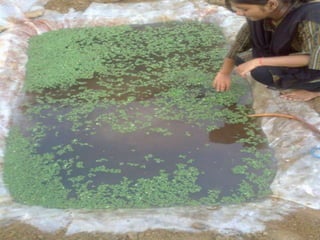
Azolla multiplies rapidly and form a green mat like a
carpet on water surface of ponds in just two weeks.
This green Azolla is harvested in bamboo basket
and transferred and released in the transplanted
rice field for further multiplication, as dual
cropping with rice for fixing nitrogen to rice crop.
Harvested green Azolla could be converted in to
compost by pounding in pits for a
month which is then used like FYM for other
crops grown under upland situation.
During summer, green Azolla is harvested at an
interval of 15-20 days but during winter growth
of Azolla becomes slow due to moisture stress
and low winter temperature, hence Azolla can be
harvested at 25-30 days interval during winter.
Favourable condition for higher efficacy of Azolla
Water: 10-15 cm fresh current water is necessary in multiplication
pond.
Temperature: the day/night temperatures ranging between 32ºC
and 20ºC have found to be most favourable. The optimum
temperature for luxurious growth of Azolla is 25-30ºC and can be
raised successfully in the mid hills.
Light: Azolla prefers to grow well under partial shade. As dual
cropping Azolla gets partial shade from rice plant and therefore as
dual cropping with rice is most successful.
Soil pH: Azolla grows well in slightly acidic soil having 5.2 to 5.8
pH.
Nutrition
Being an N fixing fern Azolla does not require nitrogenous fertilizer
for its growth. However application of N @ kg/ha is useful as a
starting dose in new multiplication area. Phosphorou 20@ kg/ha is
desirable for good bio-mass production
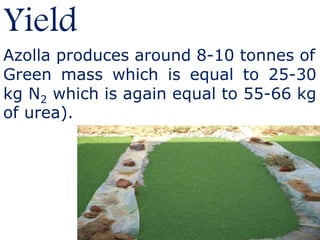
Yield
Azolla produces around 8-10 tonnes of
Green mass which is equal to 25-30
kg N2 which is again equal to 55-66 kg
of urea).
HOW TO APPLY AZOLLA IN RICE FIELD :-
The azolla bio fertilizer can be applied in 3 ways in rice field
METHOD 1:-
Fresh azolla biomass in inoculated in the rice field 2-3weeks before
transplanting as green manure.
METHOD 2 :-
Azolla can be grown in separate plot and can be applied to main field
just before transplanting.
METHOD 3 :-
Azolla can be inoculated after transplanting rice & grown as dual culture
of rice and incorporated subsequently.
In dual culture azolla is grown In the rice field with the standing
crop . When thick mat is formed water is drained out and azolla is
incorporate d in soil . Again in fresh inoculation is done @ 0.5 t/ha . In
this phase azolla is grown in 8 weeks . It is again incorporated in soil . It
is suitable for medium to long duration crop .
Contribution of Azolla
Basal application on green Azolla manure @ 10-12 t/ha increases soil
nitrogen by 50-60 kg/ha and reduces 30-35 kg of nitrogenous fertilizer
requirement of rice crop.
Release of green Azolla twice as dual cropping in rice crop @ 500
kg/ha enriches soil nitrogen by 50 kg/ha and reduces N requirement by
20-30 kg/ha.
Use of Azolla increases rice yield by 20 to 30 %.
Rice varieties like DR-92, RCPL-1-87-8, Mendri, H.-2850 and Manipuri
produced more than 30 q/ha rice yield when grown with Azolla as dual
cropping under natural soil fertility.
Under low land condition a thick Azolla mat does not allow the weeds
to grow in rice filed and creates congenial condition for rice production.
Azolla reduces evaporation from water surface and increases water
use efficiency in rice.
Dry Azolla flakes can be used as poultry feed and green Azolla is also a
good feed for fishes.
Azolla as a feed supplement in Tamil Nadu and Kerala.
Trials on dairy animals showed an overall increase of milk yield by 15–
20 % when 2–3 Kg of Azolla was combined with regular feed. 15 – 20%
of commercial feed can be replaced with the same quantity of Azolla on
dry weight basis, without affecting milk production. It was also found
that Azolla feeding improves the quality of milk and the health and
longevity of livestock.
Environmental compatibility: By growing Azolla enormous quantity of
Carbon di Oxide and Nitrogen are absorbed reducing the green house
effect on the environment. Azolla also releases an equivalent quantity of
Oxygen making the environment more oxygenic and life-supportive.
It also provides Oxygen to the water body increasing the biological
oxygen content of water, making water bodies conducive for aquatic
organisms.
Azolla regulates water pH almost near to neutral so that aquatic bio-
diversity can thrive.
It solublizes phosphorus and minerals and fixes atmospheric
Nitrogen thereby making aquatic Carbon, Nitrogen, Mineral
ratio ideal for aquatic organisms. In short Azolla will bring life
back to almost biologically dead water bodies.
De-centralized production of Azolla bio-feed both at
farmers’ level and pellet feed at factory level, will conserve
substantially the raw materials, energy, cost of production
and emission of green house gases in the production process,
transportation costs etc of the feed by 30 percent nationally.
 As a bio-fertilizer Azolla reduces the use of chemical
fertilizer by 30-40% and thus saves the environment.
Azolla is known its quality to control mosquito in water
bodies .
. Azolla technology combines the best of both macro fodder
and single cell protein without their short-comings and thus
can be called ‘Poor man’s spirulina’
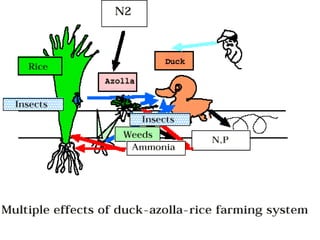
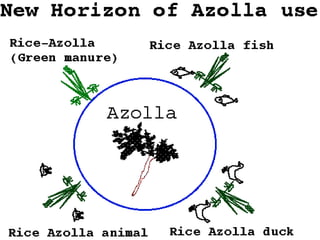
Rice-duck-azolla system
It was developed by a Japanese farmer Mr. T.Furuno .He has been practicing rice and
hybrid
duck culture. He tried hard not to use pesticide in rice cultivation. The most difficult
task was
weeding. He introduced hybrid duck primarily for weeding purpose. The duck
effectively made
a weeding job by disturbing soil surface. He found the duck contributed a lot to rice
cultivation.
Now, rice-duck culture is widely practiced in organic rice farming. Primarily for
providing
nitrogen nutrient, azolla was introduced to this system. Azolla provided nitrogen
nutrient for
rice and protein for duck, and contributed to the suppression of weed. Duck, on the
other
hand, contributed to azolla by eradicating azolla insect pest, and spreading azolla by
its
movement. Duck's excreta may supply phosphorus to azolla. This rice-duck-azolla
system is
now being adopted by organic farming farmers.
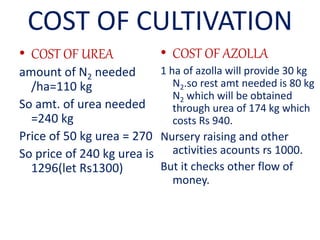
COST OF CULTIVATION
• COST OF UREA
amount of N2 needed
/ha=110 kg
So amt. of urea needed
=240 kg
Price of 50 kg urea = 270
So price of 240 kg urea is
1296(let Rs1300)
• COST OF AZOLLA
1 ha of azolla will provide 30 kg
N2.so rest amt needed is 80 kg
N2 which will be obtained
through urea of 174 kg which
costs Rs 940.
Nursery raising and other
activities acounts rs 1000.
But it checks other flow of
money.
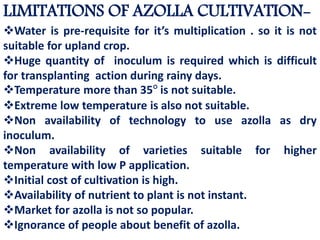
LIMITATIONS OF AZOLLA CULTIVATION-
Water is pre-requisite for it’s multiplication . so it is not
suitable for upland crop.
Huge quantity of inoculum is required which is difficult
for transplanting action during rainy days.
Temperature more than 35° is not suitable.
Extreme low temperature is also not suitable.
Non availability of technology to use azolla as dry
inoculum.
Non availability of varieties suitable for higher
temperature with low P application.
Initial cost of cultivation is high.
Availability of nutrient to plant is not instant.
Market for azolla is not so popular.
Ignorance of people about benefit of azolla.
Azolla ppt

Azolla ppt

  • 1.
    AZOLLA CULTIVATION SUBMITTED TO:- Dr. Sanat Ku. Dwivedi Asst. Prof. in Agronomy SUBMITTED BY :- B.Arpita B.Sc. (Ag),4th yr Adm.No.:-12c/10
  • 2.
    INTRODUCTION:- Azolla is abranched free floating aquatic fern & naturally available mostly on moist soils, ditches marshy ponds and is widely distributed in tropical belts of India . It grows in fresh water
  • 3.
    STRUCTURE OF AZOLLA:- Theshape of Indian species is typically triangular measuring about 1.5 to 3.0 cm in length 1 to 2 cm in breadth. Roots emanating from growing branches remained suspended in water.  The dorsal lobe which remains exposed to air is having a specific cavity containing its symbiotic partner, a Blue Green Algae (BGA), the Anabaena Azolae. The fern is capable of fixing atmospheric nitrogen in the soil In the form of NH4+ and becomes available as a soluble nitrogen for the wet land rice crop, which is the major cereal crop of India. SIZE:-1-5cm (giant azolla is 15cm in length & it is found in central africa)
  • 4.
  • 5.
    Classification (Taxonomy) Class :Pteridophyta Order : Salvinales Family : Azollaceae/Salvinaceae Genus : Azolla Sub Genus : Eu-Azolla
  • 6.
    Economic Value On dryweight basis Azolla contains the following chemical compositions: •Nitrogen : 5.0 % •Phosphorous : 0.5 % •Potassium : 2.0-4.5 % •Calcium : 0.1-1.0 % •Magnesium : 0.65 % •Manganese : 0.16 % •Iron : 0.26 % •Crude Fat : 3.0-3.3 % •Sugar : 3.4-3.5 % •Starch : 6.5 % •Chlorophyll : 0.34-0.55 % •Ash : 10.0 %
  • 7.
    History of azollause :- Until middle of the 1980's, azolla was used for greenmanure to spring rice in northern Vietnam. Because of symbiotic nitrogen fixation, and consequently, high nitrogen content, Azolla has been used as a green manure for wetland rice in northern Vietnam, and central to southern China for centuries .  In the early 1980's, the use in South Cotabato, Philippines had spread.
  • 8.
    However, since thelate 1980's, the socio- economic situation in these countries has drastically changed with the introduction of market economy system. growth period, and the collapse of farmers' organizations who provided inoculum for rice cultivation are factors to explain rapid decline of azolla use.
  • 9.
    How to growAzolla:- Growing of azolla is generally two types that are 1.azolla insitu & 2. Azolla exsitu (In insitu method azolla is grown with standing crop within the field but in exsitu it is grown in an area by accumulating sufficient water . There is also another method 3.azolla in polythene) In low land, field is ploughed; leveled and small bunds of 50 cm width are made to make small ponds of 3 x 2 x 1 M size. Only 10-15 cm standing water is allowed in the ponds. The green Azolla @ 50 -200 g/sqm + P2O5 through SSP @ 20 kg/ha along with Furadan 1 g/kg of Azolla is mixed and released in the pond maintaining a 10-15 cm of water level, for further growth and multiplication of Azolla. Azolla multiplies rapidly and form a green mat like a carpet on water surface of ponds in just two weeks.
  • 10.
    This green Azollais harvested in bamboo basket and transferred and released in the transplanted rice field for further multiplication, as dual cropping with rice for fixing nitrogen to rice crop. Harvested green Azolla could be converted in to compost by pounding in pits for a month which is then used like FYM for other crops grown under upland situation. During summer, green Azolla is harvested at an interval of 15-20 days but during winter growth of Azolla becomes slow due to moisture stress and low winter temperature, hence Azolla can be harvested at 25-30 days interval during winter.
  • 12.
    Favourable condition forhigher efficacy of Azolla Water: 10-15 cm fresh current water is necessary in multiplication pond. Temperature: the day/night temperatures ranging between 32ºC and 20ºC have found to be most favourable. The optimum temperature for luxurious growth of Azolla is 25-30ºC and can be raised successfully in the mid hills. Light: Azolla prefers to grow well under partial shade. As dual cropping Azolla gets partial shade from rice plant and therefore as dual cropping with rice is most successful. Soil pH: Azolla grows well in slightly acidic soil having 5.2 to 5.8 pH. Nutrition Being an N fixing fern Azolla does not require nitrogenous fertilizer for its growth. However application of N @ kg/ha is useful as a starting dose in new multiplication area. Phosphorou 20@ kg/ha is desirable for good bio-mass production
  • 13.
    Yield Azolla produces around8-10 tonnes of Green mass which is equal to 25-30 kg N2 which is again equal to 55-66 kg of urea).
  • 14.
    HOW TO APPLYAZOLLA IN RICE FIELD :- The azolla bio fertilizer can be applied in 3 ways in rice field METHOD 1:- Fresh azolla biomass in inoculated in the rice field 2-3weeks before transplanting as green manure. METHOD 2 :- Azolla can be grown in separate plot and can be applied to main field just before transplanting. METHOD 3 :- Azolla can be inoculated after transplanting rice & grown as dual culture of rice and incorporated subsequently. In dual culture azolla is grown In the rice field with the standing crop . When thick mat is formed water is drained out and azolla is incorporate d in soil . Again in fresh inoculation is done @ 0.5 t/ha . In this phase azolla is grown in 8 weeks . It is again incorporated in soil . It is suitable for medium to long duration crop .
  • 15.
    Contribution of Azolla Basalapplication on green Azolla manure @ 10-12 t/ha increases soil nitrogen by 50-60 kg/ha and reduces 30-35 kg of nitrogenous fertilizer requirement of rice crop. Release of green Azolla twice as dual cropping in rice crop @ 500 kg/ha enriches soil nitrogen by 50 kg/ha and reduces N requirement by 20-30 kg/ha. Use of Azolla increases rice yield by 20 to 30 %. Rice varieties like DR-92, RCPL-1-87-8, Mendri, H.-2850 and Manipuri produced more than 30 q/ha rice yield when grown with Azolla as dual cropping under natural soil fertility. Under low land condition a thick Azolla mat does not allow the weeds to grow in rice filed and creates congenial condition for rice production. Azolla reduces evaporation from water surface and increases water use efficiency in rice.
  • 16.
    Dry Azolla flakescan be used as poultry feed and green Azolla is also a good feed for fishes. Azolla as a feed supplement in Tamil Nadu and Kerala. Trials on dairy animals showed an overall increase of milk yield by 15– 20 % when 2–3 Kg of Azolla was combined with regular feed. 15 – 20% of commercial feed can be replaced with the same quantity of Azolla on dry weight basis, without affecting milk production. It was also found that Azolla feeding improves the quality of milk and the health and longevity of livestock. Environmental compatibility: By growing Azolla enormous quantity of Carbon di Oxide and Nitrogen are absorbed reducing the green house effect on the environment. Azolla also releases an equivalent quantity of Oxygen making the environment more oxygenic and life-supportive. It also provides Oxygen to the water body increasing the biological oxygen content of water, making water bodies conducive for aquatic organisms. Azolla regulates water pH almost near to neutral so that aquatic bio- diversity can thrive.
  • 17.
    It solublizes phosphorusand minerals and fixes atmospheric Nitrogen thereby making aquatic Carbon, Nitrogen, Mineral ratio ideal for aquatic organisms. In short Azolla will bring life back to almost biologically dead water bodies. De-centralized production of Azolla bio-feed both at farmers’ level and pellet feed at factory level, will conserve substantially the raw materials, energy, cost of production and emission of green house gases in the production process, transportation costs etc of the feed by 30 percent nationally.  As a bio-fertilizer Azolla reduces the use of chemical fertilizer by 30-40% and thus saves the environment. Azolla is known its quality to control mosquito in water bodies . . Azolla technology combines the best of both macro fodder and single cell protein without their short-comings and thus can be called ‘Poor man’s spirulina’
  • 18.
    Rice-duck-azolla system It wasdeveloped by a Japanese farmer Mr. T.Furuno .He has been practicing rice and hybrid duck culture. He tried hard not to use pesticide in rice cultivation. The most difficult task was weeding. He introduced hybrid duck primarily for weeding purpose. The duck effectively made a weeding job by disturbing soil surface. He found the duck contributed a lot to rice cultivation. Now, rice-duck culture is widely practiced in organic rice farming. Primarily for providing nitrogen nutrient, azolla was introduced to this system. Azolla provided nitrogen nutrient for rice and protein for duck, and contributed to the suppression of weed. Duck, on the other hand, contributed to azolla by eradicating azolla insect pest, and spreading azolla by its movement. Duck's excreta may supply phosphorus to azolla. This rice-duck-azolla system is now being adopted by organic farming farmers.
  • 21.
    COST OF CULTIVATION •COST OF UREA amount of N2 needed /ha=110 kg So amt. of urea needed =240 kg Price of 50 kg urea = 270 So price of 240 kg urea is 1296(let Rs1300) • COST OF AZOLLA 1 ha of azolla will provide 30 kg N2.so rest amt needed is 80 kg N2 which will be obtained through urea of 174 kg which costs Rs 940. Nursery raising and other activities acounts rs 1000. But it checks other flow of money.
  • 22.
    LIMITATIONS OF AZOLLACULTIVATION- Water is pre-requisite for it’s multiplication . so it is not suitable for upland crop. Huge quantity of inoculum is required which is difficult for transplanting action during rainy days. Temperature more than 35° is not suitable. Extreme low temperature is also not suitable. Non availability of technology to use azolla as dry inoculum. Non availability of varieties suitable for higher temperature with low P application. Initial cost of cultivation is high. Availability of nutrient to plant is not instant. Market for azolla is not so popular. Ignorance of people about benefit of azolla.