BIODIVERSITY:
VALUE, HOTSPOT &
THREATS
VIBHANSHU SINGH
BIODIVERSITY
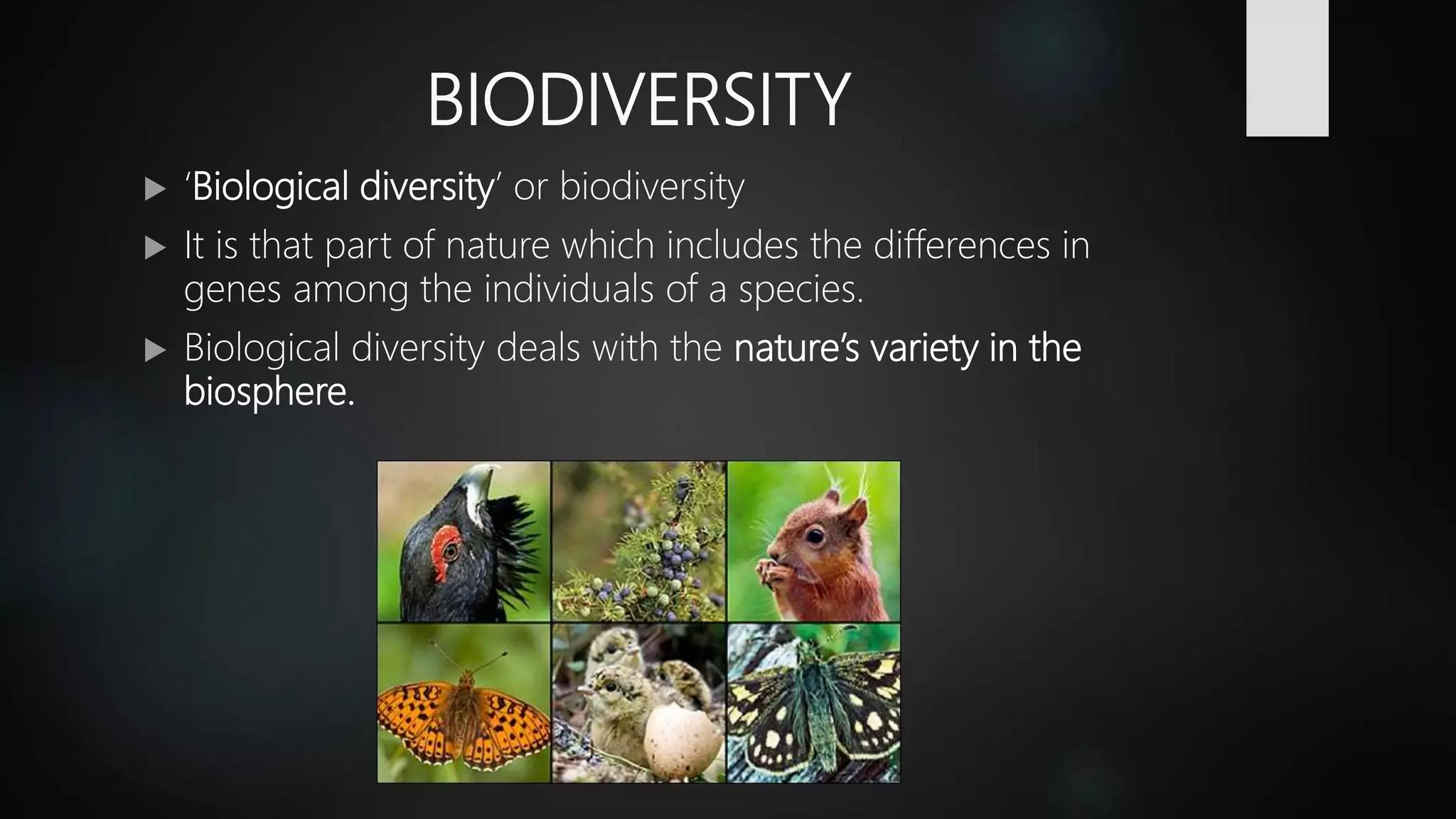
 ‘Biological diversity’ or biodiversity
 It is that part of nature which includes the differences in
genes among the individuals of a species.
 Biological diversity deals with the nature’s variety in the
biosphere.
VALUE OF BIODIVERSITY
 Environmental services from species and ecosystems are
essential at global, regional and local levels.
• Production of oxygen
• Reducing carbon dioxide
• Maintaining the water cycle
• Protecting soil
• Ecological processes such as soil formation, fixing and
recycling of nutrients.
TYPES OF VALUES
 Based on the types of benefits which we are getting
because of having biodiversity, we classify its Values
as:
1. Consumptive use value
2. Productive value
3. Social value
4. Ethical value
5. Aesthetic value
6. Option value
Consumptive Use Value
•Direct utilisation of timber, food, fuel-wood and fodder by local
communities.
•Provides forest dwellers with all their daily needs, food, building
material, fodder, medicines. They know the qualities and different
uses of wood from different species of trees, that they use as food,
construction material or medicines.
Productive Use Value
 This comprises of marketable goods.
 Biotechnologists - Search for potential genetic properties in
plants and animals that can be used to develop varieties of
crops and livestock plantation programs
 Pharmacist – raw material from which new drugs can be
identified.
 Industrialists- Rich storehouse to develop new products.
 Agricultural scientists - developing better crops by utilising
genetic engineering.
 Biological Prospecting – Identifying compounds of great
economic value from the wild species of plants in the
undisturbed natural forests.
Social Values
 Biodiversity has been preserved by traditional
societies.
 These societies valued it as a resource and believed
that its depletion would be a great loss to their
society.
 In India, Tulsi, peepal, cow, snake
are worshipped.
Ethical and Moral Values
 It is based on importance of protecting all forms of life.
 Most religious and secular creeds believe that all forms of life
have the right to exist on earth.
 Basic philosophy, “Live and let others Live”.
Aesthetic Value
 Aesthetic = Appearance
 It involves appreciation of the presence of biodiversity for its
inherent value and beauty, as well as for the contribution it
makes to our knowledge, aesthetics, imagination and
creativity.
Magnificent Mountains
Or go for scuba diving and explore the
beauty…
Option Value
 Keeping future possibilities open for their use is called the
Option Value.
 Predicting which present spices of crops and domestic
animals will be of greatest use is impossible.
 To continue to improve cultivars and domestic livestock, we
need to return to wild relatives of crops and plants.
Therefore, biodiversity should be
preserved.
THREATS TO BIODIVERSITY
1. HABITAT LOSS
2. THE POPULATION CONNECTION
3. POLLUTION
4. EXOTIC SPECIES
5. OVERUSE
 HABITAT LOSS
Habitat loss can be described when an animal loses their home.
Every animal in the animal world has a niche, a their in their animal
community and without their habitat they no longer have a niche.
 REASONS OF HABITAT LOSS BY HUMANS
• Agriculture, farming
• Harvesting natural resources for personal use
• For industrial and urbanization development
 THERE ARE NATURAL SOURCES TOO...
Habitat destruction through natural processes such as volcanism, fire
and climate change is also a major cause.
SOLUTION FOR THIS…
• Protecting remaining intact section of natural
habitat.
• Reduce human population and expansion of
urbanization and industries.
• Educating the public about the importance of
natural habitat and biodiversity.
• Planting trees and home gardens
THE POPULATION CONNECTION
 Past losses of biodiversity can be attributed to the expansion
of the human population over the globe. Continuing human
population growth will be further alter natural ecosystems,
resulting in the inevitable loss of more wild species and
additional declines in populations.
 One key to holding down the loss in biodiversity lies in
bringing human population growth down. If the human
population increases to 10 billion, as some demographers
believe that it will, the consequences for the natural world
will be frightening.
POLLUTION
 Another major factor that decreases biodiversity is pollution,
which can directly kill many kinds of animals and plants,
seriously reducing their population.
CLIMATE CHANGE
• Pollution destroys or alters habitats, which consequences just
as severe as those caused by deliberate conversions.
• Most of the global pollution problems can be traced to the
industrialized world.
EXOTIC SPECIES
 An exotic species is a species introduced into an area from
somewhere else, often a different continent.
 Exotic species threaten biodiversity by spreading diseases,
acting as predator or parasite, competing or hybridizing with
native species and altering habitat.
 The transplantation of species by human has occurred
throughout history, to the point where most people are
unable to distinguish between the native and exotic species
living in their land.
OVERUSE
 Overuse is another major assault against wild
species responsible for 23 percent of recent
extinction.
 Overuse is driven by combination of greed,
ignorance and desperation.
 Another form of overuse is the trafficking in wildlife
and in products derived from wild species.
HOTSPOT OF BIODIVERSITY
 It is a biogeographic region with a significant reservoir of
biodiversity that is under threat from humans.
 Only 25 hotspots have been identified all over the world.
 2 out of 25 hotspots are located in india.
 These hotspots are rich in endemic species of plants and
animals
such as reptiles , amphibians , insects and mammals.
 9 other regions are identified as new hotspots making a total
of 34.
MAP SHOWING HOTSPOTS OF
BIODIVERSITY
Hotspots of biodiversity in India
 Western Ghats and North East Himalaya are two
hotspots of biodiversity in India.
 The North eastern states have 1500 endemic plants
species.
 Out of 135 genera of land mammals in India, 85 are
found in the Northeast.
 Western Ghats is habitat for 1500 endemic plant
species.
 A major proportion of amphibian and reptile species,
especially snakes are also concentrated in the
Western Ghats.
 Coral reefs in Indian waters surround the Andaman
and Nicobar , the Lakshadweep island and the gulf
areas of Gujarat andTamil Nadu.
CONSERVATION AND
CONCLUSION
 Conservation methods can help protect and restore ecosystems.
 It is of utmost importance for us to develop quick and effective ways to protect species
from extinction. If we fail to conserve the species facing extinction now, we are paving
the way for easier and faster depletions in the future. We will live in a domesticated
world lacking wild biodiversity.
 The most major threats to biodiversity:
 Human Disregard and Carelessness
 Population Growth: Estimates forecast a 7% increase in number of threatened
species by 2020, and a 14% increase by 2050.
 We must abate growth to conserve biodiversity on a global scale.
 We must consider very carefully any species we eliminate or insert into
an ecosystem.
CONSERVATION AND
CONCLUSION
 Global fisheries have adopted several sustainable practices:
• rotation of catches
o Gives time to recover
• fishing gear review
o Avoids damaging sea floor
• harvest reduction
o Slows harvest, allowing recovery
• fishing bans
o Replenishes populations
CONSERVATION AND
CONCLUSION
 There are several ways that people can help to protect the
environment.
– control population growth of human and thus there will be considerable
relief in ecosystem.
– develop sustainable technology to meet demands without much
affecting the ecosystem.
– change practices i.e. to select a path that is more beneficial to
ecosystem.
– protect and maintain ecosystems
– So,it is our moral duty to conserve biodiversity as well as our
environment .
– Biodiversity should be dealt with at scale of habitats or ecosystem
rather than at species level.
THANK YOU!

BIODIVERSITY : VALUE, HOTSPOT & THREATS

  • 1.
  • 2.
    BIODIVERSITY  ‘Biological diversity’or biodiversity  It is that part of nature which includes the differences in genes among the individuals of a species.  Biological diversity deals with the nature’s variety in the biosphere.
  • 3.
    VALUE OF BIODIVERSITY Environmental services from species and ecosystems are essential at global, regional and local levels. • Production of oxygen • Reducing carbon dioxide • Maintaining the water cycle • Protecting soil • Ecological processes such as soil formation, fixing and recycling of nutrients.
  • 4.
    TYPES OF VALUES Based on the types of benefits which we are getting because of having biodiversity, we classify its Values as: 1. Consumptive use value 2. Productive value 3. Social value 4. Ethical value 5. Aesthetic value 6. Option value
  • 5.
    Consumptive Use Value •Directutilisation of timber, food, fuel-wood and fodder by local communities. •Provides forest dwellers with all their daily needs, food, building material, fodder, medicines. They know the qualities and different uses of wood from different species of trees, that they use as food, construction material or medicines.
  • 6.
    Productive Use Value This comprises of marketable goods.  Biotechnologists - Search for potential genetic properties in plants and animals that can be used to develop varieties of crops and livestock plantation programs  Pharmacist – raw material from which new drugs can be identified.
  • 7.
     Industrialists- Richstorehouse to develop new products.  Agricultural scientists - developing better crops by utilising genetic engineering.  Biological Prospecting – Identifying compounds of great economic value from the wild species of plants in the undisturbed natural forests.
  • 8.
    Social Values  Biodiversityhas been preserved by traditional societies.  These societies valued it as a resource and believed that its depletion would be a great loss to their society.  In India, Tulsi, peepal, cow, snake are worshipped.
  • 9.
    Ethical and MoralValues  It is based on importance of protecting all forms of life.  Most religious and secular creeds believe that all forms of life have the right to exist on earth.  Basic philosophy, “Live and let others Live”.
  • 10.
    Aesthetic Value  Aesthetic= Appearance  It involves appreciation of the presence of biodiversity for its inherent value and beauty, as well as for the contribution it makes to our knowledge, aesthetics, imagination and creativity.
  • 11.
  • 12.
    Or go forscuba diving and explore the beauty…
  • 13.
    Option Value  Keepingfuture possibilities open for their use is called the Option Value.  Predicting which present spices of crops and domestic animals will be of greatest use is impossible.  To continue to improve cultivars and domestic livestock, we need to return to wild relatives of crops and plants.
  • 14.
  • 15.
    THREATS TO BIODIVERSITY 1.HABITAT LOSS 2. THE POPULATION CONNECTION 3. POLLUTION 4. EXOTIC SPECIES 5. OVERUSE
  • 17.
     HABITAT LOSS Habitatloss can be described when an animal loses their home. Every animal in the animal world has a niche, a their in their animal community and without their habitat they no longer have a niche.  REASONS OF HABITAT LOSS BY HUMANS • Agriculture, farming • Harvesting natural resources for personal use • For industrial and urbanization development  THERE ARE NATURAL SOURCES TOO... Habitat destruction through natural processes such as volcanism, fire and climate change is also a major cause.
  • 19.
    SOLUTION FOR THIS… •Protecting remaining intact section of natural habitat. • Reduce human population and expansion of urbanization and industries. • Educating the public about the importance of natural habitat and biodiversity. • Planting trees and home gardens
  • 20.
    THE POPULATION CONNECTION Past losses of biodiversity can be attributed to the expansion of the human population over the globe. Continuing human population growth will be further alter natural ecosystems, resulting in the inevitable loss of more wild species and additional declines in populations.  One key to holding down the loss in biodiversity lies in bringing human population growth down. If the human population increases to 10 billion, as some demographers believe that it will, the consequences for the natural world will be frightening.
  • 21.
    POLLUTION  Another majorfactor that decreases biodiversity is pollution, which can directly kill many kinds of animals and plants, seriously reducing their population. CLIMATE CHANGE • Pollution destroys or alters habitats, which consequences just as severe as those caused by deliberate conversions. • Most of the global pollution problems can be traced to the industrialized world.
  • 22.
    EXOTIC SPECIES  Anexotic species is a species introduced into an area from somewhere else, often a different continent.  Exotic species threaten biodiversity by spreading diseases, acting as predator or parasite, competing or hybridizing with native species and altering habitat.  The transplantation of species by human has occurred throughout history, to the point where most people are unable to distinguish between the native and exotic species living in their land.
  • 23.
    OVERUSE  Overuse isanother major assault against wild species responsible for 23 percent of recent extinction.  Overuse is driven by combination of greed, ignorance and desperation.  Another form of overuse is the trafficking in wildlife and in products derived from wild species.
  • 24.
    HOTSPOT OF BIODIVERSITY It is a biogeographic region with a significant reservoir of biodiversity that is under threat from humans.  Only 25 hotspots have been identified all over the world.  2 out of 25 hotspots are located in india.  These hotspots are rich in endemic species of plants and animals such as reptiles , amphibians , insects and mammals.  9 other regions are identified as new hotspots making a total of 34.
  • 25.
    MAP SHOWING HOTSPOTSOF BIODIVERSITY
  • 26.
    Hotspots of biodiversityin India  Western Ghats and North East Himalaya are two hotspots of biodiversity in India.  The North eastern states have 1500 endemic plants species.  Out of 135 genera of land mammals in India, 85 are found in the Northeast.
  • 27.
     Western Ghatsis habitat for 1500 endemic plant species.  A major proportion of amphibian and reptile species, especially snakes are also concentrated in the Western Ghats.  Coral reefs in Indian waters surround the Andaman and Nicobar , the Lakshadweep island and the gulf areas of Gujarat andTamil Nadu.
  • 28.
    CONSERVATION AND CONCLUSION  Conservationmethods can help protect and restore ecosystems.  It is of utmost importance for us to develop quick and effective ways to protect species from extinction. If we fail to conserve the species facing extinction now, we are paving the way for easier and faster depletions in the future. We will live in a domesticated world lacking wild biodiversity.  The most major threats to biodiversity:  Human Disregard and Carelessness  Population Growth: Estimates forecast a 7% increase in number of threatened species by 2020, and a 14% increase by 2050.  We must abate growth to conserve biodiversity on a global scale.  We must consider very carefully any species we eliminate or insert into an ecosystem.
  • 29.
    CONSERVATION AND CONCLUSION  Globalfisheries have adopted several sustainable practices: • rotation of catches o Gives time to recover • fishing gear review o Avoids damaging sea floor • harvest reduction o Slows harvest, allowing recovery • fishing bans o Replenishes populations
  • 30.
    CONSERVATION AND CONCLUSION  Thereare several ways that people can help to protect the environment. – control population growth of human and thus there will be considerable relief in ecosystem. – develop sustainable technology to meet demands without much affecting the ecosystem. – change practices i.e. to select a path that is more beneficial to ecosystem. – protect and maintain ecosystems – So,it is our moral duty to conserve biodiversity as well as our environment . – Biodiversity should be dealt with at scale of habitats or ecosystem rather than at species level.
  • 31.