a social evil…….
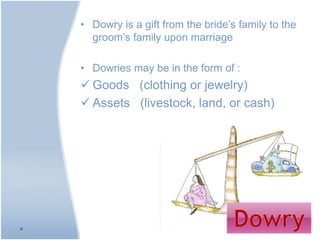
• Dowry is a gift from the bride’s family to the
groom’s family upon marriage
• Dowries may be in the form of :
 Goods (clothing or jewelry)
 Assets (livestock, land, or cash)
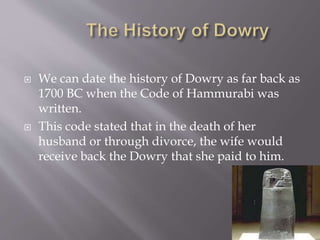
 We can date the history of Dowry as far back as
1700 BC when the Code of Hammurabi was
written.
 This code stated that in the death of her
husband or through divorce, the wife would
receive back the Dowry that she paid to him.
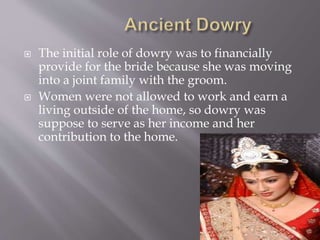
 The initial role of dowry was to financially
provide for the bride because she was moving
into a joint family with the groom.
 Women were not allowed to work and earn a
living outside of the home, so dowry was
suppose to serve as her income and her
contribution to the home.
 The family of the bride gives the groom and/or his
family dowry to ensure that their daughter will be
well taken care of.
 Dowry is a form of assurance that the bride will be
well treated. If not, it can be revoked.
 In the event that the husband dies, the wife will be
financially stable through inheritance of the dowry
she paid.
Factors that favours
this social evil …
 Early Marriages for girls
 Hypergamy
 Educational status
 Patriarchy
 Economic prosperity
Consequences…
• Late marriages for girls
• Lowering of women's status
• Breakdown of marriage
• Increase of immorality
• Suicide
• Impoverishment
 According to the Indian
National Crime Records
Bureau(NCRB) there were
approx. 6787 reported
dowry deaths in India in
2005.
 The NCRB also reported
that there were 2,276
female suicides related to
dowry in 2006 which
amounts to 6 deaths per
day.
 As times have changed, Dowry is now
considered a way for a groom and his family to
extort money and gifts from the bride and her
family.
 Families often go broke because they are
unable to supply the Dowry to the groom.
 Majority of these women come from poor to
middle class homes in which their parents save
for years in order to provide Dowry to the
groom.
 In July1961, Indian officials created The Dowry
Prohibition Act which prohibits the demand,
receipt, or payment of dowry in marriage.
 In this act, any gifts viewed as a precondition
for marriage were punishable and illegal
 Punishment for receiving or giving dowry is
imprisonment up to 6 years and/or a fine of
5000 Rupees or the amount of dowry which
was paid (whichever is more).
 Despite the Dowry Prohibition Act and Indian
Penal Code(304b) dowry and dowry death are
still occurring in India.
 Although dowry death maybe investigated
convictions are slim to none.
 The accused party states that their” beloved
bride” is dead as a result of a kitchen fire.
In a democratic
country
Where are they
Lackingtheir
rights ?
 Women Organizations, legal amendments,
media support , special police cells for women
and protest are all ways people are trying to
end the Dowry system in India.
 Despite their attempts dowry still continues to
be a social norm in the Indian society, thus
dowry deaths continue to rise.
CONCLUSION…
It is certainly a social evil
and it should be eliminated
from our society
…_.Thank you._...

Dowry System

  • 1.
  • 3.
    • Dowry isa gift from the bride’s family to the groom’s family upon marriage • Dowries may be in the form of :  Goods (clothing or jewelry)  Assets (livestock, land, or cash)
  • 4.
     We candate the history of Dowry as far back as 1700 BC when the Code of Hammurabi was written.  This code stated that in the death of her husband or through divorce, the wife would receive back the Dowry that she paid to him.
  • 5.
     The initialrole of dowry was to financially provide for the bride because she was moving into a joint family with the groom.  Women were not allowed to work and earn a living outside of the home, so dowry was suppose to serve as her income and her contribution to the home.
  • 6.
     The familyof the bride gives the groom and/or his family dowry to ensure that their daughter will be well taken care of.  Dowry is a form of assurance that the bride will be well treated. If not, it can be revoked.  In the event that the husband dies, the wife will be financially stable through inheritance of the dowry she paid.
  • 8.
    Factors that favours thissocial evil …  Early Marriages for girls  Hypergamy  Educational status  Patriarchy  Economic prosperity
  • 9.
    Consequences… • Late marriagesfor girls • Lowering of women's status • Breakdown of marriage • Increase of immorality • Suicide • Impoverishment
  • 10.
     According tothe Indian National Crime Records Bureau(NCRB) there were approx. 6787 reported dowry deaths in India in 2005.  The NCRB also reported that there were 2,276 female suicides related to dowry in 2006 which amounts to 6 deaths per day.
  • 12.
     As timeshave changed, Dowry is now considered a way for a groom and his family to extort money and gifts from the bride and her family.  Families often go broke because they are unable to supply the Dowry to the groom.  Majority of these women come from poor to middle class homes in which their parents save for years in order to provide Dowry to the groom.
  • 13.
     In July1961,Indian officials created The Dowry Prohibition Act which prohibits the demand, receipt, or payment of dowry in marriage.  In this act, any gifts viewed as a precondition for marriage were punishable and illegal  Punishment for receiving or giving dowry is imprisonment up to 6 years and/or a fine of 5000 Rupees or the amount of dowry which was paid (whichever is more).
  • 14.
     Despite theDowry Prohibition Act and Indian Penal Code(304b) dowry and dowry death are still occurring in India.  Although dowry death maybe investigated convictions are slim to none.  The accused party states that their” beloved bride” is dead as a result of a kitchen fire.
  • 15.
    In a democratic country Whereare they Lackingtheir rights ?
  • 16.
     Women Organizations,legal amendments, media support , special police cells for women and protest are all ways people are trying to end the Dowry system in India.  Despite their attempts dowry still continues to be a social norm in the Indian society, thus dowry deaths continue to rise.
  • 18.
    CONCLUSION… It is certainlya social evil and it should be eliminated from our society
  • 19.

Editor's Notes

  • #4 In India, the dowry is a gift from the bride’s family to the groom’s family upon marriage. There may be additional payments expected over the course of the marriage, for example upon the birth of a child, but the major part of the dowry is paid upon marriage. Dowry in India was historically practised only among upper caste families in Northern India (excluding the Himalayan regions), where women seek to marry men of superior rank (hypergamy). In southern India and in lower caste families in Northern India, people took spouses of equal rank (isogamy) and payment was given to the bride’s family, not the groom’s family Dowries may be in the form of goods such as clothing or jewelry, assets such as livestock or land, or cash. In India today, cash is always given as well as a large number of consumer goods which the woman may or may not get to use herself uppercaste Indian families used dowry while lower castes used brideprice. According to Risley, hypergamy results in the use of dowry this way: the upward flow of women through social ranks creates a surplus of would-be brides for top-ranking grooms, so that men of higher rank receive a groomprice, and a deficit of would-be brides for lower-ranking grooms, so that lower-ranking grooms pay a brideprice.
  • #9 There is a lot of casual evidence that dowries are a result of competition for social status. Where income-earning opportunities have not eroded the value of inherited status, dowries can be expected to persist and even rise as economic opportunities for men expand. With same age sex-ratios worsening, and fertility rates dropping, the sex ratio among marriage age –compatible people will decline. Hopefully this will easy dowry price pressures
  • #12 Although dowry is provided at the time of marriage, often grooms and their familes want to receive more dowry throughout the marriage. If this is not provided, dowry death occurs.
  • #16 In India, the caste system is still strong. But increased economic opportunities mean that there is a wider variation in income within castes.