PHYSICAL PROPERTIES AND
APPLICATIONS OF
GEOPOLYMER CONCRETE
CONTENTS
• Introduction
• Why not OPC?
• OPC usage without environmental impact
• Why geopolymer concrete?
• Constituents
• Process and Mechanism
• Types of GPC
• Test on GPC
• Properties
• Applications
• Advantages and disadvantages
• Discussion on future development
• Conclusion
INTRODUCTION
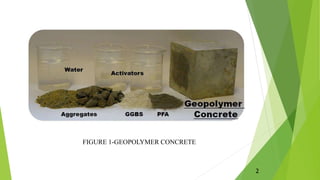
• Geopolymer concrete is an innovative, eco-friendly
construction material.
• It is used as replacement of cement concrete.
• In geopolymer concrete cement is not used as a binding
material.
• Fly ash, silica-fume, or GGBS, along with alkali solution
are used as binders.
1
FIGURE 1-GEOPOLYMER CONCRETE
2
WHY NOT OPC?
• It is the most consumed commodity in the world after
water.
• It is also the most energy intensive material
• Cement production leads to high carbon-dioxide emission.
- 1 ton of CO2 is produced for every 1 ton of cement.
-It is produced by calcination of limestone and burning of
fossil fuels
3
IS THERE A WAY TO USE OPC WITHOUT
ENVIRONMENTAL IMPACT?
-replacing some limestone with fly ash and blast furnace
slag called as blended cement
-using carbon dioxide emission captures and storage(CCS)
-accelerated carbonation where CO2 penetrate concrete
reacting with Ca(OH)2 in presence of H2O forming CaCO3
4
WHY GEOPOLYMER CONCRETE?
• Reduces the demand of OPC which leads CO2 emission.
• Utilise waste materials from industries such as fly ash,
silica-fume, GGBS.
• Protect water bodies from contamination due to fly ash
disposal.
• Conserve acres of land that would have been used for coal
combustion products disposal.
• Produce a more durable infrastructure.
5
CONSTITUENTS
• Coarse aggregate
• Fine aggregate - sand or bottom ash can be used
• Admixture - superplasticizers(naphthalene based or
naphthalene sulphonate based)
• Alkaline activators
-Alkaline activation is a process of mixing powdery
aluminosilicate with an alkaline activator .
-It produce a paste which sets and hardens within short duration
6
-Alkaline activators commonly used are sodium or potassium
hydroxide.
-They are used in combination with sodium silicate(water
glass) or potassium silicate solution.
-NaOH and Na2SiO3 are more commonly used as it leads to
higher geopolymerisation rate.
-K2SiO3 solution rarely used because of high cost and lack of
easy availability.
-Alkali hydroxide is used for dissolution and sodium-silicate
solution as binder.
7
 Sodium hydroxide
- dissolved in water to form a semi-solid paste
-higher amount reduces ettringite
-makes crystalline product which is stable in aggressive
environment
 Potassium hydroxide
-improve porosity and compressive strength
 Sodium silicate(water glass)
-available in gel form
-for good pozzolanic reaction it is mixed with NaOH
8
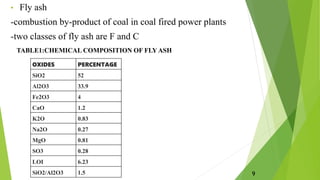
• Fly ash
-combustion by-product of coal in coal fired power plants
-two classes of fly ash are F and C
TABLE1:CHEMICAL COMPOSITION OF FLY ASH
OXIDES PERCENTAGE
SiO2 52
Al2O3 33.9
Fe2O3 4
CaO 1.2
K2O 0.83
Na2O 0.27
MgO 0.81
SO3 0.28
LOI 6.23
SiO2/Al2O3 1.5 9
-fly ash used in concrete to increase life cycle expectancy
-helps in increasing durability
-improves permeability by lowering water-cement ratio
-spherical shape of fly ash improves consolidation of
concrete
10
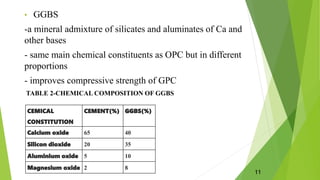
• GGBS
-a mineral admixture of silicates and aluminates of Ca and
other bases
- same main chemical constituents as OPC but in different
proportions
- improves compressive strength of GPC
TABLE 2-CHEMICAL COMPOSITION OF GGBS
CEMICAL
CONSTITUTION
CEMENT(%) GGBS(%)
Calcium oxide 65 40
Silicon dioxide 20 35
Aluminium oxide 5 10
Magnesium oxide 2 8
11
• Silica fume
-also called as micro silica or condensed silica fume
-produced during manufacture of silicon by electric arc
furnace
-another artificial pozzolan
12
• PROCESS
-Si and Al atoms in source materials dissolved using
alkaline solution.
-Source materials include fly ash ,GGBS, silica-fume.
- gel formed by applying heat.
-This gel binds aggregates and unreacted source material
forming geopolymer concrete
13
• MECHANISM
-dissolution of Si and Al atoms takes place through the
action of OH ions
-precursor ions condense to form monomers
-polycondensation of monomers to form polymeric
structures
-this framework formed is called as polysilates
-silate stands for silicon-oxo-aluminate building unit
-chains and rings formed and cross linked through
Si-O-Al bridge
14
TYPES OF GEOPOLYMER
 Slag based geopolymer
-Slag is a mixture of metal oxides and silicon dioxide
- a transparent by-product material formed in the processing
of melting iron ore.
-OPC replacement with slag improve workability and reduce
lifecycle costs
-it also increase its compressive strength
-corex slag, steel slag, iron blast furnace slag are examples
15
 Rock based geopolymer
-MK-750 in the slag based geopolymer replaced by natural
rock forming minerals forms this geopolymer
-feldspar and quartz are natural rock forming minerals
16
 Fly ash based geopolymer
- improves workability and increase compressive strength
-reduce cost of OPC along with CO2 emission
-reduce drying shrinkage
-class F fly ash used commonly
Alkali activated geopolymer: Heat curing at 60 to 80 οC
is done. Into 1:2 aluminosilicate gel fly ash particles are
embedded.
Slag based geopolymer:It contains silicate, blast
furnace slag and fly ash
17
 Ferro-silicate based geopolymer
-same properties as that of rock based geopolymers
-has a red colour
-high iron oxide content
-poly type geopolymer formed by substituting some of the
aluminium atoms in the matrix
18
TEST ON GPC
• CREEP TEST
-three 150x300 mm cylinders prepared
- placed on creep testing frame with hydraulic loading
system
-before loading 7th day compressive strength determined
-load corresponding to 40% of mean compressive strength
applied
-strain values measured and recorded
-test conducted at 23οC and relative humidity 40-60%
19
• creep of GPC smaller than that of OPC
• smaller creep due to block polymerisation concept
• presence of micro-aggregates increase creep resisting
function in GPC
• in OPC creep caused by cement paste
20
• DRYING SHRINKAGE TEST
-75x75x285 mm prisms with gauge studs used
-specimens kept in a controlled temperature environment
-temperature at 23οC and relative humidity 40-60%
-shrinkage strain measurements taken on third day of
casting concrete
-specimen demoulded and 1st measurement taken
-horizontal length comparator used for measurement
-next measurement taken on 4th day
-further measurements taken till one year
21
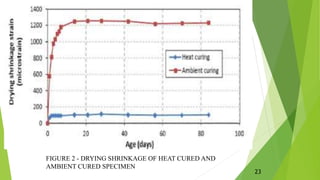
• drying shrinkage of GPC is very less
• ambient temperature cured GPC shows more shrinkage
than heat cured GPC
• excess water evaporates during heat curing reducing dry
shrinkage
• drying shrinkage of GPC at ambient temperature is same
as that of OPC
• GPC undergoes shrinkage of 100 micro strains after one
year
• 500-800 micro strains experienced by OPC
22
FIGURE 2 - DRYING SHRINKAGE OF HEAT CURED AND
AMBIENT CURED SPECIMEN
23
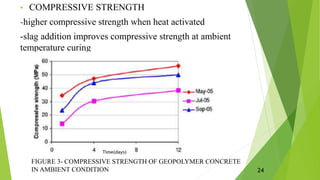
• COMPRESSIVE STRENGTH
-higher compressive strength when heat activated
-slag addition improves compressive strength at ambient
temperature curing
FIGURE 3- COMPRESSIVE STRENGTH OF GEOPOLYMER CONCRETE
IN AMBIENT CONDITION
Time(days)
24
• compressive strength of GPC decreased with increasing
fly ash content
• it increased with higher aggregate content
• higher strength at lower alkali content
• compressive strength increased with age
• Polycondensation of silica and alumina contribute to
high strength
25
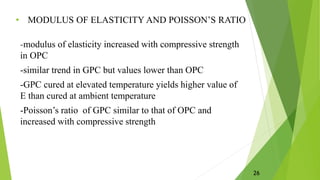
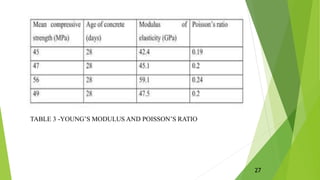
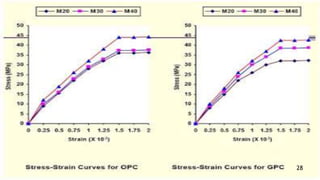
• MODULUS OF ELASTICITY AND POISSON’S RATIO
-modulus of elasticity increased with compressive strength
in OPC
-similar trend in GPC but values lower than OPC
-GPC cured at elevated temperature yields higher value of
E than cured at ambient temperature
-Poisson’s ratio of GPC similar to that of OPC and
increased with compressive strength
26
TABLE 3 -YOUNG’S MODULUS AND POISSON’S RATIO
27
28
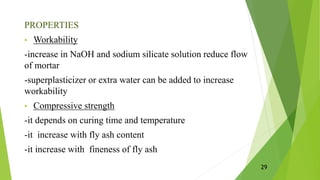
PROPERTIES
• Workability
-increase in NaOH and sodium silicate solution reduce flow
of mortar
-superplasticizer or extra water can be added to increase
workability
• Compressive strength
-it depends on curing time and temperature
-it increase with fly ash content
-it increase with fineness of fly ash
29
• Resistance against aggressive environment
-used in constructing marine structures
-in OPC white layer of crystals formed on acid exposed
surface
-in GPC there is no gypsum deposition and no visible cracks
-a soft and powdery layer formed during early stages of
exposure which later becomes harder
-mass loss on exposure to H2SO4 in GPC was 3% and in OPC
20-25%
-higher the alkali content higher the weight loss
-GPC showed better resistance
30
• Behaviour of geopolymer at elevated temperature
-high strength loss during early heating period(up to 200οC)
-beyond 600οC no further strength loss
-no visible cracks up to 600 οC
-minor cracks at 800 οC
-GPC with more compatability between aggregates and matrix
led to less strength loss
• Bond strength
-very high
-about one third of its compressive strength
-four times than that of OPC
31
APPLICATIONS
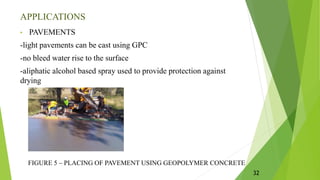
• PAVEMENTS
-light pavements can be cast using GPC
-no bleed water rise to the surface
-aliphatic alcohol based spray used to provide protection against
drying
FIGURE 5 – PLACING OF PAVEMENT USING GEOPOLYMER CONCRETE
32
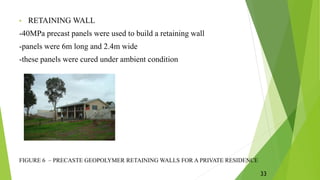
• RETAINING WALL
-40MPa precast panels were used to build a retaining wall
-panels were 6m long and 2.4m wide
-these panels were cured under ambient condition
FIGURE 6 – PRECASTE GEOPOLYMER RETAINING WALLS FOR A PRIVATE RESIDENCE
33
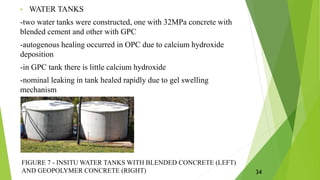
• WATER TANKS
-two water tanks were constructed, one with 32MPa concrete with
blended cement and other with GPC
-autogenous healing occurred in OPC due to calcium hydroxide
deposition
-in GPC tank there is little calcium hydroxide
-nominal leaking in tank healed rapidly due to gel swelling
mechanism
FIGURE 7 - INSITU WATER TANKS WITH BLENDED CONCRETE (LEFT)
AND GEOPOLYMER CONCRETE (RIGHT) 34
• BOAT RAMP
-approach slab on ground to ramp was made using geopolymer
reinforced with FFRP
-entire constituents remained dormant until activator chemicals were
added
FIGURE8 – BOAT RAMP CONSTRUCTED WITH BOTH IN-SITE AND PRECAST
GEOPOLYMER CONCRETE.
35
• PRECAST BEAM
-GPC beams formed three suspended floor levels of GCI building
-beams had arched curved soffit
-water pipes were placed inside them for temperature controlled
hydronic heating of building spaces above and below
FIGURE 9 – GEOPOLYMER CONCRETE BEAM CRANED TO
POSITION
36
ADVANTAGES
 high compressive strength
 high tensile strength
 low creep
 low drying shrinkage
 resistant to heat and cold
 chemically resistant
 highly durable
 fire proof
37
DISADVANTAGES
 difficult to create
-requires special handling
-chemicals like sodium hydroxide are harmful to humans
-high cost of alkaline solution
 Pre-mix only
-sold only as pre-mix or pre-caste material
 Geopolymerisation process is sensitive
-lacks uniformity
38
DISCUSSION ON FUTURE DEVELOPMENT
-more studies and wide scale acceptance for using GPC in
precast concrete products
-making GPC more user friendly by using lower amount
of alkaline solution
-producing more cost effective geopolymer
-replacing fine aggregate with quarry sand as demand for
natural sand is increasing
-studies on fibre reinforced geopolymer concrete for
improving flexural strength
39
CONCLUSION
• Geopolymer concrete is a promising construction
material due to its low carbon dioxide emission
• High early strength, low creep and shrinkage, acid
resistance, fire resistance makes it better in usage than
OPC
• Wide spread applications in precast industries due to
-its high production in short duration
-less breakage during transportation
• Enhanced research along with acceptance required to
make it great advantage to the industry
40
REFERENCES
• Aslani (2015); Thermal Performance Modelling of Geopolymer
Concrete, Journal of Materials in Civil Engineering
• Shankar H Sanni (2012); Performance of Geopolymer Concrete
under severe environmental conditions, International Journal on
Civil and Structural Engineering
• Ramujee et al (2014), Development of Low Calcium Fly
Ash Based Geopolymer Concrete, IACSIT International Journal
of Engineering and Technology, Volume 6
• Lloyd et al (2010);Geopolymer concrete: A review of
development and opportunities
• Bakharev, T., (2005(a)), Resistance of geopolymer materials to
acid attack, Cement and Concrete Research, 35, pp 658-670.
41
Geopolymer concrete ppt

Geopolymer concrete ppt

  • 1.
  • 2.
    CONTENTS • Introduction • Whynot OPC? • OPC usage without environmental impact • Why geopolymer concrete? • Constituents • Process and Mechanism • Types of GPC • Test on GPC • Properties • Applications • Advantages and disadvantages • Discussion on future development • Conclusion
  • 3.
    INTRODUCTION • Geopolymer concreteis an innovative, eco-friendly construction material. • It is used as replacement of cement concrete. • In geopolymer concrete cement is not used as a binding material. • Fly ash, silica-fume, or GGBS, along with alkali solution are used as binders. 1
  • 4.
  • 5.
    WHY NOT OPC? •It is the most consumed commodity in the world after water. • It is also the most energy intensive material • Cement production leads to high carbon-dioxide emission. - 1 ton of CO2 is produced for every 1 ton of cement. -It is produced by calcination of limestone and burning of fossil fuels 3
  • 6.
    IS THERE AWAY TO USE OPC WITHOUT ENVIRONMENTAL IMPACT? -replacing some limestone with fly ash and blast furnace slag called as blended cement -using carbon dioxide emission captures and storage(CCS) -accelerated carbonation where CO2 penetrate concrete reacting with Ca(OH)2 in presence of H2O forming CaCO3 4
  • 7.
    WHY GEOPOLYMER CONCRETE? •Reduces the demand of OPC which leads CO2 emission. • Utilise waste materials from industries such as fly ash, silica-fume, GGBS. • Protect water bodies from contamination due to fly ash disposal. • Conserve acres of land that would have been used for coal combustion products disposal. • Produce a more durable infrastructure. 5
  • 8.
    CONSTITUENTS • Coarse aggregate •Fine aggregate - sand or bottom ash can be used • Admixture - superplasticizers(naphthalene based or naphthalene sulphonate based) • Alkaline activators -Alkaline activation is a process of mixing powdery aluminosilicate with an alkaline activator . -It produce a paste which sets and hardens within short duration 6
  • 9.
    -Alkaline activators commonlyused are sodium or potassium hydroxide. -They are used in combination with sodium silicate(water glass) or potassium silicate solution. -NaOH and Na2SiO3 are more commonly used as it leads to higher geopolymerisation rate. -K2SiO3 solution rarely used because of high cost and lack of easy availability. -Alkali hydroxide is used for dissolution and sodium-silicate solution as binder. 7
  • 10.
     Sodium hydroxide -dissolved in water to form a semi-solid paste -higher amount reduces ettringite -makes crystalline product which is stable in aggressive environment  Potassium hydroxide -improve porosity and compressive strength  Sodium silicate(water glass) -available in gel form -for good pozzolanic reaction it is mixed with NaOH 8
  • 11.
    • Fly ash -combustionby-product of coal in coal fired power plants -two classes of fly ash are F and C TABLE1:CHEMICAL COMPOSITION OF FLY ASH OXIDES PERCENTAGE SiO2 52 Al2O3 33.9 Fe2O3 4 CaO 1.2 K2O 0.83 Na2O 0.27 MgO 0.81 SO3 0.28 LOI 6.23 SiO2/Al2O3 1.5 9
  • 12.
    -fly ash usedin concrete to increase life cycle expectancy -helps in increasing durability -improves permeability by lowering water-cement ratio -spherical shape of fly ash improves consolidation of concrete 10
  • 13.
    • GGBS -a mineraladmixture of silicates and aluminates of Ca and other bases - same main chemical constituents as OPC but in different proportions - improves compressive strength of GPC TABLE 2-CHEMICAL COMPOSITION OF GGBS CEMICAL CONSTITUTION CEMENT(%) GGBS(%) Calcium oxide 65 40 Silicon dioxide 20 35 Aluminium oxide 5 10 Magnesium oxide 2 8 11
  • 14.
    • Silica fume -alsocalled as micro silica or condensed silica fume -produced during manufacture of silicon by electric arc furnace -another artificial pozzolan 12
  • 15.
    • PROCESS -Si andAl atoms in source materials dissolved using alkaline solution. -Source materials include fly ash ,GGBS, silica-fume. - gel formed by applying heat. -This gel binds aggregates and unreacted source material forming geopolymer concrete 13
  • 16.
    • MECHANISM -dissolution ofSi and Al atoms takes place through the action of OH ions -precursor ions condense to form monomers -polycondensation of monomers to form polymeric structures -this framework formed is called as polysilates -silate stands for silicon-oxo-aluminate building unit -chains and rings formed and cross linked through Si-O-Al bridge 14
  • 17.
    TYPES OF GEOPOLYMER Slag based geopolymer -Slag is a mixture of metal oxides and silicon dioxide - a transparent by-product material formed in the processing of melting iron ore. -OPC replacement with slag improve workability and reduce lifecycle costs -it also increase its compressive strength -corex slag, steel slag, iron blast furnace slag are examples 15
  • 18.
     Rock basedgeopolymer -MK-750 in the slag based geopolymer replaced by natural rock forming minerals forms this geopolymer -feldspar and quartz are natural rock forming minerals 16
  • 19.
     Fly ashbased geopolymer - improves workability and increase compressive strength -reduce cost of OPC along with CO2 emission -reduce drying shrinkage -class F fly ash used commonly Alkali activated geopolymer: Heat curing at 60 to 80 οC is done. Into 1:2 aluminosilicate gel fly ash particles are embedded. Slag based geopolymer:It contains silicate, blast furnace slag and fly ash 17
  • 20.
     Ferro-silicate basedgeopolymer -same properties as that of rock based geopolymers -has a red colour -high iron oxide content -poly type geopolymer formed by substituting some of the aluminium atoms in the matrix 18
  • 21.
    TEST ON GPC •CREEP TEST -three 150x300 mm cylinders prepared - placed on creep testing frame with hydraulic loading system -before loading 7th day compressive strength determined -load corresponding to 40% of mean compressive strength applied -strain values measured and recorded -test conducted at 23οC and relative humidity 40-60% 19
  • 22.
    • creep ofGPC smaller than that of OPC • smaller creep due to block polymerisation concept • presence of micro-aggregates increase creep resisting function in GPC • in OPC creep caused by cement paste 20
  • 23.
    • DRYING SHRINKAGETEST -75x75x285 mm prisms with gauge studs used -specimens kept in a controlled temperature environment -temperature at 23οC and relative humidity 40-60% -shrinkage strain measurements taken on third day of casting concrete -specimen demoulded and 1st measurement taken -horizontal length comparator used for measurement -next measurement taken on 4th day -further measurements taken till one year 21
  • 24.
    • drying shrinkageof GPC is very less • ambient temperature cured GPC shows more shrinkage than heat cured GPC • excess water evaporates during heat curing reducing dry shrinkage • drying shrinkage of GPC at ambient temperature is same as that of OPC • GPC undergoes shrinkage of 100 micro strains after one year • 500-800 micro strains experienced by OPC 22
  • 25.
    FIGURE 2 -DRYING SHRINKAGE OF HEAT CURED AND AMBIENT CURED SPECIMEN 23
  • 26.
    • COMPRESSIVE STRENGTH -highercompressive strength when heat activated -slag addition improves compressive strength at ambient temperature curing FIGURE 3- COMPRESSIVE STRENGTH OF GEOPOLYMER CONCRETE IN AMBIENT CONDITION Time(days) 24
  • 27.
    • compressive strengthof GPC decreased with increasing fly ash content • it increased with higher aggregate content • higher strength at lower alkali content • compressive strength increased with age • Polycondensation of silica and alumina contribute to high strength 25
  • 28.
    • MODULUS OFELASTICITY AND POISSON’S RATIO -modulus of elasticity increased with compressive strength in OPC -similar trend in GPC but values lower than OPC -GPC cured at elevated temperature yields higher value of E than cured at ambient temperature -Poisson’s ratio of GPC similar to that of OPC and increased with compressive strength 26
  • 29.
    TABLE 3 -YOUNG’SMODULUS AND POISSON’S RATIO 27
  • 30.
  • 31.
    PROPERTIES • Workability -increase inNaOH and sodium silicate solution reduce flow of mortar -superplasticizer or extra water can be added to increase workability • Compressive strength -it depends on curing time and temperature -it increase with fly ash content -it increase with fineness of fly ash 29
  • 32.
    • Resistance againstaggressive environment -used in constructing marine structures -in OPC white layer of crystals formed on acid exposed surface -in GPC there is no gypsum deposition and no visible cracks -a soft and powdery layer formed during early stages of exposure which later becomes harder -mass loss on exposure to H2SO4 in GPC was 3% and in OPC 20-25% -higher the alkali content higher the weight loss -GPC showed better resistance 30
  • 33.
    • Behaviour ofgeopolymer at elevated temperature -high strength loss during early heating period(up to 200οC) -beyond 600οC no further strength loss -no visible cracks up to 600 οC -minor cracks at 800 οC -GPC with more compatability between aggregates and matrix led to less strength loss • Bond strength -very high -about one third of its compressive strength -four times than that of OPC 31
  • 34.
    APPLICATIONS • PAVEMENTS -light pavementscan be cast using GPC -no bleed water rise to the surface -aliphatic alcohol based spray used to provide protection against drying FIGURE 5 – PLACING OF PAVEMENT USING GEOPOLYMER CONCRETE 32
  • 35.
    • RETAINING WALL -40MPaprecast panels were used to build a retaining wall -panels were 6m long and 2.4m wide -these panels were cured under ambient condition FIGURE 6 – PRECASTE GEOPOLYMER RETAINING WALLS FOR A PRIVATE RESIDENCE 33
  • 36.
    • WATER TANKS -twowater tanks were constructed, one with 32MPa concrete with blended cement and other with GPC -autogenous healing occurred in OPC due to calcium hydroxide deposition -in GPC tank there is little calcium hydroxide -nominal leaking in tank healed rapidly due to gel swelling mechanism FIGURE 7 - INSITU WATER TANKS WITH BLENDED CONCRETE (LEFT) AND GEOPOLYMER CONCRETE (RIGHT) 34
  • 37.
    • BOAT RAMP -approachslab on ground to ramp was made using geopolymer reinforced with FFRP -entire constituents remained dormant until activator chemicals were added FIGURE8 – BOAT RAMP CONSTRUCTED WITH BOTH IN-SITE AND PRECAST GEOPOLYMER CONCRETE. 35
  • 38.
    • PRECAST BEAM -GPCbeams formed three suspended floor levels of GCI building -beams had arched curved soffit -water pipes were placed inside them for temperature controlled hydronic heating of building spaces above and below FIGURE 9 – GEOPOLYMER CONCRETE BEAM CRANED TO POSITION 36
  • 39.
    ADVANTAGES  high compressivestrength  high tensile strength  low creep  low drying shrinkage  resistant to heat and cold  chemically resistant  highly durable  fire proof 37
  • 40.
    DISADVANTAGES  difficult tocreate -requires special handling -chemicals like sodium hydroxide are harmful to humans -high cost of alkaline solution  Pre-mix only -sold only as pre-mix or pre-caste material  Geopolymerisation process is sensitive -lacks uniformity 38
  • 41.
    DISCUSSION ON FUTUREDEVELOPMENT -more studies and wide scale acceptance for using GPC in precast concrete products -making GPC more user friendly by using lower amount of alkaline solution -producing more cost effective geopolymer -replacing fine aggregate with quarry sand as demand for natural sand is increasing -studies on fibre reinforced geopolymer concrete for improving flexural strength 39
  • 42.
    CONCLUSION • Geopolymer concreteis a promising construction material due to its low carbon dioxide emission • High early strength, low creep and shrinkage, acid resistance, fire resistance makes it better in usage than OPC • Wide spread applications in precast industries due to -its high production in short duration -less breakage during transportation • Enhanced research along with acceptance required to make it great advantage to the industry 40
  • 43.
    REFERENCES • Aslani (2015);Thermal Performance Modelling of Geopolymer Concrete, Journal of Materials in Civil Engineering • Shankar H Sanni (2012); Performance of Geopolymer Concrete under severe environmental conditions, International Journal on Civil and Structural Engineering • Ramujee et al (2014), Development of Low Calcium Fly Ash Based Geopolymer Concrete, IACSIT International Journal of Engineering and Technology, Volume 6 • Lloyd et al (2010);Geopolymer concrete: A review of development and opportunities • Bakharev, T., (2005(a)), Resistance of geopolymer materials to acid attack, Cement and Concrete Research, 35, pp 658-670. 41