6GEO3 Unit 3 Contested Planet Topic 3: Biodiversity under Threat
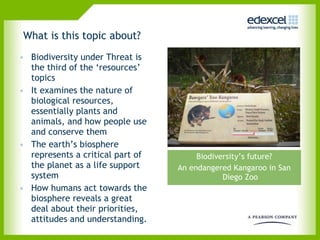
What is this topic about?  Biodiversity under Threat is the third of the ‘resources’ topics  It examines the nature of biological resources, essentially plants and animals, and how people use and conserve them The earth’s biosphere represents a critical part of the planet as a life support system  How humans act towards the biosphere reveals a great deal about their priorities, attitudes and understanding. Biodiversity’s future? An endangered Kangaroo in San Diego Zoo
1.Defining biodiversity 2. Biodiversity threats 3. Managing biodiversity  CONTENTS Click on the information icon  to jump to that section.  Click on the home button  to return to this contents page
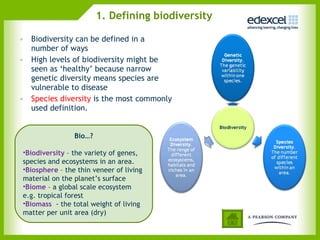
1. Defining biodiversity     Biodiversity can be defined in a number of ways  High levels of biodiversity might be seen as ‘healthy’ because narrow genetic diversity means species are vulnerable to disease Species diversity  is the most commonly used definition.  Bio…? Biodiversity  – the variety of genes, species and ecosystems in an area.  Biosphere  – the thin veneer of living material on the planet’s surface Biome  – a global scale ecosystem e.g. tropical forest  Biomass  - the total weight of living matter per unit area (dry)
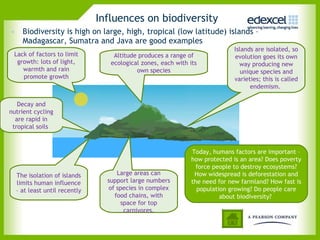
Influences on biodiversity Biodiversity is high on large, high, tropical (low latitude) islands – Madagascar, Sumatra and Java are good examples Lack of factors to limit growth: lots of light, warmth and rain promote growth Altitude produces a range of ecological zones, each with its own species Islands are isolated, so evolution goes its own way producing new unique species and varieties; this is called endemism.  The isolation of islands limits human influence – at least until recently Decay and nutrient cycling are rapid in tropical soils  Large areas can support large numbers of species in complex food chains, with space for top carnivores. Today, humans factors are important – how protected is an area? Does poverty force people to destroy ecosystems? How widespread is deforestation and the need for new farmland? How fast is population growing? Do people care about biodiversity?
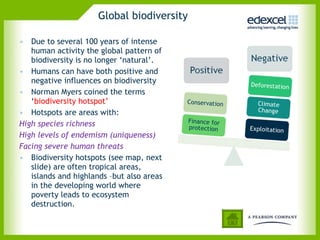
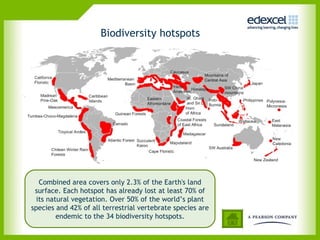
Global biodiversity  Due to several 100 years of intense human activity the global pattern of biodiversity is no longer ‘natural’.  Humans can have both positive and negative influences on biodiversity Norman Myers coined the terms ‘ biodiversity hotspot’ Hotspots are areas with: High species richness High levels of endemism (uniqueness) Facing severe human threats  Biodiversity hotspots (see map, next slide) are often tropical areas, islands and highlands –but also areas in the developing world where poverty leads to ecosystem destruction.
Biodiversity hotspots Combined area covers only 2.3% of the Earth's land surface. Each hotspot has already lost at least 70% of its natural vegetation. Over 50% of the world’s plant species and 42% of all terrestrial vertebrate species are endemic to the 34 biodiversity hotspots.
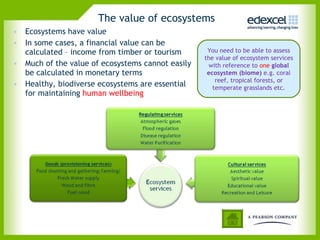
The value of ecosystems  Ecosystems have value In some cases, a financial value can be calculated – income from timber or tourism Much of the value of ecosystems cannot easily be calculated in monetary terms Healthy, biodiverse ecosystems are essential for maintaining  human wellbeing  You need to be able to assess the value of ecosystem services with reference to  one   global ecosystem (biome)  e.g. coral reef, tropical forests, or temperate grasslands etc.
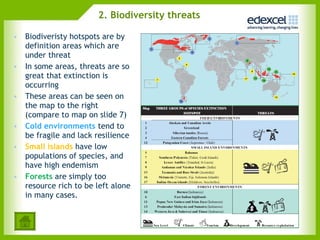
2. Biodiversity threats  Biodiveristy hotspots are by definition areas which are under threat In some areas, threats are so great that extinction is occurring  These areas can be seen on the map to the right (compare to map on slide 7) Cold environments  tend to be fragile and lack resilience Small islands  have low populations of species, and have high endemism Forests  are simply too resource rich to be left alone in many cases.
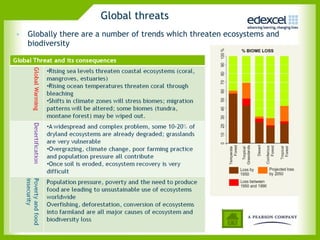
Global threats  Globally there are a number of trends which threaten ecosystems and biodiversity
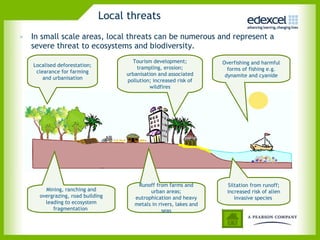
Local threats In small scale areas, local threats can be numerous and represent a severe threat to ecosystems and biodiversity.  Localised deforestation; clearance for farming and urbanisation Tourism development; trampling, erosion; urbanisation and associated pollution; increased risk of wildfires Overfishing and harmful forms of fishing e.g. dynamite and cyanide Siltation from runoff; increased risk of alien invasive species  Runoff from farms and urban areas; eutrophication and heavy metals in rivers, lakes and seas Mining, ranching and overgrazing, road building leading to ecosystem fragmentation
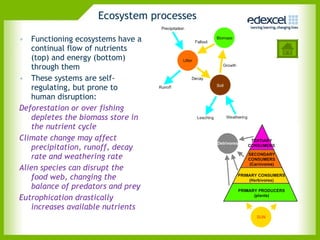
Ecosystem processes Functioning ecosystems have a continual flow of nutrients (top) and energy (bottom) through them These systems are self-regulating, but prone to human disruption: Deforestation or over fishing depletes the biomass store in the nutrient cycle  Climate change may affect precipitation, runoff, decay rate and weathering rate Alien species can disrupt the food web, changing the balance of predators and prey Eutrophication drastically increases available nutrients
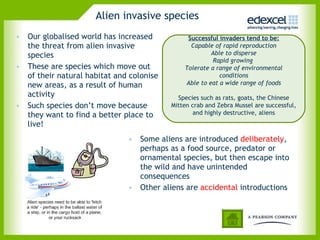
Alien invasive species Our globalised world has increased the threat from alien invasive species These are species which move out of their natural habitat and colonise new areas, as a result of human activity  Such species don’t move because they want to find a better place to live! Some aliens are introduced  deliberately , perhaps as a food source, predator or ornamental species, but then escape into the wild and have unintended consequences  Other aliens are  accidental  introductions  Successful invaders tend to be: Capable of rapid reproduction Able to disperse Rapid growing  Tolerate a range of environmental conditions Able to eat a wide range of foods Species such as rats, goats, the Chinese Mitten crab and Zebra Mussel are successful, and highly destructive, aliens
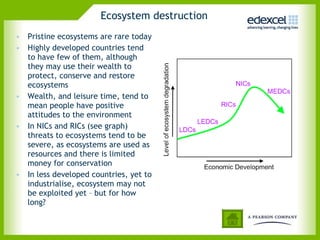
Ecosystem destruction Pristine ecosystems are rare today Highly developed countries tend to have few of them, although they may use their wealth to protect, conserve and restore ecosystems Wealth, and leisure time, tend to mean people have positive attitudes to the environment  In NICs and RICs (see graph) threats to ecosystems tend to be severe, as ecosystems are used as resources and there is limited money for conservation  In less developed countries, yet to industrialise, ecosystem may not be exploited yet – but for how long?
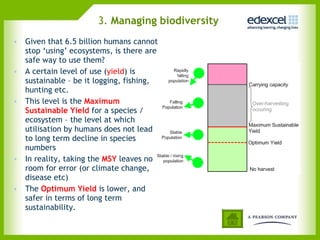
3.  Managing biodiversity   Given that 6.5 billion humans cannot stop ‘using’ ecosystems, is there are safe way to use them? A certain level of use ( yield ) is sustainable – be it logging, fishing, hunting etc. This level is the  Maximum Sustainable Yield  for a species / ecosystem – the level at which utilisation by humans does not lead to long term decline in species numbers In reality, taking the  MSY  leaves no room for error (or climate change, disease etc)  The  Optimum Yield  is lower, and safer in terms of long term sustainability.
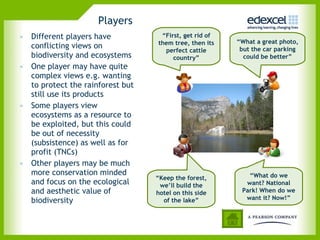
Players Different players have conflicting views on biodiversity and ecosystems One player may have quite complex views e.g. wanting to protect the rainforest but still use its products  Some players view ecosystems as a resource to be exploited, but this could be out of necessity (subsistence) as well as for profit (TNCs) Other players may be much more conservation minded and focus on the ecological and aesthetic value of biodiversity  “ First, get rid of them tree, then its perfect cattle country” “ What a great photo, but the car parking could be better” “ What do we want? National Park! When do we want it? Now!” “ Keep the forest, we’ll build the hotel on this side of the lake”
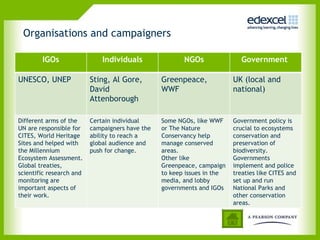
Organisations and campaigners  IGOs Individuals NGOs Government  UNESCO, UNEP Sting, Al Gore, David Attenborough Greenpeace, WWF UK (local and national)  Different arms of the UN are responsible for CITES, World Heritage Sites and helped with the Millennium Ecosystem Assessment. Global treaties, scientific research and monitoring are important aspects of their work.  Certain individual campaigners have the ability to reach a global audience and push for change. Some NGOs, like WWF or The Nature Conservancy help manage conserved areas. Other like Greenpeace, campaign to keep issues in the media, and lobby governments and IGOs Government policy is crucial to ecosystems conservation and preservation of biodiversity.  Governments implement and police treaties like CITES and set up and run National Parks and other conservation areas.
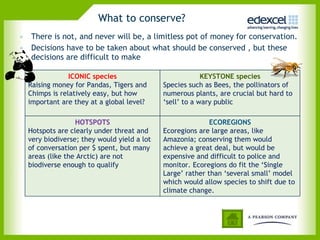
What to conserve? There is not, and never will be, a limitless pot of money for conservation. Decisions have to be taken about what should be conserved , but these decisions are difficult to make ICONIC species Raising money for Pandas, Tigers and Chimps is relatively easy, but how important are they at a global level?  KEYSTONE species Species such as Bees, the pollinators of numerous plants, are crucial but hard to ‘sell’ to a wary public  HOTSPOTS Hotspots are clearly under threat and very biodiverse; they would yield a lot of conversation per $ spent, but many areas (like the Arctic) are not biodiverse enough to qualify ECOREGIONS Ecoregions are large areas, like Amazonia; conserving them would achieve a great deal, but would be expensive and difficult to police and monitor. Ecoregions do fit the ‘Single Large’ rather than ‘several small’ model which would allow species to shift due to climate change.
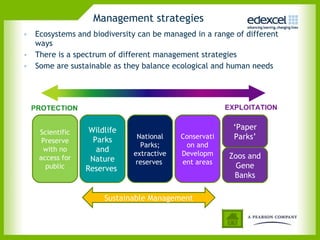
Management strategies  Ecosystems and biodiversity can be managed in a range of different ways  There is a spectrum of different management strategies Some are sustainable as they balance ecological and human needs Scientific Preserve with no access for public Wildlife Parks and Nature Reserves  National Parks; extractive reserves  Conservation and Development areas ‘ Paper Parks’ Zoos and Gene Banks Sustainable Management
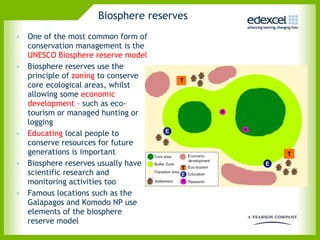
Biosphere reserves  One of the most common form of conservation management is the  UNESCO Biosphere reserve model Biosphere reserves use the principle of  zoning  to conserve core ecological areas, whilst allowing some  economic development  – such as eco-tourism or managed hunting or logging Educating  local people to conserve resources for future generations is important  Biosphere reserves usually have scientific research and monitoring activities too Famous locations such as the Galapagos and Komodo NP use elements of the biosphere reserve model
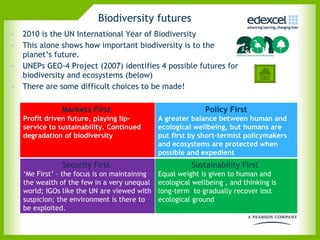
Biodiversity futures 2010 is the UN International Year of Biodiversity  This alone shows how important biodiversity is to the planet’s future.  UNEPs GEO-4 Project (2007) identifies 4 possible futures for biodiversity and ecosystems (below) There are some difficult choices to be made! Markets First  Profit driven future, playing lip-service to sustainability. Continued degradation of biodiversity  Policy First A greater balance between human and ecological wellbeing, but humans are put first by short-termist policymakers and ecosystems are protected when possible and expedient Security First  ‘ Me First’ – the focus is on maintaining the wealth of the few in a very unequal world; IGOs like the UN are viewed with suspicion; the environment is there to be exploited.  Sustainability First  Equal weight is given to human and ecological wellbeing , and thinking is long-term  to gradually recover lost ecological ground

Unit 3 contested planet biodiversity under threat

  • 1.
    6GEO3 Unit 3Contested Planet Topic 3: Biodiversity under Threat
  • 2.
    What is thistopic about? Biodiversity under Threat is the third of the ‘resources’ topics It examines the nature of biological resources, essentially plants and animals, and how people use and conserve them The earth’s biosphere represents a critical part of the planet as a life support system How humans act towards the biosphere reveals a great deal about their priorities, attitudes and understanding. Biodiversity’s future? An endangered Kangaroo in San Diego Zoo
  • 3.
    1.Defining biodiversity 2.Biodiversity threats 3. Managing biodiversity CONTENTS Click on the information icon to jump to that section. Click on the home button to return to this contents page
  • 4.
    1. Defining biodiversity Biodiversity can be defined in a number of ways High levels of biodiversity might be seen as ‘healthy’ because narrow genetic diversity means species are vulnerable to disease Species diversity is the most commonly used definition. Bio…? Biodiversity – the variety of genes, species and ecosystems in an area. Biosphere – the thin veneer of living material on the planet’s surface Biome – a global scale ecosystem e.g. tropical forest Biomass - the total weight of living matter per unit area (dry)
  • 5.
    Influences on biodiversityBiodiversity is high on large, high, tropical (low latitude) islands – Madagascar, Sumatra and Java are good examples Lack of factors to limit growth: lots of light, warmth and rain promote growth Altitude produces a range of ecological zones, each with its own species Islands are isolated, so evolution goes its own way producing new unique species and varieties; this is called endemism. The isolation of islands limits human influence – at least until recently Decay and nutrient cycling are rapid in tropical soils Large areas can support large numbers of species in complex food chains, with space for top carnivores. Today, humans factors are important – how protected is an area? Does poverty force people to destroy ecosystems? How widespread is deforestation and the need for new farmland? How fast is population growing? Do people care about biodiversity?
  • 6.
    Global biodiversity Due to several 100 years of intense human activity the global pattern of biodiversity is no longer ‘natural’. Humans can have both positive and negative influences on biodiversity Norman Myers coined the terms ‘ biodiversity hotspot’ Hotspots are areas with: High species richness High levels of endemism (uniqueness) Facing severe human threats Biodiversity hotspots (see map, next slide) are often tropical areas, islands and highlands –but also areas in the developing world where poverty leads to ecosystem destruction.
  • 7.
    Biodiversity hotspots Combinedarea covers only 2.3% of the Earth's land surface. Each hotspot has already lost at least 70% of its natural vegetation. Over 50% of the world’s plant species and 42% of all terrestrial vertebrate species are endemic to the 34 biodiversity hotspots.
  • 8.
    The value ofecosystems Ecosystems have value In some cases, a financial value can be calculated – income from timber or tourism Much of the value of ecosystems cannot easily be calculated in monetary terms Healthy, biodiverse ecosystems are essential for maintaining human wellbeing You need to be able to assess the value of ecosystem services with reference to one global ecosystem (biome) e.g. coral reef, tropical forests, or temperate grasslands etc.
  • 9.
    2. Biodiversity threats Biodiveristy hotspots are by definition areas which are under threat In some areas, threats are so great that extinction is occurring These areas can be seen on the map to the right (compare to map on slide 7) Cold environments tend to be fragile and lack resilience Small islands have low populations of species, and have high endemism Forests are simply too resource rich to be left alone in many cases.
  • 10.
    Global threats Globally there are a number of trends which threaten ecosystems and biodiversity
  • 11.
    Local threats Insmall scale areas, local threats can be numerous and represent a severe threat to ecosystems and biodiversity. Localised deforestation; clearance for farming and urbanisation Tourism development; trampling, erosion; urbanisation and associated pollution; increased risk of wildfires Overfishing and harmful forms of fishing e.g. dynamite and cyanide Siltation from runoff; increased risk of alien invasive species Runoff from farms and urban areas; eutrophication and heavy metals in rivers, lakes and seas Mining, ranching and overgrazing, road building leading to ecosystem fragmentation
  • 12.
    Ecosystem processes Functioningecosystems have a continual flow of nutrients (top) and energy (bottom) through them These systems are self-regulating, but prone to human disruption: Deforestation or over fishing depletes the biomass store in the nutrient cycle Climate change may affect precipitation, runoff, decay rate and weathering rate Alien species can disrupt the food web, changing the balance of predators and prey Eutrophication drastically increases available nutrients
  • 13.
    Alien invasive speciesOur globalised world has increased the threat from alien invasive species These are species which move out of their natural habitat and colonise new areas, as a result of human activity Such species don’t move because they want to find a better place to live! Some aliens are introduced deliberately , perhaps as a food source, predator or ornamental species, but then escape into the wild and have unintended consequences Other aliens are accidental introductions Successful invaders tend to be: Capable of rapid reproduction Able to disperse Rapid growing Tolerate a range of environmental conditions Able to eat a wide range of foods Species such as rats, goats, the Chinese Mitten crab and Zebra Mussel are successful, and highly destructive, aliens
  • 14.
    Ecosystem destruction Pristineecosystems are rare today Highly developed countries tend to have few of them, although they may use their wealth to protect, conserve and restore ecosystems Wealth, and leisure time, tend to mean people have positive attitudes to the environment In NICs and RICs (see graph) threats to ecosystems tend to be severe, as ecosystems are used as resources and there is limited money for conservation In less developed countries, yet to industrialise, ecosystem may not be exploited yet – but for how long?
  • 15.
    3. Managingbiodiversity Given that 6.5 billion humans cannot stop ‘using’ ecosystems, is there are safe way to use them? A certain level of use ( yield ) is sustainable – be it logging, fishing, hunting etc. This level is the Maximum Sustainable Yield for a species / ecosystem – the level at which utilisation by humans does not lead to long term decline in species numbers In reality, taking the MSY leaves no room for error (or climate change, disease etc) The Optimum Yield is lower, and safer in terms of long term sustainability.
  • 16.
    Players Different playershave conflicting views on biodiversity and ecosystems One player may have quite complex views e.g. wanting to protect the rainforest but still use its products Some players view ecosystems as a resource to be exploited, but this could be out of necessity (subsistence) as well as for profit (TNCs) Other players may be much more conservation minded and focus on the ecological and aesthetic value of biodiversity “ First, get rid of them tree, then its perfect cattle country” “ What a great photo, but the car parking could be better” “ What do we want? National Park! When do we want it? Now!” “ Keep the forest, we’ll build the hotel on this side of the lake”
  • 17.
    Organisations and campaigners IGOs Individuals NGOs Government UNESCO, UNEP Sting, Al Gore, David Attenborough Greenpeace, WWF UK (local and national) Different arms of the UN are responsible for CITES, World Heritage Sites and helped with the Millennium Ecosystem Assessment. Global treaties, scientific research and monitoring are important aspects of their work. Certain individual campaigners have the ability to reach a global audience and push for change. Some NGOs, like WWF or The Nature Conservancy help manage conserved areas. Other like Greenpeace, campaign to keep issues in the media, and lobby governments and IGOs Government policy is crucial to ecosystems conservation and preservation of biodiversity. Governments implement and police treaties like CITES and set up and run National Parks and other conservation areas.
  • 18.
    What to conserve?There is not, and never will be, a limitless pot of money for conservation. Decisions have to be taken about what should be conserved , but these decisions are difficult to make ICONIC species Raising money for Pandas, Tigers and Chimps is relatively easy, but how important are they at a global level? KEYSTONE species Species such as Bees, the pollinators of numerous plants, are crucial but hard to ‘sell’ to a wary public HOTSPOTS Hotspots are clearly under threat and very biodiverse; they would yield a lot of conversation per $ spent, but many areas (like the Arctic) are not biodiverse enough to qualify ECOREGIONS Ecoregions are large areas, like Amazonia; conserving them would achieve a great deal, but would be expensive and difficult to police and monitor. Ecoregions do fit the ‘Single Large’ rather than ‘several small’ model which would allow species to shift due to climate change.
  • 19.
    Management strategies Ecosystems and biodiversity can be managed in a range of different ways There is a spectrum of different management strategies Some are sustainable as they balance ecological and human needs Scientific Preserve with no access for public Wildlife Parks and Nature Reserves National Parks; extractive reserves Conservation and Development areas ‘ Paper Parks’ Zoos and Gene Banks Sustainable Management
  • 20.
    Biosphere reserves One of the most common form of conservation management is the UNESCO Biosphere reserve model Biosphere reserves use the principle of zoning to conserve core ecological areas, whilst allowing some economic development – such as eco-tourism or managed hunting or logging Educating local people to conserve resources for future generations is important Biosphere reserves usually have scientific research and monitoring activities too Famous locations such as the Galapagos and Komodo NP use elements of the biosphere reserve model
  • 21.
    Biodiversity futures 2010is the UN International Year of Biodiversity This alone shows how important biodiversity is to the planet’s future. UNEPs GEO-4 Project (2007) identifies 4 possible futures for biodiversity and ecosystems (below) There are some difficult choices to be made! Markets First Profit driven future, playing lip-service to sustainability. Continued degradation of biodiversity Policy First A greater balance between human and ecological wellbeing, but humans are put first by short-termist policymakers and ecosystems are protected when possible and expedient Security First ‘ Me First’ – the focus is on maintaining the wealth of the few in a very unequal world; IGOs like the UN are viewed with suspicion; the environment is there to be exploited. Sustainability First Equal weight is given to human and ecological wellbeing , and thinking is long-term to gradually recover lost ecological ground